Update:
2020-10-07 09:31 PM -0400
Romabama on Typewriter
con03.htm.htm
by U Kyaw Tun (UKT) (M.S., I.P.S.T., USA), and staff of Tun Institute of Learning (TIL).
Not for sale. No copyright. Free for everyone.
Prepared for students and staff of TIL Research Station, Yangon,
MYANMAR
-
http://www.tuninst.net ,
www.romabama.blogspot.com
index.htm |
Top
RBM-typewriter-indx.htm
Romabama consonants
Triads : tenuis, voiceless, voiced
Nasals : semi-nasals vs. true-nasals
R-coloring vs. L-coloring : /r/
 {ra-hu.la} vs. /l/
 {la-Gu.la.}
Same sounding pairs :
horizontal-pair
 {ga.}
{ga.}
 {Ga.};
 {za.}
{za.}
 {Za.}; .... ; vertical-pair
 {Na.}
{Na.}
 {na.}
{na.}
Problem pairs : from foreign languages
/f/-/v/ -
 {fa.}
{fa.}
 {va.}
{va.}
/ʃ/-/ʒ/ -
 {sha.}
/ʧ/-/ʤ/ -
 {cha.}
  {ja.}
{ja.}
Akshara {þa.} -
 {þa.} /θ/ (or /ð/)
Singles
UKT notes
UKT 200918: I remember when I was writing these pages on consonants, many
years ago, I had not study Skt-Dev sufficiently, and I had no knowledge of
Mon-Myan. Now, when I look into them now (200918), I had to rethink and rewrite
almost line by line. Still, I am not satisfied - these pages need more editing.
To find answers to many questions I've outlined below, I hope to find answers from a count of the number of words listed in MLC Burmese Orthography , MLC, 1st
ed 1986, ed. U Tun Tint (in Bur-Myan). Words beginning with in rows #6 and #7:
•
 {ya.} = 193 •
 {ra.} = 595 •
 {la.} = 630 •
 {wa.} = 184 •
{þa.} = 551 •
{wa.} = 184 •
{þa.} = 551 •
 {ha.} = 58 •
 {La.} = 1
Contents of this page
- UKT : latest 200915
Bur-Myan consonants, particularly in script form, have always been
important in the lives of peoples of Myanmar, because of the strong influence
Burmese Astrology or
MahaBoat

 {ma.ha
Boat}, which plays a very important
role from the time of his birth to day
he dies.
{ma.ha
Boat}, which plays a very important
role from the time of his birth to day
he dies.
Dr. Htin Aung has also written on Burmese Astrology, which has nothing to do
with Hindu Astrology in his Folk
Elements in Burmese Buddhism (Printed and published by the Religious Affairs
Dept., Rangoon, BURMA. 1981.
See: Folk Elements in Buddhism --
flk-ele-indx.htm > Nine Gods ch02.htm
(update long over-due)
Dr. Htin Aung also wrote: "The letters of the Burmese
alphabet were divided up between the eight planets. See my notes on
Wednesday-planet.
One of my online sources
http://web.ukonline.co.uk/buddhism/
I've forgotten when I looked into this website. I've made a note that on p.019-020: "A Chinese
chronicle of the ninth century, the Man-Shu, mentioned the presence in
Burma of 'many fortune tellers and astrologers'.

The consonant-akshara character has the inherent vowel (usually /a/). And because
of it, the consonant-aksharas can be pronounced or syllabic. Thus
 {ka.} can be pronounced, whereas <k>, a letter of the English-Latin alphabet, is
mute unless you supply it with a vowel such as /a/. Only then, can it be
pronounced as /ka/.
{ka.} can be pronounced, whereas <k>, a letter of the English-Latin alphabet, is
mute unless you supply it with a vowel such as /a/. Only then, can it be
pronounced as /ka/.
• akshara-consonants are grouped into  {wag} "classifiables" and
 {a.wag} "non-classifiables" . By classifiables, we mean those that can be classified as
"voiceless", "vl-aspirate", "voiced",
and "vd-retroflex". By "non-classifiables"
{a.wag}, we mean those that cannot be neatly classified. The non-classifiables
contain the semi-vowels and similar consonants except the vowel
{a.wag} "non-classifiables" . By classifiables, we mean those that can be classified as
"voiceless", "vl-aspirate", "voiced",
and "vd-retroflex". By "non-classifiables"
{a.wag}, we mean those that cannot be neatly classified. The non-classifiables
contain the semi-vowels and similar consonants except the vowel
 {a.} /a/. In Skt-Dev the position of
{a.} is occupied by
{a.} /a/. In Skt-Dev the position of
{a.} is occupied by
 -
-
 {neig~ga.hait}.
• {ñ} Alt0241is represented in English-Latin as <ny>.
• Consonants in yellow-coloured cells are mainly used for writing Pali-Myan,
however since Pali words have been incorporated into Burmese, you are bound to
run into some of these characters in ordinary Bur-Myan.
• c4 consonants in yellow-coloured cells have "retroflex" sounds, which to the
Bur-Myan speakers are the "same" as c3 sounds. And if you are to take
only the c1s, c2s and c3s from the
{wag} groups, you will get what I have formerly termed the "triads". If you are
to pronounce the triads one by one you will notice that the POA moves from the
front of the mouth to the back.
• In Bur-Myan, r2c2 is given as
 {Ña.}
{Ña.}
 {Ña.kri:}
"Nya-major" which has an alternative as
{Ña.kri:}
"Nya-major" which has an alternative as
 {ña.}
{ña.}
 {ña.lé:} "Nya-minor".
However, in Pali-Myan, there is no basic Nya-major. By basic akshara, I
mean that which can exist under a Virama
{ña.lé:} "Nya-minor".
However, in Pali-Myan, there is no basic Nya-major. By basic akshara, I
mean that which can exist under a Virama
 {a.þût}. In Bur-Myan, we have
{Ña.}/
{a.þût}. In Bur-Myan, we have
{Ña.}/
 {Ñ}.
However, in Pali-Myan,
{Ña.}
is a conjunct. It breaks down under a Virama
{a.þût} and is mute.
{Ñ}.
However, in Pali-Myan,
{Ña.}
is a conjunct. It breaks down under a Virama
{a.þût} and is mute.
{Ña.}
+ viram -->
 {ñ}
+
{ña.}
(mute)
{ñ}
+
{ña.}
(mute)
•
Nya-minor
{ña.}
is misrepresented in Bur-Myan typewritten text as vowel-letter
 {U.}, which has a shorter "foot".
•
 {Hta.}
is the regular form of r3c2. It can be pronounced. However,
{Hta.}
is the regular form of r3c2. It can be pronounced. However,
 {THta.} is the horizontal conjunct of
 {Ta.} and
{Hta.}. It is mute.
{Ta.} and
{Hta.}. It is mute.
{Ta.} + viram +
{Hta.} -->
{THta.} (mute).
It is found in the Pali-Myan word

 {AoaT~Hta. Htaan}. It is a linguistic term meaning the "sound produced at the
POA lips" or bilabial sounds.
{AoaT~Hta. Htaan}. It is a linguistic term meaning the "sound produced at the
POA lips" or bilabial sounds.
• Because, we are running out of ASCII characters to represent the /d/ sounds
(there are four), I have to use small and capital letters of Latin Eth:
 {ða.} and
 {Ða.}. However, voiced
{þa.} as in English <that> is also represented as /ð/. Because of this, the use of
{ða.} is objectionable.
{Ða.}. However, voiced
{þa.} as in English <that> is also represented as /ð/. Because of this, the use of
{ða.} is objectionable.
• For formation of conjuncts,
{ða.}
is written in a prone (horizontal) position at a level lower than the base character. e.g.
 {N~ða.} (mute).
{ka.} + viram +
{ða.} -->
 {kaN~ða} (~ is inserted to help in pronunciation)
• For formation of conjuncts,
{na.}
undergoes a change in shape to "legless"
 {na.}.
• It is to be noted that labio-dentals are absent in both Bur-Myan and
Pali-Myan. However, because of the necessity of transliteration between
Bur-Myan and Eng-Lat, we have to invent new characters to
represent them: such inventions are common in Indian scripts. In regular Burmese
they become <f> =
 {hpha.} and <v> =
 {bha.}
- conjuncts, which will break down under virama. To prevent this they are
written as <f> =
{bha.}
- conjuncts, which will break down under virama. To prevent this they are
written as <f> =
 {fa.}/
 and
<v> =
{va.}/
and
<v> =
{va.}/
 {v}.
{v}.
Note: U Tun Tint, retired editor of MLC sees nothing
objectionable to the transliteration of <f> to
{hpha.}
and <v> to
{bha.},
since such medials are not present in traditional Bur-Myan.
• During the formation of medials,
{ya.}
and
{ra.}
undergoes a change in shape to
 and
and
 /
/
 .
.
Even as a child of 10, in late 1940s, I had used my father's English typewriter
to transcribe Burmese glyphs. The idea to try came from the shape of two
letters, small c and o . They look exactly the same as Bur-Myan
 {gna.} and
{wa.}.
Then I realized that I'll have to change the types. I had to give up. Then, I
tried to transcribe the Burmese spoken language into English words. Finally in the 1990s, I finally gave up.
By then I had realized that the 33 Bur-Myan consonants can be classified into groups
of threes - triads, twos - pairs, and just one - singles.
{gna.} and
{wa.}.
Then I realized that I'll have to change the types. I had to give up. Then, I
tried to transcribe the Burmese spoken language into English words. Finally in the 1990s, I finally gave up.
By then I had realized that the 33 Bur-Myan consonants can be classified into groups
of threes - triads, twos - pairs, and just one - singles.
Contents of this page
Triads -- tenuis, voiceless (vl), voiced (vd)

- UKT (latest update) 200914
Keeping the Bur-Myan akshara array as it is, but omitting the Pali letters and the letters in
the last column and rows 6 and 7, brings out a prominent sub-array - the
triads.
{ka.}
क -----
 {hka.}
ख -----
{ga.}
ग
{hka.}
ख -----
{ga.}
ग
 {sa.}
च -----
{sa.}
च -----
 {hsa.}
छ -----
{za.} ज
{hsa.}
छ -----
{za.} ज
 {ta.}
त -----
{ta.}
त -----
 {hta.}
थ ------
{hta.}
थ ------
 {da.}
द
{da.}
द
 {pa.}
प -----
{pa.}
प -----
 {hpa.}
फ ------
{hpa.}
फ ------
 {ba.}
ब
{ba.}
ब
In comparing the Bur-Myan to Skt-Dev, we are comparing the orthographic
correspondence -- not the pronunciations.
The most contrastive sound among the triads is between
{pa.} and
{ga.}. If we are to take the vowels into consideration, the most contrastive is between
 {pi.} and
 {gau:}.
Contents of this page
There are two vertical of pairs (nasals) r1c5-r2c5
-
{gna.-Ña.}-pair which I'm calling semi-nasals, and r4c5-r5c5
- {na.-ma.}-pair, the true-nasals. The horizontal pair (approximants) is r6c1-r6c2
- {ya.-ra.}-pair.
{na.-ma.}-pair, the true-nasals. The horizontal pair (approximants) is r6c1-r6c2
- {ya.-ra.}-pair.
In English phonology (and phonetics) there is a pair of approximants known as
semi-vowels:
-
{ya.-wa.}. Take note that in the Bur-Myan akshara matrix,
{ya.} and
{wa.} are not adjacent, showing that Bur-Myan
{ra.} might be an addition to include the rhotic sounds of Pali. In colloquial
Burmese
{ya.} and
{ra.} are pronounced the same, except in the Rakhine dialect.
Semivowels -
https://en.wikipedia.org/wiki/Semivowel
200917
In phonetics and phonology, a semivowel
or glide is a sound that is phonetically
similar to a vowel sound but functions as the
syllable boundary, rather than as the nucleus
of a syllable.
[1] Examples of semivowels in English are
the consonants y and w, in
yes and west, respectively.
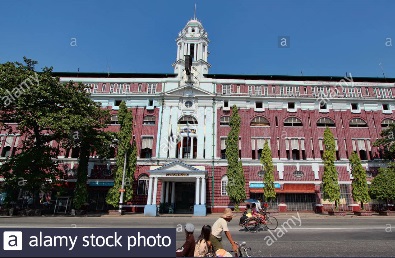 UKT 200917: I must now ask why IPA table (updated 1996)
did not include English
<w>
{wa.}. I must also note that Skt-Dev does not have /w/ for which it has /v/.
Now remember English call their w as double-u , not
double-v. I remember, the English colonial administrators in Rangoon, had spelled
their Customs House as CVSTOMS HOVSE . I had wondered why. The spelling was
changed to CUSTOMS HOUSE by
the Burmese authorities of U Né Win government who were more "English" than
the British Raj. I remember the episode graphically. I had worked, in early
1950s, as an LDC (Lower Division Clerk sometimes designated as Junior
auditor in the Pensions section) in the Accountant General's office which
was housed in a nearby building.
UKT 200917: I must now ask why IPA table (updated 1996)
did not include English
<w>
{wa.}. I must also note that Skt-Dev does not have /w/ for which it has /v/.
Now remember English call their w as double-u , not
double-v. I remember, the English colonial administrators in Rangoon, had spelled
their Customs House as CVSTOMS HOVSE . I had wondered why. The spelling was
changed to CUSTOMS HOUSE by
the Burmese authorities of U Né Win government who were more "English" than
the British Raj. I remember the episode graphically. I had worked, in early
1950s, as an LDC (Lower Division Clerk sometimes designated as Junior
auditor in the Pensions section) in the Accountant General's office which
was housed in a nearby building.
The nasal pair missing in English-Latin is r1c5-r2c5
-
{gna.-Ña.} . Though this pair is present in Skt-Dev, Bur-Myan r1c5
{gna.}
is not correctly pronounced by most Hindi-Dev speakers (those who I came to know in Canada). With all native-English
speakers (those that I came across in Australia, Canada, and the US),
-
{nga.-Ña.}-pair is the most difficult to pronounce.
The first member of
-
{nga.-Ña.}-pair, is the velar-nasal /ŋ/.
In English-Latin syllables, /ŋ/
is never present in the onset, but only in the coda, e.g. <sing> /sɪŋ/.
The phoneme,
{nga.}/
 {ng}
is found in many Bur-Myan onsets. It is also found in the codas as killed
consonants (represented as Ç in syllables of CVÇ form, where C is the consonant, V
the vowel and Ç the "killed" consonant). Usually the <g> in <ng>
in Eng-Lat corresponding to the Bur-Myan
{nga.}
is not pronounced. However, you can never tell whether the <ng> in an
English-Latin word is /ŋ/ or not just from the spelling, e.g.:
{ng}
is found in many Bur-Myan onsets. It is also found in the codas as killed
consonants (represented as Ç in syllables of CVÇ form, where C is the consonant, V
the vowel and Ç the "killed" consonant). Usually the <g> in <ng>
in Eng-Lat corresponding to the Bur-Myan
{nga.}
is not pronounced. However, you can never tell whether the <ng> in an
English-Latin word is /ŋ/ or not just from the spelling, e.g.:
<singer> /'sɪŋ.əʳ/ (US)
/-ɚ/ (<g> is not pronounced, similar to
 {sin~gna:})
<finger> /'fɪŋ.gəʳ/ (US)
/-gɚ/ (<g> is pronounced, similar to
 {fing:ga:})
The second member of this pair r2c5 is found in Spanish ñ (capital letter Ñ).
It is an alveolar-nasal. The Spanish insist that it is a consonant in its own right
and not n or N with a diacritic. See Nasalization -
con01.htm (200917)
The nasals are probably the most varied of all world phonemes.
The following is from:
https://everything2.com/title/Nasal 200917
Most languages have two nasals, m n. It is very rare for a language
to lack either or both of these, though some Salish languages of North-Western
America do. In Yoruba the consonant n occurs only before i, as
an allophone of l; though Yoruba also has nasal vowels, which are
written with a following letter N.
Less common than the near-universal bilabial m and dental or
alveolar n are nasals at other places of articulation. The palatal
nasal is written ñ in Spanish, gn in French and Italian,
nh in Portuguese, and ny in Hungarian and Catalan. Similar
NY-like sounds occur in Polish and Japanese.
The velar nasal is the NG sound of <sing>. In almost all dialects of
English this word ends in a nasal, with no consonant G after it, but
historically it came from a cluster N + G, with the G lost somewhere in the
Middle Ages. The NG is a single consonant sound: <sing> matches sin,
sill, sick, not sink, sinned, silt. It also occurs before K and the
K-like C, as in sink, uncle. Sometimes it occurs before an audible G,
as in <finger>, which has NGG as opposed to the simple NG of
singer. German has a similar kind of distribution, and a similar
phonetic history of this sound.
The NG sound also occurs in Italian, Spanish, Greek, Japanese, and
Hungarian, but not independently: it only occurs before the K and G sounds, as
in cinque, cinco. This assimilation is obligatory: San Carlo and
San Carlos are pronounced with sang, not san.
I have represented the Romabama velar-nasal r1c5 as
{gna.}/
{ng}. Formerly I had
represented it as {ñga.}. However, since this nasal is represented by most
writers as ng, you are at liberty to make your choice.
The choice between {ñg} and {ng} becomes moot when this Bur-Myan
consonant is used as a "killed" consonant. There
is the possibility that <g> might be lost in the hands of careless people
and the {ñg} became {ñ}. However, this would be of no problem in many cases,
and even became desirable in some:
The wrong spelling for "sour"
 (taste) is
 {hkyín}
• When
{ng} came after the nuclear vowel /ɪ/, we get
{hkying} with /g/.
---- However there is no /g/ sound, and we must get
rid of g . The only way is to
---- take the nuclear-vowel and coda together as
rime and write
{hkyín}
• When
 {n} is taken
as the coda,
the pronunciation becomes
{n} is taken
as the coda,
the pronunciation becomes
 {hkyûn}.
The correct spelling for "sour" is
{hkyiñ}.
It is important to remember that Bur-Myan syllables end either in vowels, or in killed consonants (shown underlined
in the following examples) with no sound of its own.
- {ka.gna.þût}:
 {king} "v. to roast", as rime:
{kín}
{king} "v. to roast", as rime:
{kín}
- {sa.gna.þût}:
 {sing} "n. rack or shelf", as rime:
{sín}
{sing} "n. rack or shelf", as rime:
{sín}
- {hsa.gna.þût}:
 {hsing} "n. elephant", as rime:
{hsín}
{hsing} "n. elephant", as rime:
{hsín}
UKT 200918: Whenever, I write the English word "elephant", I remember my
long lost American friends Jim Harrocks, his wife Jane, and their
little sons Mark and Tommy. We were bosom friends in late 1950s. Little
Tommy was about 2 or 3, and he could not pronounce the word "elephant". He
pronounced it as EFFLl'ENT .
- {ka.na.þût}:
 {kûn} "v. to kick, n. pond"
- -
{ka.tic.hkyaún:gnín-na.þût}:
-
{ka.tic.hkyaún:gnín-na.þût}:
 {koan} "n. commercial goods"
- -
- {ka.ma.þût-wut~sa.pauk}:
 {kûm:} "n. water-edge"
It is to be noted that
- {ka.na.þût}
{kan} "v. to kick, n. pond", has a
homonym word
 {kän} "n. "fortune" as in 'good fortune' ".
Contents of this page
UKT 200923:
We have been occupied with rhotic and
non-rhotic accents in English. GA
(General American aka American-English)
accent is said to be rhotic with /r/, whereas
RP (Received-pronunciation) aka
British-English (aka BBC-English before Second World War) just rhotic with /ɹ/.
English as a spoken language is not foreign to me.
When my mother, as Miss Lwè, went to school in
Rangoon before the First World War, she
learnt RP taught by English teachers from Britain.
One of her teachers she mentioned was Miss Laughlin
who taught at St. Mary's High-school Rangoon.
Another, she mentioned and whom I met just after
the Second World War was Miss Darlington. Before
she went to school at St. Mary's High
School, she went to Diocesan Girls School in very early
1900s, where she learnt RP from English teachers from
Britain.
When I went to school just after the Second World War,
I learnt English in RP taught by Anglo-Burman and
Anglo-Indian teachers. I was speaking with an RP
accent when I went to the US in 1957. My American
friends remarked that I was speaking with an accent
very similar to the American State of Maine accent.
Living and going to school alone with no Burmese or
non-Americans for two years, changed my English accent
to GA. Then in 1975 I went for further training in
chemistry to Australia for a year.
In short I have my belly-full of rhotic and non-rhotic
accents before I studied Skt-Dev, and started comparing it to Pal-Myan and
Bur-Myan when I noticed the
{ya.}-
{ra.} pair. Then I started to view rhoticity as nothing more than R-coloring.
It is worthwhile reading -
https://www.bl.uk/british-accents-and-dialects/articles/received-pronunciation
200923
The
{ya.}-
{ra.} pair is noteworthy. Though they have distinct sounds (non-rhotic and
rhotic), Myanmars
in the central region (Irrawaddy and Salween river-basins) pronounce them the
same. The reason:
• probability 1: Myanmars have lost their
ability (or are too lazy) to "roll" the r , and pronounce the
r as
y.
•
probability 2: there was no /r/ but only /l/ as in the case of Laghula
{la-Gu.la.}
being changed to Rahula
{ra-hu.la}. And also in Lagun changing into Yankon/
Rankon. See:
1. Language problem of primitive Buddhism,
by Chi Hisen-lin (季羡林 ,
1911–2009)
- lang-probl.htm - update 2015Nov
2. Buddhist Hybrid Sanskrit Grammar and
Dictionary, by F. Edgerton
Vol. 1. Grammar
- BHS-vol01-indx.htm - (link chk 200402)
3. History of Rangoon, by
B. R. Pearn, Corporation of Rangoon, American Baptist Mission Press, Rangoon,
1939
- myn-indx.htm >
History of Rangoon (last
update in 2005) (link chk 200921)
 • probability 3: of the 3 approximants,
{ya.},
{ra.}, and
{la.},
{ya.}
is the main approximant surrounded on one side by
{ra.} to give an /r/ coloring, and on the opposite side by
{la.} to give an /l/ coloring. The situation is fully expressed in vowel
• probability 3: of the 3 approximants,
{ya.},
{ra.}, and
{la.},
{ya.}
is the main approximant surrounded on one side by
{ra.} to give an /r/ coloring, and on the opposite side by
{la.} to give an /l/ coloring. The situation is fully expressed in vowel
 {i.} /i/. It is probably brought about by demographic changes
(i) when
the Pyus lost many of their males when Nancho abducted the males of military
age,
(ii) when Mons destroyed the Pyus in Lower Burma, and
(iii) when
Pyu settlements in the Samoan valley were destroyed by volcanic eruptions.
Still, the Pyu's influence remains in extreme southern part in Dawei
 {hta:wèý}.
Go to the following Wikipedia article, and see my basis of a theory
(which I plan for formulate) on Demographic change when Pyus of Ancient
Burma were destroyed by Earthquakes, Mons and Nancho. See one of the
sources:
-
https://en.wikipedia.org/wiki/Pagan_Kingdom 200921
UKT note: there are many points in Wikipedia which I cannot wholly accept.
 Thus, though Yangon (English spelling based on pronunciation) is spelled
 {rûn-koan} (with an r ) it is pronounced as if the first consonant is
y. The rhoticity increases in Skt-Myan (derived aks-to-aks from Skt-Dev). To
account for all the rhotic phonemes in BEPS, Romabama has to come up with a
Rhoticity scale shown on the right.
{rûn-koan} (with an r ) it is pronounced as if the first consonant is
y. The rhoticity increases in Skt-Myan (derived aks-to-aks from Skt-Dev). To
account for all the rhotic phonemes in BEPS, Romabama has to come up with a
Rhoticity scale shown on the right.
UKT 200923: Note that, I've used
{ka.} as the dummy-consonant in the rhoticity-scale as an illustration: any
other consonant can replace
{ka.}. However, modification by medial-former
{ra.} to produce R-coloring (rhoticity) is only part of the picture. In
Vedic-Dev, there is similar modification to produce L-coloring by
{la.}. See below in Skt-Dev grammar.

Next, notice that modification by
{ra.} results in a complete change in "shape" of
{ra.} - the form of Ra'ric or Super-r (Repha}. I'm now faced with a
similar situation with
{la.}. Should I use the Mon La-swè
 {kla.} or
 {kla.}?
Further, should I introduce Super-l
{kla.}?
Further, should I introduce Super-l
 (Lepha),
and
(Lepha),
and
 {iLLi.} ऌ ? Phonemes with L-coloring are found in Eng-Lat words such as
<clean> and <plane>.
{iLLi.} ऌ ? Phonemes with L-coloring are found in Eng-Lat words such as
<clean> and <plane>.
The Rhoticity scale is only part of the picture. Just as
 {kya.} going into
 {kra.} by changing into Ra-swè
 {ra.hswè:}, it
can go into
{kla.} (from Mon) or
{k~la.}
(from Bur). The glyph
{k~la.}
can be rightfully described as La-swè
{ra.hswè:}, it
can go into
{kla.} (from Mon) or
{k~la.}
(from Bur). The glyph
{k~la.}
can be rightfully described as La-swè
 {la.hswè:}
"the Hanging-la ". Though La-swè is found in Védic-Dev,
Skt-Dev speakers just ignore it. To explain the matter further I'll
go into Sanskrit Grammar which I'm learning from websites available free online.
{la.hswè:}
"the Hanging-la ". Though La-swè is found in Védic-Dev,
Skt-Dev speakers just ignore it. To explain the matter further I'll
go into Sanskrit Grammar which I'm learning from websites available free online.
A Skt-Dev grammar I found useful is by Dr. Pankaja Rajagopal. The
downloaded videos are in TIL HD-VIDEO libraries, which are available in TIL
research station in Yangon. For those who cannot come to the research station, I
plan to present a copy of the index page in later monthly-editions of the TIL
website.
See : Sanskrit Grammar
by Dr. Pankaja Rajagopal -
SktGramRajagopal<Ô> (link chk 200922)
103. Vowels in Sanskrit -
Lesson103<Ô>
Rajagopal states: "There are nine vowels in Sanskrit" She gives only the
Vowel-Letters (of duration 1 eye-blnk), not the Vowel-Signs which are
diacritics:
{a.} अ ;
 {I.} इ;
{U.} उ;
{I.} इ;
{U.} उ;
 {iRRi.} ऋ;
{iLLi.} ऌ (Simple vowels),
{iRRi.} ऋ;
{iLLi.} ऌ (Simple vowels),
 {É} ए;
 {è} ऐ;
 {AU:} ओ;
 औ (Diphthongs).
Rajagopal further states: "... ... ... diphthongs. They are combinations of 2
vowels each."
She illustrates:
{É} ए =
{a.} अ +
{I.} इ
{è} ऐ =
{a.} अ +
{É} ए
{AU:} ओ =
{a.} अ +
 {U} ऊ (2 blnk)
{ou}
औ =
{a.} अ +
{AU:} ओ
The change of /l/ to /y/ or /r/ can be seen in Lagun changing in
Yankon and Rankon in the History of Rangoon by Pearn. Though it has
been stated that Lagun was changed to Dagon, as it now stands /l/ has been
changed to /y/ or /r/.
Contents of this page
- UKT 200904
horizontal-pair:
{ga.}
{Ga.};
{za.}
{Za.}; .... - difference due to columns
vertical-pair:
{Na.}
{na.} - difference due to rows
Some of the Pali-Myan characters are rarely
used in everyday Bur-Myan. However, some are
routinely used, e.g.:

 {a·hkûn: kaN~ða.} , a compound of two words
for preciseness:
{a·hkûn: kaN~ða.} , a compound of two words
for preciseness:
•
{a·hkûn:} -- (Burmese-Myanmar) n.
1. compartment; room; apartment.
2. chapter (of a book); scene of part
in a drama or film.
3. role.
4. segment of a monk's robe which is
patched together from several pieces pieces
as prescribed. -- MEDict545
•
{kûN~ða.} -- (Pali-Myanmar) n. section
-- MEDict018
Some scholars in Myanmar opine that Myanmars have lost their ability to
pronounce "Pali" correctly, and Myanmar monks learning Pali have to take note of
that when they are reciting Pali texts. (Verbal communication with Rev. U Kawwida of Toronto
Myanmar Buddhist monastery.). To those scholars, the "Pali" spoken in
Sri Lanka and in modern India (under heavy influence of Sanskrit) are more authentic,
whereas, Pali-Myan pronunciations are less so.
These scholars fail to recognise that Pali
was invented only after the death of the Buddha. Pali was invented in the southern island of Lanka from
the local Aus-Asi language, and Magadhi the Tib-Bur language of north-eastern
India. Magadhi was the mother tongue of the Buddha and King Asoka who had sent
the Buddhist missionaries to Lanka. They fail to recognise that Buddha and Asoka were not
Sanskrit speaking Brahmins
 {poaN~Na.}.
The phoneme /l/ was prominent in Magadhi (as in the
name
{la-Gu.la.}, whereas /r/ was prominent in Pali (where
{la-Gu.la.}. The result was a change from
{la-Gu.la.} to
{ra-hu.la}. The language problem began to surface even in the lifetime of the
Buddha. See the
-
Language problem of
primitive Buddhism by Chi Hisen-lin, Journal of the Burma Research Society
(JBRS), XLIII, i, June 1960 (in TIL library).
The Buddha realized that the language problem was insolvable when speech is the only way
of communication. He finally ruled that:
 -- Cullavagga,
V. 33. 1
-- Cullavagga,
V. 33. 1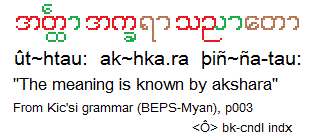
" anujānāmi bhikkhave sakāya niruttiyā buddhavacanam pariyāpunitum
"
allowing his followers to spread his teaching in the local speech.
Continue reading on this subject in
Magadhi,
Myanmar, Pali, Sanskrit in my notes.
One of his disciples, Shin Kic'si came up with the solution to spread the
teachings in written language, for which the Buddha praised Shin Kic'si.
In the matrix,
shown on right, akshara-characters with the same sound are shown in
coloured cells -- side by side or one above the other.
 Please note that c4
consonants are voiced produced from sounds deep in the throat, because of which
I've labeled the c4 as deep-H. That is the opinion held by
Sanskrit-biased peers of mine. The term deep-H does not hold in
Mon-Myan, which has a phonology different from Bur-Myan. Listen carefully
the downloaded sound of Mataban dialect of Mon-Myan.
Please note that c4
consonants are voiced produced from sounds deep in the throat, because of which
I've labeled the c4 as deep-H. That is the opinion held by
Sanskrit-biased peers of mine. The term deep-H does not hold in
Mon-Myan, which has a phonology different from Bur-Myan. Listen carefully
the downloaded sound of Mataban dialect of Mon-Myan.
- {ka.}, {hka.}, {gé}, {hké}, {gn~ré}
-
bk-cndl-{ka.}-row<))
What I am interested is the Peguan dialect of Mon-Myan. It was stated by
J. M. Haswell, that /g/ sound (r1c3) is absent in Mon-Myan, except in
r1c5.
# Grammatical notes and Vocabulary
of the Peguan Language,
by J.M. Haswell, Rangoon, American Mission Press, 1874
-
MV1874-indx (link chk 180327)
Also in TIL HD-PDF and SD-PDF libraries
- JMHaswell-PeguanGrammVocab<Ô> /
Bkp<Ô> (link chk 200308)
The Peguan is the dialect used by my great grandmother Daw Mèý Ma,
formerly of Mayan village at the southern-end of Old Dala city about 2 or 3
miles from Kungyangon town where I was born. Alas, the Peguan dialect is now
extinct.
I've given the pairs below based on Bur-Myan phonology. It is one of the
fundamental properties of Bur-Myan Akshara-Syllable system which belongs to Tib-Bur
group. However, other Myanmar languages like Mon-Myan which belong to Aus-Asi
group do not follow this phonology. I've no idea of Shan-Myan phonology.
side-by-side: r1
{ga.}
{Ga.};
---------------- r2
{za.}
{Za.};
---------------- r3
{ða.}
 {Ða.}
{Ða.}
---------------- r4
{da.}
 {Da.}
{Da.}
---------------- r5
{ba.}
 {Ba.}
{Ba.}
---------------- r6
{ya.}
{ra.}
above-below: r3c5-r4c5
{Na.}
{na.}
------------------ r6c3-r7c3
{la.}
{La.}
The first thing a Myanmar male about to enter the Theravada-Buddhist order --
all Myanmar Buddhist males have to become full-fledged monks at
least for a few days -- is told is to pronounce
{Ga.} correctly. I am speaking from personal experience:
pronounce "
 {þän-Gau:}" with zest and force something like foot-stamping.
In Devanagari names for c4-s, there is an "h" to emphasize the difference
from c3s. And, Rev. U Kawwida pointed out that "h"-sound is present in {Ga.}.
However the two members of each pair is pronounced exactly the same by ordinary
Myanmars. Soon after leaving the religious order, we lapse into our old habit and:
pronounce
{þän-Gau:} as
 {þän-gau:}.
Just as Rahu's day, (Wednesday afternoon) spelled with /r/, has to be
"invented" to turn the 7-day week to an 8-day week, were many words beginning
with
{ra.} the results of change from
{ya.},
{la.},
{þa.},
{La.} ?
Dr. Htin Aung also wrote: "The letters of the Burmese
alphabet were divided up between the eight planets. See my notes on
Wednesday-planet.
In formulating Romabama, I have followed the written script rather than the
pronunciation. (Refer to my notes Magadhi,
Myanmar, Pali and Sanskrit). I was accused of being partial to a single group of
Bur-Myan speakers, but after coming across the story of "shibboleth",
I have to follow the script rather than the pronunciation.
Romabama is based on written Burmese-Myanmar script and NOT on
pronunciation.
Please note that the Myanmar Buddhist monks are required to pronounce the
r distinctly when reciting religious texts.
Contents of this page
UKT 200921:
The problem pairs are from foreign languages,
such as Eng-Lat, that have been incorporated
into BEPS. I've to invent new glyphs for them.
They are:
{fa.} /f/ -
{va.} /v/
{sha.} /ʃ/ -
 {Sa.} /s/
{cha.} /ʧ/ -
{ ja.} /ʤ/
Contents of this page
- UKT 200924 
Labio-dental fricatives <f> /f/ - <v> /v/ (Table
of English consonants in
con02.htm)
present in Eng-Lat are absent in Bur-Myan. The POA of this pair is
between that of <p> /p/ and <b> /b/. .
<p> in <pat> /pæt/ -- similar to
 {pak}
/
{pak}
/  {pût}
{pût}
<b> in <bat> /bæt> -- similar to
 {bak}
{bak}
<f> in <fat> /fæt/
<v> in <vat> /væt/
<th> in <thin> /θɪn/ -- comparable to
 {þín:}
- /θ/ is similar to that of
{þa.} in
 {ma·þa} meaning "funeral"
<th> in <that> /ðæt/
- /ð/ is similar to that of
{þa.} in pronunciation
 {na·þa} of word
 {nän.þa} meaning "sandal wood".
It might be appropriate to emphasize here that
the consonants listed in the
Table of
English Consonants (in
con02.htm) are in phonetic characters. Three pairs of
characters not present in the regular English alphabet:
/θ ð/, /ʃ ʒ/, /ʧ ʤ/ are listed in it.
Contents of this page
- UKT 200925
The English phoneme /ʃ/ is found in the
English word <ship>, and ʒ
in <measure> .
In Bur-Myan, /ʃ/ is represented as a conjoined consonant

 {ra.kauk ha.hto:}
 {rha.}. It is derived from two consonants
{ra.} and
{ha.}. /ʃ/ can also be represented by another conjoined character
{rha.}. It is derived from two consonants
{ra.} and
{ha.}. /ʃ/ can also be represented by another conjoined character
 {þhya.}.
There is no equivalent for /ʒ/ in Bur-Myan.
Contents of this page
- UKT 200925
These two phonemes are unnecessarily confusing for Bur-Myan speakers.
The English phoneme /ʧ/ is found in the Eng-Lat
<chin>. The sound of Bur-Myan medial
 {hkya.}
is approximately equivalent to /ʧ/. This is
because English <k> is not exactly like the Bur-Myan
{ka.} but closer to
{hka.}
in pronunciation. However, by tradition
{ka.} is always represented by <k>. If only this tradition had been followed in
the case of /ʧ/, it would have been represented by
conjunct
{kya.}.
However this phoneme is a basic consonant in Skt-Dev. It is stable under a
virama. Therefore Romabama has to invent a glyph for it:
{hkya.}
is approximately equivalent to /ʧ/. This is
because English <k> is not exactly like the Bur-Myan
{ka.} but closer to
{hka.}
in pronunciation. However, by tradition
{ka.} is always represented by <k>. If only this tradition had been followed in
the case of /ʧ/, it would have been represented by
conjunct
{kya.}.
However this phoneme is a basic consonant in Skt-Dev. It is stable under a
virama. Therefore Romabama has to invent a glyph for it:
 {ca.}/
 {c - Mon)
The English phoneme /ʤ/ is found in the
English word <gin>. The Bur-Myan equivalent is the medial
 {gya.}.
Contents of this page
Akshara
{þa.} has two pronunciations depending on stress:
/θ/ (unstressed), and /ð/ (stressed)
Effect of nuclear-vowel on the
onset
Effect of the rime of the preceding syllable on the onset of the following
syllable
UKT 200922
Refer also to Paurana Katha , by Maung Daung Sayadaw


 {maún-htaún hsa.ra-tau}, 1926, 3rd ed
by Ashin Baddhanta Kumara, 2009
{maún-htaún hsa.ra-tau}, 1926, 3rd ed
by Ashin Baddhanta Kumara, 2009
p. 093, on Stress changes .
Ink-on-paper book available in TIL library.
Onset -
 {sa.tæÑ}
Nuclear-vowel -

 {nyu-ka.li-þa.ra.}
Coda -
 {hsoän:þût}
The phoneme pair /θ/ & /ð/ are written in Bur-Myan with a single akshara
{þa.}. The akshara
{þa.} in the onset
{sa.tæÑ} is pronounced either as /θ/ or /ð/ depending on
the Nuclear
{nyu-ka.li-þa.ra.} following it. When there no special vowel following
{þa.}, the pronunciation depends on the Inherent vowel
 {mwé-hkän-þa.ra.}. This effect is what I call "Effect of nuclear-vowel on the
onset" .
{mwé-hkän-þa.ra.}. This effect is what I call "Effect of nuclear-vowel on the
onset" .
Now let's look at another change in pronunciation: "Effect of the rime of the
preceding syllable on the onset of the following syllable" .
You have already seen that in the English words <
thin> and <that> the <th> has different sounds.
Phonetically, the <th> is represented as /θ/ in
<thin>, and as /ð/ in <that>. We have already seen a similar situation in Bur-Myan r6c5
{þa.}. I will illustrate this with a personal
story. One of my parents' friends was a lady with a beautiful Bur-Myan name.
Because she was born on a very pleasant day, she was given the name Miss
Pleasant. A pleasant day in Bur-Myan is


 {þa-ya-þau:né.}. Because she was born on a pleasant day, she was named "Ma Tha"
{ma.þa} "Ma" is the equivalent of Miss or Ms, and "Tha" stands for
{tha-ya}.
{þa-ya-þau:né.}. Because she was born on a pleasant day, she was named "Ma Tha"
{ma.þa} "Ma" is the equivalent of Miss or Ms, and "Tha" stands for
{tha-ya}.
{ma.þa} can be read in two ways: with a pause (or with central vowel /ə/) in between the two syllables,
or without a pause
 {ma. þa} /ma - ða/ - meaning "miss pleasant"
{ma.þa} /mə.θa/ - meaning "funeral"
{nän.þa} /nʌn θa/ - meaning "pleasant smell"
 {na.þa} /nə·ða/ - wrong spelling meaning "pleasant smell"
To understand the changes explained in Bur-Myan script, read Paurana Katha
p. 093, on Stress changes
UKT: two new terms are introduced -

 {a.þän prau.} "soft sound", and
 {a.þän ma} "hard sound".
I was still a child learning to read and write Bur-Myan
and when a letter came from "Ma Tha", I read the sender's name as /mə.θa/
which means "funeral " or "dead person". I should have read /'ma.ða/ .
(Note: /.../ stands for IPA transcription and {...} stands for Romabama
transliterations. ð in IPA is different from that of Romabama.)
Contents of this page
 The "non-classifiables"
{a.wag} consonants are found in rows 6 and 7. They, with the probable exception
of
{ya.} and
{ra.}, are best described individually. They are what I have termed the
"singles". (refer to
Table of English Consonants. (in
con02.htm):
The "non-classifiables"
{a.wag} consonants are found in rows 6 and 7. They, with the probable exception
of
{ya.} and
{ra.}, are best described individually. They are what I have termed the
"singles". (refer to
Table of English Consonants. (in
con02.htm):
approximants:
{ya.} /j/,
{ra.}
/r/ (sometimes described as /ɹ/),
{la.}
/l/,
{wa.} /w/ (sometimes described as /v/)
interdental-fricative:
{þa.}
has two sounds:
/θ/ (unstressed ) and /ð/ (stressed}. I had formerly thought
/θ/ to be voiceless and /ð/ to be voiceless.
Though
{þa.} has been
described as a sibilant
because its exact position is occupied by a sibilant in Hindi-Dev and Pali-Dev.
However, both
Bur-Myan and Pali-Myan
{þa.}
/θ/ has no hissing sounds. It is exactly like the modern Eng-Latin digraph
<th> as in <thin> /θɪn/ and <that> /ðæt/. In old English <th>
was represented as <þ>, the "thorn character'. Describing
{þa.}
as sibilant /s/ in Pali-Lanka avoids the problem of stress.
approximant:
{ha.}
/h/. In IPA it is described as a fricative.
inherent vowel
{mwé-hkän þa.ra.}:
{a.}
/a/, /æ/ or /ə/ -- present as part of a consonant.
It is instructive to see how these consonants (or their corresponding
consonants in Sinhala-Pali) are described by Ven. Narada Thera in An
Elementary Pali Course, Buddha Dhamma Association, Inc. (Sri Lanka)
http://www.buddhanet.net/.
See pix on right.
* Palatal - [y] -
{ya.}
- no comment
* Cerebral - [r] -
{ra.} - no comment
• Dental - [l] -
{la.} - {la.} is not dental, it is alveolar
* Dental and Labial - [v] -
{wa.} - Bur-Myan has no [v]. BEPS {va.}
** Dental - [s]
(sibilant) -
{þa.}
(thibilant) - Pali-Latin [s] (hissing sound) corresponds to Bur-Myan
{þa.}, (no hissing sound), and is the same as Engl-Latin <th> (no
hissing sound) in <thin> /θɪn/ and
<that> /ðæt/.
** Aspirate - [h]
(aspirate) -
{ha.}
(approximant) - Unlike the English-Latin <h>, which is sometimes silent,
Bur-Myan
{ha.} and Pali-Myan
{ha.} are never silent.
** Cerebral - [ ḷ ] -
 {La.} - Compare spelling of (Pali-Latin) Pāḷi and (Pali-Myan)
 {pa-Li.}.
** Niggahita - [ṃ] -
{än} -
Vow-sign
 {þé:þé:tín}. It does not have any colouring of <n> or <m>, and
representing it with [ṅ] , [ṃ] , or {n°} is misleading.
{þé:þé:tín}. It does not have any colouring of <n> or <m>, and
representing it with [ṅ] , [ṃ] , or {n°} is misleading.
Of rows 6 and 7 Bur-Myan akshara-characters, only 4
(three of which are semi-vowels) are allowed to form medial
conjuncts which are pronounceable.
These are: are
{ya.} /j/,
{ra.} /r/ or /ɹ/,
{wa.} /w/ ,
{ha.} /h/. These can be conjoined to a consonant from both the
{wag}-group and
{a.wag} group, e.g.:
{wag}-group
{ka.} /k/
+ hidden-viram +
{ya.} -->
{kya.} /kja/ (medial: pronounceable)
{a.wag}-group
{ya.} +
hidden-viram +
{ya.} -->
 {yya.} (medial: pronounceable)
Orthographically, other conjuncts may be formed, but they are mute. Romabama
differentiate medials from conjuncts as being pronounceable and
non-pronounceable.
Phonetically the English /l/ (U006C) has two kinds of sounds in English:
light L and dark L.
Light-L and Dark-L
"The
L is light if it comes before the vowel or diphthong in the
syllable [onset-L}. If it comes after the vowel or diphthong in a syllable,
it is a dark L. [coda-L]
See also Structure of Spoken Language, The Approximants,
- Google search 200926
-
http://cslu.cse.ogi.edu/tutordemos/SpectrogramReading/
-
http://homepage.ntu.edu.tw/~karchung/Phonetics%20II%20page%20twenty.htm
200926
We take note that /l/ is an alveolar lateral
approximant. That is, when /l/ is pronounced, the tongue tip is touching
the alveolar ridge (just behind the upper teeth) and the air escapes past the
sides of the tongue. English distinguishes two types of pronunciations: light-L
and dark-L.
Light L is found (in English words) normally only before nuclear
vowel, e.g. <light>. It is the onset.
Dark L is found after the nuclear vowel, e.g. <pill> /pɪl/. It is
the coda. In Bur-Myan, it is
 {l} which is not normally pronounced.
In several accents of English, particularly those close to London, the dark L
has given way to a [w] sound, so that <help> and <hill> might be transcribed /hewp/
and /hɪw/; this process is known as 'L vocalization'. See DJPD16
information panel on dark L.
UKT:
According to Dr. Htin Aung (see above in Romabama consonants),
{la.} and
{wa.} has been assigned to Wednesday (before noon). Why? Is there a
process similar to 'L vocalization' ?
It will come as a surprise to most Myanmar to know that the
{wa.} sound is not present in some languages such as Hindi-Devanagari.
Contents of this page
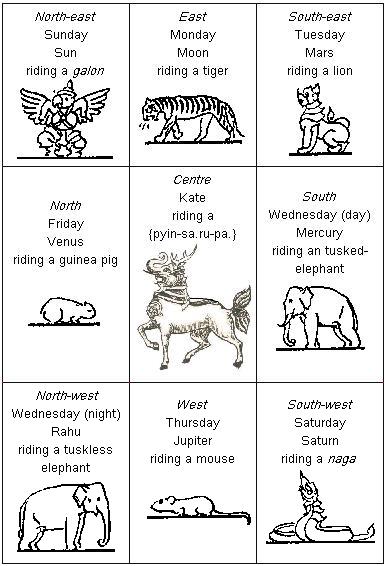
The 33 aksharas of the Myanmar akshara-matrix were distributed
between the eight Planet-gods
or simply Planets
ruling the astronomical planets. These Planets have their own pet-animals
which are considered to be vehicles for Planets to
ride. The Planets are neither Dévas nor Asuras, and unlike their Greek-Roman
gods, they are all males:
{ka.},
{hka.},
{ga.},
{Ga.}, {gna.} -- Monday-Planet
riding Tiger
{sa.},
{hsa.},
{za.},
{Za.},
{Ña.} -- Tuesday-Planet riding Chinthe-lion
{Ta.},
{HTa.},
{ða.},
{Ða.},
{Na.} -- Saturday-Planet riding the Naga-serpent
{ta.},
{hta.},
{da.},
{Da.},
{na.} -- Saturday-Planet riding the Naga-serpent
{pa.},
{hpa.},
{ba.},
{Ba.},
{ma.} -- Thursday-Planet riding the Rat
{la.},
{La.},
{wa.} -- Wednesday-before-noon-Planet riding the Elephant with tusks
{ya.},
{ra.} -- Rahu's day or Wednesday-afternoon-Planet riding the Tuskless-Elephant
{þa.},
{ha.} -- Friday-Planet riding the Guinea-Pig
{a.} -- Sunday-Planet riding the Garuda-bird
A person's name is chosen to correspond to the Planet.
Thus, the first name of a Saturday-born would begin
with one of the following letters:
{ta.},
{hta.},
{da.},
{Da.},
{na.}
- for a lay person
{Ta.},
{HTa.},
{ða.},
{Ða.},
{Na.} - for a monk or nun
as, for example, 'Tin', 'Htin', 'Nan'. This custom of naming a person after
his birthday planet has now fallen into disuse, except in old-fashioned
families. However, it is still prescribed in religious circles.
Go back bur-astr-b
Contents of this page
Contents of this page
-- by UKT (the illustration is from Facets
of Life at Shwedagon Pagoda in Colorful Myanmar by Daw Khin Myo
Chit):
There are only 7 days in a week. And therefore only 7 gods are needed to rule
the days. But in Burmese astrology, we need to indicate the 8 directions of the
compass, ruled by the same gods. Therefore, one day would have to be ruled by
two gods. That day is Wednesday. Wednesday before noon is ruled by the god of
the Wednesday-planet, and Wednesday after noon is ruled by the god Rahu.
Now Wednesday-god is mild mannered, and when certain periods of
your life fall under his rule, you would be lucky. However, Rahu is an angry
god, and when in other periods of life, you fall under his influence, you would
be unlucky. It is noteworthy that both gods ride elephants. Wednesday's elephant
has tusks, and it can be used for good causes -- like moving heavy logs.
However, Rahu's elephant is the tusk-less one. It is stronger than the one with
tusk, but it is the angry one and is not useful. I sometimes wonder if the
two gods are really one. In the morning he is good, but past noon he became sour.
If you would like to curry favour with the gods you would have to
offer them with flowers and fruits. Of course, these items have their
Bur-Myan names beginning with a particular consonant. If you would like
to offer things to the Wednesday-god, choose items with names beginning with
{la.} and {wa.}. If it is Rahu, the offertories must have names beginning with {ya.}
and {ra.}.
Now, lets see what the Greeks and Romans thought about the god of
the planet Mercury. He is Hermes to the Greek and Mercury to the Romans. He is
male but a hermaphrodite :
Hermes n. Greek Mythology 1. The god of commerce,
invention, cunning, and theft, who also served as messenger, scribe, and
herald for the other gods. -- AHTD
Mercury n. 1. Roman Mythology A god that served as
messenger to the other gods and was himself the god of commerce, travel, and
thievery. 2. The smallest of the planets and the one nearest the sun,
having a sidereal period of revolution about the sun of 88.0 days at a mean
distance of 58.3 million kilometers (36.2 million miles) and a mean radius of
approximately 2,414 kilometers (1,500 miles). [Middle English Mercurie
from Old French from Latin Mercurius] -- AHTD
mercury n. 1. Symbol Hg A silvery-white
poisonous metallic element, liquid at room temperature and used in
thermometers, barometers, vapor lamps, and batteries and in the preparation of
chemical pesticides. Atomic number 80; atomic weight 200.59; melting point -
38.87°C; boiling point 356.58 °C; specific gravity 13.546 (at 20 °C); valence
1, 2. Also Called quicksilver . See note at element . 2. Temperature:
The mercury had fallen rapidly by morning. 3. Any of several
weedy plants of the genera Mercurialis or Acalypha. [Middle
English mercurie from Medieval Latin mercurius from Latin
Mercurius Mercury] -- AHTD
Go back god-wednesday-b
Contents of this page
homonym
n. 1. One of two or more words that have the same sound and
often the same spelling but differ in meaning. -- AHTD
Go back homonym-b
Contents of this page
See the Language problem of
primitive Buddhism by Chi Hisen-lin, Journal of the Burma Research Society
(JBRS), XLIII, i, June 1960 (in TIL library).
The language problem appeared even during the life-time of Buddha, who responded:
-- Cullavagga,
V. 33. 1
" anujānāmi bhikkhave sakāya niruttiyā buddhavacanam pariyāpunitum
"
allowing his followers to spread his teaching in the local speech.
meaning: "I permit you, O Monks, to learn the word of the Buddha in his own language."
-- Buddha.
The episode is mentioned in Viniya Pitika, Cullavagga, V. 33. 1. Buddha's words
were in response to a request by two monks who were born into a Brahmin family:
"Bhante, now the Bhikkhus with different family names and personal names, of
different social ranks and families, have come to join the Order. With their own
vernaculars they have marred the Buddha's words. Please permit us to express the
Buddha's words in Sanskrit."
Buddha: "Bhikkhus, you are not allowed to express the Buddha's words in
Sanskrit. Those who act contrarily will be considered as having committed the offence of Dukkata
 {doak~ka.Ta.}."
Chi Hisen-lin wrote: "Although the above-mentioned views vary from one another, there is a
comparatively concordant point, that is, most of the scholars advocated that the
Pali language was a Western dialect, and such was truly the fact. The declensions
of the Pali words are similar to those of the language used in the Girnar
Inscriptions of the Asokan Pillars, such as the locative case ending in-amhi and
-e, the accusative case in -ne, etc. But on the other hand, the Magadha language
was an eastern dialect, in which r had become as l, and s as
ś, while the nominative case of words ending in -a,
ended in -e, etc. There is a vast difference between the two languages and they
should by no means be confused with each other."
Burma (i.e. Upper Burma) being close to Magadha, I am of holding the view that
Burmese-Myanmar pronunciations are more likely to be closer to the
pronunciations used by Lord Buddha himself.
Go back
maga-myan-pali-sanskrit-b
Contents of this page
shibboleth - n. 1. A word or pronunciation that distinguishes people of one
group or class from those of another. 2. a. A word or phrase identified
with a particular group or cause; a catchword. b. A commonplace saying or
idea. 3. A custom or practice that betrays one as an outsider.
[Ultimately from Hebrew šibbōlet torrent of water, from the use of
this word to distinguish one tribe from another, who pronounced it
sibbōleth (Judges 12:4-6)] -- AHTD
UKT:
In the Bible story, thousands of people
lost their lives in a single day because of their inability
to pronounce a single word "correctly".
After coming across that story, I hold firmly that
spoken language divides people, whereas the written script unites.
I have but one wish in formulating Romabama as an old man: may the peoples
of Myanmar remain united forever, and I firmly hold that the Myanmar script
is the instrument to bring that about.
Go back shibbo-b
Contents of this page
sibilant
Linguistics adj. 1. Of, characterized by,
or producing a hissing sound like that of (s) or (sh):
the sibilant consonants; a sibilant bird call. n.
1. A sibilant speech sound, such as English
(s), (sh), (z), or (zh). -- AHTD.
Go back sibilant-b
Contents of this page
End of TIL file