Update:
2020-10-05 10:56 PM -0400
Romabama on Typewriter
con04.htm
by U Kyaw Tun (UKT) (M.S., I.P.S.T., USA), and staff of Tun Institute of Learning (TIL).
Not for sale. No copyright. Free for everyone.
Prepared for students and staff of TIL Research Station, Yangon,
MYANMAR
-
http://www.tuninst.net ,
www.romabama.blogspot.com
index.htm |
Top
RBM-typewriter-indx.htm
UKT 201002: ref. Bur-Myan Orthography (MLC MO1986), by U (Dr.) Tun Tint, MLC, 1986, p. {Hta.}
However, it must be noted that many simple entries with vowel-duration 1
eye-blnk are not listed, e.g.
 {gya.}
(1 blnk) is not listed, but
{gya.}
(1 blnk) is not listed, but
 {gya} (2
blnk)
is. Thinking that these are uncalled-for omissions, I'd complained to my friend U Tun Tint
(but only about 30 years after the publication). He admitted there are some missing entries,
but there are relevant reasons for not listing them.
{gya} (2
blnk)
is. Thinking that these are uncalled-for omissions, I'd complained to my friend U Tun Tint
(but only about 30 years after the publication). He admitted there are some missing entries,
but there are relevant reasons for not listing them.
See also Phonological Inventories of Tib-Bur Languages,
in STEDT Monograph Series, No. 3, Ju Namkung, editor, 1996,
-
STEDT-PhonoTibBurMono3<Ô> /
Bkp<Ô> (link
chk 200928)

UKT 201003: Burmese is recognized to be of 2 forms Official (described as
"Written Burmese") and Colloquial ("Rangoon Burmese"), under LOLO-BURMESE-NAXI
/ BURMISH grouping. "Written Burmese" is on p061, and "Rangoon Burmese" on
p063. The consonants are not listed according to Myanmar akshara matrix
which shows that the authors are not aware of the matrix which is
constructed in accordance with Phonetics. What a pity!
See also Burmese by Ear, by John Okell, 2002
- JOkell-BurmeseEar<Ô>
/ Bkp<Ô>
(link chk 201003)
UKT 201003: a teaching course on colloquial Burmese.
Medial-consonants and Basic-consonants :
"The medials, except for their instability under virama
 {a·þût}, behave like basic consonants. Like basic consonants, medial have
inherent vowel
{a·þût}, behave like basic consonants. Like basic consonants, medial have
inherent vowel

 {mwé-hkän þa.ra.}
 {a.} /a/. There are 4 medials formers,
 {ya.},
 {ra.},
 {wa.},
which may be extended to 5 by addition of
{wa.},
which may be extended to 5 by addition of
 {la.}. Ya'pin medials, both
 {ya.pín.} and
 {ra.ric} are similar in their actions. Medials,
 {wa.hswè:} and
 {ha.hto:} are also similar, but
 {la.hswè:} is the odd-man out - no wonder it has disappeared from the main
dialect.
{la.hswè:} is the odd-man out - no wonder it has disappeared from the main
dialect.
Simple medials
01.
{ya.pín.} -- medial with
{ya.}
: palatalization without rhoticity
02.
{ra.ric} -- medial with
{ra.}
: palatalization with rhoticity: in central dialect of Bur-Myan
{ya.}
and
{ra.}
are both called Ya.
03.
{la.hswè:} -- medial with hanging
{la.} : articulated with tongue
04.
{wa.hswè:} -- medial with
hanging
{wa.}
: articulated with lips
05.
{ha.hto:} -- medial with
 {ha.} : not easily described.
Multiple medials
05.
{ya.pín. wa.hswè:} --
compound-medial with
{ya.} and
{wa.}
06.
{ra.ric wa.hswè:} -- compound-medial with
{ra.} and
{wa.}
07.
{ya.pín. ha.hto:} --
compound-medial with
{ya.} and
{ha.}
08.
{ra.ric ha.hto:} -- compound-medial with
{ra.} and
{ha.}
09.
{wa.hswè: ha.hto:} -- compound-medial with
{wa.} and
{ha.}
10.
{ya.pin. wa.hswè: ha.hto:}
-- compound-medial with
{ya.},
{wa.} and
{ha.}
11.
{ra.ric wa.hswè: ha.hto:}
-- compound-medial with
{ra.},
{wa.} and
{ha.}
UKT notes
• Approximants
Contents of this page
UKT 201002: From the previous pages, I am concluding that
"consonant-conjunct", or "consonant-cluster", or
"orthographic-consonant-cluster" are the same. I'll just call them "conjuncts":
they are disyllabic.
There are innumerable conjuncts in Skt-Dev. Skt-Dev and
Hindi-Dev speakers do not have medials as we do in Bur-Myan. They also find
difficulty in pronouncing my name KYAW.
The reason why my
American friends cannot pronounce my name KYAW is also because English has no
medial <ky>. They have only /kʸ/ or /kʲ/ .
See also: https://en.wikipedia.org/wiki/Palatalization_(phonetics) 200929
"In phonetics, palatalization or palatization refers to a way
of pronouncing a consonant in which part of the tongue is moved close to the
hard palate. Consonants pronounced this way are said to be palatalized
and are transcribed in the IPA by affixing the letter 〈 ʲ 〉 to the base
consonant. Palatalization cannot minimally distinguish words in English ...
"
I will now define conjunct by:
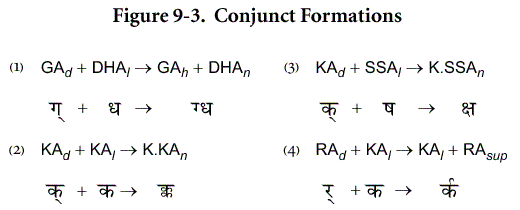 From: The Unicode Standard, Version 4.0, Unicode Consortium,
http://www.unicode.org/versions/Unicode4.0.0/
From: The Unicode Standard, Version 4.0, Unicode Consortium,
http://www.unicode.org/versions/Unicode4.0.0/
An "orthographic consonant cluster" is defined as a sequence
of characters that represents one or more dead consonants (denoted Cd )
followed by a normal, live consonant letter (denoted Cl )."
The formation of the conjunct
 {kka.} is exactly the same as that of Devanagari
क्क (U0915+U094D+U0915). Bur-Myan
{kka.} is mute.
{kka.} is exactly the same as that of Devanagari
क्क (U0915+U094D+U0915). Bur-Myan
{kka.} is mute.
 {ka.} + viram -->
 {k}
{k}
{k} +
{ka.} -->
{kka.}
A "conjunct", such as
{kka.}
is mute, but a medial such as
 {kya.} is syllabic or pronounceable. When a speaker cannot pronounce a medial,
which is monosyllabic, he usually pronounces it as a disyllabic conjunct by
adding the central vowel Schwa, /kə·ja/
. Remember, Bur-Myan
{ya.} is pronounced in IPA as /j/. It seems that
{ya.pín.}, and other medials are probably only present in Bur-Myan, for which
IPA gives "diacritics" such as: /ʲ/, /ʴ/, /ʷ/, /ʰ/.
{kya.} is syllabic or pronounceable. When a speaker cannot pronounce a medial,
which is monosyllabic, he usually pronounces it as a disyllabic conjunct by
adding the central vowel Schwa, /kə·ja/
. Remember, Bur-Myan
{ya.} is pronounced in IPA as /j/. It seems that
{ya.pín.}, and other medials are probably only present in Bur-Myan, for which
IPA gives "diacritics" such as: /ʲ/, /ʴ/, /ʷ/, /ʰ/.

The effective unit of Bur-Myan language is the orthographic syllable,
consisting of a consonant and vowel (CV) core and, optionally, one or more
preceding consonants, with a canonical structure of (((C)C)C)V. The
orthographic syllable need not correspond exactly with a phonological syllable,
especially when a consonant cluster is involved.
UKT 200927: Instead of writing the canonical structure of (((C)C)C)V , I
simplify it as CVÇ ,where C = 0, 1, 2, 3, and Ç = 0, 1, 2, 3
Four consonants from the non-definable group,

 {a.wag}-group, are the only medial-formers:
{ya.},
{ra.},
{wa.},
and
{ha.}. (You will note that the medial-formers, except
{ha.} are described as approximants.).
They undergo a change in shape or position (a lower level) in the process
of medial-formation. A medial is monosyllabic (has only one sound)
like any other consonants. In Romabama, the medial-former occupies the second place
(after the base consonant) in the syllable. A second and then a third
medial-former can be further added to form more medials.
{a.wag}-group, are the only medial-formers:
{ya.},
{ra.},
{wa.},
and
{ha.}. (You will note that the medial-formers, except
{ha.} are described as approximants.).
They undergo a change in shape or position (a lower level) in the process
of medial-formation. A medial is monosyllabic (has only one sound)
like any other consonants. In Romabama, the medial-former occupies the second place
(after the base consonant) in the syllable. A second and then a third
medial-former can be further added to form more medials.
The medials, except for their instability under virama
{a·þût}, behave like basic consonants. Like basic consonants, medial have
inherent vowel
{mwé-hkän þa.ra.}
{a.} /a/. And, they can take on various vowel-signs:
{a.}
 ,
,
 {a}
{a}
 ,
,
 {a:}
{a:}

 {i.}
{i.}
 ,
,
 {i}
{i}
 ,
,
 {i:}
{i:}
 {u.}
{u.}
 ,
,
 {u}
{u}
 ,
,
 {u:}
{u:}

 {é.}
{é.}
 ,
,
 {é}
{é}
 ,
,
 {é:}
{é:}

 {è.}
{è.}
 ,
,
 {èý}
{èý}
 ,
,
 {è:}
{è:}

In the transliteration of the column c2
consonants,
 {hka.},
 {hsa.},
{HTa.},
{hsa.},
{HTa.},
 {hta.},
 {hpa.}, <h> is placed before the base consonant. Here <h> is not a
medial-former, but only a character in the digraph.)
{hpa.}, <h> is placed before the base consonant. Here <h> is not a
medial-former, but only a character in the digraph.)
You will notice that not all consonants can form medials
with a particular medial-former. A medial must act as a single consonant, i.e.
monosyllabic. Thus,
 {ta.ya.} /tə·ja/ is not exactly a medial. It can be considered to be a horizontal conjunct.
medials break-down under the virama
{a·þût}.
{ta.ya.} /tə·ja/ is not exactly a medial. It can be considered to be a horizontal conjunct.
medials break-down under the virama
{a·þût}.
The naming the multiple conjuncts (naming sequence) is in accordance with Myanmar Saloanpaung Thutpoan Kyam
(MOrtho). Thus,
{ya.pin. wa.hswè: ha.hto:}
is correct, and {ya.pin. ha.hto: wa.hswè:} is not. Nevertheless, in Romabama the naming
sequence is based on the English pronunciation, and not on MOrtho.
In the tables on conjunct consonants, you see how a conjunct may be formed.
However, not all possible conjuncts are listed in Thutpoan Kyam, but you will
come across them in actual syllables and words combined with vowels elsewhere.
Contents of this page
01.
Ya'pin
{ya.pín.}- medials formed with
{ya.} : palatalization


There are 25
{wag}-consonants, and 8
{a.wag}-consonants (or approximants} in Myanmar-akshara matrix. Altogether, they
make 33. The akshara {a.} is treated as a consonant: one reason being able to
produce the phoneme known as onomatopoeia:
 {awa.} -->
 {awût} -->
 {auk-i-i:awût}
"sound of cock-crowing" in Bur-Myan.
{auk-i-i:awût}
"sound of cock-crowing" in Bur-Myan.
Of course, you won't find such words in MLC MOrtho.
Observation based mostly on MLC MOrtho, p. (01) to (36) of Index of mostly
monosyllabic words:
Caution: you'll find many sections beginning with unusual words
Application of
{ya.pín.} to 25
{wag}-consonants, brings down the aksharas to 9, and to 8
{a.wag}-consonants to just 1.
{kya.},
 {hkya.},
{gya.} /
{hkya.},
{gya.} /

{t·ya.}*,
 {n·ya.}*
 {pya.},
 {hpya.},
 {bya.},
 {mya.}
 {lya.}
UKT 200929: * MLC MO1986 does list
{n·ya.}. However, it is now used in Chemistry for "nuclear". To prevent confusion between r2c5 Nya-minor
 {nya.} and
{n·ya.}, Romabama has to insert the middle-dot {·} (Alt-0183) the Romabama
equivalent of IPA Schwa /ə/ in
{n·ya.}, and use ñ for Nya-minor
{ña.} .
{nya.} and
{n·ya.}, Romabama has to insert the middle-dot {·} (Alt-0183) the Romabama
equivalent of IPA Schwa /ə/ in
{n·ya.}, and use ñ for Nya-minor
{ña.} .
See also: https://en.wikipedia.org/wiki/Palatalization_(phonetics) 200929
"In phonetics, palatalization or palatization refers to a way
of pronouncing a consonant in which part of the tongue is moved close to the
hard palate. Consonants pronounced this way are said to be palatalized
and are transcribed in the IPA by affixing the letter 〈 ʲ 〉 to the base
consonant. Palatalization cannot minimally distinguish words in English. ...
"
Lets see which of the base aksharas would form
{ya.pín.} medials :
(This section is an observation based on orthography of Bur-Myan words listed in
the Myanmar Orthography of MLC.)
• The primary function of
{ya.pín.}-medial is to
palatalize the consonants. See Phonological Inventories of Tib-Bur Languages,
in STEDT Monograph Series, No. 3, Ju Namkung, editor, 1996,
-
STEDT-PhonoTibBurMono3<Ô> /
Bkp<Ô> (link
chk 200928)
Remember palatalization and
lip-rounding cannot be articulated at the same time,
all the
{ya.pín.}-medials, except the extreme
guttural or velar consonants, will drop out in
{ya.pín. wa.hswè:}.
•
{ka. ya.pín.} -- index p.(02) listed starting on main p.014 with
{kya.}.
•
{hka. ya.pín.} -- index p.(05) listed starting on main p.040 with
{hkya.}
/ʧa/ -- pronounced <ch> as in <church>
•
 {ga. ya.pín.} -- index p.(07) listed starting on main p.056 with
{gya}. Derived from
{gya.}
as in <j> in <jug>
{ga. ya.pín.} -- index p.(07) listed starting on main p.056 with
{gya}. Derived from
{gya.}
as in <j> in <jug>
UKT 200927: The pronunciations of
 {ta. ya.pín.} and
 {na. ya.pín.}, listed below, are tricky, because of the inclusion of central
vowel IPA Schwa /ə/ which in Romabama is marked with a mid-dot {·}(Alt0183).
The word Schwa is from Hebrew shva /ʃva/. Transcription of /ʃva/ is
{na. ya.pín.}, listed below, are tricky, because of the inclusion of central
vowel IPA Schwa /ə/ which in Romabama is marked with a mid-dot {·}(Alt0183).
The word Schwa is from Hebrew shva /ʃva/. Transcription of /ʃva/ is
 {shwa.} -->
 {þwa.}
•
{ta. ya.pín.} -- index p.(13) listed starting on main p.112 with
 {ta·ya}. Derived from
{ta·ya.},
and from
{ta.ya.}
{ta·ya}. Derived from
{ta·ya.},
and from
{ta.ya.}
•  {da. ya.pín.} -- not listed
•
{na. ya.pín.} -- index p.(16) listed starting on main p.135 with
 {na·yu}. Derived from
 {na·ya.},
and from
{na·ya.},
and from
 {na~ya.}
UKT 201001: Nyu
{na·yu}
is an imported phoneme standing in for English <nu> in <nuclear>
 {nu-ka.li:ya:}. It is an unnecessary importation because we have own phoneme
 {Ñu} and <nuclear> should have been
 {Ñu.ka.li-ya}. Unfortunately, the problem is with English from which we are
importing grapheme. It lacks the equivalents of Spanish Ñ and ñ
.
{Ñu.ka.li-ya}. Unfortunately, the problem is with English from which we are
importing grapheme. It lacks the equivalents of Spanish Ñ and ñ
.
•
 {pa. ya.pín.} -- index p.(18) listed starting on main p.153
{pya.}
{pa. ya.pín.} -- index p.(18) listed starting on main p.153
{pya.}
•
{hpa. ya.pín.} -- index p.(21) listed starting on main p.171
 {hpya.}
•
 {bya. ya.pín.} -- index p.(23) listed starting on main p.181
{bya.}
{bya. ya.pín.} -- index p.(23) listed starting on main p.181
{bya.}
•
 {ma. ya.pín.} -- index p.(25) listed starting on main p.198
 {mya:}
•
{ya. ya.pín.} -- not listed
•
{la. ya.pín.}
-- index p.(31) listed starting on main p.245
 {la·ya.}
•
{wa. ya.pín.} -- not listed
•
 {þa. ya.pín.}
-- is not listed ,
{þa. ya.pín.}
-- is not listed ,
Though
{þa. ya.pín.} is not realized,
{þa. ya.pín. ha.hto:} index p.(35) is listed starting on main p.269
 {thhya:}.
Similarly,
{ma. ra.ric wa.hswè:} is not realised, instead of which
{ma. ra.ric wa.hswè:
ha.hto:} index p.(27) is listed starting on main p.215 with
{thhya:}.
Similarly,
{ma. ra.ric wa.hswè:} is not realised, instead of which
{ma. ra.ric wa.hswè:
ha.hto:} index p.(27) is listed starting on main p.215 with  {mhrwa.}.
Though
{ya.} and
{ra.} are similar in forming palatal medials, they are represented differently and
should be pronounced differently. However, except in the Rakhine dialect of Bur-Myan,
and Pali-Myan,
{ya.pín.} and
{ra.ric} are pronounced the same.
 Ya'pin
{ya.pín.} medials are non-rhotic, but Ya'ric
{ra.ric} are rhotic. Because of difference in rhoticity - from non-rhotic
{ya.pín.} through almost non-rhotic Bur-Myan
{ra.ric} to Pali-Myan rhotic
{Ra.ric} and beyond to highly rhotic {RRa.ric}, Romabama has to come up with
different kinds of
{ra.ric}. As an example, I've given the action of medial-former
{ra.} on basic akshara
{ka.}.
Ya'pin
{ya.pín.} medials are non-rhotic, but Ya'ric
{ra.ric} are rhotic. Because of difference in rhoticity - from non-rhotic
{ya.pín.} through almost non-rhotic Bur-Myan
{ra.ric} to Pali-Myan rhotic
{Ra.ric} and beyond to highly rhotic {RRa.ric}, Romabama has to come up with
different kinds of
{ra.ric}. As an example, I've given the action of medial-former
{ra.} on basic akshara
{ka.}.
Contents of this page
02. Ya'ric
{ra.ric}- medials
formed with
{ra.} : palatalization with rhoticity
UKT 200929 :
All over Myanmar, except in the west coast (Rakhine or Arakan),
{Ra.ric} sounds, e.g.
 {mRa.}, are not used even though everyone is capable of pronouncing them. The
equivalent of Arakanese
{mRa.} (rhotic) is Burmese
{mRa.}, are not used even though everyone is capable of pronouncing them. The
equivalent of Arakanese
{mRa.} (rhotic) is Burmese
 {mra.} (non-rhotic). Romabama differentiates rhotic from non-rhotic by the
length of the hood of
{ra.ric} :
{mRa.} with full-hood is rhotic, whereas
{mra.} with shortened-hood is non-rhotic. Remember in these pages I am using
Burmese phonology of Irrawaddy- and Sittang-basins the dialect of the majority
of Bur-Myan speakers.
{mra.} (non-rhotic). Romabama differentiates rhotic from non-rhotic by the
length of the hood of
{ra.ric} :
{mRa.} with full-hood is rhotic, whereas
{mra.} with shortened-hood is non-rhotic. Remember in these pages I am using
Burmese phonology of Irrawaddy- and Sittang-basins the dialect of the majority
of Bur-Myan speakers.
 If you
are writing Bur-Myan, it is important that you use the correct spelling
-- otherwise the meaning will be changed, and nobody would understand you.
Remember, our primary concern is correct spelling: correct pronunciation is of
secondary importance. The following are pronounced without any rhoticity.
If you
are writing Bur-Myan, it is important that you use the correct spelling
-- otherwise the meaning will be changed, and nobody would understand you.
Remember, our primary concern is correct spelling: correct pronunciation is of
secondary importance. The following are pronounced without any rhoticity.
 {kra.},
 {hkra.},
 {gra.},
 {gnra.}
 {tra.},
 {dra.}
 {pra.},
 {hpra.},
 {bra.},
{mra.}
{bra.},
{mra.}
Above we've seen
{ya.pín.} palatalization has an IPA symbol 〈 ʲ 〉. Because, Bur-Myan
{ra.ric} is pronounced like
{ya.pín.}, it is also palatalization. Added to this is a slight rhoticity in
Arakanese dialect, and more in Pali-Myan. Note that IPA has symbols for
rhoticity 〈 ʴ 〉 (less rhoticity), and 〈 ʳ 〉
(more rhoticity).
• The primary function of
{ra.ric} is to make a palatalized basic-consonant rhotic.
See Rhotic consonants in
-
https://en.wikipedia.org/wiki/Rhotic_consonant 200928
You should also note that Bur-Myan pairs,
{pa.}
{ba.};
{ta.}
{da.}; and
{ka.}
{ga.},
correspond to Eng-Lat plosives /p b/ (bilabial), /t d/ (alveolar) and /k g/ (velar).
UKT 200930: British English is non-rhotic with /ɹ/, and so is Burmese. Remember
American English with /r/, is rhotic. Thus, for me, who is
bilingual in Burmese and English, rhotic consonants are not difficult to grasp.
But, for those who have not been exposed to English - they were the majority in
Burma when I as a child, was learning English - find it difficult to pronounce
r properly. However most of these have been exposed to Pal-Myan, and resorting to Pali
(spoken in Myanmarpré)
had offered some help.
•
{ka. ra.ric} -- index p.(03) listed starting on main p.021 with
{kra.}
•
{hka. ra.ric}
-- index p.(06) listed starting on main p.047 with
{hkra.}
•
{ga. ra.ric} --
not listed as
{gra.}, but as
 {gRoh} on index p.(07) and on main p.056 with a Pali-Myan
{gRoh}
{gRoh} on index p.(07) and on main p.056 with a Pali-Myan
{gRoh}
•  {gna. ra.ric} --
listed beginning with
{gna. ra.ric} --
listed beginning with
 {gnra} on index p.(08) and on main p.061. (28 words found)
UKT 201001: See On searching for Nya-major in
RBM-intro1.htm
Since
{gnra.} has a sound exactly like the
Nya'major
 {Ña.},
I'm speculating that with the introduction of Affricates into row#2, many of the
former Nya'major
{Ña.}
words were changed into
{gnra.}
words.
This had its origin in the introduction of Pali-Lanka into Burma at the time
of King Anawrahta who persecuted the Arigyi
{Ña.},
I'm speculating that with the introduction of Affricates into row#2, many of the
former Nya'major
{Ña.}
words were changed into
{gnra.}
words.
This had its origin in the introduction of Pali-Lanka into Burma at the time
of King Anawrahta who persecuted the Arigyi

 {a.ri:kri:} - the Burmese-speaking monks - who had arrived in northern Burma
since the time of King Abiraza long before Buddha was born. King Anawrahta
had replaced the Buddhism of Aris with that of Mon-speaking monks and their
Theravada Buddhism now practiced in Myanmarpré.
{a.ri:kri:} - the Burmese-speaking monks - who had arrived in northern Burma
since the time of King Abiraza long before Buddha was born. King Anawrahta
had replaced the Buddhism of Aris with that of Mon-speaking monks and their
Theravada Buddhism now practiced in Myanmarpré.
•
{ta. ra.ric} -- index p.(13) listed starting on main p.112 with
 {tRi.} .
•
{da. ra.ric} -- index p.(15) listed starting on main p.126 with
 {dRa.}
•
 {pa. ra.ric} -- index p.(19) listed starting on main p.156 with
{pra.}
{pa. ra.ric} -- index p.(19) listed starting on main p.156 with
{pra.}
•
{hpa. ra.ric} -- index p.(21) listed starting on main p.173 with
{hpra.}
•
{ba. ra.ric} -- index p.(23) listed starting on main p.182 with
 {bra}
{bra}
•
{ma. ra.ric} -- index p.(25) listed starting on main p.202 with
{mra}
•
{þa. ra.ric} -- non-existent. What appears to be
{þa. ra.ric} is actually Burmese-Myanmar vowel
 {au}.
{au}.
Contents of this page
03. La'swè
{la.hswè:} -- medial with hanging
{la.}
 UKT
201023: The main effect of
{la.hswè:} is to impart L-colouring with various shapes of tongue. Though used
in Pagan period, it remains only in the Tavoyan dialect. Since I've no knowledge
of the Tavoy dialect, I cannot give examples. It may be of importance in Eng-Latin,
and you should consult English Pronouncing Dictionary, by Daniel Jones, -
DJPD16-indx.htm (link chk 201003
UKT
201023: The main effect of
{la.hswè:} is to impart L-colouring with various shapes of tongue. Though used
in Pagan period, it remains only in the Tavoyan dialect. Since I've no knowledge
of the Tavoy dialect, I cannot give examples. It may be of importance in Eng-Latin,
and you should consult English Pronouncing Dictionary, by Daniel Jones, -
DJPD16-indx.htm (link chk 201003
•
{ka.la.hswè:} - Eng-Lat alphabet that mostly resembles
is not k , but c . e.g. <clad> "to cover"
•
{ga.la.hswè:} - <glad> "experiencing joy"
•  {sa.la.hswè:} - <slab> "a broad, flat, thick piece"
•
{pa.
la.hswè:} - <place> "an area with definite boundary"
•
{ba.
la.hswè:} - <blue> "colour blue"
Contents of this page
04. Wa'swè
{wa.hswè:}- medials formed with
{wa.}
One of the effects of
{wa.hswè:} is lip-rounding.
All the 25
{wag.}-consonants, and 8
{a.wag}-consonants, except those used mainly for Pali, can stand the effect of
{wa.hswè:}.
 {kwa.}
 {hkwa.}
 {gwa.}
  {gnwa.}
 {swa.}
  {hswa.}
 {zwa.}
  {Ñwa.}
 {twa.}
 {htwa.}
  {dwa.}
 {nwa.}
 {pwa.}
  {hpwa.}
 {bwa.}
  {Bwa.}
 {mwa.}
 {ywa.}
 {rwa.}
 {lwa.} {þwa.}
Observation based on Myanmar Orthography, p. (01) to (36) of Index of mostly
monosyllabic words:
• There are two candidates for r2c5: Nya-major
{Ña.}/
 {Ñ}, and Nya-minor
{ña.}/
{Ñ}, and Nya-minor
{ña.}/
 {ñ}. Representation by the digraph "ny" is misleading.
• In forming
{wa.hswè:}-medials, two base characters,
{na.} and
{ra.} have
their "foot" shortened.
• Almost all akshara-characters can form
{wa.hswè:}-medials.
•
{ka. wa.hswè:} -- index p.(03) listed starting on main p. 028 with
 {kwa}
{kwa}
•
{hka. wa.hswè:} -- index p.(06) listed starting on main p.050 with
{hkwa.}
•
{ga. wa.hswè:} -- index p.(07) listed starting on main p.056 with
 {gwé:}
•
{gna. wa.hswè:} -- index p.(08) listed starting on main p.062 with
 {gnwa:}
•
{sa. wa.hswè:} -- index p.(09) listed starting on main p.075 with
 {swa}
{swa}
•
{hsa. wa.hswè:} -- index p.(10) listed starting on main p.085 with
 {hswé}
•
 {za. wa.hswè:} -- index p.(11) listed starting on main p.089 with
{zwa}
{za. wa.hswè:} -- index p.(11) listed starting on main p.089 with
{zwa}
•
{Ña. wa.hswè:} -- index p.(12) listed starting on main p.093 with
 {Ñhwut}
•
{ta. wa.hswè:} -- index p. (13) listed starting on main p.113 with
 {twé.}
•
{hta. wa.hswè:} -- index p.(14) listed starting on main p.120 with
{htwa}
•
{da. wa.hswè:} -- index p.(15) listed starting on main p.126 with
{dwa.}
•
{na. wa.hswè:} -- index p.(17) listed starting on main p.135 with
 {nwa:}
•
{pa. wa.hswè:} -- index p.(20) listed starting on main p.163 with
{pwa.}
•
{hpa. wa.hswè:} -- index p.(22) listed starting on main p.177 with
 {hpwa}
•
{ba. wa.hswè:} -- index p.(23) listed starting on main p.183 with
{bwa}
•
 {Ba. wa.hswè:} -- index p.(24) listed starting on main p.188 with
{Bwa}
{Ba. wa.hswè:} -- index p.(24) listed starting on main p.188 with
{Bwa}
•
{ma. wa.hswè:} -- index p.(26) listed starting on main p.208 with
{mwa.}
•
{ya. wa.hswè:} -- index p.(28) listed starting on main p.219 with
{ywa.}
•
{ra. wa.hswè:} -- index p.(29) listed starting on main p.230 with
{rwa.}
•
{la. wa.hswè:} -- index p.(31) listed starting on main p.246 with
 {lwé.}
•
{þa. wa.hswè:} -- index p.(34) listed starting on main p.268 with
{þwa}
Contents of this page
{ha.hto:} -- conjuncts formed with
{ha.}
UKT 201003. One of the functions of
{ha.hto:} is to
make a basic nasal which is supposed to be voiced (vd.), into a voiceless (vl) nasal. I
noticed this when I read about voiceless nasals in Burmese by Ladefoged.
See
¤ Burmese for Foreign Friends - Burmese for
English speakers (a fictitious love story with voices of
U Kyaw Tun and wife Daw Than Than)
-
BurMyan-indx.htm >
B4FF1-indx.htm >
ch01-2.htm (link chk 180728)
See also: Voiceless nasal sounds in three Tibeto-Burman languages , Katia
Chirkova, Patricia Basset, Angelique Amelot , 2019
-
KChirkovaEtAl-VlNasalsTibBur<Ô> /
Bkp<Ô> (link chk 201003)
"Burmese voiceless nasals are the best described type of voiceless nasals, and
are therefore used as a reference point for comparison."
I cannot agree with the descriptions voiceless and voiced given as above,
because when I pronounce the syllables given as examples, I find no difference
in voicing - felt by placing my fingers on my Adam Apple. I will therefore use
the term Ha'hto-coloration
 {ha.hto:þän}
Observation based on Myanmar Orthography, p. (01) to (36) of Index of mostly
monosyllabic words :
• Only the nasals and
{a.wag}-consonant can form
{ha.hto:}
medials.
• Three of the
{a.wag}-consonants,
{ya.},
{ra.} and
{þa.} are used in
representing the /ʃ/ sounds in differing situations: e.g.
 "profuse",
 "search",
 "goose-berry". However, the simplest
would be to adopt a new phoneme from Skt-Dev - the Dental-fricative
"goose-berry". However, the simplest
would be to adopt a new phoneme from Skt-Dev - the Dental-fricative
 {Sa.}/
 {S}. Then, /ʃ/ sounds can be easily transcribe as in Eng-Latin
<ship> /ʃɪp/ =
{S}. Then, /ʃ/ sounds can be easily transcribe as in Eng-Latin
<ship> /ʃɪp/ =
 {shép} (rhyming with
  {hkét}
"Time, period, era").
{hkét}
"Time, period, era").
 ---------------------------------------
 {gnha.}
-----------------------------------------
 {Ñha.}
------------------------------------------
 {nha.}
------------------------------------------
 {mha.}
 {yha.}
 {rha.}
 {lha.}
 {wha.}
 {þha.}
The aksharas of column c5 - the nasal column - is already nasalized.
Rendering them with
{ha.hto:} makes them more nasal. Few
non-native Burmese speakers would find them impossible to pronounce. Ask a Myanmarpré-born
Bur-Myan speaker to pronounce them, and try to differentiate the sounds:
{gna.}
-->
{gnha.}
{Ña.}
/ɲa/ -->
 {Ñha.} /ɲʰa/
{na.} /na/ -->
{nha.} /nʰa/
{ma.} /ma/ -->
{mha.} /mʰa/
See the table of English consonants and the
IPA chart.
Now, let's continue with our observation based on Myanmar Orthography:
•
{nga. ha.hto:} -- index p.(08) listed starting on main p.062 with
 {gnha:}
•
{Ña. ha.hto:} -- index p.(12) listed starting on main p.093 with
{Ñha}
•
{na. ha.hto:} -- index p.(17) listed starting on main p.136 with
 {nha.}
•
{ma. ha.hto:} -- index p.(26) listed starting on main p.209 with
{mha.}
•
{ya. ha.hto:} -- index p.(28) listed starting on main p.220 with
 {yhak}
pronounced /ʃaʔ/, similar to <shack> /ʃæk/.
{yhak}
pronounced /ʃaʔ/, similar to <shack> /ʃæk/.
•
{ra. ha.hto:} -- index p.(29) listed starting on main p.231 with
{rha.} pronounced /ʃa/
•
{la. ha.hto:} -- index p.(31) listed starting on main p.247 with
{lha.}
•
{wa. ha.hto:} -- index p.(33) listed starting on main p.256 with
{wha.}
•
{þa. ha.hto:} -- is not realised, instead of which {þa. ya.pín. ha.hto:} index p.(35)
is listed starting on main p.269 with
 {thhya:} pronounced /ʃaː/
Contents of this page
UKT 201004:
By Multi-medial is meant that a
basic consonant has been acted on by two or more medial formers. We need to know
which is the primary medial former and which is the secondary. On p.
{HTa.} of Myanmar Orthography, you'll find:
{ya.pín. wa.hswè:}
{ra.ric. wa.hswè:}
{ya.pín. ha.hto:}
{ra.ric. ha.hto:}
{wa.hswè: ha.hto:}
{ya.pín. wa.hswè: ha.hto:}
{ra.ric. wa.hswè: ha.hto:}
Contents of this page
{ya.pín. wa.hswè:} :
Multi-medial formed with
{ya.} and
{wa.}
You can write either
{ya.pín. wa.hswè:} or
{wa.hswè: ya.pín.}, however the form I have given here
is that of MLC Myan-Ortho. For most of Bur-Myan speakers, there is
no difference in sound between
{ya.pín. wa.hswè:} and
{ra.ric wa.hswè:}. The function of both
{ya.pín.} and
{ra.ric} is turn a stop into an affricate.

Observation based on
Myanmar Orthography, p. (01) to (36) of Index of mostly
monosyllabic words:
•
{ka.ya.pín. wa.hswè:}
-- index p.(04) listed starting on main p.030 with
 {kywé:}
•
{hka.ya.pín. wa.hswè:}
-- index p.(06) listed starting on main p.052 with
 {hkywé}.
Contents of this page
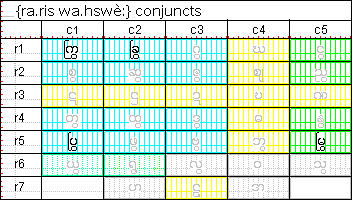
{ra.ric wa.hswè:} : Multi-medial formed with
{ra.} and
{wa.}
You can write either
{ra.ric. wa.hswè:} or
{wa.hswè: ra.ric.}, however the form I have given here
is that of MLC Myan-Ortho. For most of Bur-Myan speakers, there is
no difference in sound between
{ya.pín. wa.hswè:} and
{ra.ric wa.hswè:}.
Observation based on Myanmar Orthography, p. (01) to (36) of Index of mostly
monosyllabic words:
•
{ka.ra.ric wa.hswè:}
-- index p.(04) listed starting on main p.032 with
 {krwa.}
•
{hka.ra.ric wa.hswè:}
-- index p.(06) listed starting on main p.053 with
 {hkrwa.}
•
{pa.ra.ric wa.hswè:}
-- index p.(20) listed starting on main p.164 with
 {prwa.}
•
{ma.ra.ric wa.hswè:}
-- index p.(27) is listed starting on main p.212 with
 {mrwa}.
Contents of this page
One of the functions of {ha.hto:} is to impart an aspirate sound to a
akshara-consonant.
Observation based on Myanmar Orthography, p. (01) to (36) of Index of mostly
monosyllabic words:
 • {ma. ya.ping. ha.hto:} -- index p.(27) listed starting on main p.212 with
 {mhya.}
• {la. ya.ping. ha.hto:} -- index p.(32) listed starting on main p.249 with
 {lhya}. It is interesting to note that
 {lhya} is commonly pronounced as monosyllabic /ʃa/ for <tongue>, whereas
 {lhya:} is commonly pronounced as disyllabic /lə.jaː/.
• {tha. ya.ping. ha.hto:} -- index p.(35) listed starting on main p.269 with
{thhya:},
which is commonly pronounced as /ʃaː/.
UKT: Please note that I consider myself to be still a novice with IPA, and I
would still have to check my IPA transcriptions with my peers.
Contents of this page
Observation based on Myanmar Orthography, p. (01) to (36) of Index of mostly
monosyllabic words:

• {nga. ra.ris ha.hto:} -- index p.(08) listed starting on main p.062 with
 {nghraim:}, which has the same pronunciation as
 {Ñhaim:} even though this word is not in the vocabulary.
• {ma. ra.ris ha.hto:} -- index p.(27) listed starting on main p.213 with
 {mhra}
Contents of this page
Observation based on Myanmar Orthography, p. (01) to (36) of Index of mostly
monosyllabic words:

• {Ña. wa.hswè: ha.hto:} -- index p.(12) listed starting on main p.095 with {Ñhut}
• {na. wa.hswè: ha.hto:} -- index p.(17) listed starting on main p.139 with {nhwa}
• {ma. wa.hswè: ha.hto:} -- index p.(27) listed starting on main p.214 with {mhwé}
• {ra. wa.hswè: ha.hto:} -- index p.(30) listed starting on main p.234 with {rhwé}
pronounced as /ʃweɪ/
• {la. wa.hswè: ha.hto:} -- index p.(32) listed starting on main p.250 with {lhwa}
Contents of this page
Observation based on Myanmar Orthography: after the application of
{ya.pin.}, the 25
{wag.}-consonant aksharas drop down to just two,
 {kywa.} and
 {hkywa.}. These two just disappears when
{ha.hto:} is applied.
{hkywa.}. These two just disappears when
{ha.hto:} is applied.
• The
{ya.pin. wa.hswè: ha.hto:} is not found.
Contents of this page
•
{ma. ra.ric wa.hswè: ha.hto:} -- index p.(27) listed starting on main p.215 with
 {mhrwa}.
Observation based on Myanmar Orthography, p. (01) to (36) of
Index of mostly monosyllabic words, show that of the 25
{wag.}-consonant aksharas,
{ma.} is the most easy to produce. The following shows how the 25 consonants
drop down to 10 after the application of
{ra.ric}. Palatal-stops are the first row to drop out, followed by Dental-stops.
The most resilient are the Labial-stops.
Action of
{ra.ric},
{wa.hswè:},
{ha.hto:} on the 25
{wag.}-consonant aksharas
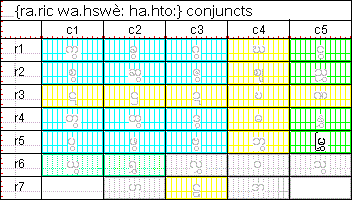
No wonder, a human baby learns to pronounce
{ma.}, and then proceeds to
 {ma} and
 {ma:}. See also:
-
https://en.wikipedia.org/wiki/Phonological_development 201005
"The production of vowel sounds (already in the first 2 months) precedes
the production of consonants, with the first back consonants (e.g., [g],
[k]) being produced around 2–3 months, and front consonants (e.g., [m], [n],
[p]) starting to appear around 6 months of age."
Contents of this page
UKT 200927
"The glides, /j/ and /w/, and the liquids (/ɻ/
and /l/) in American English
can be grouped together in a larger category called the approximants.
This name comes from the fact that the articulators are brought into closer
contact, or approximation, than in any of the vowels. However, the
constriction is less than for the obstruents (fricatives and plosives)."
See the
full article, The Approximants, in Structure of Spoken Language
-
https://www.fon.hum.uva.nl/rob/.../tutordemos/SpectrogramReading/.../cse551.html
200928
UKT 200928: Unlike English /j/ and /w/, Bur-Myan
{ya.} and
{wa.} are simply monosyllabic - they don't "glide". It is because of their
inherent vowel /a/ . Similarly
{ra.} and
{la.}, corresponding to /ɻ/
and /l/ , are not "liquids".
From: https://en.wikipedia.org/wiki/Approximant_consonant 200927
Approximants are speech sounds that involve the articulators
approaching each other but not narrowly enough
[1] nor with enough articulatory precision
[2] to create
turbulent airflow. Therefore, approximants fall between
fricatives, which do produce a turbulent air-stream, and vowels, which
produce no turbulence.
[3] This class is composed of sounds like
[ɹ] (as in rest) and
semivowels like
[j] and
[w] (as in yes and west, respectively), as well as
lateral approximants like
[l] (as in less).
[3]
Go back approximants-note-b
Contents of this page
UKT 200929:
The following is based on The Unicode Standard,
Version 4.0, Chapter 09, Unicode Consortium,
http://www.unicode.org/versions/Unicode4.0.0/ch09.pdf
The Indic scripts are noted for a large number
of consonant conjunct forms that serve
as orthographic abbreviations (ligatures)
of two or more adjacent letterforms. This abbreviation takes place only in the
context of a consonant cluster.
An orthographic consonant cluster is defined as
a sequence of characters that represents one or more dead consonants
(denoted Cd ) followed by a normal, live consonant letter
(denoted Cl ).
UKT: Caution: If you are comparing Devanagari to Myanmar script, you
can be easily led astray by this section.
Under normal circumstances, a consonant cluster
is depicted with a conjunct glyph if such a glyph is available in the current font(s).
In the absence of a conjunct glyph, the one or more dead consonants that form part of the cluster
are depicted using half-form glyphs. In the absence of half-form glyphs, the
dead consonants are depicted using the nominal consonant forms combined with
visible virama signs (see Figure 9-3).
Go back conso-conj-b
Contents of this page
End of TIL file
