 The geologic time scale is used by
geologists and other scientists to map the
timing and relationships between events* that
have occurred during the history of the
Earth.
The geologic time scale is used by
geologists and other scientists to map the
timing and relationships between events* that
have occurred during the history of the
Earth.timescale.htm
Collection downloaded and edited by U Kyaw Tun (UKT)
(M.S., I.P.S.T., USA), and staff of Tun Institute
of Learning (TIL) . Not for sale.
No copyright. Free for everyone.
Prepared for students and
staff of TIL Research Station,
Yangon, MYANMAR
-
http://www.tuninst.net ,
www.romabama.blogspot.com
index.htm | |Top
earth-indx.htm
Geologic time scale (GTS)
and Geomagnetic Polarity Time Scale
(GPTS)
Terminology
Age terms : there are two systems - based on stratigraphy, and on climate
change
Size of fossils of Fauna and Flora
UKT 190512: Geologic time scale was presented as a separate file as a part of the geol-indx page beginning from 180303. A year later, when I realized that Geologic time scale is also used for Geography and other Earth Sciences, I've again moved it.
This time to this earth-indx > timescale.htm .
How ignorant I was for being confined only to one branch of physical science - Chemistry .
UKT 180303: Without a time scale, it is impossible to put ourselves in perspective. In a way Geology is an history of the Earth from the days when the Earth was a molten mass to the present - the Earth that we are living on. Just as any other history we need a time scale. The geologic time scale (GTS) is a system of chronological dating that relates geological strata - stratigraphy - to time.
stra·tig·ra·phy - n. 1. The study of rock strata, especially the distribution, deposition, and age of sedimentary rocks. -- AHTD
To educate myself I have made the following
collection:
¤ Wikipedia -
https://en.wikipedia.org/wiki/Geologic_time_scale
180215
¤ New World Encyclopedia -
http://www.newworldencyclopedia.org/entry/Geologic_time_scale
180302
¤ Proceedings of the National Academy of Sciences
of the United States of America (PNAS),
-
http://www.pnas.org/content/106/1/24 180302.
¤ The geologic time scale -
http://scienceviews.com/dinosaurs/geologictime.html 190514
See downloaded papers in TIL HD-MHT and SD-MHT libraries
¤
The Geologic Time Scale - ScienceViews, download 190514
-
The Geologic Time Scale<Ô> / Bkp<Ô> (link chk 190514)
¤ Two-phase increase in the maximum size of life over 3.5 billion years reflects
biological innovation and environmental opportunity - Jonathan L. Paynea, Alison
G. Boyerb, James H. Brown, Seth Finnegan, Michał Kowalewski, Richard A. Krause,
Jr., S. Kathleen Lyons, Craig R. McClain, Daniel W. McShea, Philip M.
Novack-Gottshall, Felisa A. Smith, Jennifer A. Stempien, and Steve C. Wang - ed.
James W. Valentine, Univ. of California, Berkeley, CA., 2008
-
JLPayneEtAl-TwoPhaseIncreaseMaxSize<Ô> /
Bkp<Ô> (link chk 190520)
As a newcomer into the field, I have to take
extra care to come up with reliable information,
taking care to scrutinize what I have collected
as a Skeptical Chemist remembering the idol
of my days as wide-eyed university student
some 65 years ago.
-
https://en.wikipedia.org/wiki/The_Sceptical_Chymist
180303
From Wikipedia: https://en.wikipedia.org/wiki/Geologic_time_scale 180211
The geologic time scale (GTS) is a system of chronological dating that relates geological strata (stratigraphy) to time. It is used by geologists, paleontologists, and other Earth scientists to describe the timing and relationships of events that have occurred during Earth's history. The tables of geologic time spans, presented here, agree with the nomenclature, dates and standard color codes set forth by the International Commission on Stratigraphy (ICS).
UKT 190404: Myanmarpré is a part of Asia. However, my motherland and the continent of Asia have never been the same throughout geological time stretching for about 4 billion years. To appreciate the changes, see downloaded videos in the TIL HD-VIDEO and SD-VIDEO libraries, in the folder GEOLOGY:
- Geological History of the Earth<Ô> / Bkp<Ô> (link chk 190404)
- Geological History of the Earth Doc<Ô> / Bkp<Ô> (link chk 190404)
- A Brief History of Geologic Time<Ô> / Bkp<Ô> (link chk 190404)
From: http://www.newworldencyclopedia.org/entry/Geologic_time_scale 180302
The geologic time scale is used by
geologists and other scientists to map the
timing and relationships between events* that
have occurred during the history of the
Earth.
* UKT 190520: By "events" is meant as those on life-forms primarily those that depend on oxygen metabolism. Now that it is known that there are also life-forms that do not metabolize O2 - most being poisoned by O3 - the geologic time scale has to be extended to the earliest events concerning Life and life-forms such as Archean Eon.
" Instead of being based on stratigraphy, the beginning and end of the Archean Eon are defined chronometrically. The eon's lower boundary or starting point of 4 x10^9 yr ago is officially recognized by the International Commission on Stratigraphy. -- https://en.wikipedia.org/wiki/Archean 190520
" Archaea constitute a domain of single-celled microorganisms. ... Archaeal cells have unique properties separating them from the other two domains of life, Bacteria and Eukarya." -- https://en.wikipedia.org/wiki/Archaea 190520
Based on radiometric dating techniques, the Earth is estimated to be about 4.5 Ga (billion), 4.5 x 10^9 yr, or 4,570 Ma (million) years old. [UKT¶]
UKT 180304: Abbreviations used to express the number of years, such as bya and mya, can be confusing. At present the trend is to use the SI units (Système International d'Unités)
UKT 180521: I've been using SI units since March and found it very useful. So far I've used Ga = 10^9 years, and Ma = 10^6 years. Now, beginning with phanerozoic.htm , I'll use Ka = 10^3 . I'll capitalize Ka to be in sync with Ga and Ma.
Refer to: https://www.crowcanyon.org/index.php/what-do-different-date-abbreviations-mean 180521
"ka (kilo annum, thousand years) signifies "thousand calendar years ago," and it is used most often in geological, paleontological, and archaeological reporting to assign a general date to events that occurred a very long time ago. For example, the entry of humans into the New World during the Pleistocene (Ice Age) is thought to have occurred by about 15,000 years ago, or 15 ka (which is equivalent to approximately 13,000 B.C)."
The geological time scale is a means of mapping the history of the earth. It combines estimates of the age of geological formations as provided by radiometric dating techniques with the direct evidence of sequences and events in the rock record as assembled by geologists. In this way the geologic or deep time of Earth's past can be organized into various units according to events that took place in each period. Different spans of time on the time scale are usually delimited by major geologic or paleontologic events, such as mass extinctions. For example, the boundary between the Cretaceous period and the Palaeogene period is defined by the extinction event that marked the demise of the dinosaurs and of many marine species.
Mass extinctions: At least five major and global mass extinction events have occurred during the past 542 million years in which there have been sufficient bones, shells, and other hard parts to produce a fossil record supporting a systematic study of extinction patterns. Given the lack of a precise definition of mass extinction, some authorities argue for as many as 20 mass extinctions.
- http://www.newworldencyclopedia.org/entry/Mass_extinction 180305Geomagnetic reversal is a change in a planet's magnetic field such that the positions of magnetic north and magnetic south are interchanged, while geographic north and geographic south remain the same. The Earth's field has alternated between periods of normal polarity, in which the predominant direction of the field was the same as the present direction, and reverse polarity, in which it was the opposite. These periods are called chrons. ...
The past record of geomagnetic reversals was first noticed by observing the magnetic stripe "anomalies" on the ocean floor. ... It has become especially useful to metamorphic and igneous geologists where index fossils are seldom available. ... Through analysis of seafloor magnetic anomalies and dating of reversal sequences on land, paleomagnetists have been developing a Geomagnetic Polarity Time Scale (GPTS). The current time scale contains 184 polarity intervals in the last 83 million years. [7] [8] ... Shortly after the first geomagnetic polarity time scales were produced, scientists began exploring the possibility that reversals could be linked to extinctions."
- https://en.wikipedia.org/wiki/Geomagnetic_reversal 180305
Eukaryote: is any organism whose cells have a cell nucleus and other organelles enclosed within membranes. Eukaryotes belong to the domain Eukaryota or Eukarya, and can be unicellular or multicellular organisms.
- https://en.wikipedia.org/wiki/Eukaryote 180305
See also prokaryote - https://en.wikipedia.org/wiki/Prokaryote 180305
"A prokaryote is a unicellular organism that lacks a membrane-bound nucleus, mitochondria, or any other membrane-bound organelle.[1]"Also: https://en.wikipedia.org/wiki/Cyanobacteria 180305
"Cyanobacteria aka Cyanophyta, are a phylum of bacteria that obtain their energy through photosynthesis, [4] and are the only photosynthetic prokaryotes able to produce oxygen. [5] The name "cyanobacteria" comes from the color of the bacteria. [6] [7] Cyanobacteria (which are prokaryotes) used to be called "blue-green algae"{sain:pra ré-Ñhi.}. They have been renamed 'cyanobacteria' in order to avoid the term "algae"
{ré-Ñhi.}, which in modern usage is restricted to eukaryotes. [8]
The earth history mapped on the geologic time
scale contrasts with that mapped by young-earth
creationists, which see the earth as only
thousands of years old. See Wikipedia:
https://en.wikipedia.org/wiki/Young_Earth_creationism 190518
"Young Earth creationism (YEC) is a form of
creationism which holds as a central
tenet that the Earth and its lifeforms were created in their present forms
by supernatural acts of a deity*
 {hpûn-hsín: rhin} 'creator' [Bur-Myan pronunciation is
 {hpûn-hsín: shin:] between
approximately 6,000 and 10,000 years ago.
[1]
[2]"
{hpûn-hsín: shin:] between
approximately 6,000 and 10,000 years ago.
[1]
[2]"
* UKT 190519: Because of the intrusion of Christianity into Myanmarpé, the Bur-Myan word
{Bu.ra:} is now misunderstood by the majority. The Christians want to portray their God (derived from Jewish YHVH) as non-dying, and hope to belittle Gautama Buddha because he eventually died and was cremated like any other human. So, the Christians interpreted their God as non-dying or Eternal God
{hta-wa.ra. Bu.ra:}, and leave the Buddhists calling their Gautama Buddha as
{boad~Da.} "meaning possessor of highest intelligence". The concept of Creator is Axiomatic just as the Geometric Point is: length x=0, breadth y=0, height z=0, mass m=0, and I've nothing to argue against it.
From: Geologic Time Scale: Eons, Eras and Periods
- https://www.thoughtco.com/geologic-time-scale-eons-eras-periods-1440796 190519
Geologic time spans are divided into units and subunits, the largest of which are eons. Eons are divided into eras, which are further divided into periods, epochs, and ages.
UKT 190519: My main interest is in Phenerozoic Eon and some in Proterozoic Eon. Note the ending -zoic meaning "life'.
The most recent geologic eon is the Phanerozoic Eon, which began about 5.40x10^6 yr ago (540 million). This eon is very distinct from the previous three: the Hadean Eon, Archean Eon, and Proterozoic Eon.
During the Cambrian period, the earliest part of the Phanerozoic Period, the first complex organisms appeared. Most of them were aquatic; the most famous examples are trilobites. These are small arthropods (creatures with exoskeletons) whose distinct fossils are still being discovered today.
During the Ordovician period, fish, cephalopods, and corals first appeared; over time, these creatures eventually evolved into amphibians and dinosaurs
From Wikipedia: https://en.wikipedia.org/wiki/Geologic_time_scale 180211
The primary defined divisions of time are eons, in sequence the Hadean eon, the Archean eon, the Proterozoic eon and the Phanerozoic eon. The first three of these can be referred to collectively as the Precambrian supereon. [UKT ¶]
Eons are divided into eras, which are in turn divided into periods, epochs and ages.
UKT 180211: As a newcomer, I got confused with terminologies. Because of this, I wouldn't drop the suffixes and would write:
- Precambrian Supereon instead of Precambrian
- Hadean Eon instead of Hadean .
The following four timelines show the geologic time scale. The first shows the entire time from the formation of the Earth to the present, but this gives little space for the most recent eon.

UKT 180211: Note the negative numbers in Millions of Years:
-4500 millions of years = 4500 Ma. aka Mya (Millions of Years Ago.). Note also that only one supereon, the Precambrian, is defined.UKT 180307: Though the above pix shows the Hadean Eon and Archean Eon without subdivisions of periods, there are speculated to have subdivision: See: TIL Hadeon Eon (4.6x10^9 to 4.0x10^9 ago) - hadeon.htm (link chk 180307)
• Pre-Nectarian, (4,533 to about 3,920 Ma ago. [4.533x10^9 to ...])
• Nectarian (3,920 Ma to 3,850 Ma ago)UKT 180312: I sometimes get mixed up using "billions".
See Wikipedia: - https://en.wikipedia.org/wiki/Billion 180312
"A billion is a number with two distinct definitions:
• 1,000,000,000, i.e. one thousand million, or 109 (ten to the ninth power [1x10^9]), as defined on the short scale. This is now generally the meaning in both British and American English. [1] [2]
• 1,000,000,000,000, i.e. one million million, or 1012 (ten to the twelfth power [ 1x10^12), as defined on the long scale. This is one thousand times larger than the short scale billion, and equivalent to the short scale trillion.
The second timeline shows an expanded view of the most recent eon. [UKT ¶]

In a similar way, the most recent era is expanded in the third timeline,

Finally, the most recent period is expanded in the fourth timeline.

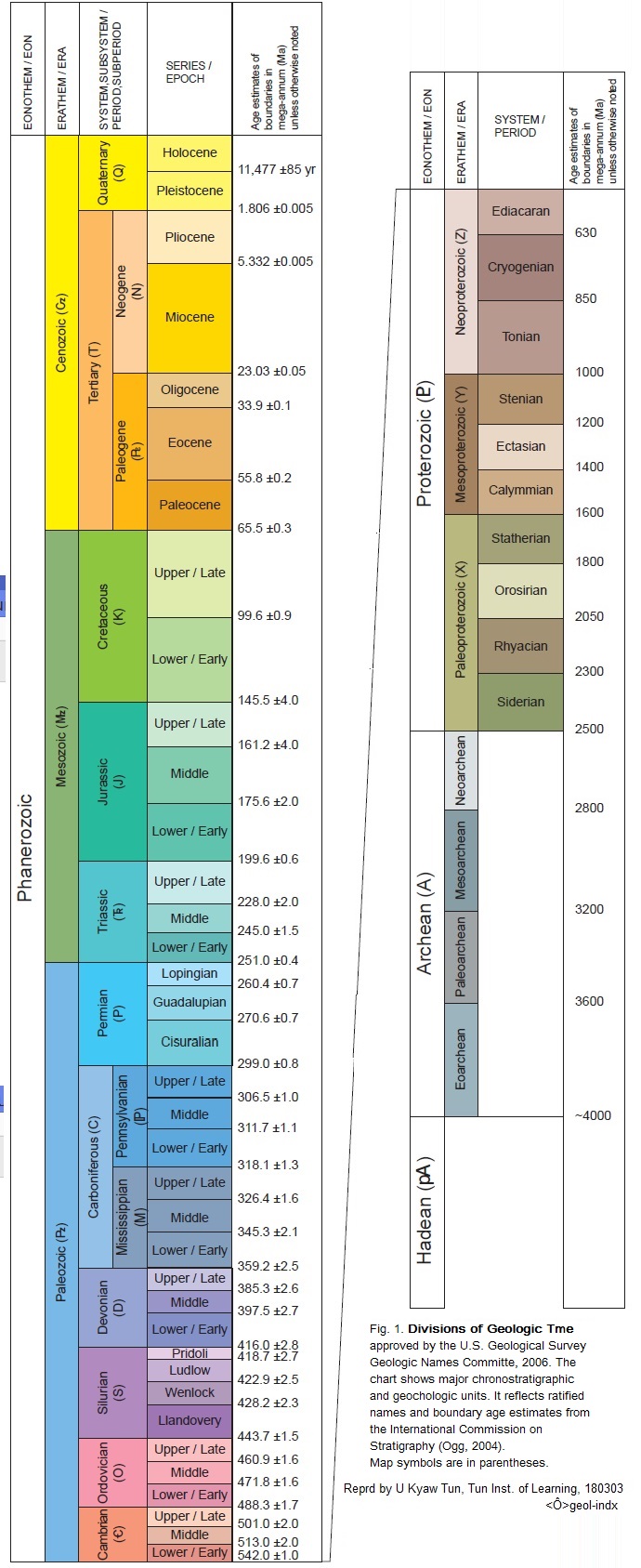
UKT 180303: The most recent period, Quaternary Period, needs to be presented in more detail for which I rely on:
U.S. Department of the Interior, U.S. Geological Survey, Fact Sheet 2007–3015, March 2007, prepared by U.S. Geological Survey Geologic Names Committee, with Randall C. Orndorff as chair. See downloaded paper in TIL HD-PDF and SD-PDF
- RCOrndoffEtAl-USGeolSurvey2006<Ô> / Bkp<Ô> (link chk 180303)UKT 190516: Quaternary Period, is made up of Pleistocene Epoch and Holocene Epoch . Recently, a new epoch has been proposed to depict the effects of prehumans and humans as Anthropocene Epoch .
See downloaded Wikipedia article in TIL HD-MHT and SD-MHT libraries:
- Anthropocene<Ô> / Bkp<Ô> (link chk 190516)
"The Anthropocene is a proposed epoch dating from the commencement of significant human impact on the Earth's geology and ecosystems, \ including, but not limited to, anthropogenic climate change. [1] [2] [3] [4] [5] "
Introduction. -- Effective communication in the geosciences requires consistent uses of stratigraphic nomenclature, especially divisions of geologic time. A geologic time scale is composed of standard stratigraphic divisions based on rock sequences and calibrated in years (Harland and others, 1982). Over the years, the development of new dating methods and refinement of previous ones have stimulated revisions to geologic time scales.
Since the mid-1990s, geologists from the U.S. Geological Survey (USGS), State geological surveys, academia, and other organizations have sought a consistent time scale to be used in communicating ages of geologic units in the United States. Many international debates have occurred over names and boundaries of units, and various time scales have been used by the geoscience community.
See pix on the right :
Remember, there are two sets of terms : based on stratigraphy, and on climate change. I'll use:
- Eon > Era > Period > Epoch > Age > Chron
The age of a stratigraphic unit or the time of a
geologic event may be expressed in years before
present (before A.D. 1950). The “North American
Stratigraphic Code” (North American Commission
on Stratigraphic Nomenclature, 2005) recommends
abbreviations for ages in SI (International System
of Units) prefixes coupled with “a” for annum:
- ka for kilo-annum, 10^3 = 103 years
[UKT: For the sake of uniformity, I'll
capitalize to Ka.
Secondly, because superscripts can easily
be lost, I'll use
10^3 instead of 103 ]
- Ma for mega-annum, 10^6 years
- Ga for giga-annum, 10^9 years. [UKT ¶]
Duration of time should be expressed in millions of years (m.y.). For example, deposition began at 85 Ma and continued for 2 m.y.
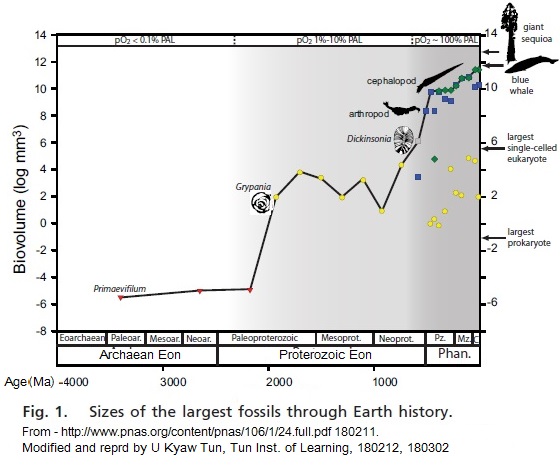
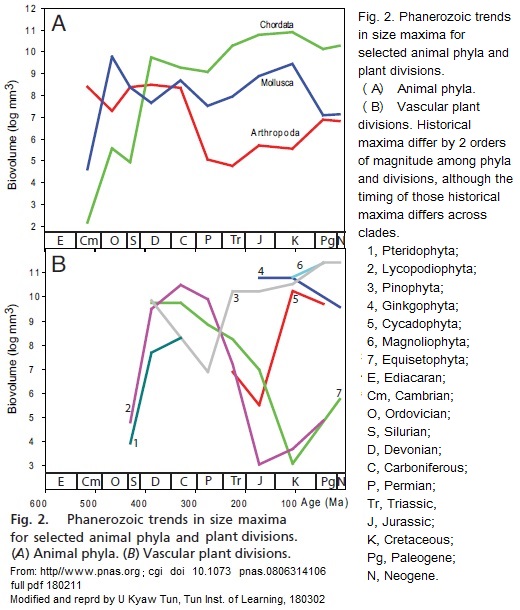
From: Two-phase increase in the maximum size of life over 3.5 billion years reflects biological innovation and environmental opportunity, by Jonathan L. Payne, Alison G. Boyer, James H. Brown, Seth Finnegan, Michał Kowalewski, Richard A. Krause, Jr., S. Kathleen Lyonse, Craig R. McClainf, Daniel W. McSheag, Philip M. Novack-Gottshallh, Felisa A. Smithb, Jennifer A. Stempien, and Steve C. Wang, in PNAS, January 6, 2009, vol.106, no.1, 24-27. Proceedings of the National Academy of Sciences of the United States of America (PNAS), - http://www.pnas.org/content/106/1/24 180302.
See downloaded papers in TIL HD-PDF and SD-PDF libraries
- JLPayneEtAl-TwoPhaseIncreaseMaxSize<Ô> / Bkp<Ô> (link chk 180302)
UKT 180212: Geologic time scale is divided into Supereons, Eons, Eras, Periods, etc. depending on the size of the fossils.
Fig. 1. (See below) Sizes of the largest fossils through Earth history. Size maxima are illustrated separately for single-celled eukaryotes, animals, and vascular plants for the Ediacaran [Period] and Phanerozoic [Eon]. The solid line denotes the trend in the overall maximum for all of life. Increases in the overall maximum occurred in discrete steps approximately corresponding to increases in atmospheric oxygen levels in the mid-Paleoproterozoic and Ediacaran–Cambrian–early Ordovician. Sizes of the largest fossil prokaryotes were not compiled past 1.9 Gya. Estimates of oxygen levels from Canfield (38) and Holland (37) are expressed in percentage of PAL. Phan., Phanerozoic; Pz., Paleozoic; Mz., Mesozoic; C, Cenozoic. Red triangles, prokaryotes; yellow circles, protists; blue squares, animals; green diamonds, vascular plants; gray square, Vendobiont (probable multicellular eukaryote).
UKT 180212: One of the authors of the above, Michał Kowalewski
( http://www.deepseanews.com/2011/05/on-the-reasons-why-we-need-a-new-supereon/ 180212) wrote:
"The largest unit of defined geologic time is the supereon. Only one is defined, the Precambrian spanning from the formation of the Earth to right before life goes crazy in the Cambrian explosion (4.6 Bya (billion years ago) to 542 Mya (million years ago). Oddly, there is no other supereon after the Precambrian, just the Phanerozoic eon ranging from the Cambrian explosion to the present. [UKT ¶]The Precambrian can be broken into three eons, Hadean, Acrhaean, and Proterozoic. Life as cyanobacteria first appears in the fossil record 3.5 bya [ 3.5 Ga ago = 3.5x10^6] during the Acrhaean. Molecular estimates place life starting around 3.97 bya [3.97x10^6]."
Corresponding to eons, eras, periods, epochs and ages, the terms " eonothem", " erathem", " system", " series", " stage" are used to refer to the layers of rock that belong to these stretches of geologic time in Earth's history.
Geologists qualify these units as "early", "mid", and "late" when referring to time, and "lower", "middle", and "upper" when referring to the corresponding rocks. For example, the lower Jurassic Series in chronostratigraphy corresponds to the early Jurassic Epoch in geochronology. [2] The adjectives are capitalized when the subdivision is formally recognized, and lower case when not; thus "early Miocene" but "Early Jurassic."
From: http://www.newworldencyclopedia.org/entry/Geologic_time_scale 180302
In the geological time scale, the largest defined unit of time is the eon, which is further divided successively into eras, periods, epochs, and stages. Overlaid on this general pattern developed by geologists is a complementary mapping by paleontologists who have defined a system of faunal stages of varying lengths, based on changes in the observed fossil assemblages. In many cases, such faunal stages have been adopted in building the geologic nomenclature, though in general there are far more recognized faunal stages than defined geologic time units.
Geologists tend to talk in terms of Upper/Late, Lower/Early, and Middle parts of periods and other units -- for example, "Upper Jurassic", "Middle Cambrian". Because geologic units occurring at the same time but from different parts of the world can often look different and contain different fossils, there are many examples where the same period was historically given different names in different locales. For example, in North America the Early Cambrian is referred to as the Waucoban series, which is then subdivided into zones based on trilobites. The same time span is split into Tommotian, Atdabanian, and Botomian stages in East Asia and Siberia. It is a key aspect of the work of the International Commission on stratigraphy to reconcile this conflicting terminology and define universal horizons that can be used around the world.
 A chronozone or chron is a slice of
time that begins at a given identifiable
event and ends at another. Such tracer events are
usually keyed to the disappearance (extinction) of
fossils of a widely distributed and rapidly changing
species or the appearance of such a species in the
geological record. Researchers use chronozones
or chrons especially frequently in the various
disciplines related to geology, notably in
stratigraphy where they contribute to
relative dating.
A chronozone or chron is a slice of
time that begins at a given identifiable
event and ends at another. Such tracer events are
usually keyed to the disappearance (extinction) of
fossils of a widely distributed and rapidly changing
species or the appearance of such a species in the
geological record. Researchers use chronozones
or chrons especially frequently in the various
disciplines related to geology, notably in
stratigraphy where they contribute to
relative dating.
Events susceptible to identification and analysis by the physical sciences (such as Earth's magnetic-field reversals or the location of a combination of chemical evidence in a layer corresponding to the meteor strike believed to have caused the extinction of the dinosaurs) can also help define chronozones. Hence chronozones, and the international identification and acceptance of widespread chronozones as official useful markers or benchmarks of time in the rock record, are non-hierarchical in that chronozones do not need to correspond across geographic or geologic boundaries, nor be equal in length (despite an early constraint that one be defined as smaller than a geological stage [2]). A chronozone is usually defined in geologic terms for a geographical area by fossil names (biozone or biochronozone) or in worldwide terms by geomagnetic-reversal identifiers (polarity chronozone).
According to the International Commission on Stratigraphy, the term "chronozone" refers to the rocks formed during a particular time period, while "chron" refers to that time period.[3] The key factor in designating an internationally acceptable chronozone is whether the overall fossil column is clear, unambiguous, and widespread. Some accepted chronozones contain others, and certain larger chronozones have been designated which span whole defined geological time units, both large and small.
For example, the chronozone known as "the reign of Tiberius" (14 to 37 AD) would be a subset of the chronozone "Imperial Rome". Similarly the chronozone Pliocene is a subset of the chronozone Neogene, and the chronozone Pleistocene is a subset of the chronozone Quaternary.
End of TIL file


