
Update: 2020-09-13 07:47 PM -0400
RBM-intro3.htm.htm
by U Kyaw Tun (UKT) (M.S., I.P.S.T., USA), and staff
of Tun Institute of Learning (TIL). Not for
sale. No copyright. Free for everyone. Prepared
for students and staff of TIL Research
Station, Yangon, MYANMAR
-
http://www.tuninst.net ,
www.romabama.blogspot.com
index.htm |
Top
RBM-typewriter-indx.htm
Speech vs. Writing
Language in Classical Indian Philosophy
Language and Meaning
Different views regarding sentence-meaning
Bhartṛhari
 {Bar~tRRi.ha.ri.}
भर्तृहरि
- the Brahmanical linguist who came about 1000 years
after Gautama Buddha
{Bar~tRRi.ha.ri.}
भर्तृहरि
- the Brahmanical linguist who came about 1000 years
after Gautama Buddha
Sphota Theory
 {Shpau:Ta.} स्फोट - linguistic
theory claimed by Brahman Poannars
{Shpau:Ta.} स्फोट - linguistic
theory claimed by Brahman Poannars

 {braah~ma.Na. poaN~Na:}
Advaita Vedânta
UKT notes
Tree of Knowledge is important to Abrahamic religions, Christianity, Islam, and
Judaism, in which the story of Adam, Eve, and the Tree of Knowledge is told. In
Buddhism there is Bodhi Tree - Ficus religiosa - under which Gautama
Buddha received Enlightenment or the Bodhi Knowledge

 {bau:Di. ñaaN}. The aks-to-aks
transform: बोधि = ब ो ध ि -->
{bau:Di.}. Note: Bodhi Knowledge is not Omniscience.
{bau:Di. ñaaN}. The aks-to-aks
transform: बोधि = ब ो ध ि -->
{bau:Di.}. Note: Bodhi Knowledge is not Omniscience.
See Wikipedia: - https://en.wikipedia.org/wiki/Gautama_Buddha 200906
"In the earliest Buddhist texts, the nikāyas and āgamas, the Buddha is not depicted as possessing omniscience (sabbaññu) [103] nor is he depicted as being an eternal transcendent (lokottara) being. According to Bhikkhu Analayo, ideas of the Buddha's omniscience (along with an increasing tendency to deify him and his biography) are found only later, in the Mahayana sutras and later Pali commentaries or texts such as the Mahāvastu. [103] In the Sandaka Sutta, the Buddha's disciple Ananda outlines an argument against the claims of teachers who say they are all knowing [104] while in the Tevijjavacchagotta Sutta the Buddha himself states that he has never made a claim to being omniscient, instead he claimed to have the "higher knowledges" ( abhijñā). [105]
For the Tree of Knowledge, read:
https://en.wikipedia.org/wiki/Tree_of_the_knowledge_of_good_and_evil
200902
and for the Bodhi Tree, read:
https://en.wikipedia.org/wiki/Bodhi_Tree 200902
The two trees are not the same: Tree of Knowledge
is hagiographical (never say "fictional"),
whereas Bodhi Tree is real: Ficus religiosa .
For Ficus religiosa , read:
https://en.wikipedia.org/wiki/Ficus_religiosa
200902
UKT 071115, 200711, 200825:
I now hold the view that Speech and Writing are
not separate. Writing or script is a form of
recording and playback of human speech. The
conventional way to view the two human endeavours
as separate is no longer tenable in the age of
computers. In a way humans are computers, and all
you need is to train them - all of them in a society,
if possible. Or, a fraction of them: to follow a
convention of corresponding speech articulations in
the human mouth to markings made on various mediums
, e.g. markings being made with a pencil on paper made of wood-fibres. In other
words teach the children Phonetics.
See
RBM-intro2.htm ,
and go to
Recording and
playback of Speech.
In the East -- Burma and India -- little boys just before being initiated into a religious order, have to learn from a "guru" or teacher to pronounce each syllable and write it out following strict rules. They are taught rules or grammars suitable for their age. In a way it is teaching Phonetics. I had the experience of going through the discipline at a vernacular school ran by lay-teachers: the principal U Hpo Hlaing in Kungyangoan.
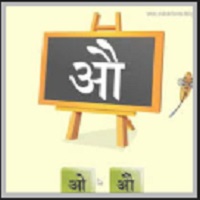 As little boys sitting on bare wooden floor made
of wooden boards, sitting cross-legged in front of
a large wooden black board -- we repeated after the
teacher holding a rattan cane which is frequently
used to chastise us who had not paid attention. We shouted at the top of our voices after
the teacher as he pointed akshara by akshara:
As little boys sitting on bare wooden floor made
of wooden boards, sitting cross-legged in front of
a large wooden black board -- we repeated after the
teacher holding a rattan cane which is frequently
used to chastise us who had not paid attention. We shouted at the top of our voices after
the teacher as he pointed akshara by akshara:
Ka-gyi, kha-gwé, ga-gnè, ...
Inset shows a small wooden blackboard with the Devanagari akshara औ «au».
I can imagine little Indian boys of the same age going through the same discipline, which lasted thousands of years before foreigners had come to "educate" us.
There are also monastic schools ran by monks and nuns. One such monastic school was Gya-kyaún. It was this monastic school system that the British colonialists had set out destroy both in India and Burma. Their aim was to destroy Hinduism and Buddhism, and their nationalistic attitude and be subservient to the Christian British Raj.
See English Education Act 1835
- https://en.wikipedia.org/wiki/English_Education_Act_1835 200825.
"In discussions leading up to the Act, Thomas Babington Macaulay produced his famous Memorandum on (Indian) Education which was scathing on the inferiority (as he saw it) of native (particularly Hindu) culture and learning. He argued that Western learning was superior, and currently could only be taught through the medium of English. There was therefore a need to produce — by English-language higher education — "a class of persons, Indian in blood and colour, but English in taste, in opinions, in morals and in intellect" who could in their turn develop the tools to transmit Western learning in the vernacular languages of India."
The spoken language aka speech is
 {sa.ka:}, and the written language aka
script is
{sa.ka:}, and the written language aka
script is
 {sa}.
Now which is important? This is a philosophical
question, which has linguistic implications. Here
are two essays one written by a philosopher and
the other by a linguist:
{sa}.
Now which is important? This is a philosophical
question, which has linguistic implications. Here
are two essays one written by a philosopher and
the other by a linguist:
• "Speech Versus Writing" in Derrida and Bhartṛhari
by Harold G. Coward, in Philosophy East and West, Vol. 41, No. 2 (1991), pp.141-162, Univ. of Hawaii Press.
- http://ccbs.ntu.edu.tw/FULLTEXT/JR-PHIL/ew95321.htm 071115, 200711
See Section 4 on LANGUAGE AND THOUGHT - lang-thot-indx.htm (link chk 200906)• The Dogma of the Priority of Speech in Language Teaching
by Vivian Cook draft as of March 2001, University of Essex, United Kingdom
See Romabama Collection - RBM-collect-indx.htm
> The Dogma of the Priority of Speech in Language Teaching - VCook-dogma.htm - (link chk 200826)
I now have two more sources to extend what I've written on Language and Thought :
1. Language and Testimony in Classical Indian Philosophy
(Language-CIP),
Stanford Encyclopaedia of Philosophy, 1st
pub 2010, rev
2020
Downloaded txt in TIL HD-nonPDF and SD-nonPDF libraries (web archive
sect.)
-
LanguageClassicIndianPhilo<Ô> /
Bkp<Ô> (200906)
2. Internet Encyclopaedia of Philosophy (IEP) -
https://iep.utm.edu/bhartrihari/#H4 200901
Downloaded txt in TIL HD-non-PDF and SD-non-PDF libraries, web archive section:
-
Bhartrihari-InternetEncycloPhilo<Ô> /
Bkp<Ô> 200905
3. The Budddha's Philosophy of Language, by David J. Kalupahana,
1999,
Downloaded txt in TIL HD-PDF and SD-PDF libraries:
-
DJKalupahana-BuddhaPhiloLanguage<Ô> /
bkp<Ô>
(link chk 200826)
4. Mahanidana Sutta, "Dependent arising (paṭiccasamuppāda)" by
Bhikkhu Bodhi, mentioned in Buddha's Philosophy of Language
Downloaded txt in TIL HD-PDF and SD-PDF libraries:
-
BikkhuBodhi-MahaNidanaSutta<Ô> /
bkp<Ô>
(link chk 200826)
- UKT 200209 :
The aim of Romabama

 {ro:ma.ba.ma} is just to function as a recording tool in Recording of Speech
in Script.
{ro:ma.ba.ma} is just to function as a recording tool in Recording of Speech
in Script.
Romabama is not concerned with what Language (both
Speech and Script) is, which is a philosophical
question, dealt in Section 4, LANGUAGE, MEANING,
RELIGION & THOUGHT .
- See Section 4 on LANGUAGE AND THOUGHT -
lang-thot-indx.htm (link chk 200906).
This section may be moved to Section 4 in later editions.
Language as a philosophical question is bound to involve speculations - which are not worth discussing among down-to-earth scientists like me. Yet out of curiosity, I want to know about the nature and function of language.
In India these speculations (on language) can be traced to its earliest period - the Védic Period of RigVéda. What language or languages the peoples of RigVédic spoke? To pin down to a specific language would be impossible, so we must be content to know to which language-group these languages belong.
We can assume that these languages would be very
simple -- just for communication. According to
Burmese tradition the simplest language is
the Magadha spoken language
 {ma-ga.Da. sa.ka:} - simple enough for even animals
to understand. That means there would be only
simple grammar, without inflexions, without gender,
without number and without tense. Instead of Tense,
Burmese makes use of Aspect and Mood to show Time.
{ma-ga.Da. sa.ka:} - simple enough for even animals
to understand. That means there would be only
simple grammar, without inflexions, without gender,
without number and without tense. Instead of Tense,
Burmese makes use of Aspect and Mood to show Time.
Bur-Myan uses grammatical Particles
 {pic~sæÑ:} extensively, and so does Vedic.
See A Vedic Grammar for Students, by A. A. Macdonell, 1916 in TIL HD-PDF
and SD-PDF libraries:
-
AAMacdonell-VedicGramm4Student<Ô> /
Bkp<Ô>
(link chk 200913)
"2. tyá is derived from tá with the suffix ya and means that . It is
common in the RV., but rare in the later Saṃhitās.¹ Unlike tá it is used
adjectivally only, hardly ever occurring without its substantive. It never
begins a sentence except when followed by the particles u, cid, nú, or sú. "
Bur-Myan is a simple language and the language-group
is Tib-Bur. So did RigVéda belong to Tibeto-Burman
language group before the Brahmin Poannars mess it
up? It was they who introduce other strata to Vedic
language. Yet we must thank them as a group for preserving a language for
thousands of years.
See Wikipedia:
https://en.wikipedia.org/wiki/Vedic_Sanskrit
200913
"According to Michael Witzel, five chronologically distinct strata can be
identified within the Vedic language
[15]
[16] : 1. Rigvedic, 2. Mantra language,
3. Samhita prose, 4. Brahmana prose, 5. Sutra
language."
Though we may not know to which language-group the
language of RigVeda belongs to - Tib-Bur or IE - we
know who the sages
 {ra.þé.} were from the words of Gautama Buddha.
UKT 170516, 200906: Some 10 rishis of the first layer of Vedic texts are held in respect by Gautama Buddha:
Vishvamitra
"In the Buddhist Vinaya Pitaka of the Mahavagga (I.245) [14] section the Buddha pays respect to these rishis by declaring that the Veda in its true form* wasbecameknowndeclaredto them (UKT: became due to the yogic practice - not by grace of any axiomatic god) "Atthako (either Ashtavakra or Atri), Vâmako, Vâmadevo, Vessâmitto (Visvamitra), Yamataggi, Angiras, Bhâradvâjo, Vâsettho (Vâshistha{wa-þéT~HTa.})**, Kassapo (Kashyapa), and Bhagu (Bhrigu) " [15] and because that true Veda was altered by some priests he refused to pay homage to the altered version. [16] . [equivalents of Pali to Skt names by Maurice Walshe (2005) translation of Digha Nikaya - see note in - https://en.wikipedia.org/wiki/Angiras_(sage) 170618 ]
Though RigVeda is counted among the Vedic scriptural texts (1500–500 BCE) consisting of the four ancient collections - the Ṛgveda, the Sāmaveda, the Yajurveda, and the Atharvaveda, RigVeda is assumed to the oldest.
UKT 020907: To which language group - Tib-Bur or IE - does RigVéda belong? Bur-Myan, a typical Tib-Bur language, has a very simple grammar. Bur-Mya is non-inflectional, is without tense and without number - the usual attributes of Grammar. To find the linguistic group to which Rig-Veda belongs, I'll have to look into its grammar. Am I knowledgeable enough for this task? Not exactly, let me try. See
- https://sreenivasaraos.com/tag/grammar-in-rig-veda/ 200907
"At the same time, Bhartrhari (a very late grammarian compared to RigVéda) also says ‘nahi sarvesham sataam shabdo abhidayakyaha (VP: 2.2.68) – ‘a word cannot always fully express the true nature of an object’ (say the god Agni). An object (Agni) is not fully expressed by the word (A-g-n-i) that denotes it. A word , according to him, is an indicator; has limited powers; and, what is intended is more powerful that the word itself.na ca sāmānyavat sarve kriyāśabdena lakṣitāḥ /
viśeṣā na hi sarveṣāṃ satāṃ śabdo+abhidhāyakaḥ "Whatever the case may be I must study RigVeda linguistically. See : indic-indx.htm > Accented Clitics in RigVeda.htm
Now back to the speculations (on language) are multi-faceted in that one detects many different strands of thought regarding language. Some of these speculations are about what one may call the principle of language, but others are about specific languages or specific uses of these languages.
One sees speculations regarding the creation of language as well as the role of
language in the creation of the universe. Once you see the word
creation, you at once think of a Creator which Theravada Buddhism
(based only on the Four Noble Truths, and Anatta Principle, (and Science) is not
concerned with about. So we should be using the term coming into being of the
universe -


 {sa.kra.wa.La hpric-pau-poän}. As Theravada Buddhists, we don't have to think of Creator, a god, or
goddess. For us, the nature of speculation becomes more realistic which may
ultimately be checked experimentally. So we should look into the communicative role
of language, and, the nature of meaning
{sa.kra.wa.La hpric-pau-poän}. As Theravada Buddhists, we don't have to think of Creator, a god, or
goddess. For us, the nature of speculation becomes more realistic which may
ultimately be checked experimentally. So we should look into the communicative role
of language, and, the nature of meaning
 {a.Daip~paèý} -- more
specifically the nature of word-meaning and sentence-meaning. Now
what is Meaning
{a.Daip~paèý}?
{a.Daip~paèý} -- more
specifically the nature of word-meaning and sentence-meaning. Now
what is Meaning
{a.Daip~paèý}?
Before proceeding to talk about Meaning
{a.Daip~paèý}, which in Sanskrit is
 {ar~hta.} अर्थ «artha», or in Pali
 {ût~hta.}, let's see the views of a famous linguist, Noam Chomsky, in the
following video which he delivered in 1989
{ût~hta.}, let's see the views of a famous linguist, Noam Chomsky, in the
following video which he delivered in 1989
-
https://www.youtube.com/watch?v=hdUbIlwHRkY 200911
UKT: Noam Chomsky
See indic-indx.htm >
Accented Clitics in RigVeda
(link chk 200913)
Mention of Noam Chomsky brings us to the topic of Linguistics. Lets watch a
video by video by Steven Pinker, a psychologist, who studies language to
understand how the brain works. He mentions and quotes Chomsky many times:
-
https://www.youtube.com/watch?v=Q-B_ONJIEcE 200912
UKT 200908:
This section is mainly based on Language and Testimony in Classical Indian Philosophy, Stanford Encyclopaedia of Philosophy.
From non-PDF web archive section:
- LanguageClassicIndianPhilo<Ô> / Bkp<Ô> (200906)
See also: https://en.wikipedia.org/wiki/Artha 200908
 The term Artha
{ar~hta.} अर्थ «artha», in Sanskrit
is used to denote the notion of meaning
{a.Daip~paèý}. However, the meaning of this
term ranges from a real object in the external world referred to by the
word to
a mere concept of an object which may or may not correspond to anything in the
external world. For us, Artha
{ar~hta.} अर्थ «artha» equal to meaning
{a.Daip~paèý} relating to real objects, which in Scientific sense has
Mass, dimensions of x, y, z (Space) and Time are important.
Our real objects are governed by Laws of Matter and Energy such as
Quantum Mechanics - not by Scriptures. Now lets look at Artha
{ar~hta.} अर्थ in Pali.
The term Artha
{ar~hta.} अर्थ «artha», in Sanskrit
is used to denote the notion of meaning
{a.Daip~paèý}. However, the meaning of this
term ranges from a real object in the external world referred to by the
word to
a mere concept of an object which may or may not correspond to anything in the
external world. For us, Artha
{ar~hta.} अर्थ «artha» equal to meaning
{a.Daip~paèý} relating to real objects, which in Scientific sense has
Mass, dimensions of x, y, z (Space) and Time are important.
Our real objects are governed by Laws of Matter and Energy such as
Quantum Mechanics - not by Scriptures. Now lets look at Artha
{ar~hta.} अर्थ in Pali.
UKT 200908: Aks-to-Aks transform of Skt-Dev to Pali-Myan gives:
Skt: अर्थ = अ र ् थ -->
By Repha Rule{ré:hpa. sæÑ:míñ:} of changing Skt-to-Pal becomes
{ûht~hta.}:
By Bur-Myan & Pal-Myan Rule of Virama
Pal: [
See meaning of
- "Meaning" in Pali - UKT from UTM
The differences regarding what meaning
{a.Daip~paèý} is are argued out by the philosophical
schools which flourished some 1000 years after the time of the Gautama Buddha
who I take to be a scientist in the modern sense. These later-day philosophical
schools are known as the Astika
 {aS~ti.ka.} आस्तिक
 {ût~ta.} view. Different from them are the Nastika
 {naaS~ti.ka.}
नास्तिक «nāstika»
(= न ा स ् त ि क
"heterodox" ) or God-negating schools.
{naaS~ti.ka.}
नास्तिक «nāstika»
(= न ा स ् त ि क
"heterodox" ) or God-negating schools.
Here, I must note that Theravada Buddhism according to the first few sermons has
nothing to do with God. It is just a way of life holding the Anatta
 {a.nût~ta.} view which stresses the "impermance" of all things including God
if there is one. In other words, Theravada Buddhism in early stages in
not Nastika
{naaS~ti.ka.}
- it is not a religion at all.
{a.nût~ta.} view which stresses the "impermance" of all things including God
if there is one. In other words, Theravada Buddhism in early stages in
not Nastika
{naaS~ti.ka.}
- it is not a religion at all.
Sanskrit poetics focused on the poetic dimensions of meaning, Sanskrit grammarians were more interested in language and communication than in ontology [metaphysics on nature of being], its communicative role, the nature of meaning, and more specifically the nature of word-meaning and sentence-meaning.
- UKT200910
See ; https://simple.wikipedia.org/wiki/Sentence 200910
See also Language and Testimony in Classical Indian Philosophy (IndPhilo), Stanford Encyclopaedia of Philosophy in non-PDF libraries, web archive section:
- LanguageClassicIndianPhilo<Ô> / Bkp<Ô> (200906)
And, also see what I've written in Section 3:
¤ English Grammar in Plain Language - EGPE-indx.htm , recent update 2019Oct - (link chk 200910)
A sentence is a group of words that are put together to mean something. A sentence is the basic unit of language which expresses a complete thought. It does this by following the grammatical basic rules of syntax. For example: 'Angela is the cutest girl in the class'.
A complete sentence has at least a subject and a main verb to state (declare) a complete thought. Short example: Walker walks. A subject , S, is the noun that is doing the main verb, V. A complete sentence may also have an object, O, on which the action is done. English is an SVO language, whereas Burmese can be either SVO or SOV. The word-order in Bur-Myan is simple because of its use of particles.
A particle is a word that has a grammatical function but does not fit into the main parts of speech (i.e. noun, verb, adverb). ... Particles appear frequently in the teaching of phrasal verbs, which can be grouped for teaching purposes by particle, e.g. 'off', 'on', 'out' etc. -- Google search 200910
The Brahmanical views of the Poannar or Brahmin the Atta-principle holders on language is different from that of Buddhists who are Anatta-principle holders. But first remember that Buddhists do not deny the existence of a Creator (aka God). Neither do we affirm the existence of the Creator-God. Anatta-principle holds that everything including God is non-permanent. Even the Christian God do age: he was portrayed as an old man in paintings, the most famous being the Creation of Adam.
Now, let's continue with the views of a Brahmanical linguist: Bhartṛhari,
{BaR~tRRi.ha.ri.} भर्तृहरि (= भ र ् त
ृ ह र ि ).
UKT 200901:
But first: who is Bhartṛhari ? He may or
may not be the originator of Sphota theory. Moreover
there can be more than one person with the name
Bhartṛhari,
{BaR~tRRi.ha.ri.} भर्तृहरि
.
We are concerned with the one who flourished
c. 5th century CE. There is almost a thousand
year difference between the time of Gautama Buddha
and Bhartṛhari.
The Buddhist scholars who had differed from
Bhartṛhari were probably Indians speaking
Sanskrit, and their views are not necessarily
the views of the Buddha who was a Tibeto-Burman.
The time-line in Burma is that of the Pyus
 {pyu} who
were advanced enough to produce a calendar using Metonic cycles. They were not Indians.
See Wikipedia articles:
{pyu} who
were advanced enough to produce a calendar using Metonic cycles. They were not Indians.
See Wikipedia articles:
1. -
https://en.wikipedia.org/wiki/Buddhist_calendar
170427
"Burmese system has followed a variation of
the Metonic cycle. It is unclear from where, when
or how the Metonic system was introduced."
2. -
https://en.wikipedia.org/wiki/Burmese_calendar 200911
"The calendar has been used continuously in various Burmese states since its
purported launch in 640 CE in the ... called the Pyu era. It was also
used as the official calendar in other mainland Southeast Asian kingdoms.
We do not really know what the present-day Burmese-Buddhist monks would think of the language.
See also in TIL HD-PDF and SD-PDF libraries:
-
Shodhganga-Bhartrhari Sphota<Ô> /
Bkp<Ô> (link chk 200828)
(p50) "Language has been one of the
fundamental concern of Indian Philosophical
tradition. In the history of Indian Philosophy
the study of Language has never been the
monopoly of Grammarians. All most all of the
schools or darsanas
 {daRR~sha.na.}
दर्शन, lit.
"view, sight"
(= द र ् श न) in Indian
Philosophy developed their own philosophy of Language
in order to defend their own metaphysics and
attack others."
{daRR~sha.na.}
दर्शन, lit.
"view, sight"
(= द र ् श न) in Indian
Philosophy developed their own philosophy of Language
in order to defend their own metaphysics and
attack others."
See Wikipedia: https://en.wikipedia.org/wiki/Dar%C5%9Bana 200903
"Darśana दर्शन
1. Nyaya : न्याय «nyā-yá» = न ् य ा य -->{n~ya-ya.}
2. Vaisheshika : वैशेषिक «vaiśeṣika» = व ै श े ष ि क -->{wè:shé-Si.ka.}
3. Samkhya : सांख्य «sāṃkhya» = स ा ं ख ् य -->{þaän-hkya.}
4. Yoga : योग «yoga» = य ो ग -->{yau:ga.}
5. Mīmāṃsā : मीमांसा «mīmāṃsā» = म ी म ा ं स ा -->{mi-maän-þa}
6. Vedanta : वेदान्त «vedānta» = व े द ा न ् त -->{wé-daan~ta.}
Buddhism and Jainism are examples of non-Hindu darśanas. [6]
(59) "The Brahrnanical tradition
{bRaah~ma.Na.}
stemming from the Vedas
 {wé-da.}, which held that language is divine
in origin, whereas the naturalistic traditions
of the Buddhism and Caroaka, which held that
language is an arbitrary * and conventional
tool. Some Darsanas like Jaina and Nyaya
{n~ya-ya.} न्याय
(= न ् य ा य) seem
to occupy an intermediary position between the
two traditions."
{wé-da.}, which held that language is divine
in origin, whereas the naturalistic traditions
of the Buddhism and Caroaka, which held that
language is an arbitrary * and conventional
tool. Some Darsanas like Jaina and Nyaya
{n~ya-ya.} न्याय
(= न ् य ा य) seem
to occupy an intermediary position between the
two traditions."
*UKT 200829: Did Gautama Buddha hold that language is arbitrary ? His rejection that God is responsible for everything including language and knowledge does not mean that he holds language to be arbitrary and conventional. In A Language of Discovery in the Budddha's Philosophy of Language by David J. Kalupahana, 1999, (see below), the Buddha has been stated to have said:
"These two conditions, monks, contribute to the confusion and disappearance of the genuine doctrine; which two?
An ill-placed terminology (dunnikkhittañ ca padavyañjanaṁ), and
a meaning ill-conveyed (attho ca dunnito).
When the terminology is ill-placed, the meaning is also not appropriately conveyed. "
From - https://en.wikipedia.org/wiki/Bhart%E1%B9%9Bhari 200826
" Bhartṛhari
{BaR~tRRi.ha.ri.}
भर्तृहरि
also romanised as Bhartrihari; fl. c.
5th century CE, is a Sanskrit writer to whom are
normally ascribed two influential Sanskrit texts:

• the Vakyapadiya
{wa-kya.pa.di-ya.} वाक्यपदीय «vākyapadīya», on Sanskrit grammar and linguistic philosophy, a foundational text in the Indian grammatical tradition, explaining numerous theories on the word
{waad} and on the sentence
{wa-kya.}, including theories which came to be known under the name of Sphoṭa
• the Śatakatraya, शतकत्रय a work of Sanskrit poetry, comprising three collections of about 100 stanzas each; it may or may not be by the same author who composed the two mentioned grammatical works.
"The Śatakatraya शतकत्रय = श त क त ् र य , "the three «śataka»", also known in Southern India sometimes as सुभाषित त्रिशति «subhāṣita triśati» , "the three hundred poems of moral values") refers to three Indian collections of Sanskrit poetry, containing a hundred verses each. The three śatakas, or "centuries", are known as the Nītiśataka , Śṛṅgāraśataka, and Vairāgyaśataka, and are attributed to Bhartṛhari. [1]"
- https://en.wikipedia.org/wiki/%C5%9Aatakatraya 200905
"In the medieval tradition of Indian scholarship, it was assumed that both texts were written by the same person. [citation needed] Modern philologists were sceptical of this claim, owing to an argument that dated the grammar to a date subsequent to the poetry. [citation needed] Since the 1990s, however, scholars have agreed that both works may indeed have been contemporary, in which case it is plausible that there was only one Bhartrihari who wrote both texts. [citation needed]
"Both the grammar and the poetic works had an enormous influence in their respective fields. The grammar in particular, takes a holistic view of language, countering the compositionality position of the Mimamsakas and others.
"According to Aithihyamala, he is also credited with some other texts like Harikītika and Amarushathaka.
"The poetry constitute short verses,
collected into three centuries of about a
hundred poems each. Each century deals with
a different
rasa
 {ra.þa.} «रस» or aesthetic mood; on the whole his
poetic work has been very highly regarded both
within the tradition and by modern scholarship.
{ra.þa.} «रस» or aesthetic mood; on the whole his
poetic work has been very highly regarded both
within the tradition and by modern scholarship.
"The name Bhartrihari is also sometimes associated with Bhartrihari traya Shataka, the legendary king of Ujjaini in the 1st century
UKT 200903: You should also watch a video by
- https://www.youtube.com/watch?v=7EKzR9IdixI 200903
A lecture on Theory of Sphota, Sound (Dhavani), and Vakyakanda, by Dr. Mrinmoy Pramanick, Calcutta Univ.UKT 200904: There are some questions regarding Sphota theory
1. What exactly is Sphota ?
2. Did the idea of Sphota originated with the Brahman Poannars
3. If the answer to question #2 is yes, who started using the word Sphota or a similar word? It is Panini, or Bhartrihari?
- UKT 200903
From Internet Encyclopaedia of Philosophy (IEP) - https://iep.utm.edu/bhartrihari/#H4 200901
Downloaded txt in TIL HD-non-PDF and SD-non-PDF libraries, web archive section:
- Bhartrihari-InternetEncycloPhilo<Ô> / Bkp<Ô> 200905
(IEP begins Sect. 5 )
Sect. 5. Bhartrihari’s theory occupies an interesting place in the ongoing
Hindu-Buddhist debates about meaning and reference. [UKT ¶]
UKT 200901: Who were the Buddhists who participated in the Hindu-Buddhist debates? They were, surely latter-day Indian Buddhists who loved debates. Gautama Buddha did have discussions - not amounting to debates - with the Brahmans in his own days. As an example, see: PiyaTan-AssalayanaSutta<Ô> / Bkp<Ô> (link chk 200903)
"SUTTA SUMMARY. A brahmin youth approaches the Buddha claiming that the brahmins are the highest class. The Buddha replies by showing in many ways how this could not be possible. For example, the brahmins are born from women, not from the Brahma‘s mouth (as they claim), and how can they be sure that their line is pure — that any of their ancestors, man or woman, have never coupled with a non-brahmin?"
(IEP cont )
For the Buddhists,
meaning is a function of social and linguistic convention
and
reference is ultimately a projection of imaginative
consciousness. [UKT ¶]
For the Brahminic Nyâyas or Logicians, words
{waad} have meaning because they refer to
external objects; words can be combined in sentences
{wa-kya.} just like things exist in
relation to one another in external reality. [UKT ¶]
UKT 200902: Who are the Brahminic Nyâyas or Logicians? The following is my stub culled from Internet Encyclopaedia of Philosophy:
" Nyāya (literally “rule or method of reasoning”)*,Epistemologically *, Nyāya develops of a sophisticated precursor to contemporary reliabilism (particularly process reliabilism), centered on the notion of “knowledge-sources” Pramana
{pRa.ma-Na.} प्रमाण «pramāṇa», and a conception of epistemic responsibility which allows for default, unreflective justification accorded to putatively veridical cognition."
UKT 200902: I derived the equivalent of Nyāya (literally “rule or method of reasoning”), न्याय «nyā-yá» to Bur-Myan as:
न्याय = न ् य ा य -->
Taking note of the "absence" of r1c5, r2c5, and r3c5} - the Doggie's Tale", I went further:
-->{nya-ya.} -->
{nya-Na.} -->
{nyaaN} "intelligence" /
"in-born trait"
A logical system depends on its fundamental premise . If you begin with the premise that "God is the source of all knowledge - an axiom", then all your logical conclusions are all axioms. They cannot arrive at Truth .* e·pis·te·mol·o·gy - n. 1. The branch of philosophy that studies the nature of knowledge, its presuppositions and foundations, and its extent and validity. - AHTD
(IEP cont )
With Advaita Vedânta, words mask
the meaning of the Absolute Self «ātman»
 {aat~män} which is Brahman, so
that, when a person predicates categories to their identity such as in the
sentence “I am tall,” this predication masks the all-inclusive nature of the
eternal Self, which is beyond categorization. [UKT ¶]
{aat~män} which is Brahman, so
that, when a person predicates categories to their identity such as in the
sentence “I am tall,” this predication masks the all-inclusive nature of the
eternal Self, which is beyond categorization. [UKT ¶]
UKT 200906: aks-to-aks transcription:
«ātman» आत्मन् = आ त ् म न ् -->-->
-->
For Vedanta, see The Wisdom of Vedanta - an introduction to the philosophy of non-dualism, by Swami AbhayaNanda, 1991 in TIL HD-PDF and SD-PDF libraries:
- SwamiAbhyaNanda-Vedanta<Ô> / Bkp<Ô> (link chk 200903)
p16. "Shankaracharya* lived sometime between the 7th and 9th centuries, during a time when Vedanta had become almost forgotten and nearly supplanted throughout the Indian landscape by Buddhism. ... ... It was Shankara who brought, through his single-handed efforts, a return to the unitive philosophy of the Upanishads and a reawakening of the Indian spirit to its long-established heritage of spiritual wisdom."* Shankaracharya is a compound word of

(शङ्कराचार्य) «shankara acharya» = श ङ ् क र ा च ा र ् य . He is well-known as Adi Shankara. Go online and watch
without subtitles - https://www.youtube.com/watch?v=aiwaoWcGtx8 200906
with English subtitles - https://www.youtube.com/watch?v=VSrUv2WLlzE 200907UKT 200903: It is generally believed that the end of Buddhism in mainland India was brought about by Muslims. It was actually Shankara - the Hindu reformer who brought about the destruction of Buddhism. The Muslims delivered the coup de grace .
(IEP cont )
Bhartrihari puts forth a theory of
language which, rather than starting by taking fundamental ontological,
epistemological or social sides in these well-established debates, starts from
the question of how meaning happens, how it emerges from the acts of both
speaker and audience [hearer], and, constructing this theory first, what he believes to
be appropriate metaphysical, epistemological and soteriological implications are
drawn from it.
For Bhartrihari, linguistic meaning cannot be conveyed or accounted for by the physical utterance and perception of sounds, so he puts forth the sphota theory: the theory which posits the meaning-unit, which for him is the sentence [consisting a single syllable or a string of syllables] , as a single entity. [UKT ¶]
The term “sphota” dates back to Pânini’s
 {pa-Ni.ni.}
reference to “sphotâyana” in his treatise Ashtâdhyâyî, [UKT ¶]
{pa-Ni.ni.}
reference to “sphotâyana” in his treatise Ashtâdhyâyî, [UKT ¶]
however
it was Patanjali
 {pa.tíñ~za.li.} पतञ्जलि «patañjali» who explicitly discusses sphota in his Mahâbhâshya
 {ma.ha-BaaS~ya.} महाभाष्य
(= म ह ा भ ा ष ् य).
{ma.ha-BaaS~ya.} महाभाष्य
(= म ह ा भ ा ष ् य).
According to him sphota signifies spoken language, with the audible sound (dhvani) as its special quality. In Bhartrihari’s treatment of this concept, while the audible noise may vary depending on the speaker’s mode of utterance, sphota as the meaning unit of speech is not subject to such variations. This is so because for Bhartrihari, meaning is conveyed by the sentence. To explicate this theory, Bhartrihari depends on the root of sphota, namely sphut, meaning “to burst forth…” as in the “idea that spews forth” (in an internal mental state) when a meaningful sound, the sentence as a whole, is uttered.
The meaning of the sentence, the speech-unit, is one entire cognitive content (samvit). The sentence is indivisible (akhanda) and owes its cognitive value to the meaning-whole. Thus, its meaning is not reducible to its parts, the individual words which are distinguished only for the purposes of convention or expression. The differentiated word-meanings, which are also ontological categories, are the abstracted “pieces” we produce using imaginative construction, or vikalpa. Sphota entails a kind of mental perception which is described as a moment of recognition, an instantaneous flash (pratibhâ), whereby the hearer is made conscious, through hearing sounds, of the latent meaning unit already present in his consciousness (unconscious). The sentence employs analyzable units to express its meaning, but that meaning emerges out of the particular concatenation of those units, not because those units are meaningful in themselves. We analyze language by splitting it up into words, prefixes, suffixes, etc….but this is indicative of the fact that we “misunderstand” the fundamental oneness of the speech-unit. Words are only abstracted meaning possibilities in this sense, whereas the uttered sentence is the realization of a meaning-whole irreducible to those parts in themselves. This fundamental unity seems to apply, also, to any language taken as a whole. Matilal explains: “it is only those who do not know the language thoroughly who analyze it into words, in order to get a connected meaning.” As this scholar suggests, it is rather remarkable that Bhartrihari’s recognition of the theoretical indivisibility of the sentence resonates with the contemporary linguistic view of learning sentences as wholes (at a later stage of development we build new sentences from learned first sentences through analogical reasoning).
Sphota is therefore the cause of manifested language, which is meant to convey meaning. Sphota is more specifically identified as the underlying totality of linguistic capability, or “potency” and secondarily as the cause of two differentiated aspects of manifested meaning: applied meaning expressed as dhvani, the audible sound patterns of speech and artha-language as meaning-bearing. The grammatical/syntactical parts of the underlying sphota can only be heard and understood through its phonetic elements. Bhartrihari explains that the apparent difference between sphota and dhvani arises as we utter words. Initially, the word exists in the mind of the speaker as a unity but is manifested as a sequence of different sounds-thus giving the appearance of differentiation. dhvanis may be more specifically described as merely the audible possibility of meaning, a necessary but hardly sufficient condition of meaning.
We might think of this unit of linguistic potency, the sphota, as the cognitive/propositional whole content of meaning that can be transposed into different languages, while the actual word-sounds comprise the contents of the “speech-act”. But what holds the act to its ability to convey intended meanings? The words sounded by a plurality of speakers comprise the physical manifestation of vâk or vaikharî–vâk and it is upon this form of vâk that physical objects as objective forms are modeled. The unity that underlies these objective referents and meanings, however, is known as the intuited vâk–pashyati–vâk, which makes possible the unmediated understanding of a complete linguistic expression. This intuitive level of understanding, constitutive of the sphota, is teleological in its nature and structure in that it contains all potential possibilities of meaning-bearing dhvanis and their order of manifestation.
But, what guarantees that the hearer of speech properly comprehends what is uttered? In the second book of the Vâkyapadîya, Bhartrihari states:
Sentence meaning is produced by word meanings but is not constituted by them. Its form is that Intuition, that innate “know how” awareness (pratibhâ) possessed by all beings. It is a cognitive state evident to the hearer…not describable or definable, but all practical activities depend on it directly or through recollection of it.
Pratibhâ intuition can be characterized as shabda, the very same speech principle externalized in the utterances of speakers, as it operates within the hearer, causing her to instantaneously comprehend the meaning of the utterance. However, linguistic convention, shared by speaker and hearer, cannot account for the flash of comprehension. If that were the case, we would not have instances where communication breaks down in spite of the shared language between speaker and hearer. The comprehension of meaning lies in the sphota that is already present in the hearer’s awareness. As she hears the succession of audible phonemes, the latent and undifferentiated language potency within her is brought to “fruition” in the form of grasping the speaker’s meaning. Thus, while the audible words are necessary for such verbal comprehension to occur in the hearer, they are not sufficient. It is her own ability to understand meaning referred to by these words, by virtue of sharing the same sphota with the speaker, which completes the act of cognition.
It is at this point that the philosophy of language has for Bhartrihari religious implications of both ontological and interpretive scope. Just as various sentences might sound different in the mouths of different speakers and yet convey the same meanings, various Vedas may seem different in form and style, but there is a unity carried by the underlying sphota, which ensures that it is the same truth, or dharma that is expressed throughout the texts. Bearing in mind that Brahman is the ultimate referent of all speech forms, this higher reality is manifested in the sacred texts-whose efficacy (ritual, soteriological, epistemological) depends upon our ability to correctly apprehend its meaning. The sphota concept makes such interpretation possible. Again, the sphota expresses a meaning-whole behind individual letters and words. The implication for the truth of Vedic discourse is clear, for that truth is already present in the speaker (the Veda) and is potentially present in the consciousness of the hearers (the practitioners).
According to Bhartrihari’s theory, we can justify this particular philosophical method as revelatory by using the concept of shabdapramâna. The implications of this method are explained in the following section; here, we examine the source of our cognitions. But in order for one to give their assent to a worldview that renders to language the cosmic and salvific roles Bhartrihari does, a theory that posits that language is the medium of ultimate knowledge, one must be convinced that language in general has the capacity to yield ordinary knowledge. Given the way Bhartrihari conceptualizes language, as not primarily referent directed, but instead as referent-constructing, we need to look at how the grammarian thematizes the knowledge-conferring power of language within his own peculiarly unique framework.
UKT: end of section 5.
In my previous works - as given above - I've given the Brahmanical views of the Poannar or Brahmin on language. The Poannar worship the Brahma who is an Axiomatic entity. However, Buddhists (and Jains) who do not recognize the existence of the axiomatic Brahma, have a different view on language.
Buddha has to be very careful in his choice of words. He has to redefine many terms, refuting the meaning held by Poannars, while injecting his discovery of Four Principles of Truth and Annata doctrine.
From: The Budddha's Philosophy of Language, by David J. Kalupahana, 1999, in TIL HD-PDF and SD-PDF libraries:
- DJKalupahana-BuddhaPhiloLanguage<Ô> / bkp<Ô> (link chk 200826)
See also Mahanidana Sutta, "Dependent arising (paṭiccasamuppāda)" by Bhikkhu Bodhi, mentioned in Buddha's Philosophy of Language
- BikkhuBodhi-MahaNidanaSutta<Ô> / bkp<Ô> (link chk 200826)
Ch02. A Language of Discovery in the Budddha's Philosophy of Language
(p020) Even though the Buddha was reluctant to
follow either the early Brahmanical philosophers in their search for the
ultimate constituents discoverable through etymological analyses (nirukti)
of words and then attempt to find the relations of words in a sentence through
pure grammatical studies (vyākaraṇa) nor the later Brahmanical thinkers
who downgraded language as a tool incapable of defining reality, he did
emphasize the importance of meaningful language in the pursuit-of
freedom. In fact, he was ready to attribute the disappearance of the genuine
doctrine (saddhamma) to the reckless use of language and its survival to
the careful use of it. [UKT ¶ ]
The following passage, repeated in three discourses (fn08), clearly states the value of responsible utilization of linguistic usage :
These two conditions, monks, contribute to the confusion and disappearance of the genuine doctrine; which two? [UKT ¶ ]
An ill-placed terminology (dunnikkhittañ ca padavyañjanaṁ), and
a meaning ill-conveyed (attho ca dunnito).
When the terminology is ill-placed, the meaning is also not appropriately conveyed.These two conditions, monks contribute to the stability, non-confusion and non-disappearance of the genuine (p020end-p021begin) doctrine. Which two? [UKT ¶ ]
A well-placed terminology (sunikkhittañ ca padavyañjanaṁ) and the meaning properly conveyed (attho ca sunito) . When the
terminology is well-placed, the meaning is well-conveyed."
I found these passages in Aŋguttara-Nikāya, Dukanipāta , Adhikaraṇa Vagga -
Sutta 20 Sad'Dhamma
-
http://obo.genaud.net/dhamma-vinaya/pali/an/02_twos/an02.011-020.pali.bd.htm
200828
[20][pts][olds] "Dve me bhikkhave dhammā Sad'Dhammassa sammosāya antara-dhānāya saŋvantanti.|| ||
Katame dve?|| ||
[59] Dunnikkhittañ ca pada-vyañ janaɱ,||
attho ca dunnīto.|| ||Dunnikakhittassa bhikkhave pada-vyañ janassa attho pi dunnayo hoti.|| ||
Ime kho bhikkhave dve dhammā Sad'Dhammassa sammosāya antara-dhānāya saɱvaṭṭantī.|| ||
Dve me bhikkhave dhammā Sad'Dhammassa ṭhitiyā asammosāya anantara-dhān saŋvantanti.|| ||
Katame dve?|| ||Sunikkhittañ ca pada-vyañ janaɱ,||
attho ca sunīto.|| ||
Sunikkhittassa bhikkhave pada-vyañ janassa attho pi sunayo hoti.|| ||
Ime kho bhikkhave dve dhammā Sad'Dhammassa ṭhitiyā asammosāya anantara-dhān saɱvaṭṭantī" ti.|| ||
UKT conclusion: All above shows how ancients were careful about Language, and it is what the colonialists had attempted to destroy. My aim in this study is to show that written language {sa.} is just a recording of spoken language {sa.ka:}, by formulating a convention of corresponding speech articulations in the human mouth to markings on paper.
End of TIL file


