Update: 2020-09-14 06:31 PM -0400
RBM-intro2.htm.htm
by U Kyaw Tun (UKT) (M.S., I.P.S.T., USA), and
staff of Tun Institute of Learning (TIL).
Not for sale. No copyright. Free for everyone.
Prepared for students and staff of TIL
Research Station, Yangon, MYANMAR
-
http://www.tuninst.net ,
www.romabama.blogspot.com
index.htm |
Top
RBM-typewriter-indx.htm
Recording and playback of Speech: Writing
Two types of vowels
in Akshara system :
- Inherent vowel

 {mwé-hkän-þa.ra.} and Nuclear
 {nyu-ka.li-þa.ra.}
Two-three tone
problem between English and Burmese
Vowel-Letters and Vowel-Signs :
-  {þa.ra.ak~hka.ra} and
  {þa.ra.þín~ké.ta.}
Comparing Pali-Myan to Pali
in other scripts
Monophthongs and diphthongs
Is Burmese-Myanmar
monosyllabic or poly-syllabic?
Mon-Myan : the
controversial language and script
Myanmar script,
ASCII, and Unicode
UKT notes
•
auk-mric
• velar
consonant
- UKT 200712, 200825:
See also: RBM-intro3.htm and go to Speech vs. Writing (link chk 200825)

 It
seems odd that nobody - almost none - has thought of
writing as a form of recording and playback of \
human speech. The conventional way is to view
the two human endeavours as separate. Speech is
taken to be Language, more specifically Spoken
Language. Almost all human societies have made
markings to record the Spoken Language which
is taken to be the Written Language. Written
languages range from picture writing as in Egyptian
to Chinese to Alphabetic writing systems. It is a
surprise to me when I literally translate the word
Aleph "ox", and Bet "house" to
come out the cowshed system
It
seems odd that nobody - almost none - has thought of
writing as a form of recording and playback of \
human speech. The conventional way is to view
the two human endeavours as separate. Speech is
taken to be Language, more specifically Spoken
Language. Almost all human societies have made
markings to record the Spoken Language which
is taken to be the Written Language. Written
languages range from picture writing as in Egyptian
to Chinese to Alphabetic writing systems. It is a
surprise to me when I literally translate the word
Aleph "ox", and Bet "house" to
come out the cowshed system


 {nwa:tín:koap sän-nic}.
Only in highly advanced societies, as in India - specifically along the foothills of Himalayas extending east and south into Burma - which has studied phonetics, do we find abstract markings (not related to every-day objects as "ox" and "house") representing phonemes.
Pix on right shows the Sa'da'ba'wa Inn

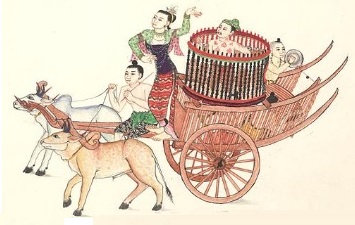
{sa.Da.ba.wa. ín:} of Burma (Myanmarpré) to convey the idea of Perfection of the Human Individual. The dent on the upper-left shows that each human individual has imperfect perceptions of Reality - feeling of the heart, which needs to be corrected. Going clockwise, which in itself means the Right-way, shows the dent at the bottom. It is the imperfection of Sexual behaviour which must be addressed. Then comes the dent at the top - views of thinking - must be changed. Only then can we have a Perfect Human Individual represented by a Full circle.
The word Akshara
{ak~hka.ra} means there is a one-to-one
correspondence between phonemes and graphemes,
and by convention it must never change. In Myanmar,
we see a step further, making use of the perfectly
rounded circle, which can be dented or cut - left,
above, right, below - to convey a message. We see
this in Sa'da'ba'wa Inn to convey the Idea of
Perfection of the Human Individual.
The Spoken language aka Speech
 {sa.ka:} speech can be recorded nowadays electronically.
Electronic recording has become a reality only in
the last century. However, the Scripts
{sa.ka:} speech can be recorded nowadays electronically.
Electronic recording has become a reality only in
the last century. However, the Scripts
 {sa} were developed, thousands of years before, to
record and playback speech.
{sa} were developed, thousands of years before, to
record and playback speech.
When I was asked years ago during my first trip
outside Myanmarpré to USA in 1957-1959, how many vowels
were there in Burmese-language or more specifically in
Bur-Myan
 {ba.ma-sa.ka:} written in
 {mrûn-ma sa}, I had answered more than 10. The response
was that Burmese-language must be more complicated than
English-language which had only 5.
{mrûn-ma sa}, I had answered more than 10. The response
was that Burmese-language must be more complicated than
English-language which had only 5.
Now both the questioner (English speaking American),
and, I, who answered (bilingual in Burmese and English)
did not know that there is big difference in speech
{sa.ka:} and script
{sa}.
English is a non-phonetic language and the number of basic script vowels 5. However, these 5 has to be expanded as digraphs (two basic vowels written side-by-side) which are pronounced as diphthongs such as <ou> <ae> <oy> etc. to make up for deficiency of vowels in speech. English has more than 12 speech-vowels - the same as Burmese and any other human language.
The trouble with English is the various ways of
pronouncing these <ou> <ae> <oy>
etc.
See Section 2: Human voice and languages >
English pronunciation guide -
EPG-indx.htm
> Vowels -
EPG-vow.htm (link chk 200829)
> Consonants -
EPG-con.htm
(link chk 200829)
Burmese written in Myanmar script is a phonetic script, and there is almost a one-to-one correspondence between speech vowels and script vowels. So Burmese is more easy than English.
Little did we realised that a human speech, whether Burmese or English, have almost the same number of consonants and vowels. It is only in the script that there is a difference. I should have answered Bur-Myan has more than 10 vowel-letters compared to 5 of the English-Latin.
Akshara
I've to define two words for this section: Inherent vowel
Devanagari

 {dé-wa.na-ga.ri} and Myanmar
{mrûn-ma} are aksharas
{ak~hka.ra} (aka abugidas) in which most symbols stand for a consonant
plus an inherent vowel
{dé-wa.na-ga.ri} and Myanmar
{mrûn-ma} are aksharas
{ak~hka.ra} (aka abugidas) in which most symbols stand for a consonant
plus an inherent vowel
 {mwé:ra-pa-þa.ra.} or
{mwé-hkän-þa.ra.}. The inherent vowel
{mwé-hkän-þa.ra.} usually has the sound /a/, or /æ/ (short a), /ə/ (schwa), and
is unknown in English and other alphabetic (sound-to-script} languages. Thus,
{mwé:ra-pa-þa.ra.} or
{mwé-hkän-þa.ra.}. The inherent vowel
{mwé-hkän-þa.ra.} usually has the sound /a/, or /æ/ (short a), /ə/ (schwa), and
is unknown in English and other alphabetic (sound-to-script} languages. Thus,
Bur-Myan: the akshara system -
{ta.} /ta/ - pronounceable or syllabic
Eng-Lat: the alphabet system - t /t/ - without the inherent-vowelThe basic unit of the akshara-system is the Syllable, because of which the system is best described as akshara-syllable system
The basic unit of the alphabet-system is the Letter, because of which the system is best described as alphabet-letter system
There is one thing that is not clearly understood in
the akshara-syllable system of Devanagari
{dé-wa.na-ga.ri} and Myanmar
{mrûn-ma}. Consonants, such as
{ta.} /ta/ are pronounceable due to presence of the
inherent vowel
{mwé-hkän-þa.ra.}. If we are to kill this inherent vowel
{mwé-hkän-þa.ra.} by use of a Virama
(viram for short)
 {a.þût}, the consonant is known as a "killed
consonant" and is marked with a sign which is
different from language to language. We have:
{a.þût}, the consonant is known as a "killed
consonant" and is marked with a sign which is
different from language to language. We have:
Skt-Dev: --------- त /ta/ + viram ------- --> त् /t/
Bur-Myan:{t} /t/
Now both त् /t/ and
By a stroke of luck while going through the Windows Character map, I came across the Georgian Letter თ /t/ . Just as English Letter t /t/ is mute, Georgian Letter თ /t/ needs a vowel to make it pronounceable.
English-Latin: --------- t /t/ + a /a/ --> ta /ta/ (pronounceable because of which it is a syllable)
Georgian-Mkhedruli : თ /t/ + ა /a/ --> თა /ta/ (pronounceable because of which it is a syllable)What a coincidence: Georgian-Mkhedruli თა /ta/ has the same pronunciation as Bur-Myan
/ta/ did not reach I claim that the Myanmar akshara is the parent of Asokan and Devanagari. I don't claim that Myanmar akshara was invented by the present population of Myanmarpré, but by a Rishi
{ra.þé.} living somewhere in the foothills of Himalayas extending east and then south to the present day Myanmarpré.
The inherent vowel
{mwé-hkän-þa.ra.} is a property of the akshara-consonants. The second-type of
vowel belongs to the realm of word and word-structure. Now before
we proceed further, I need to define my terms such as syllable and
word. Since there are no reliable definitions but only translations in the
dictionaries, I've to come up with my own definitions, which might have to be
extended and changed as I go on studying BEPS.
Words can have the canonical structure of CVC, where C
stands for consonant which can have various values: C = 0, 1, 2 , ... . V stands
for the Nuclear vowel which is also called the Peak vowel. Words are
pronounceable and hence they are Syllables. The first Consonant of the Syllable
is the Onset, and the second the Coda, with the Nuclear vowel
{nyu-ka.li-þa.ra.}
in between.
Since English belongs to Alphabet-Letter system, both the Onset and Coda are
Letters and they need not be differently represented. However, Since Burmese,
Pali, and Sanskrit belong to the Akshara-Syllable system, Onset and Coda must be
differentiated as C and Ç . The Onset consonant still has an inherent vowel
{mwé-hkän-þa.ra.}, but
the Coda consonant has none. Thus, the canonical structure of the word becomes:
CVÇ where both C and Ç can have values of 0,1, 3, etc. It is important
that there must always be the Nuclear vowel in a word.
The following is how a Pali-derived Burmese word spelled with a hidden viram
(in the form of a Vertical conjunct
 {paaHT hsín.}
step 1:
{ka.} + viram +
{k~ka.} non-pronounceable
Vertical conjuncts of this type are mute even though they still have a vowel ending. Thus, if you write {k~ka.} without showing the ~ , it looks like a double consonant {kka.} which is not permissible in BEPS. Note that Romabama uses tilde ~ to show conjunction.
See also https://en.wikipedia.org/wiki/Digraph_(orthography)#Double_letters 200713
"Doubled consonant letters can also be used to indicate a long or geminated consonant sound. In Italian, for example, consonants written double are pronounced longer than single ones. This was the original use of doubled consonant letters in Old English, but during the Middle English and Early Modern English period, phonemic consonant length was lost and a spelling convention developed in which a doubled consonant serves to indicate that a preceding vowel is to be pronounced short. In modern English, for example, the 〈pp〉of tapping differentiates the first vowel sound from that of taping. In rare cases, doubled consonant letters represent a true geminate consonant in modern English; this may occur when two instances of the same consonant come from different morphemes, for example ⟨〈nn〉in unnatural (un+natural). "
Let's now continue with "how a Pali-derived Burmese word with a hidden viram".
step 2:
{tak~ka.} pronounceble
step 3:{þol} -->
{tak~ka.þol} 'university' (pronounceable word)
 The
written script,
Myanmar akshara
{mrûn-ma ak~hka.ra}, is made up of 33 consonants
The
written script,
Myanmar akshara
{mrûn-ma ak~hka.ra}, is made up of 33 consonants
 {byæÑ:} and over 10 vowels
{þa·ra.}.
{byæÑ:} and over 10 vowels
{þa·ra.}.
Notice the "middle dot" at the end of the first syllable of the
disyllabic word
{þa·ra.} to show the central vowel schwa /ə/. Since, the glyph
ə is non-ASCII and cannot be used in e-mails, I will discontinue to use it.
Instead, I will represent the word as
{þa.ra.} with a "full-stop".
You'll also notice that I've extended the
Myanmar akshara
{mrûn-ma ak~hka.ra} to handle all the 4 speeches of BEPS: Burmese-speech,
English-speech, Pali-speech, and Sanskrit-speech. The table of Basic vowels of BEPS is made of up two parts:
 {þa.wûN} and
 {a.þa.wûN} an idea borrowed from Pali vowels which are made up of 8 vowels:
 {a.},
{a.},
 {a} /
{a} /
 {i.},
{i.},
 {i} /
{i} /
 {u.},
{u.},
 {u} //
 {é},
{é},
 {è:} . They are counted as 4 pairs, 3 pairs being
classified as "beautiful pairs" , and one pair as "ugly pair".
{è:} . They are counted as 4 pairs, 3 pairs being
classified as "beautiful pairs" , and one pair as "ugly pair".
You'll notice that
{a.} and
{a} are both /a/ differing only in time-duration to pronounce. The vowel
{a.} needs only a "short" time to pronounce, whilst
{a} needs twice as long to pronounce. Hence,
{a.} अ is the short vowel, and
{a} आ is a long vowel. The difference between the two is the
vowel-sign : Bur-Myan
 , and Skt-Dev ा .
The Bur-Myan vowel-sign is known as Re'cha
 {ré:hkya.}. It so happens that there two kinds of Re'cha for different glyphs
representing the Myanmar akshara which are based on single-circle or
double-circle. For example for
{ré:hkya.}. It so happens that there two kinds of Re'cha for different glyphs
representing the Myanmar akshara which are based on single-circle or
double-circle. For example for
 {ga.}
(based on single-circle), the Re'cha is written as Mauk'cha
{ga.}
(based on single-circle), the Re'cha is written as Mauk'cha
 {mauk-hkya.}, and for
{ka.} (based on double-circle), the Re'cha is Weik'cha
{mauk-hkya.}, and for
{ka.} (based on double-circle), the Re'cha is Weik'cha
 {weik-hkya.}.
 The MLC (Myanmar Language Commission)
recommends
Weik'cha
{weik-hkya.} be used for six akshara only:
The MLC (Myanmar Language Commission)
recommends
Weik'cha
{weik-hkya.} be used for six akshara only:
 {hka.},
{ga.},
{hka.},
{ga.},
 {gna.},
 {da.},
 {pa.}, and
 {wa.}.
The recommendation is to be memorized by a
Mnemonic
which goes something like this: khin'gu'gnau dau'poan'wa weik'cha re'pa'kya
, which has no basis. Since, the six are all based on single-circles, I've used
a simple rule that for single-circle-based akshara, Mauk'cha
{mauk-hkya.} is to be used, and for double-based akshara Weik'cha
{weik-hkya.} is to be used.
{wa.}.
The recommendation is to be memorized by a
Mnemonic
which goes something like this: khin'gu'gnau dau'poan'wa weik'cha re'pa'kya
, which has no basis. Since, the six are all based on single-circles, I've used
a simple rule that for single-circle-based akshara, Mauk'cha
{mauk-hkya.} is to be used, and for double-based akshara Weik'cha
{weik-hkya.} is to be used.
UKT 200711: The idea of pairing (two) or grouping (three) is based on relative vowel-duration counted in units of matra 'blink of eye' (shortened to "blnk"). A short vowel needs one matra (1 blnk), and a long vowel needs double length of time or two matra (2 blnk). The English, Pali, and Sanskrit idea of "short vowel" and "long vowel" is fundamentally wrong. Burmese needs three kinds: "creak", "modal", and "emphatic":
{a:} (3 blnk).
Trying to reconcile English 2-vowel classification to Burmese 3-vowel
classification had given me endless trouble until I studied Mon, very short
vowels like
 {na:.} नः . I've come across नः in Gayatri Mantra since I began studying Skt-Dev.
I could not make out what it is until I studied Mon-Myan. Listen carefully to Gayatri
Mantra: bk-cndl-gayatri<)) (link
chk 200713)
{na:.} नः . I've come across नः in Gayatri Mantra since I began studying Skt-Dev.
I could not make out what it is until I studied Mon-Myan. Listen carefully to Gayatri
Mantra: bk-cndl-gayatri<)) (link
chk 200713)
and try to catch the phoneme
{na:.} नः in the last line.
See also: RBM-rules-indx.htm > Romabamar-rule5.htm (link chk 200821)
Cardinal vowels of BEPS: A, É, I, O, U
Eight Pali-Myan Vowel-Letters of Akshara-Syllable system
Why the need of only one set of vowels for Eng-Lat, and two for Bur-Myan
Does it show a common origin of Latin script in which English is written, and Myanmar script in which Pali-Myan (script of Ari-monks ?) is written?
UKT 200824:
By their own nature Vowels
{þa.ra.} are always pronounceable. However, Consonants are pronounceable
or
non-pronounceable depending on how the Spoken-language is written. In
Eng-Lat which uses the Alphabet-Letter system, the Consonant is a
Letter without an inherent-vowel
{mwé-hkän-þa.ra.} because of which it is mute. However, in
Bur-Myan, Pali-Myan, and Skt-Dev which use the Akshara-Syllable system,
the Consonant is a syllable.
 In the Bur-Myan, Pali-Myan, and Skt-Dev, the vowels can be written either as
Vowel-Letters
{þa.ra.ak~hka.ra}, or Vowel-Signs
{þa.ra.þín~ké.ta.}
In the Bur-Myan, Pali-Myan, and Skt-Dev, the vowels can be written either as
Vowel-Letters
{þa.ra.ak~hka.ra}, or Vowel-Signs
{þa.ra.þín~ké.ta.}
Now, don't be confused by the term Vowel-Letters. Remember we are now talking about Akshara-Syllable system, and not Alphabet-Letter system. We are talking about vowels of Bur-Myan, Pali-Myan, and Skt-Dev.
The Vowel-letters ,
 {I.},
{I.},
 {I} /
{I} /
 {U.},
{U.},
 {U} //
 {É},
{É},
 {AU:} are stand-alone characters and are not used for forming words except in a few
cases.
{AU:} are stand-alone characters and are not used for forming words except in a few
cases.
UKT 200713: I'm now getting interested in the shape of
{tän-hkwun} aka
{a.lûn} at the top of a vertical stick (pole). This stick may be described as Flag pole
{tän-hkwun teín} aka
दण्ड «duṇḍa» in both Pali and Sanskrit, I'll adopt this term for use in Burmese. So, it is the
{rwÉ.} and
{É.} - or just the flag -
{nhÉIk} and
{lÉ-kaún:}.
Instead of the Vowel-letters, Myanmar script uses another set of
glyphs known as Vowel-signs :
Blank mute: ------------------------
{.},
 { }
---/---
{ }
---/---
 {.},
{.},
 { } --/--
 {.},
{.},
 { }
-----//---
{ }
-----//---
 {
},
{
},
 {:} for forming words with consonants.
With
single circle-derived: ---
{ga.},
 {ga} -/-
 {gi.},
 {gi}
-/-
{gi}
-/-
 {gu.},
 {gu} -//--
 {gé},
{gé},
 {gau:}

With
double circle-derived: --
{a.},
{a} --/-
{i.},
{i}
--/-
{u.},
{u} ---//--
{é},
 {au:}
{au:}
Note
{a.}
 { } is included in the table of consonants in Bur-Myan.
Caution : Never forget to differentiate Maukcha
and Weikcha , in naming their derivatives:
au1-mauk-sign
 au2-mauk-sign
 au3-mauk-sign
au1-weik-sign
 au2-weik-sign
 au3-weik-sign

UKT 200824
I've written that Bur-Myan and Pali-Myan are so intertwined, especially in the
study of Theravada Buddhism, that we switch without effort from one language to
another and back without realizing that we are doing it. It is because both
languages belong to the same linguistic group - Tib-Bur. My first target
language is English written in Latin script (Eng-Lat). Luckily we have the means
of comparison: Go to
index.htm and see Section 6 :
U Hoke Sein's Pali Myanar dictionary
(BP),
with my English translations aided by U Pe Maung Tin's Student's Pali English
dictionary (IP).
UKT: To see how Pali is written in different scripts, see United States of America Library of Congress ALA-LC Romanization Tables http://www.loc.gov/catdir/cpso/romanization/pali.pdf 200714
See the downloaded file in TIL - HD-PDF & SD-PDF libraries:
- loc-gov-RomanizationPali<Ô> / Bkp<Ô> (link chk 200714)
The Pali-Myan word
 {byíñ~za.na.} is given as
{byæÑ:} 'consonant' among other meanings in UHS-PMD0712c1, and Bur-Myan word
{byæÑ:} /bji:/ itself is given as 'consonant' in MLC MED2006-317c2. Thus the
Bur-Myan consonant is, pronunciation-wise,
{byæÑ:} or
{byíñ~za.na.} is given as
{byæÑ:} 'consonant' among other meanings in UHS-PMD0712c1, and Bur-Myan word
{byæÑ:} /bji:/ itself is given as 'consonant' in MLC MED2006-317c2. Thus the
Bur-Myan consonant is, pronunciation-wise,
{byæÑ:} or
 {byi:} Only the first is correct. To bring out the difference,
the Romabama word would have to be spelled as close as possible to the
Bur-Myan orthography. We should note that English transcription alone is not sufficient to study a
language. We will come across this problem when we come to
"Killed" consonants
(link broken on 200714).
{byi:} Only the first is correct. To bring out the difference,
the Romabama word would have to be spelled as close as possible to the
Bur-Myan orthography. We should note that English transcription alone is not sufficient to study a
language. We will come across this problem when we come to
"Killed" consonants
(link broken on 200714).
Now, a word about Pali and Sanskrit. Both were ancient languages of India. Pali is known as the holy language of Buddhism whereas Sanskrit is the holy language of Hinduism. Pali has many dialects such as Pali-Lanka and Pali-Myan. Myanmar Buddhist monks in the course of their religious training have to learn Pali-Myan. Some, after mastering Pali, continue to learn Sanskrit. The script used for writing Pali and Sanskrit in Myanmarpré is the Myanmar script. Hence Pali as pronounced by Myanmar monks is bound be influenced by the Bur-Myan. To bring out the difference from Pali as pronounced by the Buddhists from Sri Lanka and India I will refer to it as Pal-Myan (Pali-Myanmar).
Pali as pronounced by Sri Lankans and Indians is bound to be influenced by their
own languages. As an example, the Bur-Myan
 {þa.}
(commonly written as <tha> in English and {tha.} in Burmese) is pronounced exactly like the English-Latin <th> as in <thin> /θɪn/ and
<that> /ðæt/. However, the Sri Lankans and Indians pronounce the corresponding
akshara स (U0938) similar the English-Latin <s> /s/. Consequently,
the Pali adopted by the Europeans who came into contact with it
through Sri Lanka and India -- the so-called "International Pali" -- is
lacking in
{þa.}
/θ/ sounds. It is because of this reason, Lankan Pali is Sibilant,
whereas the Myanmar Pali is Thibilant. Another prominent difference is
the pronunciation of row#2 Palatals. Lankan Pali uses Palatal Affricates,
whereas the Myanmar Pali uses Palatal Stops as in Pali-Myan.
{þa.}
(commonly written as <tha> in English and {tha.} in Burmese) is pronounced exactly like the English-Latin <th> as in <thin> /θɪn/ and
<that> /ðæt/. However, the Sri Lankans and Indians pronounce the corresponding
akshara स (U0938) similar the English-Latin <s> /s/. Consequently,
the Pali adopted by the Europeans who came into contact with it
through Sri Lanka and India -- the so-called "International Pali" -- is
lacking in
{þa.}
/θ/ sounds. It is because of this reason, Lankan Pali is Sibilant,
whereas the Myanmar Pali is Thibilant. Another prominent difference is
the pronunciation of row#2 Palatals. Lankan Pali uses Palatal Affricates,
whereas the Myanmar Pali uses Palatal Stops as in Pali-Myan.
The question now arises which pronunciation of Pali is nearer to
that of Gautama Buddha and King Asoka of Magadha Mahajanapada


 {ma-ga.Da. ma-ha-za.na.pa.da.}. Now, King Abhiraza

 {a.Bi.ra-za-mín:} who founded the first kingdom in Myanmarpré - long before the
Buddha was born - was from Magadha
Mahajanapada
{ma-ga.Da. ma-ha-za.na.pa.da.}, and so - I hold that Pali-Myan is nearer to the
language of Gautama Buddha, and the International Pali pronunciations are
wrong. I note that unless you believe in the story of King Abhiraza
{a.Bi.ra-za-mín:}, you'll not accept my argument. That was the position of
British Colonial historians who would like to portray themselves as
benefactors of the Burmese race!
{a.Bi.ra-za-mín:} who founded the first kingdom in Myanmarpré - long before the
Buddha was born - was from Magadha
Mahajanapada
{ma-ga.Da. ma-ha-za.na.pa.da.}, and so - I hold that Pali-Myan is nearer to the
language of Gautama Buddha, and the International Pali pronunciations are
wrong. I note that unless you believe in the story of King Abhiraza
{a.Bi.ra-za-mín:}, you'll not accept my argument. That was the position of
British Colonial historians who would like to portray themselves as
benefactors of the Burmese race!
Pali is written in many scripts, such as Myanmar, Devanagari,
Latin (or loosely called "English" in Myanmarpré), Sinhala and Thai.
Pali-Latin (International-Pali)
has a pronunciation different from Pali-Myanmar.
In this work, whenever I write Pali words I will be following the
Burmese-Myanmar script in which च (U+091A [Ca.])
and स (U+0938 [Sa.]) of Devanagari will be written as
 {sa.}
and
{þa.}.
{sa.}
and
{þa.}.
Caveat: I'll be using IPA symbols /θ/, /tʰ/, /s/,
/ʃ/, /ʧ/, and IAST symbols श ś [ɕ] /ʃ/ ; ष ṣ [ʂ] /s/; स s [s] /θ/.
#1. Ordinarily,
/θ/ is given as English digraph <th> in Myanmarpré. However, this English
digraph <th> is taken to be {hta.} /tʰ/ in India and Lanka. Now,
Devanagari थ (U+0925) is given as IPA /tʰ/ -
https://en.wikipedia.org/wiki/Help:IPA/Sanskrit 200714
Because of the likelihood of mistaken identity, I've decided not to use the
English digraph th and to use its equivalent in Old English þ
which is known as the "thorn character".
#2. I'll be using the Myanmar aksharas
{sa.}/
 {c}
for Devanagari च, and
{c}
for Devanagari च, and
 {Sa.}/
 {S}
{S}
According to Ven.
Narada Thera author of An Elementary Pali Course, Buddha Dhamma
Association, Inc. (Sri Lanka)
www.buddhanet.net , the Pali language has 8 vowels
(Sinhala sara; Bur-Myan
{þa·ra.}) and 33 consonants (Sinhala vyañjana ; Bur-Myan
{byæiÑ:}). The 8 vowels are: a, ā, i, ī, u, ū
, e, o.
The 33 consonants by groups are:
- row#1. Gutturals
{ka.} group
(velar consonant);
- row#2. Palatals
{sa.} group (Sinhala ca group);
- row#3. Cerebrals
 {Ta.}
group (Sinhala tta group);
{Ta.}
group (Sinhala tta group);
- row#4. Dentals
{ta.} group;
- row#5. Labials
{pa.} group;
- and the rest not really forming any group.
UKT 200715: Though the lessons given by the Ven. Narada Thera were very helpful to me, it was his above description of the consonants that had led me astray.
One reason for confusion is because the transcribing language, Eng-Lat, does not have the tenuis-voiceless sounds of
{hsa.},
{hta.},
{hpa.}. The trouble become unsolvable when bilabial
{fa.}.
For example the row#2 Palatals r2c1
{za.} in Pali-Myan are Palatal stops, whereas the Palatals «ca» are Palatal affricates. The first three members sound like
{kya.},
{hkya.} ,
{gya.} to me. Clearly, Pal-Lankan is under the influence of Skt-Dev. Now, all the three in script form are not basic aksharas in Bur-Myan, and they could not be under Virama
r2c1 - because of the absence of tenuis in Eng-Lat, I still need to study this phoneme further
r2c2{cha.}/
{ch} - in place of
r2c3/
{j} - in place of
I still need to study r2c4 and r2c5. Because of innovation, I can now transcribe the English <church> as{chaach}.
I now have no choice but to turn to Skt-Dev. That was one of the reasons why I've landed in the study of BEPS. Believe me, it is a hard landing.
Ordinarily, I would have abandoned my study of Pali: it is my old age that has kept me going. I've nothing to do in this closing phase of my life, but to study with a computer as my second brain, and a few helpers to see me through. Because I could not pay them enough, they left me as soon as I've trained them enough in computer handling, and learning English - some even at the British Council at my expense.
Myanmar script has many characters corresponding to Devanagari (and other
Asoka-scripts). At least, in the following characters, we find the similarity:
• virama ्
-- (
{a.þût}-sign
 ),
),
• visarga -- (
 {wic~sa. pauk} or simply
{wic~sa.}) . See rim02.htm.
{wic~sa. pauk} or simply
{wic~sa.}) . See rim02.htm.
• anusvara ं -- ( {auk-mric} sign
 - "dot below")
• anunāsika ं, similar to 'chandrabindu' ँं ("moon and dot") --
( {þé:þé:tín}-sign
 )
)
See:
https://en.wikipedia.org/wiki/Anusvara 200715
"In the Devanagari script, anusvara is represented with a dot (bindu)
above the letter (e.g. मं).
In the IAST, the corresponding symbol is ṃ (m with an underdot)".
• danda । -- ( {poad-hti:} or
 {poad-hprût}-sign
 )
)
• double danda ॥ -- ( {poad-ma.}-sign
  ).
).
The term "creaky tone" (used in Wikipedia) is the same as "checked tone". The latter term is used by MLC in MEDict. See
Anunaasika (anunāsika), also called 'chandrabindu' ("moon and dot"), is a dot on top of a breve above a letter (मँ) [UKT:
{män}], used as a diacritic in Sanskrit and other Indo-Aryan languages written in Devanagari script to represent vowel nasalization. When transliterated, it is represented with a tilde above the letter ( ~ ). -- Wikipedia
There are other similar characteristics as well, and a one-to-one transcription between Bur-Myan and the various Brahmi-derived scripts is a reality. Now what I am trying to do is to derive at a transcription between Bur-Myan and Burmese-Latin which could be used for introducing Phonetics to Bur-Myan learners.
The strong similarity of the Myanmar and Devanagari consonants and the similarity in the names (given in Windows XP character map) can be seen in Myanmar consonants (link lost on 200715).
Of course there are differences. Speakers of Hindi-Devanagari and Sinhala
(language of the majority of Sri Lanka)
do not have the ability to pronounce some Bur-Myan consonants such as
{þa.}
/θ/ which they usually pronounce as "Sa" /s/. This inability to pronounce
{þa.} is also seen in some minority groups such as Inthas in Myanmarpré Shan State.
Myanmar script, as well as Devanagari, "constitutes abugidas -- a cross between syllabic writing systems and alphabetic writing systems. The effective unit of these writing systems is the orthographic syllable, consisting of a consonant and vowel (CV) core and, optionally, one or more preceding consonants, with a canonical structure of (((C)C)C)V. The orthographic syllable need not correspond exactly with a phonological syllable, especially when a consonant cluster is involved, but the writing system is built on phonological principles and tends to correspond quite closely to pronunciation." -- http://www.unicode.org/versions/Unicode4.0.0/ch10.pdf
- UKT 121127, 200715, 200825
When I speak Burmese, I rarely use diphthongs which I use when I speak English. I am an ethnic Burmese born (1934) and educated in Burma. I went, in early childhood, to a secular vernacular school which was founded as a Burmese-Buddhist monastic school.
Though both my parents speak English well, we speak at home Burmese with the Irrawaddy Delta accent. Later, I went to an English school ran by Anglo-Burmese, and my English pronunciation could be described as Anglo-Burmese. However, after coming to the US in the 1950's, I made a point of studying the American (the mid-west) accent. There, I learned to pronounce words like <boy> and <oil> which few native-Burmese could pronounce. A year in Australia, taught me that <cow> should be pronounced as a diphthong. Now, after spending some 30 years in Canada, I am sure I know the difference between monophthongs and diphthongs, and I maintain that Burmese is almost a pure monophthongal language.
What has been described as diphthongs in Burmese are in fact monophthongal digraphs which have to be used in transcription of Bur-Myan (Burmese speech written in Myanmar script) into English-Latin.
To those who would like to disagree with me, I will say this: I am a scientist, and is always ready to change my views and admit my errors in the face of experimental evidence, for example, from acoustical phonetics.
Problem of breaking up disyllabic and tri-syllabic words in Pali-Myan
- UKT: 121127, 200704, 200825
This question has come up some years ago in 2012, between my good friend U Tun Tint (of MLC) and
me. He maintains that it is monosyllabic where every syllable has meaning. To
this, I cannot wholly agree. For instance, what is
{mrûn-ma}? Is it a disyllabic
word made up of
 {mrûn}
'fast' and
{mrûn}
'fast' and
 {ma}
'strong'? Or, is it a combination of two monosyllabic
words?
{ma}
'strong'? Or, is it a combination of two monosyllabic
words?
Somewhat related to this problem is the problem of breaking up:
¤ a disyllabic word for "maiden". Is it
 {ka.Ña} or
 {kíñ~ña}
- which I differentiate by Weikcha
{weik-hkya.} and Maukcha
{mauk-hkya.}?
¤ a tri-syllabic Pali-Myan
word:

 «kada lī» or
 «ka dalī» differentiated by white space?
Whatever the case may be, in Romabama
 {ro:ma. ba.ma}, which is actually Burmese-Latin (Bur-Lat},
we would have to differentiate between words and syllables, and insert white
spaces
{ro:ma. ba.ma}, which is actually Burmese-Latin (Bur-Lat},
we would have to differentiate between words and syllables, and insert white
spaces

 {kra:kwak-hpru} in between words. At present it is common to write a string
of syllables without any indication of word boundaries. U Tun Tint maintains that when we are using
Latin alphabet for transcription, white spaces are needed, but insists that
Burmese is a monosyllabic language. That "Burmese is monosyllabic" is a
view that I had to accept before I begin to study Linguistics. Now, I don't
accept!
{kra:kwak-hpru} in between words. At present it is common to write a string
of syllables without any indication of word boundaries. U Tun Tint maintains that when we are using
Latin alphabet for transcription, white spaces are needed, but insists that
Burmese is a monosyllabic language. That "Burmese is monosyllabic" is a
view that I had to accept before I begin to study Linguistics. Now, I don't
accept!
• Like most Tibeto-Burman languages, Burmese shows a tendency toward monosyllabicity. Each syllable has C1 (initial consonant), V (vowel) and T (tone) always present. Syllables can be full, i.e. with all components receiving their full phonetic value, or reduced to a schwa in certain contexts. Final consonants are not pronounced, and consonant clusters are absent in the Burmese sound system. As a result, loan words with final consonants or consonant clusters such as "black" or "brake", for instance, are usually pronounced with an extra vowel inserted between the consonants. -- http://www.lmp.ucla.edu/Profile.aspx?LangID=72&menu=004
When you look into the following pages, you will come across many monosyllabic entries from MLC MEDict, the meanings of which you will not know even if you are well versed in Bur-Myan.
Actually Burmese is made of two languages - official language sanctioned by MLC, and colloquial language which man on the street continues to use. This has resulted in written language being more official and spoken language being colloquial. As an example when want to say;
in English "Go quickly",
1. you would write in Burmese as "{lyín mrûn swa þwa: pa}" - official language
2. you would say "{mrûn mrûn þwa:} - colloquial language
Because of colloquial language, I must insist that Burmese is mostly disyllabic. Burmese uses many disyllables derived by repetition of a monosyllable just like Malay. To get a taste of Malay spoken language, go online and watch Speak Malay like a local by Lissa - https://www.youtube.com/watch?v=cMBKNnusJG4 180601, 200914
I am saying this from personal experience. Though I do not claim to be an expert in Burmese language, I maintain that I am quite knowledgeable. I was born and educated in Myanmarpré and was in the university service for over 30 years, out which for the last 20 odd years the medium of instruction was in Bur-Myan. I was quite surprised to find that there are many entries in MLC MEDict, whose meanings are strange to me unless I take them to be syllables in a polysyllabic word. Let's look at some monosyllables with close sounding pronunciations given by MLC. Note: MLC transcriptions which are supposed to represent pronunciation are given as /.../ .
{haún} /haun/ (2 blnk} - v. ¹. (of a dog) bark, ². be rancid, give off a bad odour, stink. -- MLC MED2006-531c2
{haún:} /haun:/ (emphatic 2 blnk) - adj. old, ancient, out of date; used (e.g. used car), past (e.g. past life) -- MLC MED2006-531c2
{heín:} /hain:/ n. ¹. tuskless elephant, ². astrolog the sign of Rahu. v. be past the marriageable age.
adj beyond marriageable age. - MLC MED2006-531c2
{hain:} /hein:/ - v. ¹. (of tigers, leopards, etc.) roar, (of animals} growl. ². boom or reverberate (of drum) -- MLC MED2006-533c1
{hoän} /houn/ - adj. profuse, abundant; numerous. v ¹. be excessive. ². cloy, be fed up - MLC MED2006-533c2
{hoan} /houn/ - n. same as
{a.hoan} [UKT: physics momentum] - MLC MED2006-533c1
{hoan:} /houn:/ - v. (of flames) roar. - MLC MED2006-533c1
These words, I presume, are parts of polybasic words,
and if only a part is taken and spoken as monosyllable,
it is prone to be misunderstood. Thus, instead of
{hoan:}, give the whole word:
{hoan:hoan:tauk} /houn: houn: tau'| - v. be ablaze. -- MEDict533
UKT 200715, 200825
Recently, I've come across a book which is available to me as book-preview with many pages not shown: The World's Major Languages, 2nd. ed., ed. Benard Comrie, 2009. - https://www.taylorfrancis.com/books/e/9780203301524 200703
The section on Burmese is p724-740 by Julian K. Wheatley. :
"Tibeto-Burman branch, which includes Tibetan and Burmese, in addition to a vast number of languages spoken predominantly in southern China, Burma (Myanmar), northern India and Nepal." A book-preview of the above book, on p.271, gives:
- https://books.google.com.mm/books?id 200703
"
Until recently, the earliest reliable written specimen of Burmese was generally
considered to be the Rajakumar (aka Myazedi

 {mra.sé-ti}) inscription
 {kyauk-sa}, dated to 1111 or 1112
AD, which records the offering of a gold Buddha image in four languages
[speech-script], Pyu
{kyauk-sa}, dated to 1111 or 1112
AD, which records the offering of a gold Buddha image in four languages
[speech-script], Pyu
 {pyu}-speech,
Pali
{pyu}-speech,
Pali
 {pa-Li.}-speech, Burmese
{ba.ma}-speech, and Mon
{pa-Li.}-speech, Burmese
{ba.ma}-speech, and Mon
 {mwun}-speech. [UKT ¶]
"The Pali, Burmese and Mon faces are all written in the
same script - the Burmese-Mon Myanmar-script
{mrûn-ma ak~hka.ra} - based ultimately on a south Indian model;
[UKT ¶]
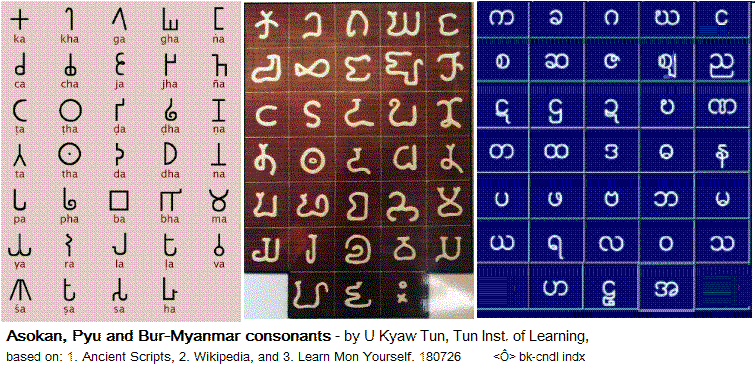
UKT 200718: I dispute that the Myanmar-script
"the script of the Pyu face, however, is slightly different from the other three in both its form and its features. Because of the near identity of the Mon and Burmese scripts, because Mon inscriptions in central Burma were thought to antedate Burmese, and because the Mon were associated, historically, with earlier coastal cultures known to have been disseminators of Indian tradition, the Mon have usually been regarded as the source of Burmese writing, as well as the inspiration for features of their early art, architecture, religion and government. [UKT ¶]
"However, Aung-Thwin (2005: 183 and passim) reveals specimens of Burmese writing form the eleventh century that may significantly pre-date the earliest Mon inscriptions; he also undermines the case for contemporary Mon hegemony in Lower Burma. Instead, he argues for the Pyu as the main substrate (or amalgam) in early Burmese culture, and Pyu writing as the model for Burmese writing, with the latter ultimately being adapted to write Mon rather than the other way round.
"While there are probably enough Pyu inscriptions to make a case for or against its script being the progenitor of the Burmese writing system, there is unlikely to be sufficient linguistic evidence for an early nexus [means of connection; a link or tie ] between Pyu and Burmese over and beyond the putative [generally regarded as such; supposed ] common origin in Tibeto-Burma. [UKT ¶]
"Mon, however, being much better attested and having a distinctive lexical stock, has left traces on Burmese in the form of loanwords showing the effects of transmission by way of Mon. In addition, it has been suggested that the iambic word structure of minor syllable followed by major, found in Burmese, but otherwise associated with Mon-Khmer languages rather than Tibeto-Burman, may have developed by way of contact with Mon."
UKT: Julian K. Wheatley's use of uncommon words (at least for me) such as nexus [means of connection; a link or tie - AHTD], and putative [generally regarded as such; supposed - AHTD] to stress his statement "Mon, however, being much better attested and having a distinctive lexical stock" has left me overwhelmed. I looked further on the internet and found:
- https://www.taylorfrancis.com/books/e/9781315644936/chapters/10.4324/9781315644936-44 200715
"Burmese is the national language of Myanmar, or Burma. 1 Burma is situated between the Tibetan plateau and the Malay peninsula, sharing borders with Bangladesh and India to the west, with China to the north-east, with Laos to the east and with Thailand to the southeast. It is a multi-national state. About two-thirds of its population are Burmans (called Bamar after 1990). The other third is made up of a large number of ethnic groups, 2 including other Tibeto-Burman speaking peoples such as the Chin, the Lahu and the Karen, Mon–Khmer peoples such as the Mon and Padaung, the Shan (whose language is closely related to Thai), and Chinese and Indians, who live mostly in the towns. The majority of the population of the country, put at about 51.5 million in the 2014 census, speaks Burmese as either a first or second language."

UKT 200825:
It is very difficult to write Myanmar script on the Internet. The old commonly used WinInnwa font was suitable for writing ink-on-paper pages, but not for writing web pages. Moreover, the commonly used Unicode fonts, such as Arial Unicode MS, and Lucida Sans Unicode do not display U1000-109F, the slot assigned by Unicode for Myanmar. To overcome this drawback, I have inserted my gif-glyphs whenever necessary. My gif-glyphs are based on Arial Unicode MS and WinInnwa. I have to standardise my gif-glyphs for two sizes:
• Arial Unicode MS size 12, used with WinInnwa size 16. The height is set at 22 pixels. The font22design is shown on the right. The version shown is of 190224
At present, as the Unicode font -- Pyidaungsu font -- is coming into use,
it is impossible for me to write online, and I rely on my assistants to do the
task for me.
Now read online:
https://www.unicode.org/faq/myanmar.html 200825
I'm glad I have not used any Burmese font for a long time. I use my own invention which uses little pix - shown on the right. I have sculpted thousands of these characters which are stored in my AK-BNKs. I'm still in the process of adjusting my AK-BNKs which are updated regularly at the end of every month. As of July-2000 update there are over 6000 pix in the AK-BNKs. Because of them, my web-pages can be read if you just have any English Unicode font. However, my favorite is Arial Unicode MS.
Derived from the word "velar" adjective for velum or soft palate. Velar
consonants are formed by articulation with the back of the tongue touching or
near the soft palate, as /g/ in <good> and /k/ in <cup>.
These consonants
are usually described by Pali scholars as "gutturals".
velar adj. 1. a. Of or relating to a velum. b. Concerning or using the soft palate. 2. Linguistics Articulated with the back of the tongue touching or near the soft palate, as (g) in good and (k) in cup. n. Linguistics 1. A velar sound. -- AHTD
guttural adj. 1. Of or relating to the throat. 2. Having a harsh, grating quality, as certain sounds produced in the back of the mouth. 3. Linguistics Velar. [French from New Latin gutturālis from Latin guttur throat] -- AHTD
Go back velar-con-b
End of TIL file


