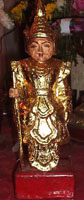
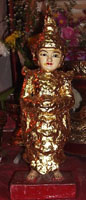
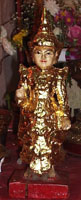
After placing the images of the above-mentioned Arahats in position,
the Puja-master now sets up the figures of the
gods of the planets. Katu or Kate {kait} (rhyming with <maid>) as pronounced by the
Burmese, being the king of all the planets, is surrounded by the other eight
planets.
Just as the gods of Hindu mythology ride on particular animals as their 'vehicles',
the nine Burmese planets have their
own animal vehicles.
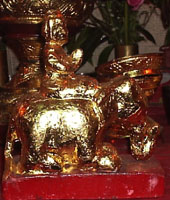
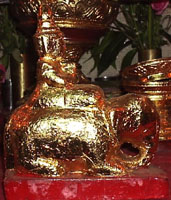
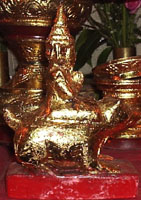
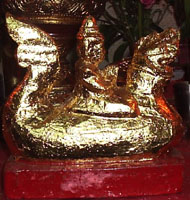
The figures now being set are those of
the Gods of the Planets astride their animals.
The Puja-master places the
Planets all facing the Buddha. Due to the lack of space, they are set in a
matrix of 3x3 on the front-left side of the alter.
Contents of this page
Then the Puja-master sets up his last group
of figures. They are the Five Great Gods (note: none of them has weapons in
their hands), namely:
| |
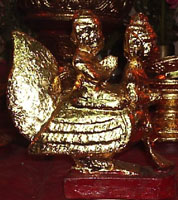
1. Goddess Thurathati
{thu-rath~tha.ti} on a {hintha} a mythical bird.
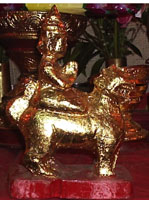
2. Goddess Sandi
{san~di} on a lion.
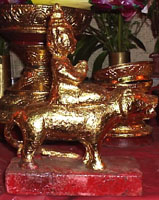
3. God Paramay-thwa
{pa.ra.mi-thwa} on an ox.
|
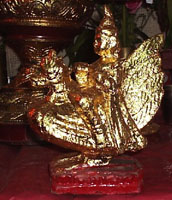
1.{thu-rath~tha.ti} on a hintha |
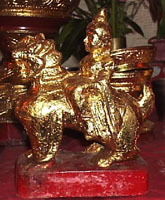
2.{san~di} on a lion |
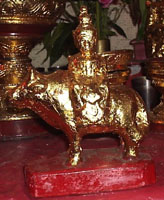
3. {pa.ra.mi-thwa} on an ox |
|
| |
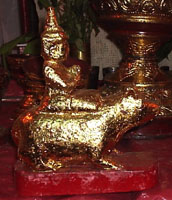
4. Maha-Peinne
{ma.ha-pein~nè} on a mouse
5. Gawra-manta
{Gau-ra. man~ta.} on a {ga.loan}. |

4. {ma.ha-pein~nè} on a mouse |

5. {Gau-ra.} on a galon |
|
According to Dr. Htin Aung, all these goddesses and gods are Hindu
in origin. (UKT note: Hindu gods and goddesses, except Saraswati, hold weapons
in their hands.) However, Burmese, unlike the Hindus regard the goddess in their own
rights and not as the consort of some other god. Thurathati to the Hindu is goddess Saraswati
(who is probably the goddess of the "vowel" {tha.ra.} in speech or language). Sandi is
goddess Chandi, Paramay-thwa is Siva himself; Maha-Peinne
is the Burmese name for Ganesh,
the elephant-headed god and Gawra-manta (who is probably not of Hindu origin.).
Though the
eight Arahats, and the nine gods of the planets, are in attitude of worship, the
gods were not, and at least the gods were not even facing the Buddha. However,
this might just be an aberration of a single puja-master.
Saya Win insisted that the four guardian gods of the world known as {sa.tu.ma.ha-ra-za}
should also be included in the Puja. These are:
| |
1. {Da.ta.raT-Hta.} -- of the eastern side of Mount Meru
2. {wi.ru-pak~hka.} -- of the southern side of Mount Meru
3. {wi.ru-Lha.ka.} -- of the western side of Mount Meru
4. {ku.we-ra.} -- of the northern side of Mount Meru |
|
Due to the lack of space, they were set on the same table but on the
right-hand side of the little monastery.
Contents of this page
| |
Left: Images are placed.
Right: The alter is almost ready |
 |
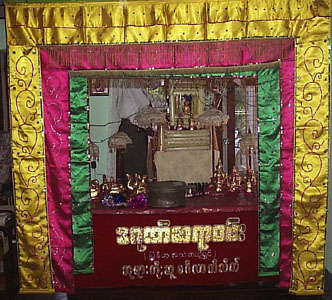 |
|
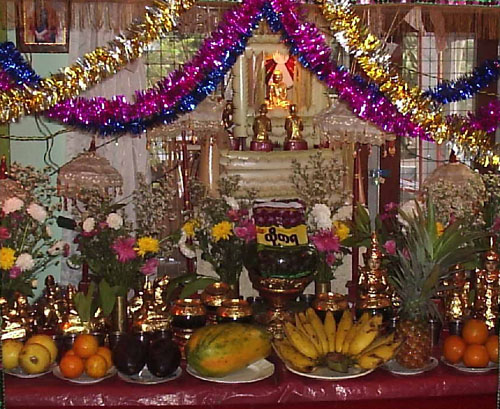
Now, that all the figures had been set in their own places, it was time to
set up flowers and fruits.
| |
The complete alter -- what the guests would
see. Note that the fruits are just ornaments at this stage. They would be
peeled and made ready to be "eaten" with cooked rice only at dawn -- the
next morning. |
 |
|
Contents of this page
Burmese-Buddhist pujas, unlike the Hindu and Mahayana pujas, are almost free of music. At the
most, there would be blowing of conch shell at the beginning of an incantation,
and the striking of a triangular brass gong.
The principal offerings are food: {hswam:} to the Buddha and his disciples and
{gro~ sa} to the Planets and {nat sa} to the Nats. The food offered to the
three parties might be the same, but Burmese use different terms:
• to the Buddha and monks -- {hswam: kup}
• to the Planets -- {gro~ sa kywé:}
• to the Nats -- {nat sa kywé:}. This term is used only in conjunction with
Nine-god puja. However, if the Nat is the principal to which the food is
offered the term changes to {nat tin}.
See how the
offerings are made.
Contents of this page
| |
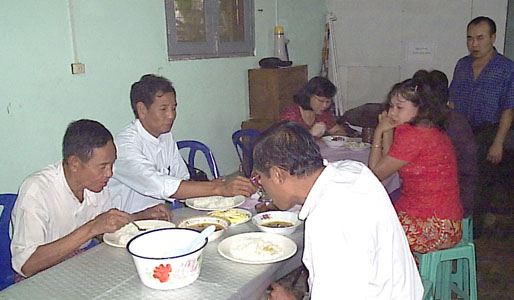
The guests are treated to either light
refreshments or to a dinner. There is no music to entertain the guests. On
this occasion, the guests were treated to rice-noodle chicken soup {kra hsan
chak} -- almost a full dinner. |
 |
|
Contents of this page
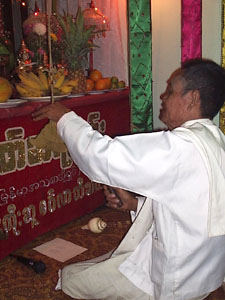
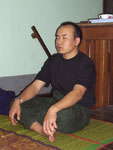
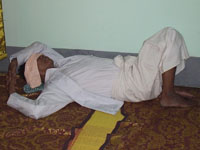
A long night for the Puja-master and his assistants. While one was doing the rites,
the others took rest. Of course, there were those who would meditate while
listening to the incantations.
| |
Left: One of the Puja-masters striking
the triangular gong at the end of an incantation.
Right upper: A devout member of the family meditates.
Right lower: A break for another Puja-master. |
 |
 |
|
| |
 |
|
Contents of this page
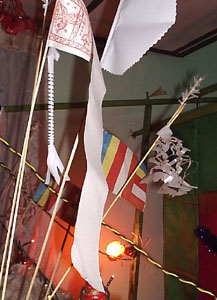
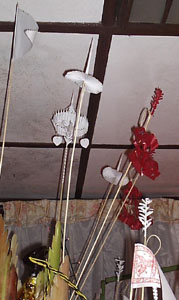
On the roof of the mini-monastery
there fly miniature prayer-flags and streamers. The Puja-master now places
flower-pots in position. He then places in position the alms-bowl, etc. The flower-pots contain three kinds of flowers
each, but the alm-bowls are empty. Finally he sets up candles lights them. He then starts to recite
extracts from Buddhist texts and offers special prayers on behalf of the
household.
By this time the guests have arrived.
They kneel before the monastery and make obeisance. The guests are served with
light refreshments: in villages pickled tea and plain tea, in towns ice-cream
and cakes. It is a social occasion and the guests chat and laugh. At about nine
or ten o'clock the guests leave, the inmates retire to their bedrooms, and the
Puja-master and his assistants are left alone in the room, still chanting
extracts from the scriptures. At midnight the Puja-masters, too, go to sleep in the
room.
About an hour before dawn the inmates
get up and prepare the food to be offered to the Nine Gods. Three kinds of
fruit (for the present occasion, nine), usually banana, coco-nut, and plum, and three kinds of jam are kept
ready. The rice to be offered to the Buddha and the Arahats is supposed to be cooked in
an earthen pot which has never been used before, and the rice to be offered to
the gods of the planets is supposed to be cooked separately in another new earthen pot,
however, for the present ocassion, the Puja-master just asked us to cook as
usual -- in the same way that the rice is cooked for the family. The reason is
simple: earthen ware is becoming less common in modern Yangon. At
dawn, the alms-bowl before the Buddha and the Arahats and the leaf-bowls before
the Great Gods and the Planets are filled with cooked rice, fruits, and jams. The
Puja-master first chants some more extracts from Buddhist
texts and offers the alms-food to the Buddha and the Arahats. Then he
invokes the Gods of the Planets to come and accept it. He recites a particular
formula of invocation for each Planet, in the following order: Sunday, Monday,
Tuesday, Wednesday, Saturday, Thursday, Rahu, Friday, Kait.
After the Planets have been invoked,
the Puja-master remains silent for a few minutes and then he recites
the formula of dispersal. Again for each Planet a particular formula is used,
but the order is changed.
The Planets are feared by the Burmese, particularly the Malefics: Sunday, Tuesday, Saturday, and Rahu.
The Benefics, Monday, Wednesday, Thursday and Friday, are also feared but to a
lesser degree. Kate is considered to be the
most powerful and a Benefic.
Thus the four Malefics are dispersed first, then the four Benefics, and finally
the Kait planet. The formula of dispersal is really a formula of expulsion or exorcism. And with
it the ceremony closes.
In the ceremony no special prayers or
scriptures are prescribed for the worship and offering of alms-food to the
Buddha and the eight Arahats. The Puja-master chooses the
prayers and the scriptures at his discretion, but certain set formulas of
worship and offering for the nine Planets are prescribed,
and the Puja-mastermust recite those particular formulas.
The Buddha and the Arahats are never invoked nor dispersed, but the
Gods and the Planets are not only
invoked but carefully dispersed.
The present day Burmese do not bother about the Nine-God Puja anymore.
And, whether the cult of the Nine Planets was superimposed on existing native cults or
otherwise, is at present a moot point. It was definitely non-Buddhist -- so
maintain those who consider themselves to be true Theravada-Buddhists.
For a non-Buddhist cult to survive it was necessary to
give it a colouring of Buddhism, and also to admit that the Gods and Planets were inferior
to the Buddha. The cult of the Nine Planets had to bow to the new order of
things and is dying out.
Contents of this page
End of TIL file
 {Bu.ra: ko:hsu} is usually held when there is sickness in the house, it is not
my family practice. As of old, the ceremony begins with the issue of invitations by my
daughter and myself
to relations and friends. And since I have lived in the same street in modern
Yangon for well over half a century, and in the case of my wife's family, for more than
80 years, we have to extend the invitation to the
whole street and to some of my friends who lived in other parts of Yangon. Sad
to say, when this puja was held, my wife had passed away exactly one month ago,
on the 5th of December 2004. The puja-master
who we had engaged was Dagon Saya Win of Kyundawlan, Sanchaung. He was a professional -- the 'Saya
of the Nine-Gods Ceremony'.
{Bu.ra: ko:hsu} is usually held when there is sickness in the house, it is not
my family practice. As of old, the ceremony begins with the issue of invitations by my
daughter and myself
to relations and friends. And since I have lived in the same street in modern
Yangon for well over half a century, and in the case of my wife's family, for more than
80 years, we have to extend the invitation to the
whole street and to some of my friends who lived in other parts of Yangon. Sad
to say, when this puja was held, my wife had passed away exactly one month ago,
on the 5th of December 2004. The puja-master
who we had engaged was Dagon Saya Win of Kyundawlan, Sanchaung. He was a professional -- the 'Saya
of the Nine-Gods Ceremony'.

 The monastery is setup in the front room. However, in
modern Yangon where living space is at premium, the monastery may be facing in
any direction, not necessarily due west as was described by Dr. Htin Aung. On
the present occasion, the monastery was facing North. Though the cardinal points are of the utmost importance in the ceremony,
the modern day Burmese people have to do away with this important point.
Of course, the audience will be facing the monastery.
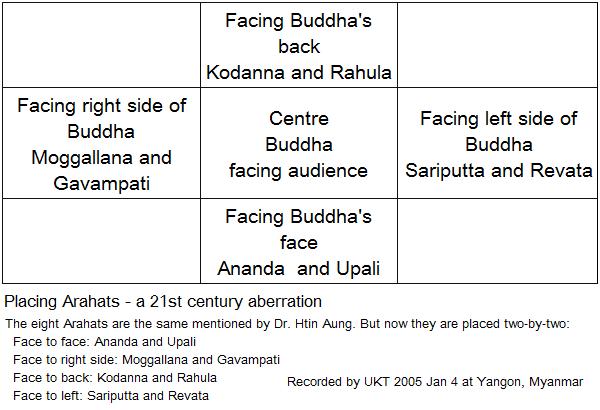
The Puja-master then sets up the images that he has brought with him. Right in the centre
of the monastery he places the image of the Buddha, and, he places the images of eight
of his disciples, all Arahats, about the monastery
with their faces turned towards the Buddha. In all cases, Puja-master is always
hampered by lack of space -- an evil of modern times.
The monastery is setup in the front room. However, in
modern Yangon where living space is at premium, the monastery may be facing in
any direction, not necessarily due west as was described by Dr. Htin Aung. On
the present occasion, the monastery was facing North. Though the cardinal points are of the utmost importance in the ceremony,
the modern day Burmese people have to do away with this important point.
Of course, the audience will be facing the monastery.
The Puja-master then sets up the images that he has brought with him. Right in the centre
of the monastery he places the image of the Buddha, and, he places the images of eight
of his disciples, all Arahats, about the monastery
with their faces turned towards the Buddha. In all cases, Puja-master is always
hampered by lack of space -- an evil of modern times.
 {ga.Loan}, who is the eternal
enemy of the Naga
{ga.Loan}, who is the eternal
enemy of the Naga
 {na.ga:}.
 {kya:}.
 {chin-thé.}.
 {hsin}.
 {hein:}.
 {krwak}.
 {pu:}.
 {na.ga:}.
 {pyin-sa.ru-pa.}
a mythical composite.
{pyin-sa.ru-pa.}
a mythical composite.