 {kyaung:hsaung}, for a miniature representation of the abode
of the Buddha or a nat. As a child, I always thought of a miniature monastery
as a <doll-house>. The term for the regular monastery is
{kyaung:hsaung}, for a miniature representation of the abode
of the Buddha or a nat. As a child, I always thought of a miniature monastery
as a <doll-house>. The term for the regular monastery is
 {kyaung:}.
ch02b-shrine.htm
by U Kyaw Tun, M.S. (I.P.S.T., U.S.A.). 2005. Not for sale. Prepared for students of TIL Computing and Language Center, Yangon, MYANMAR.
Contents of this page
Mini-monastery made of
Banana-stem
The following account was based on the Nine-God Puja performed at my home at 35 Thantadalan, Sanchaung, Yangon, Myanmar, on the evening of 2005 Jan 4th which extended into the early morning of the 5th.
For the Nine-God Puja a mini-monastery to house the Buddha and his disciples is needed. Although a ready-made wooden one could be rented from the Puja-master, we had requested him to make one. The proper custom demands that the mini-monastery with the votive flowers and other paraphernalia be floated down the river after the ceremony the following morning.
The disposable mini-monastery is usually made in about three hours from
banana-stem. Burmese use a special term,
{kyaung:hsaung}, for a miniature representation of the abode
of the Buddha or a nat. As a child, I always thought of a miniature monastery
as a <doll-house>. The term for the regular monastery is
{kyaung:}.
The mini-monastery was to be made from the banana stem. The stem or the trunk of the banana tree is not a trunk in the botanical sense -- it is a false trunk. It is actually a leaf-sheath bundle which can be peeled off until one comes to the very centre which is rather soft and which can be eaten. The miniature monastery is made from leaf-sheaths.
The only kind of banana tree suitable for such a construction is
 {ra.hkeing
nghak-pyau:}.
The plant must be mature but young (i.e. it must not have borne fruit). The
reason is not religious, but for ease of construction.
{ra.hkeing
nghak-pyau:}.
The plant must be mature but young (i.e. it must not have borne fruit). The
reason is not religious, but for ease of construction.
|
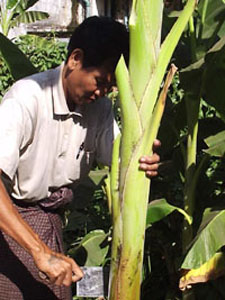
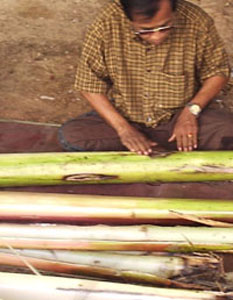
Left: The assistant, U Tin Aung cutting a banana plant. Right: Saya Win inspecting the stem for peeling off the leaf-sheaths, and some leaf-sheets which had been peeled off. |
 |
 |
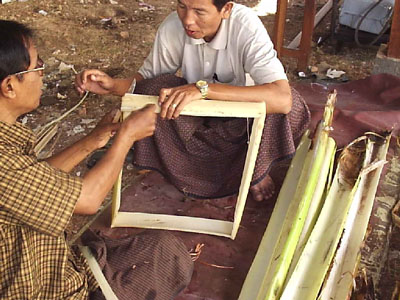
| Of course, the first step is the construction of the base. Notice how the ends are joined together -- with a pin made from bamboo. |
 |
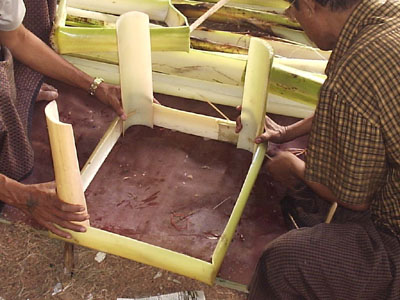
| Then, the pillars. Notice how a pillar is fixed to the base -- of course, with a longer bamboo pin. |
 |
| Left: The central pillars to support the crown (and the roof if there is to be one) are fixed. Right: Decorative pieces are made. Depending upon the artistic skill of the constructor, there is no end to how beautiful these pieces could be made. |
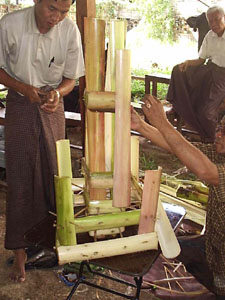 |
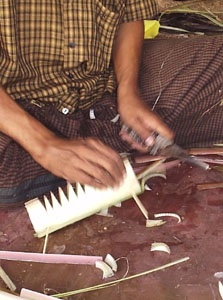 |
| Left: A voila, the mini-monastery is complete! And how fresh it looks and how fresh it smells. Right: Buddha is attended by his disciples. |
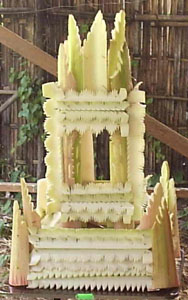 |
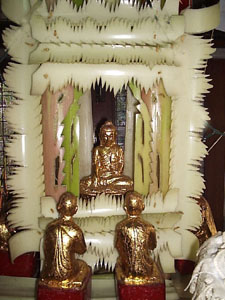 |
As stated above, the monastery would be used only for one evening, and when the ceremony was over in the morning, the miniature monastery with the votive flowers, paper-flags, etc. would be floated down the river the next morning. Of course, the golden images would not be disposed off.
Note: There must be only one Arahat, Shin Ananda, seated right in front of the Buddha. In the above photograph, there were two - an unofficial practice innovated by Saya Win which I am sure would be disapproved by traditional Puja masters.
End of TIL file