Foreword - by UKT
The Akshara
 {ak~hka.ra}:
 {mrûm~mak~hha.ra}
 s008.
The Vowels
s009.
Anusvara
 {a.nu.þwa-ra.}
 {þé:þé:tín}
 s010.
Consonants
 {byæÑ: ak~hka.ra}
 s011.
s012.
ch01-2.htm
- Burmese Grammar and Grammatical Analysis by A. W. Lonsdale, Education Department, Burma, British Burma Press, Rangoon, 1899. A photocopy of the ink-on-paper book , and downloaded PDF copies are available in the TIL Research Station, in Yangon.
Copied and edited by UKT and staff of TIL . Not for sale. No copyright. Free for everyone. Prepared for students and staff of TIL Research Station, Yangon, MYANMAR : http://www.tuninst.net , www.romabama.blogspot.com
Chapter 01
Foreword - by UKT
The Akshara
{ak~hka.ra}:
{mrûm~mak~hha.ra}
s008.
The Vowels
s009.
Anusvara
{a.nu.þwa-ra.}
{þé:þé:tín}
s010.
Consonants
{byæÑ: ak~hka.ra}
s011.
s012.
UKT 191103: The most prominent part at the back of the mouth the uvula or the little grape. The pix shows the uvula more prominently by cutting portion of the cheek (from Gray's Anatomy). In this picture you can see most of the articulators involved in the production of the consonants. See my note on palatal arches .
Let's see how modern Phoneticians analyze a language by watching videos in TIL HD-VIDEO and SD-VIDEO libraries in the Phonetics section, by Dr. Jüren Handke, Marbug Univ., Germanyh:
PHO101PhoneticsOverview<Ô> / Bkp<Ô> (link chk 191103)
Author's footnotes
UKT 191002: Lonsdale has given more explanations on
the terms in the form of foot-notes. He writes
«á» in stead of «ā» , e.g.,
Pali for Pāli .
UKT notes
•
Abugida aka Akshara aka
{ak~hka.ra} : a segmental script
• Consonants in Akshara-Syllable and Alphabet-Letter
systems
• Dot-above and Dot-below
• Same Script - Mutually Not-intelligible
UKT 201119: The following on Phonetics will be moved elsewhere
•
Laryngeal characteristics of modal voice
• Lubyandaw
 {lu-prûn-tau}
•
palatal arches
UKT 202017: See downloaded copy of A W Lonsdale work in TIL HD-PDF and SD-PDF Libraries, and in TIL Bk-Cndl Online Library
- AWLonsdale-BurGram-GramAnal<Ô> / Bkp<Ô> / BkCnd<OL> (link chk 201103)
I'm no longer using the ink-on-paper book, which I've in TIL Research station which is not convenient.
by UKT 121117, 121207, 160410, 191129, 201117 :
UKT 201117: Lonsdale begins Chapter 01, with the caption THE ALPHABET , which I've changed to THE AKSHARA
What about calling the akshara as Mrarmaksara
? Will it be acceptable to the non-Buddhist Sibilant-rhotic speakers among some of the ethnics in Myanmarpré ?
In Lonsdale's time the the Akshara
{al~hpa-bakt} were considered the same. The oldest inscriptions on stone, and on metal are in Asokan aka Brahmi script. This written language or script is in the Abugida-Syllable system (or Akshara-Syllable system) of recording the in-endurable speech-sounds in something endurable.
The recordings are in the form of markings made on stone, metal, baked-clay, palmyra-leaves, papyrus, skin-hides, and paper. The Alphabet-Letter system of recording is the second system which are of interest to us.
The Akshara-Syllable system is found in Indian subcontinent extending into South-East Asian area. On the Indian subcontinent, there are at least two varieties, one used in northern India, and the other used in southern India. Yet, it seems that Asokan is a unifying-script used by various speeches of India. The northern-variety was used by Hindi-speakers, and the southern-variety by Telugu-Tamil speakers.
I am certain that since Myanmar-script, Mrarmaksara
I will now emphasize the difference between Abugida or Akshara and Alphabet in my notes:
(s008-p004begin)
s008. Strictly speaking,
the Bur-Myan alphabet
 {ak~hka.ra sa·ka:þän-su.} "Akshara-Syllable"
[system of recording speech in script] consists of 42
{sa·ka:þän-su.} "syllables": ten are vowels,
{ak~hka.ra sa·ka:þän-su.} "Akshara-Syllable"
[system of recording speech in script] consists of 42
{sa·ka:þän-su.} "syllables": ten are vowels,
 {þa.ra.}
{byæÑ:} . These represent simple or elementary
sounds.
{þa.ra.}
{byæÑ:} . These represent simple or elementary
sounds.
[note the word "sounds": they are
not glyphs]
(s009-p004)
s009. The [Bur-Myan] Vowels
{þa·ra.} are [inset on right]:

Páli grammarians reckon only eight vowels, three of
which are short [vowel-length 1 eye-blink] called
 {raþ~þa. þa·ra.}, viz.
 {a.},
{a.},
 {I.}, and
 {U.}; the rest are long [2 blnk], called
 {di-Ga. þa.ra.} viz.
 {a},
{a},
 {I},
{I},
 {U},
{U},
 {É},
{É},
 {AU:}. [UKT ¶]
UKT 201116: The glyph
, people tend to think it as
-
{þa.ra.ric}. I had even thought of sculpting as
. But noting that it is bound to play havoc in Pal-Myan, I gave it up.
(s009-p004)-contd
The vowels -
 {è:} and
 {AU} are distinctly Burmese and not to be in Páli, although
there are aksharas
{AU} are distinctly Burmese and not to be in Páli, although
there are aksharas letters in Sanskrit nearly "corresponding to them in sound". They may be
accounted long [2 blnk}. The vowels are either similar, called
 {þa·wûN},
or dissimilar called
{þa·wûN},
or dissimilar called
 {a.þa·wûN}.
[UKT ¶]
{a.þa·wûN}.
[UKT ¶]

Thus,
{a.} &
{a} ,
{I.} &
{I} , and
{U.} &
{U} are similar
{þa·wûN} .
[The vowels]
{É}
&
{è:} in Páli; and
{É},
{è:},
{AU:}, &
{AU}, in Burmese are dissimilar
{þa·wûN} not only to one another, but to all the others.
In the Thin'boan'gyi
 {mrûm~ma þín-poän:kri:} or Burmese Spelling Book, a two other
characters
{mrûm~ma þín-poän:kri:} or Burmese Spelling Book, a two other
characters letters [representing sounds] are found added to the
vowels shown above. They are
 {än} and
 {a:} . [The sound and character]
{än} is a nasal or nose sound
{a:} . [The sound and character]
{än} is a nasal or nose sound letter
 {na-þi.ka. ak~hka.ra} ¹
(fn004-01), and is not strictly a vowel
(see infra.) (
p004end-p005begin)
{na-þi.ka. ak~hka.ra} ¹
(fn004-01), and is not strictly a vowel
(see infra.) (
p004end-p005begin)
 {a:} [ 3 blnk or emphatic 2 blnk] is not a separate sound
 letter, but
the second vowel
{a} [2 blnk] with its natural tone modified by
the two circular dots known as
 {wic~sa.pauk} [Skt: Visarga] (see par.51.).
(s009end)
{wic~sa.pauk} [Skt: Visarga] (see par.51.).
(s009end)
UKT 201124: See my note on Dot-above and Dot-below
in relation to Anusvara{a.nu.na-þi.ka.} अनुनासिक «anunāsika».
(s010-p005)
s010. Anuthwára
{a.nu.þwa-ra.} -- The nasal letter
{än} is called the Anuthwára. In Pali it
is classed with the consonants, and,
according to the way it is pronounced in
Skt-Dev, it has the power of m in
«aham». It is represented by «in» in the
transliteration of Pali words formed with
it. [UKT ¶]
When combined with a consonant it is
indicated by a tiny circle [it could be a
dot] placed above the letter. From being
used in this manner, it is commonly called
{thé:thé:tín} «the:-the:-tin» (from
 {þé:þé:} 'minute', and
 {tïn} 'to place on.') It is also called
 {naig~ga.hi.ta.} «niggahita» or, according to
the Burmese,
{naig~ga.hi.ta.} «niggahita» or, according to
the Burmese,
 {naig~ga.hait} (s010end)
UKT 201124: The Consonants
= व ् य ञ ् ज न , in the Alphabet-Letter system and the Akshara-Letter system differs primarily due to the absence or presence of Inherent vowel
(s011-p005)
s011. The Consonants :
UKT 201125: The transcriptions given on the right are Lonsdale's. which I'm reproducing below with some additions. I've added the affricate row which are not conjuncts, so that they can be under Virama
{a·þût}.
--- column: ------- c1, c2
------------ c3, c4 ---------------- c5

row: r1 ----
 {ka.},
 {hka.} ---
 {ga.},
 {Ga.} ---
 {gna.}/
 {ng}
{ng}
row: r2 ----
 {sa.},
 {hsa.} ---
 {za.},
 {Za.} ----
 {Ña.}/
 {Ñ}
{Ñ}
affricate:
 {ca.},
 {cha.} ----
 {ja.}, ? {Ja.} -----
 {ña.}/
 {ñ}
{ñ}
row: r3 ----
 {Ta.},
 {HTa.} ---
 {ða.},
 {Ða.} ---
 {Na.}/
 {N}
{N}
row: r4 ----
 {ta.},
 {hta.} ---
 {da.},
 {Da.} ----
 {na.}/
 {n}
{n}
row: r5 ----
 {pa.},
 {hpa.} ---
 {ba.},
 {Ba.} ----
 {ma.}/
 {m}
{m}
approximant, r6:
 {ya.},
 {ra.} ---
 {la.} ---
 {va.},
 {wa.}
---
{þa.}
{wa.}
---
{þa.}
approximant, r7: --------
 {ha.} ---
 {La.} -------
{a.}
{La.} -------
{a.}
To these may be added the anuthwára
{än}
UKT: Lonsdale's transcriptions are different from Romabama where the characters are given within {...}. Romabama characters show how the word is spelled in Bur-Myan. Since Bur-Myan is a phonetic alphabet, you can pronounce according to the way in which it is written.
{ré:tau. a·mhûn} 'what is written is correct'
{hpût.tau. a·þän} 'what is read is just sound' - implying being prone to error
This Bur-Myan saying is just the opposite of what the Western phoneticians mean.Generally, Romabama transcription will give a pronunciation similar to that of the dialects of the Rakhine coast and the Yaw region. The pronunciation would be slightly different from that of the mainland Myanmarpré - particularly that of the Irrawaddy- and Sittang-river basins. Notice that the consonantal aksharas are shown in a matrix of 7 rows x 5 columns, and are divided into two sections: the
{wag} (Sanskrit: Varg) and the
(s012-p005)
s012. The above arrangement
is in accordance with the Nágarí system [the
predecessor of Dévanagari]. It will be seen that
the first twenty-five consonants are divided into
five groups or classes each containing five aksharas
letters. The groups collectively
are called the Rows of Fives

 {piñ~sa. wag~ga.}
(fn005-01)
«pyinsa wegga»
(p005end-p006begin),
each of which is known by the first akshara
{piñ~sa. wag~ga.}
(fn005-01)
«pyinsa wegga»
(p005end-p006begin),
each of which is known by the first akshara
letter of the group, thus:
[UKT¶ ]
[Bur-Myan Velar-stop]: ----
[Bur-Myan Palatal-stop]: --
[Skt-Dev Palatal-affricate]: «ca» to «ña», the «ca wegga» ]
The first akshara letter of each group is pronounced sharp and strong, and the third has
the flat sound of the first; thus, (1st)
{ka.}, (3rd)
{ga.}. The second
akshara letter is the
aspirate of the first; in
,
{hka.} is the aspirate of
{ka.}; the fourth is the aspirate
of the third; thus in
,
{Ga.} is the aspirate of
{ga.}, but the Burmese do not
pronounce it differently from
{ga.}. The fifth letter is a nasal.
UKT 201118: The above paragraph of Lonsdale is unnecessarily complex due to his failure to see the Bur-Myan akshara table as a matrix of 5 rows (r) x 5 columns (c) for
(s012-p006)-contd
The rest of the aksharas letters, i.e. [rows 6 and 7]
{ya.},
{ra.},
{la.},
{wa.}/
 {ø},
{þa.}, and
{ha.},
{La.} [
{a.}] are called «a-wegga», 'no class.'
{ø},
{þa.}, and
{ha.},
{La.} [
{a.}] are called «a-wegga», 'no class.'
(End of section 012 and page 006)
p004
fn004-01 Pali,
{na-thi.ka.} 'the nose',
= 'nose letter', i.e.: a letter sounded
through the nose.
- fn004-01b
p005
fn005-01 Pali
{piñ~sa.} 'five';
{wag~ga.} 'class'. The Bur-Myan form of
{wag~ga.} is
{wag}
fn005-01b
p006
No footnotes
-- UKT 121205, 191104, 201119:
See also: https://en.wikipedia.org/wiki/Writing_system 201123
When F. Mason wrote in 1867, that Pali-Myanmar is Brahmi, what did he had
in mind? I'll have to study
¤ A Pali grammar on the basis of Kaccayano
 {kic~sæÑ:}
by Rev. F. Mason, 1868
{kic~sæÑ:}
by Rev. F. Mason, 1868
Downloaded versions of 251 pdf pages
are available in TIL HD-PDF and SD-PDF libraries:
-
FMason-KicsiPalGramm<Ô> /
Bkp<Ô> * (link chk 201123)
-
FMason-KicsiPalGramm-German<Ô> /
Bkp<Ô> (link chk 201123)
- Francis Mason & Eisel Mazard
(馬大影) version of Shin Kicsi
Pali Grammar, 1st distribution in 2015
-
FMasonMazard-PalGramm<Ô> /
Bkp<Ô> (link chk 171218)
Kicsi Pali Grammar from Burmese point of view, 1872.
-
FMason-PaliLangBurView<Ô> /
Bkp<Ô> (link chk 170313)
"THERE are two schools of Pali. One takes
for its basis the Pali derived from the oldest Burmese
manuscripts [UKT: I hold that this Pali-Myan is "Old
Magadhi" - the language of Ari-rishis of Tagaung, and the other the language as it now
exists in books and manuscripts in Ceylon, [UKT:
Pal-Lanka is the corrupt version] condemning everything as
irregular which differs from Singalese standards."
Akshara (system) - Syllable
----(basic unit is the syllable, e.g. Bur-Myan
Alphabet (system) - Letter
----(basic unit is the mute-letter, e.g. Georgian-Mkhedruli თ ‹consonant-Tan›)
The difference between the Abugida-Syllable
or Akshara-Syllable
system, and Alphabet-Letter system, can be
exemplified with reference to Bur-Myan script
and the Georgian script. Georgian-Mkhedruli თ
‹consonant-Tan› is a mute-Letter. It is not
pronounceable, whereas Bur-Myan
{ta.} is a pronounceable-syllable. Bur-Myan,
{ta.} under the virama
{a.þût} becomes
 {t}, is the same as Georgian თ ‹Tan›.
See Vowels and Consonants in BEPS languages
- MC-indx.htm > MCvowcon-indx.htm & see Canonical structure of the syllable - CVÇ , etc. (link chk 191026)
We should now differentiate between,
 {sa.ka:} 'speech',
 {sa} 'script', and
{ak~hka.ra} 'writing system'. The commonly used
word Language includes both Speech
{sa.ka:}, and Script
{sa}. When we say the Pali Language , it
is confusing. We should say Pali Speech .
{sa} 'script', and
{ak~hka.ra} 'writing system'. The commonly used
word Language includes both Speech
{sa.ka:}, and Script
{sa}. When we say the Pali Language , it
is confusing. We should say Pali Speech .
Pali Speech can be written in Latin script and in Myanmar script in Myanmarpré, and we should specify: Pali-Latin (Pal-Lat), or Pali-Myanmar (Pal-Myan). The International Pali is Pal-Lat - i.e. written in English which of course is written in basic Latin. In Myanmarpré we use the Myanmar-script, and we should specify it as Pal-Myan.
 Pali-Myan language is written linearly from
left-to-right. Because of Pali conjuncts, its
overall shape resembles a saw-tooth.
Pali-Myan language is written linearly from
left-to-right. Because of Pali conjuncts, its
overall shape resembles a saw-tooth.
When I spell the Myanmar akshara as
 {mrûm~ma ak~hha.ra}, you can clearly see the
"saw-toothedness". When I go
{mrûm~ma ak~hha.ra}, you can clearly see the
"saw-toothedness". When I go
further and Palirize it as
{mrûm~mak~hha.ra}, the saw-tooth becomes more
prominent.
Myanmar is a segmental language. We don't need to differentiate Speech from Script in Bur-Myan because our aim is a one-to-one correspondence between Speech and Script - exactly the opposite of the view of the Western phoneticians. We say Script is the king, and Speech is just wind - gone as soon as uttered!
Segments of Speech : See below in my notes
It is beneficial to our understanding by watching video-lectures, keeping in mind that, these lectures are for Alphabetic-Letter System, which is different from our Abugida-Akshara System. Moreover, the lecturer has German as his mother tongue. Watch
- PHO106-BasicSegOfSpeechConson<Ô> / Bkp<Ô> (link chk 191027)
- PHO107-BasicSegOfSpeechVowels1<Ô> / Bkp<Ô> (link chk 191027)
You'll notice that since a consonant of the Alphabet-Letter system is mute, the lecturer has to include 2 vowels to pronounce them, one before the consonant and one after the consonant, such as <ara> for /r/.
¤ https://en.wikipedia.org/wiki/List_of_writing_systems 121206, 191104
"A segmental script has graphemes which represent the phonemes (basic unit of sound) of a language. ... An abugida, or alphasyllabary, is a segmental script in which vowel sounds are denoted by diacritical marks or other systematic modification of the consonants. Generally, however, if a single letter is understood to have an inherent unwritten vowel, and only vowels other than this are written, then the system is classified as an alphasyllabary regardless of whether the vowels look like diacritics or full letters. The vast majority of alphasyllabaries are found from India to Southeast Asia and belong historically to the Brāhmī family. "¤ Pāṇini पाणिनि

{pa-Ni.ni. hsa.ra}: https://en.wikipedia.org/wiki/P%C4%81%E1%B9%87ini 121206, 191104
"Pāṇini cites at least ten grammarians and linguists before him. According to Sumitra Mangesh Katre, the ten Vedic scholar names he quotes are of Apisali, Kashyapa, Gargya, Galava, Cakravarmana, Bharadvaja, Sakatayana, Sakalya, Senaka and Sphotayana. [44] According to Kamal K. Misra, Pāṇini also refers to Yaska, "whose writings date back to the middle of the 4th century B.C." [45] "¤ http://en.wikipedia.org/wiki/Shakatayana 121206, 191104
" ... was a predecessor of Yaska and Panini in Iron Age India, [2] "¤ http://en.wikipedia.org/wiki/Yaska 121206, 191104
"Yāska{yaaS~ka.} was an early Sanskrit grammarian (4th c. BCE [1]). Preceding Pāṇini
{bya-ka.ra.Na.} 'Sanskrit grammatical tradition'."
¤ Language problem of primitive Buddhism by Chi Hisen-lin aka Ji Xianlin (季羡林 , 1911–2009), Journal of the Burma Research Society, XLIII, i, June 1960. See Section 04: lang-probl.htm (link chk 191104)
Speech can be analyzed by dividing into segments of speech. A writing system designed to represent these segments is a segmental script. The speech made up of phonemes is represented in script by graphemes.
The best kind of a segmental script is one that has a one-to-one mapping to segmental
speech. The Indic scripts, including the Bur-Myan which were based on the system
used on the inscriptions of Emperor Asoka of Ancient India came close to this
ideal. The Asokan script, now dubbed the Brahmi script (or the script of
Brahmana Poannas

 {bRaah~ma.Na. poaN~Na:}) was based on scientific observations of how the consonants
and vowels were produced in the human mouth.
{bRaah~ma.Na. poaN~Na:}) was based on scientific observations of how the consonants
and vowels were produced in the human mouth.
The Asokan script (Brahmi) was the result of work by ancient linguists notably Pāṇini

 {pa-Ni.ni.
hsa.ra} (fl. 6th-7th BC) who
flourished about the time of Gautama Buddha and others
centuries before him as mentioned by Panini himself. A name that has came to us is Yāska
{pa-Ni.ni.
hsa.ra} (fl. 6th-7th BC) who
flourished about the time of Gautama Buddha and others
centuries before him as mentioned by Panini himself. A name that has came to us is Yāska
 {yaaS~ka.} यास्क =
य ा स ् क or
{yaaS~ka.} यास्क =
य ा स ् क or
 {ya-þa.ka.}
. Details of his personal life are scanty or nil. Yaska himself came after
Śākaṭāyana
{ya-þa.ka.}
. Details of his personal life are scanty or nil. Yaska himself came after
Śākaṭāyana
 {sha-ka.ta-ya.na.} the expositor of the Vedas as mentioned by Yaska in his text.
 We need to say something
about Yaska because he was the author of the Nirukta
We need to say something
about Yaska because he was the author of the Nirukta
 {ni.roat~ta.} - a word used by
Gautama Buddha that is a source of contention between Chi Hisen-lin - the noted
Chinese Sanskritist and his Western contemporaries.
{ni.roat~ta.} - a word used by
Gautama Buddha that is a source of contention between Chi Hisen-lin - the noted
Chinese Sanskritist and his Western contemporaries.
UKT 201123: Buddha allows his monks to learn (and teach) his speech (system of Buddhism) in the monk's language with:


Chi's work has a bearing on the existence of a speech & script in Myanmarpré hundreds if not thousands of years before Anawrahta's Pagan of the 11th AD. And I contend that the Pali spoken in Myanmarpré today was that ancient language -- the Magadhi which the Buddha himself had spoken -- over which a newer layer Pali imported from Ceylon had been spread resulting in serious pronunciation discrepancies between Pal-Myan and the International Pali. -- UKT121206
Nirukta was a technical treatise on etymology, lexical category and the semantics of the Vedic words. Here I differentiate between Vedic and Sanskrit. Sanskrit came about only after Panini who codified Vedic into what is now known as Classical Sanskrit with his voluminous work the Ashtadhyayi अष्टाध्यायी «aṣṭādhyāyī» 'eight chapters'.
There is just scanty one-to-one mapping between the graphemes and phonemes in European languages, particularly English which uses the basic Latin script. A phoneme may be represented only by some combination or string of graphemes, the same phoneme may be represented by more than one distinct grapheme, the same grapheme may stand for more than one phoneme, or some combination of all of the above. This non-phonetic nature of the English and the phonetic nature of our Eastern scripts, particularly Bur-Myan is a source of problem for native Burmese speakers in speaking English, and for the native English speakers in speaking Burmese. Romabama is my attempt to solve this problem.
Segmental scripts may be divided according to the types of phonemes they typically record. At present my interest is on just three systems: Abjad, Alphabet, and Abugida.
It is a script in which only consonants are represented by glyphs. The vowels are optionally written with diacritics ("pointing") or only written word-initially. e.g. Arabic, Hebrew, Punjabi, Sindhi, Urdu.
The beloved script of the Westerners in which both consonants and vowels are represented by glyphs. e.g. Greek, Latin, IPA (International Phonetic Alphabet).
Alphabetic glyphs are not syllables and they cannot be pronounced. Thus, the consonant <k> /k/ cannot be pronounced.
I imagine a scenario of a teacher, and his audience, sitting on the ground. The teacher makes a scratch on the ground: a line, a cross of two lines, a triangle, or a circle. The glyph that he has made is given a name so that they can refer to it. The teacher calls the glyph the "letter k". He tells his audience that whenever he points to that glyph, they all must make a sound with their voices that sounded like "ka". He asks his audience to repeat it. The pointing of the glyph and the making of the sound vibration is now a system of sound recording.
Then another scratch is made the sand, and the teacher says aloud ga -- with more force. Now they have two letters: the letter k representing the sound-vibration ka , and the letter g representing the sound-vibration ga . Now they have a system of representing sounds with marks and they call that system the alphabet .
The only difference between the two sounds is the way the air from their lungs has flowed -- whether it is a laminar flow or the smooth flow for the sound of ka , and turbulent for the sound of ga . Then the teacher makes two more marks, and with the tip of his tongue in a new position -- touching a particular place on the upper part of mouth, two more sound-vibrations are made: the letter t for the sound or syllable ta with smooth air-flow, and the letter d with turbulent air-flow for the syllable da .
[Ha! you would say: the "laminar flow" and the "turbulent flow" -- that's hydrodynamics . Yes!]
I look on the human sound system and the rules of that sound system which we call grammar, as a discipline in hydrodynamics. And probably that was the way the Ancient Rishis must have looked on grammar, thousands of years ago, as they sat by the side of a mountain stream flowing past vibrating reeds, over the rocks and obstructions -- weirs.
The flow of air from the lungs, through
the mouth and the nose, to the outside
can be studied as hydrodynamics. The flow is the
 {þa.ra.} 'flow' - the vowel .
The vibrating reeds in the stream -- the
glottis , the vocal cords. The rocks and weirs
--
{þa.ra.} 'flow' - the vowel .
The vibrating reeds in the stream -- the
glottis , the vocal cords. The rocks and weirs
--
 {byæÑ:} 'constrictions' - the consonants.
The rapid vibrations with the tip of tongue - the
{byæÑ:} 'constrictions' - the consonants.
The rapid vibrations with the tip of tongue - the
 {ra.}-sounds - the rhotic accent.
Modifying the air-channel in
the mouth with varying shapes of the tongue
to give the various
{ra.}-sounds - the rhotic accent.
Modifying the air-channel in
the mouth with varying shapes of the tongue
to give the various
 {la.}-sounds - the lateral consonants.
By changing the shape of the lip-opening to give the
{la.}-sounds - the lateral consonants.
By changing the shape of the lip-opening to give the
 {wa.}-sounds - rounded-vowels and
spread-vowels. The changing velocity
of the air-flow to give voiceless-consonants
(laminar flow), voiced-consonants
(turbulent flow).
{wa.}-sounds - rounded-vowels and
spread-vowels. The changing velocity
of the air-flow to give voiceless-consonants
(laminar flow), voiced-consonants
(turbulent flow).
Remember the Letter of the alphabet is mute.ou give it the energy of the flow, the vowel, to give it a sound.
<k> -- mute
<k> + <a> --> <ka> /ka/ : pronounceable
We can also have a system of writing where the consonants and vowels are combined into a syllable.
UKT 191105: Whenever I compare the human sound or flow in terms of hydrodynamics I remember Moldau the composition of Smetana . I remember my best friend and room-mate John A. Mattor (and his wife Beth) at the Inst. of Paper Chemistry, Appleton, Wis., USA, who introduced me to classical music, in years 1957-1959.
Go online and listen: https://www.youtube.com/watch?v=3G4NKzmfC-Q 191105, 201119Personal note from 2012: In describing the above journey of a puff of air as it comes out of the lungs going through the glottis, past various obstructions, making along various channels always brings to my mind the description symphony of the course of the river Moldau. The river is one of Bohemia's great rivers. The symphony was by the Czech composer Smetana sometime in 1870s. The timeline in Myanmarpré was when my grandmother was born and when my great grandfather U Yan Shin was trying to survive the palace intrigues which had filtered down to the area where he had lived - BaBei and Ngathayauk near Salé as a respected Burmese leader with his own followers. He had to sought refuge in a small village near Gyobingauk in the-then British territory. I was introduced in 1958 to the symphony by my American friend and roommate John Mattor, in recognition of my love for the land where I was born.
The ancient sound system which was based on
the syllable is now given a name by
the Western linguists as Abugida. Since
the word <syllable> in Skt-Dev is
Akshara अक्षर
«akṣara» and in Bur-Myan is
{ak~hka.ra} I always try to refer to it the
Akshara and not Abugida - the
recently coined name
Each akshara has an inherent vowel which must be killed to turn it into a letter of an alphabet. We will take the case of the Myanmar Abugida-Akshara system, and the Georgian Alphabet-Letter. The smallest unit in Alphabet-Letter system is the mute Letter whereas in the Abugida-Akshara system it is the pronounceable Akshara or syllable. We will take the case of two consonants: /k/ and /t/.
case 1:
{k} -- mute Letter <k>
კ «Kan» (Unicode: 10D9) -- mute lettercase 2: {ta.} - pronounceable syllable
თ «Tan» (Unicode: 10D7) -- mute letter
Examples of abugida or akshara that is interest to BEPS are Myanmar and Devanagari.
Go back Abugida-note-b
UKT 160412, 191102, 201117:


In Bur-Myan consonant aksharas (which can be glyphs)
are known as
{byæÑ: ak~hka.ra} - spelled with Bur-Myan Nya-majar
{Ña.}/
{Ñ}. The nasal-ending
{Ñ} is stable: different from Pal-Myan which breaks
down under the influence of Virama
{a·þût} :
Pal-Myan:
Note the presence of Inherent vowel
 {mwé-hkän þa.ra.} <a> in
{Ña.} ञ . However, there is a catch here:
Bur-Myan Nya-major is a Palatal-stop,
whereas Skt-Dev ञ «ña» is a
Palatal-affricate. Bur-Myan
{Ña.}/
{Ñ} is a Semi-nasal unlike the
True-nasals of Eng-Lat n
/n/ and m /m/ .
{mwé-hkän þa.ra.} <a> in
{Ña.} ञ . However, there is a catch here:
Bur-Myan Nya-major is a Palatal-stop,
whereas Skt-Dev ञ «ña» is a
Palatal-affricate. Bur-Myan
{Ña.}/
{Ñ} is a Semi-nasal unlike the
True-nasals of Eng-Lat n
/n/ and m /m/ .
The presence of the inherent vowel
{mwé-hkän þa.ra.} <a> in all
Asokan-related scripts makes the characters
pronounceable. They are all syllables. The sound
of this inherent vowel is usually described as
the sound of the English short <a>
/æ/. In Georgian-Mkhedruli
 {m-hké-dru.li.} it is ა vowel An .
Incidentally, not necessarily by accident, it is
the inverse of the Bur-Myan Vowel-killer
{a.þût}-sign:
{m-hké-dru.li.} it is ა vowel An .
Incidentally, not necessarily by accident, it is
the inverse of the Bur-Myan Vowel-killer
{a.þût}-sign:
 Being the inverse it might well be described as
Vowel-giver .
Being the inverse it might well be described as
Vowel-giver .
UKT 160412: The Bur-Myan
თ /t/ + ა /a/ --> თა /ta/ pronounced like
Unfortunately, I have no knowledge of the Georgian-Mkhedruli language. I base my conjecture of the relation of Mkhedruli
- https://en.wikipedia.org/wiki/Ajatashatru 191030
The main problem in transcription of Bur-Myan to
English is twofold. Firstly, most workers do not
realized the difference between Abugida-Akshara
or Akshara-Syllable system in which Bur-Myan
is written, and Alphabet-Letter system . It
seems that the Alphabet-Letter system is
the only system which most of the Westerners,
including those in Myanmarpré, knows. Secondly, the
English short <a> is pronounced in any
convenient way depending on the nearby English
consonant. If you go through the Daniel Jones'
Pronouncing Dictionary, you will notice that
most English words, including the common ones such
as <father> is pronounced as
/'fɑː.ðəʳ/ which sounds like
 {hpau:þa:} instead of
 {hpa:þa:}.
Go back Conson-note-b
UKT201117: Why did Lonsdale introduced Skt-Dev
"Anusvara अनुस्वार
«anusvāra» ?
The word is applied to a diacritic, aptly named Dot-above
{þé:þé:tín}. It brings about nasalization of an akshara, e.g.
Stops:
(dot-above) -->
{kän}
Nasal:{nän}
Another word, Dot-below
 {auk.mric} does not bring about nasalization: moreover, it cannot be used
alone. It shortens the vowel duration: from 1 blnk to 1/2 blnk, or from 2 blnk to
1 blnk
{auk.mric} does not bring about nasalization: moreover, it cannot be used
alone. It shortens the vowel duration: from 1 blnk to 1/2 blnk, or from 2 blnk to
1 blnk
There are corresponding words in Skt-Dev, they are Anusvara
{a.nu.þwa-ra.}
and Anunathika
{a.nu.na-þi.ka.}.
Wikipedia: https://en.wikipedia.org/wiki/Anusvara 201117 :
"Anusvara अनुस्वार «anusvāra» is a symbol used in many Indic scripts to mark a type of nasal sound, typically transliterated «ṃ». Depending on its location in the word and the language for which it is used, its exact pronunciation can vary. In the context of Vedicancient Sanskrit, anusvara is the name of the particular nasal sound itself, regardless of written representation.
... ... ...
In Bur-Myan script, the anusvara
The above Wikipedia article and similar ones have given me endless
problems. The primary cause is the absence of
{gna.}/
{ng} in English and
Sanskrit - the IE languages - which have only /n/ and /m/ as nasals.
Bur-Myan - a Tib-Bur language - has five nasal sounds: three of which are
not originally present in IE.
It must be remembered that Lonsdale was writing in 1899 when the science of phonetics was still in its infancy. The philologist and phonetician Henry Sweet (1845–1912) was then the butt of a joke in the play Pygmalion written in 1912 by George Bernard Shaw. To be fair to Shaw, I must quote:
"In the preface to his play Pygmalion, George Bernard Shaw, after describing Sweet, stated that 'Higgins is not a portrait of Sweet, to whom the adventure of Eliza Doolittle would have been impossible; still, as will be seen, there are touches of Sweet in the play.' " -- Concise Oxford Companion to the English Language, as hosted on encyclopedia.com as quoted by Wikipedia:
- http://en.wikipedia.org/wiki/Henry_Sweet 121203
Clips from My Fair Lady - movie adaptation of Pygmalion, in TIL HD-VIDEO and SD-VIDEO
• Phonetics techniques in time of Henry Sweet
- zIntroEngMyFairLady1964<Ô> / Bkp<Ô> (link chk 201117)
• Movie trailer
- zMyFairLady1964Trailer1<Ô> / Bkp<Ô> (link chk 201117)The original story of Pygmalion was told in Greek mythology:
- https://en.wikipedia.org/wiki/Pygmalion_(mythology) 191101
"Pygmalion , Ancient Greek Πυγμαλίων «pugmalíōn», is a legendary figure of Cyprus [an island in the Mediterranean sea] . Though Pygmalion is the Greek version of the Phoenician royal name Pumayyaton, [notes 1] he is most familiar from Ovid's narrative poem Metamorphoses, in which Pygmalion was a sculptor who fell in love with a statue he had carved. "
It must also be noted that when Lonsdale was writing, Daniel Jones (1881-1967) from whose Pronouncing Dictionary I am taking the phonetic transcriptions was still in his teens.
Go back Dot-above-below-note-b
UKT 191227, 201116.

Bur-Myan and Mon-Myan, in spite of using the same basic akshara, are mutually not-intelligible. It is because, they belong to different Language groups: Bur-Myan to Tib-Bur group, and Mon-Myan to Aus-Asi group. What the speakers "heard" are not the same. Though we can regulate how to articulate, there is not way to regulate hearing. How much there is difference in hearing can be judged by the number of consonantal- and verbal-glyphs.
 In Mon-Myan, there are 35 consonants. Bur-Myan consonants and the corresponding
Mon-Myan consonants are of different pronunciations.
Mon-Myan - an Aus-Asi language - has a different
Phonology from that of Bur-Myan which is a Tib-Bur
language. Bur-Myan and Mon-Myan are mutually
non-understandable languages.
In Mon-Myan, there are 35 consonants. Bur-Myan consonants and the corresponding
Mon-Myan consonants are of different pronunciations.
Mon-Myan - an Aus-Asi language - has a different
Phonology from that of Bur-Myan which is a Tib-Bur
language. Bur-Myan and Mon-Myan are mutually
non-understandable languages.
Compounding the problem are the Western phoneticians. The not all the basic
sounds are "heard" by the
phoneticians who made a mess of
transliteration of these sounds into
English-Latin. Even the IPA has missed
some column aksharas.

In the case of Bur-Myan and Mon-Myan, because they have lived together (and
fought against each other) for hundreds of years, there is commonality in
culture - habits, dress, beliefs, religion (Theravada Buddhism) . Thus, when speaking
Pali of Theravada Buddhism, there are many
understandable words. Just listen to a Mon-Myan song
with some Pali-words:
-
BkCnd-Danakutho<))
txt from: spk-all-indx.htm > spk-all05song.htm (link chk 201123)
 - 01
- 01
- n. a village
-- Has043
 - 02
- 02
- n. custom, habit -- Has028
 -03
-03
- v. endure - Has078
- v. to receive - Has078
- numeral three - Has021, Has088
Now just listen the downloaded song, and enjoy.
UKT 201116: I'll now present my views of BEPS Basic vowels, and Vowel-letters. First, note what Lonsdale has said above, "[vowels] corresponding to them in sound]".
We must note that Lonsdale, as well as Phoneticians of his time,
had nothing to go on in comparing the sounds, particularly the mid-back
vowels, of different languages. Though highly trained to distinguish the
various sounds, their "hearing" is always impeded by their L1, and their
views are never reliable. Now we can rely on machine analysis of what we
call formants. The problem vowels are,
 {AU:},
{AU} which are phonetically /ɑ/, /ɔ/, /o/ which are so similar together in
formant values.
{AU:},
{AU} which are phonetically /ɑ/, /ɔ/, /o/ which are so similar together in
formant values.
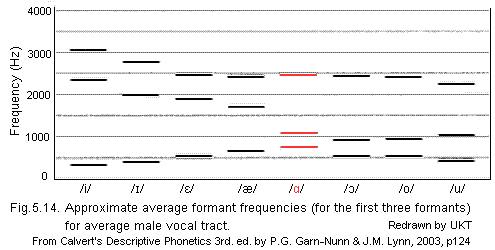


Note that what Lonsdale has given as Burmese
vowels are a mixed bag of Vowel-Letters
and Vowel-Signs. In writing day-to-day
Burmese It is mainly the vowel-signs that we use.
They are described as diacritics. In the
above table given as Basic vowels,
{a.} can be taken as the dummy vowel. If
you want the characters with {ka.} , just put it
in in the place of
{a.}. Thus, for
{ka.}-series:


 - 12 sounds
{hka.}-series:


 - 12 sounds
Each series, for all the 33 aksharas, were drilled
into our heads when we were beginning to go to school
in pre-WWII years.
UKT: 121203, 191101, 201117
Because we cannot study the vowels based on formants, we have to compare various associated languages. As Lonsdale has noted above, there are similarities between Burmese vowels and Sanskrit vowels. Now, pay attention to the third line of Skt-Dev vowels.The
vow-letters ------- ए -- ऐ -- ओ --- औ ---- special vowels -- अं अः
vow-signs + अ --- अे अै अो अौ - - (rendering engine not working for this line)
vow-signs + क --- के कै -- को -- कौ ---- (I have substituted क in place of अ)The diacritics on the vow-signs show that the pair के कै is the first pair of
From this we can say that
{è:} /ɛ/ are the front-mid pair. Eng-Lat has only
1 blnk ---- 2 blnk --- emphatic 2 blnk or 3 blnk
{é.} -----
{é} ------
{é:} -- allophones of /e/
{è.} -----
{èý} ------
The problem of representing the back-mid vowels becomes insoluble with the second pair. The back-mid pair. On the vowel-quadrilateral of Daniel Jones, the back vowels /u/, /o/, /ɔ/ & /ɒ/ (or /ɑ/) are shown well separated. However, on the vowel-space diagram (which is closer to reality - "ellipse'), these vowels are so close to be distinguishable.
Go back Same-script-note-b
UKT 191104: This section is based on The Phonetic Description of Voice quality, by John Laver, Cambridge Univ. Press, 1980, p.109-118.
"... The production of modal voice is thus carried out with only moderate adductive tension (AT) and moderate medial compression (MC), with moderate longitudinal tension (LT) when the fundamental frequency is in the lower part of the range used in ordinary conversation. The vibration of the larynx in this condition is regularly periodic, efficient in ping vibrations, and without audible friction brought on by incomplete closure of the glottis. ..."
Many factors are involved in the production of "voice" (such as the modal voice) and there are bound to differences in production of the "modal voice" when we go from one group of speakers (say, Myanmar) to the next (say, Indian); or from one language (Burmese) to another (Pali). These factors are:
01. - the lips are not protruded
02. - the larynx is neither raised nor lowered
03. - the supralaryngeal vocal tract is most nearly in equal cross-section along its full length
04. - front oral articulations are performed by the blade of the tongue
05. - the root of the tongue is neither advanced nor retracted
06. - the faucal pillars do not constrict the vocal tract
07. - the pharyngeal constrictor muscles do not constrict the vocal tract
08. - the jaw is neither closed nor unduly open
09. - the use the velopharyngeal system causes audible nasality only where necessary for linguistic purposes
10. - the vibration of the true vocal folds is regularly periodic, efficient in air use, without audible friction, with the folds in full glottal vibration under moderate longitudinal tension, moderate adductive tension and moderate medial compression (van den Berg 1968)
11. - overall muscular tension throughout the vocal apparatus is neither high nor low.
Go to Laryngeal-modal-note-b
 {lu-prûn-tau}
 -- UKT 121207 [facts in this note must be checked]
Bur-Myan Theravada monk-hood or Order
is made up of individual members known as
 {ra.hûn:} aka
 {Baik~hku}. A society of
{ra.hûn:} is
{Baik~hku}. A society of
{ra.hûn:} is
 {þïn~Ga}.
{þän-Ga} -- MED2006-510c2
UKT 121207: The meaning may be the same, but the pronunciation is quite different.
These societies are necessarily small headed by the senior
{Baik~hku} who had been the members' mentor
when they had started to take up the monk-robes.
At present there are larger groups, officially
recognized as nine groups of such small
societies known as
 {þïn~Ga geiN:} who follow the interpretation
of the Monastic Code, the Viniya
{þïn~Ga geiN:} who follow the interpretation
of the Monastic Code, the Viniya
 {wi.na.ya.}, by its founder. For example the Shwégyin
 {shwé-kyín geiN:}/
 {rhwé-kyín} follows the interpretation
of the Vinaya by the First Shwégyin Sayadaw,
and is official known as such as Shwégyin
Nikaya.
{rhwé-kyín} follows the interpretation
of the Vinaya by the First Shwégyin Sayadaw,
and is official known as such as Shwégyin
Nikaya.
There are others such as Dwa'ra, Gnak'twin, Weluwun, etc. My family had belonged to Shwégyin, and I had become a novice at the Seventh-Mile Shwégyin Monastery in my teens. I spent just a few days, took off the monk-robes and had returned to civilian life as a school boy to continue secular studies.
A Bur-Myan layman respects all Baikhkus of all
{þïn~Ga geiN:}. When I say my family had
belonged to Shwégyin, it must not be taken
that my family had always had connections
with Shwégyin. In Kungyangon where I was
born my family had connections to Gnaktwin.
My wife's family had connections to Weluwun.
It all depends on our friendship with
the presiding monk of a particular monastery
and as time changes I keeping of changing
my contacts primarily due to change of residence.
In my adult life with a wife and two children,
I had entered the Order again, but at a different
monastery under a different mentor. After
sometime because I still had a wife and very young
children to look after I doff the monk-habit and
had continued with my secular life as a chemistry
teacher at the various universities. Technically,
I am an ex-monk. If only I had spent not just
a few days as a monk, but at least one full year,
or a number of years learning the religious
literature which of course would include
Pal-Myan as a language, and had returned to
civilian life I would be known as a
{lu-prûn-tau} learned in religious affairs.
I would then be invited to deliver religious
lectures as a respected person.
The nine government-recognized
{þïn~Ga geiN:} convened together to elect
a very senior monk to head all the
{ra.hûn:}aka
{Baik~hku} in religious matters. This senior
monk unlike the Christian Catholic Pope is
just an elected official elected from time
to time. The tradition of small societies
under one senior monk was formulated by
the Buddha himself. And when one of his
senior monks asked the Buddha to name him
as the leader of all monks, the Buddha had
refused, and that had created a schism
in Buddha's life time. However, on the
death of the dissenter sometime after,
the splinter movement went out of existence.
Go online and see
http://en.wikipedia.org/wiki/Buddhism_in_Burma 121208.
See also Dissent and Protest in the Ancient Indian Buddhism, by Ven. Tran
Dong Nhat, Ph.D thesis to Univ. of Delhi, 2005, TIL HD-nonPDF and SD-nonPDF
libraries:
-
Buddh-sch-indx.htm (link chk 191105)
UKT161225: Due to failure of SD-port on my main
research computer, I've to come up with a new
setup :
TIL HD-nonPDF and SD-nonPDF libraries in Dissent-Protest section. I still have
to work on this setup.
Go back Lubyandaw-note-b
-- UKT (written by a non-medical person) 121117, 191104
palatal arch. The bony arch at the roof of the mouth, which is comprised of
the inferior faces of the maxillary and palatine bones. - GoogleExcerpt from: https://kidshealth.org/en/parents/speech-therapy-cleft-palate.html 191104
Articulation and Resonance Disorders:
An articulation disorder is when a child has trouble making specific sounds. "Cleft palate speech" refers to speech sound errors that are more common in kids with a cleft palate. These include:
• Glottal stops: formed by a "pop" of air when the child forces his/her vocal folds (located in the voice box) together. The release of air can make it sound like a child is omitting a consonant (like saying "-all" for "ball").
• Nasal fricatives: formed by directing the stream of air through the nasal cavity, instead of the oral cavity, during speech. It sounds like the child is "talking through his/her nose" for particular sounds, like S in the word "sun."
• Pharyngeal fricatives: formed by pressing the base of the tongue against the back of the throat and releasing a stream of air for speech. It can sound like the child is using a "raspy H" for particular sounds, like SH in the word "shoe."
• Mid-dorsum palatal stops: formed when the middle of the tongue contacts the middle of the roof of the mouth and used as a substitute for these sounds: T, D, K, and G. When the child produces a mid-dorsum palatal stop, it often sounds "in between" a T and a K.A resonance disorder refers to an unusual amount of nasal sound energy when the child is talking, which can result in:
• hypernasality (too much nasal sound energy): This makes a child sound "nasally."
• hyponasality (too little nasal sound energy): This makes a child sound like he/she has a cold.
• mixed (a bit of both) resonanceHypernasality may mean that the child's palate is not working properly, called velopharyngeal (vee-low-fair-en-JEE-ul) dysfunction. This can make it hard for others to understand the child's speech, and might need further treatment.
In the production of velar consonants
 {ka.},
 {hka.} &
 {ga.}, and
palatal consonants
{ga.}, and
palatal consonants
 {sa.},
 {hsa.} &
 {za.} the body of the tongue is raised to
the velar and the palatal regions, respectively,
allowing a very small stream of air to pass
through. There are two points we must not forget:
{za.} the body of the tongue is raised to
the velar and the palatal regions, respectively,
allowing a very small stream of air to pass
through. There are two points we must not forget:
#1. the tongue is like a jelly bag without
a rigid structure, and
#2 most of us cheat on the production of
palatals by producing hissing dental
fricatives resulting in two sets of sounds
which are represented separately with
different glyphs in Skt-Dev, and in IPA,
but not in Bur-Myan.
Palatals:
{sa.}/{c} च /c/,
Hissing dental fricatives:/
{Sa.}/{S} ष /s/
Even after many years of study of Skt-Dev words and their meanings by going into the dictionary entries in A. A. Macdonell A Practical Sanskrit Dictionary, and Monier-Williams Sanskrit-English Dictionary, reading together with U Hoke Sein, Pali-Myanmar Dictionary in Bur-Myan script, U Pe Maung Tin A Student's Pali Dictionary, and Pali-Text Society Pali Dictionary, I am still uncomfortable having to differentiate Palatal
However, the body of the tongue is not as versatile as the tip of the tongue that is involved in the dental and alveolar consonants. Thus the velar and palatal consonants are widely misunderstood even among the four languages of BEPS. No amount of explanations on the part of phoneticians can convey the actual picture to the students and the only remedy is to let the ear of the student register the sounds articulated by a native speaker and train the tongue muscles to imitate the sound as best as they could.
Now let's narrow down to the regions referred to above.
From: http://medical-dictionary.thefreedictionary.com/palatopharyngeal+arch 121117
palatal arch
-- the arch formed by the roof of the mouth from the teeth on one side of the
maxilla to the teeth on the other or, if the teeth are missing, from the
residual dental arch on one side to that on the other.
palatoglossal arch
-- the anterior of the two folds of mucous membrane on either side of the
oropharynx, enclosing the palatoglossal muscle.
palatopharyngeal arch
-- the posterior of the two folds of mucous membrane on either side of the
oropharynx, enclosing the palatopharyngeal muscle.
Go back palatal-arches-note-b
End of TIL file


