Update:
2021-02-11 03:01 AM -0500
TIL
Grammar of the Burman Language
CareyGram01.htm
From Grammar of the Burman Language,
by F. Carey, 1814.
-
https://books.google.co.nz/books?id=mmEOAAAAQAAJ&pg=PA1&redir_esc=y#v=onepage&q&f=false
201102
Downloaded copy in TIL HD-PDF and SD-PDF Libraries, and in TIL Bk-Cndl Online
Library
-
FCarey-GrammBurmanLang<Ô> /
Bkp<Ô> /
BkCnd<OL> (link chk 201103)
There are are 351 printed pages in the downloaded copies, but no TOC.
However, in -
https://books.google.fr/books?id=mmEOAAAAQAAJ 210112,
there is a Table des matières, which gives the book divided into 26 sections.
Downloaded and set in html and edited
by U Kyaw Tun (UKT) (M.S., I.P.S.T., USA), and staff of Tun Institute of Learning
(TIL).
Not for sale. No copyright. Free for
everyone. Prepared for students and
staff of TIL Research Station, Yangon, MYANMAR :
http://www.tuninst.net ,
www.romabama.blogspot.com
index.htm |
Top
BG-indx.htm
Preface
The year 1814, in which F. Carey wrote his grammar, is just over
200 years ago - but long enough for
Nature to change many things. With regards to Burmese grammar, how
much have we progressed?
Why is still Phonetics not taught in schools when our Akshara is a
phonetic language - a great advantage
over English which is just a Alphabetic language.
Ch01
Section01 :
Of the
Aksharas Characters
§001 §002
§003 §004 §005
§006 §007 §008
§009
On the Pronunciation
of Vowels
Similar pairs
§010 §011
§012 §013 §014
§015
Dissimilar pairs
§016
§017 §018 §019
§020 §021 §022
Before you proceed further, see -
The Vowels - Soul of a language in my notes in BG-indx.htm
On the Pronunciation
of Consonants
row#1
§023 §024
§025
row#2 §026 §027
§028
row#3 §029 §030
§031
row#4 §032 §033
§034
row#5 §035 §036
§037
row#6 §038 §039
§040 §041
§042
row#7 --- §043
§044 §045 ---
§046 §047
Ch01 : Section02 : Combining the
Aksharas (vowels or consonants) with other Aksharas (vowels or consonants)
Of Compounding Aksharas
Letters
§048 §049
§050
Romabama Akshara Compounding Process#2
:
- consonant +
a vowel,
Of compounding the
Vowels with a Consonant (Table I.), e.g.
 {ka.} +
 {a·þût} +
 {i.} -->
 {ki.}
{ki.}
§051 §052
§053 §054 §055
§056 §057
Romabama Akshara Compounding Process#3
- consonant + another consonant,
Of compounding Consonants , e.g.
{ka.} +
{a·þût} +
 {ya.} -->
 {kya.}
§058 §059
§060 §061 §062
Nasals: Dot-above
 {þé:þé:tín}] sign

- the instrument for nasalization
§063 §064
§065 §066 §067
Conjuncts or stacked consonants:
Pali conjuncts
 {paaHT.hsín.}-
 {paaHT-twè:}
§068 §069
Go to next page:
CareyGram02.htm (link chk 210206)
Search string: F Carey - A Grammar of the Burman Language
Author's footnotes
UKT 210115: Carey's pronunciations (known from his transcriptions) are,
in general, wrong. To make corrections, and to simplify his statements, I've
introduced the following terms:
Letter of Alphabet --> Akshara
 {ak~hka.ra.}
initial consonant --> onset
vowel --> nuclear vowel of the syllable or inherent vowel of
letter
final consonant --> coda
combination --> medial (pronounceable), or conjunct (mute)
Also, note that English does not have tenuis sounds: what they most
misunderstand
is the sound of
{ka.}/
 {k} which they often take to be
 {ta.}/
 {t}.
{t}.
UKT notes
•
The author F. Carey (1786-1822)
• Life of F. Carey during events in Burma
• Mixing up of Palatals
Contents of this page
UKT 201226: The 18th century English transcriptions
of Burmese words are so strange that I had a hard
time trying to make out what they are in Bur-Myan.
It is one of the reason for suspending my work many
years ago on The Burmese Empire a hundred years
ago - by Father Sangermano, 1833. -
sang-s-indx.htm
In this work by F. Carey, we find another drawback. He writes: "
has the sound of k in king". He did not mention how the Burmans would call
this character, and also he did not indicate the "k in king" are English.
I've accordingly removed this drawback by giving the name of
as "Ka-major" derived from Bur-Myan pronunciation "ka gyi:" which is
spelled as {ka.kri:} but pronounced as "ka (pause) gyi (emphatic)" meaning
the "big ka": [Ka-major]
{ka.} has the sound of k in <king> . Note how I've bold-ed
k and have angle-bracketed <king> .
(pre3)
The Burman empire and the Kingdom of Siam have been long known to the European
nations, as countries included in what geographers call India beyond the Ganges

 {gïn~ga mric};
but their boundaries and extent are but little known, and the various nations
which border upon them to the north and north-east are known in a still smaller
degree.
{gïn~ga mric};
but their boundaries and extent are but little known, and the various nations
which border upon them to the north and north-east are known in a still smaller
degree.
Towards the close of the fifteenth, and during the whole of the sixteenth and
seventeenth centuries, Siam and Pegu were much frequented by the Portuguese,
Dutch, French, and English, each of whom, at different times, possessed
factories in those countries, and had extensive mercantile dealings with the
inhabitants. Little however has been left upon record concerning the manners,
customs, and religion of those nations, and still less respecting the various
languages [speech
 {sa.ka:} and script
 {sa}] which are spoken among them.
The only persons who attempted to write on the affairs of these nations in the
sixteenth and seventeenth centuries were Pinto, Faria de Souza, Monsieur de-la Loubere, and [Engelbert] Kæmpfer; some of whom had opportunities of visiting those
countries. With the exception of the last however, little authentic information
is to be gathered from their works.
(pre4)
In the year 1800, Col. Symes published his "Embassy to the Burman Empire." This
work contains the most accurate account of that nation which has ever been
presented to the public: Col. S. has therein faithfully related all the facts
and circumstances which came within his knowledge; his opportunities, however,
were not such as could enable him to give an accurate account of the language.
UKT 201211: See An Account of an Embassy
to the Kingdom of Ava, sent by the
Governor-General of India, in the year 1795,
by Michael Symes, Major in His Majesty's
76th Regiment, 1800, TIL HD-PDF and SD-PDF
libraries:
-
MSymes-EmbassyAva1795<Ô> /
Bkp<Ô> (link chk 201212)
It is highly probable, that the religion of Boodha [Buddha
 {boad~Da.}] was the prevailing one
throughout Bengal and Hindoost'han [Hinhu-India], from its first establishment there till the
expulsion of that party, which is supposed to have taken place about three
hundred years before the Christian area: and that to escape the cruelty of their
persecutors [Hindu-Brahmins], the Boudhists [Buddhists] then emigrated towards the South West as far as
Ceylon, and to the Eastward throughout the Burman dominions and the kingdom of
Siam. From this period then must be dated the introduction of the religion
of Boodha into the Burman country, and with it the Magudha [Magadha] language, which is
evidently a dialect of the Sungskrit [Sanskrit].
{boad~Da.}] was the prevailing one
throughout Bengal and Hindoost'han [Hinhu-India], from its first establishment there till the
expulsion of that party, which is supposed to have taken place about three
hundred years before the Christian area: and that to escape the cruelty of their
persecutors [Hindu-Brahmins], the Boudhists [Buddhists] then emigrated towards the South West as far as
Ceylon, and to the Eastward throughout the Burman dominions and the kingdom of
Siam. From this period then must be dated the introduction of the religion
of Boodha into the Burman country, and with it the Magudha [Magadha] language, which is
evidently a dialect of the Sungskrit [Sanskrit].
The writings of Boodha contain a summary of all the doctrines received as
authentic, and revered as of divine authority, by the Siamese and Burman
nations. These religious books, which were originally written in the Magudha or
Palee [Pali] language, have been translated into the Burman language, and very copious
commentaries have been written upon them by successive Burman authors. The
Burmans invariably assert that they were originally brought from Ceylon. They
abound with fabulous stories and legends of events (pre4end-pre5begin)
however, which are said to have occurred in the upper provinces of Hindoost'han.
The manners and customs of the people who are the subjects of these stories,
resemble those of the nations of Hindoost'han, and greatly corroborate the idea
that the religious books, and consequently, the religion of the Siamese and
Burmans, were originally brought from thence by the circuitous route of Ceylon.

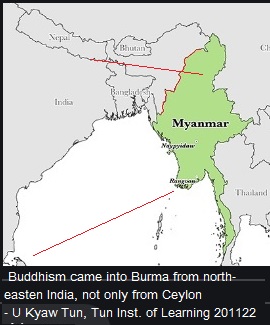
UKT 201121: I doubt that F. Cary would have
known about the overland routes from Magadha
to northern Burma long before the birth of
the Buddha. No wonder he thought that Buddhism
was brought into Burma "by the circuitous
route of Ceylon. See map:
Pilgrim monks from Burma had made regular visits to Buddhgaya
during the late Pagan period, and had left an inscription:
When the religion of Boodha [Buddha
{boad~Da.}] was the prevailing one in Hindoost'han, many of its
forms and ceremonies were probably different from those now practised among the
Burmans; but the circumstance of its former prevalence in India may be inferred
from the numerous images of Boodha which are to be seen in different parts of
Hindoost'han; some lately dug up among the ruins of Gour were evidently
disfigured by the Mahometan monarchs when they took possession of that province.
[UKT ¶]
Search string: Translation of an inscription in the Pali Character and
Burmese Language on a stone at Buddh Gaya in Behar
The Burmans appear to have had from time immemorial a greater intercourse both
in a literary and commercial point of view with Hindoost'han and the nations to
the west, than they have had with the Chinese. A circumstance, perhaps, to
be attributed to the difficulty of becoming acquainted with Chinese books and
literature.
The system of Astronomy and Laws prevalent in the Burman dominions appear to be
substantially the same with those which prevail in Hindoost'han. These were, in
all probability, first introduced into the Burman Empire by the Brahmunas
[Brahmana Poannar

 {braah~ma.Na. poaN~Na:} of of
Mani-poora
{braah~ma.Na. poaN~Na:} of of
Mani-poora
 {ma.Ni.pu-ra.} मणिपूर
It is an authenticated fact that Muni-poora has always supplied
(pre5end-pre6begin)
this nation with Astronomers and Diviners of the Brahman sect, and that these
have always had a considerable influence in the Burman court. These profess to
be of the Hindoo religion, and followers of Bruhmu
 {bRah~ma} [According to Hindu myth, who created the World, at the behest of
Vishnu-deva to rule: an idea diagonally opposite of Buddhist view.]; and it appears that they
have been indefatigable in diffusing their sentiments through the Burman
country. It is true, they have failed in spreading their religious tenets, but
they have amply succeeded in introducing their system of astronomy and the laws
of Munoo
{bRah~ma} [According to Hindu myth, who created the World, at the behest of
Vishnu-deva to rule: an idea diagonally opposite of Buddhist view.]; and it appears that they
have been indefatigable in diffusing their sentiments through the Burman
country. It is true, they have failed in spreading their religious tenets, but
they have amply succeeded in introducing their system of astronomy and the laws
of Munoo
 {ma·nu.Dûm~ma.þût}. The laws, and the system of Astronomy, at present adopted by the
Burmans appear therefore to have come to them from India through Muni-poora.
{ma·nu.Dûm~ma.þût}. The laws, and the system of Astronomy, at present adopted by the
Burmans appear therefore to have come to them from India through Muni-poora.
UKT 201212:
https://en.wikipedia.org/wiki/Wareru_Dhammathat
201212
No traces of Chinese religion appear in the Burman empire; and the only
circumstance in which the Burmans seem to have imitated the Chinese in latter
ages, is in their mode of building and in their official equipage, all of which
is evidently of Chinese origin. Except in construction and style, the Burman
language, which is the subject of the following pages, has, however, every
appearance of having originated from the Chinese, being, like it, made up of a
certain number of monosyllabic sounds, derived from natural objects, and most
commonly conveying a general idea of some action or quality: these words bear
but little resemblance to those of any of the languages spoken to the westward
of the Burman dominions.
It is probable, that there was a period in which the Burman language was merely
a dialect of the Chinese, and that the introduction of the religion of Boodha
{boad~Da.}
brought with it the Sungskrit
 {þän-SkRRi.ta.} संस्कृत language, or rather that dialect of it called the Magudha
 {ma-ga.Da.}, which may have been one great cause of the Burman language's gradually
(pre6end-pre7begin)
assuming its present form. At the present day it abounds with words evidently
derived from the Magudha, some of which are become quite naturalized by use and
custom; other again, not quite so common in conversation, are found in their
religious books to a degree scarcely to be conceived. The language being formed
upon the monosyllabic system, this renders it impossible that words
consisting of many syllables should be blended therewith without being
perceived; and any one with the least attention may always detect every word of
a foreign origin.
{ma-ga.Da.}, which may have been one great cause of the Burman language's gradually
(pre6end-pre7begin)
assuming its present form. At the present day it abounds with words evidently
derived from the Magudha, some of which are become quite naturalized by use and
custom; other again, not quite so common in conversation, are found in their
religious books to a degree scarcely to be conceived. The language being formed
upon the monosyllabic system, this renders it impossible that words
consisting of many syllables should be blended therewith without being
perceived; and any one with the least attention may always detect every word of
a foreign origin.
The Burman language, then, in its formation, seems to resemble the Chinese, but,
in its idiom and construction, the languages of Hindoost'han, and it may
consequently be styled a language which partakes both of the monosyllabic and
polysyllabic system.
There are but few words in the Burman language which coincide with the Chinese
in signification. Some vestiges of similarity may, however, be traced among the
verbal roots or monosyllabic sounds. [UKT ¶]
UKT 201125: The term verbal roots
 {a·mric} is not commonly met in Bur-Myan grammar,
an observation I've checked with my good old
friend U (Dr.) Tun Tint of MLC. However, see:
https://en.wikipedia.org/wiki/Burmese_language
201125
{a·mric} is not commonly met in Bur-Myan grammar,
an observation I've checked with my good old
friend U (Dr.) Tun Tint of MLC. However, see:
https://en.wikipedia.org/wiki/Burmese_language
201125
"The basic word order of the
Burmese language is SOV (subject-object-verb).
Pronouns in Burmese vary according to
the gender and status of the audience. Burmese
is monosyllabic (i.e., every word is a
root to which a particle but not another
word may be prefixed).
[54] Sentence structure determines syntactical
relations and verbs are not conjugated. Instead
they have particles suffixed to them. For example,
the verb "to eat,"
 {sa:} is itself unchanged when modified."
This circumstance, among others, serves to
strengthen the idea that at some remote period was, no satisfactory evidence
appears. The most probable conjecture is, that the introduction of foreign words
and phrases, which accompanied the religion of Boodha, tended to polish the
Burman tongue, and caused it to partake in some measure of the polysyllabic
plan.
Since the introduction of the Magudha language into the Burman Empire, the
Burman language has been much cultivated. This
(pre7end-pre8begin)
is corroborated by the fact that many Grammars and Dictionaries of the
Magudha
{ma-ga.Da.} language are still extent: many of the writings of Boodha
{boad~Da.} also, which
are to be met with in every part of the country, have been translated into
Burman; and the commentaries upon them by Burman writers are so numerous as
almost to defy calculation. [UKT ¶]
Learned Burmans have also written many treatises
upon the Burman language, which consist chiefly of directions for writing the
roots
correctly, and for translating from the Magudha into the Burman language;
but no one has yet attempted improving the vernacular language of their own
country. It is a fact, that a Brahmun [Brahmin] of Bengal, who has only acquired a
smattering of the Sungskrit [Sanskrit], looks up on the Bengalee, his native language, as
beneath his notice.
From what has been said, it will appear that the Burman language is
formed from monosyllabic roots, and founded upon the monosyllabic system; but
that this system is again modelled in such a way as to admit of the construction
and idiom of a polysyllabic language. This will probably appear with greater
evidence from the present work.
Proper names, and names of sensible objects excepted, all nouns are formed
regularly from verbal roots, and from these verbals are formed adjectives and
participles; the language is also supplied with inflective terminations for all
the cases of nouns.
The chief peculiarity of the Burman language lies in the verbs.
(pre8end-end of Preface)
Contents of this page
(p001)
The Burman *
(
Cp001-fn01) abugida alphabet
consists of forty-five akshara letters
{ak~hka.ra.} of which twelve are vowels
 {þa.ra.} and thirty-three consonants
 {byæÑ}. [notice the absence of Double-dot
 {wic~sa.} in
 ]
]
UKT 210204: I've been looking into the real meaning of the Pali-Myan word Ak'khara
{ak~hka.ra.} which implies the opposite of something that is not stable.
Ak'khara
{ak~hka.ra.} implies the one-to-one relationship of marking and sound, i.e.
between script and speech - the basis of a perfect phonetic language.
Vowels
:
{þa·ra.}
 {a.} ɑ † (Cp001-fn02) --
 {a} a --
 {I.} i --
 {I} ee --
 {U.} oo
 {U} oo
 {É} e --
 {è:} i --
 {AU:} au --
 {AU} au --
 {än} an --
 {a:} ?


UKT 210105: In BEPS languages, except in
Eng-Lat, vowels
{þa·ra.} are differentiated in various ways,
such as:
1. Matching pair vs. Non-matching pair:
 {þa·wûN} vs.
 {a.þa·wûN}; .
2. Intrinsic vowel vs. Nuclear vowel of the akshara:
 {mwé-hkän þa·ra.} vs. Nuclear vowel of the CVÇ
syllable
{mwé-hkän þa·ra.} vs. Nuclear vowel of the CVÇ
syllable
 {Ñu-ka.li þa·ra.}
3. Vowel-Letters:
{I.}
{I} ;
 {U.}
{U}
;
{É}
{U.}
{U}
;
{É}
 {AU:}, vs.
Vowel-signs: --
{i.}
 {i} ;
{i} ;
 {u.}
{u.}
 {u}
;
{u}
;
 {é}
{é}
 {au:}
{au:}

Note: Romabama notations for
{a.þa·wûN}
is still debated.
UKT 210205: Since we cannot rely on human ear to analyze the "human speech",
we usually rely on formants which are a measurement of the sound-waves
produced by a human.
Consonants :
{byæÑ:}
--
------------ c1, c2
--------------------------- c3, c4
--------------------------- c5
r1:
{ka.} ka ---
 {hka.} kha ------
 {ga.}
ga --
{ga.}
ga --
 {Ga.} gha ---
 {gna.} gna /
 {ng}
{ng}
r2:
 {sa.}
cha --
{sa.}
cha --
 {hsa.} chha ----
 {za.}
ja --
{za.}
ja --
 {Za.} jha ------
 {Ña.} gneea /
 {Ñ}
{Ñ}
[affricate:
 {ca.},
 {cha.} ------------
 {ja.} , ? {Ja.} -----------
 {ña.}/
 {ñ} : UKT addn]
r3:
 {Ta.} ta --
 {HTa.} tha --------
 {ða.} da --
 {Ða.} dha ----
 {Na.} na /
 {N} na ,
r4:
{ta.} ta --
 {hta.} tha ---------
 {da.} da
--
{da.} da
--
 {Da.} dha ----
 {na.}
na /
{na.}
na /
 {n} na ,
r5:
 {pa.} pa --
 {hpa.} pha -------
 {ba.} ba
--
{ba.} ba
--
 {Ba.} bha ----
 {ma.} ma /
 {m} ma ,
r6:
{ya.} ya --
 {ra.} ra -------------
 {la.} la --
 {wa.} wa -----
 {þa.} tha /
 {þ}
{þ}
r6: ---------------
 {ha.} ha ------------
 {La.} lla --
{än}
an ------ ---------------
{La.} lla --
{än}
an ------ ---------------
[- to which may be added the diacritic character
 {än}-sign ]
UKT 201212: In modern Akshara-matrix,
approximant row r7, r7c1 and r7c5 are
missing. In Carey,
{ha.} ha --
{La.} lla --
{än} an , are shown starting from c1 cell
to cell 3, leaving the last two cells blank.
Another noteworthy point is Carey shows r1c5 as
{gna.} gna . I've included the
killed-forms of all the c5, r1c5, r2c5,
r3c5, r4c5, and r5c5. It is to be noted that
F. Carey had failed to notice that Bur-Myan
r2 is Palatal-stop, whereas in
Mon-Myan and Skt-Dev r2 is
Palatal-affricate. Since English
speakers can only hear and pronounce the
affricates, he had thought that
{sa.} is «cha »--
{hsa.} is «chha » . No wonder our
{Ña.}/
{Ñ} is lost!
(p001end-p002begin)
Contents of this page
UKT 201227: For the sake of uniformity and
unambiguity, keep in mind how the aksharas are arranged
in a matrix-form: rows x columns. The first group of well-defined POA (Place
of Articulation)  {wag~ga.} : 5 x 5 , and the second
group of uncertain POA
{a.wag~ga.}.
{wag~ga.} : 5 x 5 , and the second
group of uncertain POA
{a.wag~ga.}.
§001. The first twenty-five consonants are divided
into five rows classes

 {pæÑ~sa. wag~ga} .

[Note the Nya-major and Mauk-cha.]
[Row #1 , velar ] - From
{ka.} to
{gna.}, is the first
{ka. wag~ga.};
[Row #2 , palatal]
- from
{sa.} to
{Ña.}, the second
{sa. wag~ga.};
[Row #3, retroflex]
- form
{Ta.} to
{Na.}, the third
{Ta. wag~ga.};
[Row #4, dental ] - from
{ta.} to
{na.}, the fourth
{ta. wag~ga.} ; and
[Row #5 , labial ] - from
{pa.} to
{ma.}, the fifth
{pa. wag~ga.}.
The rest are called
{a.wag~ga.}, or miscellaneous [ approximants] .
§002. The first [c1] and third [c3] akshara letters of each
row class are unaspirated, the second
[c2] and fourth [c4] aspirated, and the fifth [c5] nasal.
UKT 201227: There is an issue with the term "aspiration" because it gives
a wrong impression of the pronunciation of the akshara who are unable to
hear our pronunciations clearly because of the restriction imposed on their
hearing by their L1 (mother-tongue).
as·pi·ra·tion - n. ¹. Expulsion of breath in
speech. ². Linguistics a. The pronunciation of a
consonant with an aspirate. b. A speech sound produced with an
aspirate. ³. The act of breathing in; inhalation. -- AHTD
Similarly with the term "nasal": velar r1c5 is
not nasal when it appears either as onset or coda in a syllable.
Palatal r2c5 can be of two different species: the stop {Ña.}/
{Ñ} and the affricate {ña.}/ {ñ}. The stop {Ña.}/ {Ñ} is a non-nasal
when it appears as Onset and also as Coda, whilst the affricate {ña.}/ {ñ}
is a nasal either as Onset or Coda.
§003. The characters letters are arranged by Magudha [Magadha] grammarians according to their
different organs [in the mouth] in the following manner:
The first row class
{ka.wag~ga.}, viz.
{ka.}
{hka.}
{ga.}
{Ga.}
{gna.}, and the vowels
{a.} and
{a} , together with
{ha.}, are called

 {kûN~HTa.za},
velar
{kûN~HTa.za},
velar gutturals. [UKT ¶ ]
The second
{sa. wag~ga.}, viz.
{sa.},
{hsa.},
{za.},
{Za.} and
{Ña.} and ; the vowels
{I.} and
{I} together with
{ya.},
are
 {ta-lu.za}, palatal. [UKT ¶]
The third
{Ta. wag~ga.}, viz.
{Ta.},
{HTa.},
{ða.},
{Ða.},
{Na.} and together with
{ra.} and
{La.} are
 {moad~Da.za} retroflex
 linguals. [UKT ¶ ]
The (p002end-p003begin) fourth
{ta.wag~ga.}, viz.
{ta.},
{hta.},
{da.},
{Da.}, and
{na.}, together with
{la.} and
{Ba.}, are
 {dûn~ta.za}, dentals. [UKT ¶ ]
The
fifth
{pa.wag~ga.}, viz.
{pa.},
{hpa.},
{ba.},
{Ba.}, and
{ma.}, together with the vowels
{U.} and
{U} are
 {AUT~HTa.za}, labials.
The vowel
{É} is both guttural and palatine;
{AU:} is guttural and labial, and
{wa.} dental and
labial.[UKT ¶ ]
{AUT~HTa.za}, labials.
The vowel
{É} is both guttural and palatine;
{AU:} is guttural and labial, and
{wa.} dental and
labial.[UKT ¶ ]
N.B. The vowels
 {è:} and
{AU}, not being used in the Magudha language, are omitted in
the above arrangement. However, as they belong to the Burman akshara
{è:} and
{AU}, not being used in the Magudha language, are omitted in
the above arrangement. However, as they belong to the Burman akshara alphabet, and are
indispensably necessary in writing the language, they are reckoned with their
respective short vowels; in which case
{è:} is both a guttural and a palatal, and
{AU} guttural and labial.
UKT 201227: The terms "short vowel" and "long vowel" are convenient, but
are misleading because of which we usually give the time-duration of the
vowel sound in terms of the time it takes you to blink your eye -
eye-blinks. Thus,
 {ka:.} (1/2 blnk)
{ka.} (1blnk),
{ka:.} (1/2 blnk)
{ka.} (1blnk),
 {ka} (2blnk),
 {ka:} (emphatic 2 blnk)
§004. The akshara letters
[Semi-nasals and Nasals]
[r1c5]
{gna.}/
{ng}, [Semi-nasal]
[r2c5]
{Ña.}/
{Ñ} - Palatal-stop [Semi-nasal]
----------
{ña.}/
{ñ} - Palatal-affricate [UKT addn]
[r3c5]
{Na.}/
{N}
[r4c5]
{na.}/
{n} [True-nasal]
[r5c5]
{ma.}/
{m} [True-nasal]
are called

 {nha-la.da.ni.ka. ak~hka.ra.} or nasals.
§005. The vowels are either:
- similar
 {þa.ma-na.} 'same or similar' [UHS PMD0988] as
----
{a.} (1 blnk) and
{a} (2 blnk),
----
{I.} (1 blnk) and
{I} (2 blnk),
----
{U.} (1 blnk) and
{U}
(2 blnk); or
- dissimilar
as
{a.}
and
{I.},
{I.} and
{U.},
{U.} and
{AU:}, &c, viz. every vowel is similar to itself, and to its
corresponding long or short vowel.
In the Burman language (p003end-p004begin)
{É},
{è:},
{AU:} and
{AU} and are always reckoned dissimilar to all others; but in the Magudha
[Pali]
only
{É} and
{AU:}.
UKT 201227: When we say there are only 5 vowels in English - a e i o u -
we mean that there only 5 characters to represent vowel-sounds. This
statement is not strictly true. In Eng-Latin there are about 15 vowel-sounds
which can be easily differentiated from each other. It is the same in
Bur-Myan which we represent with 12 to 13 characters. In Pali-Myan, there
are 8 characters.
§006. The Magudha [Pali] grammarians reckon eight vowels only,
- three of which
are short
(1 blnk)
 {raþ~þa.} [ 'short' - UHS PMD0811c2], as
{a.},
{I.} and
{U.};
{raþ~þa.} [ 'short' - UHS PMD0811c2], as
{a.},
{I.} and
{U.};
- the rest are accounted long
(2 blnk)
 {di-Ga.} as
{a},
{I}, {U},
{É} and
{AU}.
{di-Ga.} as
{a},
{I}, {U},
{É} and
{AU}.
This remark refers to the writing of the Magudha [Pali] language
in the Myanmar-akshara Burman character.
§007.
[Controversial r6c5 non-nasal]
{þa.} is properly the dental sibilant s , agreeing with the Deva-nugura
[Devanagari akshara], but
by the Burmans it is constantly pronounced like the English th in <thatch>.
[UKT ¶]
UKT 201224: In Skt-Dev, there are 3 sibilants श ś /ʃ/ ; ष ṣ /s/; स
s /θ/. In place of these three Bur-Myan has only one thibilant
{þa.} /θ/. Because of the IPA /θ/, Skt-Dev स s /θ/,
is
pronounced like the English th in <thatch>. Because the
problem is in digraph th , Romabama has to adopt the Old English
"Thorn character" þ . Thus,
{þa.} /θ/.
Moreover, the IAST (International Alphabet for Sanskrit
Transcription for Skt-Dev r4c2 थ «tha» makes the digraph th confusing
in BEPS, and there is no option but not to use this digraph at all:
- r4c2:
{hta.} थ «tha» /tʰ/
- r6c5:
{þa.} स «s» /θ/
There
being only this sibilant, two new ones have been introduced into the language,
but they are not much known, and are only used by the learned when there is
occasion to write the Sungskrita [Sanskrit] language in the Myanmar-akshara
Burman characters, or by brahmuns [Brahmin] who visit that country. [UKT
¶]

They [ श ś /ʃ/ ; ष ṣ /s/; स s /θ/ ] are the palatine,  or
sh agreeing
with the Skt-Dev
or
sh agreeing
with the Skt-Dev Deva-nugura , and the lingual,
 or
sh, agreeing with the Deva-nugura.
or
sh, agreeing with the Deva-nugura.
UKT 201224: The above last line is confusing
on 3 counts:
1. uncertainty of sh in the downloaded pdf page,
2. Carey using
old-form of Devanagari, and
3. the old glyphs,
and
,
used by Sanskritists in Burma having no relation to any character of the
Bur-Myan script.
In face of the above objections, I've to come up with news glyphs
for Romabama, taking Eng-Latin, Pali-Myan and Skt-Dev into consideration.
Refer to UHS-PMD page-{za.}. All three are
basic aksharas and are stable under the Virama
{a·þût}.
§008.
[The retroflex of row#7, La'major
 {La.} is only used in writing words derived from Magudha [Pali].
UKT 201227: The retroflex of row#7
{La.} is known as La-major, and is directly under row#6
{la.} which is known as La-minor. Caution: do
not take anything seriously of what the English speakers say of row#6
{la.} when they cannot even pronounce the similar Welsh phoneme. They cannot
pronounce the name Llywelyn correctly, whereas a speaker of Bur-Myan - my
friend Dr. Maung Di - could easily do (from a personal experience of my
friend during his stay in London doing his Ph.D.) . The English <LL> is our
Bur-Myan
 {lhu} from
 {lha.}.See
https://en.wikipedia.org/wiki/Llywelyn_ap_Gruffudd 201227
{lha.}.See
https://en.wikipedia.org/wiki/Llywelyn_ap_Gruffudd 201227
§009. In words derived from the Magudha
[Pali] the
{þe:þé:tín} mark
( )
(p004end-p005begin) is
used instead of any one of the nasals, but in the
Burman it is seldom used, except it be for the final
{m}. It is reckoned among the consonants by the
Magudha [Pali] grammarians, and is called
 *
{än byíñ~za.na.}, and
{þe:þé:tín} or
*
{än byíñ~za.na.}, and
{þe:þé:tín} or


 [ ? ] by the Burmans.
UKT 201224: Pali-Myan
is derived from Bur-Myan
 {byæÑ:}
in which Nya-major
{Ña.} (Palatal-stop) is under Virama-sign. Pali - under the influence of
Aus-Asi Lanka - has only Palatal-affricates, because of which
{Ñ} breaks down into Nya'minors
{byæÑ:}
in which Nya-major
{Ña.} (Palatal-stop) is under Virama-sign. Pali - under the influence of
Aus-Asi Lanka - has only Palatal-affricates, because of which
{Ñ} breaks down into Nya'minors
 {ñ~ña.} and we arrive at
 {byíñ~ña.}. At this point, confusion between Tib-Bur Palatal-stop phonology
and Aus-Asi Palatal-affricate phonology comes in and we landed in
{byíñ~za.na.}. This is only my conjecture which needs to be confirmed from
similar situations.
{byíñ~ña.}. At this point, confusion between Tib-Bur Palatal-stop phonology
and Aus-Asi Palatal-affricate phonology comes in and we landed in
{byíñ~za.na.}. This is only my conjecture which needs to be confirmed from
similar situations.
Contents of this page
UKT 210122:
Bur-Myan is a phonetic language, and there is almost
one-to-one mapping between Pronunciation Orthoepy
/ˈɔːθəʊɛpi/ and
Spelling Orthography
/ɔːˈθɒɡrəfi/.
The first vowel
{a.} अ
followed by a pause and without a pause (as in
continuous speech) should be differentiated.
{a.} found in Pal-Myan is used for negation, whereas
{a·} as in
 {a·ni} "red colour" does not mean negation.
In Bur-Myan, negation is
{a·ni} "red colour" does not mean negation.
In Bur-Myan, negation is
 {ma.}, e.g.
 {þi.} "know" and
{ma·þi.}.
{þi.} "know" and
{ma·þi.}.
The pair
{a.} अ «a» [vowel duration: 1 eye-blink], and
{a} आ «ā» [2 blnk] are now described as
allophones , but when Carey was doing his
Burmese grammar, the word allophone had not been
coined. "The term "allophone" was
coined by Benjamin Lee Whorf [a chemical engineer
turned linguist] circa 1929. In doing so, he
placed a cornerstone in consolidating early
phoneme theory.
[4]
The term was popularized by George L. Trager and
Bernard Bloch in a 1941 paper on English phonology
[5]
and went on to become part of standard usage within
the American structuralist tradition.
[6]
" - from:
https://en.wikipedia.org/wiki/Allophone 210101
In Eng-Lat (as well as Skt-Dev), there are only 2 allophones, but in Bur-Myan,
there are three:
{a.} (1 blnk) (short),
{a} (2 blnk) (long), and
{a:} (emphatic).
In going from one language to another as in BEPS, you'll find short vowels
changing into long especially in versification. Such a change is to make
listening and repetition easier. "Euphony
involves the use of long vowel sounds, which are more melodious than
consonants. Euphony involves the use of harmonious consonants, such as l, m,
n, r, and soft f and v sounds. Euphony uses soft consonants or semi-vowels,
including w, s, y, and th or wh, extensively to create more pleasant
sounds." - Google search 210101
§010.
{a.} is pronounced as a in <pan>. Sometimes it is softened so as to have the sound
of the first a in <America>; as:
-
 {ka.hkrín} kagen, a dancing : [wrong example ?]
-  {ka·nûn:} kanan, a crab
-
 {ka·Ñic} kagneet, an iron stylus .
§011.
{a} has the sound of a in <path>.
§012.
{ I. } is sounded as i in <till>. The representative symbol of this letter
is frequently combined with the vowel
{a.}, thus
{
i. }, and has the same sound with
{ I. }, but is
never used instead of it.
§013.
{ I } is pronounced as ee in <eel>. It is the long vowel of the preceding. The
symbol of this vowel is frequently combined with
{a.} thus
{i} , and has the same sound
with
{ I }, but they are not used one for the other.
(p005end-p006begin)
§014.
or
{U.} is pronounced as oo in <good>. The symbol of the vowel
is frequently
combined with
{a.} thus
{u.}, but they cannot be used reciprocally.
§015.
{
U } is sounded as oo in <cool>. Sometimes the symbol of the vowel
{
U } is
combined with
{a.} thus
{u}, which cannot be used instead of
{
U } though it has the same
sound.
Contents of this page
 UKT
201228: We seem to be OK with our study of vowels until we come to the
Dissimilar pairs, particularly with Pali-Mya
{É} as in English <name>, and
{AU:} as in <audience>. Vowels are produced deep in the throat, and there
was no way for the ancient phoneticians to observe them. Then comes along
the surgery of parts of the throat in treating cancer, and the study of
vowels took a new turn with the study of Auditory phonetics. The vowels are
produced along with the movement of the tongue in a vowel-space. We then
idealized the vowel space as a vowel-quadrilateral. See: Daniel Jones
UKT
201228: We seem to be OK with our study of vowels until we come to the
Dissimilar pairs, particularly with Pali-Mya
{É} as in English <name>, and
{AU:} as in <audience>. Vowels are produced deep in the throat, and there
was no way for the ancient phoneticians to observe them. Then comes along
the surgery of parts of the throat in treating cancer, and the study of
vowels took a new turn with the study of Auditory phonetics. The vowels are
produced along with the movement of the tongue in a vowel-space. We then
idealized the vowel space as a vowel-quadrilateral. See: Daniel Jones
- https://en.wikipedia.org/wiki/Daniel_Jones_(phonetician) 201227
But still we cannot relying on our ear only, and we have to go into the
study of Acoustic phonetics studying formants. See a paper by R. L. Diehl
(2007) in TIL HD-PDF and SD-PDF libraries:
-
RLDiehl-AcousAuditoPhonetics<Ô> /
Bkp<Ô>
(link chk 201228)
§016.
{É} the sound is that of the English a in <name>. It also expresses the sound
of the digraph diphthong ai in <air>. It is sometimes, though but seldom, written with the
symbol joined, thus
{é}.
UKT 201226: The above section shows that English speakers cannot
differentiate
{é} from
{è:}. Though Pal-Myan has vowel-letter
{É}, the fact that it does not have vowel-letter corresponding
{è:} shows that Lankan speakers of Ceylon also have difficulty in
differentiating these two sounds. It also shows that Magadhi - the
mother-tongue of Gautama Buddha - arrived in northern-Myanmar through
over-land routes and not by "the circuitous route of Ceylon" as stated by
Carey.
§017.
{è:} constantly expresses the sound of the digraph diphthong
ei in <their>.
UKT 210101: Though described as "pair"
{é} (2 blnk), and
{è:} (2 blnk) are not-paired. Yet, in Bur-Myan, each has allophones:
-
 {é.} (1 blnk),
{é} (2 blnk),
{é.} (1 blnk),
{é} (2 blnk),
 {é:} (emphatic 2 blnk)
-
{è.},
 {èý} (2 blnk),
{è:} (emphatic 2 blnk)
{èý} (2 blnk),
{è:} (emphatic 2 blnk)
§018.
or
{AU:} is constantly pronounced as au in <audience>. The second of the above
characters is an abbreviation of the first, and is most commonly used in
writing. The symbol of this vowel is sometimes combined with
{a.} thus
{au:}, but is not
used instead of the proper vowel though they are pronounced alike.
§019.
{AU} is pronounced as aw in <awful>. Some-(p006end-p007begin)-times
also the symbols of this vowel are combined with the
{a.} to form this character
 {au} which has the same sound, but cannot be used instead of
{AU}.
{au} which has the same sound, but cannot be used instead of
{AU}.
N.B. The aksharas letters
{É},
{è:},
{AU:} and
{AU}, though reckoned among the vowels, are properly diphthongs. [UKT ¶]
UKT 201226: I dispute that they are diphthongs. They are monophthongs.
Moreover,
{AU:} and
{AU}, taken as a pair is a matching pair
{þa.wûn} differing only in emphasis. Because of which in BEPS, I've
substituted
{AU:} withj
 {ou}. With
{ou}, I can handle English words such as <now>
{ou}. With
{ou}, I can handle English words such as <now>
 {nou}.
The forms
{au:} and
{au} are but seldom used instead of their original characters, as
-
 {auk} below , is never written
-
 {aún} conquer , is never written
§020. [Single-dot above]
- this mark has the sound of an in <pan> .
UKT 201226: The above statement is incorrect. For example
 {kûn} in my grandson's name Kan Tun is pronounced with /ʌ/ not /æ/.
<bun> - /bʌn/ - DJPD16-074-c1
<pan> - /pæn/ - DJPD16-394c3
§021. [Double-dot]
 - is pronounced as ah . This mark is never used in Magudha [Pali]
language, and merely as an accent in the Burman. It is called
- is pronounced as ah . This mark is never used in Magudha [Pali]
language, and merely as an accent in the Burman. It is called
 {wi.þiz~za.ni.} .
UKT 201226: Double-dot
, known as
 {wic~sa.pauk} in Bur-Myan is used differently in
Bur-Myan and Mon-Myan:
{ka:} (emphatic 2 eye-blnk) and
{ka:.} (1/2 blnk), respectively.
§022.
 {o} is a monophthong
 diphthong , and will be taken notice of
hereafter.
(p007end-p008begin)
Contents of this page
UKT 210114: In Phonology, whenever we have
to give examples of consonants, it is always
more illustrative to give the PTK consonants
and their killed forms:
{pa.}/
 {p},
{ta.}/
{t},
{ka.}/
{k}. However, keep in mind that English has no
tenuis consonants, and that PTK consonants are
tenuis, and that you must make allowances for
this fact.
{p},
{ta.}/
{t},
{ka.}/
{k}. However, keep in mind that English has no
tenuis consonants, and that PTK consonants are
tenuis, and that you must make allowances for
this fact.
row#1
§023. [Ka'major r1c1 tenuis]
{ka.} has the sound of k in <king>,
[r1c2 voiceless]
{hka.} the aspirated letter , is pronounced something like the conjunct
sound of k and h in <brick-house>.
UKT 210101:
See my note on
Aspiration and other
misunderstanding on Bur-Myan language in BG-indx.htm
Giving the similarity with <brick-house>
is convenient, but not legitimate, because <brick> is one phoneme, and
<house> is a separate one. Failure of the English speakers to understand
that there is no
{ka.} sound, but only the
{hka.} sound in English is one of the reasons that they had hit on the idea of
Aspiration. Another reason might be due to their reliance on the
Pali-pronunciation as spoken in Ceylon which is now called Sri Lanka.
The pair
{ka.} and
{hka.} are now described as allophones , but when Carey was doing his
Burmese grammar, the word allophone had not been coined. "The term
"allophone" was coined by Benjamin Lee Whorf [a chemical engineer turned
linguist] circa 1929. In doing so, he placed a cornerstone in consolidating
early
phoneme theory.
[4]
The term was popularized by
George L. Trager and
Bernard Bloch in a 1941 paper on English phonology
[5]
and went on to become part of standard usage within the American
structuralist tradition.
[6] " -
from:
https://en.wikipedia.org/wiki/Allophone 210101
In IPA notation this allophonic pair would be given as
{ka.}/
{k} /k/ and
{hka.}/
 {hk} /kʰ/.
§024. [Ga'minor r1c3 voiced]
{ga.}
is sounded as g in <gad-fly>. [Ga'major r1c4 deep-H]
{Ga.} its aspirate, has the conjunct of g and h in
<log-house>. [UKT: another inappropriate example citing g and h
which are not in conjunction.]
§025. [The Semi-nasal r1c5]
{gna.} has the sound of gn .
 UKT 201226: The semi-nasal
{gna.} is a non-nasal in the onset, but becomes nasal in the coda as
{ng}. I remember
UKT 201226: The semi-nasal
{gna.} is a non-nasal in the onset, but becomes nasal in the coda as
{ng}. I remember
 {gnak} 'bird' being spelled with non-nasal gn when we were young
before WWII. Then my good friend U (Dr.) Tun Tint of MLC disputes me: he
insists
is always spelled with ng . Now, I can cite F. Carey.
{gnak} 'bird' being spelled with non-nasal gn when we were young
before WWII. Then my good friend U (Dr.) Tun Tint of MLC disputes me: he
insists
is always spelled with ng . Now, I can cite F. Carey.
Phoneticians are more interested in onset consonants than on the codas.
In Bur-Myan the coda-consonant seems to act strongly on the nuclear-vowel,
producing marked effect in the rhime. I'm using this effect to solve the
problem of not-finding a suitable character for representing the semi-nasal
consonant r1c5
{gna.}/
{ng} .
Contents of this page
row#2
§026. [Palatal-stop r2c1 tenuis]
{sa.}
[when killed:
 {c}
has the power of ch in <church>. [r2c2 voiceless]
{hsa.} is the aspirate of the above, and is sounded as chh in
<much-haste> were the two words combined.
{c}
has the power of ch in <church>. [r2c2 voiceless]
{hsa.} is the aspirate of the above, and is sounded as chh in
<much-haste> were the two words combined.
UKT 201228: Eng-Lat does not have Palatal-stops.
What it has are the Palatal-affricates, which we
have to spelled as
 {ya.pín.}-medials as
{kya.},
{ya.pín.}-medials as
{kya.},
 {hkya.},
 {gya.} . Remember, medials are unstable under Virama
{a·þût}. We do not have ch , chh ,
j as basic aksharas.
{gya.} . Remember, medials are unstable under Virama
{a·þût}. We do not have ch , chh ,
j as basic aksharas.

Mistaking the Palatal-stops which has almost no element of /s/ in coda
{c}
for Palatal-affricates which are hissers and hushers having is
the first major misunderstanding of Bur-Myanmar sounds. Moreover,
English speakers fail to understand that they have no tenuis-voiceless
(unless preceded by dental /s/), but only ordinary-voiceless, and it is
 {hkya.} - not
{kya.} - that is in <church>. Romabama has
to invent new glyphs for the hissing sounds:
{hkya.} - not
{kya.} - that is in <church>. Romabama has
to invent new glyphs for the hissing sounds:
Palatal-S:
{sa.}/
{c}
- as in <sick>
Dental-S:
 {Sa.}/
 {S} - as in <sister>
After recognizing the presence of Dental-S, Romabama came up with a whole
class of new consonant-onsets, and can handle English words like
<spin>, <stingy>, <skin>, <smile>, <snake>, <slow>, and <sweep>, with
 {Spa.},
 {Sta.},
 {Ska.},
 {Sma.},
 {Sna.},
 {Sla.}, and
 {Swa.}
§027. [Palatal-stop r2c3]
{za.}
is pronounced as j in <jar>; and its aspirate [r2c4]
{Za.} has the sound of ge and h in <college-hall>.
UKT 201228: Bur-Myan
{Za.} looks like derived from
{sa.} and
{ya.pín}-sign
 . Its equivalent in Mon-Myan
{Zé} looks like derived from
{za.}
and
{ya.pín}-sign
. It is more confusing in Skt-Dev
which uses a conjunct - Pseudo-Za ज ् ञ --> ज्ञ
, in spite of having the regular
{Za.} झ
. Its equivalent in Mon-Myan
{Zé} looks like derived from
{za.}
and
{ya.pín}-sign
. It is more confusing in Skt-Dev
which uses a conjunct - Pseudo-Za ज ् ञ --> ज्ञ
, in spite of having the regular
{Za.} झ
§028. [Semi-nasal Nya-major r2c5]
{Ña.} properly written
{ña.}. [So - Carey thinks that
{Ña.} is not proper! What a lopsided view thanks to the Pali-ists with whom he
must have been working.] The first character, i.e.
{Ña.} is commonly accounted a double letter [i.e. a horizontal-conjunct], though
generally used for the single.
 UKT 201228: It is probable - I insist probable - since the Pagan period -
the Pali-Lankan propagandists are hard at work trying to establish that the true
occupier of cell r2c5 is Nya-minor, and that Nya-major is just a conjunct.
UKT 201228: It is probable - I insist probable - since the Pagan period -
the Pali-Lankan propagandists are hard at work trying to establish that the true
occupier of cell r2c5 is Nya-minor, and that Nya-major is just a conjunct.
Pali-Myan:
{Ñ} is unstale and breaks down into -->
~
{ñ~ña} . e.g. in Pyin-nya - the word for "education" as:
 {píñ~ña}
Bur-Myan:
{Ñ} is stable. e.g. in the word "Nay-pyi-daw" the capital city of
Myanmarpré as:

 {né-præÑ-tau}
For BEPS languages, I've no choice but to leave r2c5 to Nya-minor, and
move Nya-major
{Ña.}/
{Ñ} down to Fricatives by the side of
{ya.}/
 {ý} which actually belongs to Velar.
It is important to note that though in the akshara-matrix, nasals are
grouped together with {wag}-consonants, they seem to form a group by
themselves as a column-5 vertical group. That the nasals are quite different
from the {wag}-consonants are recognized in the IPA table, by placing them
in a separate row below that of the plosive-stops.
Contents of this page
row#3
§029. [The retroflex r3c1 tenuis]
{Ta.} has the sound of t in <lent>. [r3c2 voiceless]
{HTa.} is its corresponding aspirate, and has nearly the power of the conjunct
sound th in <pent-house>.
UKT 210101: Don't mix-up the basic-consonant
{HTa.} which is pronounceable with horizontal-conjunct
 {T~HTa.} which is mute.
is actually
{T~HTa.} which is mute.
is actually
 . It becomes pronounceable when preceded by a syllable such as
 {ku.}, then it becomes
{koaT~Hta.} which is written
{koaT~Hta.} "leprosy". Since,
{koaT~Hta.} is Pali, the disease leprosy is usually written as
{ku.}, then it becomes
{koaT~Hta.} which is written
{koaT~Hta.} "leprosy". Since,
{koaT~Hta.} is Pali, the disease leprosy is usually written as
 {koaT~Hta.nu-na} . (p008end-p009begin)
§030. [The retroflex r3c3 voiced]
{ða.} has the sound of d in <dart>. [r3c4 deep-H]
{Ða.} is the aspirate, and has the sound of dh in <old-house>.
UKT 201228: The phoneme r3c3
{ða.} ड seems to be important in Skt-Dev. It is probable that Sanskrit
formerly did not have
{gna.}/
{ng} in its akshara-matrix and also in its vocabulary. There are two more
aksharas which were originally absent in Skt-Dev. It just borrows
{ða.} ड + dot --> ङ
{wa.} व + diagonal --> ब
{pa.} प + diagonal --> ष
Such borrowings seem to be common among old Sanskrit phoneticians:

{ga.} + dot -->
श
{pa.} + dot -->
ष
See UHS PMD-p.za.
It is also note worthy that though Mon-Myan has a lot of words using
{ða.}, Bur-Myan has almost no use for it.
§031. [Retroflex r3c5 nasal]
{Na.} is pronounced as n .
Contents of this page
row#4
UKT 201230: To explain the following entries further, I'll be using Skt-Dev
aksharas and IAST transliterations in «...». The aksharas involved are:
{ta.} त «ta» - tenuis ;
{hta.} थ «tha» - vl ;
{da.}
द «da» - vd;
{Da.} ध «dha» - deep-H.
And remember English has no tenuis. What they have is ordinary voiceless (vl).
They cannot differentiate /t/ and /tʰ/.
§032. [Dental r4c1 tenuis]
{ta.} त «ta», is the dental t , and is produced by applying the tongue [tip] to
the [root of] upper teeth. [r4c2 voiceless]
{hta.} थ «tha» is the aspirate of the foregoing akshara letter.
UKT 201229: Skt-Dev equivalent of
{hta.} थ «tha» /tʰ/, is the cause of confusion of Bur-Myan
{þa.} /θ/ which is commonly transcribed as <tha> on the international scene.
It has led me to adopt the Old English "thorn" þ for
{þa.}. Theravada Buddhism should be transcribed as Hteravada or
Þeravad, but then nobody would know what it is!
§033. [Dental r4c3 voiced]
{da.}
द «da»,
is the dental d , and is likewise expressed by applying the tongue to the
upper teeth. [r4c4 deep-H]
{Da.} ध «dha» is the aspirate of the above akshara letter.
UKT 201230: It is strange that English speakers were not aware of
movements of the throat (area of the Adam's apple) during the production of
English t /t/ (no vibration), and d /d/ (noticeable
vibration). Then they would have
{hta.} थ «tha» /tʰ/ - (no vibration) as voiceless, and
{da.}
द «da» (voiced); and
{Da.} ध «dha» as deep-H (for Bur-Myan). It is important to point out that in
Mon-Myan
{Dé} ध «dha» it is soft and not deep-H.
§034. [Dental r4c5 nasal]
{na.}
is pronounced as the English n .
UKT 210102: Counting the nasals - c5 column - in the akshara-matrix, from
top to bottom,
{na.}
is the first English nasal.
Contents of this page
row#5
§035. [Bilabial r5c1 tenuis]
{pa.} is sounded like p in <path>, and its aspirate [r5c2 voiceless]
{hpa.} has the sound of ph in <pharisee>, or f in <father>.
UKT 201231: Take note of difference POA in the bilabials and labio-dentals
in the above entry. Bur-Myan words are strictly bilabials involving both
lips, but Eng-Lat and Skt-Dev they are labio-dentals involving the tip of
the upper-front lip and lower-lip. In place of Bur-Myan bilabial
{hpa.}, Eng-Lat and Skt-Dev use labio-dental
 {fa.}. That
{hpa.} has the sound of f in <father> is totally wrong.
{fa.}. That
{hpa.} has the sound of f in <father> is totally wrong.
§036. [Bilabial r5c3 voiced]
{ba}
ब «ba» is sounded like b in <bad>; [r5c4 deep-H]
{Ba.} it its corresponding aspirate.
UKT 210101: Though in Bur-Myan c4-column consonants are all deep-H
-voiced - counterparts of ordinary-voiced c3-column consonants - they are
all "soft" in Mon-Myan. This may also be a source of confusion for English
speakers studying Burmese grammar in matter of aspirates, because they have
assumed that Bur-Myan without a written script had to borrow from the
Mon-Myan, who themselves had to borrow from a southern-Indian script.
§037. [Bilabial r5c5 nasal]
{ma.} is pronounced like the English m in <man>.
UKT 210102: Counting the nasals - c5 column - in the akshara-matrix, from
top to bottom,
{ma.} is the second English nasal. Taking Bur-Myan and Eng-Lat together,
{ma.} is the last nasal. It is also, the first or one of the first sounds
uttered by a human-infant learning to speak. In general, each of all nasals
has 3 coda-allophones in Burmese, and 2 coda-allophones in English,
differing in vowel lengths:
-

 ;
;


The akshara
{ma.} is the negation-prefix in Bur-Myan, but its counterpart in Pal-Myar is
{a.}
Contents of this page
row#6
UKT : Though Approximants have their own row as
row#6, the columns numbers are quite arbitrary.
There are only 33 basic aksharas in Bur-Myan
matrix, but 35 in Mon-Myanmar, making the column
numbers arbitrary. What I'm giving below are
those numbers in Bur-Myan matrix.
§038. [Approximant r6c1 ]
{ya.} has the sound of y in <yard> .
UKT 210102:
{ya.} is the first of the 5 medial-formers of Bur-Myan, e.g.
{kya.},
 {kya},
 {kya:} .
As a medial-former
{ya.} is known as
{ya.pín.} with the sign
.
§039. [Approximant r6c2 ]
{ra.} is pronounced like r in <rat>. It also has the sound of y in <yard>
[in Bur-Myan]
 UKT
210102: It is only in Bur-Myan of the mainland dialect that
{ra.} has the sound of y in <yard>. In Rakhine dialect and in
Pal-Myan, there is a definite rhotic or "rolling" sound and is marked as
{Ra.}. In Skt-Dev the rhoticity is at maximum. (p009end-p010begin)
UKT
210102: It is only in Bur-Myan of the mainland dialect that
{ra.} has the sound of y in <yard>. In Rakhine dialect and in
Pal-Myan, there is a definite rhotic or "rolling" sound and is marked as
{Ra.}. In Skt-Dev the rhoticity is at maximum. (p009end-p010begin)
§040. [Approximant r6c3 ]
{la.} is pronounced like l in <latter>
UKT 210102: Never trust English speakers to give you the correct
pronunciation of
{la.}: they can't pronounce even pronounce the Welsh words like "Llywelyn"
right! According to my friend Dr. Maung Di, it is
{lhya.}
>
 {lhya.} >
 {lhyu} and his Welsh professor confirms that my friend's pronunciation is
correct.
{lhyu} and his Welsh professor confirms that my friend's pronunciation is
correct.
§041. [Approximant r6c4]
{wa.}
is sounded like w in <wart>.
UKT 210102: There is confusion between w
{wa.} and v
 {va.} in German and Hindi (Sanskrit) languages. The glyph for
{va.} is a Romabama invention to handle BEPS languages. Bur-Myan uses
bilabials whereas Sanskrit uses labio-dentals.
{va.} in German and Hindi (Sanskrit) languages. The glyph for
{va.} is a Romabama invention to handle BEPS languages. Bur-Myan uses
bilabials whereas Sanskrit uses labio-dentals.
There is another aspect of
{wa.}
that usually goes unnoticed - spreading or rounding of the lips during
articulation. See §058.
§042. [Approximant r6c5 - thibilant]
{þa.} has both the sounds of the English <th> [different from Skt-Dev. «tha»] as
expressed in words <thatch> and <thee>.
UKT 210102: Bur-Myan is a Thibilant language. Thibilant languages are
quite rare. Eng-Lat has both Thibilants and Sibilants. The Sibilants are
marked by "hushers" e.g. श , and "hissers" e.g. ष .
Romabama has to invent two new glyphs to handle the husher श as
 {sha.}/
 {sh}, and hisser ष as
{Sa.}/
{S} to handle BEPS languages. These being basic aksharas can be under the
Virama.
{sh}, and hisser ष as
{Sa.}/
{S} to handle BEPS languages. These being basic aksharas can be under the
Virama.
Contents of this page
row#7
§043. [Approximant r7c2 ]
{ha.} has the sound of h in <hat>.
UKT 210102: Let's listen to Cockney or East London accent which has no
h sound, and watch clips from My Fair Lady in TIL
HD-VIDEO and SD-VIDEO
• Phonetics techniques in time of Henry Sweet
-
zIntroEngMyFairLady1964<Ô> /
Bkp<Ô> (link chk 201117)
• Movie trailer
-
zMyFairLady1964Trailer1<Ô> /
Bkp<Ô> (link chk 201117)
§044. [Approximant r7c3 retroflex La'major]
{La.} is sounded as l .
§045. [The cell r7c4 in modern akshara-tables is
occupied by
{a.} which is not a negation-prefix
{a.} as in Pali-Myan. Bur-Myan negation-prefix is
{ma.}. Carey has placed the Dot-above
{þé:þé:tín}-sign
in r7c4 and has stated:]
has the sound of n in <an> .
§046. The [following 10] consonants:
-------- c1, c2
---------------- c3, c5
r1: --- ---, ---
---- - ------ ---,
{Ga.}
r2: ---- ---, ---
--------------- ---,
{Za.}
r3:
{Ta.},
{HTa.} ---
{ða.},
{Ða.}
r4: ---- ---, ---
----------
{da.},
{Da.}
r5: --- ---, ---
-----------
{ba.},
---
-----------------------------
{La.}
are chiefly used in writing words derived from the Magudha (Pali), and
are but seldom used in the Burman language. [However, some are routinely used in
Mon-Myan language.]
Among the above
{Ga.},
{Ta.},
{Ta.},
{ða.},
{Ða.},
{ba.},
and
{La.} are never used as initials [onsets] in words purely Burman;
{Za.} is used only twice, and
{da.}
and
{Da.} but seldom. These letters are often used as initials in the Magudha
language.
§047. The Burmans cannot pronounce the aksharas
letters
{ra.} and
{þa.} when they are the initials of a compound consonant. [UKT: issue 1] In this
case therefore they are generally mute. [UKT: issue 2] (p010end-p011begin)
N.B. Nearly all the consonants and the symbols of the vowels are
called by different names, which are here omitted. In repeating the akshara
alphabet the Burmans make scarcely any distinction between the
pronunciation of the aspirated [c2 voiceless] and unaspirated [c1 tenuis]
aksharas letters. [UKT: issue 3]
UKT 210103: I've 3 issues with regard to §47.
• Issue 1: What does Carey means by the
"initials of a compound consonant.
Obviously with
{ra.}, he must mean
 {rwa.} and
 {rha.}. With
{rwa.}, how we pronounce is correct. There
are 3 allophones,
{rwa.} (1blnk) 'crisp',
{rha.}. With
{rwa.}, how we pronounce is correct. There
are 3 allophones,
{rwa.} (1blnk) 'crisp',
 {rwa} (2 blnk) 'village',
{rwa:} (emphatic) - part of
{rwa} (2 blnk) 'village',
{rwa:} (emphatic) - part of
 {hso:rwa:}. If he has meant
{rha.} which we pronounce /ʃ/, he is correct
- because the medial (compound consonant} can
only generate /ɹ/ not /ʃ/.
{hso:rwa:}. If he has meant
{rha.} which we pronounce /ʃ/, he is correct
- because the medial (compound consonant} can
only generate /ɹ/ not /ʃ/.
With
{þa.} which is a thibilant, if he had meant that
it should have been a sibilant , then his
observation is dead wrong.
• Issue 2: I do not know what he means "they
are generally mute". He needs to cite examples.
• Issue 3: To this day Westerners, cannot
"hear" the difference in sound
that we make in pronouncing
{ka.} and
{hka.}.
Contents of this page
Chapter 01 :
Section 02 : Combing the Aksharas (vowels or consonants)
with other Aksharas (vowels or consonants)
Of Compounding Aksharas Letters
UKT 210204: The term "compounding
letters" mean combining two aksharas
into one. In Romabama we have the following processes: The can be:
Process#1 - vowel + another vowel, e.g.,
{i.} +
{u.} -->
{o}
Process#2 - consonant +
a vowel, e.g.
{ka.} +
{a·þût} +
{i.} -->
{ki.}
Process#3 - consonant + another consonant, e.g.
{ka.} +
{a·þût} +
{ya.} -->
{kya.}
With
consonant and an ordinary consonant we can
get a mute combination known as conjunct
such as
 {k~ya.}, or with an approximant called
a medial former, we can get a medial
such as
{kya.} which is pronounceable.
{k~ya.}, or with an approximant called
a medial former, we can get a medial
such as
{kya.} which is pronounceable.
§048. The vowel
{a.} is inherent in every consonant.
UKT 210104: The vowel,
{a.} अ «a», that is present in both
Mranmakshara (BEPS coined-word for Myanmar-akshara)
and Devanagari script is known as the
"inherent vowel"
{mwé-hkän þa.ra.}. It is this vowel that
differentiates the Akshara-syllable
system of writing and the Alphabet-Letter
system. For example,
{ka.} is a syllable and is pronounceable, whereas k /k/ is
just a letter and is mute. Not only Carey (of 2 centuries past), but
also many linguists of the present fail to make this distinction -
making Bur-Myan language difficult to learn. We can use a simple tool, the
Viram
{a·þût} "vowel-killer", to turn an akshara into a letter:
{ka.} क +
{a·þût} -->
{k} क् /k/
§049. Consonants may be
combined with either the vowels or consonants. The
compound character thus formed is termed
 {yoat~ta. ak~hka.ra.}, or a compound akshara
letter .
UKT 210104: Romabama compounding processes
Process#2 - consonant +
a vowel, e.g.
{ka.} +
{a·þût} +
{i.} -->
{ki.}
Process#3 - consonant + another consonant, e.g.
{ka.} +
{a·þût} +
{ya.} -->
{kya.}
§050. When a vowel follows a consonant in the same
syllable, it loses its original form, and is represented by a symbol, [e.g.
Ya'pín sign
]
Contents of this page
Romabama compounding process #2 :
consonant + vowel
Of compounding the Vowels with a Consonant
UKT 210205: See: Romabama Akshara Compounding Process#2
- consonant + a vowel, e.g.
{ka.} +
{a·þût} +
{i.} -->
{ki.}
§051. The following table represents the symbolical
characters of the respective vowels, the vowels combined with a consonant, and
the power of each when thus combined:

(p011end-p012begin)
UKT 210104: Page 012 opens with the table presented on the right. This table
gives the allophones of the vowels, e.g.
{a.} (vowel-duration 1 eye-blink),
{a} (2 blnk), and
{a:} (3 blink). In the last line of Carey's table, there is a mix-up between
Bur-Myan and Mon-Myan.
Bur-Myan :
{ka.},
{ka},
{ka:} //
 {kaa.} (1/2 blnk}
Mon-Myan:
 {ka:.},
{ka.},
{ka}
{ka:.},
{ka.},
{ka}
The akshara नः is present in the last line of Skt-Dev Gayatri Mantra
BkCndl<))
After listening Gayatri Mantra many times, I came to realize that, नः is
equal to
Mon-Myan  {na:.}.
It is interesting to see how "visarga"
{wic~sa.} विसर्गः is used differently in
Skt-Dev, Mon-Myan, and Bur-Myan:
{na:.}.
It is interesting to see how "visarga"
{wic~sa.} विसर्गः is used differently in
Skt-Dev, Mon-Myan, and Bur-Myan:
Mon-Myan
{ka:.} (1/2 blnk} = Bur-Myan
{kaa.} (1/2 blnk},
and {na:.} =
 {naa.}
When I was a child going to a vernacular school in Kungyangon town, we
have to recite, firstly with basic consonant
{ka.} /k/ - the allophone of /k/ with vowel-duration = 1 eye-blink. :
{ka.} <ka>,
{ka} <ka> ;
{ki.} <ki >,
 {ki} <kee>;
{ku.} <koo>,
{ki} <kee>;
{ku.} <koo>,
 {ku} <koo>;
 {ké} <ke>,
 {kè:} <ki>;
 {kau.} <kau>,
 {kau} <kau>;
{kän} <kan>,
{ka:} <?>
{kau} <kau>;
{kän} <kan>,
{ka:} <?>
Then, we proceed to basic consonant
{hka.} /kʰ/ - the second allophone of /k/ with vowel-duration = 2 blnk:
{hka.},
 {hka};
 {hki.},
 {hki};
 {hku.},
 {hku};
 {hké},
 {hkè:},
 {hkau.},
 {hkau};
 {hkän},
 {hka:}
You can now jump to medial consonants - §090
§052. The second symbolical character of the vowel
{a} [ Mauk'cha sign
 ] is used only in junction with the akshara
 letters
{hka.},
{ga.},
{gna.},
{da.},
{pa.} and
{wa.},
because the first character cannot be joined with them without making them
assume the form of other akshara letters .

UKT
210104: §052 is stated with a rhyme in modern terms - a mnemonic - which
I've named Miss Turkey Toothsome:
 {hkin-gu-gnau:} ("Khin" is a name given to a girl; "gu" reminds me of the
sound made by turkeys; "gnau" generally refers to front-teeth jutting out.)
The second phrase
{hkin-gu-gnau:} ("Khin" is a name given to a girl; "gu" reminds me of the
sound made by turkeys; "gnau" generally refers to front-teeth jutting out.)
The second phrase
 {dau:poän-wa.} means the opening or the mouth of something usually a river.
If the aim is to prevent "making them assume the form of other akshara", we
should include other aksharas formed from single-circles, such as
{sa.},
{hpa.},
{Da.}, etc. So I've set a simple rule: use Mauk'cha for one-circle akshara, and
Weik'cha for two-circle akshara.
{dau:poän-wa.} means the opening or the mouth of something usually a river.
If the aim is to prevent "making them assume the form of other akshara", we
should include other aksharas formed from single-circles, such as
{sa.},
{hpa.},
{Da.}, etc. So I've set a simple rule: use Mauk'cha for one-circle akshara, and
Weik'cha for two-circle akshara.
§053. The vowels
{au:} and
 {au}
[
{au}
[ (au:.}] are for the most
part written with their respective symbols affixed to the compound character
{AU.} *: thus, {AU:} and
{AU}. (p012end-p013begin).
When these vowels come in conjunction, the akshara
(au:.}] are for the most
part written with their respective symbols affixed to the compound character
{AU.} *: thus, {AU:} and
{AU}. (p012end-p013begin).
When these vowels come in conjunction, the akshara letter
{AU.} is rejected, and merely
the symbols  and
and
 are retained; as
 {kau:},
{hkau}.
{kau:},
{hkau}.
§054. Every consonant may receive a vowel after it
in the above manner. ex.
{ki.},
 {gi},
{gi},
 {dé},
{dé},
 {hau:}
§055. The consonant with its annexed vowel is
considered as one syllable letter, and pronounced as such. ex.
{ki.} is not read as ka-i , but ki .
§056. The absence of the inherent vowel
{mwé-hkän þa·ra.}
{a.} is denoted by the mark [
 {tän-hkûn} "flag"]
 placed over a consonant, thus
{k},
placed over a consonant, thus
{k},
 {L} .
{L} .
UKT 210105: The counterpart of
{tän-hkûn} in Devanagari is ् . Thus,
{k} क् . It is now the same as English letter k /k/ . It is no longer
the akshara.
§057. Whenever the symbol of any vowel or consonant
is united to another consonant, it invariably occupies the place of the inherent
vowel
{mwé-hkän þa·ra.}
{a.}. ex.
[wrong example, or
{kya.}?],
 {kra.},
 {kwa.},
 {k~ka.}
Contents of this page
e.g.
{ka.} +
{a·þût} +
{ya.} -->
{kya.}
§058. The consonants
[Medial formers: those that can produce intermediate sounds. Medials
are monophthongs.]
{ya.},
{wa.},
{ra.}, and
{ha.} are expressed by the following symbols: (p013end-p014begin)
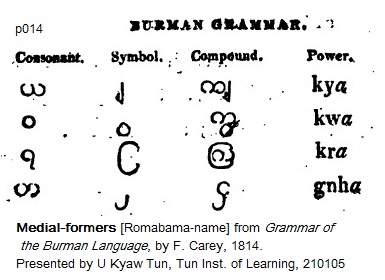 UKT 210106: There are only 33 basic consonants
that can generate derivative phonemes with
different sounds. However by con-joining the
33 with 4 Approximant consonants -
{ya.},
{wa.},
{ra.},
{ha.} - we can still generate intermediate sounds.
With the inclusion of English phonemes into BEPS
languages, we have to add one more Approximant,
{la.}. This approximant was used in the Pagan
period, but has been dropped in mainland Burmese.
However,
{la.} as a medial former still exists in Dawei
dialect. Carey has listed only 4 used in the
mainland dialect in his list given on the
right.
UKT 210106: There are only 33 basic consonants
that can generate derivative phonemes with
different sounds. However by con-joining the
33 with 4 Approximant consonants -
{ya.},
{wa.},
{ra.},
{ha.} - we can still generate intermediate sounds.
With the inclusion of English phonemes into BEPS
languages, we have to add one more Approximant,
{la.}. This approximant was used in the Pagan
period, but has been dropped in mainland Burmese.
However,
{la.} as a medial former still exists in Dawei
dialect. Carey has listed only 4 used in the
mainland dialect in his list given on the
right.
Each class of medials have its own name:
¤ Ya'pin - with
{ya.} -
{ya.pín.} "raised up by
{ya.}" with symbol
.
If the conjunction is not complete, it remains
a plain conjunct which is a diphthong. It is
then known as
 {ya.hswè:} "hanging
{ya.}" with symbol
{ya.hswè:} "hanging
{ya.}" with symbol
 .
.
Thus "K-Y-A-W" in my name is
-
{ka.ya.pín.}
{kya.} a monophthong. But English speakers and
Hindi speakers can only say
-
{ka.ya.hswè:}
 {k~ya.} (with a schwa unconsciously added
after k) as a diphthong, mis-pronouncing
my name. Finally they call me "J-O-E",
and I became Joe K. Tun.
{k~ya.} (with a schwa unconsciously added
after k) as a diphthong, mis-pronouncing
my name. Finally they call me "J-O-E",
and I became Joe K. Tun.
¤ Ra'ric - with
{ra.} -
 {ra.ric} "wrapped around by
{ra.}" with symbol
{ra.ric} "wrapped around by
{ra.}" with symbol
 /
/ .
The medial sound produced for mainland dialect
has no rhoticity, and sounds like
{ya.pín.} mentioned above. But in Pali and in
Rakhine dialect, the medial sound has noticeable
rhoticity, and Romabama differentiates the two
with the length of the hood as
.
The medial sound produced for mainland dialect
has no rhoticity, and sounds like
{ya.pín.} mentioned above. But in Pali and in
Rakhine dialect, the medial sound has noticeable
rhoticity, and Romabama differentiates the two
with the length of the hood as
 /
/
¤ Wa'hswè - with
{wa.} -
 {wa.hswè:} "hanging
{wa.}". With some consonants, such as
{ka.}, it produces a monophthong and is marked as
{wa.hswè:} "hanging
{wa.}". With some consonants, such as
{ka.}, it produces a monophthong and is marked as
 {kwa.}. But some can say it only as an ordinary
conjunct as
{kwa.}. But some can say it only as an ordinary
conjunct as
 {k~wa.} - a diphthong.}. Romabama differentiates
the two as by changing the shape of the
{wa.} that is hanging. In
{kwa.} the hanging
{wa.} has "triangular" shape, whereas in
{k~wa.}, it has the full rounded shape.
{k~wa.} - a diphthong.}. Romabama differentiates
the two as by changing the shape of the
{wa.} that is hanging. In
{kwa.} the hanging
{wa.} has "triangular" shape, whereas in
{k~wa.}, it has the full rounded shape.
 UKT 210131: Ya'pin and Wa'hswè, because of the
difference in pronunciation of medial formers
{ya.} and
{wa.}, have different effects in terms of
"spread-roundness" on the basic
consonants. Ya'pin
{ya.pín.} is pronounced with spread-lips,
whilst Wa'hswè is pronounced with round-lips.
UKT 210131: Ya'pin and Wa'hswè, because of the
difference in pronunciation of medial formers
{ya.} and
{wa.}, have different effects in terms of
"spread-roundness" on the basic
consonants. Ya'pin
{ya.pín.} is pronounced with spread-lips,
whilst Wa'hswè is pronounced with round-lips.
¤ Ha'hto - with
{ha.} -
 {ha.hto:} "propelled by being poled (as
a boat in shallow water) by
{ha.}". It is then known as
{ha.hto:} with symbol
{ha.hto:} "propelled by being poled (as
a boat in shallow water) by
{ha.}". It is then known as
{ha.hto:} with symbol
 .
.
§059. The symbol of
{ha.}, in words purely Burman, is affixed to all the nasals, besides which it is
affixed to only
{ya.},
{ra.},
{wa.},
{þa.} and
{La.} [?], and the compounds formed by their
combination with other letters, which will be
mentioned hereafter. But in words derived from
Magudha [Pali] it may be affixed to any character.
UKT 210105: §059 is complex because it
embodies several ideas into a short paragraph.
I'll have to take it apart as:
1. The symbol [Ha'hto sign
] of
{ha.} ह «ha», in words purely Burman, is
affixed to all the nasals [
{gna.},
{Ña.},
{Na.},
{na.},
{ma.}]
The products are recognized by Peter Ladefoged
(1925-2006), more than a century later, as
voiceless nasals of Burmese
 {gnha.},
 {Ñha.},
 {Nha.},
 {nha.}, {mha.}
2. [The Ha'hto, in words purely Burman,] is affixed to only
{ya.},
{ra.},
{wa.},
{þa.} and
{La.},
3. [The Ha'hto, in words purely Burman, is affixed to] the compounds formed
by their combination with other letters, which will be mentioned hereafter.

§060. [Medials can be produced by a combination of
medial formers. This sub-section will describe two combinations: Ya-wa and Ra-wa.]
{ya.}
and
{wa.}, also
{ra.} and {wa.}, when united are expressed by the
following compound symbols [shown on right]:
UKT 210107: Romabama names of medial-formers. See also MLC-BO1986,
page-
{HTa.}
Ya-wa medial-former, Ya'pin-wa'hswè -
-
{ya.pín.wa.hswè:}

Ra-wa medial-former, Ra'ric-wa'hswè -
-
{ra.ric.wa.hswè:}

Ya-ha medial-former, Ya'pin-ha'hto -
-
{ya.pín.ha.hto:}

Ra-ha medial-former, Ra'ric-ha'hto -
-
{ra.ric.ha.hto:}

Wa-ha medial-former, Wa'hswè-ha'hto - -
{wa.hswè:ha.hto:}
Ya-wa-ha medial-former, Ya'pin-wa'hswè-ha'hto -
--
{ya.pín.wa.hswè:ha.hto:}

Ra-wa-ha medial-former, Ra'ric-wa'hswè-ha'hto -
--
{ra.ric.wa.hswè:ha.hto:}

§061. Two or more consonants
may be combined so as to be pronounced without an
intervening vowel, as
 {h~ma.},
 {þ~ma.},
 {kywa.},
 {hkywa.},
 {ñhwa.},
 {rhwa.},
 {lhwa.}
(p014end-p015begin)
{lhwa.}
(p014end-p015begin)
UKT 210122: In the above
{h~ma.},
{þ~ma.}
are probably mistakes. They are probably {hwa.}
and {þwa.} .
§062. When an aspirated akshara letter
is doubled [i.e. stacked], the first [i.e. the top one] is changed
for its corresponding unaspirated akshara letter, as
-
 {k~hka.} [from:
 ],
],
 {c~hsa.} [from :
-],
{c~hsa.} [from :
-],
 {z~Za.} [from:
 -],
-],
 {ð~Ða.}[from
 -]
[cf.
-]
[cf.
 ] ,
{T~Hta.} [from:
],
] ,
{T~Hta.} [from:
],
 {t~hta.} [from:
-],
{t~hta.} [from:
-],
 {p~hpa.},
  {b~Ba.}
UKT 210107: Stacked consonants are mute, because the hidden viram on the
upper consonant. Now, remember English has no tenuis consonant, which makes
my analysis of Carey's observations somewhat iffy: what if Carey had known
this limitation of English.
If the stacking is vertical it is known as Pat'hsin
{paaHT.hsín.} in
{k~hka.},
 {c~sa.},
{c~hsa.},
{t~hta.},
{p~hpa.}, {b~Ba.}.
{c~sa.},
{c~hsa.},
{t~hta.},
{p~hpa.}, {b~Ba.}.
However, if the conjunction is horizontal as in
{T~Hta.} and
{ð~Ða.} it should be Paat'twè
{paaHT.twè:}. The terms are derived from Pali
 {pa.Li} with
{La.} changing into "look-alike"
{HTa.}. You'll notice that the consonants involved,
{Ta.},
{HTa.},
{ða.}, and
{La.} are retroflex, and the circular-glyph looks like standing on
pedestals. This suggests to me that they had belonged to a written script
which preceded the present Myanmar akshara.
{pa.Li} with
{La.} changing into "look-alike"
{HTa.}. You'll notice that the consonants involved,
{Ta.},
{HTa.},
{ða.}, and
{La.} are retroflex, and the circular-glyph looks like standing on
pedestals. This suggests to me that they had belonged to a written script
which preceded the present Myanmar akshara.
§063 does not mention 2 other stacked consonants such as
{c~sa.} (from tenuis), and
 {m~ma.} (from nasals}. I'll deal only with
{m~ma.} which appears in words like Kamma
{m~ma.} (from nasals}. I'll deal only with
{m~ma.} which appears in words like Kamma
 {kûm~ma.}
(Pali), and Karma
{kûm~ma.}
(Pali), and Karma
 {Sanskrit}. For meanings look into:
-
https://en.wikipedia.org/wiki/Karma_in_Buddhism 210107
Contents of this page
Nasals : Dot-above
{þé:þé:tín}] sign
- the instrument for nasalization
UKT 210205: All the 33 consonants can be
nasalized with Dot-above
{þé:þé:tín}] sign
.
However of the vowels, only the short vowels,
{raþ~þa. þa.ra.} can be nasalized, e.g.
,
 ,
,
 .
(Checked with U ZawTiKa of ZéYyaThuKha monastery,
Sangyaung, Yangon).
.
(Checked with U ZawTiKa of ZéYyaThuKha monastery,
Sangyaung, Yangon).
§063. The [Dot-above
{þé:þé:tín}] sign
represents any of the nasals.
§064. The [
{þé:þé:tín}] sign
written above an initial consonant, is
sometimes mute [changed over to schwa], as
 {tän-hka:} "a door" pronounced as
 {ta·ga:};
 {tän-hsa} "an ornament" pronounced as
 {
ta·za}.
{
ta·za}.
In some instances, however, [
{þé:þé:tín}] is pronounced as [in]
 {htän} "a place" ;
 {lhän} "spear" [ not
 {lhûn}]
§065. When
{la.} is the first member of a compound,
and occupies the place of [
{þé:þé:tín}], it is pronounced like
; as
 {loän-la.};
when written as

 , it is not pronounced loolla , but longa . No particular
rules are laid down for these changes.
, it is not pronounced loolla , but longa . No particular
rules are laid down for these changes.
UKT 210107: I don't know what Carey meant by longa . If he had
meant longa , where ng is killed
{ng}, the word becomes
{lu.lín} from which one of the
{la.} may be dropped.
In modern Burmese, in words like

 {bol} "army officer", killed
{l} is not pronounced and the word sound like
{bo} - something similar to dropping a
{la.}.
{bol} "army officer", killed
{l} is not pronounced and the word sound like
{bo} - something similar to dropping a
{la.}.
§066. The nasals,
{gna.}/
{ng}
excepted,
are never compounded with any letter, besides those of their respective classes,
as:
[r2, palatal] -
 {Ñ~sa.},
 {ñ~za.},
[r3, retroflex] -
 {N~HTa.},
 {N~ða.},
[r4, dental ] -
 {n~ta.},
 {n~da.},
 {n~Da.},
[r5, labial] -
 {m~pa.},
 {m~Ba.}.
(p015end-p016begin)
{m~Ba.}.
(p015end-p016begin)
UKT 210109: In §066, we see in the example for r2 palatal, a mix
up stop and affricate. See my note on the
Mixing up of Palatals resulting in the disappearance of Nya-major, and
the misunderstanding of the words Knowledge and Wisdom. As an example, "how
to build the Atomic Bomb is Knowledge, but whether to use it or not
is Wisdom.
§067.
[The r1c5, semi-nasal],
{gna.}/
{ng},
with the mark [
{tän-hkûn}-sign]
 above it, thus
{ng},
is generally placed over the consonants of its own class [r1 - velar], and the
miscellaneous aksharas, instead of [dot-above]
[UKT ¶]
above it, thus
{ng},
is generally placed over the consonants of its own class [r1 - velar], and the
miscellaneous aksharas, instead of [dot-above]
[UKT ¶]
[ The sign
 is known as
 {kín:si:} literally "ridden by a centipede".]
thus

 {män-ga.la} [wrong pronunciation of "auspiciousness" due to Indian influence],
is written
{män-ga.la} [wrong pronunciation of "auspiciousness" due to Indian influence],
is written
 {mïn-ga.la] auspiciousness
 goodness, welfare ;
 {ín~kri} a coat [shirt] [modern sp
 {ín-kyi}];
 {ta.nïn~ga.nwé} Sunday ;
 {ta.nïn~la} Monday.
Contents of this page
Conjuncts or stacked consonants :
Pali conjuncts
{paaHT.hsín.}-
{paaHT-twè:}
UKT 210205:
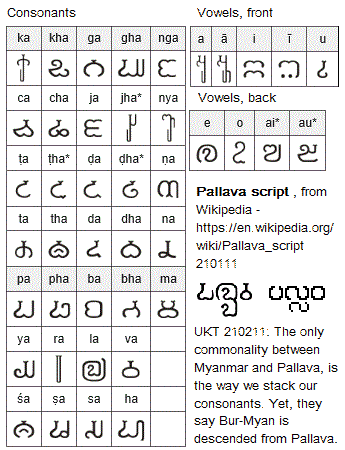
See:
https://en.wikipedia.org/wiki/Pallava_script 210205
[UKT - the word «pal~la.wa.} transposed aks-to-aks to Myanmar script gives:
 , making the uninitiated think that Myanmar script is descended from Pallava
- a south Indian script.]
, making the uninitiated think that Myanmar script is descended from Pallava
- a south Indian script.]
§068. All the consonants may be stacked
doubled [resulting in mute conjuncts - not pronounceable
medials: the top member being a killed consonant], as: [stacking the same
akshara]
-
{k~ka.},
 {g~ga.},
-
{c~sa.},
 {z~za.},
{ñ~ña.}
[=
{z~za.},
{ñ~ña.}
[=
 ],
],
-
 {T~Ta.},
 {N~Na.},
-
 {t~ta.},
 {d~da.},
 {n~na.},
-
 {p~pa.},
 {b~ba.},
{m~ma.},
{b~ba.},
{m~ma.},
-
{l~la.},
 or
or
 {þ~þa.}.
UKT 210206: Different akshara may also be stacked: e.g.
{T~HTa.}. In these stacked conjuncts, the
{a·þût} is not shown, making the pair
into a single character
.
§069. The vowel
{U.} [
{u.}] of an onset initial consonant is often pronounced like
{a.}. Ex.
-
 {pu.hso:} a cloth, garment [ pronun. {pa·hso}];
-
 {pu.hsic} the knee-bone or joint [pronun. {pa·hsic}];
-
 {pu.lè:} a pearl [pronun. {pa·lè:};
- {ku.la:} a stranger, a foreigner [pronun.
{ka·la:} ]. This deviation occurs but seldom. (p016end-p017begin)
Contents of this page
Cp001-fn01 - The proper word is Mrunma
 [
[ {mrûn-ma}: Carey reproduced the Weik'cha faithfully] - Go back
Cp001-fn01b
{mrûn-ma}: Carey reproduced the Weik'cha faithfully] - Go back
Cp001-fn01b
Cp001-fn02 - In writing Burman words with
English letters , the italics are to be pro-(cont. at
bottom of p002)- nounced short, and the Roman letters long, i.e., a is
sounded as in father, a as in man , and when final as in America ; e as a name ,
i as el in their , i as in till , ee as in read , oo as in good, oo as in
cool , and u as in bat . In repeating the akshara alphabet the
inherent vowel is invariably pronounced as in pan . Go back
Cp001-fn02b
Contents of this page
The author
F. Carey (1786-1822)
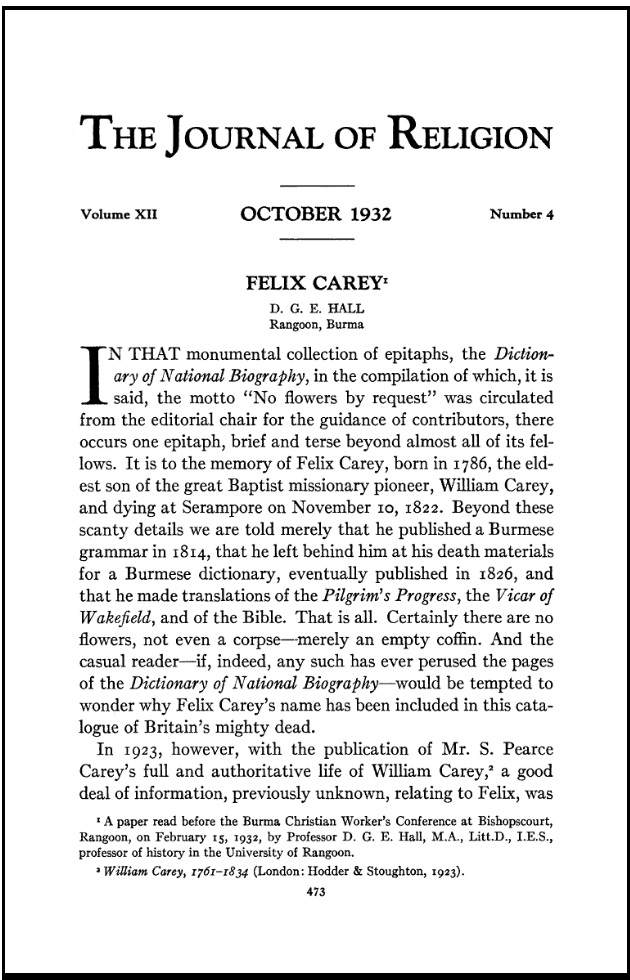
- Felix Carey, by D.G.E. Hall, Rangoon, Burma, in The Journal of
Religion, vol12, no.4, Oct1932
In that monumental collection of epitaphs, the Dictionary of National
Biography , in the compilation of which, it is said, the motto "No flowers
by request" was circulated from the editorial chair for the guidance of
contributors, there occurs one epitaph, brief and terse beyond almost all of its
fellows. It is to the memory of Felix Carey, born 1786, the eldest son of the
great Baptist missionary pioneer, William Carey, and dying at Serampore [West
Bengal, India] on November 10, 1822.
UKT 201206: Rev. Adoniram Johnson, did meet William Carey is mentioned in
The Man Who Gave the Bible to the Burmese, on Adoniram and Ann
Judsons
https://christianhistoryinstitute.org/magazine/article/the-man-who-gave-the-bible-to-the-burmese
201206
Adoniram knew he would meet the pioneer English Baptist missionary William
Carey when he arrived in India, and in fact he carried a letter of introduction.
While at sea, therefore, he carefully studied the New Testament in an effort to
understand the differences between the Congregationalists and Baptist views on
baptism. [UKT ¶]
Although his plan was to refute the Baptist teaching, the opposite happened:
He became convinced that believers' baptism was correct. Though painfully aware
that this would mean cutting ties with friends and supporters, Ann agreed. After
the Judsons arrived in India, they decided to have Carey's associate William
Ward baptize them by immersion. Luther Rice, who had had similar doubts, was
immersed several months later.
... ... ...
Being gifted linguists, Ann and Adoniram quickly learned to speak Burmese,
and Adoniram spent years studying the structure of the language. His ultimate
goal was to translate the entire Bible into Burmese— this, he firmly believed,
was his first priority as a missionary and the key to the conversion of a
nation. [UKT ¶]
Noting that the Burmese were a “reading people” with an extensive literature,
he became more and more convinced that the written word was a vital evangelistic
tool. In July 1816 he composed a manuscript about Burmese grammar and the text
of his first tract, “A View of the Christian Religion.” The English Baptists in
India supplied him with a press, and the American Baptist Board's first new
appointee, missionary printer George H. Hough, arrived three months later.
Judson completed the translation of the Gospel of Matthew in May 1817 and began
compiling a full-fledged Burmese grammar—all while suffering from diseases and
from grief over the death of a second child, seven-month-old Roger.
Contents of this page
- UKT 201202
When did F. Carey visited Burma and what would have he seen can be gauged
from the Timeline of Burmese history -
https://en.wikipedia.org/wiki/Timeline_of_Burmese_history 201202.
| 1785 |
2 January |
Konbaung armies capture
Mrauk U, ending five centuries of Arakanese
independence |
| |
Bodawpaya's
invasion of Siam fails; Lan Na now firmly in Siamese
camp (to 1786) |
| 1787 |
|
Defeats
Siamese invasion of Tenasserim |
| 1790 |
|
Resumes diplomatic relationship with China |
| 1792 |
|
Defeats another
Siamese invasion of Tenasserim |
| 1797 |
|
Burmese invasion of Lan Na and Luang Prabang fails
|
Would F. Cary and his father have met the following
- Father Sangermano , who wrote The Burmese Empire a hundred
years ago - by Father Sangermano, 1833 -
sang-s-indx.htm - update 13Sep)
- Bishop Bigandet, who wrote Gaudama the Buddha of the Burmese, by Bishop Bigandet, 1866
.
-
BishopBigandet<Ô> /
Bkp<Ô> (link
chk 200308)
Whatever the case may be, what F. Cary has written on Burmese Grammar, is the
grammar during the reign of King Bodawpaya of the Konbaung dynasty - the most
colourful (may be on the verge of insanity) monarch. The Grammar gives quaint
transcriptions of the Burmese names.
Contents of this page
UKT 210108: Palatal affricates as base consonants are not present in
Bur-Myan, because of which we don't have native glyphs for them. However,
they are present in Skt-Dev, and whenever necessary, I rely on Devanagari
aksharas to differentiate them. Thus:
{ñ~za.}
ञ ् ज = ञ्ज can easily be differentiated from
 {z~ña.} ज ् ञ = ज्ञ .
The second one, ज्ञ , is one of the two Skt-Dev conjuncts that has baffled me for a
long time:
¤ क ् ष = क्ष , Pseudo-Kha
¤ ज ् ञ = ज्ञ , Pseudo-Za
A word containing ज्ञ is ज्ञान "knowledge, wisdom" -
https://www.pinterest.com/pin/371054456788781371/ 210108
I've listened the word pronounced by various speakers, Hindi and Sanskrit. One
person pronounces it as / {ñaan}/ which in Burmese is "knowledge". However, pronunciation is not reliable
when it comes to interpretation and deeper meaning. Spelling-wise - aks-to-aks - making
allowance for difference in affricate and stop, I'll say it is the same as Bur-Myan
{ñaan}/ which in Burmese is "knowledge". However, pronunciation is not reliable
when it comes to interpretation and deeper meaning. Spelling-wise - aks-to-aks - making
allowance for difference in affricate and stop, I'll say it is the same as Bur-Myan
 {Zaan} ? According to my understanding of Theravada Buddhist practice,
{Zaan} as "knowledge" is the product of
{Zaan} ? According to my understanding of Theravada Buddhist practice,
{Zaan} as "knowledge" is the product of
 {þa.ma.hta.}, whereas
{ñaan} is the product of
{þa.ma.hta.}, whereas
{ñaan} is the product of
 {wi.pæþ~þa.na}.
You can read more in Wikipedia gives:
https://en.wikipedia.org/wiki/Dhy%C4%81na_in_Buddhism 210108
"ध्यान
= ध ् य ा न (Skt-Dev) - झान (Pali-Dev)"
Go back
Mixing up of Palatals-note-b
Contents of this page
End of TIL file
