 {na} ना
 {na-ka.} नाक
  {na-ga.} नाग
  {na-ga.ra.} नागर
  {na-ga.wa.}
तागव
{na-ga.wa.}
तागव  {na-Ta.}
ताट
{na-Ta.}
ताट  {na-hta.} नाथ
 na2-095top-4.htm
from: Online Sanskrit Dictionary, February 12, 2003 . http://sanskritdocuments.org/dict/dictall.pdf 090907
Downloaded, set in HTML, and edited by U Kyaw Tun, M.S. (I.P.S.T., U.S.A.), and staff of TIL Computing and Language Centre, Yangon, Myanmar. Not for sale. No copyright. Free for everyone.
index.htm | Top
SED-con-r4-indx.htm
{na} ना
{na-ka.} नाक
{na-ga.} नाग
{na-ga.ra.} नागर {na-ga.wa.}
तागव {na-Ta.}
ताट {na-hta.} नाथ
UKT notes
• Naga - the celestial dragon
{na-ka.} नाक
• नाक (naaka)
Skt: नाक (naaka) - heaven, sky -
OnlineSktDict
Pal: nāka m. heaven - UPMT-PED118
Pal:
{na-ka.}
 -
UHS-PMD0512
-
UHS-PMD0512
¤ नाक nāka m. tin - SpkSkt
{na-ga.} नाग
•
नाग
(naaga)
Skt: नाग
(naaga) - snake - OnlineSktDict
Skt: नाग
nāga m. cobra; snake - SpkSkt
Pal:
nāga m. a serpent, snake, dragon, elephant,
iron-wood tree, chief - UPMT-PED118
Pal:
{na-ga.}
 -
UHS-PMD0512
-
UHS-PMD0512
Of all the non-human mythical beings which can be identified as 'animals', नाग nāga, is the only one of importance. You'll meet them in many stories and place-names in the religion and culture of Bur-Myan. I have been collecting these stories and place-names which you'll see in my note on Naga नाग nāga - UKT110917
¤
नाग
nāga
Skt: नाग
nāga n. lead - SpkSkt
UKT: Check whether the above definition is Alchemical or not, since it reminds
me of Bur-Myan Alchemy. - 100907
• तागफणी (naagaphaNii)
Skt: तागफणी
(naagaphaNii) - cactus - OnlineSktDict
• तागबन्ध
(naagabandha)
Skt: तागबन्ध
(naagabandha) - cobra pattern, a form of poetry - OnlineSktDict
{na-ga.ra.}
नागर
¤ नागर nāgara
Skt: नागर
nāgara adj. civic; dexterous; versatile;
cunning; clever - SpkSkt
Pal: nāgara m. a townsman, citizen -
UPMT-PED118
Pal:
{na-ga.ra.}
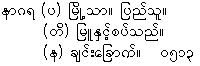 -
UHS-PMD0513
-
UHS-PMD0513
¤ नागरक nāgaraka adj. living in a town; clever - SpkSkt
¤ नागरिक nāgarika adj. town-born; clever; m. inhabitant of a city - SpkSkt
¤ नागरता nāgaratā f. finesse; smartness - SpkSkt
¤ नागराजः अस्ति वा? nāgarājaḥ asti vā? sent. Is Nagaraj in? - SpkSkt
{na-ga.wa.}
तागव
• तागवल्लि
(naagavalli)
Skt: तागवल्लि
(naagavalli) - the paan (betel leaf) - OnlineSktDict
Pal: nāgalatā, nāgavalli f. the betel vine - UPMT-PED118
Pal:
 {na-ga.wal~li}
 -
UHS-PMD0513
-
UHS-PMD0513
• तागानां
(naagaanaaM)
Skt: तागानां
(naagaanaaM) - of the manyhooded serpents - OnlineSktDict
• तागाशन (naagaashana)
Skt: तागाशन (naagaashana) - peacock (whose
food is snakes) - OnlineSktDict
• तागेन्द्र
(naagendra)
Skt: तागेन्द्र
(naagendra) - elephant - OnlineSktDict
{na-Ta.}
ताट
• ताटक (naaTaka)
Skt: ताटक (naaTaka) - m.
a play, drama - OnlineSktDict
*Pal: nāṭaka m. (√naṭ)
a dancer - UPMT-PED118
*Pal:
 {naTaka}
 -
UHS-PMD0513
-
UHS-PMD0513
• ताडी (naaDii)
Skt: ताडी (naaDii) - a channel within the subtle body - OnlineSktDict
• ताडीशोधन
(naaDiishodhana)
Skt: ताडीशोधन
(naaDiishodhana) - the purification of the nadis - OnlineSktDict
• ताणकम् (naaNakam.h)
Skt: ताणकम्
(naaNakam.h) - n. coin OnlineSktDict
{na-hta.} नाथ
• नाथ (naath)
Skt: नाथ
(naath) - lord - OnlineSktDict
• नाथ (naatha)
Skt: नाथ
(naatha) - Protector - OnlineSktDict
Pal: nātha m. a protector, saviour, lord,
master - UPMT-PED118
Pal: {na-hta.}
 -
UHS-PMD0513
-
UHS-PMD0513
• नाथाय (naathaaya)
Skt: नाथाय (naathaaya) - to the protector or lord
- OnlineSktDict
• नाद (naada)
Skt: नाद
(naada) - sound - OnlineSktDict
Pal: nāda m. (√nad) a sound, cry,
shout - UPMT-PED118
Pal:  {na-da.}
 -
UHS-PMD0513
-
UHS-PMD0513
• नादः (naadaH)
Skt: नादः (naadaH) - the sound - OnlineSktDict
• नादत्ते
(naadatte)
Skt: नादत्ते
(naadatte) - (verb) does not wear - OnlineSktDict
• नादब्रह्म
(naadabrahma)
Skt: नादब्रह्म
(naadabrahma) - Blissful tone - OnlineSktDict
• नाना (naanaa)
Skt: नाना (naanaa) - many - OnlineSktDict
Pal: nānā indecl. various, diverse, different - UPMT-PED118
Pal:  {na-na}
 -
UHS-PMD0514
-
UHS-PMD0514
• नानाभावान्
(naanaabhaavaan.h)
Skt: नानाभावान्
(naanaabhaavaan.h) - multifarious situations - OnlineSktDict
• नानाविधानि
(naanaavidhaani)
Skt: नानाविधानि
(naanaavidhaani) - variegated - OnlineSktDict
• नानृतं (naanRitaM)
Skt: नानृतं (naanRitaM) - not untruth -
OnlineSktDict
• नान्तं (naantaM)
Skt: नान्तं
(naantaM) - no end - OnlineSktDict
• नान्यं (naanyaM)
Skt: नान्यं (naanyaM) - no other -
OnlineSktDict
• नान्यगामिना
(naanyagaaminaa)
Skt: नान्यगामिना
(naanyagaaminaa) - without their being deviated - OnlineSktDict
• नाभिं (naabhiM)
Skt: नाभिं (naabhiM) -
navel - OnlineSktDict
Pal: nābhi f. the navel , nave of a wheel, centre - UPMT-PED118
Pal:  {na-Bi.}
 -
UHS-PMD0515
-
UHS-PMD0515
• नाभिजानाति
(naabhijaanaati)
Skt: नाभिजानाति
(naabhijaanaati) - does not know - OnlineSktDict
• नाभिपेदासन
(naabhipedaasana)
Skt: नाभिपेदासन
(naabhipedaasana) - the upward ankle-twist posture - OnlineSktDict
• नाभियान
(naabhiyaana)
Skt: नाभियान
(naabhiyaana) - focussing - OnlineSktDict
• नाभीदेशं
(naabhiideshaM)
Skt: नाभीदेशं
(naabhiideshaM) - nAbhI + deshaM, navel + region/ country - OnlineSktDict
• नाम (naama)
Skt: नाम (naama) - Name - OnlineSktDict
Pal: nāma adv. namely, indeed; n. a name, noun - UPMT-PED118
Pal:  {na-ma.}

-
UHS-PMD0515
• नामन् (naaman.h)
Skt: नामन् (naaman.h) - name - OnlineSktDict
• नामभिः (naamabhiH)
Skt: नामभिः (naamabhiH) - the names of rAma
- OnlineSktDict
• नामभिर्दिव्यैः
(naamabhirdivyaiH)
Skt: नामभिर्दिव्यैः
(naamabhirdivyaiH) - by the divine 'nAmAs' - OnlineSktDict
• नामयति (naamayati)
Skt: नामयति (naamayati) - to bend - OnlineSktDict
• नामस्मरणात्
(naamasmaraNaat.h)
Skt: नामस्मरणात्
(naamasmaraNaat.h) - (except) through/ from rememberance of the lord's name - OnlineSktDict

1. From Wikipedia: http://en.wikipedia.org/wiki/Naga 110917
Nāga (Skt: नाग, nāgá, Bur:
 {na.ga:};
Javanese: någå, Khmer: នាគ neak, Thai:
นาค
nak, Chinese: 那伽, Tibetan:
ཀླུ་) is the Sanskrit and Pāli word for a deity or class of entity or being,
taking the form of a very great snake
— specifically the King Cobra, found in Hinduism and Buddhism. The use of
the term nāga is often ambiguous, as the word may also refer, in similar
contexts, to one of several human tribes known as or nicknamed "Nāgas"; to
elephants; and to ordinary snakes, particularly the King Cobra and the
Indian
Cobra, the latter of which is still called nāg in Hindi and other
languages of India. A female nāga is a nāgī or nāginī.
{na.ga:};
Javanese: någå, Khmer: នាគ neak, Thai:
นาค
nak, Chinese: 那伽, Tibetan:
ཀླུ་) is the Sanskrit and Pāli word for a deity or class of entity or being,
taking the form of a very great snake
— specifically the King Cobra, found in Hinduism and Buddhism. The use of
the term nāga is often ambiguous, as the word may also refer, in similar
contexts, to one of several human tribes known as or nicknamed "Nāgas"; to
elephants; and to ordinary snakes, particularly the King Cobra and the
Indian
Cobra, the latter of which is still called nāg in Hindi and other
languages of India. A female nāga is a nāgī or nāginī.
UKT: more in the Wikipedia article.
UKT: The two pix below are from Burmese-Buddhist temple, Penang, Malaysia, http://www.dhammikarama.org/ 110917.
Pix #1 - shows the likeliness of a Bur-Myan
done in the proper Bur-Myan style.
Pix #2 - shows the{nût Bi-lu:} {poaN~Na.ka.} trying to kill the Buddha-to-be
Minister Vidura at the bidding of {I.yan~na.þi} the Naga princess.
Bur-Myan spellings need to be checked. - UKT110917
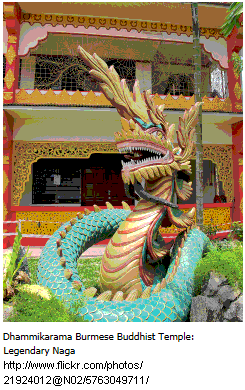

UKT: Bur-Myan
{na.ga:} are single headed. - UKT110917
2. Place-names: Founding villages of the First Pagan Kingdom, mentioned in U Kula, {ma.ha ra-za.wing}, {ra-præÑ.}-book printer, 1st printing 2006 July, book#1, 3rd part, p.133.
There are many place-names relating to
{na.ga:}. The text below shows that
the ancient city of Pagan founded in 107 AD was made up of 19 villages, two
of which has the word
{na.ga:}.
#02. {na.ga:so:} 'realm of Naga', and #03. {na.ga:kyic} '...'.

3. History-culture: Dr. Htin Aung, Folk Elements in Burmese Buddhism (my edition of the book is in another CD pkt: file:///C:/~~MYAN-DVD-110319/MYAN-CD/M01-M4M/Folk-elements/ch07-naga/ch07-cult-naga.htm#Duttabaung-note
You'll the Naga mentioned in chapter 07 The Cult of Naga. You'll also read my note on King Duttabaung, king of the Pyu and his ocean-going boat propelled by the action of Naga scales (which probably used the hydro-dynamic drive - factual chk?) and manned by Naga sailors.
4. Buddha's birth story: Vidhurapandita Jātaka (No.545), http://www.palikanon.com/english/pali_names/vy/vidhurapandita_jat_545.htm 110917
v.l. Vidhūrapandita. Four kings, 1.
Dhanañjaya Korabba, king of
Indapatta
[human], 2.
Sakka , king of the Deva [god], 3.
Varuna,
the Nāga
king [non-human
{na.ga:},
4.
Venateyya, king of the Supannas [non-human being], having taken the uposatha-vows,
meet together in a garden and there have a dispute as to which of them is the
most virtuous. [UKT ¶]
They cannot decide among themselves and agree, therefore, to refer the matter to Dhanañjaya's minister, Vidhurapandita (the Bodhisatta). The minister listens to the claims of each and then declares that all are equal; their virtues are like the spokes of a wheel. They are pleased, and Sakka gives the minister a silk robe, Varuna a jewel [Naga living under the sea are guardians of treasures], the Supanna king a golden garland, and Dhanañjaya one thousand cows.
Vimalā, Varuna's wife [Naga queen], hearing from her husband of Vidhura's wisdom, is so enchanted that she yearns to see him, and in order to do so feigns illness, and says that she must have Vidhura's heart. [UKT ¶]
Varuna's daughter, Irandatī [Naga princess], is offered to anyone who can get possession of Vidhura's heart, and the Yakkha Punnaka, nephew of Vessavana [whom the Hindus would describe as 'demon'], who sees her and is fascinated by her beauty, accepts the condition. He obtains Vessavana's consent by a ruse and visits Dhanañjaya's court. There he challenges the [human] king to a game of dice, giving his name as Kaccāyana, and offers as stake his wonderful steed and all seeing gem, provided the king will offer Vidhura as his. Dhanañaya agrees, plays and loses.
UKT: The game of dice which was so important in Mahabharatta, and the name of minister involved Vidhura is the source of confusion of the two stories, one from Hinduism and the other from Buddhism. - UKT110917
Vidhura agrees to go with Punnaka; the king asks him questions regarding the householder's life for his own guidance, and Vidhura is given three days' leave to visit his family. Having taken leave of them, he goes with Punnaka. On the way Punnaka tries in vain to kill him by frightening him. [See painting from from Burmese-Buddhist temple, Penang, Malaysia, http://www.dhammikarama.org/ 110917]. [UKT ¶]
When Vidhura discovers Punnaka's intention, he preaches to him as he sits on the top of the Kālapabbata, and the Yakkha ['demon'] is so moved that he offers to take Vidhura back to Indapatta. But in spite of his protestations, Vidhura insists on going on to the Nāga world. They arrive in Varuna's abode; Vidhura preaches first to Varuna and then to Vimalā. They are both delighted, and Punnaka wins the hand of Irandatī. In his great joy Punnaka gives Vidhura his marvellous jewel and takes him back to Indapatta. There Vidhura relates his adventures and gives the jewel to the king. A festival lasting one month is held in honour of Vidhura's return.
The story was related in reference to the Buddha's wisdom. Vidhura's chief wife, Anujjā, is identified with Rāhulamātā; his eldest son, Dhammapāla, with Rāhula; Varuna with Sāriputta; the Supanna king with Moggallāna; Sakka with Anuruddha, and Dhanañjaya with Ananda (J.vi.255-329).
The Jātaka is also referred to as the Punnaka Jātaka (E.g., J.iv.14, 182).
Four scenes from the Jātaka are found on the Bharhut Tope. Cunningham, Bharhut, p.82.
Go back Naga-note-b
End of TIL file