 {di.}
{di.}  {daig~ba.la.}
दिग्बल
{daig~ba.la.}
दिग्बल  {di.ta.} दित
  {di.na.} दिन
  {di.wa.} दिव
  {di.wa} दिवा
  {di.wi.} दिवि
  {di.bya.} दिव्य
 {di.sha.} दिश
(
{di.sha.} दिश
( {di.rha.} is objectionable from phonetic aspect)
 di1-083b2-2.htm
from: Online Sanskrit Dictionary, February 12, 2003 . http://sanskritdocuments.org/dict/dictall.pdf 090907
Downloaded, set in HTML, and edited by U Kyaw Tun, M.S. (I.P.S.T., U.S.A.), and staff of TIL Computing and Language Centre, Yangon, Myanmar. Not for sale. No copyright. Free for everyone.
index.htm | Top
SED-con-r4-indx.htm
{di.}
{daig~ba.la.}
दिग्बल
{di.ta.} दित
{di.na.} दिन
{di.wa.} दिव
{di.wa} दिवा
{di.wi.} दिवि
{di.bya.} दिव्य
{di.sha.} दिश
(
{di.rha.} is objectionable from phonetic aspect)
Noteworthy passages in this file:
• ... the time when Shiva and his retinue of ghosts and spirits moved about;
which was considered inauspicious and unsuited [for copulation to have
children]. UKT comment: Shiva and his consort in the form of Kālī seem to side
with the Asuras aka demons (ghosts and spirits) at times. This is very unlike
Vishnu who always side with the Devas sometimes even stooping down to cheating
on their behalf. - I am waiting for comments from my Hindu peers. - UKT100824
UKT notes
• Diti - Aditi's sister
• Guardians of directions •
Lucifer - signified by the planet Venus
{daig~ba.la.}
दिग्बल
• दिग्बल
(digbala)
Skt: दिग्बल
(digbala) - directional strength - OnlineSktDict
• दिङ्निर्णययन्त्र
(di.n.hnirNayayantra)
Skt: दिङ्निर्णययन्त्र
(di.n.hnirNayayantra) - compass - OnlineSktDict
{di.ta.} दित
• दिति (diti)
Skt: दिति (diti) - mother of the daityas demons -
OnlineSktDict
Skt: In Sanskrit, the word Diti means tej or 'brilliance'. - Wiki
http://en.wikipedia.org/wiki/Diti
100822
*Pal: ditti f. (√dip) splendour, light - UPMT-PED111
*Pal:
 {dait~ti.}
 -
UHS-PMD0470
-
UHS-PMD0470
UKT: The story of Diti (the mother of Asuras, whose name दिति (diti) means 'brilliance') tells part of the story of the struggle of Devas (gods) and Asuras (devils) struggling to gain control of the human world. The story in many ways bring to my mind the struggle of the Christian God and the Devil (who at one time was Lucifer 'light'). See my notes on Diti and Lucifer .
• दिदर्शयिषन्
(didarshayishhan.h)
Skt: दिदर्शयिषन्
(didarshayishhan.h) - wishing to show - OnlineSktDict
{di.na.} दिन
• दिन (dina)
Skt: दिन (dina) - Day - OnlineSktDict
Skt: दिन dina - n. day - SpkSkt
Pal: dina n. day - UPMT-PED111
Pal:
{di.na.}
 -
UHS-PMD0470
-
UHS-PMD0470
• दिनदर्शिका
(dinadarshikaa)
Skt: दिनदर्शिका
(dinadarshikaa) - (f) calendar - OnlineSktDict
• दिनयामिन्यौ
(dinayaaminyau)
Skt: दिनयामिन्यौ
(dinayaaminyau) - dine + yAminI, day + night - OnlineSktDict
• दिनाङ्कः
(dinaa.nkaH)
Skt: दिनाङ्कः
(dinaa.nkaH) - (m) date - OnlineSktDict
• दिने (dine)
Skt: दिने (dine) - (Loc.sing.) during the day i.e
day-by-day- OnlineSktDict
¤ दिपयति { दीप् } dipayati { dīp } v. caus. set on fire - SpkSkt
{di.wa.} दिव
• दिवं (divaM)
Skt: दिवं (divaM) - to heaven - OnlineSktDict
*Pal: diva m. (√div) the sky, heaven - sky, heaven - UPMT-PED111
*Pal:
{di.wa.}
 -
UHS-PMD0472
-
UHS-PMD0472
'Heaven' should never be translated as Nirvana 'nibbana'
{naib~baan} [MED238] because the fundamental ideas are diametrically opposite. 'Heaven' implies an unchanging existence which is just an unsubstantiated postulate to Theravada Buddhism. Nirvana implies an end of all unsubstantiated postulates. In fact 'Nirvana' has been equated to nihilism to which the Buddha had objected. I usually translate 'heaven' as an unchanging blissful existence or as given in UHS-PMD 'the village of Nats'
{nût rwa} . - UKT100812
• दिवङ्गतः
(diva.ngataH)
Skt: दिवङ्गतः
(diva.ngataH) - died - OnlineSktDict
• दिवस (divasa)
Skt: दिवस (divasa) - day - OnlineSktDict
Pal: divasa mn. a day - UPMT-PED111
Pal:
 {di.va.þa.}
 -
UHS-PMD0472
-
UHS-PMD0472
• दिवसकृतं
(divasakRitaM)
Skt: दिवसकृतं
(divasakRitaM) - day-time -done - OnlineSktDict
• दिवसस्य
(divasasya)
Skt: दिवसस्य
(divasasya) - of days - OnlineSktDict
• दिवसे (divase)
Skt: दिवसे (divase) - on the day - OnlineSktDict
{di.wa} दिवा
• दिवा (divaa)
Skt: दिवा (divaa) - during the day - OnlineSktDict
Pal: divā adv. by day - UPMT-PED111
Pal:
{di.wa}
 -
UHS-PMD0472
-
UHS-PMD0472
• दिवाकर (divaakara)
Skt: दिवाकर (divaakara) - sun -
OnlineSktDict
Pal: divākara m. the sun - UPMT-PED111
Pal:
 {di.wa-ka.ra.}
 -
UHS-PMD0472
-
UHS-PMD0472
{di.wi.} दिवि
• दिवि (divi)
Skt: दिवि (divi) - in heaven - OnlineSktDict
*Pal: divi m. a jay - UPMT-PED111
*Pal:
{di.wi.} -
UHS-PMD0472
-
UHS-PMD0472
{di.bya.} दिव्य
• दिव्य (divya)
Skt: दिव्य (divya) - divine - OnlineSktDict
*Pal: dibba adj. (√div) celestial, heavenly, divine - UPMT-PED111
*Pal:
 {diab~ba.}
 -
UHS-PMD0470
-
UHS-PMD0470
• दिव्यं (divyaM)
Skt: दिव्यं (divyaM) - transcendental - OnlineSktDict
• दिव्याः
(divyaaH)
Skt: दिव्याः
(divyaaH) - divine - OnlineSktDict
• दिव्यान्
(divyaan.h)
Skt: दिव्यान्
(divyaan.h) - celestial - OnlineSktDict
• दिव्यानां
(divyaanaaM)
Skt: दिव्यानां
(divyaanaaM) - of the divine - OnlineSktDict
• दिव्यानि
(divyaani)
Skt: दिव्यानि
(divyaani) - divine - OnlineSktDict
• दिव्यायुधः
(divyaayudhaH)
Skt: दिव्यायुधः
(divyaayudhaH) - the man with divine weapons - OnlineSktDict
• दिव्यौ (divyau)
Skt: दिव्यौ (divyau) - transcendental - OnlineSktDict
{di.sha.} दिश
• दिशः (dishaH)
Skt: दिशः (dishaH) - on all sides - OnlineSktDict
• दिशति (dishati)
Skt: दिशति (dishati) - (6 pp) to show - OnlineSktDict
• दिशा
(dishaa)
Skt: दिशा
(dishaa) - directions - OnlineSktDict
*Pal: disa m. an enemy; f. a country, region, point of the
compass
*Pal:  {di.þa.}
 -
UHS-PMD0471
-
UHS-PMD0471
See my notes for Guardians of directions [Eight-points of compass]
• दिशां (dishaaM)
Skt: दिशां (dishaaM) - direction - OnlineSktDict
• दिशि (dishi)
Skt: दिशि (dishi) - in all directions - OnlineSktDict
From Wikipedia: http://en.wikipedia.org/wiki/Diti 100822
In Hinduism, Diti (Skt: दिति) is an earth goddess and mother of the Maruts with Rudra. She wanted to have a son who would be more powerful than Indra (who had killed her previous children) and so she practiced magic and kept herself pregnant for one year [1]. Indra used a thunderbolt to splinter the fetus into many pieces, the Maruts. She is also Aditi's sister. Diti is the daughter of Daksha-Prajapati one of the grandfather's of creation, a son of Brahma, the god of ritual skill and a king. Her mother was Veerni. She is among one of the sixty daughters of Daksha. She is one of the thirteen wives of Kashyapa, another prajapati and a great sage. She has many demon [Asura] sons and daughters. Her two most famous sons were the rebirths of Vishnu's gatekeepers Jaya and Vijaya who failed to keep their dharma. They were Hiranyaksha who was slain by Vishnu's varaha avatara and Hiranyakashipu who was slain by Vishnu's man-lion, narasimha avatara. She also had a daughter named Holika who was killed by her own powers. Diti is usually mean and cruel to Kashyapa and Aditi. She is always obsessed with trying to raise the power of demons to its peak. She also hates Aditi's sons who are the gods [Deva].
In Sanskrit, the word Diti means tej or 'brilliance'.
Seeing Aditi's cowives being blessed with children; Diti too was eager to have a son. So, she had asked Kashyapa for company. Though Kashyapa had acceded to her request, He had asked her to wait for an hour as it was then the time when Shiva and his retinue of ghosts and spirits moved about; which was considered inauspicious and unsuited. However; Diti; shaken by the passion of love and lust, couldn't wait and she seized Kashyapa by his garments, which was a sign of immodesty. Since Diti's mind was impure; tainted by lust, she would give birth to two unworthy sons who would violate all the ethics (Dharma) and follow the path of Adharma. When Diti felt sorry, Kashyapa consoled her by saying that they would be slain by Lord Vishnu himself and thus be blessed by the Lord's contact in the end. Also; one of her four grandsons by her first son, would be a great devotee of Vishnu and also the noblest man (He is Prahlada). In this way, Jaya and Vijaya were born on this earth to Diti as Hiranyakashipu and Hiranyaksha. In Section 67, Adi Parava of Mahabharata, it is stated that king Sisupala, the powerful ruler of Chedis, was also an incarnation of Hiranyakasipu, the son of Diti.
Besides great Asura Hiranyakashipu, some other more famous sons of Diti are also mentioned in Adiparava, Mahabharata, as follows:
1. Sivi: A great Asura, known among the sons of Diti, became on earth the famous monarch Druma;
2. Aswa: That great Asura, son of Diti, known as Aswa (Asva) [2], became on earth the monarch Ashoka of exceeding energy and invincible in battle [3] [4].
3. Aswapati: Younger brother of Aswa and another son of Diti, was born as Hardikya, the king of the Mallas;
4. Sarabha: A great Asura and son of Diti, was born on this earth as royal sage Paurava;
5. Chandra: The foremost among the sons of Diti and handsome as the lord of the stars himself, became on earth noted as Chandra Varmana Kamvoja, the king of the Kamvojas (i.e. Kambojas)[5]. Also see link: [1].
UKT: End of Wikipedia article.
Go back Diti-note-b
From Wikipedia: http://en.wikipedia.org/wiki/Guardians_of_the_directions 100507
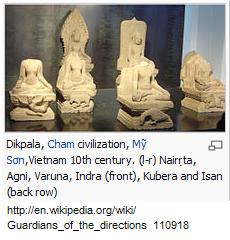 The Guardians of the Directions (Skt: दिक्पाल, Dikpāla) are the
deities who rule the specific directions of space according to
Hinduism
and
Vajrayāna
Buddhism —
especially
Kālacakra. As a group of eight deities, they are called
Aṣṭa-Dikpāla (अष्ट-दिक्पाल), literally meaning guardians of eight
directions. They are often augmented with two extra deities for the ten
directions (the two extra directions being
zenith and
nadir), when they
are known as the
Daśa-dikpāla. In Hinduism it is traditional to represent their images
on the walls and ceilings of Hindu temples. In ancient Java the nine guardian
gods of directions is called Dewata Nawa Sanga (Nine guardian
devata), the
diagram of these guardian gods of directions is featured in
Surya Majapahit, the emblem of
Majapahit empire.
The Guardians of the Directions (Skt: दिक्पाल, Dikpāla) are the
deities who rule the specific directions of space according to
Hinduism
and
Vajrayāna
Buddhism —
especially
Kālacakra. As a group of eight deities, they are called
Aṣṭa-Dikpāla (अष्ट-दिक्पाल), literally meaning guardians of eight
directions. They are often augmented with two extra deities for the ten
directions (the two extra directions being
zenith and
nadir), when they
are known as the
Daśa-dikpāla. In Hinduism it is traditional to represent their images
on the walls and ceilings of Hindu temples. In ancient Java the nine guardian
gods of directions is called Dewata Nawa Sanga (Nine guardian
devata), the
diagram of these guardian gods of directions is featured in
Surya Majapahit, the emblem of
Majapahit empire.
UKT: There are three major sects of Buddhism with titles ending in yāna {ya.na.} meaning 'vehicle' : 1. Mahayāna, 2. Hinayāna (now aka Theravada), and 3. Vajrayāna . It has been speculated that some of the Ari aka Arigyi of Pagan practiced the Vajrayāna sometimes identified with Tantric practices. They were subsequently disrobed by Anawratha but we should expect some to go into hiding only to resurface after the fall of Pagan as "forest dwelling" monks. -- UKT100814

UKT: The Burmese-Myanmar Buddhist astrological way of counting points of compass usually follows the right-hand way starting from the Sunday-corner or {ta.nïn~ga.nwé daung.}, in the north-east. This is how the "planet-posts" are placed around a ceti {sé-ti} pagoda in Myanmar. The directions are: North-East (Sun), East (Moon), South-East (Mars), South (Mercury), South-West (Saturn), West (Jupiter), North-West (Rahu), North (Venus).

[UKT: Rearranged to suit Bur-Myan astrological system which starts with the North-West aka the Sunday-corner aka {ta.nïn~ga.nwé daung.}. Note: {daung.} literally means 'corner', but here it means 'direction'. ]
01. North-east - Skt: Īśānya - {a.shé.mrauk Bak} aka {ta.nïn~ga.nwé daung.}
02. East - Skt: Pūrva, Prāchi, Prāk - {a.shé. Bak} aka {ta.nïn~la daung.}
03. South-east - Skt: Āgneya - {a.shé.taung Bak} aka {ïn~ga daung.}
04. South - Skt: Dakshina, Avāchi - {taung Bak} aka {boad~Da.hu: daung.}
05. South-west - Skt: Nairṛti - {a.nauk-taung Bak} aka {sa.né daung.}
06. West - Skt: Paścima, Pratīchi, Apara - {a.nauk Bak} aka {kra-þa.pa.té: daung.}
07. North-west - Skt: Vāyavya - {a.nauk-mrauk Bak} aka {ra-hu. daung.}
08. North - Skt: Uttara, Udīchi - {mrauk Bak} aka {þau:kra daung.)
09. Zenith - Skt: Ūrdhva
10. Nadir - Skt: Adho
In Hinduism
the Guardians of the four cardinal directions are called the
Lokapālas (लोकपाल)
 {lau:ka.pa-la.}. They are
[UKT: rearranged to suit Bur-Myan system]:
{lau:ka.pa-la.}. They are
[UKT: rearranged to suit Bur-Myan system]:
• Indra (east)
• Yama (south)
• Varuṇa (west)
• Kubera (north)
Images of the Lokapālas are usually placed in pairs at the entrance to tombs. As Guardians they can call upon the spirits of the next world to help them protect the tomb if necessary.
UKT: End of Wikipedia article.
Go back guard-directions-note-b
From Wikipedia: http://en.wikipedia.org/wiki/Lucifer 100822
 Lucifer
is a Latin word (from the words lucem ferre), literally meaning
"light-bearer", which in that language is used as a name for the dawn appearance
of the planet Venus,
heralding daylight. Use of the word in this sense is uncommon in English, in
which "Day Star" or "Morning Star" are more common expressions.
Lucifer
is a Latin word (from the words lucem ferre), literally meaning
"light-bearer", which in that language is used as a name for the dawn appearance
of the planet Venus,
heralding daylight. Use of the word in this sense is uncommon in English, in
which "Day Star" or "Morning Star" are more common expressions.
UKT: As a material scientist, I am beginning to form an opinion on the religions involving God and Devil (or Good and Evil) as something based on the astronomical phenomena of Day and Night. The Sun rules the day, and Venus can appear only when there is darkness just after the Sun has disappeared in the evening and just before it (the Sun) has appeared in the morning. The historical Buddha, Gautama, rejected the idea of God or the Creator as only a hypothesis, and based his religion on an altruism that all sentient beings suffer from mental suffering - The Principle of Suffering. UKT100824.
In English, "Lucifer" generally refers to the Devil, although the name is not applied to him in the New Testament. The use of the name "Lucifer" in reference to a fallen angel stems from an interpretation of Isaiah 14:3–20, a passage that speaks of a particular Babylonian King, to whom it gives a title that refers to what in English is called the Day Star or Morning Star (in Latin, lucifer),[2] as fallen or destined to fall from the heavens or sky.[3] In 2 Peter 1:19 and elsewhere, the same Latin word lucifer is used to refer to the Morning Star, with no relation to the devil. However, in post-New Testament times the Latin word Lucifer has often been used as a name for the devil, both in religious writing and in fiction, especially when referring to him before he fell from Heaven.
A myth[4] of the fall of angels, associated with the Morning Star, was transferred to Satan, as seen in the Life of Adam and Eve and the Second Book of Enoch,[5] which the Jewish Encyclopedia attributes to the first pre-Christian century:[6] in these Satan-Sataniel (sometimes identified with Samael) is described as having been one of the archangels. Because he contrived "to make his throne higher than the clouds over the earth and resemble 'My power' on high", Satan-Sataniel was hurled down, with his hosts of angels, and since then he has been flying in the air continually above the abyss.[4]
... ... ...
Because the planet Venus is an inferior planet, meaning that its orbit lies between the orbit of the Earth and the Sun, it can never rise high in the sky at night as seen from Earth. It can be seen in the eastern morning sky for an hour or so before the Sun rises, and in the western evening sky for an hour or so after the Sun sets, but never during the dark of midnight.
It is the brightest object in the sky after the Sun and the Moon. As bright and as brilliant as it is, ancient people did not understand why they could not see it at midnight like the outer planets, or during midday, like the Sun and Moon. It outshines the planets Saturn and Jupiter, which do last all night, but it soon disappears. Canaanite mythology has a story of an unsuccessful attempt by Athtar, the Morning Star pictured as a god, to take over the throne of Baal.[24][25]
In Latin, the word "Lucifer", meaning "Light-Bringer" (from lux, lucis, "light", and ferre, "to bear, bring"), is a name used for the Morning Star (the planet Venus in its dawn appearances).[26] The word is used in its astronomical sense both in prose[27] and poetry,[28] but most poets personify the star in a mythological context.[29]
UKT: Wikipedia article is an extensive article. The above are excerpts.
Go back Lucifer-note-b
End of TIL page