 {dé}
दे
{dé}
दे  {dé-wa.} देव
  {dè:} दै
 de-086b3-3.htm
from: Online Sanskrit Dictionary, February 12, 2003 . http://sanskritdocuments.org/dict/dictall.pdf 090907
Downloaded, set in HTML, and edited by U Kyaw Tun, M.S. (I.P.S.T., U.S.A.), and staff of TIL Computing and Language Centre, Yangon, Myanmar. Not for sale. No copyright. Free for everyone.
index.htm | Top
SED-con-r4-indx.htm
{dé}
दे
{dé-wa.} देव
{dè:} दै
UKT notes
• Ambapāli - the courtesan of Vaishali •
Devadatta - Buddha's cousin •
Devadasi • dainyayoga
• Devala - the rishi • God
and Deva - a matter of translation
{dé}
दे ¤ देदीप्यमान् dedīpyamān adj. radiant - SpkSkt
¤ देदीप्यमान dedīpyamāna pr.p. radiant - SpkSkt
• देयं (deyaM)
Skt: देयं (deyaM) - is to be given - OnlineSktDict
• देयता (deyataa)
Skt: देयता (deyataa) - is to be given - OnlineSktDict
• देयम् (deyam.h)
Skt: देयम् (deyam.h) - to be given - OnlineSktDict
{dé-wa.} देव
•
देव
(deva)
Skt: देव
(deva) - god - OnlineSktDict
Pal: deva m. a spirit, celestial being, angel, sky, king, death -
UPMT-PED113
Pal:
{dé-wa.}
 -
UHS-PMD0484
-
UHS-PMD0484
Bur:
{dé-wa.}
- n. Same as
 {nût} -
MED2010-210
{nût} -
MED2010-210
See my note on the Christian God and the Buddhist Deva - a matter of translation.
• देवं (devaM)
Skt: देवं (devaM) - god - OnlineSktDict
• देवः (devaH)
Skt: देवः (devaH) - m. nom. sing. god; demi-god -
OnlineSktDict
• देवता (devataa)
Skt: देवता
(devataa) - goddess - OnlineSktDict
Pal: devatā f. a deva, deity, angel,
spirit - UPMT-PED113
Pal:  {dé-wa.ta}
 -
UHS-PMD0485
-
UHS-PMD0485
• देवताः
(devataaH)
Skt: देवताः
(devataaH) - the demigods - OnlineSktDict
• देवदत्त
(devadatta)
= द े व द त ् त
Skt: देवदत्त
(devadatta) - one of the vital airs, which causes yawning - OnlineSktDict
*Pal: devadatta m. the cousin of the Buddha - UPMT-PED113
*Pal:  {dé-wa.dût~ta.}
 -
UHS-PMD0485
-
UHS-PMD0485
See my note on Devadatta (देवदत्त = द े व द त ् त ) - Buddha's cousin
Note: The orthography given by OnlineSktDict and Wikipedia are different due to an extra component in that of the latter: ‍ = Hex 200D --> 'zero width joiner' . - UKT100823
• देवदत्तं
(devadattaM)
Skt: देवदत्तं
(devadattaM) - the conch shell named Devadattam - OnlineSktDict
• देवदासी
(devadaasii)
Skt: देवदासी
(devadaasii) - God's (female) servant.
(the word has degenerated to a temple prostitute) - OnlineSktDict
See my notes on Devadasi and Ambapāli - the famous courtesan of Vaishali who became a Buddhist Arahant.
• देवदेव (devadeva)
Skt: देवदेव (devadeva) - O Lord of all
demigods - OnlineSktDict
• देवदेवस्य
(devadevasya)
Skt: देवदेवस्य
(devadevasya) - of the Supreme Personality of Godhead - OnlineSktDict
• देवभोगान्
(devabhogaan.h)
Skt: देवभोगान्
(devabhogaan.h) - the pleasure of the gods - OnlineSktDict
• देवयजः (devayajaH)
Skt: - OnlineSktDict
• देवरः (devaraH)
Skt: देवरः (devaraH) - m. husband's younger
brother - OnlineSktDict
Pal: devara m. husband's brother, brother-in-law - UPMT-PED113
Pal:
 {dé-wa.ra.}
 -
UHS-PMD0486
-
UHS-PMD0486
•
देवर्षिः
(devarshhiH)
Skt: देवर्षिः
(devarshhiH) - the sage among the demigods - OnlineSktDict
•
देवर्षीणां
(devarshhiiNaaM)
Skt: देवर्षीणां
(devarshhiiNaaM) - of all the sages amongst the demigods - OnlineSktDict
•
देवलः
(devalaH)
Skt: देवलः
(devalaH) - Devala - OnlineSktDict
See my note on Devala - the rishi.
• देववर (devavara)
Skt: देववर (devavara) - O great one amongst the
demigods - OnlineSktDict
• देवव्रताः
(devavrataaH)
Skt: देवव्रताः
(devavrataaH) - worshipers of demigods - OnlineSktDict
• देवहितं
(devahitaM)
Skt: देवहितं
(devahitaM) - that which is healthy or 'pro' or good for the Devas - OnlineSktDict
• देवाः (devaaH)
Skt: देवाः
(devaaH) - demigods - OnlineSktDict
• देवान् (devaan.h)
Skt: देवान् (devaan.h) - demigods - OnlineSktDict
• देवानां
(devaanaaM)
Skt: देवानां
(devaanaaM) - of the demigods - OnlineSktDict
• देवाय (devaaya)
Skt: देवाय (devaaya) - Divine - OnlineSktDict
• देवालयः
(devaalayaH)
Skt: देवालयः
(devaalayaH) - m. temple - OnlineSktDict
Pal: devālaya m. a Hindu temple - UPMT-PED113
Pal:
 {dé-wa-la.ya.}
 - UHS-PMD0486
• देवि (devi)
Skt: देवि (devi) - goddess - OnlineSktDict
• देवी (devii)
Skt: देवी (devii) - goddess - OnlineSktDict
UKT: देवी (devii) must not be confused with Apsara who are dancers at the court of Indra - the king of the deva. Apsara belong to the Gandharva beings not to the Deva beings. See http://en.wikipedia.org/wiki/Gandharva 100505 and http://en.wikipedia.org/wiki/Apsara 100212
However, both देवी (devii) and अप्सराः apsarāḥ are given as {nût þa.mi:} 'female Nat'.
Pal:{ic~hsa.ra}
-- UHS-PMDict0016
• देवेश (devesha)
Skt: देवेश (devesha) - O Lord of all lords - OnlineSktDict
• देवेषु
(deveshhu)
Skt: देवेषु
(deveshhu) - amongst the demigods - OnlineSktDict
• देश (desha)
Skt: देश
(desha) - country - OnlineSktDict
*Pal: desa m. a place, region, country, part, side - UPMT-PED113
*Pal:  {dé-þa.}
 -
UHS-PMD0487
-
UHS-PMD0487
• देशद्रोहः
(deshadrohaH)
Skt: देशद्रोहः
(deshadrohaH) - m. treason - OnlineSktDict
• देशांतर्गत
(deshaa.ntargata)
Skt: देशांतर्गत
(deshaa.ntargata) - within a country or region - OnlineSktDict
• देशे (deshe)
Skt: देशे (deshe) - land - OnlineSktDict
• देह (deha)
Skt: देह (deha) - body - OnlineSktDict
Pal: deha mn. the body - UPMT-PED113
Pal:  {dé-ha.}
 -
UHS-PMD0487
-
UHS-PMD0487
• देहं (dehaM)
Skt: देहं (dehaM) - body, existence - OnlineSktDict
• देहत्रयः
(dehatrayaH)
Skt: देहत्रयः
(dehatrayaH) - the three forms of bodies
(corporal or physical, astral, and causal) - OnlineSktDict
• देहभृत्
(dehabhRit.h)
Skt: देहभृत्
(dehabhRit.h) - the embodied - OnlineSktDict
• देहभृता
(dehabhRitaa)
Skt: देहभृता
(dehabhRitaa) - by the embodied - OnlineSktDict
• देहभृतां
(dehabhRitaaM)
Skt: देहभृतां
(dehabhRitaaM) - of the embodied - OnlineSktDict
• देहलि (dehali)
Skt: देहलि (dehali) - doorstep - OnlineSktDict
Pal: dehanī , dehalī - f. a threshold - UPMT-PED113
Pal:
 {dé-ha.ni}
 {dé-ha.li}
• देहवङ्भिः
(dehavadbhiH)
Skt: देहवङ्भिः
(dehavadbhiH) - by the embodied - OnlineSktDict
• देहाः (dehaaH)
Skt: देहाः
(dehaaH) - material bodies - OnlineSktDict
• देहान्तर
(dehaantara)
Skt: देहान्तर
(dehaantara) - of transference of the body - OnlineSktDict
• देहापाये
(dehaapaaye)
Skt: देहापाये
(dehaapaaye) - when life departs the body - OnlineSktDict
• देहिन्
(dehin.h)
Skt: देहिन्
(dehin.h) - man - OnlineSktDict
• देहिनं
(dehinaM)
Skt: देहिनं
(dehinaM) - of the embodied - OnlineSktDict
• देहिनां
(dehinaaM)
Skt: देहिनां
(dehinaaM) - of the embodied - OnlineSktDict
• देही (dehii)
Skt: देही (dehii) - the self - OnlineSktDict
•
देहीनं
(dehiinaM)
Skt: देहीनं
(dehiinaM) - the living entity - OnlineSktDict
•
देहीनः
(dehiinaH)
Skt: देहीनः
(dehiinaH) - of the embodied - OnlineSktDict
•
देहे
(dehe)
Skt: देहे
(dehe) - in the body - OnlineSktDict
• देहेऽस्मिन्
(dehe.asmin.h)
Skt: देहेऽस्मिन्
(dehe.asmin.h) - in this body - OnlineSktDict
• देहेषु
(deheshhu)
Skt: देहेषु
(deheshhu) - bodies - OnlineSktDict
•
दैत्य
(daitya)
Skt: दैत्य
(daitya) - a demon son of Diti - OnlineSktDict
UKT: Daitya, like Asura, are the enemies of Deva. And so in Skt-Dev, the language of the Hindus - the Deva worshippers, Asura, Daitya, and all enemies of the Deva are dubbed "demons". However, Buddhism treats them as equals. -- UKT 110829
•
दैत्यानां
(daityaanaaM)
Skt: दैत्यानां
(daityaanaaM) - of the demons - OnlineSktDict
•
दैन्ययोग
(dainyayoga)
Skt: दैन्ययोग
(dainyayoga) -
Combination of planets (Yoga) which give rise to poverty - OnlineSktDict
See my note on Planetary combination dainyayoga
•
दैव
(daiva)
Skt: दैव
(daiva) - destiny - OnlineSktDict
•
दैवं
(daivaM)
Skt: दैवं
(daivaM) - in worshiping the demigods - OnlineSktDict
•
दैवः
(daivaH)
Skt: दैवः
(daivaH) - godly - OnlineSktDict
•
दैवी
(daivii)
Skt: दैवी
(daivii) - transcendental - OnlineSktDict
•
दैवीं
(daiviiM)
Skt: दैवीं
(daiviiM) - divine - OnlineSktDict
From: http://en.wikipedia.org/wiki/Ambapali 100822
 Ambapāli,
also known as "Ambapālika" or "Amrapāli", was a
nagarvadhu
(royal
courtesan) of the republic of
Vaishali in ancient India around 500 BC.[1].
Following the Buddha's teachings she became an Arahant. She is mentioned in the
old Pali texts and Buddhist traditions, which most notably mention Buddha
staying at her Mango grove, Ambapali vana which she later donated to his
Order, and wherein he preached the famous Ambapalika
Sutta
[2][3][4][5].
Ambapāli,
also known as "Ambapālika" or "Amrapāli", was a
nagarvadhu
(royal
courtesan) of the republic of
Vaishali in ancient India around 500 BC.[1].
Following the Buddha's teachings she became an Arahant. She is mentioned in the
old Pali texts and Buddhist traditions, which most notably mention Buddha
staying at her Mango grove, Ambapali vana which she later donated to his
Order, and wherein he preached the famous Ambapalika
Sutta
[2][3][4][5].
Ambapali or Amrapali was of unknown parentage, and was given her name because at her birth she was found at the foot of a mango tree in one of the royal gardens in Vaishali. (Etymologically, the name, Ambapali or Amrapali, is derived from a combination of two Sanskrit words: "amra", meaning mango, and "pallawa", meaning young leaves or sprouts.)
UKT: Compare to the Japanese Geisha and Greek Hetaera .
hetaera also hetaira n. pl. hetaerae or hetaeras also hetairai or hetairas 1. An ancient Greek courtesan or concubine, especially one of a special class of cultivated female companions. [Greek hetaira from hetairos companion] - AHTD
Ambapali grew to be a lady of extraordinary beauty, charm, and grace. Many young nobles of the republic desired her company. To avoid confrontations among her suitors, she was accorded the status of the state courtesan of Vaishali. Stories of her beauty traveled to the ears of Bimbisara, who was at that time king of the hostile neighboring kingdom of Magadha. He attacked Vaishali, and for some days he took refuge in Amrapali's house as a traveller. Bimbisara was a good musician. Before long, Amrapali and Bimbisara fell in love. When she learned that he was actually Bimbisara, the king of Magadha, Ambapali asked him to go away and stop the war. Bimbisara, smitten with love, really did stop the war. In the eyes of the people of Vaishali, this incident made him a coward King. Later, Amrapali bore him a son named Vimala Kondanna. Ajatashatru, Bimbisara's son, took revenge by invading Vaishali.
At one time, Ambapali desired the privilege of serving food to Buddha. The Buddhist traditions state that Buddha accepted the invitation against the wishes of the ruling aristocracy of Vaishali. Ambapali received Buddha with her retinue, and offered meals to him. Soon thereafter, she renounced her position as courtesan, accepted the Buddhist faith, and remained an active supporter of the Buddhist order.
On growing up, Vimala Kondanna too became a Buddhist monk.
References; Khuddaka Nikaya, part 9 (Therigatha) Canto 13; Digha Nikaya 16 (Mahaparinibbanasutta - part 2, 16-26); Malalasekera: Buddhist Dictionary of Pali Proper Names (s.v.)
Go back Ambapali-note-b
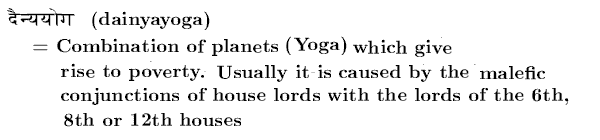
From: Online Sanskrit Dictionary, February 12, 2003 . http://sanskritdocuments.org/dict/dictall.pdf 090907
Go back dainyayoga-note-b
From Wikipedia: http://en.wikipedia.org/wiki/Devadasi 100821
Devadasi (देवदासी / ದೇವದಾಸಿ) is a Hindu religious practice in which girls are "married" and dedicated to a deity (deva or devi) or temple. The marriage usually occurs before the girl reaches puberty and always requires the girl to become a prostitute for upper-caste community members [1]. [UKT ¶]
UKT: It seems that a prostitute for the upper 'class' was not a lowly profession. The term could be loosely translated as
{præÑ.tûn-hsa} 'the ornament of state'. See the meaning of the term in MED290. I am thinking of Ambapāli one of the female Buddhist Arahant who was a
The profession should be compared to that of the highly educated female 'entertainers' of ancient Greece who would socially entertain a person or persons of high rank whose wives were usually just 'child-bearing' spouses left behind in their homes. - UKT100822
Originally, in addition to this and taking care of the temple and performing rituals, these women learned and practiced Bharatanatyam and other classical Indian artistic traditions and enjoyed a high social status. The devadasi system was outlawed in all of India in 1988, yet some devadasis still practice illegally [2].
Following the demise of the great Hindu kingdoms devadasis lost their high status and were seen as simply prostitutes. As a result of these social changes, devadasis were left without their traditional means of support and patronage. Colonial views on devadasis are hotly disputed by several groups and organizations in India and by western academics.[1][2][3][4]
Recently the devadasi system has started to disappear, having been outlawed in all of India in 1988 [3][5] However, devadasis still exist in India today, as shown in a 2004 report by the National Human Rights Commission of the Government of India.[6] According to this report, "after initiation as devadasis, women migrate either to nearby towns or other far-off cities to practice prostitution" (p200). A study from 1990 recorded that 45.9% of devadasis in one particular district were prostitutes, while most of the others relied on manual labour and agriculture for their income.[7] The practice of dedicating devadasis was declared illegal by the government of the Indian state Karnataka in 1982[8] and by the government of Andhra Pradesh in 1988. However as of 2006 the practice was still prevalent in around 10 districts of northern Karnataka and 14 districts in Andhra Pradesh.[9]}.
Devadasis are also known by various other local terms, such as jogini. [UKT ¶]
UKT: The similarity between 'jo' and
{zau} is so striking that it has occurred to me that 'jogini' and
{zau-ga.ni} might have meant the same - 'a female artisan' which has degenerated into 'a female witch' . See MED151 for Bur-Myan meaning of the word
Futhermore, the devadasi practice of religious prostitution is known as basivi in Karnataka and matangi in Maharastra. It is also known as venkatasani, nailis, muralis and theradiyan [4]. Devadasi are sometimes referred to as a caste; however, some question the accuracy of this usage. "According to the devadasis themselves there exists a devadasi 'way of life' or 'professional ethic' (vritti, murai) but not a devadasi jāti (sub-caste). Later, the office of devadasi became hereditary but it did not confer the right to work without adequate qualification" (Amrit Srinivasan, 1985). In Europe the term Bayadere (from French: bayadère, ascending to Portuguese: Balliadera, literally dancer) was occasionally used.[10]
UKT: More in the Wikipedia article.
Go back devadasi-note-b
From Wikipedia: http://en.wikipedia.org/wiki/Devadatta 100823
Devadatta (देवदत्त) was a Buddhist monk and the cousin of Gautama Buddha. He was recorded as having created a schism in the sangha, or monastic community. This schism was later undone when all his followers came back to the Buddha, after which Devadatta also wanted to come back. However, Devadatta died shortly after beginning to feel remorse, and accounts differ about whether he was able to express his remorse to the Buddha. Devadatta is often described as having been jealous of the Buddha's greatness and wisdom and wanting to become a great religious leader himself.[1]
The original motivation of Devadatta to lead the holy life and become a monk was pure, but later he became corrupted after allegedly developing some supernatural powers.
According to the Pali Canon, he taught his sangha to do five tapas (rules) in their whole life:
His followers (including bhikkhus and bhikkhunis) came mainly from the Shakya clan. His closest four companions did not come back to the Buddha. According to Faxian, Xuanzang and I Ching's writings, some people practised in a similar way and with the same books as common Buddhists, but followed the similar tapas and performed rituals to the past three buddhas and not Sakyamuni Buddha. Many followers of that sect listened to the lessons in the Nalanda with the others, but they said they were not students of Devedatta. [2]
Devadatta is noted for attempting to kill the Buddha on several occasions including:
• Rolling a boulder towards him. Devadatta missed, but a splinter from the rock drew blood from the Buddha's foot. According to Buddhist tradition, this is one of the five ànantarika-kammas, the five most heinous deeds a human can perform.
• Inciting an elephant to charge at the Buddha. The Buddha was able to pacify the elephant by directing metta toward it.
According to the Suttapitaka, after trying to kill Sakyamuni a number of times, Devadatta set up his own Buddhist monastic order by splitting the monastic community (sangha) in two (another 'anantarika-kamma'). During his efforts to become the leader of his own sangha, he proposed five extraordinarily strict rules for monks, which he knew the Buddha would not allow. Devadatta's reasoning was that after he had proposed those rules and the Buddha had not allowed them, Devadatta could claim that he did follow and practice these five rules, making him a better and more pure monk. One of these five extra rules required monks to be vegetarian .
In the Mahayana Buddhist text, Contemplation Sutra, Devadatta is said to have convinced Prince Ajatasattu to murder his father King Bimbisara and ascend the throne. Ajatasattu follows the advice, and this action (another 'anantarika-kamma' for killing your own father) prevents him from attaining stream-entry at a later time, when listening to some teaching of the Buddha.
Devadatta is the only individual from the early Buddhist tradition to have committed 3 anantarika-kammas. The three were: 1. killing an arhat (he indirectly killed King Bimbisara who attained arhatship before he died.) 2. splitting up the Sangha 3. and wounding the Buddha's foot when a sliver lodges in the Buddha's foot when Devadatta rolls a boulder at the Buddha to kill the Buddha.
Only two of these three are recognized in the Pali cannon. In the Pali cannon Buddha says that Devadatta is doomed to hell for an eon. Devadatta is recorded in the Pali cannon as wounding the Buddha foot from his attempt on his life. He is also recorded in the Pali cannon as splitting up the Sangha. And while the account of Ajatasatru killing his father the king is recorded in the Pali cannon (this prevents Ajatasatru from attaining stream-entry when he meets the Buddha, which the Buddha says would definitely have happened if he had not killed his father) the account of King Bimbisara attaining enlightenment before death and Ajatasatru being motivated to this deed by Devadatta are from purely Mahayana Sutras, as opposed to the Pali cannon. This is not in the Pali cannon.
Due to the loss of reputation and popularity after splitting the Sangha in two, Devadatta felt bad about what he did, and wanted to make a sincere apology to the Buddha. However, after entering the monastery where the Buddha was living at the time, it is said that some of the bad karma (intentional action) he made came to fruition; the earth opened to draw him straight into the deepest hell, known as the Hell of Avici.
Other accounts claim that towards the end of his life, he was struck by a severe remorse caused by his past misdeeds and did indeed manage to approach the Buddha and retook refuge in the Triple Gem, dying shortly afterwards. Because of gravity of his sins, he was condemned to suffer for several hundred millennia in Avici. However, it was also said that he would eventually be admitted into the heavens as a Pratyekabuddha due to his past merits prior to his corruption.
In the Lotus Sutra, chapter 12, found in the Mahayana Buddhist tradition, the Buddha teaches that in a past life, Devadatta was his holy teacher who set him on the path, and makes a noteworthy statement about how even Devadatta will in time become a Buddha:[3]
"The Buddha said to his monks: "The king at that time was I myself, and this seer was the man who is now Devadatta. All because Devadatta was a good friend to me, I was able to become fully endowed with this six paramitas, pity, compassion, joy, and indifference, with the thirty-two features, the eighty characteristics, the purple-tinged golden color, the ten powers, the four kinds of fearlessness, the four methods of winning people, the eighteen unshared properties, and the transcendental powers and the power of the way. The fact that I have attained impartial and correct enlightenment and can save living beings on a broad scale is all due to Devadatta who was a good friend."Then the Buddha said to the four kinds of believers: "Devadatta, after immeasurable kalpas have passed, will attain Buddhahood. He will be called Heavenly King Thus Come One (Heavenly King Tathagata), worthy of offerings of right and universal knowledge, perfect parity and conduct, well gone, understanding the world, on itself worthy, trainer of people, teacher of heavenly and human beings, Buddha, World-Honored One."
The name Devadatta is often spelled as "Deodatta". The literal meaning of the word "Devadatta" (or "Deodatta") is "divine gift". In the Bhagvad Geeta from the Mahabharata, the conch shell used by Arjuna on the battle-field of Kurukshetra was named Devadatta.
Go back Devadatta-note-b
From Wikipedia stub: http://en.wikipedia.org/wiki/Devala 100822
In Hinduism, Devala was one of the great rishis or sages. He is acknowledged to be a great authority like Narada and Vyasa and is mentioned by Arjuna in Bhagavad Gita.
Go back Devala-note-b
by UKT 100820, 120103
Bur-Myanmar should never translate देव
(deva) as God, particularly with a capital G as it invariably
translates into the Christian God or
 {hta-wa.ra. Bu.ra:} 'permanent Buddha'.
It should be noted that many, myself included
at one time, do not realize that Buddha
 {Bu.ra:} stands for <wisdom> which you [or any other human being born of
human parents] can achieve by
practice and not by birth.
{Bu.ra:} stands for <wisdom> which you [or any other human being born of
human parents] can achieve by
practice and not by birth.
The best translation for देव
(deva) is
 {nût Bu.ra:},
 {nût dé-wa.} or simply
{nût} for male god; and
{nût dé-wa.} or simply
{nût} for male god; and
 {nût Bur.ra:ma.} aka
 {nût þa.mi:} for female god or goddess, and collectively as
{nût dé-wa.}. However, you must remember that there are two other meanings for
Bur-Myan word
{nût þa.mi:}:
{nût þa.mi:} for female god or goddess, and collectively as
{nût dé-wa.}. However, you must remember that there are two other meanings for
Bur-Myan word
{nût þa.mi:}:
1. Skt: अप्सर = Pal: अच्छरा accharā 'a celestial nymph' (UPMT-PED006). It is given as
2.
Finally, the best translation for the Christian God is
 {hpûn-hsing:rhing} 'one who creates' or the 'Creator'. One bonus being the
absence of the gender issue. This translation can be applied to the Hindu
Brahma - one of the Hindu Trinity aka
Trimurti .
{hpûn-hsing:rhing} 'one who creates' or the 'Creator'. One bonus being the
absence of the gender issue. This translation can be applied to the Hindu
Brahma - one of the Hindu Trinity aka
Trimurti .
When I say that the word 'God' should be translated as
{hpûn-hsing:rhing} 'one who creates' or the 'Creator', I am basing my view on
my personal family background.
My mother, who spoke Cantonese quite well besides her first language Burmese, and English, in her childhood [before 1900] had gone to an exclusive Anglican ('Church of England') school in Rangoon with the first name Mary . One of her friends by the name Eva Rafael (widow of Jacob Rafael a Jew of Bassein who had died sometime in the early 1940s). Aunty Eva came to live us for a time soon after the Second World War, and I usually accompanied her to St. Mary Cathedral (near Rangoon General Hospital) [Anglican] every Sunday for almost a year. Rangoon was then under the British Military government or CAS(B), and the church would be full of British service-men. The service was in English which I as a child was beginning to understand. Though my mother had remained a Buddhist, her outlooks on life were Christian biased.
My father, who spoke Hindi as well as his first language Burmese, and English, was a Theosophist who had first learned Theravada Buddhism under the guidance of his mentor, an Arakanese by the name U Kyaw Dun (I was named after him but had my name Burmanised to Kyaw Tun). My father had studied the Koran and the Hindu religion. It was from him that I learned how to have a balance view on my personal religion.
During the Second World War, I had gone to a vernacular school by the name Gya Kyaung (which had its beginnings at Gya Kyaung Monastery) in Kungyangon. During the War years, U Aung Din (#4 on the list of Rangoon College Boycotters on the pillar on the Shwedagon Pagoda) had been a constant visitor at our house. It was he who had installed in me my love of the Burmese culture and religion. He finally came to marry one Daw Hla Myint of Kungyangon who used to be my mother's pupil at Kungyangon National School.
I had attended an English primary [Anglican] school soon after the War, had lived front-door neighbour to the Ramakrisna Society in Thompson Street in East Rangoon, and had volunteered as a library help at the Society. Of course, it meant that I had attended many Hindu pujas and had Bengali friends. Moreover, some of my family friends were Socialists to the boot.
I had as a best college friend one Karel Kyaw Ohn, a Baptist from Moulmein, and through him had come to know many Baptists as a college student, particularly Dr. Hla Thwin, Professor of Psychology, and his wife Daw Aye, Director of Social Welfare Dept., and U Kyaw Nyeing, Head of Ceramics Dept., UBARI, and his wife Daw San Yin, Head Mistress of St. Augustine School.
To improve my English I had studied the King James Bible and the Gideon Version and I am proud to say that I had gone through the two, cover to cover, at least four times. I must have gone through the Gideon innumerable times later looking for a subject. Lately, I had studied the Book of Mormon in Deep River, Canada.
Go back God-Deva-note-b
End of TIL file