UKT: Home is the First School for the Child
"A well-written book for children."
geog-child.htm
- Highroads of Geography, in The
Royal School Series, 1916:
a school book primarily for British
children: two chapters on Burma.
See TIL HD-nonPDF and SD-nonPDF
---
RoyalSchSeries-Geography<Ô> /
bkp<Ô> (link chk 190502)
See also:
https://archive.org/details/highroadsofgeogr11218gut
180821
Downloaded and set in html by U Kyaw Tun (UKT) (M.S., I.P.S.T., USA), and staff of Tun Institute of Learning (TIL). Not for sale. No copyright. Free for everyone. Prepared for students and staff of TIL Research Station, Yangon, MYANMAR: http://www.tuninst.net, www.romabama.blogspot.co
index.htm | |Top
earth-indx.htm |
geog-indx.htm
UKT: Home is the First School for the Child
"A well-written book for children."
01. Good-bye
to Father
02. A Letter from France,
03. In Paris,
04. On the Way to Egypt,
05. A Letter from Egypt,
06.
Children
of Egypt,
07.
Through
the Canal,
08.
Amongst
the Arabs.—I.,
09.
Amongst
the Arabs.—II.,
10.
A
Letter from India,
11.
In
the Streets,
12.
Our
Indian Cousin,
13.
In
the Garden,
14.
Indian
Boys and Girls,
15.
Elephants
and Tigers,
16.
A
Letter from Burma, 1
17.
A
Letter from Burma. 2
18.
A
Letter from Ceylon,
19.
A
Letter from China,
20.
Chinese
Boys and Girls,
21.
Hair,
Fingers, and Toes,
22.
A
Letter from Japan,
23.
Jap
Children,
24.
A
Letter from Canada,
25.
Children
of Canada,
26.
The
Red Men,
27.
The
Eskimos,
28.
Father's
Last Letter,
29.
Home
Again,
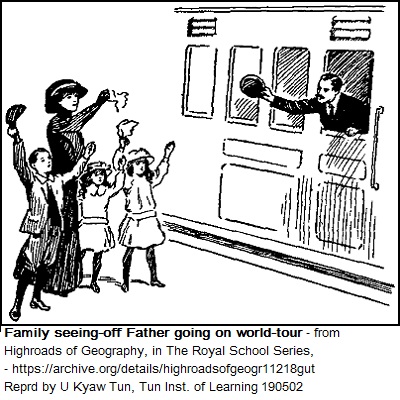 1. Father kissed us and said, "Good-bye, dears. Be good children, and help
mother as much as you can. The year will soon pass away. What a merry time we
will have when I come back again!"
1. Father kissed us and said, "Good-bye, dears. Be good children, and help
mother as much as you can. The year will soon pass away. What a merry time we
will have when I come back again!"
2. Father kissed mother, and then stepped into the train. The guard blew his whistle, and the train began to move. We waved good-bye until it was out of sight.
3. Then we all began to cry -- even Tom, who thinks himself such a man. It was so lonely without father.
4. Tom was the first to dry his eyes. He turned to me and said, "Stop that crying. You are the eldest, and you ought to know better."
5. He made mother take his arm, just as father used to do. Then he began to whistle, to show that he did not care a bit. All the way home he tried to make jokes.
6. As soon as we had taken off our coats and hats, Tom called us into the sitting-room. "Look here," he said: "we're going to have no glum faces in this house. We must be bright and cheerful, or mother will fret. You know father wouldn't like that."
7. We said that we would do our best. So off we went to help mother to make the beds and to dust the rooms. While we were doing this we quite forgot to be sad.
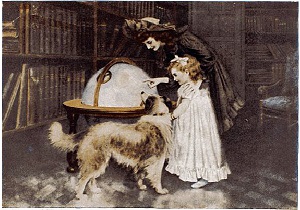
8. After tea we went into father's room and looked at the globe. "I'm going to follow father right round the world," said Tom. "Please show me which way he is going." Mother did so.
9. "By this time next week," she said, "we shall have the first of many long letters from father. I am sure we shall enjoy reading them. He will tell us about the far-off lands which he is going to see."
10. "That will be grand," I said. "I hope he will tell us lots about the children. I want to know what they look like, what they wear, and what games they play."
11. Tom said he would rather not hear about children. He wanted to hear about savages and tigers and shipwrecks, and things like that.
12. A week later the postman brought us father's first letter. How eager we were to hear it! Mother had to read it for us two or three times.
13. Every week for many weeks the postman brought us letters from father. When he handed us a letter he used to say, "I'm glad to see that your daddy is all right so far."
14. This book is made up of father's letters from abroad. I hope you will enjoy them as much as we did.
1. MY DEAR CHILDREN, -- Since I last wrote to you I have visited several of the large cities of India. A week ago I was in the largest city of all.
2. On Christmas morning I sailed down the mouth of the Ganges into the open sea, on my way to the country of Burma.
3. Now I am in the chief town of Burma, and you
will expect me to tell you something about the
land and its people. From what I have seen, I
think Burma is a prettier country than India.
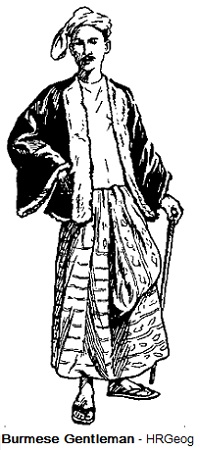
5. Kate and May will like to hear something about the Burmese girls and women. They are not at all sad like the Indians, but are very bright and gay. As I write these lines I see a party of Burmese girls passing my window, I can hear them laughing.
6. They are very dainty in their dress. One girl wears a skirt of pink silk and a blouse of light green. She has bracelets on her arms, ear-rings in her ears, a string of coral round her neck, and flowers in her hair.
7. In one hand she carries a bamboo sunshade; in the other she holds a big
paper cigar! She is very fond of smoking, and you never see her without a cigar.
On her feet she wears sandals.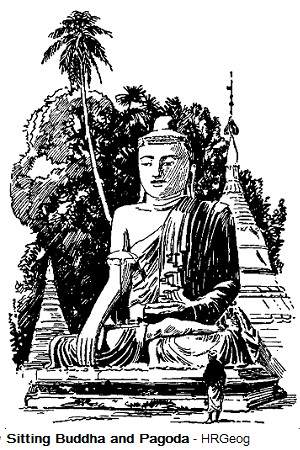
8. The men are gentle and rather lazy. The women have far more "go" in them than the men. Many of them keep shops, and are very good traders. The wife is the chief person in every home.
9. The men also wear skirts, and sometimes their jackets are very gay. They wrap a handkerchief of pink, or of some other bright colour, round their head.10. The Burmese worship Buddha, a prince who lived more than two thousand years ago. He was a very noble man, and he gave up all the pleasant things of life that nothing might turn his thoughts from goodness.
11. Amongst other things he taught men to be kind to animals. All animals are well treated in Burma.
12. All over the land you see temples to Buddha. These temples grow narrower and narrower the higher they rise. They all end in a spire above which there is a kind of umbrella. It is made of metal, and all round its edge are silver or golden bells, which make pretty music as they are blown to and fro by the wind.
13. By the side of many of these temples you may see a great image of Buddha. Most of the images are made of brass. The Burmese pray before these images, and offer flowers and candles and rice to them.
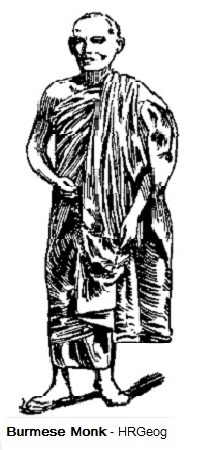
1. Wherever you go in Burma you see monks. They have shaven heads, and they wear yellow robes. Every morning they go out to beg. Boys in yellow robes go with them, and carry large bowls in their hands.
2. The people come out of their houses and put food into the bowls. The monks do not thank them. They say that he who gives is more blessed than he who takes.
3. The monks live in houses built of teak wood. In every village you can see a monk's house standing in a grove of palm trees. In these houses the monks keep school.
4. Every Burmese boy lives for some time in one of the monks' houses. Here he learns to read and write, and is taught to be a good man.
5. I went to see the most beautiful of all the monks' houses. It is in a city far up in the country. The building is of dark-brown teak wood, and has many roofs, one above the other. It is covered with carving, and here and there it is gilded.
6. Many boys in yellow robes were playing beneath the trees. They were the scholars of the school. One of the boys told me that he was never going to leave the place. When he was old enough he meant to be a monk.
7. In the city I saw the palace of the king from whom we took Burma. It stands inside a large space, with high walls all round it. Outside the wall is a broad ditch full of water. When I saw the ditch it was overgrown with water-plants covered with pink blossoms.
8. Many buildings, something like the monks' houses, form the king's palace. Some of the buildings are very richly carved, and are covered with gold leaf. Inside one of them I saw great teak pillars, also covered with gold.
9. The chief building ends in a very lofty spire, with a beautiful metal
umbrella above it. The Burmese used to believe that this spire was in the very
middle of the earth.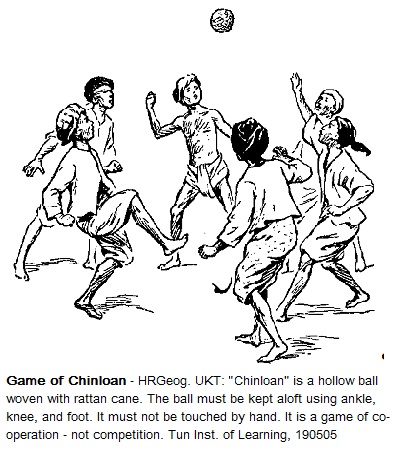
11. As I drove to my hotel last night I saw a number of boys playing Burmese football. They do not take sides, nor do they try to kick goals. The football is made of basket-work.
12. The boys stand round in a ring, and the game is to keep the ball from touching the ground. The boys pass the ball from one to the other by knocking it up with their heads, arms, hands, legs, or toes. Some of the boys are very clever at this game.
13. Burma has many beautiful rivers and some fine mountains. By the side of the rivers much rice is grown. Away in the north there are grand forests filled with wild animals. Tigers are often shot within twenty miles of the old king's palace.
14. Now I have filled my paper, and I must bring this letter to an end. I hope you are all well and happy. I am leaving Burma tomorrow.—Best love to you all. FATHER.
End of TIL file