
earlyearth.htm
A collection from Wikipedia: -
https://en.wikipedia.org/wiki/Early_Earth 180310, 190515
and other websites.
The downloaded Wikipedia article is in TIL HD-nonPDF and SD-nonPDF libraries, in
Webarchive .MHT section:
- EarlyEarth<Ô> /
Bkp<Ô> (link chk 190603)
Collection downloaded and edited by U Kyaw Tun (UKT)
(M.S., I.P.S.T., USA), and staff of Tun Institute
of Learning (TIL) . Not for sale.
No copyright. Free for everyone.
Prepared for students and
staff of TIL Research Station,
Yangon, MYANMAR
-
http://www.tuninst.net ,
www.romabama.blogspot.com
index.htm | |Top
earth-indx.htm
UKT 190506: What is meant by the "Early Earth" (sometimes referred to as Gaia), is roughly the First Billion Year, from 4.5 to 3.5 x10^9 yr. ago.
There was no TOC in original article. The following TOC is my own.
Introduction
Problem of Time: Theory of General Relativity
and Quantum Mechanics
Relativistic Mass:
Big Bang Theory
Star formation
Solar System formation
Age of the Earth
Formation of Moon
UKT 190628: Big Bang and the first part of Early Earth belong to Cosmology and theoretical Sciences and might be separated in future uploads into a separate section.
Atmosphere
Hydrosphere
Life forms in
Archean Eon and Proterozoic Eon
Hominims
UKT notes
• The Giant-Impact Hypothesis for Moon's
Formation Is in Doubt
UKT 190523:
Academic subjects are simply boring. They become more boring still because they are presented in a boring way by professors and teachers, some lecturing in monotones. I'm not one of those, and I always try to teach telling my students, now and then, hilarious incidences that are connected to the subject. I usually look straight into their eyes to keep them awake. Now, well over 80 years in age, and have been teaching over 60 years, I teach at my TIL research station with the help of downloaded videos in English which also improves the English language skill of my students.
Many years ago, when I was teaching at the Arts and Science University in Rangoon, on Quantum Mechanics, I touch on the idea of Relativity. I took my M.Sc. students on an imaginary drive from Kamayut, where the Rangoon Univ. and then the Arts & Sc. Univ. was, to the centre of Rangoon marked by Sulé Pagoda.
"Let's go on a drive. Now everybody aboard my car, and close your eyes. I'll tell you what's happening outside. I turn the key, the engine starts. The wheels revolve. Do you see anything? Nothing! Well, I turn the steering left and right. I see the road starting to go under the car. Trees run past us. I am still sitting in the driver seat. We all are sitting still. It is the Earth moving under us. I see the U Wizara monument coming straight at us. I just turn the steering and the monument turns away. Finally, Sulé Pagoda comes bearing down on us. I turn the steering, and the Pagoda avoids hitting us. Now, open your eyes. Are you still sitting in your seats? Yes! We are not the ones moving! It is the Earth. If you take yourself as not moving, it is the Earth moving. However, if you take the Earth to be stationary, it is you who are moving." At the end of my talk, all - I'm sure all my students - took me for a Nut, with a capital N.
Watch a video on Relativity in TIL HD-VIDEO and SD-VIDEO libraries, in Geology section:
- EiensteinRelativity<Ô> / Bkp<Ô> 31.5 MB (link chk 190527)
The above video clip ends with the remark that the fastest thing we know is Light. Now we will move into the nature of Light both as a stream of particles (photons) or as a a beam of energy, and it will make you feel that there is something wrong with what we know as motion. Now, we will now look into the Michelson-Morley experiment which measures the speed of Light.
Watch The speed of Light and the Michelson-Morley experiment by Jason Kendall, in TIL HD-VIDEO and SD-VIDEO libraries, in Geology section:
- SpeedLightMichelson-Morley<Ô> / Bkp<Ô> 354 MB (link chk 190527)If you're getting serious, look into the Wikipedia article, The Michelson–Morley experiment , downloaded into TIL non-PDF libraries in Webarchive section, where the article is saved in .MHT format:
- MichelsonMorleyExpt-Wiki<Ô> / Bkp<Ô> (link chk 190606)
The conclusion of this experiment is there is no such thing as Æther aka Ether.
Now, what is Æther in Myanmar Alchemy? According to them, there are five
material elements, Earth, Fire, Water and Wind. However, a combination of all
the four in proportion of a human being would give only an inanimate body aka a
dead body. Now add the Fifth element,
 {a-ka-þa. Daat}, then the dead body becomes alive. This fifth element is
supposed to be Æther. It shows that mixing up disciplines such as Alchemy and
Science should not be done. See also Wikipedia: https://en.wikipedia.org/wiki/Aether_(classical_element)
190606
{a-ka-þa. Daat}, then the dead body becomes alive. This fifth element is
supposed to be Æther. It shows that mixing up disciplines such as Alchemy and
Science should not be done. See also Wikipedia: https://en.wikipedia.org/wiki/Aether_(classical_element)
190606
However, since languages are already mixed up with Mythologies we should be careful in giving the name Giae to Earth.
 We usually assume that everything, and every event
must have a beginning. So what is the beginning of
Time and the Universe. First, let's see what the Ancients think
about Time, and how they personified Time.
We usually assume that everything, and every event
must have a beginning. So what is the beginning of
Time and the Universe. First, let's see what the Ancients think
about Time, and how they personified Time.
From Wikipedia: https://en.wikipedia.org/wiki/Father_Time 190527
and, https://en.wikipedia.org/wiki/Personification 190527
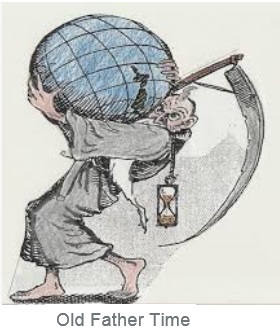
Father Time is the personification of Time. [or, an anthropomorphic metaphor in which a thing or abstraction is represented as a person.]. In recent centuries he is usually depicted as an elderly bearded man, sometimes with wings, dressed in a robe and carrying a scythe and an hourglass or other timekeeping device (which represents Time's constant one-way movement, and more generally and abstractly, entropy).
From Wikipedia - https://en.wikipedia.org/wiki/Problem_of_time 190524
"In theoretical physics, the problem of time is a conceptual conflict between General Relativity and Quantum Mechanics in that quantum mechanics regards the flow of time as universal and absolute, whereas general relativity regards the flow of time as malleable and relative. [1] This problem raises the question of what Time really is in a physical sense and whether it is truly a real, distinct phenomenon. It also involves the related question of why time seems to flow in a single direction, despite the fact that no known physical laws seem to require a single direction. [2]
Read what late theoretical physicist Stephen Hawking had to say - http://www.hawking.org.uk/the-beginning-of-time.html 190525
"In this lecture, I would like to discuss whether Time itself has a beginning, and whether it will have an end. All the evidence seems to indicate, that the universe has not existed forever, but that it had a beginning, about 15 x10^9 (billion) years ago. This is probably the most remarkable discovery of modern cosmology. Yet it is now taken for granted. ..."
UKT 190608: We think we know what Time is. Now, because of Theory of Relativity, we now know that we know nothing. Let's see what we know of Matter or Mass. Don't be surprised that Mass is also relativistic. Or, is it?
Wikipedia: https://en.wikipedia.org/wiki/Mass_in_special_relativity 190609
Mass in special relativity incorporates the general understandings from the laws of motion of special relativity along with its concept of mass–energy equivalence. [UKT ¶]
E = m c2
where, E = energy, m = mass, c = velocity of light which is constant at 300,000 km/sec (or 186,000 miles/sec).
The word mass is given two meanings in Einstein's Theory of Special Relativity: one (rest or invariant mass, and its equivalent rest energy) is an invariant quantity which is the same for all observers in all reference frames; the other (relativistic mass or the equivalent total energy of the body) is dependent on the velocity of the observer. [UKT ¶]
The term relativistic mass tends not to be used in particle and nuclear physics and is often avoided by writers on special relativity. [1] They do, however, talk about the (total) energy of a body, which is the equivalent to its relativistic mass, rather than the rest energy equivalent to its rest mass. The measurable inertia and gravitational attraction of a body in a given frame of reference is determined by its relativistic mass, not merely its rest mass. For example, light has zero rest mass but contributes to the inertia (and weight in a gravitational field) of any system containing it.
Watch Is Relativistic Mass real? by Dr. Don Lincoln, Fermilab, U.S. Dept. of Energy, in TIL HD-VIDEO and SD-VIDEO libraries, in Geology section:
- RelativisticMass<Ô> / Bkp<Ô> (190609)
The above problem of Time and Mass (or Energy) brings to mind my understanding of the Eighth Jhanic
State of Theravada Buddhism:
Neither perception nor non-perception
 {neva þaÑa na þaÑa} [UKT: I'm not sure of spelling because of Nya-major & Nya-minor
problem present between International Pali and Pali-Myan].
{neva þaÑa na þaÑa} [UKT: I'm not sure of spelling because of Nya-major & Nya-minor
problem present between International Pali and Pali-Myan].
The Eighth Jhanic State, according to my respected friend Sayadaw U Zawtika, is
the highest of the
 {lau:ki Zaan}. A person who has reached that state is born into lower Brahma
worlds from which there is a chance that he can still be reborn even in the
Animal World. In other words, he has not reached the Nibbanic state. Caution:
I'm talking here about the Theravada view which is at odds with Mahayana schools
which use Sanskrit language the result being mixed up with Hindu Brahmana
schools.
{lau:ki Zaan}. A person who has reached that state is born into lower Brahma
worlds from which there is a chance that he can still be reborn even in the
Animal World. In other words, he has not reached the Nibbanic state. Caution:
I'm talking here about the Theravada view which is at odds with Mahayana schools
which use Sanskrit language the result being mixed up with Hindu Brahmana
schools.
See also https://dhammawiki.com/index.php/9_Jhanas#List_of_jhanas 190524
UKT 190524: My understanding of the higher Jhanic States began when I first came across the Heisenberg Uncertainty Principle in Quantum Mechanics.
See Wikipedia: https://en.wikipedia.org/wiki/Uncertainty_principle 190524
" In quantum mechanics, the Uncertainty Principle (aka Heisenberg's Uncertainty Principle) is any of a variety of mathematical inequalities [1] asserting a fundamental limit to the precision with which certain pairs of physical properties of a particle [such as an electron] known as complementary variables or canonically conjugate variables such as position x and momentum p, can be known."
Instead of getting muddled with our understanding of Time and Energy, (and, for Buddhists with our understanding of Jhanic States), let's begin with what everyone knows , or, think we know - that there is a beginning for everything. Even our Universe has a beginning - a beginning which we call the Big Bang.
UKT 190526: The Christian "Creationists" have their own ideas of the Beginning. As one who went as a young boy to a Christian school, and as one who had the studied the Bible - both King James and Gideon versions just for the fun of it - I am lucky to understand what the Creationists are saying. For those who haven't read the Bible, go online and read your fill. Or,
"We would not normally consider it necessary to explain how a theory works that we don’t even believe in. However, there are a lot of misunderstandings about the Big Bang theory. This includes misunderstandings amongst fellow creationists, who therefore sometimes end up opposing ideas that the Big Bang theorists don’t even believe in. This article is therefore an attempt to understand a little of what the theory is about, and why, as creationists, we do not accept it." Eric Hovind - https://creationtoday.org/the-big-bang-theory/ 190526
See downloaded Wikipedia article in TIL HD-nonPDF and SD-nonPDF libraries, in Webarchive .MHT section:
- BigBang-Wiki<Ô> / Bkp<Ô> (link chk 190601)
"The Big Bang theory is the prevailing cosmological model for the observable universe".See downloaded video is in the Geology section of TIL HD-VIDEO and SD-VIDEO libraries
- BigBangTh<Ô> / Bkp<Ô> 36.0 MB (link chk 190523)
So, there must be a beginning for Earth. And, before that there must be a beginning of our Solar System to which our Earth belongs.
Now, what about the
Creator? As a scientist and as a Theravada Buddhist, I'll keep silent. That is
what Gautama Buddha did on unanswered questions, I will just refer you to Wikipedia:
https://en.wikipedia.org/wiki/The_unanswered_questions 190527
"The phrase unanswered questions or undeclared questions (Skt: «avyākṛta»,
Pali: «avyākata» - "unfathomable, unexpounded"
[1]), in Buddhism,
refers to a set of common philosophical questions that
Buddha refused to answer, according to Buddhist texts. The Pali texts give
only ten, the Sanskrit texts fourteen questions." - He was certainly a
scientist in our modern sense.
UKT 190528: Somehow or other, we are now deep in Astronomy. So why not wade in further? See Theory of Galaxy Formation by Frank van den Bosch, 2018, in TIL HD-PDF and SD-PDF libraries:
- FvandenBosch-GalaxyFormation<Ô> / Bkp<Ô> (link chk 190603)
"Stars form out of Giant Molecular Clouds (GMCs), which have densities ~100 cm-3, and sizes of tens of parsecs.
Stars have sizes of ~10-7 pc, and densities of ~1 g cm-3.
After the Big Bang, what happened next. Stars are formed. We'll only look at our very own Sun - the Star we depend on.
See downloaded video is in the Geology section of TIL HD-VIDEO and SD-VIDEO libraries
- Protostars<Ô> / Bkp<Ô> 103 MB (link chk 190603)
I've no intention of transcribing the lecture from the voice. Yet, here are some excerpts from the text that have accompanied the voice.
• The Sun is old and it is in equilibrium: If we look at the Sun some
4.6 billions ( 4.6x10^9) after it formed, we find
¤ It is in hydrostatic equilibrium: its internal pressure and gravity are
in balance, so it neither expands nor contract.
¤ It is in thermal equilibrium: Energy transport balances Energy
generation, so its energy lost by its Luminosity is made up for by nuclear
fusion generated in its core.
The big question is, how did it get this way.
• Steps to Stardom: Star birth is basically 2-stage process:
¤ Establish hydrostatic equilibrium. This is the Protostar Formation
phase.
¤ Establish thermal equilibrium. This is the Pre-Main Sequence phase.
The first question we have to ask is: where stars are Born?
We learn this by looking around the Galaxy.
[In our case, the Milky Way Galaxy
 {na.ga:gnwé. tûn:}. Look up at the night-sky - the Milky Way Galaxy looks like
milk because of what you see as specks of light forming a band across the
night-sky.]
{na.ga:gnwé. tûn:}. Look up at the night-sky - the Milky Way Galaxy looks like
milk because of what you see as specks of light forming a band across the
night-sky.]
• Cloud Fragmentation: GMCs are clumpy:
¤ Clumps sizes about 0.1 persec
¤ Clump masses a few M☉
High-density clumps are more unstable than low density-regions, so the densest
clumps will collapse first and fastest.
This results the GMC fragmenting into dense cores, and these cores have masses
comparable to stars.
UKT: ¤ The parsec (symbol: pc) is a unit of length used to measure large distances to astronomical objects outside the Solar System. - Wikipedia: https://en.wikipedia.org/wiki/Parsec 190528
¤ M☉ represents Solar mass equal to 1.98892×1030 kg. - https://en.wikipedia.org/wiki/Astronomical_system_of_units 190528
• The formation of stars like the Sun:
Go on listening to the lecture. I'll stop here now that our Sun has been formed. Below, we'll the Solar System Formation.
The standard model for the formation of the Solar System (including the Earth) is the solar nebula hypothesis. [23]
See Wikipedia: https://en.wikipedia.org/wiki/Nebular_hypothesis 190525
Watch videos in TIL HD-VIDEO and SD-VIDEO libraries in Geology Section:
- SolarNebulaTh<Ô> / Bkp<Ô> 16.7 MB (link chk 190603)
Also on Solar System from National Geographic
- SolarSyst101NatGeog<Ô> / Bkp<Ô> 32.9 MB (link chk 190603)
In this model, the Solar System was formed from a large, rotating cloud of interstellar dust and gas called the solar nebula. It was composed of hydrogen H, and helium He created shortly after* the Big Bang 13.8 x10^9 years ago (Ga aka billion years) and heavier elements ejected by supernovae.
We will also see what Prof. Stephen Hawking has to say on Formation of the Solar System. See downloaded video is in the Geology section of TIL HD-VIDEO and SD-VIDEO libraries:
- SHawkingFormaSolarSys<Ô> / Bkp<Ô> 16.9MB (link chk 190523)
"Our Solar system, the place we call home, lies about 26 thousand light-years from the centre of our Galaxy, the Milky Way. We are about two thirds of the way out ..."
- SolarSyst101NatGeog<Ô> / Bkp<Ô> 32.9 MB (link chk 190523)
You've already seen the Big Bang above. If not, go back and watch it.
- BigBangTh<Ô> / Bkp<Ô> 36.0 MB (link chk 190603)
* Now that you've watched the video, you know how short the shortly after is: less than a billionth of a second! Now, don't be awed. With the Big Bang we are getting into the beginning of Time itself.Also, watch a Supernova through the eyes of the Hubble space telescope
- SupernovaHubble<Ô> / Bkp<Ô> 103 MB (link chk 190603)
About 4.5 x10^9 yr ago, the nebula began a contraction that may have been triggered by the shock wave from a nearby supernova. [24] A shock wave would have also made the nebula rotate. As the cloud began to accelerate, its angular momentum, gravity, and inertia flattened it into a protoplanetary disk perpendicular to its axis of rotation. Small perturbations due to collisions and the angular momentum of other large debris created the means by which kilometer-sized protoplanets began to form, orbiting the nebular center. [25]
The center of the nebula, not having much angular momentum, collapsed rapidly, the compression heating it until nuclear fusion of hydrogen into helium began. After more contraction, a T Tauri star ignited and evolved into the Sun. Meanwhile, in the outer part of the nebula gravity caused matter to condense around density perturbations and dust particles, and the rest of the protoplanetary disk began separating into rings. [UKT ¶]
UKT 190526: In the above we see, "After more contraction, a T Tauri star ignited and evolved into the Sun." We must note that the contraction is due to gravity and it releases energy which raises the temperature of the T Taui star, which I will call the "Pre-Sun".
I have chosen "Pre-Sun" as analogous to the familiar term Pre-buddha
{Bu.ra:laún:} "one who will eventually become a
{Bu.ra:}" : not necessarily the Gautama Buddha. Remember, there are
The rise in temperature of the Pre-Sun T Tauri sets off a nuclear fusion of the Hydrogen atoms to Helium atoms in the case of our Sun.
Now, what is a T Tauri star?
"T Tauri stars (TTS) are a class of variable stars associated with youth. They are less than about ten million years old. [1] This class is named after the prototype, T Tauri, a young star in the star-forming region of the Taurus constellation{praiþ~þa. ra-þi}. They are found near molecular clouds and identified by their optical variability and strong chromospheric lines. [UKT ¶]
T Tauri stars are pre-main-sequence stars in the process of contracting to the main sequence along the Hayashi track, a luminosity–temperature relationship obeyed by infant stars of less than 3 solar masses (M☉) in the pre-main-sequence phase of stellar evolution. It ends when a star of 0.5 M☉ develops a radiative zone, or when a larger star commences nuclear fusion on the main sequence. ..."
Go online and watch: https://www.youtube.com/watch?v=RVQYMBzsIHQ
Watch video on T Tauri Stars in TIL HD-VIDEO and SD-VIDEO libraries
- TTauriStar<Ô> / Bkp<Ô> 29.5 MB (link chk 190603)
In a process known as runaway accretion, successively larger fragments of dust and debris clumped together to form planets. [25] Earth was formed in this manner about 4.54 x10^9 (billion) yr ago (with an uncertainty of 1%) [26] [27] [4] [28]. The formation was largely completed within 10 to 20 x10^6 (million) years. [29] [UKT ¶]
UKT 190526: Remember our interest is the First Billion Year, 1x10^9 = 1000x10^6, so the formation years of 10 to 20 x10^6 is just a very short time.
The solar wind of the newly formed T Tauri star cleared out most of the material in the disk that had not already condensed into larger bodies. The same process is expected to produce accretion disks around virtually all newly forming stars in the universe, some of which yield planets. [30]
 The proto-Earth grew by accretion until its
interior was hot enough to melt the heavy,
siderophile metals [Note: transition metals, e.g. Fe].
Having higher densities than the silicates, these
metals sank. This so-called
iron catastrophe resulted in the
separation of a
primitive mantle and a (metallic) core only 10 million years after the Earth
began to form, producing the layered
structure of Earth and setting up the formation of
Earth's magnetic field.
[31] J.A. Jacobs
[32] was the first to suggest that
Earth's inner core -- a solid center distinct
from the liquid outer core -- is
freezing and growing out of the liquid outer
core due to the gradual cooling of Earth's interior
(about 100 degrees Celsius per billion years
[33]).
The proto-Earth grew by accretion until its
interior was hot enough to melt the heavy,
siderophile metals [Note: transition metals, e.g. Fe].
Having higher densities than the silicates, these
metals sank. This so-called
iron catastrophe resulted in the
separation of a
primitive mantle and a (metallic) core only 10 million years after the Earth
began to form, producing the layered
structure of Earth and setting up the formation of
Earth's magnetic field.
[31] J.A. Jacobs
[32] was the first to suggest that
Earth's inner core -- a solid center distinct
from the liquid outer core -- is
freezing and growing out of the liquid outer
core due to the gradual cooling of Earth's interior
(about 100 degrees Celsius per billion years
[33]).
See Iron catastrophe in Wikipedia article in TIL HD-nonPDF and SD-nonPDF libraries, Webarchive .MHT section:
IronCatastrophyWiki<Ô> / Bkp<Ô> (link chk 190603)
UKT 190528: As a chemist, I'm curious about metals: now siderophile metals and how they stand in the Periodic Table:
From Wikipedia: https://en.wikipedia.org/wiki/Goldschmidt_classification 190528
See Goldschmidt classification in Wikipedia article in TIL HD-nonPDF and SD-nonPDF libraries, Webarchive .MHT section:
- GoldschmidtClassifi<Ô> / Bkp<Ô> (link chk 190603)
The Goldschmidt classification, [1] developed by Victor Goldschmidt (1888-1947), is a geochemical classification which groups the chemical elements within the Earth according to their preferred host phases into lithophile (rock-loving), siderophile (iron-loving), chalcophile (ore-loving or chalcogen-loving) [Note: chalcogens are elements of Oxygen group], and atmophile (gas-loving) or volatile (the element, or a compound in which it occurs, is liquid or gaseous at ambient surface conditions). Some elements have affinities to more than one phase.
Nearly all branches of natural science have contributed to the understanding of the main events of Earth's past. The age of the Earth is approximately one-third of the age of the universe.* An immense amount of geological change has occurred in that time span, accompanied by the emergence of life and its subsequent evolution.
*UKT 190521: The beginning of the Earth, 4.54 x10^9 yr ago must be compared the beginning of the Universe or the Big Bang, 13.799±0.021 x10^9 yr ago. [The two figures can be rounded to 4.5 x10^9 and 13.8 x10^9]
Earth was formed around 4.54 x10^9 (billion) years ago by
accretion from the solar nebula.
[3]
[4]
[5] Volcanic outgassing probably created
the primordial atmosphere and then the
ocean, but the early atmosphere contained almost
no oxygen O2 and so would not have
supported known forms of life. [UKT ¶]

UKT 190521: Oceans on Earth means liquid water. So the question is when liquid water - presumably boiling hot - was formed.
See Wikipedia: https://en.wikipedia.org/wiki/Origin_of_water_on_Earth 190521
"[Liquid] water may have accumulated on Earth's surface over the past 4.5 x10^9 (billion) years in sufficient quantity to form oceans. ... Liquid water oceans existed despite the surface temperature of 230°C (446 °F) because of the atmospheric pressure of the heavy CO2 atmosphere. As cooling continued, subduction and dissolving in ocean water removed most CO2 from the atmosphere but levels oscillated wildly as new surface and mantle cycles appeared. [19]Note: For H2O, the critical point is at 217.7 atm., and 374°C. Remember, at present, the atmospheric pressure is about 1 atm. and water boils at 100°C. In the above "Liquid water ... temperature of 230°C " (below the critical temp. 374°C) the atmospheric pressure is about 25 bara.
Downloaded Origin of Water on Earth in Wikipedia article in TIL HD-nonPDF and SD-nonPDF libraries, Webarchive .MHT section:
- OriginWater-Wiki<Ô> / Bkp<Ô> (link chk 190603)
The origin of water on Earth, or the reason that there is clearly more liquid water on Earth than on the other rocky planets of the Solar System, is not completely understood. There exist numerous more or less mutually compatible hypotheses as to how water may have accumulated on Earth's surface over the past 4.5 x10^9 (billion) years in sufficient quantity to form oceans.UKT 180312: The phrase known forms of life includes both aerobic and anaerobic forms. Since both aerobic and anaerobic bacteria are known, the phrase is not entirely correct. See Wikipedia:
- https://en.wikipedia.org/wiki/Anaerobic_organism 180312
"An anaerobic organism or anaerobe is any organism that does not require oxygen for growth. It may react negatively or even die if oxygen is present. (In contrast, an aerobic organism (aerobe) is an organism that can survive and grow in an oxygenated environment.)"See an interesting video on Life on a volcanic vent on the seafloor in TIL HD-VIDEO and SD-VIDEO libraries in Geology section
- DepthsBelowLifeOnVent<Ô> / Bkp<Ô> 36.8 MB (link chk 190603)
Transcript: "There's another world beneath the ocean's surface. Come join, us as we explore The Depths Below.
"The earth cracks open. Fluid and minerals spew up from the seafloor. Water shimmers. Life abounds. We're looking at hydrothermal vents, originally discovered near the Galapagos Rift in 1977. Basically, a hydrothermal vent is a hot spring produced by underwater volcanoes or tectonic activity.
"But what's really cool about them is the abundance and assortment of life that exists there. It's not life like we're used to up here on the surface – it's adapted to the dark conditions of the deep ocean.
"Organisms that live around hydrothermal vents don't rely on sunlight and photosynthesis. Instead, bacteria and archaea use a process called chemosynthesis to convert minerals and other chemicals in the water into energy. This bacterium is the base of the vent community food web, and supports hundreds of species of animals.
"What kinds of animals? Well, scientists on the NOAA ship Okeanos Explorer went to the rift in twenty-eleven. And here's just some of what they saw.
"Riftia tube worms, also called giant tube worms, which can grow to their full size of almost five feet long in less than two years. Bathymodiolus deep sea mussels, which are often the first creatures to colonize the vent and are able to survive for a short time after the vent is inactive. Serpulid, or “feather duster” worms, and tevnia tubeworms, which are often the food of choice for vent crabs, the top predator of the vent community.
"But it's not all animals down there. Researchers also saw white flocculent material erupting from the vents like a snowblower - an indicator of microbial life beneath the seafloor. And of course, there were the fresh lava flows, which means the seafloor is continuing to change. And that change, means there's always more to learn.
"So join us, as we continue to explore The Depths Below."
Much of the Earth was molten because of frequent collisions with other bodies which led to extreme volcanism. A giant impact collision with a planet-sized body named Theia while Earth was in its earliest stage, also known as Early Earth , is thought to have been responsible for forming the Moon. [UKT ¶]
UKT 180312: I've already said something of the giant impact collision in Giant Impact hypothesis . Though it is the most accepted view, it is still a hypothesis, being challenged again and again.
Over time, the Earth cooled, causing the formation of a solid crust, and allowing liquid water to exist on the surface.
UKT 190522: Now watch downloaded videos in TIL HD-VIDEO and SD-VIDEO libraries; Geology section:
- GeolHistEarth<Ô> / Bkp<Ô> 22.3 MB (link chk 190603)
- HistEarthHowFormed<Ô> / Bkp<Ô> 379 MB (link chk 190603)
- GeolHistEarthDoc<Ô> / Bkp<Ô> 552 MB (link chk 190603)
The geological time scale (GTS) depicts the larger spans of time, from the beginning of the Earth to the present, and it chronicles some definitive events of Earth history. [UKT ¶]
UKT 180312: When we are speaking of the time-spans such as from the beginning of the Earth to the present , we have to define what we mean by the "beginning". Here we will take it as the Giant Impact hypothesis mentioned above. But still we are not certain, because after the Impact, did the smaller body which we will call the Moon just broke away, or was Synestia torus formed first, and only afterwards the outer part of the torus spun away to form the Moon?
See Wikipedia: https://en.wikipedia.org/wiki/Synestia 180312
"A synestia is a rapidly spinning donut-shaped mass of vaporized rock."For my work I will take the beginning of the Earth as the time the Moon was formed. But you can still argue, "what will solidify into Earth may happen only afterwards."
See: https://ourplnt.com/moon-formation-synestia-theory/ 180312
"According to a new study, the Moon might has been formed a thousand years earlier than Earth. The new, “synestia theory” suggests a Mars-sized object smashed into the proto-Earth. The “giant impact” vaporized about 10 percent of the rock and liquefied the rest, and created a rapidly spinning donut-shaped mass of vaporized rock called “synestia”. The synestia eventually shrunk and cooled. Computer models demonstrated that the Earth subsequently emerged about 1,000 years after the moon."
As a safe bet we'll say that our Earth and its Moon are formed at the same time. Then, when was our Moon formed? There are at least 4 theories on how it was formed. See: - https://www.mnn.com/earth-matters/space/stories/4-theories-about-how-moon-formed 180310
1. Fission theory - In the 1800s, George Darwin, the son of Charles Darwin, suggested that the moon looked so similar to the Earth because at one point in Earth's history, Earth might have been spinning so fast that part of our planet spun off into space but was kept tethered by Earth's gravity.
2. Capture theory - The capture theory suggests that the moon originated elsewhere in the Milky Way, completely independent of Earth. Then, while traveling past Earth, the moon got trapped in our planet's gravity.
3. Co-accretion theory - Also known as the condensation theory, this hypothesis offers that the moon and the Earth formed together while orbiting a black hole.
4. Giant Impact hypothesis - [edited by UKT 180310] The reigning theory is that a Mars-sized object [a planetesimal] impacted with a very young, still-forming Earth [aka Gaia] about 4.5 Ga ago [ 4.5x10^9 yr ago]. [The impactor planetesimal has been dubbed "Theia" the daughter Moon-
goddessTitaness (Hindu equiv Asura) Selene of Greek mythology, and the impactee is sometimes known as Gaia - the Earth-goddessTitaness (Hindu equiv Maata 'Mother'{mèý-tau}).
There are several challenges to the conventional Giant Impact hypothesis, one being both the impactor and impactee vaporised forming a giant torus, called synestia '
See also Giant Impact Hypothesis in Doubt by in UKT notes below.
Now, by giving names to these astronomical bodies, we are unwittingly entering into the field of Mythologies. We need to know what these names of mythical beings imply. Moreover, since we the students of BEPS, have to deal with four languages and cultures which include - Buddhism and Hindu - we cannot confine ourselves to the European mythical beings only:
#1. When you are dealing with mythologies don't be fooled by the English words Gods and Goddesses, make sure you differentiate Déva
{dé-wa.}, Asura
{a.þu.ra},
{nût}, and their equivalents.
#2. Theia - https://en.wikipedia.org/wiki/Theia 180312
"... Theia (Ancient Greek Θεία),... also called Euryphaessa "wide-shining", is a Titaness".
The Early Earth (sometimes referred to as
Gaia) is loosely defined as Earth in its
first 1x10^9 (one billion) years, or gigayear.
[1]. On the geologic time scale, this comprises
all of the Hadean Eon (starting with the formation
of the Earth about 4.6 x10^9 yr ago
[2]),
lasting 1x10^9 (billion) years. Thus it includes the
Eoarchean
(starting 4 x10^9 yr ago) and part of the
Paleoarchean (starting 3.6 x10^9 years ago) eras of the Archean eon.
This period of Earth's history involved the planet's formation from the solar nebula via a process known as accretion. This time period included intense meteorite bombardment as well as giant impacts, including the Moon-forming impact, which resulted in a series of magma oceans and episodes of core formation. [3] After formation of the core, delivery of meteoritic or cometary material in a "late veneer" may have delivered water and other volatile compounds to the Earth. [4] Although little crustal material from this period survives, the oldest dated specimen is a zircon mineral of 4.404 ± 0.008 x10^9 enclosed in a metamorphosed sandstone conglomerate in the Jack Hills of the Narryer Gneiss Terrane of Western Australia. [5] The earliest supracrustals (such as the Isua greenstone belt) date from the latter half of this period, about 3.8 x10^9 yr ago, around the same time as peak Late Heavy Bombardment.
According to evidence from radiometric dating and other sources, Earth formed about 4.54 x10^9 yr ago. [6] [7] [8] Within its first 1x10^9 (billion) years, [9] Life appeared in its oceans and began to affect its atmosphere and surface, promoting the proliferation of aerobic as well as anaerobic organisms. [UKT ¶]
Since then, the combination of Earth's distance from the Sun, its physical properties and its geological history have allowed life to emerge, develop photosynthesis, and, later, evolve further and thrive. [UKT ¶]
The earliest Life on Earth arose at least 3.5 x10^9 (billion) years ago. [10] [11] [12] Earlier possible evidence of life includes graphite, which may have a biogenic origin, in 3.7-billion-year-old metasedimentary rocks discovered in southwestern Greenland [13] and 4.1-billion-year-old zircon grains in Western Australia. [14] [15]
UKT 190607: Before we look into the beginning of Life on Earth, we must look into its atmosphere and its hydrosphere. We'll now look into its atmosphere. The two important things we must know about the atmosphere is its pressure p, and its temperature T, related by well-known gas-law ,
p v = n RT
The Earth's atmosphere has changed, and the changes marked by change in pressure and pressure. We are now in its third stage or Third Atmosphere. The following is my writing based on my knowledge, and:
downloaded Wikipedia article in TIL HD-nonPDF and SD-nonPDF libraries, Webarchive .MHT section:
- AtmosphereOfEarth-Wiki<Ô> / Bkp<Ô> (link chk 190607)
First Atmosphere: The first atmosphere - the First stage - consisted of gases in the solar nebula, primarily hydrogen which has more than one isotope: 1H (non-radioactive, at. mass 1), 2H (non-radioactive, at. mass 2), and 3H (radioactive, at. mass 3), and diatomic molecules. There were probably simple hydrides such as those now found in the gas giants planets (Jupiter and Saturn), notably water vapor H2O, methane CH4 , and ammonia NH3 . [38]
Second Atmosphere: Outgassing from volcanism, supplemented by gases produced during the late heavy bombardment of Earth by huge asteroids, produced the next atmosphere.
The second atmosphere consists largely of nitrogen N2 plus carbon dioxide CO2 , and inert gases. [38] . By inert gases, we usually mean the noble gases: Helium He, Neon Ne, Argon Ar, Krypton Kr, Xenon Xe, and radioactive Radon Rn. Since, the radioactive Rn is still issuing today from underground we must assume that the second atmosphere is radioactive to some extent.
A major part of carbon-dioxide CO2 emissions dissolved in water, which means that surface water and oceans must have cooled somewhat but the atmospheric pressure was still high.
The dissolved CO2 reacted with weathered crustal rocks containing calcium Ca and magnesium Mg to form carbonates CaCO3 and MgCO3 which are insoluble in water, and were deposited as sediments. Water-related sediments have been found that date from as early as 3.8 x10^9 (billion) yr ago. [39]
UKT 190607: Because as elements, Ca and Mg are active, it is hard to imagine that they would occur in pure element state. They are more likely present in the crustal rocks in combined state with other elements.
Third Atmosphere: The constant re-arrangement of continents by
plate tectonics influences the long-term evolution of the atmosphere by
transferring carbon dioxide CO2 to and from large continental carbonate stores
[mainly made up of CaCO3 ]. Free
oxygen O2 did not exist in the atmosphere until about 2.4 x10^9 (billion) yr ago during
the
Great Oxygenation Event and its appearance is indicated by the end of the
banded iron formations.

Before this time, any oxygen O2 produced by photosynthesis was consumed by oxidation of reduced materials, notably iron Fe [which can occur in elemental form in the crustal rocks]. [UKT ¶]
UKT 190607: 4 Fe + 3 O2 --> 2 Fe2O3 (red-brown in colour, insoluble in water and deposited as sediment)
Molecules of free oxygen O2 did not start to accumulate in the atmosphere until the rate of production of oxygen began to exceed the availability of reducing materials that removed oxygen. This point signifies a shift from a reducing atmosphere to an oxidizing atmosphere. O2 showed major variations until reaching a steady state of more than 15% by the end of the Precambrian. [44] [UKT ¶]
 The following time span from 541 x10^6 (million) yr ago to the present day is the
Phanerozoic Eon, during the earliest period of which, the
Cambrian,
oxygen-requiring
metazoan life forms began to appear.
The following time span from 541 x10^6 (million) yr ago to the present day is the
Phanerozoic Eon, during the earliest period of which, the
Cambrian,
oxygen-requiring
metazoan life forms began to appear.
The amount of oxygen O2 in the atmosphere has fluctuated over the last 600 x10^6 (million) years, reaching a peak of about 30% around 280 x10^6 (million) yr ago, significantly higher than today's 21%. [UKT ¶]
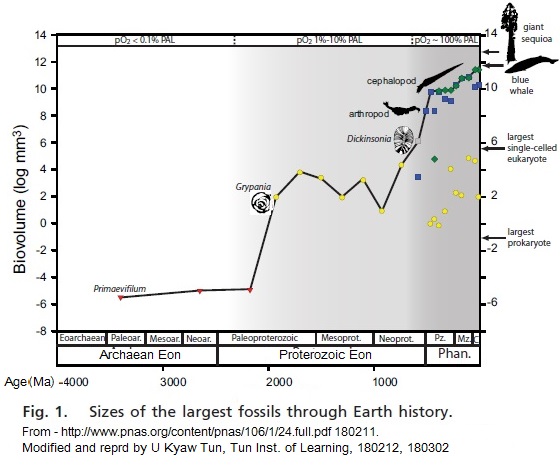
UKT 190607: Comparison of the two graphs, O2 in the Atmosphere and Sizes of the largest fossils, show how both plants and animals have advanced in the present 1x10^9 (billion) years.
See Two-phase increase in the maximum size of life over 3.5 billion years reflects biological innovation and environmental opportunity, by J.L. Paynea, A.G. Boyer , J.H. Brown, S.Finnegan, M.Kowalewski, R.A. Krause Jr., S.K.Lyons, C.R. McClain, D.W. McShea, P.M. Novack-Gottshall, F.A. Smith, J.A. Stempien, and S.C. Wang, ed. by J.W. Valentine, Univ. of California, Berkeley, CA, and apprvd Nov. 14, 2008 (recvd for review Jul. 1, 2008), in TIL HD-PDF and SD-PDF libraries.
- JLPayneEtAl-TwoPhaseIncrease<Ô> / Bkp<Ô> (link chk 190608)
Legend: Red triangles, prokaryotes; yellow circles, protists;
blue squares, animals; green diamonds, vascular plants;
gray square, Vendobiont (probable multicellular eukaryote).
Two main processes govern changes in the atmosphere: Plants use carbon dioxide CO2 from the atmosphere, releasing oxygen O2. Breakdown of pyrite FeS2 and volcanic eruptions release sulfur [as sulfur dioxide SO2 ] into the atmosphere, which oxidizes and hence reduces the amount of oxygen in the atmosphere. However, volcanic eruptions also release carbon dioxide, which plants can convert to oxygen. The exact cause of the variation of the amount of oxygen in the atmosphere is not known. Periods with much oxygen in the atmosphere are associated with rapid development of animals. Today's atmosphere contains 21% oxygen, which is great enough for this rapid development of animals.[45]
- UKT 190607:
From Wikipedia article is in TIL HD-nonPDF and SD-nonPDF libraries, in Webarchive .MHT section:
- Hydrosphere-Wiki<Ô> / Bkp<Ô> (link chk 190610)
The hydrosphere (Greek: ὕδωρ hydōr, and σφαῖρα sphaira ) is the combined mass of water found on, under, and above the surface of a planet, minor planet or natural satellite. Although the Earth's hydrosphere has been around for longer than 4 x10^9 (billion) years, it continues to change in size. This is caused by seafloor spreading and continental drift, which rearranges the land and ocean. [3]
It has been estimated that there are 1,386 million cubic kilometres (333,000,000 cubic miles) of water on Earth. [4] This includes water in liquid and frozen forms in groundwater, oceans, lakes and streams. [UKT¶]
Saltwater [mainly Sodium chloride NaCl ] accounts for 97.5% of this amount, whereas fresh water accounts for only 2.5%. Of this fresh water, 68.9% is in the form of ice and permanent snow cover in the Arctic, the Antarctic, and mountain glaciers; 30.8% is in the form of fresh groundwater; and only 0.3% of the fresh water on Earth is in easily accessible lakes, reservoirs and river systems. [4]
The total mass of the Earth's hydrosphere is about 1.4 × 10¹⁸ tonnes, [metric ton = 1 tonne = 1000 kilograms = 1 megagram ] which is about 0.023% of Earth's total mass. At any given time, about 20 × 1012 tonnes of this is in the form of water vapor in the Earth's atmosphere (for practical purposes, 1 cubic meter of water weighs one tonne). Approximately 71% of Earth's surface, an area of some 361 million square kilometers (139.5 million square miles), is covered by ocean [containing salt]. The average salinity of Earth's oceans is about 35 grams of salt per kilogram of sea water (3.5%). [5]
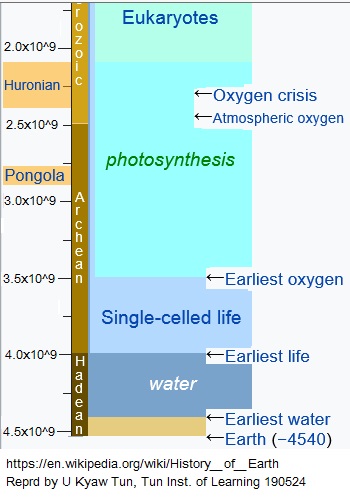
The Hadean Eon represents time before the reliable (fossil) record of life beginning on Earth; it began with the formation of the planet and ended at 4.0 Ga ago as defined by international convention. [6] [UKT ¶]

UKT 190523: Though the above pix shows the Hadean Eon without subdivisions of periods, it is speculated to have subdivisions from comparison to the Moon: See: TIL Hadeon Eon (4.6x10^6 to 4.0x10^6 ago)
- hadeon.htm (link chk 190522)
• Pre-Nectarian, (4,533 to about 3,920 Ma ago.)
• Nectarian (3,920 Ma to 3,850 Ma ago)
Because these are based on Moon's time scale, they are not important to us. As such we have to deal only with the Archean Eon. But, it is preferable to view the Hadean Eon and Archean Eon together
The Hadian-Archean Eon pair is followed by Proterozoic Eon. The Archean-Proterozoic Eon pair produced the abiogenesis of life on Earth and then the evolution of early life. [UKT ¶]
UKT 180313: The Eons are separated from each other by defining events. See:
Geological time with major evolutionary events in the fossil record, by William L. Kruczynski and Pamela J. Fletcher, in Chapter 1, Geographic Setting and Impacts to the Environment . See TIL HD-PDF and SD-PDF libraries,
- WLKruczynskiPJFletcher-GeologTimeEvents<Ô> / Bkp<Ô> (link chk 190603)From Pix on right: Major Events in:
1. Hadean Eon - Earth forms
2. Archean Eon - Oldest rocks, Earth crust forms
3. Proterozoic Eon - Life begins in sea
UKT 180314: You can easily get confused when you compare datelines from various websites. Look for the dividing line of 2500 Ma or 2.5 Ga., dividing between "only rocks" and "bacteria life in the form of blue-green"
{sain:pra ré-Ñhi.} being formed.
The succeeding eon is the Phanerozoic Eon, which is represented by its three component eras: the Palaeozoic Era; the Mesozoic Era, and Cenozoic Era. [UKT ¶]

 The Palaeozoic Era and the Mesozoic Era spanned
the rise, reign, and climactic extinction of the
non-avian dinosaurs. [UKT ¶] .
The Palaeozoic Era and the Mesozoic Era spanned
the rise, reign, and climactic extinction of the
non-avian dinosaurs. [UKT ¶] .
See a video on flying dinosaurs in TIL HD-VIDEO and SD-VIDEO libraries:
- LargestFlyPterosaurs<Ô> / Bkp<Ô> 269 MB (link chk 190603)
The Cenozoic Era presented the subsequent development of dominant mammals on Earth.
See a video on Dawn of the Mammals in TIL HD-VIDEO and SD-VIDEO libraires:
- DawnMammals<Ô> / Bkp<Ô> 484 MB (link chk 190603)
 Hominins, the earliest direct ancestors
of the human clade, rose sometime during the
latter part of the Miocene Epoch; the precise
time marking the first hominins is broadly
debated over a current range of 13 to 4 million
years ago. The succeeding Quaternary period is
the time of recognizable humans, i.e., the genus
Homo, but that period's two million-year-plus
term of the recent times is too small to be visible
at the scale of the GTS graphic. (Notes re the
graphic: Ga means "billion years";
Ma, "million years".)
Hominins, the earliest direct ancestors
of the human clade, rose sometime during the
latter part of the Miocene Epoch; the precise
time marking the first hominins is broadly
debated over a current range of 13 to 4 million
years ago. The succeeding Quaternary period is
the time of recognizable humans, i.e., the genus
Homo, but that period's two million-year-plus
term of the recent times is too small to be visible
at the scale of the GTS graphic. (Notes re the
graphic: Ga means "billion years";
Ma, "million years".)
Wikipedia: https://en.wikipedia.org/wiki/Clade 190604
"Over the last few decades, the cladistic approach has revolutionized biological classification and revealed surprising evolutionary relationships among organisms. [2] Increasingly, taxonomists try to avoid naming taxa that are not clades; that is, taxa that are not monophyletic. Some of the relationships between organisms that the molecular biology arm of cladistics has revealed are that fungi are closer relatives to animals than they are to plants, archaea are now considered different from bacteria, and multicellular organisms may have evolved from archaea. [3]
Hominins: - https://en.wikipedia.org/wiki/Hominini 180313
"The Hominini ("hominins") form a taxonomic tribe of the subfamily Homininae ("hominines"). Hominini includes genus Homo (humans), but excludes genus Gorilla (gorillas). There is at present (as of 2018 [update]) no consensus on whether it should include genus Pan (the chimpanzees), the question being closely tied to the complex speciation process connecting humans and chimpanzees and the development of bipedalism in proto-humans.
The earliest undisputed evidence of life on Earth dates at least from 3.5 x10^9 yr ago, [7] [8] [9] during the Eoarchean Era after a geological crust started to solidify following the earlier molten Hadean Eon. [UKT ¶]
UKT 190605: Life on Earth can mean Life that depends on photosynthesis , or that which depends on chemosynthesis .
From: https://en.wikipedia.org/wiki/Chemosynthesis 190605
"In biochemistry, chemosynthesis is the biological conversion of one or more carbon-containing molecules (usually carbon dioxide CO2 or methane CH4 ) and nutrients into organic matter using the oxidation of inorganic compounds (e.g., hydrogen gas H2 , hydrogen sulfide H2S ) or methane as a source of energy, rather than sunlight, as in photosynthesis. ... It has been hypothesized that chemosynthesis may support life below the surface of [planet] Mars, [planet] Jupiter's moon Europa, and other planets. [1] Chemosynthesis may have also been the first type of metabolism that evolved on Earth, leading the way for cellular respiration and photosynthesis to develop later. "
UKT 190605: Let's stop here and ponder some more. You'll notice that in the above note, we are only talking about the Carbon-based Life (C-Life). Since there are other elements more abundant on Earth than Carbon, and just below Carbon in ability to form giant molecules, such as Silicon Si (tetravalent like C), the question is why can't we have Silicon-based Life (Si-Life), and Life forms which are based jointly on Carbon and Silicon (C-Si-Life)?
See Could silicon be the basis for alien life forms, just as carbon is on Earth? , by Raymond Dessy, professor of Chemistry, Virginia Polytechnic Inst. and State Univ. in Blacksburg, Va., in Scientific American (downloaded on 190607) in TIL non-PDF libraries, Webarchive section:
- CouldSiliconBeBasisForLifeForms-ScAm<Ô> / Bkp<Ô> (190605)
" It is possible to think of micro- and nano-structures of silicon; solar-powered silicon forms for energy and sight; a silicone fluid that could carry oxidants to contracting muscle-like elements made of other silicones; skeletal materials of silicates; silicone membranes; and even cavities in silicate zeolites that have handedness. Some of these structures even look alive. But the chemistries needed to create a life-form are simply not there. The complex dance of life requires interlocking chains of reactions. And these reactions can only take place within a narrow range of temperatures and pH levels. Given such constraints, carbon can and silicon can't."Also read - https://bigpictureeducation.com/possibility-silicon-based-life 190605
"The complex chemistry of carbon is vastly favourable to life under conditions on Earth. However, that does not mean that silicon-based life-forms would be impossible under different planetary environments. ... In theory, planets far, far away may have environmental conditions that favour silicon chemistry over carbon chemistry. For example, silicon bonds are much more stable than carbon at high temperatures. Perhaps silicon-based life could arise on a planet that is too hot for carbon-based life."
 There are microbial mat fossils such as
stromatolites found in 3.48 billion-year-old
sandstone discovered in Western Australia.
[10]
[11]
[12] Other early physical evidence of a
biogenic substance is graphite
[carbon atoms arranged in 2-dimensional layers]
in 3.7 x10^9 (billion) year-old metasedimentary
rocks discovered in southwestern Greenland
[13] as well as "remains of biotic life"
found in 4.1 billion-year-old rocks in Western Australia.
[14]
[15] According to one of the researchers, "If
life arose relatively quickly on Earth … then it could
be common in the
universe."
[14]
There are microbial mat fossils such as
stromatolites found in 3.48 billion-year-old
sandstone discovered in Western Australia.
[10]
[11]
[12] Other early physical evidence of a
biogenic substance is graphite
[carbon atoms arranged in 2-dimensional layers]
in 3.7 x10^9 (billion) year-old metasedimentary
rocks discovered in southwestern Greenland
[13] as well as "remains of biotic life"
found in 4.1 billion-year-old rocks in Western Australia.
[14]
[15] According to one of the researchers, "If
life arose relatively quickly on Earth … then it could
be common in the
universe."
[14]
Wikipedia: https://en.wikipedia.org/wiki/Metasedimentary_rock 190604
"In geology, metasedimentary rock is a type of metamorphic rock. Such a rock was first formed through the deposition and solidification of sediment. Then, the rock was buried underneath subsequent rock and was subjected to high pressures and temperatures, causing the rock to recrystallize. The overall composition of a metasedimentary rock can be used to identify the original sedimentary rock, even where they have been subject to high-grade metamorphism and intense deformation. [1] "
Photosynthetic organisms appeared between 3.2 and 2.4 x10^9 (billion) years ago and began enriching the atmosphere with oxygen O2 . [UKT ¶]
UKT 190605: Diatomic oxygen O2 is somewhat soluble in water, because of which surface water (of lakes, rivers and ocean) contains dissolved oxygen on which animals such as fishes can live obtaining oxygen through their gills. Not all oxygen is beneficial to life. Triatomic oxygen known as ozone O3 is poisonous.
Life remained mostly small and microscopic until about 580 x10^6 (million) years ago or 0.58 x10^9 (Ga) yr ago, when complex multicellular life arose, developed over time, and culminated in the Cambrian Explosion about 541 million years ago. [UKT ¶]
The Cambrian Period is the first geological time period of the Paleozoic Era (the “time of ancient life”). This period lasted about 53 million years and marked a dramatic burst of evolutionary changes in life on Earth, known as the "Cambrian Explosion." ... The Cambrian Period was followed by the Ordovician Period. Mary Bagley, Live Science, May 27, 2016
- https://www.livescience.com/28098-cambrian-period.html 190605
This event drove a rapid diversification of life forms on Earth that produced most of the major phyla known today, and it marked the end of the Proterozoic Eon and the beginning of the Cambrian Period of the Paleozoic Era. More than 99 percent of all species, amounting to over five billion species, [16] that ever lived on Earth are estimated to be extinct. [17] [18] Estimates on the number of Earth's current species range from 10 million to 14 million, [19] of which about 1.2 million are documented, but over 86 percent have not been described. [20] Scientists recently reported that 1 trillion species are estimated to be on Earth currently with only one-thousandth of one percent described. [21]
The Earth's crust has constantly changed since its formation. Likewise, life has constantly changed since its first appearance. Species continue to evolve, taking on new forms, splitting into daughter species or going extinct in the process of adapting or dying in response to ever-changing physical environments. The process of plate tectonics continues to shape the Earth's continents and oceans and the life they harbor. Human activity is now a dominant force affecting global change, adversely affecting the biosphere, the Earth's surface, hydrosphere, and atmosphere, with the loss of wild lands, over-exploitation of the oceans, production of greenhouse gases, [an example being CO2 ], degradation of the ozone [ O3 ] layer, and general degradation of soil, air, and water quality.
By Joel Hruska on August 8, 2017 at 3:00 pm
- https://www.extremetech.com/extreme/253830-giant-impact-hypothesis-moon-formation-synestia#disqus_thread 180312UKT 180315: "God and Goddess", the English translations of mythological entities usually misinterpret the meanings, because of which I have to edit the original article. In Hindu mythology (with equivalents in Greek and Roman) there are: Déva and Dévi; Asura and Asuri, and Maata 'Mother'. In English all have become "gods and goddesses", failing to note that Déva and Asura are enemies, and Maata 'Mother' is the anthropomorphic term for a country, an astronomical body, or even a prominent object. Maatas 'Mothers' is from Tib-Bur mythology taken over by the Hindu Brahmins
{poaN~Na:}, mating them to their male gods. I need to clarify these terms for my work in connection with BEPS languages even when I am dealing with scientific disciplines such as Geology.
For decades, astronomers and scientists have relied on a theory of how the Earth-Moon system formed known as the Giant-impact hypothesis: A large chunk of rock nicknamed Theia (mother of Selene, 'Moon' in Greek mythology) slammed into the Earth not long after it formed. This impact would have liquefied both Theia and the Earth, while simultaneously ejecting a huge amount of material.
Impact of Titans : Theia (mother of Moon 'Selene') and Gaia 'Earth' giving birth to Moon.
UKT 180115: Definitions from Greek mythology (edited):
#1 - https://en.wikipedia.org/wiki/Selene 180311
"Selene, Ancient Greek Σελήνη 'Moon' is the Titan-goddess of the Moon. Selene 'Moon' is the daughter of Titan father Hyperion and Titaness mother Theia. Selene is sister of Sun Helios, sister of Dawn Eos"
#2 - https://en.wikipedia.org/wiki/Gaia 180311
"Gaia, Ancient Greek Γαῖα aka Γῆ Gē, 'Earth' or "land" [1])"
Note that it is a union of two females, one of which acts as the father giving birth to a daughter. In the act the mother dies. What a mess!
Over time, conventional thinking goes, the Earth cooled again and became rocky, while the huge lump of ejected rock formed the Moon. There’s even an explanation for why the Moon is thicker on one side than the other. A second, smaller moon may have briefly formed, before its orbit destabilized and it impacted on the far side of our own Moon.
The problem with the giant-impact hypothesis is it’s increasingly difficult to square with data. A new paper posits the conventional great impact hypothesis isn’t quite right, and argues for an entirely new theory of Earth-moon formation.
Let’s back up a moment and start with an uncontestable fact: The Moon -- our moon -- is quite odd. First, we’re the only rocky planet with a moon of significant size at all; Mercury and Venus have no moons, and the moons of Mars are either asteroids captured by that planet’s gravity or the remnants of a giant impact event that struck Mars in its own distant past. For example, Deimos, which orbits Mars, is little more than a dot, roughly as bright as Venus in our own sky.
UKT 180312: Wikipedia: https://en.wikipedia.org/wiki/Deimos_(moon) 180312
"Deimos (systematic designation: Mars II) [6] is the smaller and outer of the two natural satellites of the planet Mars, the other being Phobos. Deimos has a mean radius of 6.2 km (3.9 mi) [1] and takes 30.3 hours [1] to orbit Mars. In Greek mythology, Deimos is the twin brother of Phobos and anthropomorphicpersonified"terror".
"Deimos is 23,460 km (14,580 mi) from Mars, much farther than Mars's other moon, Phobos. [7]"
Note: Mars is the god of destruction, and therefore his sons are gods of terror.
The Moon is about 1 percent the mass of Earth, while the combined mass of all the moons of the outer planets is no more than one tenth of one percent of their parent planets. [UKT ¶]
The Moon is also responsible for 80 percent of the angular momentum in the Earth-Moon system [a two-body system: to say that the Moon revolves around Earth is wrong - both revolves around the common center of mass.], while in the other planets, this value is less than 1 percent. [UKT ¶]
And unlike every other planet or satellite in the solar system, it appears to be made of exactly the same isotopes in the same ratios we observe on Earth. That’s highly unusual in and of itself. As the early solar system formed, the lighter isotopes were dispersed by stellar wind, explaining why the inner planets are rocky while the outer planets are gas giants and so-called ice giants (Uranus, Neptune, and the still-hypothetical Planet IX). Each of the planets and satellites contains its own unique mixture of isotopic ratios, which is why we can sometimes identify the origins of various meteorites; a meteorite from Mars has a distinctly different isotopic ratio than a meteor from the asteroid belt.
The problem with the giant-impact hypothesis is that it has difficulty accounting for why the isotopic ratios on the moon look exactly like the ones we see on Earth. Over at The Atlantic, Rebecca Boyle steps through the various potential options, including new work by scientist Sarah Stewart and her student, Simon Lock. Stewart and Lock have offered an intriguing option that posits a new idea for how the Earth and moon may have coalesced after a massive impact. They propose Theia struck the Earth and thoroughly vaporized it, forming a torus of molten rock and vaporized material. As the lava-bagel spun, the outer edge moved much more quickly than the inner region, and never completely differentiated from it. They’ve named this hypothetical structure a synestia, syn from the Greek “together” and Hestia, the Greek goddess of the home, hearth, and architecture.
The inner, rocky planet eventually became the Earth, while the faster-moving cloud of vaporized rock coalesced into the Moon. This explains both the high conservation of angular momentum and the isotope mixing, though this is a still a theoretical model and not one we’ve observed in the real-world to date. Then again, our data on planetary formation is still extremely limited. We’ve directly observed geologic activity on Mercury and captured planets in the process of forming around a distant star, but this kind of impact and mixing is far more difficult to see, particularly around a planet as small as ours to start with.
A synestia isn’t the only way to theoretically create an Earth-Moon system. Rebecca Boyle steps through some other hypotheses, including the idea that Theia was a body with near-identical isotope ratios to Earth to start with, or that the Earth may have been subject to multiple large impacts that collectively broke off and mixed enough material to create the Moon. Given our lack of time travel, it may not be a theory we can ever test. Then again, spacecraft like Kepler have pushed back the boundaries of observed astronomy by leaps and bounds, confirming some of our ideas about how planets and stars form and disrupting others.
It’s entirely possible that if we keep an eye out (and keep building bigger telescopes) we will catch the above process in action around a different star. To be sure, most of these new ideas are variants on the standard giant-impact hypothesis, not wholesale repudiations of it. But they still represent several challenges to the conventional explanation.
UKT: End of article.Go back Giant-Impact-Hypo-Doubt-note-b

