by U Kyaw Tun, M.S. (I.P.S.T., U.S.A.). Set in html by UKT and staff of TIL Computing and Language Center, Yangon, for students and staff of TIL. Not for sale.
This is to accompany The Burmese Empire, A hundred years ago, V. Sangermano, and Notes by J. Jardine. It is intended for those who may not be familiar with subjects mentioned in the text.
St. John of Damascus
Seduction of St. Josaphat
Vanity of Vanities
from: Catholic Online Saints: St. John of Damascus http://www.catholic.org
b. 645 d. 749: Saint John Damascene has the double honor of being the last but one of the fathers of the Eastern Church, and the greatest of her poets. It is surprising, however, how little that is authentic is known of his life. The account of him by John of Jerusalem, written some two hundred years after his death, contains an admixture of legendary matter, and it is not easy to say where truth ends and fiction begins.
The ancestors of John, according to his biographer, when Damascus fell into the hands of the Arabs, had alone remained faithful to Christianity. They commanded the respect of the conqueror, and were employed in judicial offices of trust and dignity, to administer, no doubt, the Christian law to the Christian subjects of the Sultan. His father, besides this honorable rank, had amassed great wealth; all this he devoted to the redemption of Christian slaves on whom he bestowed their freedom.
John was the reward of these pious actions. John was baptized immediately on his birth, probably by Peter II, bishop of Damascus, afterwards a sufferer for the Faith. The father was anxious to keep his son aloof from the savage habits of war and piracy, to which the youths of Damascus were addicted, and to devote him to the pursuit of knowledge. The Saracen pirates of the seashore neighboring to Damascus, swept the Mediterranean, and brought in Christian captives from all quarters. A monk named Cosmas had the misfortune to fall into the hands of these freebooters. He was set apart for death, when his executioners, Christian slaves no doubt, fell at his feet and entreated his intercession with the Redeemer. The Saracens enquired of Cosmas who he was. He replied that he had not the dignity of a priest; he was a simple monk, and burst into tears.
The father of John was standing by, and expressed his surprise at this exhibition of timidity. Cosmas answered, "It is not for the loss of my life, but of my learning, that I weep." Then he recounted his attainments, and the father of John, thinking he would make a valuable tutor for his son, begged or bought his life of the Saracen governor; gave him his freedom, and placed his son under his tuition. The pupil in time exhausted all the acquirements of his teacher. The monk then obtained his dismissal, and retired to the monastery of S. Sabas, where he would have closed his days in peace, had he not been compelled to take on himself the bishopric of Majuma, the port of Gaza.
The attainments of the young John of Damascus commanded the veneration of the Saracens; he was compelled reluctantly to accept an office of higher trust and dignity than that held by his father. As the Iconoclastic controversy became more violent, John of Damascus entered the field against the Emperor of the East, and wrote the first of his three treatises on the Veneration due to Images. This was probably composed immediately after the decree of Leo the Isaurian against images, in 730.
Before he wrote the second, he was apparently ordained priest, for he speaks as one having authority and commission. The third treatise is a recapitulation of the arguments used in the other two. These three treatises were disseminated with the utmost activity throughout Christianity.
The biographer of John relates a story which is disproved not only by its exceeding improbability, but also by being opposed to the chronology of his history. It is one of those legends of which the East is so fertile, and cannot be traced, even in allusion, to any document earlier than the biography written two hundred years later. Leo the Isaurian, having obtained, through his emissaries, one of John's circular epistles in his own handwriting -- so runs the tale -- caused a letter to be forged, containing a proposal from John of Damascus to betray his native city to the Christians. The emperor, with specious magnanimity, sent this letter to the Sultan. The indignant Mahommedan ordered the guilty hand of John to be cut off. John entreated that the hand might be restored to him, knelt before the image of the Virgin, prayed, fell asleep, and woke with his hand as before. John, convinced by this miracle, that he was under the special protection of our Lady, resolved to devote himself wholly to a life of prayer and praise, and retired to the monastery of Saint Sabas.
That the Sultan should have contented himself with cutting off the hand of one of his magistrates for an act of high treason is in itself improbable, but it is rendered more improbable by the fact that it has been proved by Father Lequien, the learned editor of his works, that Saint John Damascene was already a monk at Saint Sabas before the breaking out of the Iconoclastic dispute.
In 743, the Khalif Ahlid II persecuted the Christians. He cut off the tongue of Peter, metropolitan of Damascus, and banished him to Arabia Felix. Peter, bishop of Majuma, suffered decapitation at the same time, and Saint John of Damascus wrote an eulogium on his memory. Another legend is as follows: it is probably not as apocryphal as that of the severed hand: -- The abbot sent Saint John in the meanest and most beggarly attire to sell baskets in the marketplace of Damascus, where he had been accustomed to appear in the dignity of office, and to vend his poor ware at exorbitant prices. Nor did the harshness of the abbot end there. A man had lost his brother, and broken-hearted at his bereaval, besought Saint John to compose him a sweet hymn that might be sung at this brother's funeral, and which at the same time would soothe his own sorrow. John asked leave of the abbot, and was curtly refused permission. But when he saw the distress of the mourner he yielded, and sang him a beautiful lament. The abbot was passing at the time, and heard the voice of his disciple raised in song. Highly incensed, he expelled him from the monastery, and only re-admitted him on condition of his daily cleaning the filth from all the cells of his brethren. An opportune vision rebuked the abbot for thus wasting the splendid talents of his inmate. John was allowed to devote himself to religious poetry, which became the heritage of the Eastern Church, and to theological arguments in defense of the doctrines of the Church, and refutation of all heresies. His three great hymns or "canons," are those on Easter, the Ascension, and Satin Thomas's Sunday. Probably also many of the Idiomela an Stichera which are scattered about the office- books under the title of "John" and "John the Hermit" are his. His eloquent defense of images has deservedly procured him the title of "The Doctor of Christian Art." The date of his death cannot be fixed with any certainty; but it lies between 754 and before 787.
The following is from the Catholic Encyclopedia on:
St. John of Damascus or Damascene
-- copied from Catholic Encyclopedia
http://www.newadvent.org/cathen/08459b.htm
Born at Damascus, about 676; died some time between 754 and 787. The only extant life of the saint is that by John, Patriarch of Jerusalem, which dates from the tenth century (P.G. XCIV, 429-90). This life is the single source from which have been drawn the materials of all his biographical notices. It is extremely unsatisfactory from the standpoint of historical criticism. An exasperating lack of detail, a pronounced legendary tendency, and a turgid style are its chief characteristics. Mansur was probably the name of John's father. What little is known of him indicates that he was a sterling Christian whose infidel environment made no impression on his religious fervour. Apparently his adhesion to Christian truth constituted no offence in the eyes of his Saracen countrymen (UKT: Muslims), for he seems to have enjoyed their esteem in an eminent degree, and discharged the duties of chief financial officer for the caliph, Abdul Malek. The author of the life records the names of but two of his children, John and his half-brother Cosmas. When the future apologist had reached the age of twenty-three his father cast about for a Christian tutor capable of giving his sons the best education the age afforded. In this he was singularly fortunate. Standing one day in the market-place he discovered among the captives taken in a recent raid on the shores of Italy a Sicilian monk named Cosmas. Investigation proved him to be a man of deep and broad erudition. Through the influence of the caliph, Mansur secured the captive's liberty and appointed him tutor to his sons. Under the tutelage of Cosmas, John made such rapid progress that, in the enthusiastic language of his biographer, he soon equalled Diophantus in algebra and Euclid in geometry. Equal progress was made in music, astronomy, and theology.
On the death of his father, John Damascene was made protosymbulus, or chief councillor, of Damascus. It was during his incumbency of this office that the Church in the East began to be agitated by the first mutterings of the Iconoclast heresy. In 726, despite the protests of Germanus, Patriarch of Constantinople, Leo the Isaurian issued his first edict against the veneration of images. From his secure refuge in the caliph's court, John Damascene immediately entered the lists against him, in defence of this ancient usage of the Christians. Not only did he himself oppose the Byzantine monarch, but he also stirred the people to resistance. In 730 the Isaurian issued a second edict, in which he not only forbade the veneration of images, but even inhibited their exhibition in public places. To this royal decree the Damascene replied with even greater vigour than before, and by the adoption of a simpler style brought the Christian side of the controversy within the grasp of the common people. A third letter emphasized what he had already said and warned the emperor to beware of the consequences of this unlawful action. Naturally, these powerful apologies aroused the anger of the Byzantine emperor. Unable to reach the writer with physical force, he sought to encompass his destruction by strategy. Having secured an autograph letter written by John Damascene, he forged a letter, exactly similar in chirography, purporting to have been written by John to the Isaurian, and offering to betray into his hands the city of Damascus. The letter he sent to the caliph. Notwithstanding his councillor's earnest avowal of innocence, the latter accepted it as genuine and ordered that the hand that wrote it be severed at the wrist. The sentence was executed, but, according to his biographer, through the intervention of the Blessed Virgin, the amputated hand was miraculously restored.
The caliph, now convinced of John's innocence, would fain have reinstated him in his former office, but the Damascene had heard a call to a higher life, and with his foster-brother entered the monastery of St. Sabas, some eighteen miles south-east of Jerusalem. After the usual probation, John V, Patriarch of Jerusalem, conferred on him the office of the priesthood. In 754 the pseudo-Synod of Constantinople, convened at the command of Constantine Copronymus, the successor of Leo, confirmed the principles of the Iconoclasts and anathematized by name those who had conspicuously opposed them. But the largest measure of the council's spleen was reserved for John of Damascus. He was called a "cursed favourer of Saracens", a "traitorous worshipper of images", a "wronger of Jesus Christ", a "teacher of impiety", and a "bad interpreter of the Scriptures". At the emperor's command his name was written "Manzer" (Manzeros, a bastard). But the Seventh General Council of Nicea (787) made ample amends for the insults of his enemies, and Theophanes, writing in 813, tells us that he was surnamed Chrysorrhoas (golden stream) by his friends on account of his oratorical gifts. In the pontificate of Leo XIII he was enrolled among the doctors of the Church. His feast is celebrated on 27 March.
John of Damascus was the last of the Greek Fathers. His genius was not for original theological development, but for compilation of an encyclopedic character. In fact, the state of full development to which theological thought had been brought by the great Greek writers and councils left him little else than the work of an encyclopedist; and this work he performed in such manner as to merit the gratitude of all succeeding ages. Some consider him the precursor of the Scholastics, whilst others regard him as the first Scholastic, and his "De fide orthodoxa" as the first work of Scholasticism. The Arabians too, owe not a little of the fame of their philosophy to his inspiration. The most important and best known of all his works is that to which the author himself gave the name of "Fountain of Wisdom" (pege gnoseos). This work has always been held in the highest esteem in both the Catholic and Greek Churches. Its merit is not that of originality, for the author asserts, at the end of the second chapter of the "Dialectic", that it is not his purpose to set forth his own views, but rather to collate and epitomize in a single work the opinions of the great ecclesiastical writers who have gone before him. A special interest attaches to it for the reason that it is the first attempt at a summa theologica that has come down to us.
The "Fountain of Wisdom" is divided into three parts, namely, "Philosophical Chapters" (Kephalaia philosophika), "Concerning Heresy" (peri aipeseon), and "An Exact Exposition of the Orthodox Faith" (Ikdosis akribes tes orthodoxou pisteos). The title of the first book is somewhat too comprehensive for its contents and consequently is more commonly called "Dialectic". With the exception of the fifteen chapters that deal exclusively with logic, it has mostly to do with the ontology of Aristotle. It is largely a summary of the Categories of Aristotle with Porphyry's "Isagoge" (Eisagoge eis tas kategorias). It seems to have been John Damascene's purpose to give his readers only such philosophical knowledge as was necessary for understanding the subsequent parts of the "Fountain of Wisdom". For more than one reason the "Dialectic" is a work of unusual interest. In the first place, it is a record of the technical terminology used by the Greek Fathers, not only against the heretics, but also in the exposition of the Faith for the benefit of Christians. It is interesting, too, for the reason that it is a partial exposition of the "Organon", and the application of its methods to Catholic theology a century before the first Arabic translation of Aristotle made its appearance. The second part, "Concerning Heresy", is little more than a copy of a similar work by Epiphanius, brought up to date by John Damascene. The author indeed expressly disclaims originality except in the chapters devoted to Islamism, Iconoclasm, and Aposchitae. To the list of eighty heresies that constitute the "Panarion" of Epiphanius, he added twenty heresies that had sprung up since his time. In treating of Islamism he vigorously assails the immoral practices of Mohammed and the corrupt teachings inserted in the Koran to legalize the delinquencies of the prophet. Like Epiphanius, he brings the work to a close with a fervent profession of Faith. John's authorship of this book has been challenged, for the reason that the writer, in treating of Arianism, speaks of Arius, who died four centuries before the time of Damascene, as still living and working spiritual ruin among his people. The solution of the difficulty is to be found in the fact that John of Damascene did not epitomize the contents of the "Panarion", but copied it verbatim. Hence the passage referred to is in the exact words of Epiphanius himself, who was a contemporary of Arius.
"Concerning the Orthodox Faith", the third book of the "Fountain of Wisdom", is the most important of John Damascene's writings and one of the most notable works of Christian antiquity. Its authority has always been great among the theologians of the East and West. Here, again, the author modestly disavows any claim of originality -- any purpose to essay a new exposition of doctrinal truth. He assigns himself the less pretentious task of collecting in a single work the opinions of the ancient writers scattered through many volumes, and of systematizing and connecting them in a logical whole. It is no small credit to John of Damascus that he was able to give to the Church in the eighth century its first summary of connected theological opinions. At the command of Eugenius III it was rendered into Latin by Burgundio of Pisa, in 1150, shortly before Peter Lombard's "Book of Sentences" appeared. This translation was used by Peter Lombard and St. Thomas Aquinas, as well as by other theologians, till the Humanists rejected it for a more elegant one. The author follows the same order as does Theodoret of Cyrus in his "Epitome of Christian Doctrine". But, while he imitates the general plan of Theodoret, he does not make use of his method. He quotes, not only form the pages of Holy Writ, but also from the writings of the Fathers. As a result, his work is an inexhaustible thesaurus of tradition which became the standard for the great Scholastics who followed. In particular, he draws generously from Gregory of Nazianzus, whose works he seems to have absorbed, from Basil, Gregory of Nyssa, Cyril of Alexandria, Leo the Great, Athanasius, John Chrysostum, and Epiphanius. The work is divided into four books. This division, however, is an arbitrary one neither contemplated by the author nor justified by the Greek manuscript. It is probably the work of a Latin translator seeking to accommodate it to the style of the four books of Lombard's "Sentences".
The first book of "The Orthodox Faith" treats of the essence and existence of God, the Divine nature, and the Trinity. As evidence of
the existence of God he
cites the concurrence of opinion among those enlightened by Revelation and those
who have only the light of reason to guide them. To the same end he employs the
argument drawn from the mutability of created things and that from design.
Treating, in the second book, of the physical world, he summarizes all the views
of his times, without, however, committing himself to any of them. In the same
treatise he discloses a comprehensive knowledge of the astronomy of his day.
Here, also, place is given to the consideration of the nature of angels and demons, the
terrestrial paradise, the properties of human nature, the foreknowledge of God, and
predestination.
Treating of man (c.xxvii), he gives what has been aptly called a "psychology
in nuce". Contrary to the teachings of Plotinus, the master of Porphyry, he
identifies mind and soul. In the third book the personality and two-fold nature
of Christ are discussed with great ability. This leads up to the consideration
of the Monophysite heresy. In this connexion he deals with Peter the Fuller's
addition to the "Trisagion", and combats Anastasius's interpretation of this
ancient hymn. The latter, who was Abbot of the monastery of St. Euthymius in
Palestine, referred the "Trisagion" only to the Second Person of the Trinity. In
his letter "Concerning the Trisagion" John Damascene contends that the hymn
applies not to the Son alone, but to each Person of the Blessed Trinity. This
book also contains a spirited defence of the Blessed Virgin's claim to the tile
of "Theotokos." Nestorius is vigorously dealt with for trying to substitute the
title of "Mother of Christ" for "Mother of God". The Scriptures are discussed in
the fourth book. In assigning twenty-two books to the Old Testament Canon he is
treating of the Hebrew, and not the Christian, Canon, as he
finds it in a work of Epiphanius, "De ponderibus et mensuris". His treatment in
this book of the Real
Presence is especially satisfactory. The nineteenth chapter contains a
powerful plea for the veneration of images.
The treatise, "Against the Jacobites", was written at the request of Peter,
Metropolitan of Damascus, who imposed on him the task of reconciling to the
Faith the Jacobite bishop. It is a strong polemic against the Jacobites, as the
Monophysites in Syria were called. He also wrote against the Manicheans and Monothelites. The
"Booklet Concerning Right Judgment" is little more than a profession of Faith,
confirmed by arguments setting forth the mysteries of the Faith, especially the
Trinity and the Incarnation. Though John of Damascus wrote voluminously on the
Scriptures, as in the case of so much of his writing, his work bears little of
the stamp of originality. His "Select Passages" (Loci Selecti), as he himself
admits, are taken largely from the homilies of St. John Chrysostom and
appended as commentaries to texts from the Epistles of St. Paul. The commentary
on the Epistles to the Ephesians, Philippians, Colossians, and Thessalonians is
taken from Cyril of Alexandria. The "Sacred Parallels" (Sacra parallela) is a
kind of topical concordance, treating principally of God, man, virtues, and
vices.
Under the general title of "Homilies" he wrote fourteen discourses. The sermon on the Transfiguration, which Lequien asserts was delivered in the church on Mt. Tabor, is of more than usual excellence. It is characterized by dramatic eloquence, vivid description, and a wealth of imagery. In it he discourses on his favorite topic, the twofold nature of Christ, quotes the classic text of Scripture in testimony of the primacy of Peter, and witnesses the Catholic doctrine of sacramental Penance. In his sermon on Holy Saturday he descants on the Easter duty and on the Real Presence. The Annunciation is the text of a sermon, now extant only in a Latin version of an Arabic text, in which he attributes various blessings to the intercession of the Blessed Virgin. The second of his three sermons on the Assumption is especially notable for its detailed account of the translation of the body of the Blessed Virgin into heaven, an account, he avers, that is based on the most reliable and ancient tradition. Both Liddledale and Neale regard John of Damascus as the prince of Greek hymnodists. His hymns are contained in the "Carmina" of the Lequien edition. The "canons" on the Nativity, Epiphany, and Pentecost are written in iambic trimeters. Three of his hymns have become widely known and admired in their English version -- "Those eternal bowers", "Come ye faithful raise the strain", and "Tis the Day of Resurrection". The most famous of the "canons" is that on Easter. It is a song of triumph and thanksgiving -- the "Te Deum" of the Greek Church. It is a traditional opinion, lately controverted, that John Damascene composed the "Octoëchos", which contains the liturgical hymns used by the Greek Church in its Sunday services. Gerbet, in his "History of Sacred Music", credits him with doing for the East what Gregory the Great accomplished for the West -- substitution of notes and other musical characters for the letters of the alphabet to indicate musical quantities. It is certain he adapted choral music to the purposes of the Liturgy.
Among the several works that are dubiously attributed to John Damascene the most important is the romance entitled "Barlaam and Josaphat". Throughout the Middle Ages it enjoyed the widest popularity in all languages. It is not regarded as authentic by Lequien, and the discovery of a Syriac version of the "Apology of Aristides" shows that what amounts to sixteen printed pages of it was taken directly from Aristides. The panegyric of St. Barbara, while accepted as genuine by Lequien, is rejected by many others. The treatise entitled "Concerning those who have died in the Faith" is rejected as spurious by Suarez, Bellarmine, and Lequien, not only on account of its doctrinal discrepancies, but for its fabulous character as well. The first Greek edition of any of the works of John Damascene was that of the "Exact Exposition of the Orthodox Faith" brought out at Verona (1531) under the auspices of John Matthew Gibertus, Bishop of Verona. Another Greek edition of the same work was published at Moldavia (1715) by John Epnesinus. It was also printed in a Latin edition at Paris (1507), by James Faber. Henry Gravius, O.P., published a Latin edition at Cologne (1546) which contained the following works: "Dialectic", "Elementary and Dogmatic Instruction", "Concerning the two Wills and Operations", and "Concerning Heresy". A Greek-Latin edition with an introduction by Mark Hopper made its appearance at Basle (1548). A similar edition, but much more complete was published at the same place in 1575. Another Latin edition, constituting a partial collection of the author's works is that by Michael Lequien, O.P., published at Paris (1717) and Venice (1748). To the reprint of this edition, P.G., XCIV-XCVI (Paris, 1864), Migne has added a supplement of works attributed by some to the authorship of John Damascene.
http://home.c2i.net/monsalvat/josaphat.htm
The name Josaphat has been derived from Bodhisattva.
The tale of the hermit St. Barlaam and his convert St. Josaphat is a
curious link between Christianity and Buddhism, since at least the beginning of
the story is unmistakably an account of the early life of the Buddha. The story is
thought to have been composed by John of Damascus
in the 6th century AD. It also
appears, in abridged form, in the Golden Legend of Jacobus de Voragine.
The attempted seduction of St. Josaphat by the beautiful maiden seems to be a
Christian reworking of part of the conflict between the future Buddha and the dark lord,
Mára. What does this have to do with Richard Wagner?
, the reader might
well ask. Wagner had a version of the story of Barlaam and Josaphat, in one of
the books that he left behind him when he had to leave Saxony in haste in 1849.
This was a German translation made by Rudolf von Ems about 1325.
Barlaam and Josaphat
The story of Barlaam and Josaphat closely follows, with additions, the story of the youth of Gautama Shakyamuni, the future Buddha. The details of his life-story are slightly different, but in broad terms similar, in Indian, Ceylonese and Tibetan texts. The main difference here is that, in a prologue to the story, an astrologer predicts that the newly-born Josaphat, son of King Avennir, will be a follower of the Christian religion, which at that time was being persecuted by Avennir. Obviously the events of the Buddhist scriptures have been brought forward by about 900 years, so that in this version they take place after Christian missionary activity has begun in India. The young prince is brought up in ignorance of old age, sickness and death; but eventually finds out about their existence during excursions from the palace. In the Buddhist versions, his father finds a wife for him at this point, but the Christian version leaves the prince unmarried.
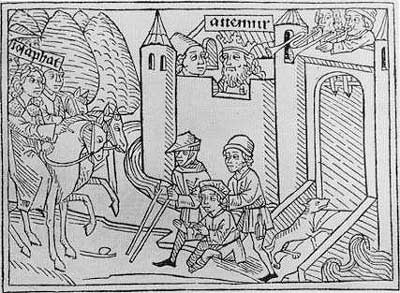
| Prince Josaphat then meets the hermit Barlaam, a Christian missionary, who preaches in parables. The young prince becomes a convert to Christianity. After unsuccessfully attempting to dislodge him from the new faith by various stratagems, his father King Avennir receives a visit from the sorcerer Theodas, who offers to help him. On the sorcerer's advice, the king replaces the prince's male attendants with beautiful women (as Shakyamuni's father also does in the Buddhist version). Theodas sends an evil spirit into Josaphat's heart to inflame him with lust. The women flirt with Josaphat but fail to seduce him. |
|
|
| Josaphat sees a cripple while returning to the palace. King Avennir and his sorcerer Theodas watch from the battlements. Illustration from a 1477 edition of Barlaam und Josaphat. | ||
The king then sends to Josaphat the orphan daughter of a king, a beautiful maiden.
The young prince attempts to convert her to his new religion, to which she
responds that she will only convert if Josaphat will marry her. Josaphat tells
her that he has taken a vow of chastity. The
nameless maiden tells him, if you want to save my soul, grant me one little
request: sleep with me tonight, just once is all I ask, and I promise you I will
become a Christian first thing tomorrow morning... just do as I ask this once
and you will win my salvation.
Josaphat prays and receives a vision of
heaven. He rejects the temptress, and is attacked by evil spirits. Josaphat
destroys them by making the sign of the cross.
Parsifal and Kundry
So it seems that the Buddha became a Christian saint, and even received a feast-day, 27 November. The name Josaphat has been derived from Bodhisattva, one whose being is illumination. It seems entirely possible that Wagner had this story in mind when he made his first sketch for Parsifal. The sorcerer Theodas became Klingsor, Josaphat became the act 2 Parsifal and the beautiful maiden the act 2 Kundry. It could be argued that Wagner based his scene directly on a Buddhist version of the story, perhaps never having read the Christian version. Two elements weigh against this hypothesis. One is the common emphasis on chastity, typical of medieval Christian literature, but less important in the Buddhist versions. The other is that Josaphat concludes the struggle with the agents of Theodas by making the sign of the cross. It would have been typical of Wagner to go beneath the surface of the sources he first encountered, and by 1865 he had almost certainly read several versions of the life of the Buddha. In none of these, however, does the Buddha make the sign of the cross!
After the apparently Buddhist detour of the second act of Parsifal, an act that might have been based on the struggle between the future Buddha and the dark lord, Mára, we suddenly encounter a Christian symbol. It seems so out of place that most "modern" productions simply (but unwisely) ignore Wagner's stage directions at the end of this act:
"Er hat den Speer im Zeichen des Kreuzes geschwangen; wie durch ein Erdbeben versinkt das Schloss. Der Garten ist schnell zur Einöde verdorrt; verwelkte Blumen verstreuen sich auf dem Boden. Kundry ist schreiend zusammengesunken."
"(He has swung the Spear in the sign of the Cross; the castle collapses as in an earthquake. The garden withers to a desert; the ground is strewn with faded flowers. Kundry collapses with a scream.)"
http://biblia.com/jesusbible/ecclesiastes.htm
UKT: Ecclesiastes is one of the books in the Old Testament of the Christian Bible. The author is Solomon, the 10th century B.C. king of Israel, and he lived 5 centuries before Gautama Buddha (563?-483? B.C.). Compare it to what the Buddha had said in Anguttara-nikkaya, Tika-nibat, Thu'nama'wa'la-sutta and Patha'ra'thi-sutta, Mijjama-nikkaya, Mula'panna'tha. See Before Attainment of Buddhahood in Buddha and Dhamma, according to Pitikat (Little known suttas), copied from official Burmese translation of Pitikat, (in Burmese), by U Aye Maung, in manuscript form (one out of four) in Burmese.1990 Mar 5. Interpretation and edition in English by U Kyaw Tun.
Ecclesiastes is the book of vanity of vanities ... all under the Sun, under God, is vanity of vanities, meaningless, all things under the sun are vanity of vanities and a chasing of the wind (Ecc.1:14, 2:11)....nothing on earth will make us happy... nothing!... not reaches nor honor nor fame nor pleasures... nothing!... and it is the backbone of every word in the Book.
The book has a great philosophy of life and practical proverbs, with beautiful and very practical advices to the young, the best allegory of the old age in the Bible, and a Great Solution of life in the last two verses with the Last Judgment after death.
The author is Solomon, the Qoheleth, the Teacher... Jesus Christ! (Ecc.1:1, 12:9-12).
Solomon recounts the experience of his life: He had all the wisdom and pleasures of the world, with 700 wives and 300 concubines (1K.11:3)... and all is vanity of vanities and a chasing of the wind under the sun ... all the wine and philosophies is vanity... nothing on earth under the sun will make you happy... nothing!
He made great works, palaces, vineyards, beautiful gardens... and all is vanity of vanities under the sun, under God, under Jesus Christ!...
He was very rich, with many servants, and flocks and herds, and choirmaster and singers, "more than anyone before me in Jerusalem"... and it is vanity of vanities, meaningless under the sun...
He was the King, living in palace, with great honor and power... and all of it is vanity of vanities and chasing the wind, there is no profit under the sun, under God...