thantun-saraswati.htm
by Than TUN*, South East AsiaN Studies, Vol. 14, No.3, December 1976,
http://repository.kulib.kyoto-u.ac.jp/dspace/bitstream/2433/55854/1/KJ00000133051.pdf
080903
Downloaded and edited by U Kyaw Tun, M.S. (I.P.S.T., U.S.A.). Not for sale. Prepared for students of TIL Computing and Language Center, Yangon, MYANMAR.
Saraswati of Burma (UKT's caption)
Identifying unknown pictures as
Saraswati (UKT's caption)
Author' notes
Supplementary notes
UKT: I still have to go over the article to check letters with diacritic. The original PDF is with the TIL and you may be able to open it by clicking on: PDF file.
p432
SARASWATI is the sacred river of the early Aryans and is lauded for its power to bestow fertility, fatness and wealth. It falls from the Himalayas and is lost in the sands of the desert. The river is now called Sarsuti. As a deity, Saraswati is the Goddess of Speech and Learning. She is the consort of Brahma (fn01). In Greek and Roman mythology her counterparts are Athena and Minerva (fn02). Hindus depict the Goddess Saraswatī as a beautiful woman riding on a swan or peacock with a vina in her hand (fn03).
UKT: Comparison of Saraswati to Athena is totally wrong if one takes into consideration the art of waging war. Saraswati has never been considered to be a goddess of war, and is never depicted with a weapon in her hand, whereas Athena is also a goddess of war depicted with a shield in her hand:
Athena also Athene
n. Greek Mythology 1. The goddess of wisdom, the practical arts, and warfare. -- AHTD
Mahayanists take up many of the deities from the Hindu pantheon and Saraswatī is included in them.
The Buddhists borrowed this Hindu goddess (who) may have one face with two
arms or three faces and six arms.... She confers wisdom, learning, intelligence,
memory, etc. (fn04)
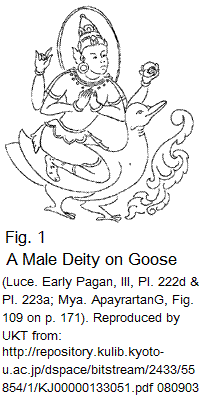
When Mahayanism reached Burma, it could well be imagined that the goddess would also be popular in Burma. Yet no archaeologist has been fortunate enough to find her image in any of the sites they excavated. But a wall painting at Pagan of late 11 century A.D. looks like Goddess Saraswati on the Goose (fn05) (Fig. I). The picture is one of the eighteen figures thought to be Brahmanical found on the upper portion of the inner wall of Abeyadana pagoda, Myinpagan. The walls are of the outside of the centre room on east, south and west sides. The pagoda or cave-like temple is attributed to Abeyadana, queen of Htilaing Min whose regnal title was Sri Tribhuwanadityadhammaraja.
Fig. 1 A Male Deity on Goose
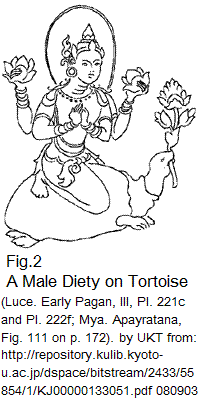
(Luce. Early Pagan, III, PI. 222d & PI. 223a; Mya. ApayrartanG, Fig. 109 on p. 171)Fig.2 A Male Diety on Tortoise
(Luce. Early Pagan, III, PI. 221c and PI. 222f; Mya. Apayratana, Fig. 111 on p. 172)UKT: Instead of postulating the sex of the figure and theorising who the figure was supposed to represent, what about postulating that the unknown artist was just drawing fanciful drawings to decorate the wall and that was the reason why he did not leave any written words. He was probably also getting fed up the political and religious upheavals of the times and had not shown any symbols of violence. 080904
The said pictures have no written words to identify them [{p432end, p433 has pix, p434begin}] but some have many heads on one shoulder or many arms to one trunk and each has an animal to ride. This naturally led some scholar to name them Brahma, Siva, Viṣṇu, etc. Number sixteen in the series of eighteen becomes "Sarasvati on White HamSa". (fn06) But the more prudent would simply mention this picture as a male deity on goose. (fn07) Because the sitting figure does not look feminine. (fn08) The head-dress and more clearly the chest show that the person is male. The animal he or she uses to ride on might help to identify the deity but the same animal might be used by several of them. For instance lion is used by many and so is the peacock. Another figure in the same set (Number Twelve) sitting on a tortoise (fn09) could be the Goddess Yamunā though the picture clearly shows that it is a male (Fig. 2). Nevertheless as one of the Mahayana pantheon, a picture of the Goddess Saraswati might have been drawn somewhere on the walls of temples at Pagan, though the one we now allege to find at the Abeyadana is not exact Saraswatī.
UKT: Burmese scholars like Dr. Than Tun following the footsteps of English colonial historians are confirmed in their opinion that whatever that is found in Pagan must have as their origin in foreign places such as southern India and Sri Lanka. And so in this paper he has gone to the extent of using pictures with no written words to point out what they were supposed to represent as Hindu or Mahayana Buddhist gods and goddesses. What I would like to suggest is since the word "sara" can mean the vowels or words, the ancients must have personified our very voice and our ability to speak (which differentiates us from the animals) as Saraswati. With an attitude such as mine the following inscription with the word "saraswati" simply suggests that the king always chose his words very carefully and that he was an eloquent speaker.
The Shwezigon Mon Inscription of A.D. 1084 uses the word or name saraswati like this:
yaṅ prajñā makkamo' saraswatī goḥ stāw ḍey mukhawār gna smin Śrī Tribhuwanādityadhammarājā goḥ) ut ku kāl
(The wisdom of eloquence called saraswati shall dwell in mouth of King Śrī Tribhuwanadityadhammaraja at all times.) (fn10)
 It might also be interpreted that Saraswati was always helping the king to say
things
correct and wise to the benefit of all his subjects. It is not unlikely that a
picture or a
statue of this goddess was kept in the palace of this king. We are told in his
Palace
Inscription (A.D. 1110) that gold statues of Narayana (Viṣṇu) and his consort
Sri
(Laksmi) were there. (fn11)
It might also be interpreted that Saraswati was always helping the king to say
things
correct and wise to the benefit of all his subjects. It is not unlikely that a
picture or a
statue of this goddess was kept in the palace of this king. We are told in his
Palace
Inscription (A.D. 1110) that gold statues of Narayana (Viṣṇu) and his consort
Sri
(Laksmi) were there. (fn11)
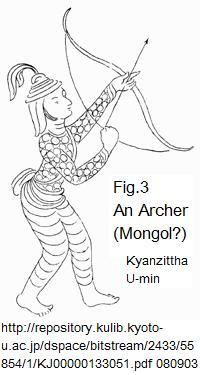
Fig.3 An Archer (?Mongol) drawn on the wall of Kyanzittha U-min, (marked B in Fig. 5) (late 13 century?)
Note: My sketches are only an approximation of what is there on the wall and therefore an
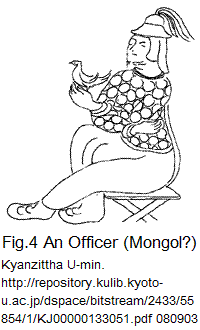
interested reader is advised to look up in the reference works for photographs.Fig.4 An Officer (?Mongol) drawn on the wall of Kyanzittha U-min (marked A in Fig. 5) (late 13 century?)
Fig.5 Plan of Kyanzittha U-min (drawn from memory) showing places where A ?Mongol Officer, B ?Mongol Archer & C two figures of ?Saraswati are found ?late 13 century
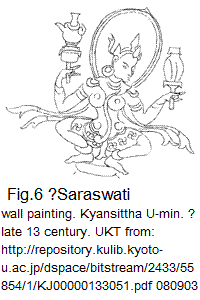
Fig.6 ?Saraswati, wall-painting, Kyanzittha U-min, Pagan, ?Iate 13 century
Fig.7 ?Saraswati, wall-painting, Kyanzittha U-min, Pagan, ?Iate 13 century
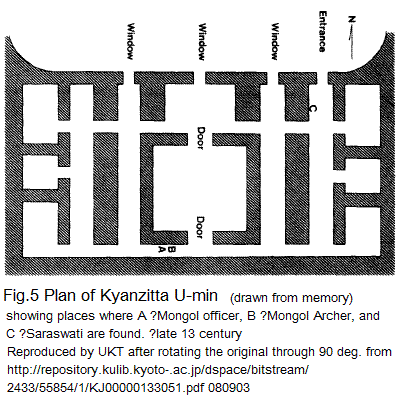

 Close to the Shwezigon (Nyaung-U) on its south west sector is located a tunnel
known by the name of Kyanzittha U-min. On the walls of the tunnel are drawn
pictures unlike any other pictures found on many walls of several other
buildings at
Pagan. Although it bears the name of Kyanzittha who was king at Pagan from A.D.
[{p435end}]
1084 to 1112, the date of the tunnel or the time when the drawings were made is
unknown. We have, however, one clue which in the absence of anything else is
usuable. At two places close together are drawn the picture of an archer ready
to
shoot with a bow (Fig. 3) and a sitting army officer with a hawk perched on his
left
hand (Fig. 4). Both of them look like Mongols. The presence of Mongols (if we
are
correct in calling them Mongols) denotes the time that immediately follows the
fall
of Pagan by the close of the 13 century. At another place (see plan, Fig. 5) in
the
same tunnel are drawn two pictures of what I think Saraswati.
Close to the Shwezigon (Nyaung-U) on its south west sector is located a tunnel
known by the name of Kyanzittha U-min. On the walls of the tunnel are drawn
pictures unlike any other pictures found on many walls of several other
buildings at
Pagan. Although it bears the name of Kyanzittha who was king at Pagan from A.D.
[{p435end}]
1084 to 1112, the date of the tunnel or the time when the drawings were made is
unknown. We have, however, one clue which in the absence of anything else is
usuable. At two places close together are drawn the picture of an archer ready
to
shoot with a bow (Fig. 3) and a sitting army officer with a hawk perched on his
left
hand (Fig. 4). Both of them look like Mongols. The presence of Mongols (if we
are
correct in calling them Mongols) denotes the time that immediately follows the
fall
of Pagan by the close of the 13 century. At another place (see plan, Fig. 5) in
the
same tunnel are drawn two pictures of what I think Saraswati.
 Identifying the figure of a woman as Goddess Saraswati is another problem.
Usually she would be shown with hands holding vina or lotus and a goose or
peacock
would be around. Without these attributes it is too bold to assert that the
figure
represents the goddess. Both of the pictures, that I am alluding to are feminine
in
appearance and have haloes around their heads. That is enough to call them
goddesses. Goddess turning slightly to the left (Fig. 6) holds what I supposed
to be a [{p436end.p437pix.p438begin}]
closed white umbrella in her left hand and a pot in her right. Goddess turning
slightly to the right (Fig. 7) holds in her left hand a pot and double rings in
her right.
Details are missing but the rings could be swastikas. A lotus flower hovers just
above her halo. The white umbrella, lotus flower, kalasa and swastika together
with
two gold fish, conch, flag and srivatsa are eight auspicious emblems (fn12) used by
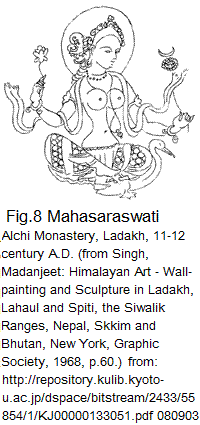
Mahayanists. The lotus suggests that the goddess is Saraswati. In addition to
this,
the pictures of the goddess at Kyanzittha U-min have a close resemblence to the
painting of Mahasarasvati (11-12 centuries A.D.) found at the Alchi Monastery at Ladakh (fn13) (Fig. 8). But she is sitting on a goose. Unfortunately none of the
goddesses
of Kyanzittha U-min has a goose.
Identifying the figure of a woman as Goddess Saraswati is another problem.
Usually she would be shown with hands holding vina or lotus and a goose or
peacock
would be around. Without these attributes it is too bold to assert that the
figure
represents the goddess. Both of the pictures, that I am alluding to are feminine
in
appearance and have haloes around their heads. That is enough to call them
goddesses. Goddess turning slightly to the left (Fig. 6) holds what I supposed
to be a [{p436end.p437pix.p438begin}]
closed white umbrella in her left hand and a pot in her right. Goddess turning
slightly to the right (Fig. 7) holds in her left hand a pot and double rings in
her right.
Details are missing but the rings could be swastikas. A lotus flower hovers just
above her halo. The white umbrella, lotus flower, kalasa and swastika together
with
two gold fish, conch, flag and srivatsa are eight auspicious emblems (fn12) used by
Mahayanists. The lotus suggests that the goddess is Saraswati. In addition to
this,
the pictures of the goddess at Kyanzittha U-min have a close resemblence to the
painting of Mahasarasvati (11-12 centuries A.D.) found at the Alchi Monastery at Ladakh (fn13) (Fig. 8). But she is sitting on a goose. Unfortunately none of the
goddesses
of Kyanzittha U-min has a goose.
Fig.8 Mahasaraswati, Alchi Monastery, Ladakh, 11-12 century A.D.
(from Singh, Madanjeet: Himalayan
Art - Wall-painting and Sculpture in Ladakh, Lahaul and Spiti,
the Siwalik Ranges,
Nepal, Skkim
and Bhutan, New York, Graphic Society, 1968, p.60.)
In conclusion I suggest that the two pictures of women at Kyanzittha U-min are Saraswatis of the Mahayanist school and they belong to the end of 13 century. The earliest mention of the name is found in an inscription of the early 12 century.
UKT: Is not the absence of a water fowl enough proof that the so-called "goddeses" (with their masculine features) at Kyanzittha U-min are not Saraswati? Since the Mongols might have used the Kyanzittha U-min as a barrack, some of the homesick soldiers might have just painted the local girls as "goddesses". Moreover, it is apparent that the ability of the artist's skill at representing the human figure was never questioned in determining the sex of the figures.
Saraswati, Goddess of Eloquence,(fn14) occupies only a subordinate position in the Hindu pantheon. (fn15) Her worship is mostly confined to sects connected with [{p438end. p439pix. p440begin}] Siva. A lady full of compassion could become popular with the Buddhista (fn16) and it was probably in about the 5 century A.D. that she was worshipped by the Buddhists. With them she holds a prominent position as one of the guardians of the Religion. From being consort to Brahma, she becomes the Sakti of Mafijusri (fn17). She is also important in the Sino-Japanese and Tibetan Buddhism (fn18). With Pustaka (Book) on Padma (Lotus) held by her left hand and Akṣamala (Rosary Beads) on her right hand which is in the Varada mudrā (gift bestowing attitude),(fn19) she supersedes Prajfiaparamita (former Buddhist Goddess of Wisdom). (fn20) This change could have happened when Vajrayana form of Buddhism rose to eminence and spread beyond India in the 7 and 8 centuries A.D. (fn21) Even in Japan, Goddess Sarasvati is recognisable in the deity of Benten. (fn22)
Sarasvati mentioned in A.D. 1084 Shwezigon Inscription in early Mon seems to be the earliest reference to the goddess in Burma. But in Burmese literature we find a fairly numerous reference (fn23) to her. These references date from 1494 to 1924. In almost all these references Sarasvati is the Goddess of Eloquence and Wisdom. From being a Hindu deity, she became Buddhist and how this happened is mentioned in Giithiikhrokchay Pyui, (§ 78) and Wohara linattha (§ 72) identifies her as a deity having an abode at a lake. In three places, viz. Hitakari (§ 3), Nanachanda (§ 106) and Adikappa (p. 116) she is described as a deity of white complexion" riding a goose and holding a lotus in one hand. At one reference we find a remarkable statement like this. [{p440end}]
Goddess Sarasvati exists right from the beginning of the Earth. She is powerful. She speaks exceedingly well. It is believed that when she favours a person, that person would utter only words of importance. Authors of non-religious works like Riima, Samma and Da~¢iworshippedher before they commence writing. But one who works on a religious text would certainly pay homage to the Tipitaka which Sarasvati symbolises. Thus it was expressedly mentioned by the Tontwan: charatoau on 31 August 1762 (Lakwainoauratha Lhyokthum:, pp. 214-15).
Fairly recent references to Sarasvati and her propitiation can be found in:
• Balinatcapujoaunafi, Rangoon, Thudamawadi Press, 1951, pp. 13, 17, 29-30 & 97. Cin Phe. Bhura :kui :chupujoaunafi :catam:, Rangoon, Shwedagon U Pyine Publications, 1973, pp. 111-12, 121, 122, 123, 125, 127 & 245.
• Guha, Devaprasad. "Ghoramanta (alias) Goravinda-A Burmese God," JBRS, XLIII,i, June, pp. 51-5.
• Kyoau (Dibbacakkhu Chara-). Imphrutoau Mantanpon :khyup, Rangoon, Thudamawadi Press, 1961, pp. 139, 140, 142,143,144,147,148,149, 151, 152,155,157 & 161.
• Maung Htin Aung. "The Nine Gods," JBRS, XXXVII,ii, December 1954, pp. 1-9. Phui: Kha. Sum :chay, khunaman:, Rangoon, Myanmagonyi Press, 1973 Fourth Printing, pp. 16, 20, 21 & 24. [{p441end}]
fn01) See Dowson, John. A Classical Dictionary of Hindu Mythology and Religion, Geography, History and Literature, London: Routledge and Kegan Paul, 1961 Tenth Edition, pp. 284-5 for details. fn01b
fn02) Oswalt, Sabine G. Concise Encyclopedia of Greek and Roman Mythology, London: Collins, 1969, pp. 4952 and 188-9. fn02b
fn03) Thomas, P. Epics, Myths and Legends of India - A Comparative Survey of the Sacred Lore of the Hindus, Buddhists and Jains, Bombay: Taraporevala, 1961 Eleventh Edition, p. 61 and Fig. 102 of pI. XXXVII facing p. 72. fn03b
fn04) Bhattacheryya, Beneytosh. The Indian Buddhist Iconography, Calcutta: Mukhopadhayay, 1958 Second Edition, p. 349 and Figs. 230, 231, 234 and 235 ofpp. 369-70. fn04b
fn05) Luce, G. H. Old Burma - Early Pagan, New York: Artibus Asiae, 1969, I, pp. 223, 226 and 326; III, PI. 221d and 223a. fn05b
fn06) Luce: Early Pagan, I, p. 226. fn06b
fn07) Mya. Apayratana Lui1}gfiphura, Rangoon: Government Printing, 1974 Second Printing, pp. 106 and 171 Fig. 109. fn07b
fn08) Luce: Early Pagan, III, PI. 221d and PI. 223a. fn08b
fn09) Luce: Early Pagan, I, p. 226; III, PI. 221c and PI. 222f. fn09b
fn10) "The Great (Mon) Inscription of the Shwezigon Pagoda, Pagan", E face, line 41, Epigraphia Birmanica, II, i, Rangoon: Government Printing, 1960 Reprint, Mon text on p. 105 and English translation on p. 124; "Inscription on Biography of King Kyanzittha, Pagan", ~a face, line 41, Mwan Kyokciipon: khyup, Rangoon: Government Printing, 1969, Mon text on p. 25 and Burmese translation on p. 16; "Shwezigon Mon Inscription", Rangoon: Ministry of Culture, 1956, Mon text on p. 14 and Burmese translation on p. 15. fn10b
fn11) "An Inscription (Mon) found near the Tharaba Gate, Pagan", R face, line 5, Ep. Birm., III, i, 1923, text p. 33 and Eng. tr. p. 67; Mwan Khyup, 69, 40. fn11b
fn12) Singh, Madanjeet. Himalyan Art-Wall-painting and Sculpture in Ladakh, Lahaul and Spiti, the Siwalik Ranges, Nepal, Sikkim and Bhutan, New York: Graphic Society, 1968, p. 81. fn12b
fn13) Singh: Himalyan Art, p. 60. fn13b
fn14) Bath, A. The Religions of India, Eng. tr. by Rev.]. Wood, New Delhi: S. Chand and Co., 1969, Sixth Edition, p. 256. fn14b
fn15) Thomas, P. Epics, Myths and Legends of India - A Comprehensive Survey of the Sacred Lore of the Hindus, Buddhists and Jains, Bombay: Taraporevala, 1961 Eleventh Edition, p. 61 fn15b
fn16) Eliot, C. Hinduism and Buddhism-An Historical Sketch, II, London: Routledge and Kegan Paul, 1968 Reprint, pp. 145-6; Bhattacharyya, Benoytosh. The Indian Buddhist Iconography, Calcutta: Firma K. L. Mukhopadhyay, 1958 Second Edition, p. 350; Gupte, R. S. The Iconography of the Buddhist Sculptures (Caves) of Ellora, Aurangabad: Marathwada University, 1964, pp. 9 and 109. fn16b
fn17) Eliot. Hinduism and Buddhism, II, p. 19; Grunwedel, A. Buddhist Art in India, London: Susil Gupta, 1965 Second Edition, p. 105; Smith, V. A. A History of Fine Art in India and Ceylon, Bombay: Taraporevala, Third Edition, p. 151. fn17b
fn18) Grunwedel: Buddhist Art, p. 105. fn18b
fn19) Goetz, H. India-Five Thousand Years of Indian Art, Hoole Verlag, G.M.B.H., Baden-Baden, Germany, 1964 Second Edition, p. 104; Gupte. Icon Ellora, pp. 110 & 116; Gupte, R. S. and B. D. Mahajan. Ajanta, Ellora and Aurangabad Caves, Bombay: Taraporevala, 1962, p. 128. fn19b
fn20) Gupte. Icon Ellota, pp. 103, 107 and 108. fn20b
fn21) Gupte. Icon Ellora, p. 28. fn21b
fn22) Gupte. Icon Ellora, p. 109; Grunwedel. Buddhist Art, pp. 105, 148 fn. fn22b
fn23) Toe Hla, one of my colleagues supply the extracts from Silavamsa. Chuton: kham: Pyui, (1494) §27; Kantoauman: kyon: charatoau: Lofr,asara Pyui, (?1500) §54; Hloauka: sum: thonmhu: Man: tara: rhwethi: Ekhyan: (1516) §34; Un: NUi: Giithlikhrokchay Pyui, (1517) §78; Man: raja: Hitakarilanka (1750) §3; Twan: san; man: kri: MudulakkhaTJa Pyui, (1751) §16; Rhwetonsihasu: Ratanakre: muriman: twan: jattoaukri: (?1756) pp. 29, 38-40, 52, 152 & 161; Lakwainoauratha: Lhyokthum: (1762) pp. 214-15; Rhwetoimandamit: Calan: man: monpon: khyon Ekhyan: (1771) §55; Tui: Riimarakan, I (1789) p. 79; Ariyavamsaadiccaramsi: Samantacakkhudipani, I (1808) pp. 91 & 92; Ariyavamsaadiccaramsi: Niinachanda Pyui, (1826) §106; Mahajeyasankhaya Lhesan: AtwaiJ.: wan: Woharalinatthadipani (1830) §72; Buddhuppatti Pyui, (?1900) §19; Rhwe Noau: Adikappakambha-ii: Kyam: (1901) p. 110; Manlancharatoau: Mahlisutakarimaghadevalankasac (1904) §1 and Laytipary.9ita U: Mon Kri: Siirassatiniti (1924) passim. fn23b
* Dr. Than Tun, Professor of History, Arts and Science University, Mandalay.
Go back DrThanTun-note-b
From: http://pallas.athene.nu/ 080904
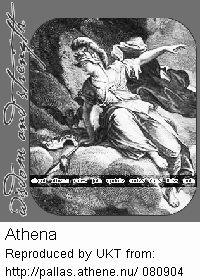 Pallas
Athena is the goddess of war, wisdom, the arts, the city, agriculture, and a
variety of other areas. She is the embodiment of reason and purity. Athena is
the child of Zeus and Metis, the goddess of wisdom. Fearing that Metis's child
would overthrow him (as he had overthrown Cronus, his father), Zeus swallowed
Metis whole. Athena later sprung from her father's head fully grown and armored.
She is the favorite of Zeus's children; not only is she charged with the task of
carrying the Aegis, she is the only god/goddess allowed to use his weapons.
Pallas
Athena is the goddess of war, wisdom, the arts, the city, agriculture, and a
variety of other areas. She is the embodiment of reason and purity. Athena is
the child of Zeus and Metis, the goddess of wisdom. Fearing that Metis's child
would overthrow him (as he had overthrown Cronus, his father), Zeus swallowed
Metis whole. Athena later sprung from her father's head fully grown and armored.
She is the favorite of Zeus's children; not only is she charged with the task of
carrying the Aegis, she is the only god/goddess allowed to use his weapons.
As the goddess of war, she is extremely skilled and brave, and never lost a battle. She even surpasses Ares, the god of war, because of her superior strategic skills. However, Athena does not enjoy war, and she fights only to defend the State (except in The Iliad).
Benefactor to humanity, she gave the city of Athens (her special city, which was named after her) the olive tree, from which they could get food and firewood; invented many useful objects such as the bridle, the flute, the plow, and the chariot; was a patron of the sciences; and encouraged men against the temptation of war. She also sponsored and assisted many Greek heroes.
Athena is one of the three virgin goddesses, the other two being Artemis and Hestia. As the chief of the three, she is called the Maiden, Parthenos, and her temple is the Parthenon.
One of her companions is Nike, goddess of victory, and her symbols include her favorite animal, the owl; her created tree, the olive; the Aegis, Zeus's shield that she held for him, which also displays the head of Medusa; her helmet; and her spear. She is described as being "grey-eyed" or "flashing-eyed."
In Roman mythology, the goddess Minerva came to be identified with Athena.
Go back athena-note-b
End of TIL file