1. Daikok
2. Ebis
3. Benzaiten (Sarasvatî Devî)
4. Bishamon
5. Hotê
6. Jurôjin
7. Fukrokju
8. Kisshôten
saras-japan.htm
by Teitaro Suzuki, The Open Court Publishing Co., Volume XXI,
1907, p.397 (HTML by Christopher M. Weimer, July 2002),
http://www.sacred-texts.com/journals/oc/ts-sgb.htm 080912
downloaded and edited by U Kyaw Tun, M.S. (I.P.S.T., U.S.A.). Not for sale. Prepared for students of TIL Computing and Language Center, Yangon, MYANMAR.
Contents of this page
1.
Daikok
2. Ebis
3. Benzaiten (Sarasvatî Devî)
4. Bishamon
5. Hotê
6. Jurôjin
7. Fukrokju
8. Kisshôten
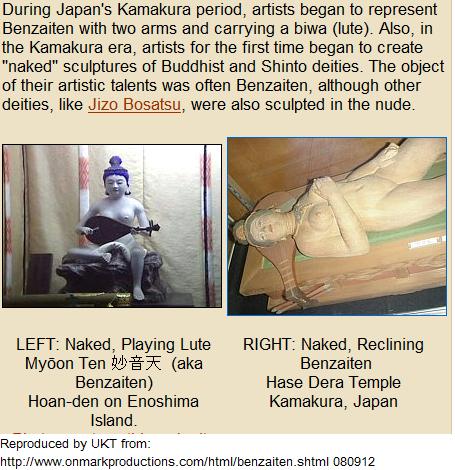
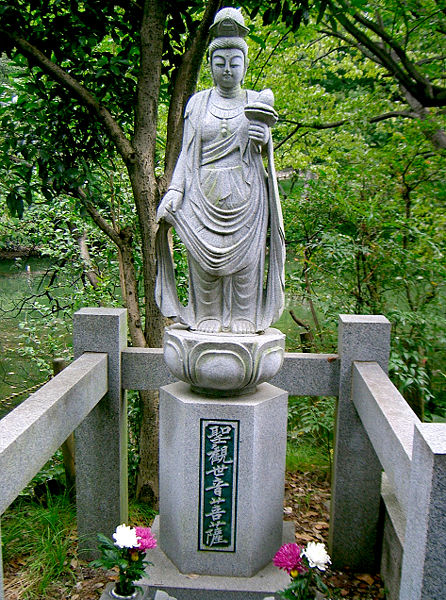
UKT: Click on the pix on the right to enlarge. Notice that Saraswati in becoming Benzaiten has lost her vehicle the Brahmani duck. Though she is portrayed fully clothed, she was for the first time represented nude in Kamakura period (1186 - 1333).
Contents of this page
p.397
UKT: While looking for the belief in {thu-rath~tha.ti} in other lands, I came across this article on this goddess in Japan by by Teitaro Suzuki. It should be noted that this goddess is loved by ordinary people not only in Myanmar but in other lands because of her knowledge and grace rather than feared as in the case of other gods and goddesses.
THERE is in Japanese folklore a group of supernatural beings popularly known as the seven gods of bliss, who in the order of their popularity are as follows: Daikok (The Great Black One), Ebis (The Stranger), Benzaiten (Goddess of Eloquence), Bishamonten (Vaishravana), Hotê (Linen-bag), Jurôjin (Old Man), and Fukrokju (Wealth and Long Life), or Kisshôten (goddess of Good). One of them only (Ebis) is of native origin; four others have been introduced from India and the three last mentioned from China. But their real birthplaces have long been forgotten by the people, and the gods have become thoroughly naturalized.
 The
first three, Daikok, Ebis, and Benzaiten, are almost equally popular, and it is
difficult to give any one of them a preference over the other two. In Daikok we
perceive a very peculiar and at the same time a very interesting example of the
development, or rather transformation, of human fancy. Daikok is Mahâkâla of the
Hindus and as such he is far from being a god of bliss. He is one of the most
destructive and awe-inspiring deities in the Hindu pantheon. But we can
understand the paradox by what might be called the law of opposition whereby two
extremes frequently become interchangeable.
The
first three, Daikok, Ebis, and Benzaiten, are almost equally popular, and it is
difficult to give any one of them a preference over the other two. In Daikok we
perceive a very peculiar and at the same time a very interesting example of the
development, or rather transformation, of human fancy. Daikok is Mahâkâla of the
Hindus and as such he is far from being a god of bliss. He is one of the most
destructive and awe-inspiring deities in the Hindu pantheon. But we can
understand the paradox by what might be called the law of opposition whereby two
extremes frequently become interchangeable.
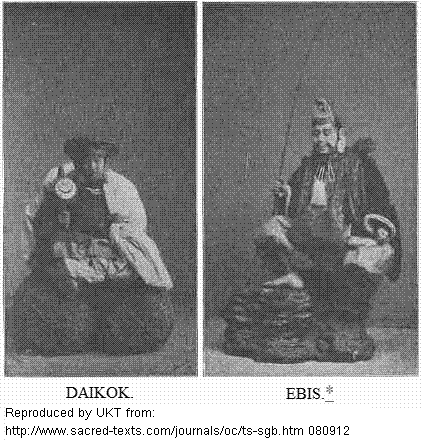
The Japanese Daikok is usually represented as either sitting or standing on rice sacks, with a "hammer of plenty" in his right hand and with a large bag on his left shoulder. He commonly wears a flat cap like those which we occasionally see on the heads of little American girls. He is always smiling as if ready to shake out any earthly treasure from his hammer according to the wishes of his devotees. His color is black, as is indicated by his name (dai = [{p398}] "great," kok = "black"), but in his physiognomy there is not a single sign that betrays his original nature as the god of destruction.
The Hindu god Mahâkâla Deva is a manifestation of Shiva, the Hindu Chronos, for Kâla means in Sanskrit "time." The following passage as quoted in Moor's Hindu Pantheon (p. 33) from Paterson (As. Res., Vol. VIII., p. 61) gives us a vivid image of this all-destroying god:
"Mahâkâla as represented in the caverns of Elephanta had eight arms. In one he holds a human figure; in another a sword or sacrificial axe; in a third he holds a basin of blood; and with a fourth he rings over it the sacrificial bell. Two other arms are broken off; with the two remaining he is drawing behind him a veil, which extinguished the sun and involves the whole universe in one undistinguished ruin. One of the titles of this tremendous deity is Bhavara, the terrific; but his principal designation is Kâla (time), Agni (fire), Rudra (fate)."
How then did this awe-inspiring deity come to be known as the Great Black One and revered as a god of bliss br the Japanese? On account of the lack of authentic records, we have at present no means of historically ascertaining the process of this singularly interesting transformation. It seems to have already taken place in India, before the time of I-Tsing's pilgrimage (A.D. 671-695). From his work, Correspondence from the Southern Seas, we epitomize the following accounts:
"In all the great Western (Indian) monasteries there stands by the kitchen pillar or post, or in front of a large store-room, a wooden image of a god, two or three feet in height, carrying a golden bag, and sitting on a small stool with one leg hanging down toward the floor. He is constantly smeared with oil which gives him a blackish appearance, and so he is called Mahâkâla, that is, Great Black God. According to tradition he belongs to the group of Mahâdevas. He is very kindly disposed toward the Three Treasures (triratna) and protects the five multitudes (of Buddhists) against destruction. Whoever asks his favor is sure to be gratified in his wishes. At meal time incense and fire are offered by the cooks, and also all kinds of food and drink are displayed on his altar."
I-Tsing concludes his remarks with the words: "All this was personally observed by myself."
Then the Chinese traveler relates the following story by way of an explanation of the foregoing. At a certain monastery about one [{p.399}] hundred monks used to be fed, but one time in the spring or fall, when one of the great festivals was about to take place, there arrived quite unexpectedly a multitude of monks numbering five hundred. It was then found to the great dismay of the cooks that the provision prepared for the occasion was utterly insufficient, and they were at a loss to know how to meet the emergency. At that time here was among the crowd the old mother of a Brahmacharin, who said to them, "This is nothing unusual. Do not trouble yourselves." he burned incense and fire on the altar of Mahâkâla and made him some offerings, and prayed thus: "The great sage (Buddha) entered Nirvana, but his followers are still here. Monks coming from all quarters are desirous to pay homage to the holy places. Through thy grace let them not suffer from want of provision." She bade [{p400}] the people proceed as usual to distribute all the food they had at the time among the multitudes, and they found that it was more than sufficient to feed every one of the new comers.
It is strange to observe that Mahâkâla, the god of time, has here entirely lost his original significance, and that Kâla is understood to mean "black" instead of "time." Coleman in his Hindu Mythology says that Mahâkâlî, the female counterpart of Mahâkâla, was commonly painted black or dark blue. Might it not then be possible that the original meaning of the god having been forgotten, he came to be known only by his conspicuously dark complexion and that later generations gave him their own interpretation?
Ebis — in spite of his name which means "foreigner" or "stranger" — is a thoroughly indigenous production of Japan. He belongs to the mythical age of Japanese history. He was the third child of Izanagi-no-Mikoto, the first mythical hero of Japan, and was the younger brother of the famous sun-goddess Amateras. He somehow incurred the displeasure of his elders and was expelled to the Western sea, where he spent his remaining life as a fisherman. Accordingly, he always wears an ancient Japanese court dress, with a fishing rod in his right hand and with a large reddish braize under his left arm. This fish, which is zoologically known as pagrus cardinalis or major, is considered by the Japanese the most delicious provision on the table, and as indispensable at all important festivals as is turkey at an American Thanksgiving dinner.
Ebis and Daikok are usually in the company of each other; Daikok may be said principally to be a patron of farmers, and Ebis of merchants and tradesmen. The birthday of Ebis which falls in November, is celebrated by the commercial people, especially the dry-goods dealers, by offering the public a special sale. Some think that any fancy needle work made of the material bought on Ebis day brings the owner good luck. One of the largest Japanese brewing companies is named after this god and uses his picture for a trade mark.
 Benzaiten's
Sanskrit name is Sarasvatî Devî, which means: "flowing water" or "eloquence,"
and her character has remained the same in Japan; only the Japanese paint her in
their own fashion, for so far as the outside appearance goes, the identity
between Sarasvatî [{p.401}] and Benzaiten is hardly recognizable. Muir in his
Original Sanskrit Texts, V. 339, says of her:
Benzaiten's
Sanskrit name is Sarasvatî Devî, which means: "flowing water" or "eloquence,"
and her character has remained the same in Japan; only the Japanese paint her in
their own fashion, for so far as the outside appearance goes, the identity
between Sarasvatî [{p.401}] and Benzaiten is hardly recognizable. Muir in his
Original Sanskrit Texts, V. 339, says of her:
"Sarasvatî is a goddess of some though not of any great importance in the Vedas. She is celebrated both as a river and a goddess. She was primarily a river deity, as her name 'watery' clearly denotes; and in this capacity she is celebrated in a few separate passages . . . . The Sarasvatî thus appears to have been to the early Indians what the Ganges is to their descendants."
The tradition of Sarasvatî or Benzaiten as water goddess is not lost sight of in Japan, for we see her temples very frequently in isolated islands or in caverns on the sea-coast.
That she was also the goddess of eloquence, learning, writing, in short of general culture, is told by Sir W. Jones who says (Works, vol. XIII, p. 315):
"Sarasvati Devî is adored as the patroness of the fine arts, especially of music and rhetoric, as the inventress of the Sanskrit language, [{p.402}] of the Devanâgari characters, and of the sciences which writing perpetuates; so that her attitudes correspond with those of Minerva Musica in Greece or Italy, who invented the flute and presided over literature. In this character she is addressed in the ode; and particularly as the goddess of harmony, since the Hindus usually paint her with a musical instrument in her hand. The seven notes, an artful combination of which constitutes music and variously affects the passions, are feigned to be her earliest production."
Benzaiten in Japan is also the popular goddess of beauty. In stories of ancient Japan we read that when a mother wished to have handsome daughters, she went to the temple of Benzaiten, and confining herself in a special room or cave, she fasted and prayed with all her heart, generally for a period of seven days. In case her urgent wish was granted, the goddess manifested herself in a dream, and the child thus favored always surpassed all others in beauty and wisdom.
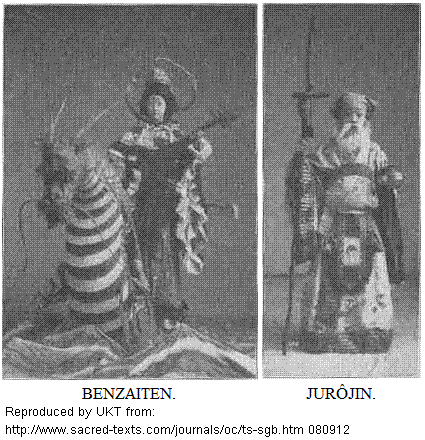
As Benzaiten is associated with water, she is often represented as standing or sitting on a dragon or sea-serpent, and sometimes assumes the shape of her sacred animal. In Hindu mythology she is pictured as riding on a peacock. In Japan as well as in India she holds a musical instrument in her hand, but the Japanese common sense hesitated to let her have more than two arms, while the fertile Indian imagination depicts her with four arms, though she looks more human than some other Hindu deities.
From: http://en.wikipedia.org/wiki/Benzaiten 080912
Benzaiten (弁才天, 弁財天) is the Japanese name of the goddess Saraswati; there was an important river in ancient India of this name (see Vedic Saraswati River). Worship of Benzaiten arrived in Japan during the 6th through 8th centuries, mainly via the Chinese translations of the Sutra of Golden Light, which has a section devoted to her. She is also mentioned in the Lotus Sutra.
Her Sanskrit name is "Sarasvatî Devî", which means "flowing water", and so Benzaiten is the goddess of everything that flows: water, words (and knowledge, by extension), speech, eloquence, and music. The characters used initially to write her name, read "Biancaitian" in Chinese and "Bensaiten" in Japanese (辯才天), reflected her role as the goddess of eloquence. Because the Sutra of Golden Light promised protection of the state, in Japan she became a protector-deity, at first of the state and then of people. Lastly, she became one of the Seven Gods of Fortune, and the Sino-Japanese characters used to write her name changed to 弁財天 (Benzaiten), which reflects her role in bestowing monetary fortune. Sometimes she is called Benten, although this name refers to the goddess Lakshmi.
In the Rig-Veda (6.61.7) Sarasvati is credited with killing the three-headed Vritra, also known as Ahi ("snake"). This is probably one of the sources of Sarasvati/Benzaiten's close association with snakes and dragons in Japan. She is enshrined on the Island of Enoshima in Sagami Bay, about 50 kilometers south of Tokyo, and numerous other locations throughout Japan; and she and a five-headed dragon are the central figures of the Enoshima Engi, a history of the shrines on Enoshima written by the Japanese Buddhist monk Kokei (皇慶) in AD 1047. According to Kokei, Benzaiten is the third daughter of the dragon-king of Munetsuchi (無熱池; literally "lake without heat"), known in Sanskrit as Anavatapta, the lake lying at the center of the world according to an ancient Buddhist cosmological view.
Benzaiten has been syncretized with some Shinto goddesses.
Bishamonten, or Bishamon, was also originally a Hindu god, whose Sanskrit name is Vaishravana. He is the god of wealth and one of the guardians of the four cardinal points of the universe. He is the guardian of the North. His other name is Kuvera. We read in Griffith's Râmayana, II, 20:
"May he whose hands the thunder wield [Indra],
Be in the East thy guard and shield:
May Yama's care the South befriend,
Varuna's arm the West defend:
And let Kuvera, Lord of Gold,
The North with firm protection hold."
In Buddhism the four guardian-gods are differently named: East, Dhrtârashtra; West, Virûpâksha; South, Virûdhaka; and North, Vaishravana. Some Hindu scholars say that this last-mentioned god did not play a very important part in the Hindu pantheon, and in spite of being Lord of Gold, no images or pictures [{p403}] are to be had of him. As a Buddhist god he is well known and in Buddhist countries his pictures and images are plentiful.
In the Japanese group of the seven gods Bishamon has lost his qualification as god of wealth. He is known only as the patron of knowledge, and it is in this capacity that he is sometimes called by the Japanese the God of Great Learning. Some of the great men in the history of Japan are believed to have been incarnations of this guardian of the North. Perhaps the Sanskrit name Vaishravana, which would be interpreted as being a derivative of the root shru, "to hear," might have suggested the rendering of his name by "much hearing," that is, "great learning."
Bishamon is not so popular as the preceding three, though many temples are dedicated to him and annual festivals are celebrated in his honor. In pictures and images he appears as holding a miniatare tower or castle in his left hand and a spear in his right, which evidently symbolizes his function as guardian warrior-god.
It is not exactly known when all these Hindu deities were introduced into the Island Empire. The probability is that when Vajrabodhi, Amogha, and other representatives of the Mantra sect came from India to China in the eighth century, they brought along all these gods with many others. As this sect is a sort of hybrid of Buddhist and Tantric beliefs, it incorporated a great number of Hindu deities. When it was imported to Japan soon after its establishment in China, these wonderful creations of the Hindu mind proved very attractive to the popular conception of the masses.
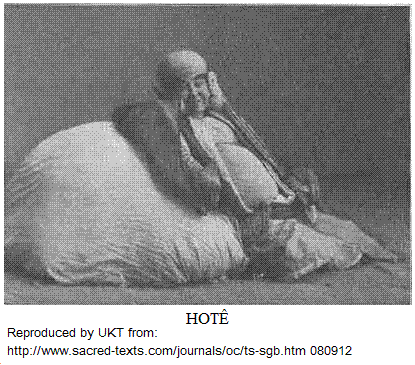 Hotê,
or Pu Tai in Chinese, was a wandering hermit of China who is believed to have
lived in the latter part of the Tung dynasty (620-905 A.D.) One legend considers
him an incarnation of Maitreya Buddha. He carries a large linen bag on his
shoulders, and, a Japanese Santa Claus, is a great favorite with children, and
wherever he appears they flock around him. Occasionally he may be seen among
them distributing gifts dear to their hearts. He has no special name of his own.
He is called Hotê, which is "linen bag," because the large bag on his back is
very conspicuous and he is never seen without it. Aside from these meager
accounts, the history of this Buddhist saint is lost in oblivion, and nobody now
knows how it came to pass that he was admitted to our group of the seven gods of
bliss. Probably, he signifies, the spiritual bliss of loving kindness and
childlike cheer. [{p404}]
Hotê,
or Pu Tai in Chinese, was a wandering hermit of China who is believed to have
lived in the latter part of the Tung dynasty (620-905 A.D.) One legend considers
him an incarnation of Maitreya Buddha. He carries a large linen bag on his
shoulders, and, a Japanese Santa Claus, is a great favorite with children, and
wherever he appears they flock around him. Occasionally he may be seen among
them distributing gifts dear to their hearts. He has no special name of his own.
He is called Hotê, which is "linen bag," because the large bag on his back is
very conspicuous and he is never seen without it. Aside from these meager
accounts, the history of this Buddhist saint is lost in oblivion, and nobody now
knows how it came to pass that he was admitted to our group of the seven gods of
bliss. Probably, he signifies, the spiritual bliss of loving kindness and
childlike cheer. [{p404}]
Properly speaking, Hotê is not a god at all, and I do not believe the Japanese regard him as such. Nobody worships him, nobody prays to him for special favors, spiritual or material. Most likely it is as a jolly old fellow who is able to impart something humorous to the severity of our daily struggle for existence, that he has been initiated into the congregation of the seven gods.
Next comes Jurôjin which means "old venerable man." He symbolizes longevity and stands for the star Canopus which is called by the Chinese the star of longevity. We do not know at present how the luminary came to signalize the bliss of longevity. Jurôjin is thus of Chinese origin. The popular conception of him is to depict him as carrying a long staff made of natural wood and accompanied by a white stag,—the staff and the animal being symbols of holiness. Like Hotê just preceding, he is not really a god.
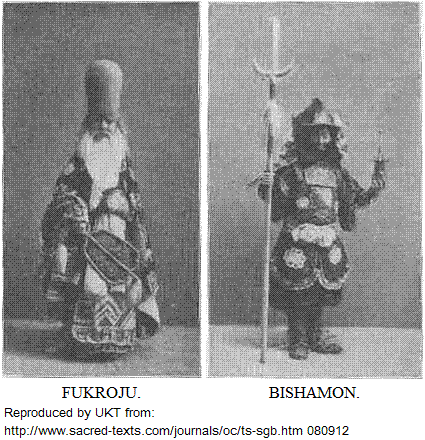 The
seventh god of bliss according to one tradition is Fukrokju, and according to
another Kisshoten (Shridevî). Fukrokju is not [{p405}] a historical figure nor
is he a Hindu deity. He is simply a personification of the combined ideas,
fuk, rok and ju, that is, Bliss, Wealth and Longevity, — these
three being considered by the Chinese the most desirable things in the world.
The most prominent physical mark of this mythical personage, as pictured by the
Japanese, is his extraordinarily long head, as if our ordinary-sized cranium was
not large enough to hold all his virtues, knowledge, and happiness, which were
added to him as he advanced in age. Other than as a mere symbol of bliss, he
plays no interesting rôle in Japanese popular belief.
The
seventh god of bliss according to one tradition is Fukrokju, and according to
another Kisshoten (Shridevî). Fukrokju is not [{p405}] a historical figure nor
is he a Hindu deity. He is simply a personification of the combined ideas,
fuk, rok and ju, that is, Bliss, Wealth and Longevity, — these
three being considered by the Chinese the most desirable things in the world.
The most prominent physical mark of this mythical personage, as pictured by the
Japanese, is his extraordinarily long head, as if our ordinary-sized cranium was
not large enough to hold all his virtues, knowledge, and happiness, which were
added to him as he advanced in age. Other than as a mere symbol of bliss, he
plays no interesting rôle in Japanese popular belief.
Kisshôten is a goddess borrowed from India, her Sanskrit name being Shridevî. According to a Hindu scholar, she was the wife of Daksha by whom she had one hundred and one daughters. One of them was given her in answer to her earnest prayer to have a child p. 406 exactly like herself. This her duplicate named Sati was married to Mahâdeva. In Japan as in India she has done nothing important or significant. She is sometimes represented as scattering gems of luck, and people who own any one of them may use it, like Aladdin's lamp, to procure at their request all kinds of earthly treasures.
* * *
All these seven gods or genii travel on board a ship called Takara-buné, "boat of treasure," and pictures of it are sold on New Year's Eve. For there is an ancient custom in which superstitious people (and perhaps others also) are wont to indulge—to place the picture under their pillows at night in the hope that a pleasant dream will disclose all the good luck which the new year has in store for them. When the voice of the picture peddler rings through the cold clear night of December, many Japanese youths tremble with excitement to enjoy a glimpse at their future fortune, and the old feel rejuvenated by the festive sentiment that prevails. It is a night full of romantic imaginings — so dear to the Japanese of all classes.
End of TIL file