Update:
2008-09-16 03:05 PM +0800
TIL
Iron-producing furnaces of Pagan
iron-Pagan.htm
by Bob Hudson and U Nyein Lwin, Old iron-producing furnaces in the eastern
hinterland of Bagan, Myanmar - Field survey and initial excavation, 2002.
http://acl.arts.usyd.edu.au/~hudson/furnaces.PDF 080915
Downloaded and edited by U Kyaw Tun, M.S. (I.P.S.T., U.S.A.).
Not for sale. Prepared for students of TIL Computing and Language Center,
Yangon, MYANMAR.
indx-myan | Top
indx-folk
Contents of this page
UKT: Some of the captions are mine.
Iron works in Old Pagan
Excavation at Zi-o
Conclusion and future prospects
Footnotes
Contents of this page
In November 2001, an investigation was made of a number of sites known from
local informants around the villages of Zi-o and Panidwin, east of Bagan, to
contain remains of furnaces and what appeared to be large quantities of
iron-making debris. The group on the field trip included U Aung Kyaing, Deputy
Director General of Archaeology for Upper Myanmar, U Win Maung (Tanpawady), a
classical architect and antiquarian from Mandalay, U Nyein Lwin, archaeological
research officer and excavator from Bagan, and Bob Hudson, from the Archaeology
Department, University of Sydney, Australia. The outcome was the survey and
mapping of 12 separate sites which between them contain hundreds of furnaces,
and the subsequent excavation of a furnace to determine its structure. Samples
were also recovered for future radiocarbon dating, and are held at the
University of Sydney and at the Archaeology Department at Bagan.
Contents of this page
 The investigation grew out of an interest in identifying and locating sites
claimed in the Glass Palace Chronicle (fn01) to
be the founding villages of the first kingdom of Bagan in the 2nd century AD.
Some of the results of this project are to be published internationally in 2002
(fn02). But an offshoot of the research was a
growing awareness that the area east of Bagan, strongly represented in the
traditional accounts of the old chronicles, contained this substantial number of
iron furnaces. While the most logical timescale for iron production near Bagan
would be its main period of construction between the 11th to 13th centuries, the
city also sits in the region of Upper Myanmar (formerly Burma) that in the first
millennium AD was inhabited by an iron-using people known as the Pyu (fn03).
An early role for at least some of the furnaces east of Bagan could be
hypothesised, in the light of evidence that now suggests settlement activity in
Bagan itself well before the 11th century (fn04).
[{p01end}]
The investigation grew out of an interest in identifying and locating sites
claimed in the Glass Palace Chronicle (fn01) to
be the founding villages of the first kingdom of Bagan in the 2nd century AD.
Some of the results of this project are to be published internationally in 2002
(fn02). But an offshoot of the research was a
growing awareness that the area east of Bagan, strongly represented in the
traditional accounts of the old chronicles, contained this substantial number of
iron furnaces. While the most logical timescale for iron production near Bagan
would be its main period of construction between the 11th to 13th centuries, the
city also sits in the region of Upper Myanmar (formerly Burma) that in the first
millennium AD was inhabited by an iron-using people known as the Pyu (fn03).
An early role for at least some of the furnaces east of Bagan could be
hypothesised, in the light of evidence that now suggests settlement activity in
Bagan itself well before the 11th century (fn04).
[{p01end}]
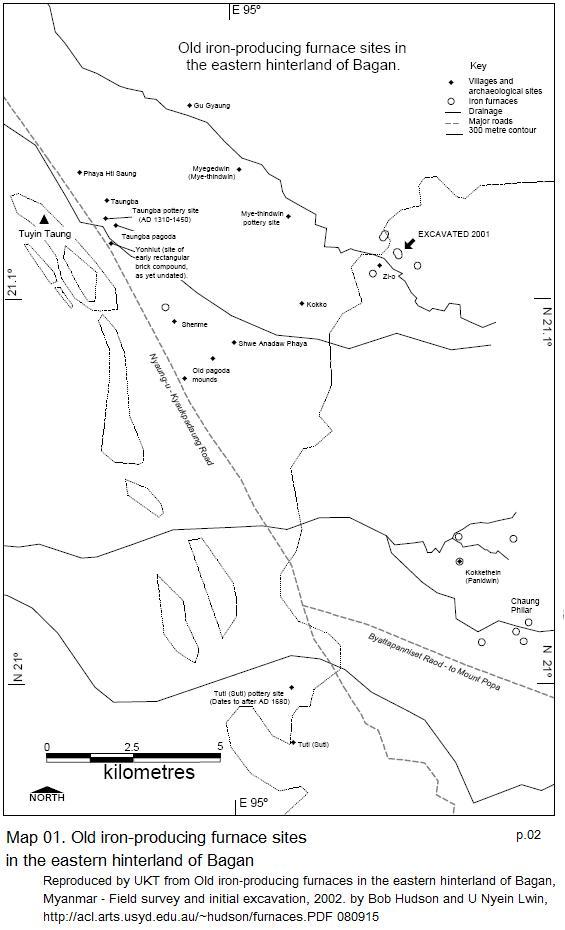
UKT: Notice that the Irrawaddy river is on the west of the area
represented by map 01, so that the "stream at Chaung Philar" is "flowing"
from east to west. Though I am not certain, since the lay out of the land is
pretty familiar to me, I would presume that the stream is dry most of the
time of the year. The name "Chaung Philar" is probably spelled {hkyaung-hpi-la}
literally meaning that it is an out-of-the-way place or {hkyaung} pronounced
as /{gyaung}/, and does not mean "stream" or {hkyaung:}. (to be checked with
the authors.)
The furnace sites fall into two main clusters, around the villages of Panidwin
(which may be the Kokkethein of the chronicles) and Zi-o. They range in size
from 7 furnaces along the side of a stream at Chaung Philar to mounds of iron
and charcoal debris that are up to 100 metres long, which could each, on a rough
count, contain more than 100 furnaces. The furnaces can often be distinguished
by the remains of [{p02end}] their rectangular, fired-clay walls protruding
above the slagheaps and redeposited topsoil.
Contents of this page
UKT: The spelling of Zi-o is probably {hsi:o} (to be checked with the
authors.)
Furnaces of this type had not, as far as the investigators could tell, been
excavated before in Myanmar. It was therefore decided that U Nyein Lwin and Bob
Hudson would excavate one of the sites, outside Zi-o.
Contents of this page
This is a preliminary report, and a more substantial document with site drawings
and measurements will come later. However it seemed appropriate to bring this
interesting discovery to the notice of scholars as quickly as possible.
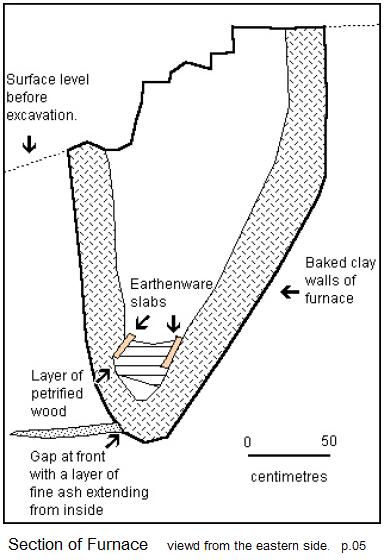
The Zi-o furnace appears to be part of an extensive complex that was extracting
iron from natural sources. Many of the charcoal pieces were neatly cut,
suggesting that the charcoal had been prepared beforehand as fuel. The
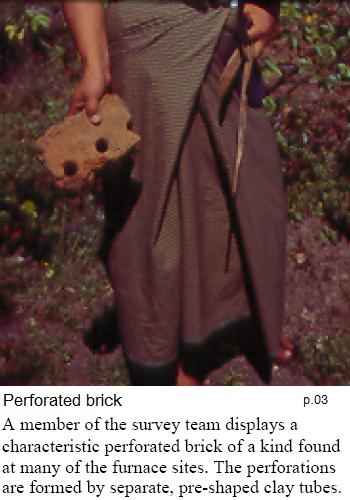
earthenware slabs found in the bottom of the furnace and the perforated clay
slabs, with pre-manufactured clay tubes forming the perforations, are further
indications of well-organised technology.
The actual functioning of the furnace is not yet clear, nor is its age. Several
more excavations, and radiocarbon dating of the charcoal found, would help place
this site chronologically in relation to Bagan and technologically in relation
to the broader region.
Contents of this page
fn01. Pe Maung Tin and G. H. Luce. 1923. (trans)
The Glass Palace Chronicle of the Kings of Burma. Rangoon University Press.
(Reprinted 1960). fn01b
fn02. Hudson, Bob; Nyein Lwin and Win Maung (Tanpawady).
2002 (In press.) Digging for myths: archaeological excavations and surveys among
the legendary nineteen founding villages of Pagan. The Silver Gong is Struck:
New Research in the Art and Archaeology of Burma. British Museum, London.
fn02b
fn03. For background on the Pyu, see Stargardt,
Janice. 1990 The Ancient Pyu of Burma: early Pyu cities in a man-made
landscape. PACSEA Cambridge; Aung Myint, U. 1998 Site Characteristics of Pyu
and Pagan ruins. A Comparative Study of the Dry Areas in Southeast Asia:
International Seminar, Kyoto, Japan, October 14-16 (Conference paper). Gutman,
Pamela and Hudson, Bob. 2002 (in press). The Archaeology of Burma, from the
Neolithic to Pagan. In The Archaeology of Southeast Asia (eds Bellwood &
Glover), Curzon, London. fn03b
fn04. Hudson, Bob; Nyein Lwin and Win Maung (Tanpawady).
2001 The Origins of Bagan; New Dates and Old Inhabitants. Asian Perspectives
40(1): 48-74. fn04b
Contents of this page
Contents of this page
End of TIL file