Update:
2008-09-21 12:48 PM +0800
TIL
The founding villages and early palaces of Bagan
- an exploration of some chronicle and parabaik sources
via computer mapping, field survey and archaeological excavation.
found-Pagan.htm
by Bob Hudson, Archaeology Department, University of Sydney, Sydney 2006, Australia, “Texts
and Contexts” Conference, Yangon, 2001 December.
http://acl.arts.usyd.edu.au/~hudson/villages_parabaik.pdf 080918
Downloaded and edited by U Kyaw Tun, M.S. (I.P.S.T., U.S.A.).
Not for sale. Prepared for students of TIL Computing and Language Center,
Yangon, MYANMAR.
indx-myan | Top
indx-folk
Contents of this page
Introduction
The nineteen villages
The dimensions of Bagan
A Brief History of Bagan
Discussion and future prospects
Acknowledgments
Footnotes
UKT notes
• Sokkaté
• NyaungU Sawrahan aka Taungthugyi-min
• Prince Pataikkara
• Royal line of Yonlwutkywun
Contents of this page
Bagan
 {pu.gän} is an urban centre in upper Myanmar. It reached its peak in terms of
the construction of religious monuments and political dominance over the upper
Ayeyarwady valley region between the 11th and 13th centuries AD.
The origin of the city, or at least the origin of settlement
in the general area that later became Bagan, is traditionally attributed
to a confederation of nineteen villages dated to 107 AD
(fn01).
The first part of this paper summarises some recently collected data,
ranging from chronicle descriptions and oral history to archaeological survey
and excavation, which has pinpointed many of the claimants for founding village status
(fn02). It must be stressed that
these are contenders whose claims remain to be tested by further historical and
archaeological study.
{pu.gän} is an urban centre in upper Myanmar. It reached its peak in terms of
the construction of religious monuments and political dominance over the upper
Ayeyarwady valley region between the 11th and 13th centuries AD.
The origin of the city, or at least the origin of settlement
in the general area that later became Bagan, is traditionally attributed
to a confederation of nineteen villages dated to 107 AD
(fn01).
The first part of this paper summarises some recently collected data,
ranging from chronicle descriptions and oral history to archaeological survey
and excavation, which has pinpointed many of the claimants for founding village status
(fn02). It must be stressed that
these are contenders whose claims remain to be tested by further historical and
archaeological study.
The chronicles agree that the earliest civilisation in Myanmar
was that of the Pyu. Four chronicles compiled between 1672 and 1829 AD
mention the founding of Sri Ksetra, also called Thayekittaya,
and all have it precede Bagan
(fn03).
The four largest Pyu settlements, Beikthano, Halin, Mongmao and Sri Ksetra,
which all enclose areas of 600 hectares or more within brick walls,
have been the subject of extensive archaeological investigation.
Beikthano appears to be the earliest, according to the available
radiocarbon dates, possibly operating between the 2nd century BC
and 7th century AD. Radiocarbon dates have indicated activity
at Halin between the 1st and 8th centuries AD. Mongmao,
at the south end of the Kyaukse valley, has been assigned
on stylistic grounds to the 2nd to 6th centuries.
Sri Ksetra (Thayekittaya) is considered the latest, [{p01end}]
between the 4th and 10th centuries AD
(fn04).
The Pyu are also identified with Waddi
(fn05),
a smaller walled site west of Mongmao (Maingmaw), and a cluster of settlements
around Binnaka. The latter, located at E 96.15° N 20.5666° in the Samon River
valley,
 appears
to have been continuously occupied from the Pyu to Konbaung periods
(fn06).
appears
to have been continuously occupied from the Pyu to Konbaung periods
(fn06).
The story of Bagan was summarised in 1829 in the Hmannan Yazawin,
later translated as the Glass Palace Chronicle
(fn07).
The Glass Palace Chronicle says that the Pyu founded Yon Hlut Kyun,
a name with folkloric origins, about fourteen kilometres from Bagan
on the eastern side of Mount Tuyin, in the second century AD
(fn08).
The local story is that Pyu soldiers fleeing from a war saw a hunter
and his dogs chasing a rabbit. The rabbit turned on its pursuers
and drove them away, and this was taken as an omen that
such a place would be a site worth defending against enemies.
Despite such obstacles as a malicious flying squirrel and other
aggressive faunal and floral totems King Thamoddarit
then “began to build a city with the dwellers in nineteen villages”
(fn09).
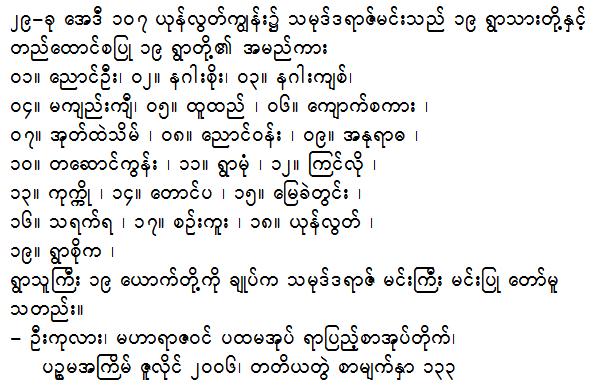
The Glass Palace Chronicle lists the members of this confederation as
01. Nyaung-U, 02. Nagabo, 03. Nagakyit,
04. Magyigyi, 05. Tuti, 06. Kyaussaga,
07. Kokkethein, 08. Nyaungwun, 09. Anurada,
10. Tazaunggun, 11. Ywamon, 12. Kyinlo,
13. Kokko, 14. Taungba, 15. Myegedwin,
16. Tharekya, 17. Onmya (with a quibble as to whether this should actually be Singu),
18. Yonhlut and 19. Ywasaik
(fn10).
UKT: Insert is from U Kala Maha Yazawun, vol. 1 (?), Part 3, p133,
5th printing 2006 July. The numbering of villages is mine. I have also
numbered the villages given in this paper. Readers of Burmese-Myanmar would
notice that though the names given by U Kala and Bob Hudson tallied to a
large extent, there are spellings differences between the two lists.
In another version of U Kala Maha Yazawun, we find some
slight differences in spelling. Click on the insert to see the comparison.
Collection of data on the sites mentioned in the list of nineteen villages
has ranged from a re-examination of English and Myanmar documentary sources and
inch-to-the-mile [{p02end}] survey maps to interviews with local residents,
including the abbots of monasteries, who are often custodians of local history.
The locations of places that may not easily be found again, such as abandoned
habitation sites, were pinpointed with a Global Positioning System (GPS)
receiver. All site locations are reported in this paper in decimal degrees,
which is the standard form of longitude and latitude used in computer mapping
(fn11).
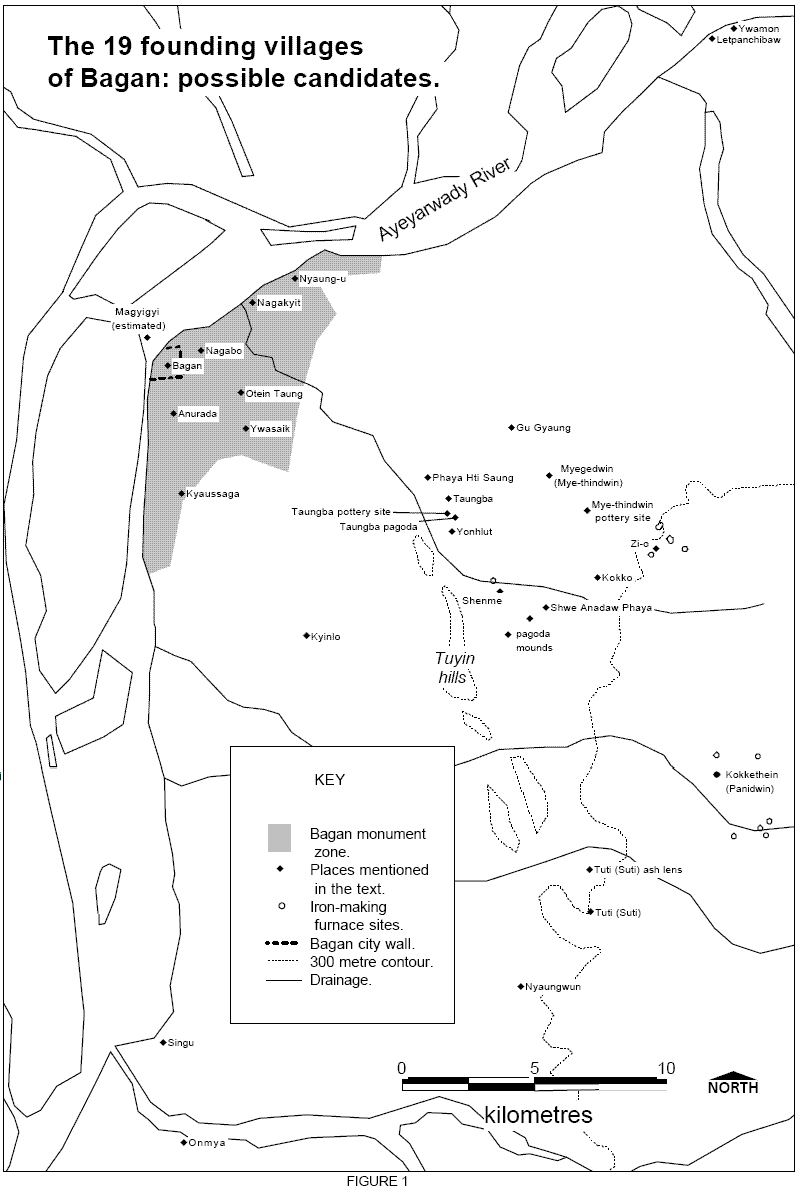
The sites are listed in the order of their distance from the walled medieval
elite centre now known as “Old Bagan” (Figure 1).
Contents of this page
UKT: I have inserted the the Burmese-Myanmar names (the closest to those
of Bob Hudson) given by U Kala without implying that the names given by
U Kala are to be preferred. [Map at size 125 print-screened.]
Nagabo
 {na.ga:so:} (E 94.8757° N 21.1767°) is now a palimpsest of Bagan era
and later buildings, located to the east and southeast of modern Taungbi village.
{na.ga:so:} (E 94.8757° N 21.1767°) is now a palimpsest of Bagan era
and later buildings, located to the east and southeast of modern Taungbi village.
Nagakyit
 {na.ga:kyic} (E 94.8946° N 21.1929°)was located between the Wetkyi-in stream
and the Shwezigon Pagoda, according to an inscription in the Shwezigon
that mentions a village called Naga Kyitmaw.
{na.ga:kyic} (E 94.8946° N 21.1929°)was located between the Wetkyi-in stream
and the Shwezigon Pagoda, according to an inscription in the Shwezigon
that mentions a village called Naga Kyitmaw.
Anurada
 {a.nu.ra-Da.} (E 94.8654° N 21.1552°)is today called Myinkaba
 {mring:ka.pa}, and is the only Pali name found among the nineteen villages.
UKT: Anawrahta killed his foster brother
Sokkate
 {soak~ka.té:} the natural son of
NyaungU-Sawrahan or Taungthugyi-Min. Sokkaté's mother, the elder sister
of Anawrahta's mother, gave birth to him only after she became queen of
Anawratha's father, and thus Sokkaté became Anawrahta's foster brother.
Sokkaté seized the throne from Anawrahta's father, and then took his aunt
(Anawrahta's mother) as his queen. This angered Anawrahta
who rebelled against Sokkaté, and killed him a dual on
the bank of the Myinkaba creek, and ascended the throne.
I wonder if the name of the village Anurada (Pali for Anawrahta)
and Myinkaba became connected because of this dual.
{soak~ka.té:} the natural son of
NyaungU-Sawrahan or Taungthugyi-Min. Sokkaté's mother, the elder sister
of Anawrahta's mother, gave birth to him only after she became queen of
Anawratha's father, and thus Sokkaté became Anawrahta's foster brother.
Sokkaté seized the throne from Anawrahta's father, and then took his aunt
(Anawrahta's mother) as his queen. This angered Anawrahta
who rebelled against Sokkaté, and killed him a dual on
the bank of the Myinkaba creek, and ascended the throne.
I wonder if the name of the village Anurada (Pali for Anawrahta)
and Myinkaba became connected because of this dual.
Ywasaik
 {rwa-so-ka.} (E 94.8918° N 21.15°)is estimated to have been near
the modern villages of east and west Phwasaw. The “third palace”,
said to have been founded by King Thiketine-min in 514 AD,
is believed to have been located here on the perimeter of the Bagan archaeological
zone. The palace site, south of West Phwasaw village, is today marked by
an inscribed brick and concrete pillar, as are Bagan’s other supposed palaces.
{rwa-so-ka.} (E 94.8918° N 21.15°)is estimated to have been near
the modern villages of east and west Phwasaw. The “third palace”,
said to have been founded by King Thiketine-min in 514 AD,
is believed to have been located here on the perimeter of the Bagan archaeological
zone. The palace site, south of West Phwasaw village, is today marked by
an inscribed brick and concrete pillar, as are Bagan’s other supposed palaces.
Nyaung-U
 {Ñaung-U:} (E 94.9101° N 21.2011°), a modern market town and administrative centre,
retains its archaic name. Housing developments in the area make
new archaeological discoveries difficult, though open excavations
from construction work remain potential sources of information.
{Ñaung-U:} (E 94.9101° N 21.2011°), a modern market town and administrative centre,
retains its archaic name. Housing developments in the area make
new archaeological discoveries difficult, though open excavations
from construction work remain potential sources of information.
Kyaussaga
 {kyauk-sa.ka:} (E 94.8681° N 21.1277°),
east of the present day Thiripyitsaya village, is south of New Bagan and on the
southern bank of Ye-O-Zin stream. Thiripyitsaya is said to have been the second
capital, located near the Lokananda pagoda, a riverside structure that
prominently marks the southern extent of the city. It is credited to King
Thinlikyaung (344-377 AD) (fn12).
{kyauk-sa.ka:} (E 94.8681° N 21.1277°),
east of the present day Thiripyitsaya village, is south of New Bagan and on the
southern bank of Ye-O-Zin stream. Thiripyitsaya is said to have been the second
capital, located near the Lokananda pagoda, a riverside structure that
prominently marks the southern extent of the city. It is credited to King
Thinlikyaung (344-377 AD) (fn12).
Kyinlo
 {kring-lo} (E 94.9133° N 21.0792°) is a site in a cultivated field
east of Kinka on the Bagan-Chauk road, and north of Kyaukkan.
Potsherds, elephant-shaped pendants and [{p03end}]
spherical and barrel shaped green and orange beads
(fn13) have been discovered
in this village. Archaeological excavation at Kyinlo in 1906 recovered iron
implements, a stone image of the Buddha, stone receptacles supposed to be
reliquaries, and mutilated bronze figures of the Buddha and two disciples
(fn14). Field survey has revealed
two major scatters of pottery, suggesting abandoned habitation sites, near Kyinlo.
{kring-lo} (E 94.9133° N 21.0792°) is a site in a cultivated field
east of Kinka on the Bagan-Chauk road, and north of Kyaukkan.
Potsherds, elephant-shaped pendants and [{p03end}]
spherical and barrel shaped green and orange beads
(fn13) have been discovered
in this village. Archaeological excavation at Kyinlo in 1906 recovered iron
implements, a stone image of the Buddha, stone receptacles supposed to be
reliquaries, and mutilated bronze figures of the Buddha and two disciples
(fn14). Field survey has revealed
two major scatters of pottery, suggesting abandoned habitation sites, near Kyinlo.
Taungba
 {taung-pa.} (E 94.9656° N 21.1259°) is a village near the road between Nyaung-U
and Kyaukpadaung, within view of the Tooth Relic Pagoda on Tuyin Mountain.
It was relocated in modern times due to highway construction.
There are several sites of historic and archaeological significance.
The Phaya Hti Saung or Hti Ta Hsaung pagoda, located one kilometre
northwest of Taungba village, is reputed to enshrine bodily relics
of the medieval monk, Shin Arahan, who is credited with being mentor
to King Anawrahta
(fn15).
It was most recently restored in 1985, and is an active religious site,
with an attached monastery. On the southern side of Taungba village
is a small pagoda (E 94.9681° N 21.1193°) that was restored in 1907,
according to an ink inscription inside. There is evidence
to support local opinion that it was originally a medieval structure.
A circular stone slab, now used as a stepping stone at the entrance,
resembles the capstones found in old relic chambers, although it might
also be a traditional monastery entrance-stone.
Part of a stone capsule or container, possibly a reliquary
or a container for offerings, was found among brick debris nearby,
in a depression formed by a disused water tank. This site appears
on the 1945 British Army Survey map 84 K/16 as a monastery.
{taung-pa.} (E 94.9656° N 21.1259°) is a village near the road between Nyaung-U
and Kyaukpadaung, within view of the Tooth Relic Pagoda on Tuyin Mountain.
It was relocated in modern times due to highway construction.
There are several sites of historic and archaeological significance.
The Phaya Hti Saung or Hti Ta Hsaung pagoda, located one kilometre
northwest of Taungba village, is reputed to enshrine bodily relics
of the medieval monk, Shin Arahan, who is credited with being mentor
to King Anawrahta
(fn15).
It was most recently restored in 1985, and is an active religious site,
with an attached monastery. On the southern side of Taungba village
is a small pagoda (E 94.9681° N 21.1193°) that was restored in 1907,
according to an ink inscription inside. There is evidence
to support local opinion that it was originally a medieval structure.
A circular stone slab, now used as a stepping stone at the entrance,
resembles the capstones found in old relic chambers, although it might
also be a traditional monastery entrance-stone.
Part of a stone capsule or container, possibly a reliquary
or a container for offerings, was found among brick debris nearby,
in a depression formed by a disused water tank. This site appears
on the 1945 British Army Survey map 84 K/16 as a monastery.
An ash lens (E 94.9652° N 21.1209°) dense with potsherds was excavated
and sampled at Taungba for radiocarbon dating. The sample, OZE 765,
had a radiocarbon age of 530 ± 40 BP, giving a calendar date range
of 1300-1450 AD at 95.4% probability
(fn16).
About 300 metres west of the earthenware deposits there
is a mound, [{p04end}] apparently a pagoda ruin. There are
pieces of worked sandstone among the debris. It fits the description
of a mound “near Taungba village” excavated early last century
(fn17b).
Yonhlut
 {yoan-lwat} (E 94.9647° N 21.1133°), also known as Yon Hlut Kyun,
is a name that has been variously translated as Free Rabbit Island,
Free Animal Forest, A Jungle Where Rabbits Were Set Free, or
The Place of the Hare’s Release. [UKT: Here we find a problem
with the spelling of the name. Since, the rabbit by its own effort
had expelled its enemies, the word should be
{yoan-lwat} (E 94.9647° N 21.1133°), also known as Yon Hlut Kyun,
is a name that has been variously translated as Free Rabbit Island,
Free Animal Forest, A Jungle Where Rabbits Were Set Free, or
The Place of the Hare’s Release. [UKT: Here we find a problem
with the spelling of the name. Since, the rabbit by its own effort
had expelled its enemies, the word should be
 {lwat} without the {ha.hto:} sound -- not
 {lhwat}. My use of Romabama is to avoid this problem which arises
out of the English transcription.] The archaic word “kyun”
{lhwat}. My use of Romabama is to avoid this problem which arises
out of the English transcription.] The archaic word “kyun”
 {kywan:} is still used for “jungle” in this area, though it more generally means
“island”. To confuse matters, an island in the Ayeyarwady River opposite Bagan
is also called Yon Hlut Kyun {fn18}, although
its claim to historical status barely goes back 50 years. The current residents,
when interviewed, appeared to have forgotten the names of the villages that were
mapped there in 1945 (Burma One Inch Series, Map 84 K/16). Field survey in 1999
indicated that the location of the villages on the island, as well as the
island’s shape, has substantially changed since 1945 due to regular inundation.
{kywan:} is still used for “jungle” in this area, though it more generally means
“island”. To confuse matters, an island in the Ayeyarwady River opposite Bagan
is also called Yon Hlut Kyun {fn18}, although
its claim to historical status barely goes back 50 years. The current residents,
when interviewed, appeared to have forgotten the names of the villages that were
mapped there in 1945 (Burma One Inch Series, Map 84 K/16). Field survey in 1999
indicated that the location of the villages on the island, as well as the
island’s shape, has substantially changed since 1945 due to regular inundation.
 In 1905, the archaeologists at Bagan spent 200 rupees [UKT: a huge sum of
money in those days when an ounce of gold was selling for about 30 rupees. Price
of gold to be checked.] to erect masonry pillars marking all of the old palace
sites mentioned in the chronicles. This included a pillar at Yon Hlut Kyun
identifying it as the home of Bagan's first dynasty. The masonry pillars were
referred to only peripherally in a list of “expenses sanctioned and incurred”,
with no explanation as to why the particular sites were chosen
(fn19).
However a handwritten version of the New Pagan Chronicle by Saya Be
[UKT {hsa.ra Bé} or {hsa.ra hpé} - grandfather of Daw Khin Myo Chit?]
reputedly contains a drawing of brick foundations at Yon Hlut Kyun
(fn20), so the site may have been well known
locally at the time the monument was erected.
In 1905, the archaeologists at Bagan spent 200 rupees [UKT: a huge sum of
money in those days when an ounce of gold was selling for about 30 rupees. Price
of gold to be checked.] to erect masonry pillars marking all of the old palace
sites mentioned in the chronicles. This included a pillar at Yon Hlut Kyun
identifying it as the home of Bagan's first dynasty. The masonry pillars were
referred to only peripherally in a list of “expenses sanctioned and incurred”,
with no explanation as to why the particular sites were chosen
(fn19).
However a handwritten version of the New Pagan Chronicle by Saya Be
[UKT {hsa.ra Bé} or {hsa.ra hpé} - grandfather of Daw Khin Myo Chit?]
reputedly contains a drawing of brick foundations at Yon Hlut Kyun
(fn20), so the site may have been well known
locally at the time the monument was erected.
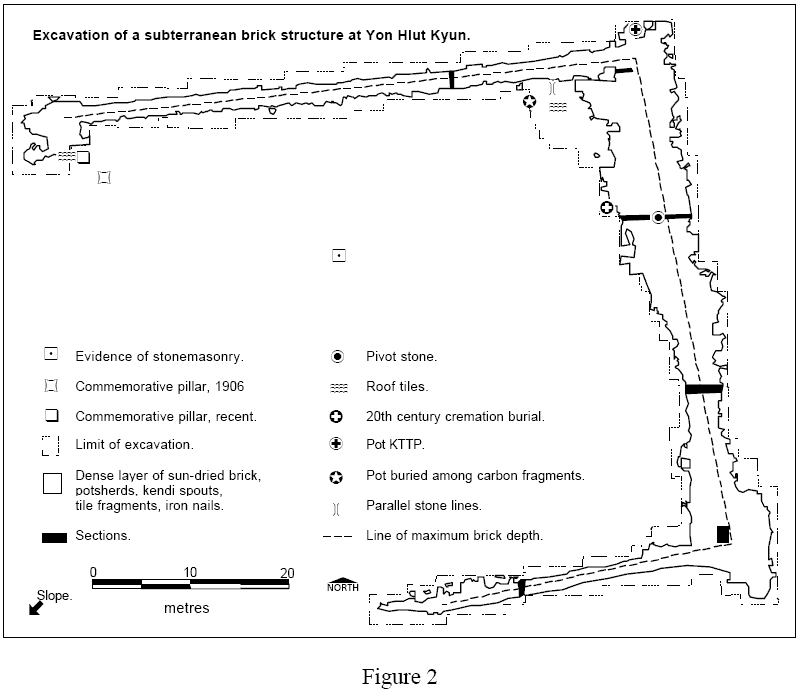
In 1999, the author and U Nyein Lwin, now director of excavation at Bagan,
investigated Yon Hlut Kyun at the suggestion of Assistant Director for Upper
Myanmar, U Aung Kyaing. There was no above-ground structure visible. However the
excavation program (fn21) resulted in the
discovery of a rectangular structure made of sun-dried brick with roof tiles,
iron nails, worked sandstone pieces, a pivot-stone from a doorway and
earthenware pottery fragments that included several near-intact pots, including
a 20th century burial (indicative of continuing use of the site for ritual
purposes) and kendi, or [{p05end}] sprinkler pots
(fn22)
(Figure 2). The structure is located on the eastern approach to Bagan from Mount
Popa, a well-known pilgrimage site, beyond which is the medieval rice growing
area and putative homeland of the Burmans, Kyaukse. When measurements of
bricks from a number of archaeological sites in Myanmar were subjected to
statistical comparison by multivariate analysis
(fn23)
the bricks at Yon Hlut Kyun corresponded closely with samples from Gu Gyaung,
a Pyu-style monument several kilometres to the north, and also with Bagan bricks
of the twelfth and thirteenth centuries. Deposits of roofing tiles were also found,
along with iron nails. The nails were characteristically square in the shaft,
and turned at the top. A pivot stone, with an indentation to take
a vertical wooden doorpost, similar to those seen in pagodas at Bagan,
was found while excavating a section along the eastern wall.
There was at least a centimetre of wear around the indentation in the pivot stone.
Carbon was found in relative abundance, but none was found in a context
that would justify radiocarbon dating. The dating, and for that matter
the function, of the building at Yon Hlut Kyun remains an open question.
Augering of the site down to natural soil at five metre intervals
failed to locate any central structure, which one might expect
if the wall had enclosed a temple or monastery complex.
Myegedwin
 {mré-hkè:twing:} (E 95.0024° N 21.1337°). The present village of Mye-thindwin is only
150 years old, but the area is claimed in local folklore to have been
the birthplace of Bagan’s first king, Thamoddarit. There is evidence
in local fields of earthenware pottery manufacture.
Numerous abandoned furnaces for smelting iron have been located
near the neighbouring village of Zi-o (E 95.0411° N 21.1087°, Map 84 O/4).
The unrestored Gu Gyaung pagoda complex (E 94.9888° N 21.1504°)
near Mye-thindwin features a stupa on the western side of a small temple.
There is also a brick foundation of a third structure, eight by ten metres.
The complex sits on a brick platform, twenty-six by twenty-two metres,
and there is evidence of an enclosure wall. Temple doorways
open to the east, north and south. The roof of the temple has collapsed
and the structure is filled with rubble, but the temple appears to have
had a vaulted chamber with no central pillars. A brick base
that presumably supported a Buddha image abuts the western wall,
indicating that the image faced east in the conventional manner.
A sandstone spire about a metre high, with seven multi-tiered umbrellas,
was found here and is now in the Bagan archaeological museum.
The relic chamber in the stupa, broken [{p06end}] open in times
beyond the memory of the local people, is lined with stone,
and has a capacity of more than one cubic metre.
{mré-hkè:twing:} (E 95.0024° N 21.1337°). The present village of Mye-thindwin is only
150 years old, but the area is claimed in local folklore to have been
the birthplace of Bagan’s first king, Thamoddarit. There is evidence
in local fields of earthenware pottery manufacture.
Numerous abandoned furnaces for smelting iron have been located
near the neighbouring village of Zi-o (E 95.0411° N 21.1087°, Map 84 O/4).
The unrestored Gu Gyaung pagoda complex (E 94.9888° N 21.1504°)
near Mye-thindwin features a stupa on the western side of a small temple.
There is also a brick foundation of a third structure, eight by ten metres.
The complex sits on a brick platform, twenty-six by twenty-two metres,
and there is evidence of an enclosure wall. Temple doorways
open to the east, north and south. The roof of the temple has collapsed
and the structure is filled with rubble, but the temple appears to have
had a vaulted chamber with no central pillars. A brick base
that presumably supported a Buddha image abuts the western wall,
indicating that the image faced east in the conventional manner.
A sandstone spire about a metre high, with seven multi-tiered umbrellas,
was found here and is now in the Bagan archaeological museum.
The relic chamber in the stupa, broken [{p06end}] open in times
beyond the memory of the local people, is lined with stone,
and has a capacity of more than one cubic metre.
Kokko
 {koak~ko} (E 95.0195° N 21.0989°) was abandoned, according to local records,
in 1878 and families transferred to neighbouring villages,
including Mye-thindwin. Locals believe that Myin-kwe-min,
said to have become king at Bagan in AD 716, was the son of
a wealthy man from Kokko. On an unexcavated mound of potsherds
up to two metres high, remains from the Bagan and Ava periods
have been recovered. In this general area near Shenme there
are two mounds (Map 84 K/16 E 94.9868° N 21.0795°), each about
twenty metres in diameter, containing bricks as well as pieces
of shaped and pecked sandstone. There are two other groups of apparently
early pagoda ruins southeast of Shenme. These include a pair of mounds about
eight metres in diameter (E94.9947° N 21.0848°), and a small monument known as
the Shwe Anadaw Phaya (E95.0006° N 21.0888°). Restored in 1973, the Shwe Anadaw
Phaya has a ruined pagoda mound beside it, containing dressed sandstone
reminiscent of the capping of a medieval relic chamber. The presence of sima
stones, which customarily mark the site of ordination halls, suggests that it
may have been the site of an earlier monastery.
{koak~ko} (E 95.0195° N 21.0989°) was abandoned, according to local records,
in 1878 and families transferred to neighbouring villages,
including Mye-thindwin. Locals believe that Myin-kwe-min,
said to have become king at Bagan in AD 716, was the son of
a wealthy man from Kokko. On an unexcavated mound of potsherds
up to two metres high, remains from the Bagan and Ava periods
have been recovered. In this general area near Shenme there
are two mounds (Map 84 K/16 E 94.9868° N 21.0795°), each about
twenty metres in diameter, containing bricks as well as pieces
of shaped and pecked sandstone. There are two other groups of apparently
early pagoda ruins southeast of Shenme. These include a pair of mounds about
eight metres in diameter (E94.9947° N 21.0848°), and a small monument known as
the Shwe Anadaw Phaya (E95.0006° N 21.0888°). Restored in 1973, the Shwe Anadaw
Phaya has a ruined pagoda mound beside it, containing dressed sandstone
reminiscent of the capping of a medieval relic chamber. The presence of sima
stones, which customarily mark the site of ordination halls, suggests that it
may have been the site of an earlier monastery.
Kokkethein
 {oat-htè:thaim} (E 95.06267 N 21.03181) is claimed by the people of Panidwin to
be the original name of their village. It is one of several villages in the
eastern hinterland of Bagan with a substantial presence of old furnaces for
extracting iron from natural iron nodules in the soil.
{oat-htè:thaim} (E 95.06267 N 21.03181) is claimed by the people of Panidwin to
be the original name of their village. It is one of several villages in the
eastern hinterland of Bagan with a substantial presence of old furnaces for
extracting iron from natural iron nodules in the soil.
Tuti
 {htu-htæÑ} (E 95.0163° N 20.9850°), modern Suti, has at least three fields
nearby which contain old potsherds. A hint of antiquity is contained in the name
of the village monastery, Than-bo or “iron smelting”. There are old iron
furnaces nearby, and local people report digging up bronze bowls with lids.
{htu-htæÑ} (E 95.0163° N 20.9850°), modern Suti, has at least three fields
nearby which contain old potsherds. A hint of antiquity is contained in the name
of the village monastery, Than-bo or “iron smelting”. There are old iron
furnaces nearby, and local people report digging up bronze bowls with lids.
Nyaungwun
 {Ñaung-wan:} (E 94.9905° N 20.9597°), the present Tetma village,
is near the southernmost tip of the Tuyin mountain range.
Its older name was Nyaung Bin or Banyan Tree
village, on account of big banyan trees that once surrounded it.
Around the village are old and ruined furnaces for smelting iron.
{Ñaung-wan:} (E 94.9905° N 20.9597°), the present Tetma village,
is near the southernmost tip of the Tuyin mountain range.
Its older name was Nyaung Bin or Banyan Tree
village, on account of big banyan trees that once surrounded it.
Around the village are old and ruined furnaces for smelting iron.
Ywamon
 {ywa-moän} (E 95.0707° N 21.2861°) is an abandoned settlement known today
as Shwetaung Ywahmine, near Letpanchibaw (E 95.0627° N 21.2828°).
Parts of a circular brick wall can be see here, somewhat eroded by the river.
In 1978 and 2001, excavations by the Archaeology Department
revealed evidence of Neolithic, Bronze and Iron (Pyu) Age activity.
Artifacts found included potsherds, domestic utensils, stone and bronze weapons,
beads, ear plugs and stone rings. The evidence suggests [{p07end}]
continuous occupation, or regular re-occupation,
from prehistoric times through to the Bagan and Konbaung periods.
{ywa-moän} (E 95.0707° N 21.2861°) is an abandoned settlement known today
as Shwetaung Ywahmine, near Letpanchibaw (E 95.0627° N 21.2828°).
Parts of a circular brick wall can be see here, somewhat eroded by the river.
In 1978 and 2001, excavations by the Archaeology Department
revealed evidence of Neolithic, Bronze and Iron (Pyu) Age activity.
Artifacts found included potsherds, domestic utensils, stone and bronze weapons,
beads, ear plugs and stone rings. The evidence suggests [{p07end}]
continuous occupation, or regular re-occupation,
from prehistoric times through to the Bagan and Konbaung periods.
There is disagreement in the Great Chronicle, the New Chronicle
(fn24) and the Glass Palace Chronicle
(fn25)
as to whether Onmya (E 94.8675° N 20.9065°), or Singu (E94.8675° N
20.9065°) should be in the canonical list of nineteen villages. Conveniently for
the purposes of regional settlement analysis, at least, both are in the same
geographical area in relation to Bagan.
There remain several claimant villages with dubious or unknown locations.
Magyigyi
 ,
according to local informants, is a name that appeared in a stone inscription
which had been removed from a pagoda near Old Bagan that was washed away by the
Ayeyarwady river. On the strength of this, Magyigyi has been assigned to a
hypothetical spot in the river, at E 94.8562° N 21.1808°. Tazaunggun
, according to the New Pagan Chronicle, was near Myingyan, a considerable
distance upriver from Bagan. Tazaung (E 95.3291° N 21.4426°) may
be the place the chronicle’s author had in mind, but field survey has found no
apparent link with antiquity. A village elder in Nyaung-do, which is on the
eastern side of Tuyin Taung, suggested during a visit to collect oral history
that Tazaunggun had been on the west side of the Ayeyarwady opposite Bagan.
Tharekya
,
according to local informants, is a name that appeared in a stone inscription
which had been removed from a pagoda near Old Bagan that was washed away by the
Ayeyarwady river. On the strength of this, Magyigyi has been assigned to a
hypothetical spot in the river, at E 94.8562° N 21.1808°. Tazaunggun
, according to the New Pagan Chronicle, was near Myingyan, a considerable
distance upriver from Bagan. Tazaung (E 95.3291° N 21.4426°) may
be the place the chronicle’s author had in mind, but field survey has found no
apparent link with antiquity. A village elder in Nyaung-do, which is on the
eastern side of Tuyin Taung, suggested during a visit to collect oral history
that Tazaunggun had been on the west side of the Ayeyarwady opposite Bagan.
Tharekya
 {tha.rak-ra.} were described as “not existing now” in the New Chronicle,
and no claimants have so far been found.
{tha.rak-ra.} were described as “not existing now” in the New Chronicle,
and no claimants have so far been found.
Several issues come to the fore in the light of this preliminary
investigation into whether the nineteen founding villages of Bagan are
mythological, historical, or something in between. The activity in Bagan’s
eastern hinterland is intriguing. Ritual buildings at Gu Gyaung, Taungba and
Shenme appear to date from some part of the Bagan monument construction period,
and further investigation might find them a more clearly defined place in the
timescale. The geographical location of this cluster of villages would also fit
Stargardt’s model of first millennium settlements locating themselves along
secondary streams, rather than major rivers, to enable more efficient
control of water resources
(fn26). A recent discovery is
the presence of an estimated 1,000 iron-making furnaces in the eastern region,
notably near the villages of Zi-o and Panidwin. These are as yet undated, but
they suggest substantial economic activity at some time in the past. The
structure [{p08end}] found at Yon Hlut Kyun remains a puzzle. The mytho-historical
view is that it should be the palace of King Thamoddarit, as described in the
Glass Palace Chronicle, although it does not immediately appear to be related in
terms of its layout to palaces of the historical era, or for that matter to
other buildings of the Bagan period.
Contents of this page
In the second part of this paper, I would like to present and briefly comment
on a parabaik, or traditional folding book (fn27),
which contains a description of Bagan that includes a record of its dimensions.
The translation (fn28) is based on two copies
of the same document, apparently dating back to at least 1790 AD. A version
owned by the late scholar, U Maung Maung Tin, which contained the first few
pages, including the measurements of the city, was brought to my attention in
1999. A complete version was later located in the library of the Archaeology
Department at Bagan. Metric measurements, dates in years AD, and some brief
explanations in parentheses have been added in an attempt to enhance and clarify
the meaning of the original. Gaps have been left where words or sentences in the
document could not be clearly deciphered. Complex and difficult to follow
listings of the genealogies of men and buildings are dealt with here by leaving
the translation as literal as possible. It is hoped that English speaking
scholars will find this document a useful resource. [{p09end}]
Contents of this page
[UKT: The following "A Brief History of Bagan" was given as <blockquote>
in Bob Hudson's pdf paper. Since some of the paragraphs given in the pdf are found
to be unnecessarily long which made reading difficult, I have split them up. The
places at which I have split the paragraphs is marked as: "UKT¶".]
 The capsule summary regarding the glorious golden city of Bagan which is
graceful, significant and auspicious as well as a symbol of good fortune,
has been compiled and presented, Venerable Sir.
The capsule summary regarding the glorious golden city of Bagan which is
graceful, significant and auspicious as well as a symbol of good fortune,
has been compiled and presented, Venerable Sir.
Guatama Buddha, The Most Enlightened One, who had attained four different
kinds of incomprehensibility, six different sorts of power and prowess, four
different states of endlessness and infinity, eightfold holy (or) noble
path, the ten powers, the ten enlightenment factors, the six different kinds
of hues of the rays, who was also the Incomparable Lord of the human beings,
terrestrial and celestial beings and the Brahmas (or) Gods, paid a visit to
Tantkyi golden hill-range, across the Ayeyarwady River, on the right and
western side of the river, accompanied by his 500 Buddhist disciples (or)
Buddhist holy saints, and set foot on top of the hill. Gautama, The Most
Awakened and Exalted One, made a prophecy (or) boon as regards the bright
prospects of the future for the holy city of Bagan
(fn29).
According to the Myanmar traditional typical abbreviation pronounced as
kyar-oh-ann, Bagan, formerly known as Arimaddhana-Paukkan, holy city of
Paukkan, royal capital endowed with conquest over the five reigning fierce
animals and fast-growing gourd (or) squash climbing plants, was established
by King Pyinbya on the sixth waxing moon (day) of Pyartho, tenth month of
Myanmar traditional lunar calendar, corresponding with January of Gregorian
calendar, in the year 211 Myanmar Chronological Era (849 AD) on Thursday
approximately at 3 am, that is to say, past two strikes (or) chimes, 7
phawars and 1 philar, according to the Myanmar ancient unit of telling the
time. The city’s circumference in Myanmar measurement units was 1142 tar
which is equal to 23,982 feet
(fn30)
as regards the length and width of the town, with [{p10end}] pyitsin,
tuyindaing, pyahoh, pavilion, the Myanmar traditional typical
parts of a city, with three-moated canals and the passage-ways for the royal
forces in time of danger and strife. (The city was founded) following
discussions and consultations with four wise monks and the well educated
ministers. The surface of the golden, glorious royal city of Bagan was like
that of the royal drum made of cow hide. A grand gala, graceful, magnificent
ceremony was celebrated in a majestic, grand scale, successfully with good,
rich, and rewarding omens of value, treasure, and precious gems.
 The four wise monks were Ta-ma-lein-dah Thera, Ananda Thera, Uttara-ziwa Thera
and Sabada Thera . The four wise ministers were Prince Seint, Hoora-phyu (a
court-astrologer wearing white clothing), Hoora-nyo (a court-astrologer
wearing brown clothing) and Yarzathingyan, who was a native of the village
of Inbyin, a name which was later changed to Linnbin village. The golden
glorious ancient city of Bagan was laid out with 1142 Myanmar ancient linear
measurement of tar which equals 23,982 feet (in circumference). There were
12 doorways. The Tharawut gate was two tar (7.33 metres) deep and one
tar (3.67 metres) wide (fn31). It was
guarded and protected by the Betthadin nat (spirit). The Thatpa-yan-gar gate
(fn32) was well guarded by two nats, Master
Handsome, the Black-smith
The four wise monks were Ta-ma-lein-dah Thera, Ananda Thera, Uttara-ziwa Thera
and Sabada Thera . The four wise ministers were Prince Seint, Hoora-phyu (a
court-astrologer wearing white clothing), Hoora-nyo (a court-astrologer
wearing brown clothing) and Yarzathingyan, who was a native of the village
of Inbyin, a name which was later changed to Linnbin village. The golden
glorious ancient city of Bagan was laid out with 1142 Myanmar ancient linear
measurement of tar which equals 23,982 feet (in circumference). There were
12 doorways. The Tharawut gate was two tar (7.33 metres) deep and one
tar (3.67 metres) wide (fn31). It was
guarded and protected by the Betthadin nat (spirit). The Thatpa-yan-gar gate
(fn32) was well guarded by two nats, Master
Handsome, the Black-smith
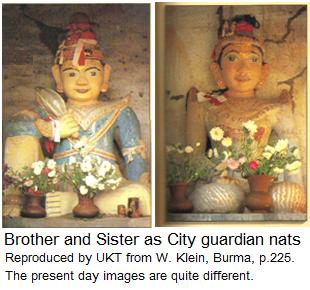
 {pan:pè: maung-ting.tèý}, and his beloved younger sister, the Golden Face
 {rhwé-myak-nha} [UKT: see insert "Brother and Sister as City guardian nats.].
The Thara-pay gateway was protected by the Shwepathin nat. There were 253
tar (927 metres) from the north-east corner through to the south-east
corner, and 149 tar (546 metres) from the Thatpa-yan-gar gate-way up to the
royal palace site and this portion (or) face was taken care of by Prince
Yaegathu, Pyi-soe-zeiya-pinn, Tsa-chi-nanda-thu and Tsoe-kae-theinkha-yarzar,
and these four persons were given assignments. The eastern face of the royal
city site was 50 tar (183 metres). The eastern face Phaya Thartann doorway
was guarded by the Zabu-tanhsaung nat.
{rhwé-myak-nha} [UKT: see insert "Brother and Sister as City guardian nats.].
The Thara-pay gateway was protected by the Shwepathin nat. There were 253
tar (927 metres) from the north-east corner through to the south-east
corner, and 149 tar (546 metres) from the Thatpa-yan-gar gate-way up to the
royal palace site and this portion (or) face was taken care of by Prince
Yaegathu, Pyi-soe-zeiya-pinn, Tsa-chi-nanda-thu and Tsoe-kae-theinkha-yarzar,
and these four persons were given assignments. The eastern face of the royal
city site was 50 tar (183 metres). The eastern face Phaya Thartann doorway
was guarded by the Zabu-tanhsaung nat.
The Nga-myee-khatt gate was protected by the Kara-wei nat. The Nyaung-byu
gate was guarded by the Zambu-thabyay nat’. From the northwest corner to the
northeast corner was 318 tar (1166 metres). It [{p11end}]
was 101.5 tar (372 metres) from the Nga-myee-khatt gate to the royal city site and this part
(or) face was assigned to four persons, namely Prince Si-thu, Tharay-nanthu,
Tsa-chi-napataw-thiha-pakyan, and Tsoekae-theinkha-pyitsie. The northern
face of the royal palace site was 20 tar (73.4 metres). The northern
face Tharzi gateway was guarded by the Zambu-tamut nat. The Wi-rula nat
guarded the Mingala-dazeik gateway. The Myin-byu-shin
 {mring:hpru-rhing} nat took care of the Ma-kyithar gateway.
From the southwest to the northwest was 253 tar (927 metres) and
149 tar (546 metres) from the Mingalar-dazeik gateway to royal palace
site. This face (or) side was given to 4 caretakers, namely Prince Pyan-chi,
Pyi-zoe-nayin-sinnthu, Tsachi-maha-thamann and Tsoe-kae-manawyarzar. The
western face of royal palace site was 50 tar (183 metres) and the
western face phaya and Win-manar doorway was guarded by the Nga-nwae-thin
nat.
The Ma-taunt-tah doorway was protected by the Wi-nila nat, and the
Nga-zwae-thin nat guarded Kula-lei-nu gateway. From the southeast to the
southwest was 318 tar (1166 metres) and it was 101.5 tar (372
metres from the southern city wall to the southern wall of the palace
enclosure). This part had four caretakers, namely Prince Htauk-shoo-kar,
Pyi-soe-minnyin, Tsachi-narga-wuttana and Tsoe-kae-mah thein-zee. It was 20
tar wide at the southern face of the royal palace site and the
southern side phaya.
After King Pyin-bya had unified these twelve places of the city of
Paukkan, called as Ari-maddhana, conquest over huge, fierce, reigning
animals including fast-growing gourd, (or) squash climbing plants to become
one seat in the year of 211 Myanmar Chronological Era (849 AD), the 14th
monarch of the Bagan Dynasty, King Popa-tsaw-rahan-gyi lessened the
Chronological Era according to the ancient traditional numerological belief,
known as kha-hsah-pyinsah.
In the Myanmar Chronological Era of 53, at the time of King Narapatisithu
(fn33), in the aforesaid four sides of the
city, the edge of the eastern Nyaung-mya-ywa-gyi was identified as being at
the level of a town, and presented to Prince Yae-ga-thu. The edge of
Taung-ba-luywa-gyi was graded as a town and offered to Prince Tse-thu and it
was in the southern side. On the northern side, the edge of Chauk-taung was
rated as a town and given to Prince Pyan-chi. To the northeastern side,
[{p12end}] the edge of Let-htoke was classified as a big village and
presented to Prince Htawk-shoo-gar.
King Narapatisithu brought the Shin-byu and Shin-jla Phaya (images of the
Lord Buddha) although in some chronologies it was King Alaungsithu who
carried the Phaya. On the way back to the golden glorious city of Bagan, at
the port city of Man-aung, the ruler was under the influence of conceit not
to pay obeisance to the powerful king of Paukkan and he held the pot around
his neck and it was filled with water and he descended to the river water
and committed suicide. Afterwards, the King of Paukkan struck the water with
his powerful wand from the front of the Karaweik barge, and the corpse of
the ruler of Man-aung floated to the surface (fn34).
Two beloved daughters of King Man-aung were presented to the Paukkan King
[to be his concubines wives not necessarily "queens"] and the King made a fantastic return riverine journey, upstream. These two
cherished daughters of King Manaung were promoted to medium-ranked ones and
they were presented with a line of nine villages in the upper part to the
elder sister and a lower line of nine villages to the younger sister. UKT
Up
until now, the descendants of King Man-aung, who came from ancestors known
as Malla, and the chieftains, are still existing. Nga-kyaw-tarn was offered
to Tsit-chi-yoe Nanda-thu-ta-yoe. Up till now, there exists a line of
tradition well kept generation after generation. The southern side was
presented to Tsit-chiyoe Nara-patei-thiha-pakyan. The good traditional line
still exists. Mahatha-man was added with Man-minn-thar-lei-yoe who was well
looked after and supported separately by townspeople as well as village
folk. Therefore Maha-tha-man was known as Minn-thar-paung, which implies
“prince who was added in unison with another prince” and there still
survives regarding this line of generation. The five exterior localities
which surround the city are named Tsi-gu, Ywa-tha, Taung-zinn, Taywin-daing
and Nga-tha-yauk. UKT
[UKT: According to my family tradition, {tu:rwing:teing}
and  {nga.tha.yauk} were my paternal ancestral villages. My paternal great
grandfather U Yan Shin, son of either Hpo Mintha or Hpo Tagaung (my father
could not recall which) was from those two villages. However, according to
another account, our ancestral village was {pan:pè:}. U Yan Shin being from
the lines of chieftains was buried with ceremony such as gold leaf applied
to his forehead, and his hearse covered by four golden umbrellas. Such
custom, according to Hanthawaddy U Ba Yin, a well known local historian,
told me that my ancestor U Yan Shin had belonged to the line of
chieftains.]
{nga.tha.yauk} were my paternal ancestral villages. My paternal great
grandfather U Yan Shin, son of either Hpo Mintha or Hpo Tagaung (my father
could not recall which) was from those two villages. However, according to
another account, our ancestral village was {pan:pè:}. U Yan Shin being from
the lines of chieftains was buried with ceremony such as gold leaf applied
to his forehead, and his hearse covered by four golden umbrellas. Such
custom, according to Hanthawaddy U Ba Yin, a well known local historian,
told me that my ancestor U Yan Shin had belonged to the line of
chieftains.]
These are
existing up to the present, generation after generation. The religious
edifice linked to four princes Yae-ga-thu, Tsi-thu, Pya-chi and
Htauk-shu-gar is Pyi-soe, which signifies chieftain of a city and they built
the Pyi-soe pagoda and the names of these four chieftains are Zei-ya-pin,
Na-rin-thinn-htu, Tha-raynan-thu, and Taung-minn-yi, the sacrosanct monument
erected by four Tsit-chis who were solider heroes, namely, Nan-da-thu,
Na-ra-pa-teithiha-pa-kyan, Ma-ha-tha-man, and Na-ga-wut-ta-na, the sacred
pagoda concerned with four authorities, namely Thin-kha-ra-za, Thin-kha-pyittsee,
Ma-nao-ra-za, Ma-nao-thein-zee, Tsit-pin, Tsi-bin, Hton-tha-myar, [p13end]
Na-ti-ra-za at Tsit-pin, Pauk-kha-ra-ni-ra-za at Tsi-bin, U-da-ka-ra-za at
Hton, Nan-da-wa-ra-za at Tha-myar and these four pagodas relating to the
demarcation of the Ayeyarwady River, Ah-yway-ma-ti at Aung-tha, Khint-ga,
Htan-po, Nga-kyaw-ga-doh at Aung, Hmon-bo-ga-doh at Ahyway-ma-ti, La-bin-ga-doh
at Khint-ga, Taung-pon-ga-doh at Htan-po, Nga-thet-bin, Nga-thet-ya,
Nga-kaung-mae, Nga-kaung-phyu and these four village head-men built their
respective pagodas, Hseit-ta-yoe, Ti-tayoe, Hmaw-kunn-tain-ta-yoe,
Khun-nit-kyo-myae-taing-tayoe, That-bahra-za pagoda at Hseit-ta-yoe,
Wa-neiz-za-ra-za pagoda at Ti-ta-yoe, Otta-na-ra-za pagoda at
Hmaw-kunn-tain-ta-yoe, Bon-mah-ra-za pagoda at Khun-nit-kyo-myae-taing, and
there exist 99 villages in total number, apart from four localities at the
four edges and four parts in a row and five surrounding towns.
There is an ancient prophecy which reads the great, magnificent
Ayeyarwady River is making her flowing at the foot of the Si-khon-daw
Pagoda, which means the Great Pagoda situated at the sandy side of the
river. The Golden Stupa is held in great veneration, for sacred relics of
the Enlightened One were enshrined inside it, and also at the place where
the golden, glorious city of Pauk-kan is located, where a long line of
fifty five monarchs ruled over the city, the seat of the dynasty, and golden
glorious royal capital which has inhabitants living in 99 villages in total
number. The prophecy says that the monarch will rigidly follow the rules
that a king of justice should possess on account of the flowing of the
Ayeyarwady River close to the Golden Pagoda Shwe-tsee-gon. There will be a
white acacia tree growing on the northern side of the Great Pagoda. There
surely will appear a king of justice like Maho-sa-dha, who was a previous
existence of Gautama Buddha noted for great wisdom, at the time when the
tree will be grown to the size at which the mighty elephant known as
Ga-za-gi-ri can catch hold of it with its strong trunk. That ruler of
justice will appear at the place located to the eastern cardinal direction
of that tree and that very king will rule over the golden, glorious city of
Pauk-kan and people from all walks of life will be prosperous and the people
of Pauk-kan surely will have peace and development, and paddy rice and other
staple food will be plentiful. It will be in (…) of the Myanmar
Chronological Era that the Great King will be chosen as king among men and
the royal throne will be ascended by him, according to the authentic
chronologies, ancient legendary accounts and as far as I know, as much as I
can, to the best of my ability making logical conclusion by judging from the
most reliable sources and I have made my presentation under the golden feet
of the royal monarch. May [{p14end}] the genuine, real, authentic
dispensation, teachings of the Most Enlightened One last and prevail for
always.
In the year after 236 years after entering Nirvana of Gautama Buddha, a
group of Buddhist missionary monks headed by Venerable Ot-ta-ra-thera
introduced and established the purest form of the Buddha’s Teachings by way
of the elder Buddhist monks at the golden glorious city of Thaton known as
Thu-dhamma-na-ga-ra in the region of Ra-myin-nyah, Thuwun-na-bhum-mi. Also
at the same year of 236 years after the final passing away of Gautama
Buddha, in the island of Ceylon a group of five Buddhist arahats, holy
saints, led by the Venerable Ma-hein-dah introduced and established the
Teachings of Buddha for purification, perpetuation, and propagation of
Buddha’s dispensation. Over fifty years after Gautama Buddha’s
maha-peri-nirvana, in the royal glorious city of Tha-yay-khit-ta-ya, two
brothers, Su-la Tham-ba-wa and Ma-ha Thamba-wa unified and formed a city
state. Their son, known as Dut-ta-baung became king in the year of 121
Buddhist Dispensation Era (423 BC). He united and founded
Thi-ri-khit-ta-ra-ra-ma city in collaboration, in cooperation and
coordination with the holy hermit, Indra Lord of thunder, the naga (dragon
or serpent), and garuda (mythical bird) and he became the great king after
having a coronation ceremony. Starting from Sula-Tham-ba-wa and Ma-ha-Tham-ba-wa
and second consecutive reign, there was a king known as Thu-pyin-nya-na-ga-ra-hsein-na
in the year of 624 Myanmar Chronological Era. This became the year which was
appropriate to subtract from the Myanmar Chronological Era (fn35)
by the number of 622 and only the remaining number of 2 was reckoned. That
king expired in that very year. The number of the years which had been
subtracted was 622 and in the year of 2 (the remaining year after
subtraction) Myanmar Chronological Era, Tha-yay-khit-ta-ya city ceased to be
the royal capital. Afterwards, there became three different ethnic groups,
namely, Thet, Pa-deik-kha-ya [UKT: see my note on
Prince Pataikkara],
and Pyu. The Thet returned to the
city of Thet-minn-ka-ton. Members of the Pa-deik-kha-ya race went
back to their homeland (…) The prince who was known as Tha-mot-darit,
nephew of Thu-pyin-nya-ga-ra-hsein-na, the king, (…) became the
ruler of this region in the place which was called Yon-hlut-kyun. UKT
The
cluster of 19 Pyu villages were Yon-hlut-kyun, Nyaung-U, Na-gae-hso,
Na-ga-kyi, Ma-gyee, Anu-ra-hta, (…),Ywa-hsaik, Kyinn-pi, Kyauk-tok,
[{p15end}] Tse-ku, Nyaung-wun, Athet-yah, Ta-tauang-kyun, Kok-ko, Taung-ba,
Myei-gae-dwinn, Ya-da-thein and Sha-bok. These 19 villages were founded by
King Tha-mok-darit.
The royal line of Yon-hlut-kyun was Tha-mok-da-rit, Ya-thae-gyaung,
Pyu-saw-di
 {pyu-sau:hti:} [aka.
 {pyu-ming:hti:}, Hti-Minn-yin
 {hti:ming:yiñ}, Yin-minnpaik
 {yiñ-ming:peik}, Paik-thin-li
 {peik-thíñ-læÑ}, Thin-li-gyuang
 {thíñ-læÑ-kraung}. Out of
the 7 ruling kings, Pyu-saw-di in the year 121 Sakka Era (199 AD) (fn36) ascended
the throne and named the
royal city as Ari-madd-da-na, the city of conquest over five fierce
enemies. The 7th ruler of Bagan Dynasty Thin-li-gyaung
{thíñ-læÑ-kraung} transferred the
seat to Kyauk-za-gar village and called it Thi-ri-pyit-sa-ya. During his
reign, the rains of treasures poured down. The patron of the guardian
spirits Master Handsome and his younger sister were placed in Mount
Popa. They came from Thinn-dwae, Tagaung, in Upper Myanmar. His
son, known as Thin-li-poe, and the son of Thin-li-poe, called as Kyaungtu-rit, then Thi-htan, Tu-tha-ra-mon, and Thaik-taing ruled over the city
and they were six in number. During the reign of the sixth king, King
Thaik-taing, the royal site was shifted to Tanpa-di-pa, the third royal city
from Thi-ri-pyit-sa-ya. Originally it was known as Ywa-saik. A line of 21
kings ruled over the royal capital city from King Thaik-taing to King (…),
and the seat was in Tan-pa-wa-dy. At the time of the monk, teacher of
Thin-ga-ra-za’s wife (several lines undecipherable).
{thíñ-læÑ-kraung}. Out of
the 7 ruling kings, Pyu-saw-di in the year 121 Sakka Era (199 AD) (fn36) ascended
the throne and named the
royal city as Ari-madd-da-na, the city of conquest over five fierce
enemies. The 7th ruler of Bagan Dynasty Thin-li-gyaung
{thíñ-læÑ-kraung} transferred the
seat to Kyauk-za-gar village and called it Thi-ri-pyit-sa-ya. During his
reign, the rains of treasures poured down. The patron of the guardian
spirits Master Handsome and his younger sister were placed in Mount
Popa. They came from Thinn-dwae, Tagaung, in Upper Myanmar. His
son, known as Thin-li-poe, and the son of Thin-li-poe, called as Kyaungtu-rit, then Thi-htan, Tu-tha-ra-mon, and Thaik-taing ruled over the city
and they were six in number. During the reign of the sixth king, King
Thaik-taing, the royal site was shifted to Tanpa-di-pa, the third royal city
from Thi-ri-pyit-sa-ya. Originally it was known as Ywa-saik. A line of 21
kings ruled over the royal capital city from King Thaik-taing to King (…),
and the seat was in Tan-pa-wa-dy. At the time of the monk, teacher of
Thin-ga-ra-za’s wife (several lines undecipherable).
The calendar was corrected during the reign of King Thin-ga-ra-za, a
former monk. In the year of 211 Myanmar Chronological Era (849 AD),
representing the Myanmar term kya-oh-aing after relacing each word
with numbers, King Pyin-bya moved the royal site to Ma-gyee village
from Tan-pa-wa-dy and named the glorious royal capital Pu-ga-ra-ma.
Twenty-three kings from King Pyin-bya ruled over the city of Pu-ga-rama.
The eighth ruler from King Pyin-bya was King Anaw-ra-hta and in
the year of 419 Myanmar Chronological Era (1057 AD), in the month of
Ka-son, Ve-sak, this great king among men introduced and established
the purest form of Buddhism, known as Theravada Buddhism, the ways
of the elder Buddhist monks, which he brought from Thaton. He later
renamed the royal city Pon-na-ga-ma. He was also known as Anaw-rahta-minn-saw , and was regarded as the great able guardian king or lawka-nat
 {lau:ka.nat} in Myanmar language. He brought the whole canonical sacred
scriptures of Buddhist doctrine and the order of the Buddhist monks from
[{p16end}] the city of Thu-dhamma-na-ga-ra, that is to say, the holy
city where real, authentic, genuine Buddhism flourished, and the city was
popularly known as Thaton. The powerful founder-king Anaw-ra-hta introduced
and established Theravada Buddhism for purification, perpetuation, and
propagation of the realistic teachings of the Buddha in the golden glorious
city of Ari-madd-da-na. In the year of 163 Buddhist Dispensation Era,
corresponding with Myanmar Chronological Era of 419 (1057 AD), on the 10th
waxing moon of Da-boh-dwae, corresponding with February, on Thursday and
when the moon was shining along with Kyatt-bi-ka constellation, at the times
when the crab zodiac sign is at its lag, from the astrological point of
view, King Anaw-ra-hta built the great golden pagoda of Shwe-zi-gon after
enshrining the frontal bone, the left collarbone and a duplicated form of
the sacred tooth-replica of Gautama Buddha. The sacrosanct relics are
imperishable, kept in a gem-studded casket. Afterwards, the great king
Anaw-ra-hta erected pagodas on top of Tant-kyi-taung, Tuyin-taung,
Tha-lyaung and Pyet-kyei-taung (fn37). He
enshrined four duplicated forms of the sacred tooth of Gautama Buddha in the
stupas. The king also built the Shwe-hsan-daw pagoda (fn38),
housing the sacred hair relic of Gautama Buddha, to the southern side of the
royal holy city. King Anaw-ra-hta erected another pagoda, the Lokananda, on
the southern side of the royal capital, Thi-ri-pyit-sa-ya. Nineteen years
after the building of the Shwe-zi-gon pagoda, the great founder king
Anaw-ra-hta ascended to the upper realm of the celestial beings at the age
of 74.
{lau:ka.nat} in Myanmar language. He brought the whole canonical sacred
scriptures of Buddhist doctrine and the order of the Buddhist monks from
[{p16end}] the city of Thu-dhamma-na-ga-ra, that is to say, the holy
city where real, authentic, genuine Buddhism flourished, and the city was
popularly known as Thaton. The powerful founder-king Anaw-ra-hta introduced
and established Theravada Buddhism for purification, perpetuation, and
propagation of the realistic teachings of the Buddha in the golden glorious
city of Ari-madd-da-na. In the year of 163 Buddhist Dispensation Era,
corresponding with Myanmar Chronological Era of 419 (1057 AD), on the 10th
waxing moon of Da-boh-dwae, corresponding with February, on Thursday and
when the moon was shining along with Kyatt-bi-ka constellation, at the times
when the crab zodiac sign is at its lag, from the astrological point of
view, King Anaw-ra-hta built the great golden pagoda of Shwe-zi-gon after
enshrining the frontal bone, the left collarbone and a duplicated form of
the sacred tooth-replica of Gautama Buddha. The sacrosanct relics are
imperishable, kept in a gem-studded casket. Afterwards, the great king
Anaw-ra-hta erected pagodas on top of Tant-kyi-taung, Tuyin-taung,
Tha-lyaung and Pyet-kyei-taung (fn37). He
enshrined four duplicated forms of the sacred tooth of Gautama Buddha in the
stupas. The king also built the Shwe-hsan-daw pagoda (fn38),
housing the sacred hair relic of Gautama Buddha, to the southern side of the
royal holy city. King Anaw-ra-hta erected another pagoda, the Lokananda, on
the southern side of the royal capital, Thi-ri-pyit-sa-ya. Nineteen years
after the building of the Shwe-zi-gon pagoda, the great founder king
Anaw-ra-hta ascended to the upper realm of the celestial beings at the age
of 74.
The four holy Buddhist monks who came and visited the golden glorious
city of Bagan during the reign of King Anaw-ra-hta were Shin-ma-ha-kittsee,
who resided to the north of Lei-gaing-kyaung monastery, Shin-anurud-dha, who
lived to the eastern side of the Minn-ta-yar-shwe-kyaung monastery,
Shin-ma-ha-Buddha-go-hsa who resided to the north-western side of the Ma-myaw-ra-za
Temple and Shin-u-pa-li, who resided to the western side of the U-pali
Ordination Hall. The Myanmar term leigaing-kyaung which became the word lei-gaing
refers to the four venerated Buddhist monks. During the reign of King
Kyan-sit-tha, the Upa-li monastic centre was renamed Tha-man-ta-rit, and the
Pa-thein- [{p17end}] kyaung was built by the governor of Pa-thein (Bassein)
and named after him during Na-ra-pa-ti-zei-ya-thu-ra’s reign. UKT
After King Anaw-ra-hta had passed away his elder son, crown prince Saw-lu,
ascended the throne of Bagan. He was crowned in the year 440 Myanmar
Chronological Era (1078 AD). During his reign, the Mons under Ngaman-kan
revolted. After fighting against Nga-man-kan’s forces, King Saw-lu built a
pagoda at the top of the hill which is situated at the right side of
Pinn-chaung creek at the mouth of Aye-yar-wa-dy River. The pagoda was in the
shape of Kya-thut-oh, the part of the pagoda resembling the lotus petal,
with four entrances. The king enshrined a number of Buddha’s sacred relics,
and after completion of the pagoda, he paid reverence after he had hoisted
the sacred umbrella. He had a coronation ceremony and became king of Bagan
only after placing the sacred crowning part of the pagoda. After six years,
King Saw-lu was executed by Nga-man-kan. UKT
In the year of 446 Myanmar Chronological Era (1084 AD), Klan-pok-ta, also
known as Min-kyan-yit-thar, ascended the throne of Bagan. He spent most of
his time on serious domestic affairs for four years. In the fifth year, he
rebuilt the great pagoda known as Ze-ya-hkon (Shwe-zi-gon). In the year of
421 Myanmar Chronological Era (1059 AD) and thirty years after that, the
pagoda had been small. In the year of 451 (1089 AD), known in the Myanmar
language as Tha-rawun year, on the 13th waxing moon of Da-zaung-mon, the
eighth month of the Myanmar traditional lunar calendar, corresponding with
November, on Wednesday, he enlarged the Pagoda, which was built of blocks of
sandstone rather than bricks. In the year of 452 Myanmar Chronological Era
(1090 AD) which was Ba-ra-paik year, on the full-moon day of the 15th waxing
moon of Kason, the second Myanmar month, the King finished the building of
the Grand Shwe-zi-gon Pagoda. He erected four standing Buddha images facing
the cardinal directions. The images were made from an amalgam of five
different metals. He also constructed four pavilions, made from blocks of
sandstone and bricks, beautifully and well done. He also made an ordination
hall, a reclining Buddha statue, parts of four different kinds of zedi, and
different statues of Thi-kyar-minn, Indra, Lord of thunder and chief of the
celestial beings, and statues of other nat spirits. He erected the great
precinct, (or) enclosure wall, guarded by chinthe (figures of heraldic
lions). The interior great enclosure wall was made for the purpose of
offering oil-lamps by the Rakhine (Arakan) Buddhist monk. This monk was the
preceptor of King Minn-gyi-tswasaw-kae, who was the descendant of the royal
line of the Bagan Dynasty and the second ruler of Ra-ta-na-pura Inwa (Ava)
city. The golden [{p18end}] glorious city of Inwa (Ava) was
established and founded by this king, who was a very great, powerful, and
mighty ruler of prowess and who also was well-known as Tha-doe-minn-phya.
Thus, it was mentioned by the old well-learned and well-versed experts that
the interior enclosure wall was constructed for the purpose that oil-lamps
would be lighted. The year of 452 Myanmar Chronological Era was the same
year, expressed in a parabaik, or ancient traditional folded document, in
which the gold umbrella became the crowning part of the great Zei-yah-khon
Pagoda, and Kalan-pok-taw, also known as King Kyan-tsit-tha, built the
significant Ananda Temple. This great king of justice also erected the
Na-ga-yon Temple, Pae-ya-da-na Temple, Minn-oh-chann-tha Pagoda and other
religious edifices as a token of performing meritorious deeds. UKT
In the year of 473 Myanmar Chronological Era (1111 AD) the great
benevolent king of justice entered the age of 81. He was called Rin-nya
Kalan-pok-taw, also known as King Kyan-tsit-tha. He passed away, or as the
Myanmar language puts it, ascended to the upper realm of celestial beings.
After King Kyan-tsit-tha had entered the abode of the celestial beings, the
crown prince, who was the beloved grandson of King Kyantsit-tha as well as
the great-grand-son of King Naw-ya-hta (Anawratha) attained the royal
coronation ceremony and obtained the name of Na-rapa-ti-zei-ya-thu-ra,
popularly known as Alaung-si-thu, in the year of 473 Myanmar Chronological
Era.
After thirty years, in the year 573 (fn39)
Myanmar Chronological Era, in the year when the Mi-ga-thi constellation
tilted, on the 4th waxing day of Kahson, Ve-sak, the second Myanmar month,
corresponding with the Vesak constellation, on Saturday which coincided with
the Tha-ra-wun constellation, King Alaung-si-thu who attained the name of
Thi-ri-tri-bawa-na-ti-bi-ta-ya-pa-wa-ra-pan-di-ta-dhamma-ra-za and who
possessed great prowess, and who was well-known in the title of Na-ra-pa-ti-zeiya-thu-ra
and who was the greatly embraced grand-son of King Kyantsit-tha and also
great-grand-son of King Naw-ra-hta-saw, built the famed, sacrosanct edifice
of Shwe-gu in the golden, glorious city of Bagan. This holy temple was
amazing and finely-proportioned. It resembled the golden pagoda, with
magnificent Buddha image, which was dedicated to the great, venerable
Buddha’s right-hand disciple, noted for great wisdom, next to Gautama
Buddha, who was known as Ashintha-ri-put-ta-ra. Sacred relics from the body
of the holy Buddhist saint were enshrined inside this temple and a life-size
statue of the disciple was [{p19end}] also sculpted. After he had
performed the meritorious deed of building the Shwe-gu sacred temple, the
great, powerful king performed another work of merit by building the
imposing, impressive, captivating, and magnificent temple of That-byin-nyu,
which implies the All-knowing Wisdom of the Buddha, The Most Enlightened
One. The temple resembled the Pok-va-yon pagoda complex, which was
constructed in dedication to the venerated Buddhist disciple, who was the
left-hand saint of Gautama Buddha and was noted for his supernatural psychic
powers. A great donor, a lay woman, known as Wi-tha-kha, contributed a large
amount of money at a cost of ninety million, after having sold a precious
ornament known as Maan-li-ka. The mighty king enshrined the sacred relics
and replicas from the Holy One’s body and made the Buddha image, the size of
which was the same as that of The Buddha, The Omniscient One, in the
attitude of preaching His sermon to the celestial beings, as well as to the
lay human beings. In addition, the great king performed the meritorious deed
of erecting a huge bell, made from the purest bronze, weighing five thousand
viss, to the south-eastern side of the That-byin-nyu Temple. The throne name
of the great monarch, was
Thi-ri-tri-ba-wa-na-ti-bi-ta-ya-pa-wa-ra-pan-di-ta-dhamma-ra-za. He was also
called Na-ra-pa-ti-zei-ya-thu-ra-dhamma-ra-za, as well as King Alaung-si-thu.
After performing the meritorious work of building the holy temples of
Shwe-gu and That-byin-nyu and other religious edifices, the king entered the
upper realm of the nats, the celestial beings, at the age of 74 (in 1167
AD), 26 years after 503 Myanmar Era, the year in which the Shwe-gu Temple
was built.
There was a long line of 55 kings who ruled over the glorious city of
Bagan, which was known by five different names: Ari-madd-da-na,
Thiri-pyit-sa-ya, Tam-pa-wa-dy, Pon-na-ga-ma, and Pu-ga-ma. Out of these 55
rulers, the great king Na-ra-pa-ti-zei-ya-thu-ra, popularly known as King
Alaung-si-thu, had got two grand-sons, Minn-yin-na-ra-thein-ga and
Na-ra-pa-ti-si-thu. These were the sons of King Na-ra-thu. Na-ra-pa-tisi-thu
erected the Su-la-ma-ni temple, the Gaw-daw-pa-lin, the Dham-miya-ladd-da,
the Dham-ma-yan and a number of temples as well. His regnal name was
Thi-ri-tri-ba-wa-na-ti-ta-ya-pa-wa-ra-pan-di-tadhamma-ra-za. During the
reign of King Na-ra-pa-ti-si-thu, five venerated Buddhist monks arrived in
Bagan from Ceylon. These five missionaries were known as Hsa-ba-da Thera,
Ta-pa-nein-da Thera, Thiwa-li Thera, Ananda Thera and Rahula Thera, and they
performed their religious duties for the sake of the Dispensation of the
Buddha, The Most Enlightened One (several lines missing). [{p20end}]
The grandson of that king, known as Na-daung-mya, constructed famous
religious edifices such as Cei-da-na Zedi, Ma-ha-bodhi Zedi, Hti-lo-minnlo
Zedi and several other monuments. The famous king who built these three
prominent zedis was known as King Zei-ha-thein-kha. His elder son, King
Kya-zwa, was deeply absorbed in the purification, perpetuation, and
prolongation of the teachings of the Buddha and compiled the historic,
thought-provoking treatise known in the Pali language as Pa-ramatt-hta-bein-du
kyann. The grand-son of King Kya-zwa was King Thiha-pa-tei who built the
great Min-ga-la Zedi to the southern side of the city of Bagan. A
high-ranking royal court official who served under King Thi-ha-pa-tei
compiled the authoritative, comprehensive text Ti-ka-letthann-than-yoke
kyann, which means the text which was measured as one small finger in
thickness. This was a commentary and introduction to the famed Kit-tsee
kyann. UKT
In the city of Pan-ya
 {ping:ya.},
King Thi-ha-thu-radhamma-ra-za, known as Hsin-byu-shin, erected the pagoda
known as the Pan-ya Shwe-zi-gon. The eminent envoy, Tsa-tu-rin-ga compiled
the comprehensive text, which was a commentary on the dictionary known in
Pali as Abi-dan-ti-ka kyann. He served under King Hsin-byu-shin. UKT
{ping:ya.},
King Thi-ha-thu-radhamma-ra-za, known as Hsin-byu-shin, erected the pagoda
known as the Pan-ya Shwe-zi-gon. The eminent envoy, Tsa-tu-rin-ga compiled
the comprehensive text, which was a commentary on the dictionary known in
Pali as Abi-dan-ti-ka kyann. He served under King Hsin-byu-shin. UKT
The preceding document was finished in the year of 1152 Myanmar
Chronological Era (1790 AD). UKT
The next manuscript was finished in the year 1237 Myanmar Era (1875 AD).
UKT
The third written parabaik was finished on Saturday on the 7th waning day
of Tha-dinn-gyut, the seventh month in the Myanmar traditional lunar
calendar. The document, made from one kind of palm leaves, was written,
copied and the record was completed in the evening of the last (14th) waning
day of Na-yon, third month in the Myanmar traditional lunar calendar, on
Monday, in the year of 1279 Myanmar Chronological Era (1917 AD.
[UKT: end of "blockquote}]
Contents of this page
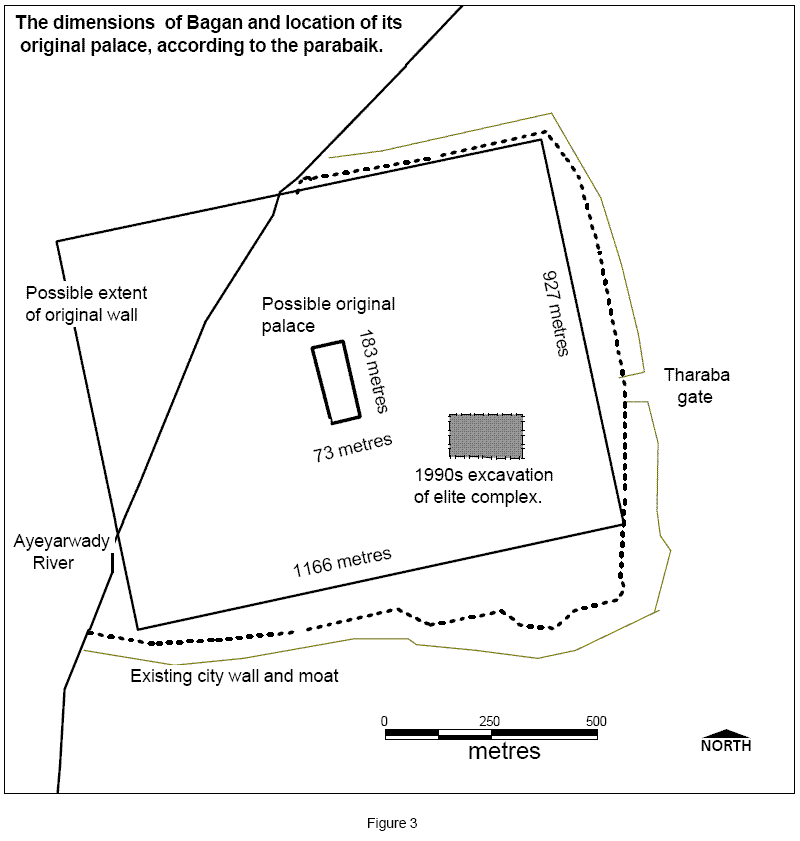
 This document, while in part a retelling of earlier traditional stories,
whose analysis we will leave to the textual specialists, contains some valuable
technical information. The measurements of the city, despite what may be a few
misprints or reproduced errors, fit the existing city walls fairly well (Figure
3). They suggest a rectangular site, with four walls, which supports the
hypothesis that a western wall may have been washed away [{p21end}] by
the river at some time in the past (fn40). The
parabaik’s location of the “original” palace in the geometric centre of the city
is of course suggestive of a symbolic “Mount Meru”, with four slopes forming
cosmological hillsides leading up to the royal (and holy) centre
(fn41).
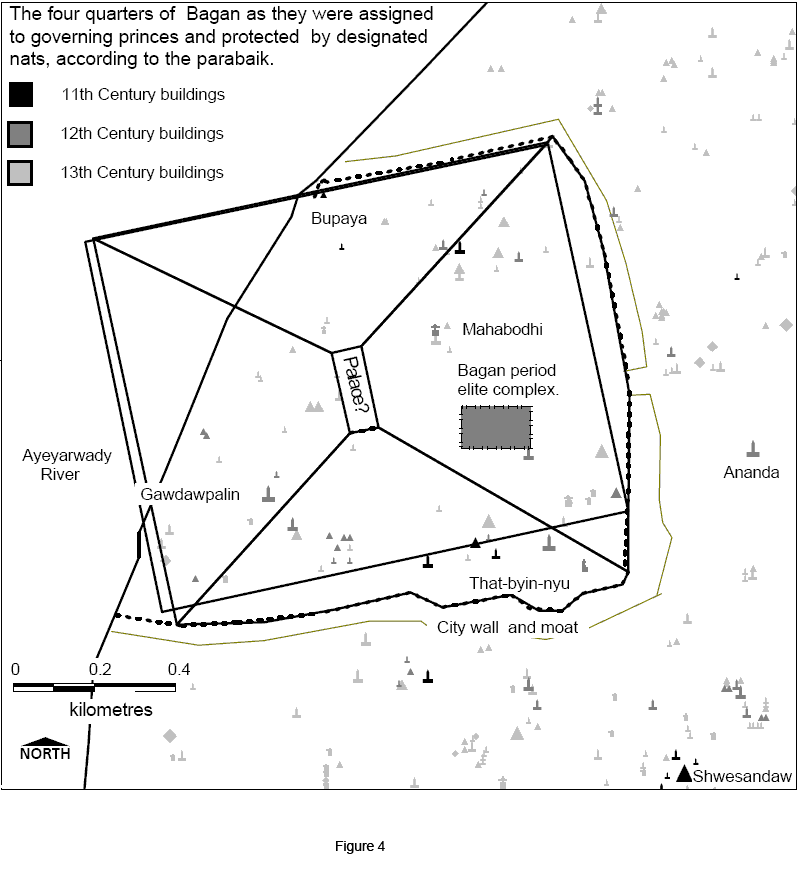
The apportioning of responsibility for different parts of the city to
“management committees” of men and nats also has cosmological implications It
suggests that the quarters of the city were divided into four rhomboid zones,
based on a side of the main wall and the relevant side of the central elite
centre (Figure 4). The description of a new allocation of governance in the city
at the time of King Narapatisithu is interesting in that the western side of the
city does not get a mention. Absence of evidence is not much evidence at all,
but if we were to hypothesise that the document contains some valid historical
information, could we ask if this was because the western wall had been washed
away by that time?
This document, while in part a retelling of earlier traditional stories,
whose analysis we will leave to the textual specialists, contains some valuable
technical information. The measurements of the city, despite what may be a few
misprints or reproduced errors, fit the existing city walls fairly well (Figure
3). They suggest a rectangular site, with four walls, which supports the
hypothesis that a western wall may have been washed away [{p21end}] by
the river at some time in the past (fn40). The
parabaik’s location of the “original” palace in the geometric centre of the city
is of course suggestive of a symbolic “Mount Meru”, with four slopes forming
cosmological hillsides leading up to the royal (and holy) centre
(fn41).
The apportioning of responsibility for different parts of the city to
“management committees” of men and nats also has cosmological implications It
suggests that the quarters of the city were divided into four rhomboid zones,
based on a side of the main wall and the relevant side of the central elite
centre (Figure 4). The description of a new allocation of governance in the city
at the time of King Narapatisithu is interesting in that the western side of the
city does not get a mention. Absence of evidence is not much evidence at all,
but if we were to hypothesise that the document contains some valid historical
information, could we ask if this was because the western wall had been washed
away by that time?
The Brief History of Bagan must be viewed in the light of the existing
archaeological evidence. Only half a dozen structures (Figure 5) are attributed
to the 11th Century AD by the Inventory of Monuments at Pagan
(fn42).
They cluster in the northern and southern portions of the city, though there are
not really enough of them to suggest a pattern. The radiocarbon dates
(fn43)
that are now available relate to activities on the eastern side of the city,
including a site excavated in the early 1990s that is widely assumed to be a
palace complex (Figure 5). The carbon dates suggest that there was wall-building
activity some time during or after the period 1020-1300 AD, that an
earthenware-lined latrine was in use just outside the present wall some time
between 990 and 1210 AD, and that in the elite compound, in which a teak post a metre wide,
from a tree that dated to between 980 and 1250 AD, was used as
construction material, there was also a substantial fire no earlier than 1300 AD.

None of this evidence supports a ninth century origin for the city. However
proponents of the “ninth century” hypothesis can still take heart from the
parabaik. The information in the document has been put to a practical test, with
promising results. An excavation [{p22end}] by the Archaeology Department
at Bagan in 2000-2001 on a corner of the area suggested by the measurements in
the parabaik as the location of the “original” palace site has led to the
discovery of some previously unrecorded building foundations
(fn44).
It is much too early to reach any conclusions about this discovery, and more
investigation will be required. For research methods, we might look to a range
of technologies. The structure at Yon Hlut Kyun (Figure 2) was first located by
augering, using a simple posthole-digging tool. Over a broader area, where there
has not been, as we had at Yonhlut, both oral history and documentary
information to point the way, there may be scope in the future for the use of
ground-penetrating radar. Airborne radar survey, for example, has provided
substantial new data on the origins and growth of Angkor, another of the great
capitals of Southeast Asia
(fn45).
We should not exclude any method, from state-of-the-art science to discussions with
farmers or local residents about what they have learned from the land they live
on. As the hints already given to investigators by the Brief History of Bagan
indicate, documentary sources can be, by design or by accident, valuable
repositories of information for the field archaeologist, and help trigger the
acquisition of hard evidence to aid the historian and the textual scholar.
Contents of this page
The archaeological side of the research was made possible by the Carlyle
Greenwell Bequest and the Australian Institute of Nuclear Science and
Engineering (Grants 00/180S, 01/150). The work has been encouraged and
facilitated by U Nyunt Han, Director General of Archaeology, and U Aung Kyaing,
Assistant Director General. Heartfelt thanks for their collaboration on ongoing
projects goes to U Nyein Lwin and U Win Maung (Tanpawady). Thanks for data and
academic input go to Pierre Pichard, Roland Fletcher, Mike Barbetti, Michael
Aung-Thwin, Andrew Wilson, Ian Johnston and Pamela Gutman. At the Yon Hlut Kyun
excavation, I would like to acknowledge the contributions of Tessa Boermah, Emma
Hetherington, Shah Alam Zaini, Don [{p23end}] Tindale, Ted Robinson,
Jordan Robinson and the excavators, U San Ke, U Nyunt Aung, U Kan Myint, Bo Kyin,
Aung-Nine, Shwe-oo and Myint-oo. [{p24end. End of article.]
Contents of this page
fn01 Pe Maung Tin and G. H. Luce. 1923. (trans)
The Glass Palace Chronicle of the Kings of Burma. Rangoon University Press.
(Reprinted 1960). 28-29. fn01b
fn02 A more detailed account of this survey is to
appear in Hudson, Bob, U Nyein Lwin and U Win Maung (Tanpawady) (in press)
Digging for Myths: Archaeological Excavations and Surveys of the Legendary
Nineteen Founding Villages of Pagan. In The Silver Gong is Struck: New
Research in the Art and Archaeology of Burma. British Museum, London.
fn02b
fn03 Maung Hla. 1923 The Chronological Dates of the
Kings of Burma who reigned at Thayekhittaya (ancient Prome) and at Pagan.
Journal of the Burma Research Society 13(2): 82. fn03b
fn04 Aung Thaw. 1968 Report on the excavations
at Beikthano. Revolutionary Government of the Union of Burma, Ministry of
Union Culture, Rangoon. Myint Aung. 1970 The excavations at Halin Journal of
the Burma Research Society. 53(2): 55-62. Sein Maung U. 1981 Mongmao, a
forgotten city. The Working People’s Daily. Jan 21 & 23, Feb 3.There is
no equivalent monograph in English for Sri Ksetra, as for Beikthano and Halin,
but research dating back to the early 20th century (such as Archaeological
Survey of India.1909-1910 Excavations at Hmawza near Prome. Annual report of
the Archaeological Survey of India. Manager of Publications, Delhi) is
neatly summarised in Aung Thaw 1972 Historical Sites in Burma. Ministry
of Union Culture, Rangoon, 16-33. The scientific evidence for Pyu chronology is
discussed in detail in Hudson, Nyein Lwin and Win Maung, in press, op cit.
fn04b
fn05 Aung Myint. 1999 Ancient Myanmar Cities in
Aerial Photos. Ministry of Culture, Yangon (in Burmese).
fn05b
fn06 Aung-Thwin, Michael. 1983 Burma before Pagan:
The Status of Archaeology Today. Asian Perspectives 25(2): 1-21. Win
Maung (Tanpawady). 1981 Binnaka Myohaung (“Binnaka Ancient City”).
In Burmese. Privately circulated manuscript. fn06b
fn07 Pe Maung Tin and G. H. Luce. 1923. op cit: ix
fn07b
fn08 ibid 28-36. fn08b
fn09 ibid 28. fn09b
fn10 ibid 29. fn10b
fn11 Decimal degrees = degrees + (minutes/60) +
(seconds/3600). fn11b
fn12 Pe Maung Tin and G. H. Luce, op cit: 45
fn12b
fn13 These beads are considered characteristic
trade goods of the Pyu period - see Moore, Elizabeth & Aung Myint. 1993 Beads of
Myanmar (Burma). Journal of the Siam Society 81(1): 55-81, Aung Myint
1999, op cit. fn13b
fn14 Archaeological Survey of Burma. 1907 Report
of the Superintendent, Archaeological Survey of Burma. Rangoon: Office of
the Superintendent, Government Printing: 9 (referred to in subsequent notes as
ASB). fn14b
fn15 Khin Maung Nyunt. 1997 Hagiography of Maha
Thera Shin Arahan and an account of the reconstruction of Shin Arahan’s brick
monastery. Ministry of Culture, Myanmar. fn15b
fn16 AMS (Accelerator Mass Spectrometry) dating by
ANSTO- the Australian Nuclear Science and Technology Organisation, Sydney.
Calibration by OxCal, Version 3.5, a computer program by C Bronk Ramsey, 2000.
fn16b
fn17 ASB 1915: 7 fn17b
fn18 Lubeigt, Guy. 1998 Pagan: Historie et
Légendes. Editions Kailash. fn18b
fn19 ASB 1906:25 fn19b
fn20 This information comes from U Win Maung (Tanpawady).
fn20b
fn21 Hudson, Bob & U Nyein Lwin. 1999.
Archaeological Excavations and Survey, February-March, 1999, Yon Hlut Kyun,
Pagan, Burma: a preliminary report. Report to Director General of
Archaeology, Yangon. Hudson, Bob. 2000. The King of “Free Rabbit” Island; a
GIS-based archaeological approach to Myanmar’s medieval capital, Bagan.
Proceedings of the Myanmar Two Millennium Conference. Volume 3: 10-20.
fn21b
fn22 See Myint Aung 1969 The contribution of
libation jars to defining historical periods. Tetkatho Pyinnya Padetha
4(2): 35-46 (in Burmese). fn22b
fn23 Wright, R. V. S. 1994 The MV-NUTSHELL
program for multivariate archaeology. Author, Sydney fn23b
fn24 The historiography of the various chronicles
is discussed at length in the introduction to the Glass Palace Chronicle
(Pe Maung Tin and Luce op cit: xvi). fn24b
fn25 This argument is summarised in Pe Maung Tin
and Luce, op cit: 29 fn25b
fn26 Stargardt, Janice. 1990 The Ancient Pyu of
Burma: early Pyu cities in a man-made landscape. PACSEA Cambridge
fn26b
fn27 Parabaiks, folding books made from paper,
survive from the Konbaung period, 1752-1885, onward (Herbert, Patricia. “Burmese
Court Manuscripts”. The Art of Burma: New Studies. Marg Publications,
Mumbai. 1999). Existing examples of palm-leaf documents from Myanmar have been
dated to the fourteenth century AD (Singer, Noel F. “Palm leaf manuscripts of
Myanmar (Burma)”. Arts of Asia 1991 21(1): p 138). However the palm-leaf
form, reproduced and preserved as gold sheets, appears much earlier, in the
middle of the first millennium AD (Stargardt, J. “The oldest known Pali texts,
5th-6th century: results of the Cambridge Symposium on the Pyu golden Pali text
from Sri Ksetra, 18-19 April, 1995.” Journal of the Pali Text Society
1995 31: p 119-223). A definitive study of traditional documents can be found in
Thaw Kaung, U. “Myanmar Traditional Manuscripts and their Preservation and
Conservation”. Myanmar Historical Research Journal 1: 241-273. 1995
fn27b
fn28 English translation by U Thaung Lwin.
fn28b
fn29 The prophecy is related in Pe Maung Tin and G.
H. Luce, op cit, 29. fn29b
fn30 23,982 feet [UKT: 5,280 feet = 1 mile. Thus,
23982 ft = 4.5 mile approx.] in circumference is much too big, and I suggest
that the figure is erroneous. Luce suggested that 1 tar (or ta)
was equal to 7 cubits (Luce, G. H. Economic Life of the Early Burman Journal
of the Burma Research Society 1940 30(1): 291-292). I have taken this to
mean the 20.62 inch Egyptian (52.37 centimetres) “Royal cubit”. See Flinders
Petrie, W. M. The Pyramids and Temples of Gizeh. London; Field & Tuer, Ye
Leadenhalle Presse; Simpkin, Marshall & Co., Stationers' Hall Court; Hamilton,
Adams & Co., Paternoster Row. New York: Scribner & Welford, 743 Broadway. 1883.
Chapter 20. By this reckoning 1 tar would equal 3.6659 metres and the
circumference of the city would be 4,186 metres or 13,734 feet.
fn30b
fn31 The parabaik describes every gate as being one
tar wide and two tar deep. Repetition of this description has been omitted.
fn31b
fn32 Also known as the Tharaba or Saraba gate, this
is the main entrance to the old city from the east today. It is item number 1634
in Pichard, Pierre The Inventory of Monuments at Pagan (Volume 6) 1996 KISCADALE
EFEO UNESCO. Statues of the brother and sister nats flank each side of the
entrance, in shrines that the Inventory suggests are later additions.
fn32b
fn33 This king reigned in the late 12th century AD.
The date 53 MCE would be 691 AD. It may be a misprint. (Year AD = Year MCE +
638). fn33b
fn34 See The Glass Palace Chronicle, op cit, p
116-120, for more of this complex tale. fn34b
fn35 This may be an error on the part of the author
or someone involved in a later transcription. It more likely refers to a
calendrical transition from the Buddhist (Sasana) Era, which begins in 544 BC,
to the Sakka Era, which begins in 78 AD fn35b
fn36 This is a little later than the traditional
date mentioned in the Glass Palace Chronicle. Interestingly, the Hsipaw
Chronicle puts the founding of the 19 villages about a century after the Glass
Palace Chronicle date, at around 221 AD - see U Sai Aung Tun’s paper,
Shan-Myanmar Relations As Found in the Hsipaw Chronicle, Texts and Contexts
Conference, 2001. fn36b
fn37 The first two sites, mountaintop pagodas on
the western and eastern sides of the city, are well known. The locations of
other two have eluded this author - the Lokananda and the Shwezigon are more
commonly viewed as the city’s other two main boundary markers.
fn37b
fn38 There is a useful discussion of this pagoda,
now mainly used as a viewing-platform for tourists, in Strachan, Paul. 1989
Pagan: Art and Architecture of Old Burma, Kiscadale. P 42-44.
fn38b
fn39 This is presumably a misprint in the original
document-503 MCE/1141 AD would be more likely. fn39b
fn40 See Thin Kyi, Daw. 1964 The Old City of Pagan.
Essays offered to G. H. Luce, Volume 2. Artibus Asiae.
fn40b
fn41 Thanks to Dr Waldemar Sailer for pointing this
out when the paper was read in Yangon in 2001. fn41b
fn42 Pichard 1992-1999, op cit.
fn42b
fn43 Grave, Peter and Barbetti, Mike. 2001 Dating
the City Wall, Fortification and the Palace Site at Pagan. Asian Perspectives
40(1). The authors point out that plateaux exist in the radiocarbon calibration
curve for this period, seriously broadening the calendar age ranges. However
their results essentially point to construction “no earlier than the thirteenth
and possibly during the fourteenth century”. fn43b
fn44 This work owes much to the indefatigable
antiquarian U Win Maung (Tanpawady), who introduced me to the parabaik.
fn44b
fn45 See Fletcher, Roland. 2001 New radar imagery
contributes to better understanding of Angkor World Heritage property, Cambodia.
Asia-Pacific Focal Point Newsletter 1: 3. fn45b
Contents of this page

UKT's part translation from Glass Palace Chronical, vol.1,
p.229.
I am giving this account to check the Burmese-Myanmar spelling of
several words:
• Sokkaté {soak~ka.té:}
• Thamahti creek {tha.ma.hti: hkyaung:}
• Areindama spear {a.rain~da.ma lhän}
Click on the insert to view the whole page.
Anawrahta after collecting enough troops came to Pagan and demanded of his
elder [foster] brother either to give up the throne or face him in battle. The
elder Sokkaté{sok~ka.té:} on hearing the demand was beset with anger and said,
"This fellow with the smell of mother's milk in his mouth has dared me to fight.
Let my ministers [and troops] stand aside, and I will give him single combat on
horse back."
When Anawrahta heard the answer, he was more than happy and went on the
appointed day to the place riding his "nat" horse ["nat" here means the horse
given by a nat and refers to the story of his father in his days as a tax
collector when an unknown elder, purported to be the {thi.kra:ming:} had given
him a horse and the "flying" spear], and with the spear and sword given him by
his father went to {tha.ma.hti:} creek. The elder Soak~ka.té greeted the
younger, when Anawrahta said, "Elder, since you are senior to me in age, thrust
[with your spear] first." Elder Sokkaté thrust his spear [or threw the javelin]
at the younger. The younger used his {thi.kra:}-given {a.rain~da.ma} spear to
ward off the oncoming spear because of which it struck only the saddle of
Anawrahta. When Sokkaté saw that the thrust of his spear had not harm the body
of the younger, he became greatly alarmed. At that moment, cried the younger
Anawrahta, "Elder, your turn is over. Now, it's my turn. Defend yourself if you
can" and let fly {a.rain~da.ma} at Sokkaté. The spear went in from the front of
body and came out of the back. Sokkaté together with his horse fell. ["with his
horse" in Burmese-Myanmar is {mring:ka.pa}]. To this day the place is known as {mring:ka.pa}.
Go back Sokkate-note-b
Contents of this page
From Wikipedia
http://en.wikipedia.org/wiki/Nyaung-u_Sawrahan 080919
 {Ñaung-U: sau:ra.han:} MLCTS:
nyaung u: sau ra. han:; also spelt Ngyaung-ú-Tsau Rahán; died
964 AD) was a ruler of the kingdom of Pagan in what is now Myanmar. He is also
known as Taungthumingyi
{Ñaung-U: sau:ra.han:} MLCTS:
nyaung u: sau ra. han:; also spelt Ngyaung-ú-Tsau Rahán; died
964 AD) was a ruler of the kingdom of Pagan in what is now Myanmar. He is also
known as Taungthumingyi
 {taung-thu-kri: ming:}.
Nyaung-U Sawrahan usurped the previous king,
Theinhko.
Previously a farmer, NyangU
{Ñaung-U: sau:ra.han:} killed Theinhko when the hungry king took a
cucumber from his field. NyaungU Sawrahan was accepted as king by the queen to
prevent unrest in the kingdom and became known as the Cucumber King or
Farmer King ("Taung-thugyi Min"). There is a similar story in
Cambodian
history and both stories may be mythical.
NyaungU Sawrahan reigned for 33 years and was overthrown by
Kunhsaw Kyaunghpyu, who in turn was overthrown by NyaungU Sawrahan's sons
Kyiso and Sokka-te
{soak~ka.té:}.
UKT: It is said that Taungthugyimin was a devotee of the Cult of Naga
(the Burmese Dragon) and had a huge image of the Naga erected in his
cucumber field to show his devotion to it. It is to be noted that there were
two villages with names of naga among the founding villages which were
situated near the river - water being the home of naga.
Go back NyaungU-Sawraha-note-b
Contents of this page
The mention of "three different ethnic groups, namely, Thet, Pa-deik-kha-ya,
and Pyu" reminds me of the story of
 {pa.Taik~ka.ra:} and
 {rhwé-aim-thæÑ}. See Glass Palace Chronicles, vol.1, p279-280. (See the story in
ch04-alchem.htm
.) It makes me wonder whether the word
{pa.Taik~ka.ra:} stands for Bengal or {wé-tha-li} (check spelling) in India.
{rhwé-aim-thæÑ}. See Glass Palace Chronicles, vol.1, p279-280. (See the story in
ch04-alchem.htm
.) It makes me wonder whether the word
{pa.Taik~ka.ra:} stands for Bengal or {wé-tha-li} (check spelling) in India.
Go back Prince-Pataikkara-note-b
Contents of this page

The king who unified the 19 villages into the first capital of Pagan was Tha-mok-da-rit,
who was followed by Ya-thae-gyaung.
1. Tha-mok-da-rit
2. Ya-thae-gyaung
Then came
{pyu-ming:hti:}
and his descendants -- from the names of the kings of this dynasty in Glass Palace Chronicles,
vol.1, p.203-209.
3.
{pyu-ming:hti:} (r. 75yr, 89 BE - 164 BE, life-span 110yr) >
4.
{hti:ming:yiñ} (r. 57yr, 164 BE - 221 BE, life-span 107yr) >
5.
{yiñ-ming:peik} (r. 25yr, 221 BE - 246 BE, life-span 75yr) >
6.
{peik-thíñ-læÑ} (r. 20yr, 246 BE - 266 BE, life-span 61yr) >
7. {thíñ-læÑ-kraung}
(r. 43yr, 266 BE - 309 BE, life-span 96yr) >
8.
 {kraung-du-ric}
(r. 25yr, 309 BE - 334 BE, life-span 80yr)
{kraung-du-ric}
(r. 25yr, 309 BE - 334 BE, life-span 80yr)
Go back
royal-line-Yonlwutkywun-note-b
Contents of this page
End of TIL file