Update:
2008-09-26 02:15 PM +0800
TIL
Folk Elements in Burmese Buddhism
ch07-nat-list.htm
Maung Htin Aung. Printed and published by U Myint Maung,
Deputy Director, Regd: No (02405/02527) at the Religious Affairs Dept. Press. Yegu,
Kaba-Aye P.O., Rangoon, BURMA. 1981.
Set in HTML by the staff of TIL and edited by U Kyaw Tun,
M.S. (I.P.S.T., U.S.A.). Not for sale. Prepared for students of TIL Computing
and Language Center, Yangon, MYANMAR.
indx-myan |
Top
indx-folk
contn. from p107
Contents of this page
List of Thirty-seven Lords
List in Folk Elements in Burmese Buddhism
List in Method of Worshipping 37-Nats
Author's notes
UKT notes
Contents of this page
UKT: The Burmese name of this group of nats is
 {37 min:}. Since the number 37 is usually written in numerical form rather than
being spelled out, I have followed the Burmese practice.
{37 min:}. Since the number 37 is usually written in numerical form rather than
being spelled out, I have followed the Burmese practice.
A well known work on
Thirty-seven Kings (in Burmese)
by U Po Kya, {pa-ra.mi sa-pé} 2nd printing 1999, pp.146
gave three sets of thirty-seven nats:
1. Buddhist 37 nats, p.9
-- headed by {Ein~da.}
2. Inner 37 nats, p.12
-- Pagan-era 37 nats kept within the precincts of Shwézigon pagoda,
headed by
 {Da.ta.raT~Hta} with
 {
thi-kra:} as the fifth.
{
thi-kra:} as the fifth.
3. Outer 37 nats, p.36
-- nats kept outside the precincts of Shwézigon pagoda, headed by
{thi-kra:} with
 {ma.ha-gi-ri. nat} as the second.
The list referred to by Dr. Htin Aung corresponded
to that of the Outer 37 nats of U Po Kya.
Though the 37 were headed by Thagyamin
 {thi.kra:ming:} according to Dr. Htin Aung, a contemporary book, Method of
Worshipping 37-Nats (in Burmese), 2nd printing by MinRama, Yangon, 1992, did
not mention Thagyamin at all. Instead,
the list was headed by Min Maha-Giri'
{thi.kra:ming:} according to Dr. Htin Aung, a contemporary book, Method of
Worshipping 37-Nats (in Burmese), 2nd printing by MinRama, Yangon, 1992, did
not mention Thagyamin at all. Instead,
the list was headed by Min Maha-Giri'
 {ming:ma.ha-gi.ri.}. It should be noted that though Dr. Htin Aung
was an internationally noted scholar, Min Rama was U Ohn Maung
who I met in Yangon in 2004. He is a local scholar writing under
the pen-name of Min Rama. He has extensive
information on nat-worship, particularly from the keepers of the Taungbyoan Nat shrine.
{ming:ma.ha-gi.ri.}. It should be noted that though Dr. Htin Aung
was an internationally noted scholar, Min Rama was U Ohn Maung
who I met in Yangon in 2004. He is a local scholar writing under
the pen-name of Min Rama. He has extensive
information on nat-worship, particularly from the keepers of the Taungbyoan Nat shrine.
Contents of this page
UKT: The following list tallied with the list of Outer 37-nats
Thirty-seven Kings of U Po Kya, {pa-ra.mi sa-pé} 2nd printing 1999, p.36-51.
| |
Dr. Htin Aung |
U Po Kya (Burmese) |
U Po Kya (Romabama) |
| |
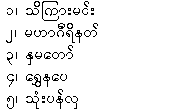
01. Thagyamin (the King of the Gods)
02. The Lord of the Great Mountain
03. Princess Golden Face
04. Lady Golden Sides
05. Lady Three Times Beautiful
|
|
01. {thi.kra:ming:}
02. {ma.ha-gi-ri. nat}
03. {nha.ma.tau}
04. {rhwé-na.pé}
05. {thoän:pan-lha.}
|
| |
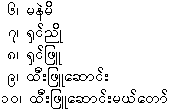
06. Little Lady with the Flute
07. Brown Lord of Due South
08. White Lord of the North
09. Lord with the White Umbrella
10. Royal Mother (of No.9)
|
|
06. {ma.nè:mi.}
07. {rhing-Ño}
08. {rhing-hpru}
09. {hti:hpru-hsaung:}
10. {hti:hpru-hsaung: mèý-tau}
|
| |
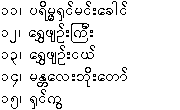
11. Sole Lord of Pareim-ma
12. Elder Inferior Gold
13. Younger Inferior Gold
14. Lord Grandfather of Mandalay
15. Lady Bandy-Legs
|
|
11. {pa.reim~ma.rhin-ming:hkaung}
12. {rhwé-hpyiñ:kri:}
13. {rhwé-hpriñ:ngè}
14. {man~ta.lé: Bo:tau}
15. {rhing-kwa.}
|
| |
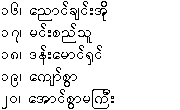
16. Old Man by the Solitary Banyan Tree
17. Lord Sithu
18. Young Lord of the Swing
19. Valiant Lord Kyawswa
20. Captain of the Main Army Aungswa
|
|
16. {Ñaung-hkying:o}
17. {ming:sæÑ-thu}
18. {dan:maung-rhing}
19. {kyau-swa}
20. {aung-swa-ma.kri:}
|
| |
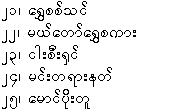
21. Royal Cadet
22. His Mother, the Lady Golden Words
23. Lord of Five Elephants
24. The Lord King, Master of Justice
25. Maung Po Tu
|
|
21. {rhwé-sic-thing}
22. {mèý-tau rhwé-sa.ka:} [{p108}]
23. {nga:si:rhing}
24. {ming:ta.ra: nat}
25. {maung-po:tu}
|
| |
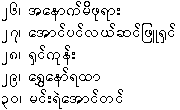
26. Queen of the Western Palace
27. Lord of Aungpinlè, Master of White Elephants
28. Lady Bent or Lady Hunchback
29. Golden Nawrahta
30. Valiant Lord Aung Din
|
|
26. {a.nauk-mi.hpu.ra:}
27. {aung-ping-lèý hsing-hpru-rhing}
28. {rhing-koan:}
29. {rhwé-nau-ra.hta}
30. {ming:rè:aung-ting}
|
| |
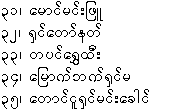
31. Young Lord White
32. Lord Novice
33. Tabinshwehti
34. Lady of the North
35. Lord Minhkaung of Toungoo
|
|
31. {maung-ming:hpru}
32. {rhing-tau nat}
33. {ta.ping-rhwé-hti:}
34. {mrauk-Bak rhing-ma}
35. {taung-ngu-rhing ming:hkaung}
|
| |
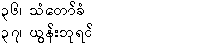
36. Royal Secretary
37. King of Chiengmai
|
|
36. {thän-tau-hkän}
37. {ywan: Bu.ring}
|
 According to
Minister Myawaddi
and the devotees of the cult at the present day,
the Nats numbered 1 to 22 belonged to the pre-Pagan and Pagan periods and the
rest to the Ava and Toungoo periods of Burmese history.
According to
Minister Myawaddi
and the devotees of the cult at the present day,
the Nats numbered 1 to 22 belonged to the pre-Pagan and Pagan periods and the
rest to the Ava and Toungoo periods of Burmese history.
UKT:
Minister Myawaddi --
Thirty-seven Kings of U Po Kya, {pa-ra.mi sa-pé} 2nd printing 1999, p.52, gave
the identity of the minister as
 {mya.wa.ti wan-kri: u:sa.} (1128-1215 BE) corresponding to (1766-1853 AD)
However, according to the list recognized by the hereditary attendants
of the Nat images at the Shwezigone Pagoda, we find that:
(i) Nos. 1 to 17, 19, and 20 are included;
(ii) Nos. 18, The Young Lord of the Swing, 21, The Royal Cadet and 22, The Lady
Golden Words are not included;
(iii) Nos. 23, The Lord of the five Elephants,
25, Maung Po Tu, 26, The Queen of the Western Palace, 27, The Master of White
Elephant from Aungpinle Lake, 34, The Lady of the North, and 36, The Royal
Secretary are included as belonging to the Pagan period, for the attendants do
not recognize any Nat who belonged to a later period than Pagan as one of their
Thirty-seven, and
(iv) the following twelve Nats complete the list of
Thirty-seven:
01. Master Aung Pyi
02. The Lord of the White Elephant
03. The Lord of the White Horse [{p109}]
04. The Lord of the Nine Towns
05. The Lord of the Four Islands
06. The Lord of the Five Village
07. The Lord of the Ten Villages
08. The Great Physician
09. The Lord of the Ninety-nine Shan States
10. The Lady of the Tame Waters (i.e. Inland Waters)
11. The Lord of the Salt Water Lands (i.e. the Irrawaddy Delta)
12. The Lord of the Open Ocean
Contents of this page
UKT: The following list is given in Method of Worshipping 37-Nats (in
Burmese), 2nd printing by MinRama (Zoology), Yangon, 1992.
House-interior Nat Group -- 7 nats
1. {ain-twing: ming:ma.ha-gi.ri.},
2. {rhwé-na.Bé nat} also known as {na.ga: mè-tau},
3. {mrat-hla} also known as {mi.hpu.ra: sau-mè-ya}
4. {dwé: hpru} also known as {oak~ka.la-pa. mi.hpu.ra:}
5. {rhwé-nhè:mi.} also known as {ma.nhè:lé:}
6. {rhing-hpru}
7. {rhing-ño}
Popa Nat Group -- 5 nats
1. {pop~pa: mè-tau} also known as {mè-wuN~Na.}
2. {taung-tau-tha.hkin-ma.} also known as {ma.mè-u.}
3. {ko-rin-maung nat}
4. {taung-proan:ming:kri:} also known as {rhwé-hpyiñ:kri:}
5. {taung-proan:ming:lé:} also known as {rhwé-hpyiñ:lé:}
Master of White Horse Group -- 4 nats
1. {yam~ma: mring:hpru-rhing}
2. {kan~ni mring:hpru-rhing}
3. {rhwé-pré. mring:hpru-rhing}
4. {rhwé-sic-thing mring:hpru-rhing}
Nine-Towns Group -- 4 nats
1. {ko:mro.shin}
2. {pu.lè:yiñ} also known as {a.mé-pu.lè:}
3. {hkun-hkyo}
4. {hkun-tha}
Five-Mothers Group -- 5 nats
1. {a.rhé. mè-tau}
2. {a.nauk mè-tau} also known as {a.mé-ré-yiñ} and {ré-yiñ-ka.tau}
3. {taung mè-tau}
4. {mrauk mè-tau}
5. {a.mé-gyam:}
Pye Lei Pyin Group -- 2 nats
1. {pré-lè-prin maung-tau}
2. {pré-lè-prin nha.ma.tau}
Pegu Group -- 2 nats
1. {nan-ka-reing: mè-tau}
2. {ko-aung-naing} also known as {aung-naing}
Delta Group -- 2 nats
UKT: {ré-ngän-peing} literally means the 'master of salty water'
which implied
'owner of Irrawaddy-delta waters'. Since the ocean tides reached
far up the delta,
the river-water as well as water in the surface wells tastes
salty and is not portable.
Formerly, people of the Delta
(I was born in a small
Delta-town now incorporated into Greater Yangon)
drank rain-water stored in huge
dug-up tanks protected by earthen bunds
from the outside contamination.
1. {ré-ngän-peing U:rhing-kri:}
2. {kwing:peing a.hpo:}
Miscellaneous Group -- 6 nats
1. {poan:ma.kri~ nat}
2. {pa.hkan: U:ming:kyau}
3. {ko:thein:rhin}
4. {beith~tha.no: nat} also known as {beith~tha.no: nat-tha.mi:}
UKT: though the spelling is the same as for the Hindu god Vishnu
who is male, {beith~tha.no: nat} is a female.
5. {rhing-ma.aung-hpru nat} also known as {hpya-leip nat}
6. {mo:hkaung-kyau-swa nat}
Contents of this page
Contents of this page
Contents of this page
End of TIL file