Update:
2008-10-01 10:42 PM +0800
TIL
Folk Elements in Burmese Buddhism
ch07-0408.htm
Maung Htin Aung. Printed and published by U Myint Maung,
Deputy Director, Regd: No (02405/02527) at the Religious Affairs Dept. Press. Yegu,
Kaba-Aye P.O., Rangoon, BURMA. 1981.
Set in HTML by the staff of TIL and edited by U Kyaw Tun,
M.S. (I.P.S.T., U.S.A.). Not for sale. Prepared for students of TIL Computing
and Language Center, Yangon, MYANMAR.
indx-myan |
Top
indx-folk
Contents of this page
Thirty-seven Lords
List
Thirty-four Lords
Lords 4 to 8
Lady Golden Sides
Lady Three Times Beautiful
Little Lady
Lord of Due South
Lord of the North
Author's notes
UKT notes
• Fall of Prome • Naga
image for worship • Prome •
Prome period • Seven
Hill District
Contents of this page
p083
UKT: The Burmese name of this group of nats is
 {37 ming:}. Since the number 37 is usually written in numerical form rather than being spelled out,
I have followed the Burmese practice.
{37 ming:}. Since the number 37 is usually written in numerical form rather than being spelled out,
I have followed the Burmese practice.
Though the 37 were headed by Thagyamin
 {thi.kra:ming:} according to Dr. Htin Aung, a contemporary book, Method of Worshipping 37-Nats
(in Burmese), 2nd printing by MinRama, 1992, did not mention Thagyamin at all. Instead,
the list was headed by in Maha-Giri'
{thi.kra:ming:} according to Dr. Htin Aung, a contemporary book, Method of Worshipping 37-Nats
(in Burmese), 2nd printing by MinRama, 1992, did not mention Thagyamin at all. Instead,
the list was headed by in Maha-Giri'
 {ming:ma.ha-gi.ri.}. It should be noted that though Dr. Htin Aung was a noted scholar,
MinRama is a local scholar writing under a pen-name.
I met MinRama in Yangon in 2004.
{ming:ma.ha-gi.ri.}. It should be noted that though Dr. Htin Aung was a noted scholar,
MinRama is a local scholar writing under a pen-name.
I met MinRama in Yangon in 2004.
Contents of this page
In the previous chapter I (Dr. Htin Aung) explained how Anawrahta
was constrained to give some royal recognition to the existing cult
of the Thirty six Lords with the Lord of the Great Mountain
as the chief Nat, and how Anawrahta added the guardian-god of Buddhism,
whose name was Sakra in Pali and Thagya in Burmese
{thi.kra:min:}, to the list, thus making it the cult of 'Thirty-seven Lords' instead of
'Thirty-six Lords'. In addition, he set up their images on the platform of the Shwezigone pagoda
 {shwé-si~:hkoan} that he built. The list had closed at thirty-six before Anawrahta,
and it needed Anawrahta's prestige and power to change the number
from thirty-six to thirty-seven. After Anawrahta no one dared to assume authority
to change the number. However, with the passing of time the list varied,
for some old Nats were displaced by new Nats, and the personalities of later characters became merged
with those of earlier ones. This has misled some European scholars into scoffing at the number
thirty-seven and to proceed to point out the existence of the 'thirty-eighth', 'thirty-ninth'
and 'fortieth' Nats. In actual fact, the number of Nats worshipped in Burma amounts to well over
a hundred, but the Nats associated with the cult of the Thirty-seven Lords number at one time no
more and no less than thirty-seven. From time to time official lists of the thirty-seven Nats
were drawn up by royal authority, and under King Bodawpaya
{shwé-si~:hkoan} that he built. The list had closed at thirty-six before Anawrahta,
and it needed Anawrahta's prestige and power to change the number
from thirty-six to thirty-seven. After Anawrahta no one dared to assume authority
to change the number. However, with the passing of time the list varied,
for some old Nats were displaced by new Nats, and the personalities of later characters became merged
with those of earlier ones. This has misled some European scholars into scoffing at the number
thirty-seven and to proceed to point out the existence of the 'thirty-eighth', 'thirty-ninth'
and 'fortieth' Nats. In actual fact, the number of Nats worshipped in Burma amounts to well over
a hundred, but the Nats associated with the cult of the Thirty-seven Lords number at one time no
more and no less than thirty-seven. From time to time official lists of the thirty-seven Nats
were drawn up by royal authority, and under King Bodawpaya
 {Bo:tau-Bu.ra:} such a list was compiled by the Minister Myawaddi.
Because of the [{p084}] historical accident of the fall of the Burmese kingdom in 1885,
Myawaddi's list became the final official list.
fn084-01
{Bo:tau-Bu.ra:} such a list was compiled by the Minister Myawaddi.
Because of the [{p084}] historical accident of the fall of the Burmese kingdom in 1885,
Myawaddi's list became the final official list.
fn084-01
UKT:
Myawaddi's list of 37 Nats -- The list
was headed by the following three:
1. Thagyamin (the King of the Gods)
{thi.kra:min:}
2. Lord of the Great Mountain, Min Maha-Giri'
{ming:ma.ha-gi.ri.}
3. Princess Golden Face
 {rhwé-myak-nha}
The list recognized by the hereditary attendants at Shwezigone also became fixed
and finalized only by the time of the fall of the kingdom of Pagan. That it had
varied from time to time even during the Pagan period can be seen from the fact
that some of the Nats mentioned in the list appeared after Anawrahta had set up
the images of the Nats on the platform of the Pagoda. The images are crude and
primitive, and they were gathered from the various Nat-shrines in various parts
of the country and set up at the Pagoda. The King's architects and sculptors,
whose handiwork still adorns the Pagoda, were never allowed to touch them. Thus
the images have stood throughout the centuries fixed and unchanged, although
some of their identities and some of their names have changed from time to time.
Thus, for example, Lord Sithu
 {ming: sæÑ-thu}, who was unborn at the time the images were first set up,
is now taken as represented by one of the images and he therefore
has replaced an older Sithu.
{ming: sæÑ-thu}, who was unborn at the time the images were first set up,
is now taken as represented by one of the images and he therefore
has replaced an older Sithu.
Contents of this page
I (Dr. Htin Aung) have already given in the chapter on
the Lord of the Great Mountain an account of the King of the Gods, the
Lord of the Great Mountain, and Lady Golden Face. I shall now
give and account of the remaining Thirty-four Lords. By way of introduction,
I may say that all of them were originally quite ordinary human beings,
whose strange and sudden deaths, however, roused feelings of terror
and pity in the minds of their contemporaries.
Contents of this page
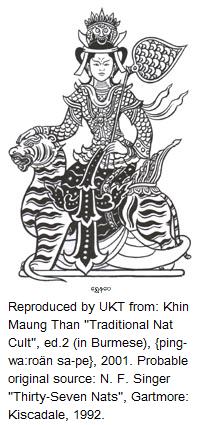
UKT: Entry number 4 of Dr. Htin Aung's Folk Elements in Burmese Buddhism
Picture right was from U Khin Maung Than Traditional Nat Cult
whose original source seemed to be Noel F. Singer Thirty-Seven Nats Gartmore: Kiscadale, 1992.
Singer's illustrations were quite different from that of Sir Richard C. Temple Thirty-Seven Nats,
Griggs, London, 1906.
Click to see
R.C. Temple's nats.
U Po Kya described the image as: standing on lotus platform;
head-dress in the form of the head and hood of a naga,
conical ear-ornament, right-hand on chest, left-hand down.
Reproduced by UKT from: Khin Maung Than "Traditional Nat Cult", ed.2
(in Burmese), {ping-wa:roän sa-pe}, 2001. Probable original source:
N. F. Singer "Thirty-Seven Nats", Gartmore: Kiscadale, 1992.
The Lady Golden Sides
 {rhwé-na.Bé nat} (no.4), Lady Three Times Beautiful
 {thoän:pan-lha.} (no.5), Little Lady with the Flute
 {ma. nhè: lé:} (no.6), Brown Lord of Due South
 {maung-rhin-ño} (no.7), and White Lord of the North
 {maung-rhin-hpru} (no.8) are Pyu gods who were [{p085}] worshipped at
Prome
{maung-rhin-hpru} (no.8) are Pyu gods who were [{p085}] worshipped at
Prome
 {præÑ mro.} and were later worshipped at Pagan. The Lady Golden Sides
obtained her name from the special robe she was entitled to wear,
a robe with trimmings of gold. She was from Mindon
{præÑ mro.} and were later worshipped at Pagan. The Lady Golden Sides
obtained her name from the special robe she was entitled to wear,
a robe with trimmings of gold. She was from Mindon
 {ming:toan:mro.}, a town behind Thayetmyo
 {tha.rak-mro.} on the right (western) bank of the Irrawaddy
 {É-ra-wa.ti-mric}. According to legend, she was either the Naga-King's daughter
 {na.ga: ming: tha.mi:}, who was forsaken by her human husband,
or a human woman who was forsaken by her Naga
{na.ga: ming: tha.mi:}, who was forsaken by her human husband,
or a human woman who was forsaken by her Naga
 {na.ga:} lover, as a result of which she died of grief.
My (Dr. Htin Aung's) family has belonged to MIndon
{ming:toan:mro.} since the
Prome period of Burmese history and, until the First Anglo-Burmese War of 1824,
Mindon was the capital of the
'Seven Hill Districts'
which lay between Arakan and the Irrawaddy. The Lady Golden Sides
was one of my family ancestors and, according to tradition in our family,
she was appointed to succeed her husband as the king's representative
at MIndon, as both her sons were in the service of the king at Prome.
(It may be mentioned that under the Burmese kings no official was hereditary but,
other things being equal, the son or brother, or occasinonally
the widow of a deceased official, was often chosen by the king
as his successor.)
After her death Lady Golden Sides was worshipped as a Nat-goddess
by the people of Mindon. When
Prome fell
some time later, the king and his people escaped across
the Irrawaddy and remained as wandering refugees for some twelve years,
spending three years at Mindon.
fn085-01
When the king and his followers migrated north to
the region which was to be come the kingdom of Pagan,
they had added Lady Golden Sides to their list of Pyu gods
and goddesses. Lady Golden Sides is still worshipped at Mindon,
but she is worshipped in her own right as the guardian-goddess
of the town, and not as one of the Thirty-seven Lords.
It may be mentioned that in our family she is remembered
but never worshipped, and according to our family tradition
she died of grief when her two sons were executed by the king.
Neither the local [{p086}] tradition at Mindon nor
our family tradition makes her a Naga. Yet the very old ritual
song relating to her as one of the Thirty-seven begins with the words:
For the golden Naga to wear,
Bring we a robe of satin-velvet.
The song seems appropriate as it gives the emphasis to the robe of satin-velvet --
the robe trimmed with gold, but it is difficult to understand how the goddess became
associated with the cult of Naga worship. Her image at the Shwezigone Pagoda shows no
trace of her connexion with the Naga. It is true that later figures found in various
Nat-shrines all over the country show the goddess wearing a head-dress with
the Naga hood, but the Goddess Golden Face is also shown in later wooden figures wearing
the same type of head-dress and she has never been associated with the Naga in any way.
It may be that the Lady Golden Sides became merged with a Naga-goddess,
for the worship of the Naga-dragon was prevalent in Tagaung
on the upper Irrawaddy and traces of the cult of the Naga
fn086-01
still exist at Tagaung to the present day in the worship
of 'Bobo Gyi of Tagaung', 'the Great Grandfather of Tagaung.'.
The cult spread to Pagan, and the Chronicles mention a king of Pagan,
before Anawrahta, setting up a great
image of the Naga in his garden for worship.
fn086-02
Before Pagan, the Naga is mentioned as one the builders of the city of Prome.
His tail was held by the King of the Gods while
he moved around in a circle, thus marking the circumference of the city.
Before the advent of Buddhism an image of the Naga was set up
with those of the village gods and goddesses outside
the eastern gate of a village. The mud volcanoes of Minbu
 {ming:Bu:} still have a tradition that Nagas live beneath,
and there still exist many villages whose names [{p087}]
refer to Nagas, as for example, 'the Naga-Hole', 'the Male Naga',
'When the Naga Descends (into the earth)', 'When the Naga is Angry'.
In the Popa Hills, and in some parts of the Shan States,
there still remain traces of a snake-cult. It may
well be that there was a Naga god or goddess among the Thirty-six gods, or even
that the Tagaung Dragon was one of the Thirty-six, whom Anawrahta replaced with
the Nat spirit of one of his own heroes.
{ming:Bu:} still have a tradition that Nagas live beneath,
and there still exist many villages whose names [{p087}]
refer to Nagas, as for example, 'the Naga-Hole', 'the Male Naga',
'When the Naga Descends (into the earth)', 'When the Naga is Angry'.
In the Popa Hills, and in some parts of the Shan States,
there still remain traces of a snake-cult. It may
well be that there was a Naga god or goddess among the Thirty-six gods, or even
that the Tagaung Dragon was one of the Thirty-six, whom Anawrahta replaced with
the Nat spirit of one of his own heroes.
Contents of this page
UKT: Entry number 5 of Dr. Htin Aung's Folk Elements in Burmese Buddhism
Picture right was from U Khin Maung Than Traditional Nat Cult
whose original source seemed to be Noel F. Singer Thirty-Seven Nats
Gartmore: Kiscadale, 1992. Singer's illustrations were quite different from that
of Sir Richard C. Temple Thirty-Seven Nats, Griggs, London, 1906. Click to see
R.C. Temple's nats.
U Po Kya described the image as: standing on belu-platform above elephant,
hair in knot, right-hand on chest, left-hand down.
The second Pyu Goddess, the Lady Three Times Beautiful, was a village maiden
whose beauty surpassed man's imagination. She was beautiful
'in the morning, at midday, and at night', and her fame reached
the ears of her king, the great Duttabaung
 {dwat~ta.baung}. He sent a nobleman to fetch her to be crowned queen of Prome. But
like Kyansittha and the Peguan princess of Pagan, the nobleman and Three Times
Beautiful fell in love on the way. When they reached the gates of Prome the
nobleman went in alone and announced to the King, 'Great King, her face is
beautiful, but her body is so monstrously fat that she cannot enter the gates of
the city.' Duttabaung believed him and ordered that she be abandoned. A hut was
built for her outside the city gates and she dwelt there, forgotten by the king
and forsaken by her lover. She earned her living as a weaver. In course of time
she gave birth to a little girl and then died of grief and became a Nat.
{dwat~ta.baung}. He sent a nobleman to fetch her to be crowned queen of Prome. But
like Kyansittha and the Peguan princess of Pagan, the nobleman and Three Times
Beautiful fell in love on the way. When they reached the gates of Prome the
nobleman went in alone and announced to the King, 'Great King, her face is
beautiful, but her body is so monstrously fat that she cannot enter the gates of
the city.' Duttabaung believed him and ordered that she be abandoned. A hut was
built for her outside the city gates and she dwelt there, forgotten by the king
and forsaken by her lover. She earned her living as a weaver. In course of time
she gave birth to a little girl and then died of grief and became a Nat.
Contents of this page
UKT: Entry number 6 of Dr. Htin Aung's Folk Elements
in Burmese Buddhism
The Burmese name is
{ma. nhè: lé:} which, as Dr. Htin Aung had suggested,
means the 'Lady with the Flute'. However, since the spirit-medium assuming her
part usually spoke with a child's piping voice, the name could be referring to
the piping-voice rather than to an actual flute.
Picture right was from
U Khin Maung Than Traditional Nat Cult
whose original source seemed to be Noel F. Singer Thirty-Seven Nats
Gartmore: Kiscadale, 1992. Singer's illustrations were quite different from that
of Sir Richard C. Temple Thirty-Seven Nats, Griggs, London, 1906.
Click to see
R.C. Temple's nats.
U Po Kya described the image as: standing on lotus-throne-platform,
a child figure, {si:poän} on head, belt on waist, bead bangles on both hands
which were hanging down.
The daughter [the Lady Three-times Beautiful] is the third Pyu Goddess,
the Little Lady, and her name originally meant 'the Little Lady with the Flute'.
However, the image at Pagan and later wooden images do not show her playing a flute.
As Hindu gods, especially Krishna, a reincarnation of Vishnu,
are often shown playing on a flute, it seems logical to assume
that the Little Lady of Prome became merged with an earlier
Hindu goddess. Among [{p088}] the Thirty-seven Nats the Little Lady
is most charming, and she is the guardian-goddess
of little children and schoolboys and schoolgirls.
When a Burmese child smiles in his sleep it is believed
that the Little Lady is playing with him, and boys and girls
on the Little Lady is playing with him, and boys and girls
on the eve of their annual school examinations
make offerings of toys and tiny jackets and skirts to the little goddess.
Whereas Golden Face, Golden Sides, and Three Times Beautiful
are shown in the later wooden figures in the conventional
attitude depicting grief, right hand on the left breast,
the Little Lady is depicted as a plump little child,
with her chubby hands hanging free in the conventional attitude of joy,
and with long necklaces and large bracelets of solid gold.
Contents of this page
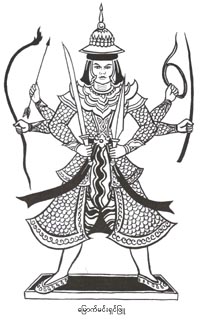
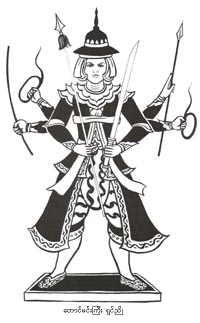
UKT: Entry numbers 7 and 8 of Dr. Htin Aung's
Folk Elements in Burmese Buddhism
Pictures right were from U Khin Maung Than Traditional Nat Cult
whose original source seemed to be Noel F. Singer Thirty-Seven Nats
Gartmore: Kiscadale, 1992. Singer's illustrations were quite different from that
of Sir Richard C. Temple Thirty-Seven Nats, Griggs, London, 1906.
Click to see
R.C. Temple's nats.
U Po Kya described the image of Shin Nyo as: lotus-platform, 6 hands -- 3 hands
on each side, one upper left-hand and one upper right-hand in supplication on
chest, remaining left-hands holding rod and whip, remaining right-hands holding
sword and spear, soldier-hat (mauk-to} on head and dressed in a soldier's
uniform. Shin Pyu also has six hands.
The Lord of Due South
{maung-shin-ño} (no.7), and the Lord of the North
{maung-shin-hpru} (no.8) were brothers who held high
office under King Duttabaung at Prome. They were tax officials, and the kingdom
was divided into two main tax regions, the north and the south. The term 'due
south' is used to distinguish this god from the Lord of the Great Mountain, as
the Burmese words for 'south' and 'mountain' are the same. They are also known
as the 'Brown Lord' and the 'White Lord' from the colour of the official robes
they wore. They became so powerful and popular with the people that the king
thought that they might rebel. According to the Chronicles fn088-01 they were put to
death by the king, but according the tradition of the Nat-worshippers they lost
their lives through the guile of the kin. They were great pugilists, and the
king made them box and wrestle with each other until both died through
exhaustion. An old tradition makes them the sons of the Lady Golden Sides,
but neither the local tradition at Mindon nor our own family tradition
remembers them. The Lady Golden Sides did have two sons [{p089}]
serving the king at Prome. They were later executed,
but no details of these sons are remembered.
Just as the Lady Golden Sides is worshipped by herself at Mindon, and not as a
member of the pantheon of the Thirty-seven, the Lords Brown and White were
worshipped separately from the others at Prome until recent years. In addition
to their usual names, in the Prome area they were called 'the Lords of the Royal
Cave', probably because their images were placed in a cave for worship.
These two gods are unique among the Thirty-seven, because whereas the other gods are
shown with the usual physical features of human beings, they are always shown with six
hands each. Two of the hands are folded in an attitude of worship, and the other
four hands are shown holding various weapons of war. They are dressed in the ancient
uniform of Burmese army commanders, with war helmets on their heads. Obviously
the Nat spirits of the Lords Brown and White had merged with some six-handed
Hindu gods who were known to the Pyus at Prome. The worship of these five Pyu gods
and goddesses was already in existence when the cult of the Lord of the
Great Mountain came into being, but there were attempts made to link these five
with the Lord of the Great Mountain and his sister, Golden Face. Some
spirit-worshippers insisted that the Lady Golden Sides became the lover of
Master Handsome while he was a fugitive at Mindon from Tagaung and,
therefore, the Lords Brown and White were the sons of the Lady Golden Sides and
Master Handsome. Moreover, in the Popa region the younger sister Master Handsome
and Golden Face, known as Youngest-Beautiful, has always been worshipped along
with the Brother and Sister, although she has never been admitted to the
circle of the Thirty-seven. Accordingly, some spirit-worshippers merged Three
Times Beautiful with Youngest-Beautiful, which would also bring her daughter,
the Little Lady, into the family of the Lord of the Great Mountain.
Contents of this page
fn084-01 For Myawaddi's list see
Appendix 1 to this chapter.
fn084-01b
fn084-01 For Myawaddi's list see
Appendix 1 to this chapter.
fn084-01b
fn085-01Tin & Luce, op. cit., p. 28.
fn085-01b
fn086-01 For the sake of completeness, some details of the cult
of the Naga are give here. Further details will be found in the
Appendix to this chapter.
fn086-01b
fn086-02 Tin & Luce, op. cit., p. 59
fn086-02b
fn088-01. Tin & Luce, Op., cit., p.18 fn088-01b
Contents of this page
Pix on right: BawBawGyi Pagoda near Prome. From Wikipedia
http://en.wikipedia.org/wiki/Pyay 081002
In reviewing this part, since I did not have at hand the Glass Palace Chronicle
of Tin and Luce, I had to refer to the original
The Glass Palace Chronicle (in Burmese),
Mandalay Royal Printing Press, 1829. Fourth printing in 1993 by Information
Ministry, Myanmar. In volume 1,on p187, we read the insert on the right.
First, we have to establish what Dr. Htin Aung had meant by "Prome'. It is
presumed to be Sri Ksetra aka
 {tha.ré-hkít~ta.ra}.
It was the largest Pyu city well outside the Pyu heartland of Samoan valley to
the south-east on the Irrawaddy river. It served as the trading centre of the
Pyu with trade links to Orissa in India. According to Glass Palace Chronicles
Sri Ksetra was founded in the year 544BC - the year of Buddha's {pa.ri.naib~baan}
(sp.to check). It flourished in the 7 A.D. (638 AD ?). It was destroyed by the
Mons.
{tha.ré-hkít~ta.ra}.
It was the largest Pyu city well outside the Pyu heartland of Samoan valley to
the south-east on the Irrawaddy river. It served as the trading centre of the
Pyu with trade links to Orissa in India. According to Glass Palace Chronicles
Sri Ksetra was founded in the year 544BC - the year of Buddha's {pa.ri.naib~baan}
(sp.to check). It flourished in the 7 A.D. (638 AD ?). It was destroyed by the
Mons.
All facts in the previous paragraph need to be checked. For reference to
• Samoan valley see A Pyu Homeland in the Samon Valley:
a new theory of the origins of Myanmar's early urban system by Bob Hudson -
Pyu-homeland.htm .
• Founding of Sri Ksetra -
moore-bricks.pdf
Taking this insert into consideration, the period referred to
Dr. Htin Aung seemed to be that of pre-Pagan period.
Go back
Fall-Prome-note-b
Contents of this page
The king who promoted the Naga worship was identified on p.223 of volume 1 of
The Glass Palace Chronicle (in Burmese), Mandalay Royal Printing Press, 1829,
4th printing in 1993 by Information Ministry, Myanmar, as Taungthugyimin
 {taung-thu-kri: min:} who was also known as Naung-u-saw-rahan
 {ñaung-U:sau:-ra.han:}. The year he became king of Pagan was given as 931 AD in
Pagan Historical Pagodas (in Burmese) by U Than Hswé, Research Officer, Archeology Department,
Yangon, 1st printing 1975, 11th printing p.17. Since Anawrahta ascended the throne in 1044 AD,
we can conclude that the official Naga worship in Pagan lasted over a hundred years.
Taungthugyimin was a simple cucumber farmer before he assassinated the previous king.
{ñaung-U:sau:-ra.han:}. The year he became king of Pagan was given as 931 AD in
Pagan Historical Pagodas (in Burmese) by U Than Hswé, Research Officer, Archeology Department,
Yangon, 1st printing 1975, 11th printing p.17. Since Anawrahta ascended the throne in 1044 AD,
we can conclude that the official Naga worship in Pagan lasted over a hundred years.
Taungthugyimin was a simple cucumber farmer before he assassinated the previous king.
Go back
naga-image-note-b
Contents of this page
As this is the name of a town
{præÑ mro.} , we should include the word
 {mro.} for <town>, though we drop it whenever there is no possibility of a mistake. The word
 {præÑ} by itself can also mean a <country> or a <city-state>. Thus for the
country or city-state of Pagan, we usually refer to it as
{præÑ} by itself can also mean a <country> or a <city-state>. Thus for the
country or city-state of Pagan, we usually refer to it as
 {pu.gän præÑ} usually pronounced (phonetically) as /bəgʌn prɪ/. Similarly, for
the word Irrawaddy, if it is the name of the river we usually refer to it
{E-ra-wa.ti-mric}. As with the names of towns, the word {mric} is dropped when
there is no possibility of a mistake.
{pu.gän præÑ} usually pronounced (phonetically) as /bəgʌn prɪ/. Similarly, for
the word Irrawaddy, if it is the name of the river we usually refer to it
{E-ra-wa.ti-mric}. As with the names of towns, the word {mric} is dropped when
there is no possibility of a mistake.
Go back
Prome-note-b
Contents of this page
The area around
{præÑ mro.} was part of the ancient
 {pyu} territory of the pre-Pagan period. However,
{præÑ mro.} came to be ruled by sub-kings paying tribute to a much stronger neighbour
such as Pagan, Hanthawaddy or Ava. The the period referred to as the Prome period is
not specific. Continued in Fall of Prome.
{pyu} territory of the pre-Pagan period. However,
{præÑ mro.} came to be ruled by sub-kings paying tribute to a much stronger neighbour
such as Pagan, Hanthawaddy or Ava. The the period referred to as the Prome period is
not specific. Continued in Fall of Prome.
Go back
Prome-period-note-b
Contents of this page
Consisting of seven townships:
1. {ming:toan:}, 2. {ming:tup}, 3. {mro.thic},
4. {pan:taim:}, 5. {nan:tau:}, 6. {taing-ta:},
and 7. {nga.hpè:}.
During the reign of the Burmese kings, the mayor of MIndon
{ming:toan:mro.} ruled over these seven townships with the power of life and death
 {thak-U:hsän-peing} -- Myanmar Encyclopedia, vol.9, p.238.
Go back
SevenHill-note-b
Contents of this page
End of TIL file