
Cult of Naga
Naga in Buddhism
ch05-magus.htm
Maung Htin Aung. Printed and published by U Myint Maung, Deputy Director, Regd: No (02405/02527) at the Religious Affairs Dept. Press. Yegu, Kaba-Aye P.O., Rangoon, BURMA. 1981.
Set in HTML by the staff of TIL and edited by U Kyaw Tun, M.S. (I.P.S.T., U.S.A.). Not for sale. Prepared for students of TIL Computing and Language Center, Yangon, MYANMAR.
Contents of this page
Cult of Naga
Naga in Buddhism
UKT notes
• Burmese village •
King Duttabaung • Naga's head •
Naga in the sky • Tagaung
Contents of this page
contd from p109
The Cult of the Naga [big snake-like creature] was the one pre-Buddhist cult which did not recover from Anawrahta's suppression. At the present day the Naga is not worshipped at all, and there remain only two faint traces fn109-01 of the original cult. As part of the initiation ceremony, the Burmese boy is 'shown' to the Naga at the western gate of a northern or Upper Burmese village. ¶UKT
[For distant travelling], people avoid, as much as possible, going in a direction which is not 'according to the Naga's head'. In the first, second and twelfth months of the Burmese year, the Naga's head is turned towards the west, with the tail pointing east. In the sixth, seventh and eighth months this process is reversed. In the third, fourth and fifth months the head faces the north and the tail the south. This process is reversed in the ninth, tenth and eleventh months.
If one goes into the Naga's mouth, disaster will result, and if one goes against the direction of the Naga's scales, ill-luck will follow; for example, during the months in which [{p110}] the Naga's head is turned towards the east, one must absolutely avoid journeys from due east to due west, and avoid as much as possible journeys from due west to due east. The origin of the belief can no longer be traced and it is not possible to know, or even guess, which particular Naga is being referred to: in fact, if is not even known whether this Naga is in the sky or at the bottom of the ocean, or in the bowels of the earth.
As has been stated above, the worship of the Naga was prevalent in the kingdom of Tagaung. The Burmese Naga is similar in many ways to the Indian Naga and the Chinese Dragon, but it is difficult to say whether the worship of the Naga was originally a native cult or borrowed from the neighbouring regions of Manipur [in the west] and Yunnan [in the east]. Moreover, the worship of the Naga could have developed from the worship of the snake and, as has been noted above, in the Shan state and at Popa there are traces of a snake-cult. However, in these regions it is not so much the snakes, but their Nat masters who are worshipped. Thus, the Burmese snake-charmer goes to the Popa region, makes his offerings to the Popa Nats, promises to bring back the snakes within three years, and then proceeds to trap some cobras. The Burmese consider the Naga to be half animal and half spirit and do not identify it with the snake, with the result that, unlike the Southern Indians, they set upon and kill snakes, including cobras, whenever they find them.
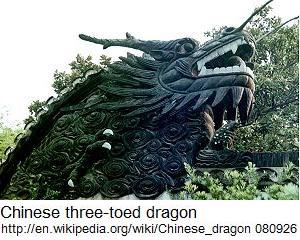
UKT: When we note that the Burmese Naga does not have legs, and that the Chinese dragon has them (and toes on the legs), we can see that they are entirely different. The Burmese Naga is a semi-aquatic or aquatic creature and always lives under the sea or a deep lake. If the naga is living inland, it lives in a very deep hole very near a body of water.
In many ways, the Burmese Naga and Indian Nag are similar.
The Burmese Naga is dangerous when angered, and its mere frown turns the human being into ashes. Even when not angry its breath can blind a human being as it is so hot. It can assume human form and, on the whole, it is a benevolent being. The Burmese believe that Nagas live at the bottom of deep rivers, seas and oceans and in the bowels of the earth. Although they can fly in the air they do not do so too often because they will become exposed to attacks from their eternal enemies, the galon (garuda) birds. Just as the great [{p111}] Asoka of India had Naga retainers, an early king of Pagan was, according to the Chronicles, attended by an army of Naga youths. Naga workmen helped in the building of a palace at Tagaung and, when the palace was completed, the king of the Nagas himself assisted in the coronation ceremonies of the king. A Naga king assisted in the foundation of the city of Prome and gave his daughter as a second queen to the king, Duttabaung, together with a wondrous ocean going boat covered with Naga's scales. However, towards the end of his reign there was a quarrel between the Nagas and the king, and as he was travelling in the boat near the seaport of Bassein, the Nagas appeared from below a whirlpool and took back their boat, with the result that the king was drowned. The whirlpool still exists at the present day and it is called the 'whirlpool of 'Naga-yit' {na.ga:ric}, which means 'where the Nagas twist and turn'. One of the early kings of Pagan, the hero Pyusawhti, was the ward of a Naga king and queen who lived in a hole in a garden on the side of a hill, and who were worshipped with offerings of food and flowers by the people of the nearby villages. The king of Pagan, Nyaung-U Sawrahan [aka Taungthugyi Min], whom Anawrahta's father dethroned, built Buddhist temples, but he also set up the image of a Naga in a garden for worship. fn111-01
 The cult of the Naga did not reappear after the death
of Anawrahta, because long before A.D. 1056 Buddhist literature had modified the
pre-Buddhist conception of the Naga, and the Nagas were shown to
be adherents of Buddhism and devout worshippers of the Buddha. The Naga
tradition in Buddhism began with an episode in the life of the Buddha. After
attaining Buddhahood, the Buddha spent seven weeks in continuous meditation in
the vicinity of the Bodhi Tree, and the sixth of the seven weeks was spent on
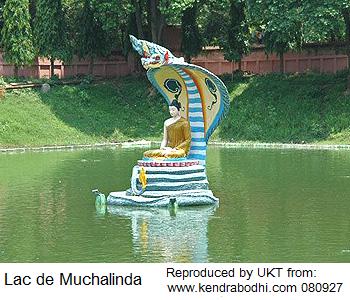
the shore of the [{p112}] Mucalinda Lake, a few yards away from the Tree; there blew a
great storm, and the Naga king [named Mucalinda: "king" or {ming:} is just an
honorific suffix], who lived in a tree nearby, sheltered the
Buddha by winding his coils seven times round the meditating Buddha's body and
holding his hood over the Buddha's head.
fn112-01 The depiction of the meditating Buddha
protected by the coils of the Naga king later became a popular motif in
Buddhist art and sculpture. The Buddha subdued one fierce Naga near a
hermitage, and later the Great Naga who lived on Mount Mayyu. A Naga king
was present when the relics of the Buddha were being distributed after
the cremation of the body. In the Buddhist literature of Ceylon, the Naga
appeared often. The Buddha made a special visit to the north of Ceylon to bring
peace between the Nagas who were fighting among themselves. When the
Branch of the Bodhi Tree was being brought to Ceylon by sea, the Nagas
wanted it for themselves, but still afforded protection to the ship bringing the
Branch. When 'the Great Temple' was being built in Ceylon to enshrine some
relies of the Buddha, the Nagas contributed the relics in their
possession. In the face of such established Buddhist tradition the Burmese
Naga could no longer be worshipped separately from the Buddha.
The cult of the Naga did not reappear after the death
of Anawrahta, because long before A.D. 1056 Buddhist literature had modified the
pre-Buddhist conception of the Naga, and the Nagas were shown to
be adherents of Buddhism and devout worshippers of the Buddha. The Naga
tradition in Buddhism began with an episode in the life of the Buddha. After
attaining Buddhahood, the Buddha spent seven weeks in continuous meditation in
the vicinity of the Bodhi Tree, and the sixth of the seven weeks was spent on
the shore of the [{p112}] Mucalinda Lake, a few yards away from the Tree; there blew a
great storm, and the Naga king [named Mucalinda: "king" or {ming:} is just an
honorific suffix], who lived in a tree nearby, sheltered the
Buddha by winding his coils seven times round the meditating Buddha's body and
holding his hood over the Buddha's head.
fn112-01 The depiction of the meditating Buddha
protected by the coils of the Naga king later became a popular motif in
Buddhist art and sculpture. The Buddha subdued one fierce Naga near a
hermitage, and later the Great Naga who lived on Mount Mayyu. A Naga king
was present when the relics of the Buddha were being distributed after
the cremation of the body. In the Buddhist literature of Ceylon, the Naga
appeared often. The Buddha made a special visit to the north of Ceylon to bring
peace between the Nagas who were fighting among themselves. When the
Branch of the Bodhi Tree was being brought to Ceylon by sea, the Nagas
wanted it for themselves, but still afforded protection to the ship bringing the
Branch. When 'the Great Temple' was being built in Ceylon to enshrine some
relies of the Buddha, the Nagas contributed the relics in their
possession. In the face of such established Buddhist tradition the Burmese
Naga could no longer be worshipped separately from the Buddha.
Kyansittha attempted to bring the cult under his control by announcing that when he was hiding from the wrath of Anawrahta, he was sheltered by a Naga lad. He later named the particular place where this incident took place. Modern scholars have tried to give a rational explanation to this episode in Kyansittha's life by explaining that it was not a Naga but a cobra that Kyansittha was referring to, or that it was a young attendant from a nearby temple devoted to Naga worship that gave Kyansittha protection. However, such explanations are unnecessary when we remember Kyansittha's contention that he was a reincarnation of Vishnu and that he was a fellow-worshipper, in a previous existence, with the Lord of the Great Mountain. Just as he allowed the builders [{p113} of his palace to devote one whole day to ceremonies connected with the worship of the Lord of the Great Mountain and one whole day to those connected with Vishnu, so he permitted them to devote a whole day to ceremonies involving the worship of the Nagas. But although many of his courtiers themselves took part in the ceremonies held by the builders to propitiate the Nagas who had been disturbed when the foundations of the palace were laid, there was no popular revival of the Naga cult.
When Kyansittha later found that the people had accepted the new Buddhist conception of the Naga, he built a beautiful pagoda at the place where he was supposed to have been protected by the Naga lad, and named it 'the 'Naga-yone' meaning 'robed by the Naga', referring to the 'robing' of the Buddha by the Naga Mucalinda's coils. Later on, the name 'Naga-yone' became a term to describe an image of the Buddha with the coils of the Naga round his body, or a pagoda with large Naga figures around it. In fact, up to the present day the Naga is the most popular motif in Burmese art, both religious and secular.
fn109-01 In addition to local traces at Tagaung, Popa and Shan States, as already mentioned above. fn109-01b
fn111-01 The religion of this king is discussed in Chapter 9. fn111-01b
fn112-01 The Naga's name was Mucalinda, hence the name of the lake. fn112-01b
by UKT
Even though the actual shape of a Burmese village may not be rectangular or square, we can always orient ourselves by taking note of the points of the compass by imagining ourselves at the village centre. With this background information in mind, the statement "As part of the initiation ceremony, the Burmese boy is 'shown' to the Naga at the western gate of a northern or Upper Burmese village, ..." brings out one important point. The Naga shrine, if there is one, is at the western gate - the gate that is supposed to be non-auspicious. Of the four directions, we consider the eastern and southern gates to be auspicious or Mingala {mïn~ga.la} gates, and generally there would be the Nat shrine. Along the parameter of the village would be grown a special kind of catus plants (in northern villages) and bamboo ({kya-hkût} (sp. to check) (in southern villages). The village gates are usually closed at sundown and are guarded by the village officials under the authority of the village headman}. In small villages there would be only two gates, the eastern and western, or the southern and northern).
A stranger in the village is carefully noted for security reasons but every kind of hospitality would be shown to him by the village headman himself. Before the second World War, a traveller can always expect a place to sleep and free meals for a day (or two, for health reason) from the headman. The monastery of the village abbot and its adjoining pagoda are usually outside the village parameter, and a passing stranger can always expect a place to sleep at the monastery and a morning meal. If he were to arrive at the village at night, instead of entering the village, he could go to the monastery and beg the abbot for a place to sleep. However, since the monks do not eat after midday, he could not expect an evening meal, but the abbot would see to that he would not be hungry through out the night, and would usually give him bananas and palm jaggery, and of course, the plain Burmese tea.
The western and northern gates are considered to be non-auspicious or A'Mingala {a.mïn~ga.la} gates and usually there would be the cemetery. Back in the 1930's as a boy growing up in a small town (Kungyangon in Hanthawaddy district, now incorporated into Greater Yangon), we always avoid going near western end at night for fear of ghosts.
That the Naga is at the western end, and the Nat is at the eastern end shows that the Burmese villager would look upon the Naga (if there is a belief in Naga cult in the particular village) for protection, but would not place him on the same level as the Nat.
Go back Bur-villa-note-b
 {dwat~ta.Baung} -- the founder of a Pyu dynasty and builder of Sri Ksetra
 {tha.ré-hkit~ta.ra}. According to The Glass Palace Chronicle (in Burmese),
(GPC-Bur)
vol. 1, p.170, the city of {tha.ré-hkit~ta.ra} was built 101 years after the
death of the Gautama Buddha. Since the accounts of the building the city and the
reign and the death of the king were full of mythical creatures, modern
historians tend to dismiss the whole period of this part of Burmese history as
irrelevant. Even though the name of city, as rendered by the English speaking
modern historians, sounds Hindu or Brahmanical, the first part of the Burmese
name was {tha.ré} and not {thi-ri.} as it should have been if the Burmese had
recognized the city to be of Brahmanical origin. Though my argument appears
weak, I must cite the name of another city -- Thiripyissaya
{tha.ré-hkit~ta.ra}. According to The Glass Palace Chronicle (in Burmese),
(GPC-Bur)
vol. 1, p.170, the city of {tha.ré-hkit~ta.ra} was built 101 years after the
death of the Gautama Buddha. Since the accounts of the building the city and the
reign and the death of the king were full of mythical creatures, modern
historians tend to dismiss the whole period of this part of Burmese history as
irrelevant. Even though the name of city, as rendered by the English speaking
modern historians, sounds Hindu or Brahmanical, the first part of the Burmese
name was {tha.ré} and not {thi-ri.} as it should have been if the Burmese had
recognized the city to be of Brahmanical origin. Though my argument appears
weak, I must cite the name of another city -- Thiripyissaya
 {thi.ri.pic~sa.ya}, where the first part of the name is {thi-ri.} and not {tha.ré}.
This shows that the Burmese tend to differentiate the two prefixes.
{thi.ri.pic~sa.ya}, where the first part of the name is {thi-ri.} and not {tha.ré}.
This shows that the Burmese tend to differentiate the two prefixes.
Go back duttabaung-note-b
There are
two different naga (note -- there in no differentiation between singular and
plural in Burmese-Myanmar) involved in this paragraph:
1. Naga as the nat
in the nat-shrine.
2. Naga according to a rhyme: naga head facing:

Unfortunately, Dr. Htin Aung's presentation was misleading because, he had focused on the reversal of the direction.
Go back naga-head-note-b
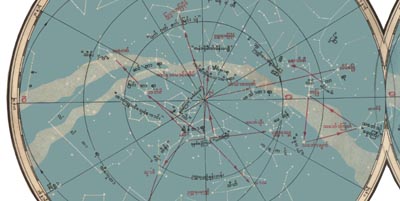
The Naga in the sky is actually the Milky Way as seen in the night sky. See insert -- the head of the Naga is on the right side of the insert while the tail is on the left. The Pole Star is in the centre. From: Map of Union of Myanmar and the World (in Burmese), by Dr. Daw Thin Kyi, et.al., {tha.ma-meit~ta.}, 1956, p.5. See a full account of the Breath of Naga in Nakshatra in the Sky (in Burmese), by U Tézaniya et.al, B.E.T. Press, Yangon, 1967
Go back naga-sky-note-b
According to
tradition {mran-ma a.sa. ta.kaung: ka.} -- meaning "the origin of Myanmar was
Tagaung", Myanmar as a kingdom and then a country had
its beginnings at the time of Gautama Buddha about 500 years B.C. From Tagaung,
the capital shifted to Sri Ksetra {tha.ré-hkít~ta.ra}, and then to Pagan. From
Pagan, the capital shifted to Pinya, to Sagaing, to Ava (Innwa), to Ammarapura,
and finally to Mandalay under the Burmese kings. See U Ba Than Myanmar Razawin p.32. Under
the British and until now the capital is Rangoon (Yangon).
Modern historians, in particular Professor Luce and U Pe Maung Tin, and
their former student Dr. Than Tun of Rangoon University, dismissed the accounts given by the Burmese sources
such as Glass Palace Chronicles on Tagaung and Sri Ksetra to be of little historical value because the accounts are
full of mythical beings such as the King of the Nats and Nagas. However, there
is enough archeological evidence that the accounts given in Burmese sources are
built on actual events, though garnished by explanations not acceptable in
modern times.
Go back tagaung-note-b
End of TIL file