Update:
2008-10-01 08:32 PM +0800
TIL
Folk Elements in Burmese Buddhism
ch06-1-mahagiri.htm
Maung Htin Aung. Printed and published by U Myint Maung,
Deputy Director, Regd: No (02405/02527) at the Religious Affairs Dept. Press. Yegu,
Kaba-Aye P.O., Rangoon, BURMA. 1981.
Set in HTML by the staff of TIL and edited by U Kyaw Tun,
M.S. (I.P.S.T., U.S.A.). Not for sale. Prepared for students of TIL Computing
and Language Center, Yangon, MYANMAR.
indx-myan |
Top
indx-folk
Contents of this page
Lord of the Great Mountain
Great mountain
Mighty men
Need for a new religion
Mr. Handsome and Ms. Golden Face
(brother and sister)
Worship
of the Lords of the Great Mountain established as a national cult
Author's notes
UKT notes
• Burmese and Mons • Burmese
era • Earthquake and rise of Mount Popa •
Forest of Refuge
UKT: This page has been modified extensively, and the reader is advised
to refer to the originals before using its textual content paying attention
to the accuracy of the source and the page numbers.
The reader is reminded that since I am descended from both the
Burmese and Mon ethnic stocks, I am writing this text as an introduction to
my own life story. Moreover, since the story is about Upper or Central
Myanmar centering Mount Popa from whence my paternal Burmese ancestors
originate, I am treating it as a message to my own grandsons both born
outside the country of my birth - Myanmar.
Contents of this page
p061
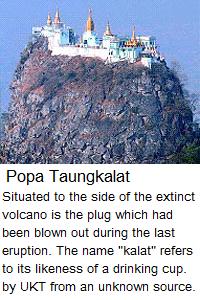 Mount Popa
 {poap-pa:} is not very high. It is about three thousand feet in height and it stands
on a level plateau of some eight hundred feet. The plain on which the plateau stands
itself is about a thousand feet above sea level. However, Mount Popa seems to be
a great mountain because it stands solitary, almost in the centre of the plain of Myingyan.
It has stood sentinel over the varying fortunes of the
Burmese people, whose first settlements in the middle Irrawaddy valley were in the Myingyan plain. It is an extinct volcano whose subterranean
fires first saw daylight some two hundred and fifty thousand years ago, but whose
raging fires died out only in historic times. According to the Burmese Chronicles,
in 442 B.C. there was a great earthquake and Mount Popa
'rose like a cone from the plains'. There is a crater at the top of the cone,
but one side of the crater had been blown away during one of the volcano's many eruptions.
The crater is about a mile in width and about two thousand feet deep. The presence
of volcanic ash makes the soil fertile, and the high ground catches the moisture
from the clouds. Therefore, while the Myingyan plain itself is parched and bare
of vegetation, Mount Popa is covered by a
green forest.
Even nowadays there are many flowering trees, though in ancient times the slopes
of the hill were wholly covered with flowering trees which led to the hill being
called 'Popa' which, in Sanskrit, means 'Flowers'. Thus to the early Burmese it
was the 'mountain of flowers', and it was also the 'great mountain,' the 'golden mountain'.
[{p062}]
{poap-pa:} is not very high. It is about three thousand feet in height and it stands
on a level plateau of some eight hundred feet. The plain on which the plateau stands
itself is about a thousand feet above sea level. However, Mount Popa seems to be
a great mountain because it stands solitary, almost in the centre of the plain of Myingyan.
It has stood sentinel over the varying fortunes of the
Burmese people, whose first settlements in the middle Irrawaddy valley were in the Myingyan plain. It is an extinct volcano whose subterranean
fires first saw daylight some two hundred and fifty thousand years ago, but whose
raging fires died out only in historic times. According to the Burmese Chronicles,
in 442 B.C. there was a great earthquake and Mount Popa
'rose like a cone from the plains'. There is a crater at the top of the cone,
but one side of the crater had been blown away during one of the volcano's many eruptions.
The crater is about a mile in width and about two thousand feet deep. The presence
of volcanic ash makes the soil fertile, and the high ground catches the moisture
from the clouds. Therefore, while the Myingyan plain itself is parched and bare
of vegetation, Mount Popa is covered by a
green forest.
Even nowadays there are many flowering trees, though in ancient times the slopes
of the hill were wholly covered with flowering trees which led to the hill being
called 'Popa' which, in Sanskrit, means 'Flowers'. Thus to the early Burmese it
was the 'mountain of flowers', and it was also the 'great mountain,' the 'golden mountain'.
[{p062}]
Throughout human history people of all races have pictured their gods and
goddesses as living on a mountain. The Buddhists believe that their gods and
goddesses live on Mount Mayu, just as the Ancient Greeks believed that their
gods and goddesses dwelt on Mount Olympus. In the same way, the early Burmese
came to believe that Mount Popa was the home of their gods and goddesses. They
came to believe, too, that beautiful ogresses, who lived not on flesh but on
flowers, played hide-and-seek in the groves of Mount Popa, and that on its
slopes there wandered magicians and alchemists in search of potent herbs and
roots. In the flower-forests of the hill, moreover, there actually lurked
robbers and outlaws. Anawrahta himself, while striving to regain his father's
throne usurped by another, formed his army on the slopes of Mount Popa.
Kyansittha, after the defeat of the forces of Anawrahta's son by the Peguan
rebels, led the remnants of the Burmese army to Popa Hill to be re-equipped and
reorganized. Perhaps at one time the hill itself was worshipped as separate from
the gods and goddesses, and it was probably considered to be 'a hallowed ground
of victory' whose very touch would give success to 'men of endeavour' in their
'mighty undertakings'.
Contents of this page
'Mighty men of endeavour'
 {thu-rè:kaung:} were greatly feared by the king in the early periods
of Burmese history because they were likely to seize the throne with the support
of the people. On the other hand, if they were not too ambitious or mighty they
would be given high posts in the king's army. One of the main aims of magic and
alchemy, in fact, was the evolution of a body which was not only invulnerable
but also prodigiously strong. The emphasis was not only on valour but also on
physical might. Anawrahta himself had four famous generals in his army, three of
whom were physically mighty, the first being a great swimmer, the second a great
runner, and [{p063}] the third a great climber. However, the fourth, the great Kyansittha, was not
exceptionally strong, but he was the most skilful because he was the most
intelligent. Anawrahta himself was not a mighty man and was always careful to
demonstrate that his superior intelligence and his god-given lance were more
powerful than unusual brute strength.
{thu-rè:kaung:} were greatly feared by the king in the early periods
of Burmese history because they were likely to seize the throne with the support
of the people. On the other hand, if they were not too ambitious or mighty they
would be given high posts in the king's army. One of the main aims of magic and
alchemy, in fact, was the evolution of a body which was not only invulnerable
but also prodigiously strong. The emphasis was not only on valour but also on
physical might. Anawrahta himself had four famous generals in his army, three of
whom were physically mighty, the first being a great swimmer, the second a great
runner, and [{p063}] the third a great climber. However, the fourth, the great Kyansittha, was not
exceptionally strong, but he was the most skilful because he was the most
intelligent. Anawrahta himself was not a mighty man and was always careful to
demonstrate that his superior intelligence and his god-given lance were more
powerful than unusual brute strength.
Contents of this page
The kingdom of Pagan was, in the beginning, merely a cluster of nineteen
villages. Under King
Thinlikyaung
 {thíñ-læÑ-kraung}, who according to the Chronicles flourished in A.D. 344-387
but who possibly reigned later than these dates, the villages felt strong enough to
form themselves into a city, and thus Thiripyissaya
{thíñ-læÑ-kraung}, who according to the Chronicles flourished in A.D. 344-387
but who possibly reigned later than these dates, the villages felt strong enough to
form themselves into a city, and thus Thiripyissaya
 {thi.ri.pic~sa.ya} came to be built on the bank of the river Irrawaddy. It was the forerunner
of the city of Pagan. At that time the religion of the people must have been very similar to
that form of animism now practised by the remoter hill peoples of Burma. Nat spirits were
worshipped everywhere in the country but each village restricted its worship to its own local Nats.
It would seem that both the king and the people were looking for a Nat which would be worshipped
all over the country, and which would become a national Nat, to be distinguished from a local Nat.
In other words, they were looking for a new religion which would bind the various tribes of
the kingdom into a nation.
{thi.ri.pic~sa.ya} came to be built on the bank of the river Irrawaddy. It was the forerunner
of the city of Pagan. At that time the religion of the people must have been very similar to
that form of animism now practised by the remoter hill peoples of Burma. Nat spirits were
worshipped everywhere in the country but each village restricted its worship to its own local Nats.
It would seem that both the king and the people were looking for a Nat which would be worshipped
all over the country, and which would become a national Nat, to be distinguished from a local Nat.
In other words, they were looking for a new religion which would bind the various tribes of
the kingdom into a nation.
UKT: Dr. Htin Aung's conjecture that "the religion of the people must
have been very similar to that form of animism now practised by the remoter
hill peoples of Burma" is questionable. His view was probably due to the
view of the British colonial historians who summarily set aside the accounts
of the Burmese chronicles such as the Glass Palace Chronicles on the history
of the Pyus as without creditable evidence. Since metal works have been
found around the original 19 villages, the culture and technology of the
people must have been high.
Contents of this page
At that time, according to the Chronicles, there was another kingdom to the
north, the kingdom of Tagaung {ta.kaung:}; here, a great tragedy had occurred.
On the outskirts of the city of Tagaung there lived a mighty blacksmith, whose son
became even mightier. This son had a perfectly proportioned body and came to be
known as Mr. Handsome
 {maung ting. tèý}. Even as a young boy Mr. Handsome was a great eater, but when he attained
[{p064}] full manhood it was said that he ate a quarter-basket of rice
fn064-01 at every
meal. When he took over his father's smithy he wielded two hammers; with his
right hand he held and iron hammer weighing fifty viss, and
with his left hand he held another weighing twenty-five viss. When Mr. Handsome
worked his smithy and when he used his hammers against the anvil, the whole city
quaked and trembled. (It seems obvious that this account of Mr. Handsome preserves a memory
of the various earthquakes in prehistoric and historic times which occurred in
north Burma, especially when Popa was still active.) The news of this mighty man
reached the king of Tagaung, who, fearing rebellion, ordered the arrest of Mr.
Handsome. The blacksmith was warned in time and took to the
forest.
{maung ting. tèý}. Even as a young boy Mr. Handsome was a great eater, but when he attained
[{p064}] full manhood it was said that he ate a quarter-basket of rice
fn064-01 at every
meal. When he took over his father's smithy he wielded two hammers; with his
right hand he held and iron hammer weighing fifty viss, and
with his left hand he held another weighing twenty-five viss. When Mr. Handsome
worked his smithy and when he used his hammers against the anvil, the whole city
quaked and trembled. (It seems obvious that this account of Mr. Handsome preserves a memory
of the various earthquakes in prehistoric and historic times which occurred in
north Burma, especially when Popa was still active.) The news of this mighty man
reached the king of Tagaung, who, fearing rebellion, ordered the arrest of Mr.
Handsome. The blacksmith was warned in time and took to the
forest.
UKT: viss
 {peith~tha} -- the Burmese unit of weight equal to approximately 1.6 kg.
 The disappointed king now stooped to treachery. Now Mr. Handsome had a younger
sister who was very beautiful. The king raised her to be his queen, and after
some months told her, 'I no longer fear your brother because he is now my
brother also. Invite him to Tagaung and I shall make him governor of the city.'
The sister believed the king and sent messengers to Mr. Handsome, who came to
Tagaung, unsuspectingly. But he was at once seized by the king's soldiers and
tied to a Saga tree
The disappointed king now stooped to treachery. Now Mr. Handsome had a younger
sister who was very beautiful. The king raised her to be his queen, and after
some months told her, 'I no longer fear your brother because he is now my
brother also. Invite him to Tagaung and I shall make him governor of the city.'
The sister believed the king and sent messengers to Mr. Handsome, who came to
Tagaung, unsuspectingly. But he was at once seized by the king's soldiers and
tied to a Saga tree
 {sa.ka:pin} fn064-02
on the bank of the Irrawaddy. The king, together with his queen and his court,
now came on the scene, and he ordered that a huge fire be lit at the feet of
the helpless blacksmith. As her brother writhed in agony in the fire the queen
suddenly shook herself free from her maids-of-honour and rushed into the fire
to die with him. The king, who had learnt to love her, tried to save her by
pulling her back by the hair. But it was too late. Only her beautiful face
was saved, as the rest of her body had burnt even in that short space of time.
Later on, when she was worshipped as a Nat spirit, this was remembered and
she was affectionately called 'Golden [{p065}]
Face'
{sa.ka:pin} fn064-02
on the bank of the Irrawaddy. The king, together with his queen and his court,
now came on the scene, and he ordered that a huge fire be lit at the feet of
the helpless blacksmith. As her brother writhed in agony in the fire the queen
suddenly shook herself free from her maids-of-honour and rushed into the fire
to die with him. The king, who had learnt to love her, tried to save her by
pulling her back by the hair. But it was too late. Only her beautiful face
was saved, as the rest of her body had burnt even in that short space of time.
Later on, when she was worshipped as a Nat spirit, this was remembered and
she was affectionately called 'Golden [{p065}]
Face'
 {rhwé-myak-nha} . Thus the brother and sister died and they became Nat spirits and made
their abode on the Saga tree. In their anger against the treacherous king the
two spirits killed all the animals and human beings who came under the
shade of the tree. The king was frightened and ordered that the tree be cut down
and the trunk floated down the river. After some days the trunk of the Saga tree
reached the new city of Thiripyissaya, where King Thinlikyaung and his people
waited, for the account of the two Nat spirits had reached them. Here was the
opportunity to establish a new religion or at least a new cult. The king's
carvers soon carved out of the tree trunk images of the brother and sister, and
then covered them with gold.
{rhwé-myak-nha} . Thus the brother and sister died and they became Nat spirits and made
their abode on the Saga tree. In their anger against the treacherous king the
two spirits killed all the animals and human beings who came under the
shade of the tree. The king was frightened and ordered that the tree be cut down
and the trunk floated down the river. After some days the trunk of the Saga tree
reached the new city of Thiripyissaya, where King Thinlikyaung and his people
waited, for the account of the two Nat spirits had reached them. Here was the
opportunity to establish a new religion or at least a new cult. The king's
carvers soon carved out of the tree trunk images of the brother and sister, and
then covered them with gold.
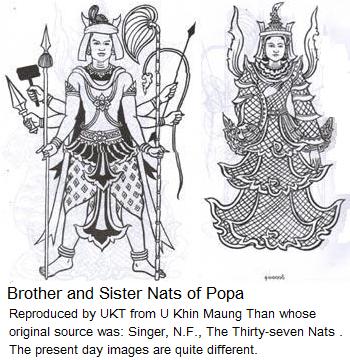
UKT: Pictures above were from
U Khin Maung Than Traditional Nat Cult
whose original source seemed to be Noel F. Singer Thirty-Seven Nats
Gartmore: Kiscadale, 1992. Singer's illustrations were quite different from that
of Sir Richard C. Temple Thirty-Seven Nats, Griggs, London, 1906. Click
to see R.C. Temple's nats.
U Po Kya described the image of Minmahagiri as: standing on belu platform on
white-elephant, dressed like a prince with {baung:} head-dress, conical ear
ornament, and crossed-sash, fan in left-hand and sword in right-hand. U Po Kya
further described the image of sister as: standing on belu platform on black
female-elephant, right-hand on chest with thumb and pointer-finger holding a Terminalia
citrina fruit {kra.su.thi:}, left-hand hanging down.
Minmahagiri is also known as {pan:bè: maung-ting.tèý}, the Burmese
word {pan:bè:} meaning <black-smith>. Notice the hammer in one of hands of the
image of the brother in the above pictures.
Contents of this page
p065
It was near the time of the full moon, and according to the English calendar it
was December. The fields had been reaped, the harvest had been successfully
gathered, and the people were in festive mood. The images of the two Nats were
put on golden palanquins and attended by the king himself, they were carried
along the road to Mount Popa. Red was the colour associated with Nat spirits and
red flags and red streamers were carried by the people taking part in the
procession and by the people who lived along the route. Everyone danced and
sang, and when the procession halted at villages on the way, food and toddy-wine
flowed free. The procession reached the summit of Mount Popa on the full moon
day and a golden Nat shrine, newly constructed, awaited the two images. The
images were set up in the shrine with great pomp and ceremony, and the king
proclaimed that the village on the slope of the hill, Popa Ywa, was given as a
perpetual fief to the two Nat spirits. As spirit mediums danced in abandoned
joy, hundreds of white oxen, white horses, and white goats were sacrificed to
the Nat spirits.
It was the ninth month of the Burmese year, and it seemed
so propitious that the month associated with the magic number nine should now be associated
with the two Nats.
UKT: Ninth Month -- The names of the Christian year
from the month of September to December point out that they are actually the
ordinal numbers of the months: September -- the 7th, October -- the 8th,
November -- the 9th, and December -- the 10th. That indicated that February is
the last, and March is the first month of the year.
This order of the months bears a striking resemblance to the order
of the Burmese months: 1. {tan.hku:}, 2. {ka.hsoan}, 3. {na.yoan}, 4. {wa-hso},
5. {wa-hkaung}, 6. {tau-tha.lin:}, 7. {thi-tin:kyut}, 8. {tan-hsaung-moan:}, 9.
{nat-tau}, 10. {pra-tho}. 11. {ta.po.twè:}, 12. {ta.paung:}
The Ninth Month of the Burmese year is the {nat-tau} or the
"spirit-royal month". This should be compared to the Western tradition of <Haloween>
which is celebrated on the 31st of October.
Contents of this page
p066
Both were now given by the king the title of 'Lords of the Great Mountain'. The
brother was given the title in a Burmese-Pali form, 'Min Maha-Giri'
 {ming:ma.ha-gi.ri.}. (Min in Burmese means 'Lord', and Maha-Giri in Pali means 'Great Mountain'.)
The sister was given a title in its pure Burmese form, 'Taunggyishin', Taunggyi meaning
'Great Mountain' and Shin meaning 'Lord', However, the sister continued to be affectionately called
'Shwe-Myetnha', 'Golden Face'. The king further ordered that the month be renamed 'Nat-Taw', or
'the month of the Royal Nats', and fixed the full moon day in this month as the date of
the annual festival in honour of the Popa Nats. The name of the eighth month of the Burmese year,
Tazaung-mon {tan-hsaung-moan:}, means 'the month of the Festival of Lights', and before the advent
of the Lords of the Great Mountain the full moon day of this month was the occasion for the
offering of lights to the gods of the planets in particular and to all gods in general.
But the king now ordained that the festival of lights was to be held one month later,
in the month of Nat-Taw {nat.tau}.fn066-01
{ming:ma.ha-gi.ri.}. (Min in Burmese means 'Lord', and Maha-Giri in Pali means 'Great Mountain'.)
The sister was given a title in its pure Burmese form, 'Taunggyishin', Taunggyi meaning
'Great Mountain' and Shin meaning 'Lord', However, the sister continued to be affectionately called
'Shwe-Myetnha', 'Golden Face'. The king further ordered that the month be renamed 'Nat-Taw', or
'the month of the Royal Nats', and fixed the full moon day in this month as the date of
the annual festival in honour of the Popa Nats. The name of the eighth month of the Burmese year,
Tazaung-mon {tan-hsaung-moan:}, means 'the month of the Festival of Lights', and before the advent
of the Lords of the Great Mountain the full moon day of this month was the occasion for the
offering of lights to the gods of the planets in particular and to all gods in general.
But the king now ordained that the festival of lights was to be held one month later,
in the month of Nat-Taw {nat.tau}.fn066-01
Contents of this page
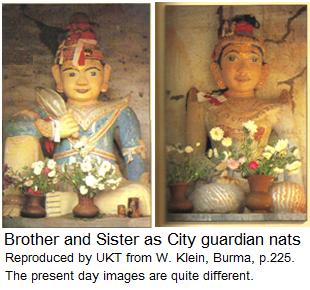 The kings who followed Thinlikyaung on the throne of Pagan continued the royal
patronage of the Maha-Giri spirits and the worship of these spirits became established as a
national cult. When the city of Pagan was built in A.D. 849
the figures of the 'Brother and Sister' were carved on the pillars of the main gate, to symbolize
the fact that they were the guardian Nats of the city and the people. Every king's first visit to
the mountain was considered as important as his coronation, and as the date of his coronation was
noted down carefully by palace officials, so the date of his 'climbing the Golden Mountain' was
carefully recorded. The Lord of the Great Mountain was believed to make himself visible to each
[{p067}] reigning king of Pagan and to advise him on important state affairs. When a monk
known as Popa Sawrahan
The kings who followed Thinlikyaung on the throne of Pagan continued the royal
patronage of the Maha-Giri spirits and the worship of these spirits became established as a
national cult. When the city of Pagan was built in A.D. 849
the figures of the 'Brother and Sister' were carved on the pillars of the main gate, to symbolize
the fact that they were the guardian Nats of the city and the people. Every king's first visit to
the mountain was considered as important as his coronation, and as the date of his coronation was
noted down carefully by palace officials, so the date of his 'climbing the Golden Mountain' was
carefully recorded. The Lord of the Great Mountain was believed to make himself visible to each
[{p067}] reigning king of Pagan and to advise him on important state affairs. When a monk
known as Popa Sawrahan
 {poap~pa: sau:ra.han:}, who had his monastery in the Popa region, became the king's chaplain and
was later elected to succeed him, the Lord of the Great Mountain refused to make himself visible
to the new king, since he was not of royal bone'. Some years later the king had a daughter born
to him, and when she was of age he married her to the son of the former king and declared him
as his heir. fn067-01 Only then did the Lord of
the Great Mountain appear and advise the king. This story, given in the Chronicles, might very
well be a formalized or popularized account of an actual event; perhaps the king at first refused to
recognize the worship of the Lord of the Great Mountain until he became interested in gods and
planets and astrology, for he was the king who, a few months before he died, had established the
Burmese era for astrological reasons, abandoning the Pyu era.
{poap~pa: sau:ra.han:}, who had his monastery in the Popa region, became the king's chaplain and
was later elected to succeed him, the Lord of the Great Mountain refused to make himself visible
to the new king, since he was not of royal bone'. Some years later the king had a daughter born
to him, and when she was of age he married her to the son of the former king and declared him
as his heir. fn067-01 Only then did the Lord of
the Great Mountain appear and advise the king. This story, given in the Chronicles, might very
well be a formalized or popularized account of an actual event; perhaps the king at first refused to
recognize the worship of the Lord of the Great Mountain until he became interested in gods and
planets and astrology, for he was the king who, a few months before he died, had established the
Burmese era for astrological reasons, abandoning the Pyu era.
UKT: Nat-worship as a National Cult
-- From the time of Thinlikyaung of Thiripyissaya
{thi.ri.pic~sa.ya}, until the founding of Pagan in 849 AD, the brother and sister
of Popa were nats of the mountain. However at the founding of Pagan they became
the city-nats. At the present for many Burmese, they have become
the household or family nats. In other words they are being recognised as our
own ancestors.
At the present, there are seven in the group headed by the
brother and sister. Though the brother and sister were from Tagaung and were
Burmese-nats, the other five seemed to be from Prome and were Pyu-nats. The
popular story makes them all related as shown in the table on the right,
from: Min Rama Thirty-seven Nat Puja (in
Burmese) p.11
Lady Golden Sides or Shwénapé was a Pyu nat, whereas Minmahagiri
was from Tagaung who had become a city-nat in Pagan and therefore a Burmese nat.
But now that they were a family, it was natural for the Pyus and the Myanmars
to feel as one. Because Thoanpanhla had become the queen of Okkalapa of the Mons,
Ma Nhèlé was half-Mon. Similarly, Shan-nats have been incorporated into the pantheon of
nats in Myanmar, and in a way, the nat-worship had brought the various
linguistic groups or peoples together.
Guardian-nats of the city - With the
founding of Pagan in 849 AD, the brother and sister of Popa the
founding of Pagan they became the city-nats.
Contents of this page
fn064-01 One basket of rice weighs about 70 Ib.
fn064-01b
UKT: Since, Maung Tint Tè was reported to eat
"a quarter-basket of rice", means that he ate 17 1/2 lb of rice at each meal, or
35 lb of rice a day.
fn064-02 The Indian 'Champa' tree. fn064-02b
UKT: The name of the tree given by Dr. Htin Aung is not specific. It could be:
• {tau: sa.ka:sain:} -- Polyalthia simiarum of the family Annonaceae producing green flowers
• {sa.ka:sain:} --
Cananga odorata of the family Annonaceae producing green flowers
• {sa.ka:wa} --
Michelia champaca of the family Magnoliaceae producing yellow flowers
From a passage in one of the oldest Nat hymns {tho:ka.lé} in which the {sa.ka:}
flowers of Popa were compared to <gold>, we may conclude that the Popa {sa.ka:}
trees were {sa.ka:wa}, but the {sa.ka:} tree of Tagaung to which the blacksmith
was tied could very well be {sa.ka:sain:}. which is Cananga odorata of the family Annonaceae.
fn066-01 See the Appendix to this chapter.
fn066-01b
Contents of this page
p067
For complete understanding
of this chapter, we should remember that the area of the present day Myanmar country was
populated by two linguistic groups who use the same Myanmar script. The area of northern
or Upper Myanmar was populated by the Burmese speakers and that of southern or Lower
Myanmar by Mon or Mon-Khmer speakers. The capital of the Burmese speakers was Pagan
 {pu.gän} and that of the Mon speakers was Thaton
 {tha.htoän}. The one major
linguistic group which probably preceded both Burmese speakers and Mon speakers
was Pyu
{tha.htoän}. The one major
linguistic group which probably preceded both Burmese speakers and Mon speakers
was Pyu  {pyu} who disappeared from the scene about 1000 AD though some of their
old gods [nats] still remain today.
{pyu} who disappeared from the scene about 1000 AD though some of their
old gods [nats] still remain today.
Go back Bur-Mon-note-b
Contents of this page
B.C. before Christ
adv. Abbr. B.C. 1. In a specified year of the pre-Christian era. --
AHTD
It is recorded that the
Burmese first counted their years according to the Buddhist Era or

 {tha-tha.na
thak~ka.rìz}. It was abandoned during the Pyu period, and the Pyu Era itself was
abandoned in Pagan period. The present Burmese Era is the Pagan Era. As an
example, 2512 Buddhist Era coincides with 1330 Burmese Era which began during
the month of April 1968 and ended in April 1969. See Chapter 03, Feast of the New Year
(ch03-new-yr.htm).
{tha-tha.na
thak~ka.rìz}. It was abandoned during the Pyu period, and the Pyu Era itself was
abandoned in Pagan period. The present Burmese Era is the Pagan Era. As an
example, 2512 Buddhist Era coincides with 1330 Burmese Era which began during
the month of April 1968 and ended in April 1969. See Chapter 03, Feast of the New Year
(ch03-new-yr.htm).
An approximate conversion between A.D. and Burmese Era (B.E.) is 1968 A.D =
1330 B.E. There is a difference of 638.
{thak~ka.rìz} n. - the present Myanmar Era [B.E.] (reckoned from the time
Lord Buddha attainment of nirvana in 544 BC, but which incorporates the {dau:dau:ra.tha.}
and {hka.hsa.piñ~sa.} modifications which eliminated 622 and 560 years
respectively from it, so that in effect it can be said to have been reckoned
from 638 AD to the present) -- MEDict507
Go back Bur-era-note-b
Contents of this page
The prediction that one hundred and one years after the death of Buddha,
there would be a great earthquake and that Mount Popa would rise, was given by
the Buddha himself. SeeThe Glass Palace Chronicle (in Burmese),
(GPC-Bur) vol. 1, p.161
Go back rise-Popa-note-b
Contents of this page
Mount Popa
{poap-pa:}, an ancient inactive volcano, about 3000 ft in height, is not very high.
However, since it stands on a level plateau of some eight hundred feet, almost
in the centre of the plain of Myingyan, it acts as a catcher of rain. Therefore,
while the Myingyan plain itself is parched and almost bare of vegetation, Mount
Popa is covered by a green forest. Even nowadays there are many flowering trees,
though in ancient times the slopes of the hill were wholly covered with flowering
trees which led to the hill being called 'Popa' which, in
Sanskrit, means 'Flowers'. Thus to the early Burmese it was the
'mountain of flowers', and it was also the 'great mountain,' the 'golden mountain'.
My paternal great-grand father, U Yan Shin (who died round about 1900 AD)
(son of one of the two brothers by the names Hpotagaung {hpo:ta.kaung:} and Hpomintha
{hpo:ming:tha:}) was a native of the Popa area. He was a native of the village of {nga.tha.yauk}.
(There are some in my extended family, who maintained that U Yan Shin was from
the village of Pabè.) The village of {nga.tha.yauk} was mentioned by U Khin Maung Than on p45, as one of the
places in the heartland of the Minmahagiri Nat-worship where animal sacrifices
were done until 1555 AD when the custom was banned by king Bayinnaung.
U Yan Shin himself was known in his time as a local hero or Bo Yan Shin, and
there are many family stories connected with the Popa area. My father, who was a
boy of about six, had told me in detail, about his grand-father's funeral: how
the body was prepared for burial with the forehead being gilded with gold-leaf.
During the funeral procession, the hearse was carried with four gold umbrellas
at each corner. One of the local historians, Hanthawaddy U Ba Yin, told me that the fact that the
forehead was being gilded showed that U Yan Shin was a man of title but not of
royal lineage. My father also told me what little he remembered of the funeral
of his grand-mother, who died when my father was four. The body was buried with
a pole known in Burmese as {tän-hkyu} for picking fruits and flowers from high
branches and a basket {pa.laing:} for carrying the plucked items, showing that
she was of {taung-thu} lineage. My interest in the stories connected with Mount
Popa and the Popa forest are very personal.
Go back forest-refuge-note-b
Contents of this page
It seems that western-educated Burmese
seems to place more regard on Sanskrit than on Pali which is more close to
Burmese. It is my conjecture (just pure conjecture) that Māgadi, the forerunner
of Pali or its sister dialect, and Burmese are sister-languages of Tibeto-Burmese group. The following
is from Pali-English Dictionary of Pali Text Society.
Puppha
 {poap~hpa.} -- (nt.) [Vedic puṣpa] a flower -- PTS p467
This should be compared to Burmese
{poap-pa:} .
Go back Sans-note-b
Contents of this page
Thinlikyaung
{thíñ-læÑ-kraung}
: orthography
• Burmese and Mons • Burmese
era • Earthquake and rise of Mount Popa •
Forest of Refuge •
Sanskrit • Thinlikyaung
The spelling and the pronunciation of this Burmese word in
Myanmar script has been bothering me for a long time. The third syllable is
spelled exactly like the word for <cat> and is pronounced as in {kyaung} without
rolling the tongue for the onset. The second syllable {læÑ} can be pronounced
either as {li} or {lè}.
The most troublesome is the first syllable. The principal consonant
is {tha.} and can be represented phonetically (IPA -- International phonetic alphabet)
by /θ/ (Unicode number U03B8 -- a voiceless dental thibilant similar to
the English [th] in <thin>, which is usually and wrongly described as a
'spirant'. Note that there is no "hissing" sound in [th].). The killed consonant at the end of the syllable
(coda) is the Pali-Myanmar consonant small {ñ} which in IPA is /ɲ/ (Unicode number
U0272 -- a palatal nasal similar to the Spanish Ñ). However, the
vowel {é} (not shown in Romabama spelling) is the one that is problematical. It
is highly probable that the pronunciation given by Dr. Htin Aung /<thin>/ or
IPA [θɪŋ] is
right.
The next question that is troubling me is whether the three
syllables are three separate words, or two. From the names of the kings of this
dynasty ({pyu-ming:hti:} > {hti:ming:yiñ} > {yiñ-ming:peik} > {peik-thíñ-læÑ} >
{thíñ-læÑ-kraung} > {kraung-du-ric}), we can see that
{thíñ-læÑ} is probably a disyllabic word, and therefore
{thíñ-læÑ-kraung} is made up of two words.
Go back ortho-thinlikyaung-note-b
Contents of this page
End of TIL file