UKT: The term for the worship of the Nine-Gods is
 {Bu.ra: ko:hsu}

ch02-nine-gods.htm
Maung Htin Aung. Printed and published by U Myint Maung, Deputy Director, Regd: No (02405/02527) at the Religious Affairs Dept. Press. Yegu, Kaba-Aye P.O., Rangoon, BURMA. 1981.
Set in HTML by the staff of TIL and edited by U Kyaw Tun, M.S. (I.P.S.T., U.S.A.). Not for sale. Prepared for students of TIL Computing and Language Center, Yangon, MYANMAR.
UKT: This file needs to be rechecked with the original book, especially on the page numbers. -- 080831
The Nine Gods
Preparations for the ceremony
Eight Arahats
Gods of Planets
The Five Great Gods
Ceremony begins
Explanations of the ceremony
Footnotes
UKT notes
• Animal of Five Beauties
• Astrology of Nakshatras
• begging bowl
• Burmese astrology
• Burmese astrology
• Chronicles
• Five Great Gods
• Gods of the planets
• Hindu astrology: Rahu and Ketu
• makeshift bed
• miniature monastery
• Native Animal Cult
• Phaya
• sickness in the house
• streamers
• Thagyamin or Sakra •
Vessavana • werevolves
UKT: The term for the worship of the Nine-Gods is
{pu-zau pwè:} . If I were to translate it for my Indian friends: The Nine-Gods Puja
The ceremony of the Nine Gods
{Bu.ra: ko:hsu} is usually held when there is
sickness in the house. As in the case of all Burmese
ceremonies it begins with the issue of invitations by the head of the household
to relations and friends. In the villages, of course, the invitation is to the
whole village. A master of ceremonies is then engaged for a fee. In villages he
is an amateur, but in towns he is a professional and is known as the 'Saya of
the Nine-Gods Ceremony'. The Burmese term Saya means a 'Master Craftsman' and
usually the craft that he practises is attached to his term of Saya, as, for
example, 'Saya of the School' (a teacher), 'Saya of the University', 'Saya of
Medicine', 'Saya of Magic', 'Saya of Astrology', 'Saya of Carpentry', 'Saya of
Masonry', 'Saya of Pot-Making', 'Saya of Machines', etc. That there should be a
Saya to perform the ceremony of the Nine Gods is surprising since Burmese
Buddhist ceremonies do not need a priest to act as the medium between the
worshipper and the worshipped, and Burmese phongyis
 {Boan:kri:} are monks and not priests in fact.
Invitations are issued in the morning and the 'Master' is engaged from the morning, although the ceremony will begin only in the evening. The Master spends the whole day in making a miniature monastery (ch02b-shrine.htm) of banana stem, and in making paper umbrellas, paper flag-poles with streamers, and paper prayer-flags. In towns, however, the Master has a ready-made miniature monastery of wood. In the evening, when darkness has fallen, the Master of the Ceremony comes to the house with all his paraphernalia and, in the front room, he sets up his monastery.
Contents of this page
approx. p008
The monastery is placed at the eastern end of the front room, and it is imperative that it faces due west. The cardinal points, are of the utmost importance in the ceremony. The audience will be facing the monastery and, therefore, facing east. The Master then sets up the images that he has brought with him. Right in the centre of the monastery he places the image of the Buddha, and, he places the images of eight of his Chief Disciples (all Arahats) at the cardinal points and corners of the monastery and with the faces turned towards the Buddha:
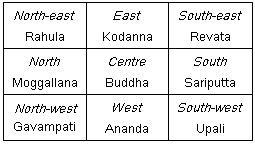 Of the eight Arahats, six are well known to all Buddhists, but two,
Revata and Gavampati, are not so frequently mentioned in the Buddhist scriptures.
Sariputta and Moggallana were the Chief and Vice-Chief Disciples of the Buddha.
They were friends, born to luxury and riches, and together they renounced the world
and sought for the true faith, until they met the Buddha. By that time the Buddha
had established his Order and there were already many members,
but because of their special purity and saintliness
they were appointed First and Second Chief Disciples.
Of the eight Arahats, six are well known to all Buddhists, but two,
Revata and Gavampati, are not so frequently mentioned in the Buddhist scriptures.
Sariputta and Moggallana were the Chief and Vice-Chief Disciples of the Buddha.
They were friends, born to luxury and riches, and together they renounced the world
and sought for the true faith, until they met the Buddha. By that time the Buddha
had established his Order and there were already many members,
but because of their special purity and saintliness
they were appointed First and Second Chief Disciples.
UKT: Count clock-wise starting from North-east:
1. Rahula - North-east (Sun-corner)
2. Kodnna - East
3. Revata - South-east (Mars-corner)
4. Sariputta - South
5. Upali - South-west (Saturn-corner)
6. Ananda - West
7. Gavampati - North-west (Rahu-corner)
8. Moggallana - North
It should be noted that the Nine-god puja and Burmese astrology (the kind related to the Planets) are intimately connected. It is usual, for the parents of the family to consult an astrologer regularly, say at least once a year. Most of the times the astrologer using the Mahaboat{ma.ha boat} or Thondanpauneit method would require the enquirer to give the year of his or her birth in Burmese era, and the day on which he or she was born. Using a very simple calculation, and quoting the predictions he had learnt by heart, he would predict the future, usually for the coming 364 days, and recommend what astrological action must be taken. Usually he would find out the Planet that is having an effect on him at the present, and the up and coming Planet. The action would be usually either to placate the Planet or have something done to overwhelm it. Of the eight Planets ruling the days of the week (Wednesday is divided into two to make the week have 8 rulers), the Planets ruling the corners of the compass (North-west, North-east, South-east, South-west) are considered to be malefic Planets, whereas those ruling the cardinal points (East, South, West, North) are considered to be benefic. You will notice that the principal disciples of the Buddha are assigned to the cardinal points. Please also note that what I have just described is quite different from Hindu astrology which is usually known as
{nak~hkat be-ding} or the Astrology of Nakshatras.
Contents of this page
approx. p009
Sariputta was in his wisdom next only to the Buddha himself.
Moggallana was famous for his supernatural powers, and using
these powers he often visited the abode of the Gods and
the various other worlds of the universe; he even subjugated
the Great Naga of Mount Mayyu and once scolded Sakra or
Thagyamin,
 {thi.kra:ming:} (pronounced as {tha.kya:ming:} literally meaning
the "Sugar-king"), King of the Gods, and the Great God,
Brahma Baka
{thi.kra:ming:} (pronounced as {tha.kya:ming:} literally meaning
the "Sugar-king"), King of the Gods, and the Great God,
Brahma Baka
 {ba.ka. brah~ma}.
UKT: Devas and Brahmas, though commonly translated as "gods", are different. Devas belong to the sexual world and there are male devas and female devas (known as 'devi'). The Brahmas on the other hand are a-sexual, viz. no differentiation into males and females. Brahmas are of two kinds: those still connected to the material world (with "form" - explained as "matter") and those connected to the philosophical world (without "form" - explained as "energy"). Devas have comparatively short life, whereas the Brahmas have extremely long lives. The formless Brahmas are considered to be the longest living of all. However, everyone including the formless ones must change or "die". Baka Brahma was one who had lived for so long that he had forgotten when he had come into the Brahma world, and had thought that he was eternal and had refuted the Principle of Anatta (or Change).
Kodanna was one of the eight Brahmin astrologers who were invited by the king, the Buddha's father, to prognosticate the future of his new-born son, and while the other seven foretold that the child would become either the Buddha or the emperor of the universe [UKT: U Tun Tint explains as Juggernaut], Kodanna alone announced that the child would become the Buddha definitely. Confident in his own prophecy he renounced the world and, becoming a recluse in the forest, he awaited the appearance of the Buddha. He was one of the 'Five Recluses' to whom the Buddha preached the First Sermon, and who became, therefore, the first members of the Buddha's Order. He later retired to the forest and lived alone for twelve years, waited upon by thousands of wild elephants.
Ananda was a cousin and the attendant of the Buddha. He was so busy attending on the Buddha that he had no time to meditate and become an Arahat during the Buddha's life time. He was well-loved by monks and laymen alike because of his humility and good-nature. When the Buddha lay dying, surrounded by Arahats and Gods, Ananda was human enough to cry like a child until the Buddha consoled him.
Upali was the barber to the prince cousins of the Buddha, and when his masters renounced the world he also followed suit. He became the chief authority on the Vinaya, or the rules of discipline of the Order.
Rahula was the Buddha's only son and was received into the Order when he was still a child; after becoming an Arahat he became one of the Chief Disciples on his own purity and merit.
Revata and Gavampati were also possessors of unusual supernatural powers. Revata once created, by his super natural powers, splendid monasteries for the Buddha and his monks while they were passing through a wilderness, and Gavampati once stopped the tide and thus saved some monks from drowning as they slept on a sand-bank. Revata was the youngest brother of Sariputta, and although he made his abode in the forest he used to come and visit the Buddha and Sariputta regularly. He was later declared by the Buddha to be the foremost of the forest-dwelling monks of his Order. As he foresaw that his end was approaching he went and visited the Buddha and Sariputta for the last time, and on his way back to the forest he was mistaken for a thief by some king's officials and arrested and taken to their master. Revata now announced that he was a monk and an Arahat, and sitting cross-legged in the air he preached a sermon to the king. As he finished his sermon he died and flames rose out of his body and consumed it.
Gavampati was a god with a golden palace before he was born as Gavampati, but unlike other palaces which disappeared with the death of their gods, this palace did not disappear; Gavampati, in fact, used to spend much of his time in his old age in this palace among the gods, and he was there when he was invited to come and participate in the First Synod, held soon after the Buddha's death. He realized, however, that his own death was imminent and after making an offering to the Order of his begging-bowl [UKT: now described as "alms bowl" because Buddhist monks do not beg.] and his robes, he died. According to purely Mon and Burmese tradition (i.e. not according to the general Buddhist tradition), Gavampati in a previous birth was a native of southern or Lower Burma; he was hatched from an egg laid by a Naga-Princess after her union with an alchemist, but he died when he was only ten years of age; when he was later reborn as Gavampati and became an Arahat he remembered his previous life, and on his invitation the Buddha himself visited the kingdom of Thaton [{p010end-p011begin}] in southern or Lower Burma. According to another local tradition Gavampati did not die at the time of the First Synod, and he even assisted in the foundation of the Pyu city of Prome. The special supernatural powers attributed to Revata and Gavampati impressed the early Burmese. Revata was adopted as their patron saint by the magicians, alchemists, hermits, and monks who dwelt in the Burmese forest performing austerities, and Gavampati became the patron saint of the Mons and the Pyus.
UKT: You will notice that these two Arahats, Revata and Gavampati, with their great magical powers, are assigned to South-east (ruled by Mars - the God of War) and North-West (ruled by Rahu - the God of Darkness), two of the most feared Planets because of their connection to sudden death. It seems that only those Arahats with magical powers are capable of dealing with such malefics.
After placing the images of the above-mentioned Arahats in position,
the Master of the Ceremony now sets up the figures of the
Gods of the Planets.
Burmese astrology
recognizes the nine planets, namely, Sun, Moon, Mars, Jupiter, Mercury, Venus, and Saturn,
and two other planets, Rahu and Kate
 {kait}.
All the Burmese names of the planets are borrowed from Hindu astrology,
but the Burmese Rahu and Kate are different from the
Hindu Rahu and Katu.
The Burmese consider them to be distinct and separate planets, whereas Hindu astrology considers
them to be either the Dragon's Head and Tail, or the Ascending and Descending Nodes. To the
Burmese, Kate is the king of all the planets.
{kait}.
All the Burmese names of the planets are borrowed from Hindu astrology,
but the Burmese Rahu and Kate are different from the
Hindu Rahu and Katu.
The Burmese consider them to be distinct and separate planets, whereas Hindu astrology considers
them to be either the Dragon's Head and Tail, or the Ascending and Descending Nodes. To the
Burmese, Kate is the king of all the planets.
UKT: The most popular form of Burmese astrology is the
As with other nations the Burmese name the seven days of their week after the seven planets, but Burmese astrology recognizes an eight-day week, Wednesday being divided into two days; until 6 p.m. it is Wednesday, but from 6 p.m. to midnight it is Rahu's day.
UKT: The above paragraph needs to be checked. The division point in time is the 'noon' on Wednesday when the Sun is at Zenith. Twelve hours before noon is the day of Wednesday-planet (animal: elephant with tusks), whereas 12 hours after the 'noon' is the Rahu day (animal: elephant without tusks - considered untamable). -- 080829
 Just as the gods of Hindu mythology ride on particular animals as their 'vehicles',
the nine Burmese planets have their
own animal vehicles and are often represented by these animals.
Just as the gods of Hindu mythology ride on particular animals as their 'vehicles',
the nine Burmese planets have their
own animal vehicles and are often represented by these animals.
UKT: the figures of animals, except the
{piñ~sa.ru-pa.} at the centre, are from Facets of Life at Shwedagon Pagoda in Colorful Myanmar by Daw Khin Myo Chit.
1. Sunday-planet,

 {ta.nïn~ga.nwé groh} rides on a Galon
 {ga.Loan}, the Burmese name for the Pali Garuda, a mythical bird, who is the eternal
enemy of the Naga
{ga.Loan}, the Burmese name for the Pali Garuda, a mythical bird, who is the eternal
enemy of the Naga
 {na.ga:}.
2. Monday-planet,
 {ta.nïn~la groh} rides a tiger
 {kya:}.
3. Tuesday-planet,
 {ïn~ga groh} rides a
 {hkrïn~thé.}
commonly translated as "lion".
{hkrïn~thé.}
commonly translated as "lion".
4. Wednesday-planet,
 {boad~Da.hu: groh} rides an elephant with tusks,
 {hsing}.
5. Rahu-planet or Rahu,
 {ra-hu. groh} rides a tuskless elephant
known as
{ra-hu. groh} rides a tuskless elephant
known as
 {heing:
hsing} which is believed to be more powerful than elephants with tusks.
{heing:
hsing} which is believed to be more powerful than elephants with tusks.
6. Thursday-planet,
 {kra-tha.pa.té: groh} rides a mouse (or rat)
 {krwak}.
7. Friday-planet,
 {thau:kra groh} rides a guinea pig
 {pu:}.
fn012-01
{pu:}.
fn012-01
8. Saturday-planet,
 {sa.né groh} rides on a Naga
{na.ga:}.
{sa.né groh} rides on a Naga
{na.ga:}.
9. Kate-planet,
{kait groh} rides on an 'Animal of Five Beauties',
{piñ-sa.ru-pa.} a mythical animal with the antlers of a deer, the tusks and trunk of an
elephant, the mane of a lion, the body of a Naga, and the tail of a fish.
The figures now being set are those of the gods of the planets astride their animals.
The Master places the figures of the Kate planet in the centre of the
monastery but behind the Buddha. The other eight planets have their cardinal
points and corners and each is placed behind an Arahat as shown in the table. From their
cardinal points, and behind the Arahats, the figures of the planets face towards the Buddha.
UKT: There have been suggestions that the worship of the Planets in Myanmar had its origin in the worship of animals. If that is so, it would be helpful to look into the four animals assigned to the cardinal points. Starting with tiger of the East, it should be remarked that at least two Burmese nats have tigers as their vehicles, which may be traced to the belief in were-tigers similar to the werewolves.
The next is the elephant of the South. The elephants were quite abundant in the forests of Myanmar from the north to the south and all the indigenous tribes would have been familiar with the largest land animal with their remarkable intelligence, memory and strength. Surely, this is an animal worthy to be worshipped by the prehistoric Burmese.
Then, the ever present mouse (or even rat) of the West. The house mouse is one of the most intelligent animals which have found ways to co-exist with the humans. In spite of our efforts to eliminate them, they do survive and multiply in all ages and in all societies. (Exception: Arctic circle?). There have been instances of house mice becoming quite friendly to the humans. To cite one example, my father being the public health inspector at one time in his life was responsible to mouse eradication. In his old age, long time after being the cause of death to many mice, he became friends with a little mouse who came to make friends with him even accepting food from his hand. Surely, the mouse is worthy of respect.
The last, the guinea pig of the North. These little animals makes excellent pets and companions to lonely children who would remember them with fondness and love expecting to be united after death.
The animals of the corners, the garuda or galon is a bird of prey. There have been reports of very young infants being carried away for food by huge eagles, and surely the biggest bird of prey the galon is to be feared and secretly hated. The lion was probably unknown to the ancient Burmese - something foreign and something to be feared. The naga is of course the fictionalized king cobra - never friendly but always ready to warn the humans with its hisses. The last is the tuskless elephants which are quite rare and something totally unlike the useful elephants with tusks. (I still have to check the factual contents of my note -- 080829.
Contents of this page
approx. p012-013
Then the Master sets up his last group
of figures. They are five in number representing the
Five Great Gods, namely:
1. Thurathati
 {thu-rath~tha.ti},
2. Sandi
 {saN~ði}, (not to be confused with
 {san~da}
the 'Moon')
{san~da}
the 'Moon')
3. Paramay-thwa
 {pa.ra.mé-thwa},
4. Maha-Peinne
 {ma.ha-pain~nè},
5. Peikthano
 {baith~tha.No:} or Gawra-manta
 {Gau-ra.man~ta.} .
All these goddesses and gods are Hindu in origin. Thurathati is the Hindu goddess Saraswati, the consort of Brahma; Sandi is Chandi, the consort of Siva; Paramay-thwa is Siva himself; Maha-Peinne is the Burmese name for Ganesh fn013-01, the elephant-headed god; Peikthano is Vishnu, and Gawra-manta or 'he with the horse' is the ninth (and future) incarnation of Vishnu. As in the case of the eight Arahats, and the nine gods of the planets, the figures of the Hindu gods are carved in an attitude of worship, and they are set in line facing the Buddha in front of the little monastery. Thurathati is on the extreme left of the line and Siva is therefore in the centre. It is to be noticed that Thurathati's consort, Brahma, is absent, and Vishnu's consort, the gentle Lakshmi, is also absent.
On the roof of the miniature monastery there fly nine miniature prayer-flags and streamers from the nine miniature poles, and there are also nine miniature golden umbrellas. The largest prayer-flag, pole (with streamers) and golden [{p013end-p014begin}] umbrella are above the Buddha, and the remaining eight flags, poles and umbrellas are above the Arahats and the gods at the eight cardinal points, and are of the same size. The five Hindu gods do not have these insignias of worship.
The Master of the Ceremony now places nine miniature flower-pots in position, the flower-pot placed before the Buddha being the largest, the other eight of equal size. He then places in position nine miniature begging-bowls (UKT: alms-bowl), the largest in front of the Buddha, the remaining eight of equal size before the eight Arahats, and nine miniature plates, the largest in front of the Kate planet and the other eight of equal size before the gods of the other planets. The flower-pots contain three kinds of flowers each but the begging-bowls (alms-bowl) and the plates are empty. Finally he sets up nine beeswax candles at the nine points and lights them. He then starts to recite extracts from Buddhist texts and offers special prayers on behalf of the household.
By this time the guests have arrived. They kneel before the monastery and make obeisance. The guests are served with light refreshments: in villages pickled tea and plain tea, in towns ice-cream and cakes. It is a social occasion and the guests chat and laugh. At about nine or ten o'clock the guests leave, the inmates retire to their bedrooms, and the Master of the Ceremony is left alone in the room, still chanting extracts from the scriptures. At midnight he, too, goes to sleep in a makeshift bed in the room.
About an hour before dawn the inmates get up and prepare the food to be offered to the Nine Gods. Three kinds of fruit, usually banana, coco-nut, and plum, and three kinds of jam are kept ready. The rice to be offered to the Buddha and the Arahats is cooked in an earthen pot which has never been used before, and the rice to be offered to the gods of the planets is cooked separately in another new earthen pot. At dawn, the begging-bowls (alms-bowl) before the Buddha and the Arahats and the plates before the gods are filled with three kinds of fruit, [{p014end-p015begin}] three kinds of jam, and cooked rice. The Master of the Ceremony first chants some more extracts from Buddhist texts and offers the alms-food to the Buddha and the Arahats. Then he invokes the gods of the planets to come and accept it. He recites a particular formula of invocation for each planet, in the following order: Sunday, Monday, Tuesday, Wednesday, Saturday, Thursday, Rahu, Friday, Kate.
It will be noticed that the gods of the planets are invoked in the order of the cardinal points, and that the chief planet, Kate, is invoked last. After the gods of the planets have been invoked, the Master of the Ceremony remains silent for a few minutes and then he recites the formula of dispersal. Again for each planet a particular formula is used, but the order is changed, as follows: Sunday, Tuesday, Saturday, Rahu, Monday, Wednesday, Thursday, Friday, Kate.
The Sunday, Tuesday, Saturday, and Rahu planets are considered by the Burmese to be Malefics, or planets with an evil influence, and the Monday, Wednesday, Thursday and Friday planets are considered to be Benefics, or planets with a benign influence. Kate is considered to be the most powerful and a Benefic, but as the chief planet it cannot be grouped with the other planets. fn015-01 Thus the four Malefics are dispersed first, then the four Benefics, and finally the Kate planet. Another explanation is the astrological belief that at the beginning of this universe the nine planets appeared one by one in this order. The formula of dispersal is really a formula of expulsion or exorcism. And with it the ceremony closes.
With all Burmese ceremonies there is a Buddhist explanation, and a story from the Dhammapada Commentary is cited as the basis of the ceremony of the Nine Gods.
A Brahman, his wife, and their little son saluted a monk, who said 'Live long!' to both parents, but remained silent to the little son.
Said the father, 'Reverend Sir, why was it that when we saluted you, you said, "Live long!" But when this boy saluted you, you said not a word?' 'Some disaster awaits this boy, Brahman.' 'How long will he live, Reverend Sir?' 'For seven days, Brahman.' 'Is there any way of averting this, Reverend Sir?' 'I know of no way of averting this.' 'But who might know, Reverend Sir?' 'The monk Gotama; go to him and ask him.' 'Were I to go there, I should be afraid because of having abandoned my austerities.' 'If you love your son, think not of having abandoned your austerities, but go to him and ask him.'
The Brahman went to the Teacher, and himself straightway saluted him. 'Live long!' said the Teacher. When the boy's mother saluted him, he said the same. But when they made the boy salute him, he held his peace. Then the Brahman asked the Teacher the same question he had previously asked the monk, and the Teacher made the same prediction. The Brahman asked the Teacher, 'Reverend Sir, is there no way of averting this?' 'There might be, Brahman.' 'What way might there be, Reverend Sir?'
'If you erect a pavilion before the door of your house, and set a chair in the centre of it, and arrange eight or sixteen seats in a circle about it, and cause my disciples to sit therein; and if you then cause texts to be recited for the purpose of securing protection and averting evil consequences for the space of seven days uninterruptedly, in that case the danger that threatens him might be averted.' 'Sir Gotama, it is a perfectly easy matter to erect a pavilion and do all the rest, but how am I to obtain the services of your disciples?' 'If you will do all this, I will send my disciples.' 'Very well, Sir Gotama.'
So the Brahman completed all of the
preparations at the door of his house and then went to the Teacher. The Teacher
sent the monks, and they went and sat down, seating the boy also on a little
bench. For seven nights and seven days without interruption, the monks recited
the usual texts, and on the seventh day the Teacher came himself. When the
Teacher came, the deities of all the worlds assembled. But a certain ogre named
Avaruddhaka
 {a.wa.roat~ta.ka.}, [{p016end-p017begin}] who had served
Vessavana
{a.wa.roat~ta.ka.}, [{p016end-p017begin}] who had served
Vessavana
 {wuth~tha.wuN~Na.} for twelve years and who had received the
boon, 'Seven days hence you shall receive this boy', approached and stood
awaiting. But when the Teacher came there, and the powerful deities gathered
themselves together, and the weak deities drew back stepping back twelve leagues
so as to make room, then Avaruddhaka stepped back also.
{wuth~tha.wuN~Na.} for twelve years and who had received the
boon, 'Seven days hence you shall receive this boy', approached and stood
awaiting. But when the Teacher came there, and the powerful deities gathered
themselves together, and the weak deities drew back stepping back twelve leagues
so as to make room, then Avaruddhaka stepped back also.
The Teacher recited the Protective Texts all night long, with the result that when the seven days had elapsed, Avaruddhaka failed to get the boy. Indeed, when the dawn of the eighth day rose, they brought the boy and caused him to make obeisance to the Teacher. Said the Teacher, 'Live long!' 'Sir Gotama, how long will the boy live?' 'For a hundred and twenty years, Brahman.' So they gave him the name of Lad-Whose-Years-Increased, Ayuvaddhana. fn017-01
That the explanation is an afterthought seems obvious. The Dhammapada story does mention eight or sixteen monks seated round the Buddha, but they did not sit in the form of a square but a circle. The story makes no mention of the planets. Moreover, the story of the Nine Gods contains elements which can have no Buddhistic explanation.
The full name of the ceremony means 'Offering of Alms-food to the Nine Buddhas.' It will be noticed, however, that there are only one Buddha and eight Arahats. Phaya, the Burmese word for Buddha, can never be applied to a monk, even if he be an Arahat, but before the introduction of Buddhism it could mean a god, and so the real meaning of the Burmese word Phaya-kozu would seem to be the Nine Gods. If that is so, the Nine Gods must mean the nine planets, and in the ceremony the gods of the nine planets are, in fact, being worshipped, although that fact is hidden underneath a coating of Buddhism.
In the ceremony no special prayers or scriptures are prescribed for the worship and offering of alms-food to the Buddha and the eight Arahats. The Master of the Ceremony chooses [{p017end-p018begin}] the prayers and the scriptures at his discretion, but certain set formulas of worship and offering for the nine planets are prescribed, and the Master of the Ceremony must recite those particular formulas. The Buddha and the Arahats are never invoked nor dispersed, but the nine gods are not only invoked but carefully dispersed.
That the ceremony has some Hindu origin is illustrated by the presence of the figures of the five Hindu gods and goddesses, although no prayers nor offerings are made to them, and by the fact that the alms-food offered does not include any meat. To the more devout Masters of the Ceremony the combination of the worship of the Buddha and the Arahats, on the one hand, and that of the planets, on time other, seems so incongruous that occasionally one finds such a Master using a miniature monastery for the Buddha and the Arahats and a miniature one-roomed house for the planets; he calls the monastery 'the Buddha's Monastery' and the the 'Planet's House'.
Hindu astrology was known and practised in Burma before A.D. 1056, and the Chronicles tell of two reforms of the Burmese calendar in A.D. 78 and A.D. 640 respectively, according to astrological predictions and requirements. Even at the present day Hindu astrology, necessarily modified by Burmese beliefs, still holds sway in the mind of the average Burmese, who often consults a professional astrologer.
The basic belief of Burmese astrology is that the planets, except Kate, mould a man's fate. The planet of a man's birth day will be the main guardian of his fate, but at each particular period of a man's life, a particular planet throws upon him its baneful or its beneficial influence. For example, at one period of his life he will be under the influence of Saturn and ill-fortune will befall him, but at another period he will be under the influence of Venus and good fortune will result. Thus the ebb and flow of a man's fortune depends on the paths in sky of the planets. The Burmese chronicles [{p018end-p019begin}] always mention the particular day of the week on which each king was born, and until the last two decades the name of a Burmese indicated upon which day of the week he was born.
The letters of the Burmese alphabet were divided up between the eight planets thus:
ka kha, ga, gha, nga} -- Monday
sa, hsa, za, zha, nya -- Tuesday
ta, hta, da, dha, na -- Saturday
pa, hpa, ba, bha, ma -- Thursday
la, wa -- Wednesday (Wednesday before noon)
ya, ra -- Rahu's day (Wednesday afternoon)
tha, ha -- Friday
a -- Sunday
and on this division a person's name was chosen. Thus, the first name of a Saturday-born would begin with one of the following letters:
ta, hta, da, dha, na
 as, for example, 'Tin', 'Htin', 'Nan'.
This custom of naming a person after his birthday planet has now fallen into
disuse, except in old-fashioned families.
as, for example, 'Tin', 'Htin', 'Nan'.
This custom of naming a person after his birthday planet has now fallen into
disuse, except in old-fashioned families.
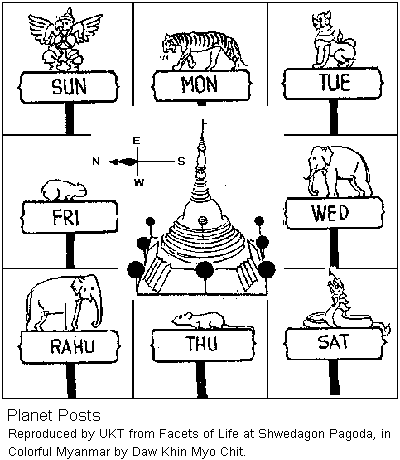
The Burmese pagoda, like the ceremony of the Nine Gods, retains under a Buddhistic colouring the cult of the planet gods. The eight cardinal points round a pagoda are named after the planets, and the terms east, west, north, south, south east, south-west, north-east and north-west are never used to refer to the various points of the pagoda; instead the following terms are used:
the Sunday corner (north-east)
the Monday corner (east)
the Tuesday corner (south-east)
the Wednesday corner (south)
the Saturday corner (south-west)
the Thursday corner (west)
the Rahu corner (north-west)
the Friday corner (north)UKT: The figure on right is from Facets of Life at Shwedagon Pagoda in Colorful Myanmar by Daw Khin Myo Chit.
A person who has been told by the astrologer that he is under the baneful influence of a Malefic offers special prayers at the 'corner' of that particular planet. He will also offer special prayers at the corner of his own birthday planet. It will be noticed that the Kate planet is absent. The original reason for this can only be guessed. Perhaps it was found difficult to put the Kate planet right in the centre, or perhaps, as the fortunes of a man never fell directly under this planet's influence, no special prayers to the Kate planet were considered necessary. Each of the eight corners of the pagoda has a sign, which depicts not the particular god astride his animal, but the animal itself.
All the above facts will indicate that there existed a magico-religious cult connected with the worship of the planets before Buddhism became the official religion of the Burmese. A Chinese chronicle of the ninth century, the Man-Shu, mentioned the presence in Burma of 'many fortune tellers and astrologers'. The cult was, of course, Hindu in origin, but whether it was superimposed on an existing native cult is a matter for consideration.
Leaving aside the mythical and composite animal that the Kate planet rides, the animals ridden by the other eight gods are real animals to the Burmese mind. Although the Naga and the Galon are mythical animals, the average Burmese villager still believes that they are real animals living in the depths of the forests of Burma. The conception of these animal-vehicles of the planets is Hindu in origin but Burmese in development. It has been noted that the signs at the eight corners of a pagoda depict not the planet-gods but the animals. It may therefore be that the cult of the nine planets took over for its support an existing native animal cult. Just as the Naga fn020-01 was worshipped, perhaps the other seven animals also were once worshipped by the Burmese. It may be also that there was a native cult connected with the mystic number nine. Of [{p020end-p021begin}] course with most peoples of the world nine is a mystic number, and to the Buddhist it is also a mystic number because the Buddha has 'nine special attributes'. However, there is some evidence that with the Burmese there was a definite magico-religious cult connected with the number. The Burmese word ko {ko:} can mean both 'nine' and' to seek protection by worshipping', and the Burmese phrase Nat-ko {nat.ko:} means to 'offer (food) to the Nat to get his protection'. In making offerings to a Nat, nine candles, nine dishes of food or nine kinds of food are often used. With the Ceremony of the Nine Gods, although the nine candles, the nine-flower pots, etc., can be explained away as being merely consequential to the fact that the gods were nine in number, it is to be noted that nine kinds of offering are made, leaving aside the rice, namely: three kinds of flowers, three kinds of fruit, and three kinds of jam.
The popular Burmese card game Ko-Mee {ko:mi:} or 'Nine Fires', success at which depends entirely on chance and not on skill, was originally a ritual game connected with the mystic number nine. In addition, there were 'nine districts' of Kyaukse in Upper Burma, and in these districts, even at the present day, the number nine must be avoided, as the Nats will be angry if their special number is used by human beings. For example, if a caravan of nine carts goes on a trading venture, a dire accident will result; if one builds a house on the ninth waxing or waning of a Burmese month, disaster will follow, and if one goes out with eight companions, sorrow will result.
But whether the cult of the Nine Planets was superimposed on existing native cults or otherwise it was definitely non-Buddhist, and all non-Buddhist religious cults, whether native or alien in origin, were suppressed after Buddhism became the official religion of the Burmese under Anawrahta. For a non-Buddhist cult to survive it was necessary to give it a colouring of Buddhism, and also to admit that the gods of the cult were inferior to the Buddha and were supporters of the new religion. The cult of the Nine Planets had to bow to [{p021end-p022begin}] the new order of things. The Ceremony of the Nine Planets was transformed into the joint-ceremony of the worship of the Buddha and the eight Arahats, and the worship of the Nine Planets. Admission that its gods were inferior to the Buddha and were supporters of the new religion was made by carving the figures of the Nine Planets and the Five Hindu Gods and Goddesses in an attitude of worship, and by placing them with their faces turned towards the image of the Buddha. At first, of course, there could have been no real change of heart, and in secret many devotees at the new ceremony would be worshipping the old gods of the planets. But as centuries passed and Buddhism gradually became firmly rooted in the life of the Burmese people, the anti-Buddhist and the pre-Buddhist elements in the ceremony gradually receded to the background.
fn020-01 The
worship of the Naga is considered in the appendix to Chapter 7.
Go back fn020-01b
fn012-01 According to astrological beliefs prevailing among the Shans, the Friday planet rides on an ox. fn012-01b
fn013-01 The
Burmese Ganesh and the other Hindu gods
are considered in detail in Chapter 3.
fn013-01b
fn015-01 Although Kate remains important in the ritual
of the Nine Gods, modern Burmese astrology tends to ignore it.
fn015-01b
fn017-01 Burlingame, Buddhist Legends, Part II
(Harvard Oriental Series).
fn017-01b
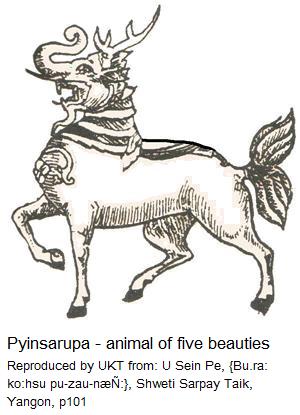
The figure of
{piñ-sa.ru-pa.} shown on the right was from: U Sein Pe,
{Bu.ra: ko:hsu pu-zau-næÑ:}, Shweti Sarpay Taik, Yangon, p101. Notice that the body
of the animal was represented short and the animal looked like a
bull.
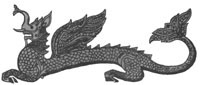 Because
this animal is a composite, it seems that the Burmese artists are at their
liberty to create other versions, and one (shown on the left
from an unknown source) had wings. The animal with the elongated body is
usually found on top of the pole from which the big drum of the traditional
Burmese orchestra is hung.
Because
this animal is a composite, it seems that the Burmese artists are at their
liberty to create other versions, and one (shown on the left
from an unknown source) had wings. The animal with the elongated body is
usually found on top of the pole from which the big drum of the traditional
Burmese orchestra is hung.
Go back animal5beauti-note-b
From: Vedic astrology lessons - the nakshatras, http://www.astrojyoti.com/lesson2.htm 080829
First the zodiac was divided into 12 main rasis, to study the effects of the planets placed there. Then the ancient seers added another sub divisional system of breaking down the zodiac into 27 Nakshatras or star constellations. Each nakshatra has a span of 13 degrees and 20 minutes. After that each nakshatra was further subdivided into 4 Padas, or quarters, of 3 degrees and 20 minutes. Hence the first zodiac sign Aries, which has 30 degrees, contains the entire 4 padas (13:20') of the 1st star constellation Ashwini, the entire 4 padas (13:20') of the 2nd star constellation Bharani and the 1st pada (3:20') of the third star constellation Krittika. So each rasi contains total 9 padas. These nakshatras belong to three main groups: Deva or divine, Manusha or human and Rakshasa or Demonic. They have different ruling deities, owned by different planets and have divergent qualities. Hence while studying the effects of a planet placed in Aries, it is also studied in which nakshatra it is placed and in which pada of that nakshatra it is placed. This system of analysis exists only in Indian astrology.
The nakshatra in which your moon [UKT: Moon in astrology is
 {san:} -
MEDict125] is
placed at the time of your birth is called your Janma Nakshatra. This janma
nakshatra has also got its influence on you.
{san:} -
MEDict125] is
placed at the time of your birth is called your Janma Nakshatra. This janma
nakshatra has also got its influence on you.
Nakshatras:
01. Ashwini, 02. Bharani, 03. Krittika, 04. Rohini, 05. Mrigasira, 06. Arudra,
07. Punarvasu, 08. Pushyami, 09. Aslesha, 10. Magha, 11. Poorvaphalguni, 12.
Uttaraphalguni, 13. Hasta, 14. Chitra, 15. Swati, 16. Visakha, 17. Anuradha, 18.
Jyestha, 19. Moola, 20. Purvashadha, 21. Uttarashadha, 22. Shravana,
23. Dhanishta, 24. Satabhistha, 25. Purvabhadra, 26. Uttarabhadrapada, 27. Revati.
Go back astro-nak-note-b
The word <begging> is deemed inappropriate, since the Buddhist monks do not <beg>, and the current usage is <alms-bowl>. However, if a monk does <beg>, then, and only then, should he be termed a <mendicant monk>, and his bowl, a <begging-bowl>. The usage of the word <begging-bowl> was common at one time, probably due to the Westerner's outlook on those who would not <work> for a living. To a Myanmar, it is the lay-man who has to <thank> the monk for receiving the alms offered, and thus a monk does not say <thank you> in return, but would say approvingly {tha-du.} three times to express his recognition of the good deed done by the lay-man.
mendicant adj. 1. Depending on alms for a living; practicing begging. n. 1. A beggar. 2. A member of an order of friars forbidden to own property in common, who work or beg for their living. [Middle English from Old French from Latin mendīcāns mendīcant- ,present participle of mendīcāre to beg from mendīcus needy, beggar from mendum physical defect] -- AHTD
Go back beg-bowl-note-b
According to the {mahaboat} version,
each of the planets influences the individual for a certain number of years known as
"planet life" {groh thak}:
Sun -- 6 years; Mon -- 15 years; Tuesday -- 8 years;
Wednesday -- 17 years; Saturn -- 10 years; Thursday -- 19 years; Rahu -- 12 years; Friday -- 21 years.
The total -- 108 years
The {mahaboat groh thak} is different from the "main
division" {htu-la dath~tha} of the {nak~hkat bé-ding}.
Go back bur-astro-note-b
Glass Palace Chronicle, Part 1, 1993 reprint, p184 states that in
Buddhist Era {tha-tha.na
thak~ka.riiz} 624 in the reign of King {thu.moan~da.ri} of Srikhsetra there was
a calendar reform. The reform is known as {dau:dau:ra.tha.} reform.
The second calendar reform took place in Pagan period in the Pyu
Era 562 which is known as {hka.hsa.pyin~sa.} reform resulting in Pagan Era which
is the present Burmese Era.
Go back chroni-note-b
Though Thurathati and Sandi are goddesses, they are collectively called <gods>. It should be noted that the ceremony is to placate the angry planet or planets. The five gods are present only as part of the worshippers.
The term Five Great Gods {nat-kri: nga:pa:} is very confusing: it can mean differently on different occasions.
In U Po Kya Thirty-seven Kings (in
Burmese), p.017-019, we find six sets of five nats. The set of five given above
corresponds to the set recognized during the reign of King Thalun in the 17th
century. This set included Thurathati
{thu-rath~tha.ti}. However during the reign of King Bodawpaya (18th century) a
different set, without Thurathati, was recognized. U Po Kya noted that the set
recognized by the present day Nine-Gods-Sayas and Nat-Sayas is the set which
included Thurathati.
UKT: From Thurathati, through Sandi to Peikthano, we have the {nat-kri: nga:pa:}. Now that they have been incorporated into the pantheon of Nats, where do ordinary Burmese think they should be placed? Are they above {thi.kra:ming:} or under him? What about the Planets {groh}? This question does not come in in the worship of the Nine-Gods is
{pu-zau pwè:}, because neither the {thi.kra:ming:} nor his entourage of the 36 Burmese nats, Anawratha had placed under him, are included. [to be checked with my Burmese-Myanmar peers -- 080902]
Go back five-gr-gods-b
All, including those of the Moon and Venus, are considered to be males. Mercury is also a male and is not considered to be a hermaphrodite.
Go back god-planet-note-b
Rahu and Ketu are not 'real' planets of the Celestial sphere with the Earth at its centre. In this respect what we are talking about here is different from the planets in the Solar system where the Sun is at one of the foci of the ellipse. By 'planet' is meant a luminary in the sky which travel against the back ground of 'fixed' stars. Because they do travel, the Sun and the Moon are considered to be planets. Rahu and Ketu are 'assumed' planets postulated to predict the eclipses of the Sun and Moon in Vedic Astronomy. Astrologically, Rahu is considered by both Burmese and Hindus to be an evil (malefic) planet, whereas, Kate is considered by the Burmese to be not only benefic but the king of the planets. To the Hindus, Ketu is a malefic.
Excerpt from: http://www.komilla.com/pages/rahu-ketu.html 080829
Rahu Ketu is the name given to the Nodes of the Moon. Rahu is the North Node and Ketu is the South Node. They are points on the ecliptic where the Moon is in alignment with the Sun and the Earth. They indicate the precise point of the harmony with the three most important influences in our life- the Sun, the Earth and the Moon. This relationship plays an important part in the enfolding of individual consciousness.
Note from the article:
All planetary positions in this article refer to the sidereal Zodiac which is currently 23 degrees 49 minutes and 30 sec. behind the Tropical Zodiac. Nakshatras are fixed stars or lunar mansions.
Their role as Karmic indicators of our life is connected with their power to cause eclipses. The eclipses occur in the vicinity of Rahu Ketu during the Full Moon and the New Moon. (During New Moon when it is +/- 18 degrees from Rahu Ketu, the Solar eclipse takes place. At the full Moon +/- 11 degrees 15' from the nodal position, the Lunar eclipse takes place.) As they symbolically eclipse the Sun (consciousness) and the Moon (the Mind), they have a great part to play in darkening our perspective in order to bring in new light. They deal with the concept of death and re-birth, transformation and regeneration. During the eclipses the light from the Luminaries is darkened. The energies created are powerfully psychic, pregnant with new information and occult power. The period after the eclipse is considered a rebirth of the Sun and the Moon. The role of Rahu Ketu in this powerful alignment of the Sun Moon and the Earth gives them the role of the ultimate controllers of the destiny.
The prime importance given to Rahu Ketu in Vedic Astrology is one of it's key features. They have been given the status of Planets to emphasise their significance and the importance placed on eclipses. They are known as Chayya Grahas (shadow planets). They have no substance and are physically non-existent. Yet their influence is full of potency and spiritual significance. They work in unison 180 degrees apart, two opposite points in the zodiac with a mission to churn our lives in order to externalise hidden potential and wisdom. In keeping with their shadowy nature, they work on a psychological level. It is always difficult to gauge their effect because their main concern is with our emotional makeup. They effect us internally. We are unaware of what exactly is happening to us at the time.
In Vedic Astrology, the concept of the Soul's journey through different lifetimes is central to it. The final goal of the soul is to break this cycle of life and death. Like the beads on a necklace, various lifetimes are joined together to form a necklace, each life being different but interconnected by an invisible thread. The invisible thread is Rahu and Ketu. The purpose of the soul in this life to act out his given Karma, destroy the illusions of the materialistic life and move towards the pursuit of self realisation. To live on the astral planes where pleasure and pain do not have the capacity to hurt, the mind is still and at peace. The soul's journey in a particular life time and it's connection with eternal life is indicated by the position of Rahu and Ketu. Ketu deals with the past Karma and Rahu with the future.
The five instincts that keep us attached to the materialistic purpose of life are Kaam (Desire, passions) Krodh (Anger) Madh (intoxicants- drugs, alcohol etc) Moh (Attachment) Lobh(Greed) and Matsaya(Jealousy). We need to control our instincts rather than allowing ourselves to be controlled by them. Both Rahu and Ketu have the ability to keep our mind focused on these instincts -- Rahu by exaggerating and Ketu by obscuring or blocking. We are tied down to the cycle of unhappiness and dissatisfaction as we cannot break away from our lower selves. We are born again and again to experience the pleasures and pains of the earthly life until we recognise them to be the illusions that they are. On a subconscious level we are afraid that if we give up these desires, we will lose out. Once we start understanding the principle of letting go, enjoying what life has to offer but not getting attached, then we are able to grow spiritually. Rahu Ketu deals with the inner fight within us, the moral and the social choices we have to constantly make and the inner dilemmas.
Go back hind-rahu-ketu-note-b
A makeshift bed was a simple affair: a reed mat, a pillow, and a light blanket. Being males, we (UKT still a child and others) as children, were allowed to sleep in the room. It was a pleasant smelling room filled with scent -- from the beeswax candles, from the fruits and flowers and from the incense sticks. We knew that "goodies" would be offered at dawn and were ready to grab them when the offering was over when the invited gods, goddess and the planets had left.
Go back makeshift-bed-note-b
Burmese
use a special term, {kyaung:hsaung} , for a miniature representation of the
abode of Buddha or a nat. As a child, I always thought of a miniature monastery
as a <doll-house>. The term for the regular monastery is {kyaung:} . All other
items made for the ceremony are made to scale: little umbrellas, little
flag-poles with miniature streamers, and little prayer-flags.
Go back miniature-monas-b
Apart from the composite
Animal of Five Beauties
{piñ~sa.ru-pa.}, of the eight other animal-vehicles of the planets, six are real animals and
two are mythical. The real animals are: tiger, lion (though different in appearance from the real ones),
elephant, mouse, tuskless-elephant, and guinea pig. The mythical ones are the galon (Hindu: garuda) and naga.
It should be noted that animals are important in Hindu mythology -- from:
The Animal Deities
http://www.webonautics.com/mythology/animaldeities.html
"Animals have a special
place in Hindu mythology. One comes across various animals in Hindu mythology some,
which have been personified and given a form as the centuries passed. These animals have
been symbolic as the vehicles and carriers of various gods or one, which have helped
the gods in various times. Some of them appear as independent divine creatures and
are worshipped in various ways:
• AIRAVATA the elephant - vehicle of Indra
• AKUPARA the tortoise - on which Earth or Prithvi rests
• ANTELOPE - vehicle of Vayu and Chandra
• ARVA, mythical being half horse and half bird - one of the horses of the moon
• BUFFALO - vehicle of Yama
• CERBURA - the three headed infernal dog of the Krishna legend
• CROW - vehicle of Shani
• DOG and HORSE - vehicle of Shiva as Bhairava
• GARUDA the king of birds - half man and half eagle or vulture, vehicle of Vishnu
• JAMBAVANT - the king of bears - ally of Rama
• KAMADHENU - the cow of plenty
• MAKARA or JALAMPA the mythical sea monster - Varuna ( god of water)
• MOUSE - vehicle of Ganesha
• NANDI the bull - vehicle of Shiva and Parvati
• PATAVANI the peacock - vehicle of Kartikeya
• PARROT - vehicle of Kamadeva
• RAM, the he-goat - vehicle of Agni
• SARAMA - dog of Indra
• SHESHNAG or ANANTA the infinite - the king of Nagas vehicle of Vishnu or the bed on which Vishnu rests
• SWAN - vehicle of Saraswati and Brahma
• TARKSHYA - winged horse personifying the sun
• TIGER and LION - vehicle of Parvati as Kali and Durga
• UCHCHAIH - SRAVAS - the eight headed king of horses produced during the churning of oceans
Go back nati-ani-cult-b
The word "Phaya" is an English rendering of a Burmese-Myanmar word, and is incorrect from the point of view of the rules of writing the Myanmar akshara. The consonant involved is either {hpa.} or {ba.} and not {pa.}. The mistake has been made because of the absence of the IPA [p] sound unless preceded by <s> in English words.
The Burmese word phaya
 {Bu.ra:} usually means the Buddha. However, since the word is also used in
addressing monks and royalty, and at one time, even for high officials,
and also as part of
{Bu.ra:} usually means the Buddha. However, since the word is also used in
addressing monks and royalty, and at one time, even for high officials,
and also as part of
 {mi.Bu.ra:} for <queen>, we cannot say that it is used for Buddha only.
The word {Bu.ra:} can be a form of address like <your majesty>, <your honour>,
and <your worship>. In the case of {mi.Bu.ra:}, {mi.} can be translated as
<mother>, and therefore {mi.Bu.ra:} can be literally be translated as <Mother
Worshipful>. Therefore, I would have to disagree with Dr. Htin Aung and would suggest that
the ceremony is used to worship the Buddha and his eight disciples, all eight
taken together as those who do deserve worship. As to Dr. Htin Aung's conclusion
that the ceremony is the worship of the nine planets, I would have to agree with
him.
{mi.Bu.ra:} for <queen>, we cannot say that it is used for Buddha only.
The word {Bu.ra:} can be a form of address like <your majesty>, <your honour>,
and <your worship>. In the case of {mi.Bu.ra:}, {mi.} can be translated as
<mother>, and therefore {mi.Bu.ra:} can be literally be translated as <Mother
Worshipful>. Therefore, I would have to disagree with Dr. Htin Aung and would suggest that
the ceremony is used to worship the Buddha and his eight disciples, all eight
taken together as those who do deserve worship. As to Dr. Htin Aung's conclusion
that the ceremony is the worship of the nine planets, I would have to agree with
him.
Go back phaya-note-b
Though Dr. Htin Aung had stated that the ceremony was held because of an ailment, it was not always so -- at least in our house. We do it for fun, as an excuse for an evening party, where friends meet friends, neighbours meet neighbours, and of course, boys meet girls. However, sad to say, this custom of the worship of the Nine Gods as an evening party is slowly dying, at least, in larger towns.
Go back sickness-in-house-note-b
Streamers are of two kinds:
{tän-hkwan}.
•  {tän-hkwan} -
a long cylindrical streamer - UHS-Dict326
{tän-hkwan} -
a long cylindrical streamer - UHS-Dict326
•  {koak~ka:}
- /{kou'ka:}/ n. kokkar bent bamboo stick tied to a flagstaff -
MEDict014; a paper streamer - UHS-Dict030;
{koak~ka:}
- /{kou'ka:}/ n. kokkar bent bamboo stick tied to a flagstaff -
MEDict014; a paper streamer - UHS-Dict030;
Go back streamer-note-b
To the Burmese Buddhist
{thi.kra:ming:} (pronounced as /{tha.kya:ming:}/ literally meaning the "Sugar-king")
is the King of the Gods. He is one of chief supporters of Buddhism. Though U Hoke Sein
(UHS-Dict-p855) gave the meaning of Thagyamin as
Indra  {AIn~da.}, Childers on p419 gave the
following entry under:
{AIn~da.}, Childers on p419 gave the
following entry under:
SAKKO, Çakra or Indra. - Childers p419
"When Gautama Buddha deposed Indra from his godship, he made him a
powerful archangel ruling over the five lowest kámadevalokas and having his
abode in the Távatimsa heavens (see Máro). He is widely different from
the Hindu Indra, though retaining many of his attributes. He is inferior in
majesty and power to the two other archangels Mahábrahma and Mára. Like
Mahábrahma, he is represented as exercising a beneficial influence over the
affairs of men. When a good man is struggling with adversity, the fact is made
known to Sakka by the throne on which he sits becoming warm ... . It is then his
wont to take some earthly disguise and descend to the relief of the sufferer..."
See Dictionary of Pali Proper Names by G.P. Malalasekera on Sakka and Sujā
From: Wikipedia
http://en.wikipedia.org/wiki/Sakka 080923
Vedic religion and Hinduism : The name
Śakra "powerful", used as an epithet of Indra, is found in several verses of the
Rig Veda. It is also found many times in the other Vedas such as the
Samaveda
and
Atharva Veda. The name is also copiously used in many later texts like the
Mahabharata.
Jainism : In Jain texts, Śakra appears
several times as a name of the king of the devas.
Buddhism : Śakra (Sanskrit) or
Sakka
 {thak~ka.}
is the ruler of the
Trāyastriṃśa Heaven in Buddhist cosmology. His full title is
Śakro devānām indraḥ (Pāli:
Sakko devānaṃ indo "Śakra, lord of the devas"). In Buddhist texts
Śakra is the proper name and not an epithet of this deity; conversely, indra
in Sankrit and inda Pali are sometimes used as an epithet for Śakra as
"lord". In the Chinese tradition, he is usually analogous with the Taoist
Jade
Emperor, whose birthday is celebrated on the ninth day of the first lunar
month of the
Chinese calendar (usually in February).
{thak~ka.}
is the ruler of the
Trāyastriṃśa Heaven in Buddhist cosmology. His full title is
Śakro devānām indraḥ (Pāli:
Sakko devānaṃ indo "Śakra, lord of the devas"). In Buddhist texts
Śakra is the proper name and not an epithet of this deity; conversely, indra
in Sankrit and inda Pali are sometimes used as an epithet for Śakra as
"lord". In the Chinese tradition, he is usually analogous with the Taoist
Jade
Emperor, whose birthday is celebrated on the ninth day of the first lunar
month of the
Chinese calendar (usually in February).
In Buddhist texts, Śakra's myth and character are very different
from those of the Vedic Indra. According to G.P. Malalasekara, "Sakka and Indra
are independent conceptions. None of the personal characteristics of Sakka
resemble those of Indra. Some epithets are identical but are evidently borrowed,
though they are differently explained."
The
Trāyastriṃśa heaven which Śakra rules is located on the top of Mount
Sumeru (cf.
Meru), imagined to be the polar center of the physical world, around which
the Sun and Moon revolve.
Trāyastriṃśa is the highest of the heavens which is in direct contact
with the Earth. Like the other deities of this heaven, Śakra is long-lived but
mortal. When one Śakra dies, his place is taken by another deity who becomes the
new Śakra. Buddhist stories about Śakra (past or present) are found in the
Jātaka stories and in several sutras, particularly in the
Saṃyutta Nikāya.
Śakra is married to
Sujā[7],
daughter of the chief of the
Asuras,
Vemacitrin (Pāli Vepacitti). Despite this relationship, a state of
war generally exists between the Thirty-three gods and the Asuras, which Śakra
manages to resolve with minimal violence and no loss of life.
Śakra is mentioned in many Buddhist
sūtras, and is often shown consulting the Buddha on questions of morality.
Together with
Brahmā, he is considered a protector of the Buddhist religion.
Go back Thagya-note-b
{wuth~tha.wuN~Na.} also known as
 {ku.we-ra.}, one of the four guardian gods of
the world. He is the ruler of ogres, and his abode is on the northern side of Mount Meru.
{ku.we-ra.}, one of the four guardian gods of
the world. He is the ruler of ogres, and his abode is on the northern side of Mount Meru.
There are four guardian gods of the world known as {sa.tu.ma.ha-ra-za}:
1.  {Da.ta.raT-Hta.} -- of the eastern side of Mount Meru
2.  {wi.ru-pak~hka.} -- of the southern side of Mount Meru
3.  {wi.ru-Lha.ka.} -- of the western side of Mount Meru
4.
{ku.wé-ra.} -- of the northern side of Mount Meru
-- UMK-USL, p.43
Of the four, at least one,
{wi.ru-pak~hka.}
is described surprisingly as a huge snake with an ugly body -- a far-cry from
the picture of a ruling god in human-like form. To be checked with PTS
dictionary.
Go back vessavana-note-b
Excerpt from Wikipedia http://en.wikipedia.org/wiki/Werewolf 080829
Werewolves, also known as lycanthropes or wolfmen, are mythological humans with the ability to shapeshift into wolves or wolf-like creatures, either purposely, being bitten by another werewolf or after being placed under a curse. The medieval chronicler Gervase of Tilbury associated the transformation with the appearance of the full moon; however, there is evidence that the association existed among the ancient Greeks, appearing in the writings of Petronius. This concept was rarely associated with the werewolf until the idea was picked up by Gervase. Shape-shifters similar to werewolves are common in tales from all over the world, though most of them involve animal forms other than wolves.
UKT: See Professor Dr. Sein Tu on were-tigers of Myanmar in an accompanying article. weretiger.htm
Go back werewolves-note-b
End of TIL file