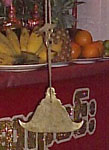
Let lower: triangular brass gong
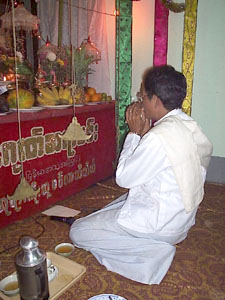
Right: Saya blowing the conch shell. Notice the white jacket and the white longyi worn by the Puja-master. White dress is usually worn when he is performing religious and semi-religious rites.
ch02-21-offer.htm
by U Kyaw Tun, M.S. (I.P.S.T., U.S.A.). 2005. Not for sale. Prepared for students of TIL Computing and Language Center, Yangon, MYANMAR.
Offerings
Offerings of Hswamm
Invocations
UKT notes
• no coconut in the offertories
The following account was based on the Nine-God Puja performed at my home at 35 Thantadalan, Sanchaung, Yangon, Myanmar, on the evening of 2005 Jan 4th which extended into the early morning of the 5th.
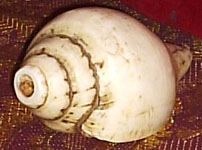
Burmese-Buddhist pujas, unlike the Hindu and Mahayana pujas, are almost free of music. At the most, there would be blowing of conch shell at the beginning of an incantation, and the striking of a triangular brass gong suspended by a single rope. Because, the gong is suspended from a single string, it rotates on when struck on a corner producing a very notable sound that goes up and down, up and down for some time. To the Burmese ears, it sounds like {du wé wé ...}. Bells and drums are not part of the Burmese ceremonies.
| Left upper: conch shell Let lower: triangular brass gong Right: Saya blowing the conch shell. Notice the white jacket and the white longyi worn by the Puja-master. White dress is usually worn when he is performing religious and semi-religious rites. |
|
|
||
|
|
The night is almost over and it's almost time to offer food
 {hswam:} to the Buddha, his Disciples, the Planets and
the Great Gods or major Nats. The Burmese term {hswam:}
means "cooked rice for the Buddha and the Sangha".
Of course, cooked rice is never eaten all by itself -- it is always
taken with curry, salad or fruit. By "curry" or
{hswam:} to the Buddha, his Disciples, the Planets and
the Great Gods or major Nats. The Burmese term {hswam:}
means "cooked rice for the Buddha and the Sangha".
Of course, cooked rice is never eaten all by itself -- it is always
taken with curry, salad or fruit. By "curry" or
 {hing:}, we usually mean meat, sea-food, or vegetable cooked
over a fire, and, by "salad"
{hing:}, we usually mean meat, sea-food, or vegetable cooked
over a fire, and, by "salad"
 {a.thoat} we mean a mixture of cut vegetables usually uncooked.
This is the usual fare for ordinary people. However,
for highly religious persons, cooked rice is taken with fruit.
Offering of hswam in the Nine-god ceremony is exclusively cooked rice,
fruits and jams -- "food without the loss of life"
{a.thoat} we mean a mixture of cut vegetables usually uncooked.
This is the usual fare for ordinary people. However,
for highly religious persons, cooked rice is taken with fruit.
Offering of hswam in the Nine-god ceremony is exclusively cooked rice,
fruits and jams -- "food without the loss of life"
 {a.thak-thût lwat}.
Three kinds of fruits and three kinds of jams are usually offered, however, a Puja-master is free to increase the kinds of items to nine. On the occasion I am describing, Saya Win had chosen to offer nine kinds of fruits. Curiously, the coconut, the usual fruit of the Hindu procedures was not offered. The food (rice, fruits and jam) were simply placed on the alter during the evening. Since, hours past mid-day are not proper to offer food to the Buddha and his disciples, fruits and jams were just placed on the alter for the guests to see.
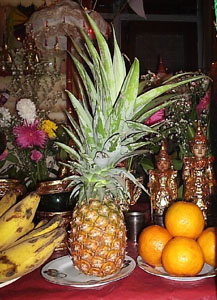
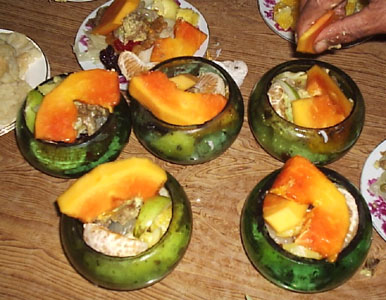
Left: Of the nine kinds of fruits,
here we see three kinds:
 {hpi:kram:} banana, pine-apple and orange.
Right: The fruits are peeled, and sliced. At dawn, the prepared fruits are offered cooked rice in alm-bowls to the Buddha and his disciples. |
 |
 |
One hour before dawn, rice is cooked (but not in new earthen pots as described by Dr. Htin Aung and U Sein Pe), and the fruits are peeled and sliced. For the Buddha and his disciples, cooked rice was placed at the bottom of the bowl over which were spread the fruits and jams.
Planets and nats are inferior to the Buddha and his disciples,
and though the food offered to them are the same, the food is
placed in leaf-bowls made from banana leaves
 {hpak-hkwak}. Burmese people consider those who had to eat from
leaf-bowls to be inferior in status. We say we "offer"
{hpak-hkwak}. Burmese people consider those who had to eat from
leaf-bowls to be inferior in status. We say we "offer"
 {kûp} food to the Buddha, but we "feed"
 {kywé:} eatables to the planets and nats. (Note: usage of
{kup} and
{kywé:} may change in other context.)
{kywé:} eatables to the planets and nats. (Note: usage of
{kup} and
{kywé:} may change in other context.)
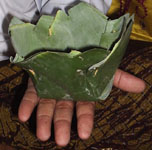
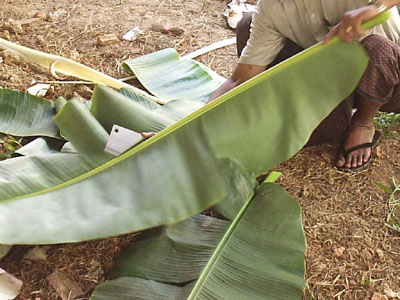
| Left: Green banana leaves. Right upper: a leaf-bowl Right lower: food in leaf-bowls for planets and nats. |
 |
|
||
|
|
The principals (Buddha, Planets and Nats) are so different from each other that the invitations and invocations of the three are bound to be different.
The Puja-master first chants some more extracts from Buddhist
texts and offers the alms-food
 {hswam: kûp} to the Buddha and the Arahats. Then he invokes
the gods of the Planets to come and accept the food. Last of all,
he invokes the Great Nats to come and accept it.
{hswam: kûp} to the Buddha and the Arahats. Then he invokes
the gods of the Planets to come and accept the food. Last of all,
he invokes the Great Nats to come and accept it.
He recites a particular formula of invocation for each planet, in the following order: Sunday, Monday, Tuesday, Wednesday, Saturday, Thursday, Rahu, Friday, Kate.
It will be noticed that the gods of the planets are invoked in the order of the cardinal points, and that the chief planet, Kate, is invoked last. After the the Planets and the Great Nats have been invoked, the Puja-master remains silent for a few minutes and then he recites the formula of dispersal. For each, a particular formula is used, but the order is changed.
In the ceremony no special prayers or scriptures are prescribed for the worship and offering of alms-food to the Buddha and the eight Arahats. The Puja-master chooses the prayers and the scriptures at his discretion, but certain set formulas of worship and offering for the nine Planets are prescribed, and the Puja-master must recite those particular formulas. The Buddha and the Arahats are never invoked nor dispersed, but the nine Planets are not only invoked but carefully dispersed.
The term for dispersal of the Planets
 {groh-nhing}, is really strong. The word
 {nhing} is used to "drive away" or "expel" an undesirable person or animal,
and in fact the formula of dispersal is really a formula of expulsion
or exorcism. The term for dispersal of the Great Nats is milder --
{nhing} is used to "drive away" or "expel" an undesirable person or animal,
and in fact the formula of dispersal is really a formula of expulsion
or exorcism. The term for dispersal of the Great Nats is milder --
 {nat po.} to "send off a nat".
Why is the coconut not offered? Is it a lapse by the Puja master? Is this the usual practice? If it is so, this fact can be very significant as to the origin of the Nine-God Puja. I have read somewhere that coconut is not indigenous to northern India. It is also probably not indigenous to northern Myanmar especially in the Yaw area which I visited a child.
Coconut is usually given to the burned victims, and so it is offered to Min MahaGiri because as a man, he had been executed in a air-blown furnace. But in the Yaw area and in many areas in Upper Burma, it is not the actual fruit that is offered but a drawing of the fruit. My parents and I noted that the locally grown coconut was quite scarce in Pauk, a small town of the Yaw area, and was not tasty. It had a taste which was very disagreeable to us people from the Delta.
So if the coconut had not been an offertory in ancient times, it would probably (I emphasize the flimsiness of my assertion) that the Nine God Puja has been a Burmese Puja even before Anawratha, and that the worship of the Planets has its origin in northern Myanmar.
Go back no-coconut-note-b
End of TIL file