Update:
2008-11-11 06:09 PM +0800
TIL
Burmese for Foreign Friends
intro.htm
by U Kyaw Tun (UKT) and Daw Than Than, Tun Institute of Learning, Jan 1991
http://www.tuninst.net
Edited by UKT, and digitization by UKT and the staff of TIL. Start: 2008 Nov
indx-RBM4M |Top
indx-B4FF
Contents of this page
Introduction
Transliteration
UKT notes
• abugida
Contents of this page
p001
Welcome to BURMESE FOR FOREIGN FRIENDS.
Before we set out on our journey into the Burmese language, and the country of
Myanmar, let us settle on the term "language". The word "language" means the
spoken language - a system of sounds used by humans to communicate with each
other. When these sounds are recorded on paper, papyrus, clay tablets, stones,
metal sheets, etc., we get the written language or simply 'script'. We have to
be clear about using our terms even though they are in use daily in a community,
because once we get into a different community, a different time-frame or period
in history - even into a different social setting, these common terms can come
to have different meanings. Therefore, let's be clear: language means the spoken
part of communication and script means the written part. So I will be using
terms like: Burmese-Myanmar, English-Latin, and Hindi-Devanagari where there are
different names for the spoken part and the written part. However, we may come
across terms such as Bangali-Bengali and Tamil-Tamil where there are no well
defined names (at least that I know) for the spoken and the written parts, and
the cross-overs such as Pali-Myanmar, Pali-Devanagari, and Burmese-Latin. We
must not forget that in the country of Myanmar, there are other spoken languages
which are written in the Myanmar script: Karen-Myanmar, Mon-Myanmar,
Shan-Myanmar, etc. Karen, Mon, and Shan are all Myanmar languages because they
are spoken by Myanmar people. And therefore, the term "Myanmar language" is a
misnomer unless you mean that it is a spoken language used in the country of
Myanmar, and not only confined to Burmese spoken by the majority. Myanmar is the
script used by many spoken languages. When we started out to write BURMESE FOR
FOREIGN FRIENDS, we did not know the difference in 'language' and 'script', and
in the original version, the terms we have used may be confusing.
Unlike the electronic recording, the sound of a language which you can hear
cannot be regenerated from the script. And so we have to have a set of symbols
agreed on by the users to mean the system of sounds. When you see a written
symbol, and read (or sing) it aloud, and the sound you hear is the sound
generated by the reader and not the original sound. Therefore, to claim that
"such and such is the correct Pali-sound (to take an example)" purported to mean
that it was used by a historical person such as the Buddha is a just a tall
claim and nothing else.
According to language experts the Burmese language, the language of some
thirty millions of natives of Burma, belongs to the group of Tibeto-Burman languages.
Thus, it is entirely different from the Indo-European (formerly known as the
Indo- Aryan) languages such as Latin, French and English.
However, since the country of Myanmar has always been under the sway of India
where Indo-European languages such as Hindi (modern), Sanskrit and Pali (ancient languages)
are spoken, we can find elements of Indo-European languages particularly that of Pali,
in the modern Burmese language. More than ninety per cent of the Burmese speakers are Buddhists,
and since Pali is the holy language of Theravada Buddhism,
the religion of the majority, we can find a very large number
of Pali or Pali-derived words in the Burmese language.
Now, let's come to the written part of the human communication - the script.
There are two systems in used that is of interest to us. The alphabetic system
and the abugida or the alpha-syllabary.
Or, if you are uncomfortable with the tern abugida just call it the akshara system.
In fact, there are some ten letters in the Burmese-Myanmar akshara-matrix of 7 rows X 5 columns
(note: the Burmese people are extremely fond of matrices),
which are almost exclusively used to write Pali or Pali-derived words.
And therefore, those speakers of English aspiring to learn the Burmese language
should find solace in the fact that the Burmese language is not entirely unrelated
to English and French because of the Pali (an Indo-European) coloring in the Burmese language.
 The Burmese language does not use the Latin (or the Roman script),
but a system based on circles. And, if you know how to draw a perfectly round circle,
starting from the bottom and clockwise, you can write the Burmese-Myanmar script.
It is entirely different from the Chinese and is very easy to write; more so than English-Latin.
To some writers, such as V.C. Scott O'Connor (in 'Mandalay and Other Cities of the Past in
Burma', Hutchinson & Co., London, 1907), the Burmese-Myanmar akshara
was formerly thought to be based on the Gupta script of Northern India,
but the later epigraphists traced the Burmese alphabet to the Pallavas of
Southern India. However, I hold a different view.
The Burmese language does not use the Latin (or the Roman script),
but a system based on circles. And, if you know how to draw a perfectly round circle,
starting from the bottom and clockwise, you can write the Burmese-Myanmar script.
It is entirely different from the Chinese and is very easy to write; more so than English-Latin.
To some writers, such as V.C. Scott O'Connor (in 'Mandalay and Other Cities of the Past in
Burma', Hutchinson & Co., London, 1907), the Burmese-Myanmar akshara
was formerly thought to be based on the Gupta script of Northern India,
but the later epigraphists traced the Burmese alphabet to the Pallavas of
Southern India. However, I hold a different view.
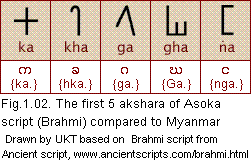
 Myanmar script is directly descended from the Asoka script, because there are many
similarities between the two. In fact, it was probably brought into northern
Myanmar (to be specific, the ancient city of Tagaung during the life time of the
Buddha) and made into a script based on circles to cast runes or
Myanmar script is directly descended from the Asoka script, because there are many
similarities between the two. In fact, it was probably brought into northern
Myanmar (to be specific, the ancient city of Tagaung during the life time of the
Buddha) and made into a script based on circles to cast runes or
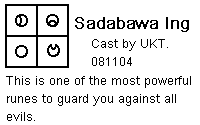
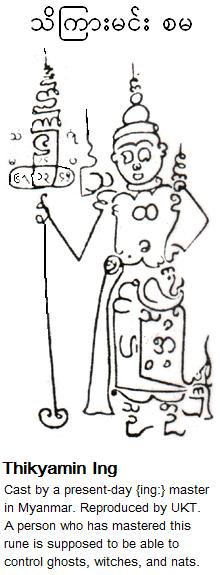
 {ing:}, a
pre-Buddhistic instrument of a magico-religion which the Buddhists sought to
suppress. (Please note: this is pure supposition arrived at from my foray into
the folk elements of Buddhism in Myanmar.) [{p001end}]
{ing:}, a
pre-Buddhistic instrument of a magico-religion which the Buddhists sought to
suppress. (Please note: this is pure supposition arrived at from my foray into
the folk elements of Buddhism in Myanmar.) [{p001end}]
The Burmese-Myanmar akshara matrix is made up of 33 letters
all of which may be classified as consonants. There are some twelve simple vowels.
The Burmese script is written in three levels; a main level, and a level above
the main level and a level below the main level. Most of the consonants
are written on the main level, while the vowel points are written on all three levels.
Some letters are written on the bottom most level in conjuncts (or conjoined aksharas).
The Burmese script is always written from left to right: it is impossible
to write from right to left. The punctuation marks are also quite different from
that of English and French. The whole thing might be confusing at first, but if
we recall that the French write their e's in three different ways: è, e
and é , and the Spanish have two marks of interrogation: ¿(Alt0191) and ?,
Burmese cannot be particularly more difficult than languages that
use the Roman script. however, it is always comforting to remember that what we
are attempting is to introduce the Burmese language to a speaker of English.
This is not a scholarly work; at best, it is the work of an amateur who is a
native son of Burma, and who thinks that he knows English, some French, just a
wee bit of technical German, some words of Swedish, and who aspires to learn
Spanish. Since, he has lived for some time in Australia, where he used to wash
his face in the 'bison' - not basin - and where all his friends were 'mites' -
not mates, and in the United States and Canada where no one was supposed to
speak the King's English, it is hoped that BURMESE FOR FOREIGN FRIENDS should be
interesting if not entertaining. [{p002end}]
Contents of this page
p003
To the best of my knowledge, there had been no attempt to write
the Burmese-Myanmar language with the Latin script of the Roman alphabet.
And, as late as 1984, Caroline Courtard wrote in the "In Search of Burma"
(Frederick Muller Limited, London SW19 7JZ): "Transliteration
from the Burmese does not conform to a single system;
one comes across the same word spelt a multitude of different ways."
Thus, the first hurdle I had to overcome in presenting Burmese for Foreign Friends
is to devise a consistent system of writing the language with Latin script
of Roman alphabet which would be readily understood by a speaker of English
or French from North America. Please note that I am not confining myself
to using the letters used for writing the English language,
but would be using the extended Latin alphabet. I wish I could use the IPA alphabet.
However, since IPA uses non-ASCII characters, I have to confine myself
to using the ASCII characters only.
Being a native-born speaker of Burmese who had traveled
extensively in Myanmar and who had worked as a university teacher in Burma
for over thirty years, I have come across many dialects spoken by my friends
and students. At one time, I had to teach my students in English,
and I know how difficult it is for an adult to learn a second language
or even a different dialect. Moreover, since I have lived and studied in the U.S.,
Australia and Canada, I have come to appreciate the difficulty facing
a foreigner in trying to pronounce even my own Burmese name. Eventually,
this led me to change my name to the nearest to it in pronunciation.
When children were born to me, I had to name them not only in
conformity with the Burmese-Buddhist custom, but also with a mind to making the
names pronounceable by non-Burmese speakers.
I had attempted to devise a system of transliteration many times
previously based on the English system of writing. But, unfortunately, there is
no natural or logical correspondence between a letter and a sound that the
letter represents in English. This has led George Bernard Shaw to propose
[{p003end}] that the word 'fish' should be spelled 'ghoti':
<gh> to represent the sound /f/ as in enough, <o>
to represent the sound /i/ as in women, and <ti> to represent
the sound /ʃ/ as in <nation>. And, therefore,
my attempts were never successful.
Then, when I came to learn French, it dawned on me that a word
such as <comment> written in Latin script (please remember that speech and
script are different: English-Latin, French-Latin, Spanish-Latin )
is pronounced differently in French. I had to forget the English system completely
to read French. This idea is the basis on which I have devised my system
of writing the Burmese language with the Latin script.
I have named my system 'Romabama' or
 {rau:ma.ba.ma}.
Just as in French, do not pronounce the end consonant. This is
the most important rule in my system.
I have spelled all the words beginning with a consonant and
for those with the sounds of "soft"
 {a.} IPA [ə]. Remember, Burmese-Myanmar is based on syllables of the canonical
form CVÇ, where the coda-akshara is a "killed" akshara.
The vowel is monophthongal in pronunciation in spite what the Western phoneticians
say --Burmese-speakers, including myself at one time, are unable to pronounce
English words like <oil>, <boy> and <cow>. The vowel sound
even if represented by a digraph must be pronounced as a monophthong. Thus, the word
{a.} IPA [ə]. Remember, Burmese-Myanmar is based on syllables of the canonical
form CVÇ, where the coda-akshara is a "killed" akshara.
The vowel is monophthongal in pronunciation in spite what the Western phoneticians
say --Burmese-speakers, including myself at one time, are unable to pronounce
English words like <oil>, <boy> and <cow>. The vowel sound
even if represented by a digraph must be pronounced as a monophthong. Thus, the word
 {peing} which is very close in pronunciation to English <pine>
is spelled {peing}. Do not pronounce the n , and never spell Romabama words
with the so-called "magic e". Remember, Myanmar
is a phonetic script similar to IPA preceding it by hundreds of years.
Romabama spelling can be easily arrived at by: 1. choose the onset,
2. choose the coda, and then, 3. choose the peak vowel.) Since,
I have introduced my system gradually, I hope that there would be no difficulty
for you in studying the Burmese language by yourself. [{p004end}]
{peing} which is very close in pronunciation to English <pine>
is spelled {peing}. Do not pronounce the n , and never spell Romabama words
with the so-called "magic e". Remember, Myanmar
is a phonetic script similar to IPA preceding it by hundreds of years.
Romabama spelling can be easily arrived at by: 1. choose the onset,
2. choose the coda, and then, 3. choose the peak vowel.) Since,
I have introduced my system gradually, I hope that there would be no difficulty
for you in studying the Burmese language by yourself. [{p004end}]
Contents of this page
From:
http://en.wikipedia.org/wiki/Abugida 081104
An abugida (pronounced
/ˌɑːbuːˈɡiːdə/,
from Ge‘ez አቡጊዳ ’äbugida
or Amharic አቡጊዳ ’abugida)
is a segmental writing system which is based on consonants but
in which vowel notation is obligatory. About half the writing systems in the world
are abugidas, including the extensive Brahmic family of scripts used in South
and Southeast Asia. [UKT: Myanmar belongs to the Brahmic family of scripts -
found on the pillars erected by the Buddhist emperor a few centuries after the
birth of Gaudhama Buddha.]
In general, a full letter of an abugida transcribes a consonant. Full letters
are written in a linear sequence in a consistent direction. Vowels are dependent
on the consonant. They are written through modification of the consonant letter,
either by means of diacritics which are placed in a vowel-dependent position
relative to the consonant (rather than always progressing in the same direction
as the sequence of full letters) or through changes in the form of the consonant
itself.
Vowels not preceded by a consonant may be represented with:
• a zero consonant letter with dependent vowel signs attached
[UKT: In Burmese-Myanmar it is
{a.} from which we get
 {i.},
{i.},
 {u.},
{u.},
 {é}, etc.]
• separate full letters for each initial vowel, that are distinct from the
dependent vowel signs
Consonants not followed by a vowel may be represented with:
• a dependent vowel sign which explicitly indicates lack of a vowel (virama) [UKT:
virama (Sanskrit) means the vowel killer or
 {a.thût}]
• lack of a dependent vowel sign (often with ambiguity between no vowel and a
default inherent vowel)
[UKT: the "inherent vowel" is represented in Romabama with
{a.}, but
not shown in Myanmar.]
• a dependent vowel sign for a short or neutral vowel such as schwa (with
ambiguity between no vowel and that short or neutral vowel)
[UKT: Schwa is IPA [ə] with the shape of Myanmar
 {hka.}.
This sound is present in disyllabic words like
 {a.ni}
where the stress is not on
{a.} and is
pronounced very lightly.]
{a.ni}
where the stress is not on
{a.} and is
pronounced very lightly.]
• conjunct consonant letters where two or more consonant letters are graphically
joined in a ligature
[UKT: there are three types of conjuncts in Myanmar: the
pronounceable medials (e.g.
 {kya.}),
mute vertical conjuncts (e.g.
 {k~ka.}),
and mute horizontal conjuncts (e.g.
{k~ka.}),
and mute horizontal conjuncts (e.g.
 {th~tha.}/{þ~tha.}.]
• dependent consonant signs, which may be smaller and/or differently placed
versions of the full consonant letters, or distinct signs
[UKT:
 {thé:thé:ting},
 {auk-mric} (MEDict620) and
 {wic~sa.}
(MEDict480} would fit into this category.]
{wic~sa.}
(MEDict480} would fit into this category.]
The term abugida was adopted into English [UKT: in 1996] as a
linguistic term by Peter T. Daniels. It is the Ethiopian name of the Ge‘ez
script, derived from the first four letters aləf, bet, gäməl, dənt (in
the traditional A B G D order of Hebrew and Greek), graded by the first four
vowel forms, much as the term abecedary is derived from the Latin a be
ce de. As Daniels used the word, an abugida contrasts with a syllabary,
where letters with shared consonants or vowels show no particular resemblance to
each another, and with an alphabet proper, where independent letters are used to
denote both consonants and vowels. Sometimes, abugidas have been considered to
be syllabaries or intermediate between syllabaries and alphabets ("semi-syllabaries",
"alpha-syllabaries", etc.). Less formally, however, abugidas are simply
called "alphabets".
Go back abu-note-b
Contents of this page
End of TIL file