01. The Basics
01.01. Dialogue
01.02. Dialogue
01.03. Dialogue
basics.htm
by U Kyaw Tun (UKT) and Daw Than Than, Tun Institute of Learning, Jan 1991
http://www.tuninst.net
Edited by UKT, and digitization by UKT and the staff of TIL. Start: 2008 Nov
Contents of this page
01. The Basics
01.01. Dialogue
01.02. Dialogue
01.03. Dialogue
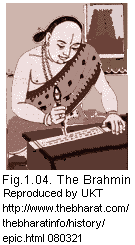
UKT: Please remember that I am writing this for a mixed readership. And, I have to include explanations for linguists, phoneticians and grammarians of other languages as well. (And who knows, Panini the ancient Sanskrit phonetician and grammarian, presumably a Brahmin, a contemporary of the Buddha, might be watching me in spirit over my shoulder.) And so, if you are a beginner with hardly any knowledge of linguistics, phonetics and grammar of other languages, some of my explanations would be beyond you. For such people, all I can suggest is to ignore my notes and explanations.
UKT notes
• Panini
(IAST:Pāṇini, Devanāgarī: पाणिनि)
 {a.hkan:tic}
A man is trying to teach his foreign friend some Burmese. He seeks the help of a woman friend of his, and she agrees to help him. In this episode, the man has not brought his foreign friend - you - along, and so you are not expected to say anything in Burmese.
The dialogue is given in four columns: 1. Burmese-Myanmar script, 2. Formal pronunciation, 3. Casual pronunciation, and 4. one-to-one translation. If you are a beginner you are advised to imitate the formal pronunciation.
W.  |
la-pa / la-pa | la-ba / la-ba | come/ come |
M.  |
ma-tèý-nau | ma-dè-nau | healthy be? |
W.  |
hoat-kè. | hoat-kè. | yes |
M.  |
lu-tic-yauk-ko | lu-ta.yauk-go | man one-person to |
 |
to. | do. | we |
 |
ba.ma sa.ka: | ba.ma za.ga: | Burmese-speech |
 |
thing-pé: tè. a.hka | thing-pé: dè. a.hka | teach-give when |
 |
ku-pé: pa | ku-pé:Ba | help-give |
W. |
ku-paa. mèý | ku-Ba. mèý | help will (agree) |
(The above table straddles p005 and p006.)
You are expected to guess the meaning of the dialogue from the meaning of
each word given.
Loosely translated, the dialogue runs thus:
W: Please come.
M: How do you do?
W: I'm very well, thank you.
M: Please help me teach a man Burmese.
W: I'll help. [{p006end}]
The Burmese people do not greet each other saying 'good morning' or 'good day'. To the Burmese, the Western habit of greeting each other seems superfluous; how would you greet a man on his sickbed? A simple smile that conveys congeniality or sympathy is all that is required.
In Myanmar, you would probably enquire about the health of the
person you are meeting even when that person seems to be in the best of health.
Superfluous? Yes, I believe so. But still you have to say something, so you say,
"How do you do?" A lot of Burmese do not know how to greet a person who is
obviously in ill-health or on his sickbed. I was one of them until someone, whom
I consider to be less knowledgeable than I, pointed out that I should say:
 {né-tha hteing-tha rhi. rè. la:}. (Shame on me for being so arrogant in thinking that
the other person is less knowledgeable!)
{né-tha hteing-tha rhi. rè. la:}. (Shame on me for being so arrogant in thinking that
the other person is less knowledgeable!)
Also, it is not the habit of the Burmese people to say 'thank
you', and if you realize that a lot of the present day thank-you's do not
involve a single iota of genuineness either in the tone or facial expression,
you would agree with the Burmese people that a simple smile is all that is
required to express thanks. However, the modern city dwellers would tend to use a
coined word, the equivalent of a 'thank you'
 {kyé:zu. ting-pa-tèý} to show off their cultural awareness.
Similarly, a natural equivalent of 'please' is also missing, and
here too, there is a deliberate attempt to use a coined word:
 {kyé:zu. pru. pri:} or the like.
Caveat: In all these dialogs you will rarely come across phrases like: • Thank you • Please .
Because you are a foreigner, a occasional "Thank you" and "Please" on your part is OK, but avoid doing it too much.
You will be taken to be showing off your cultural awareness to remind the locals of their "lack of culture",
and will bring on an negative attitude toward you!
It must be admitted that the above dialogue would appear to be
somewhat artificial to the native speakers. However, because of the general
inability of the North American speakers to pronounce what are known as the

 {ra.-ric ya.ping.} sound, the
 {ha.htô:} sound, and the
 {wa.hswè:} sound, the conversation had been deliberately altered to avoid such sounds.
Such sounds are very common and are present in words such as 'Myanmah', [{p008end}]
the inhabitants of the country of Myanmar, and 'Myanmah-pyay', the "Land of Myanmah'.
And, in conclusion, I must ask you to be patient and be satisfied with a
somewhat truncated dialogue. [{p008end}]
{wa.hswè:} sound, the conversation had been deliberately altered to avoid such sounds.
Such sounds are very common and are present in words such as 'Myanmah', [{p008end}]
the inhabitants of the country of Myanmar, and 'Myanmah-pyay', the "Land of Myanmah'.
And, in conclusion, I must ask you to be patient and be satisfied with a
somewhat truncated dialogue. [{p008end}]
The woman inquires about the prospective student: who he is, where he came from, how long he has been in Yangon, and she comes to a conclusion.
W:  |
thing-mæÑ. thu-ka. | thing-mè. thu.ga. | teach-to-be he from |
 |
Bèý-thu lè: / Bèý-ka. lè: | Bèý-thu lè: / Bèý-ga. lè: | who be / where be (question) |
M:  |
thu-ka. | thu-ga. | he from |
 |
ka.né-da ka. pa | ka.né-da ga. Ba | Canada from be |
W: |
thu | thu | he |
 |
ran-koan | yan-goan | Yankon |
 |
rauk-né ta | yauk-né da | arrived |
 |
Bèý-toan: ka. lè: | Bèý-doan: ga. lè: | when |
M:  |
a.ring la. ka. pa | a.ying la. ga. Ba | previous month be |
(or) * * |
(or) ya.hking la. ka. pa | (or) ya.hking la. ga. Ba | |
W:  |
di-lo hso-ring | di-lo hso-ying | such said |
 |
a.saim: thak-thak | a.saim: thak-thak | (he is) green pure |
 |
Bè: pau. | Bè: pau. | be (conclusion) |
M:  |
hoat-pa tèý | hoat-pa dèý | true be (agreement) |
* The reader might have seen {ya.hking} in a shortened form,
 .
This is wrong, because, the grapheme in red is not pronounceable: .
This is wrong, because, the grapheme in red is not pronounceable: {ya.} +
( {ya.} +
( {a.thût} - the vowel killer) + {a.thût} - the vowel killer) +
 {hka.} --> {y~hka.}
(vertical conjunct with hidden {a.thût}-sign known as {hka.} --> {y~hka.}
(vertical conjunct with hidden {a.thût}-sign known as
 {paaT-hsing.}: not pronounceable because there is no vowel between {y} and {hka.}.)
 {y~hka.} + {nga.} + {a.thût} --> {y~hking} (Not pronounceable) |
|||
(The above table straddles p009 and p010.)
Translated loosely, the dialogue runs:
W: Who is he? And from where?
M: He is from Canada.
(The man does not tell her who the prospective student is.
Obviously, but unknown to the woman, he has something up his sleeve. Beware!)
W: When did he arrive in Yangon?
M: Sometime last month.
W: If so, he must be very green.
(She means that the foreigner knows nothing of Myanmar. Is she also
a party to some devious scheme?
No one can tell right now, but let us only hope that they are honest people.)
M: That's true. [{p010end}]
You might have noticed by now that the only punctuation mark
I have given is a very short vertical line between the words
{Bèý-thu lè:} and {Bèý-ka. lè:} in the first sentence spoken by the woman.
This punctuation mark stands for a comma and is known as
 {poad-hprat}. So far, I have not given the mark equivalent for the full-stop or period.
It is represented by two short closely-placed vertical lines known as
{poad-hprat}. So far, I have not given the mark equivalent for the full-stop or period.
It is represented by two short closely-placed vertical lines known as
 {poad-ma.}: literally meaning the female or the mother poad'. These were
the only two punctuation marks used in Burmese-Myanmar script. No semicolons, colons,
and question marks. There are no capital letters either. However, there are
attempts to introduce the comma and the question mark.
{poad-ma.}: literally meaning the female or the mother poad'. These were
the only two punctuation marks used in Burmese-Myanmar script. No semicolons, colons,
and question marks. There are no capital letters either. However, there are
attempts to introduce the comma and the question mark.
The most outstanding difference between modern English (as
different from Old English) and Burmese can be seen from the following sentence
in modern English: 'Pig chases man' cannot be changed into 'Man chases pig'
without a change in meaning. However it is possible to do so in Burmese. {wak-ka. lu-kô
 leik-tèý} has the same meaning as
 {lu-kô wak-ka. leik-tèý}. The indicating words
 {ka.} and
 {kô} indicate who is doing what. Either one of the two words may be dropped
and still the sentence means 'Pig chases man'. More than eighty per cent
of the population in Myanmar are Buddhists, and they like eating pork and beef.
If you are a good Buddhist, you must refrain from killing: let the other fella
do the dirty job for you!
{kô} indicate who is doing what. Either one of the two words may be dropped
and still the sentence means 'Pig chases man'. More than eighty per cent
of the population in Myanmar are Buddhists, and they like eating pork and beef.
If you are a good Buddhist, you must refrain from killing: let the other fella
do the dirty job for you!
Cultural awareness: The use of the word "pig"
{wak}, might be offensive to some readers, I am using it because another animal such as "dog"
{hkwé:} or "cow"
{nwa:} would be comparatively difficult to pronounce. Can you think of another example of this kind?
[{p011end}]
The woman had thought there would be one man coming to learn Burmese, but now she finds out there would be more than one.
M:
 |
thuu.ko nak-hpan-hka | thu.go nak-hpan-ga | he-to tomorrow |
 |
di-ko hkau-la mèý-nau // | di-go hkau-la-mèý-nau // | here bring-will |
W:
 |
hkau-la-pa // | hkau-la-Ba // | bring |
M:
 |
pa.hta.ma.tau. | pa.hta.ma.dau. | first (only) |
 |
thuu. tic-yauk htè:Bè: | thu.ta.yauk htè:Bè: | his one-person only |
 |
hkau-la-mèý // | hkau-la-mèý // | bring-will |
W:
 |
Bèý-lo ? | Bèý-lo ? | how come ? |
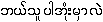 |
Bèý-thu pa-oän:mha-lè: ? | Bèý-thu pa-oän:ma.lè: ? | who else include |
M:
 |
thu.main:ma.pa | thu.main:ma.Ba | his wife also |
 |
pa-la-mèý // | pa-la-mèý // | together come will |
W:
 |
hau:tau. // | hau:tau. // | (exclamation exclusively used by females) |
M:  |
thu.main:ma. pa-la-ring | thu.main:ma. pa-la-ring | wife come if |
 |
lak-ma.hkän tau.Bu:la: ? | lak-ma.hkän dau.Bu:la: ? | not-receive is-not |
W:  |
ma.hoat-pa-Bu: / | ma.hoat-pa-Bu: / | not-true no |
 |
hkau-tha hkau-la-pa // | hkau-tha-hkau-la-Ba // | bring (simply) bring-be |
M:  |
wam:tha leik-ta // | wam:tha-leik-ta // | (feel deep) inside pleasant-be |
Translated loosely, the dialogue runs:
M: I'll bring him here tomorrow.
W: Please, do.
M: First, I'll bring him only.
W: What did you say? Who else is coming?
M: His wife will come also.
W: (exclamation)
M: Won't you have us, if the wife comes along?
W: No. (She contradicts the suggestive question of the man,
and to explain herself, adds:) Just bring them.
(Here, the woman does not like the man
Caution: Myanmar culture, especially those of the people of Buddhist faith has norms of its own, which even the minority groups fail to understand fully. For instance, the use of exclamations is not considered very polite and is used only between close friends and when speaking to person of junior status. Thus, when the woman uses the phrase
However, if you go deeper, you will notice that even among Burmese-Buddhists, there are differences when you go from region to region and from social group to social group. So, my advice is, don't be pretentious, and let the other person know that you are an outsider, in which case your audience would not only appreciate but go out of its way to please you.
The word
 {thuu.}
appears in this conversation several times. It can be either 'his' or 'hers'.
Another word with the same checked sound is
{thuu.}
appears in this conversation several times. It can be either 'his' or 'hers'.
Another word with the same checked sound is
 {thu.}
which is spelled differently and meant differently. It is Pali prefix meaning
'good'.
{thu.}
which is spelled differently and meant differently. It is Pali prefix meaning
'good'.
From:
• 1. Panini -- by J J O'Connor and E F Robertson http://evans-experientialism.freewebspace.com/panini.htm 081103
• 2. Panini and Sanskrit Grammar: http://evans-experientialism.freewebspace.com/panininix.htm 081103
From • 1.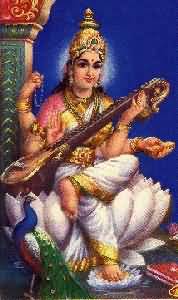
The tradition of Paninian Grammar as it has reached us clearly believes that Panini was inspired by Mahesvara/Siva to write his grammar, and that he received his major influence from him.
UKT: Though the article mentions the Hindu god Siva, no image of Siva was given, instead of which the authors chose to include the image of the Goddess of Learning, known in Myanmar as {tha.raþ~tha.ti} .
Panini was an Indian grammarian who was believed to have flourished around. c. 400 B. C. His AshtAdhyAyI [eight books] (tr. 1891) is one of the earliest works of descriptive linguistics and is also the first individually authored treatise on Sanskrit. He was born: about 520 BC in Shalatula (near Attock), now Pakistan Died: about 460 BC in India
Panini was born in Shalatula, a town near to Attock on the Indus river in present day Pakistan. The dates given for Panini are pure guesses. Experts give dates in the 4th, 5th, 6th and 7th century BC and there is also no agreement among historians about the extent of the work which he undertook. What is in little doubt is that, given the period in which he worked, he is one of the most innovative people in the whole development of knowledge. We will say a little more below about how historians have gone about trying to pinpoint the date when Panini lived. Panini was a Sanskrit grammarian who gave a comprehensive and scientific theory of phonetics, phonology, and morphology. Sanskrit was the classical literary language of the Indian Hindus and Panini is considered the founder of the language and literature. It is interesting to note that the word "Sanskrit" means "complete" or "perfect" and it was thought of as the divine language, or language of the gods.
UKT: While Sanskrit is taken to be the "perfect language", Pali is taken as the "proto-language" or Prakrit. The language that was used by the Buddha was known as Magadhi which was considered to be the eastern dialect and Pali was the western dialect of the Magadha Kingdom. Both are described as the Prakrits and sometimes derisively called the "imperfect languages". Theravada Buddhist texts and Janist texts (Janism is the religion of Mahavera) were in Pali. All the while it is intriguing that no written texts on Grammar of Panini, Buddhism of the Buddha, or Janism of Mahavera from the periods before Asoka were found in India. The earliest written texts found were of a couple of centuries later on the Asoka pillars. The question facing historians of today was whether to consider Panini, Buddha, and Mahavera to be without the knowledge of the written script -- or illiterates. Read an interesting article (online) on state of "writing" before Asoka titled "The Illiterate Harappans" www.safarmer.com/washstate.pdf 081104
A treatise called Astadhyayi (or Astaka ) is Panini's major work. It consists of eight chapters, each subdivided into quarter chapters. In this work Panini distinguishes between the language of sacred texts and the usual language of communication. Panini gives formal production rules and definitions to describe Sanskrit grammar. Starting with about 1700 basic elements like nouns, verbs, vowels, consonants he put them into classes. The construction of sentences, compound nouns etc. is explained as ordered rules operating on underlying structures in a manner similar to modern theory. In many ways Panini's constructions are similar to the way that a mathematical function is defined today. ...
From • 2
The most fascinating non-Western grammatical tradition, and the most germinal and independent - is that of India, which dates back at least two and one-half millennia and which culminates with the grammar of Panini whose date is usually given as being circa the 5th century BC. The Sanskrit grammar of Panini already comprises a fully formulated system, its author standing at the end of a long line of precursors of which sixty-four are named but whose works have entirely perished.
Panini himself uses the word 'Yavanani' which Katyayana explains as 'writing of the Yavanas' (i. e. Iaones or Greeks.) Although it is unlikely that Indian scholars could have come into first hand contact with Greek manuscripts before the invasion of Alexander in 327 BC, Panini could well have had contact with Greeks familiar with studies of rhetoric, since the Ionian Greeks had dealings with Persia from c. 540 BC, and many who were exiled settled in Persia well before 327 BC. They must, however, have grown familiar with Greek ideas before a grammarian would make a rule as to how to form from Yavana, 'Greek, ' a derivative form meaning 'Greek writing. ' Panini's grammar consists of nearly 4,000 rules divided into eight chapters. It provides a collection of 2,000 roots.
Being composed with the maximum conceivable brevity, this grammar describes the entire Sanskrit language in all the details of its structure, with a unity which has never been equalled elsewhere. It is at once the shortest and fullest grammar in the world. The grammar of Panini is a 'sabdanusasana,' or 'Treatise on Words', the cardinal principle of which is, that all nouns are derived from verbs, and because of this belief it was natural that the Sanskrit copula should also be categorized as a verb. It is tempting to speculate that maybe it was Panini's inclusion of the copula as a verb that influenced the Greek grammarians to wrongfully classify the 'be' word as a verb, but there is no evidence that the early Greek grammarians ever read the Sanskrit grammar of Panini, although there was communication between the Greek classical world and that of the Indian northwest, and some of the ancient Vedic scholars may well have been known to the Greeks and possibly vice versa. For example, in 302 BC the Greek historian Megasthenes was known to have been the ambassador of Seleucus I Nicator, founder of the Seleucid Empire, to the court of Candragupta Maurya, Ashoka's grandfather in what is modern-day Patna.
Ashoka's reign of the third century BC is comparatively well documented. He issued a large number of edicts, which were inscribed in many parts of the empire and were composed in Prakrit, Greek, and Aramaic, depending on the language current in a particular region. Greek and Aramaic inscriptions are limited to Afghanistan and the trans-Indus region. In one edict Ashoka referred to five Greek kings who were his neighbours and contemporaries and to whom he sent envoys, but no amount of cultural intercourse proves with certainty that there was any cross-fertilisation of linguistic theory and that the curious beliefs of the Indians that all words were essentially verbs influenced the Greeks when they were dividing up their lexicon into various word-types based on their perceived sentential function in a linguistic string. Certainly the renowned Greek grammarian Dionysius Thrax doesn't appear to have known of Panini and he is not mentioned anywhere in the Greek classical writings of antiquity that still survive. Panini's work very early acquired a canonical value, and has continued, for at least 2,000 years, to be the standard of usage and the foundation of grammatical studies in Sanskrit. Panini's principle of brevity is, moreover, notably employed in the invention of technical terms.
Those of Panini's terms which are real words, whether they describe the phenomenon, as sam-dsa, 'compound' or express a category by an example, as dvi-gu ('two-cow'), 'numeral compound, ' are probably all borrowed from predecessors. But most of his technical terms are arbitrary groups of letters resembling algebraic symbols, and to an extent that obscures any real evidence of his actual classification of 'be' as a verb, but as has been said it was his belief that all nouns were derived from verbs and 'be' (bhu) was patently not a noun or noun-like in any way, it is logical to draw the conclusion that he considered it to be a verb or he created a distinct class of its own in which to place it, but there is no evidence that he did so. On account of the frequent obscurity of a work which sacrifices every consideration to brevity, attempts soon began to be made to explain it, and with the advance of grammatical knowledge, to correct and supplement its rules. Among the earliest attempts of this kind was the formulation, by unknown authors, of rules of interpretation (Paribhasa), which Panini was supposed to have followed in his grammar.
Because the classificatory systems of parts of speech within Panini's original work have been updated many times by later scholars both Indian and occidental who where educated with western (Greek) notions of the copuletic function of 'be', it must have been natural for them to rearrange Panini's tables in such a manner that the 'be' word ended up in the verb section, particularly in view of the fact that it inflected in a like manner to the verbs forming the first conjugation of Sanskrit. In other words what happened was similar to the way in which the Latin-trained grammarians of the Germanic languages tried to coerce the 'be' complex into a Latinate conjugational straightjacket. This is evidenced by the modern disorderly and irregular state of the English 'be' inflectionary system, constituting as it does a bewildering mixture of two different verbs, and the varying degrees of paradigmatic abnormality of the copula in all the other languages of Europe. Those who followed and 'elucidated' Panini's great work also regarded his ancient grammar as more comprehensible particularly for western readers, if viewed through the lens of a Latin classificatory system.
Go back panini-note-b
End of TIL file