Update:
2008-11-14 12:43 AM +0800
TIL
Burmese for Foreign Friends
aksh.htm
by U Kyaw Tun (UKT) and Daw Than Than, Tun Institute of Learning, Jan 1991
http://www.tuninst.net
Edited by UKT, and digitization by UKT and the staff of TIL. Start: 2008 Nov
indx-RBM4M |Top
indx-B4FF
Contents of this page
01.04. The Burmese-Myanmar Script
01.05. Activation - the Triads
01.06. Activation - the Pairs
01.07. Activation - the Singles
01.08. The Vowels
01.09. Activation - the Simple Triplets
or the Pitch-registers which were mistaken to be tones.
01.10. Activation - the Simple Doublets
or Simple Pseudo-triplets
UKT: According to some sources, such as
http://www.omniglot.com/writing/burmese.htm 081111, "The Burmese or
Myanmar script developed from the Mon script, which was adapted from a
southern Indian script during the 8th century. The earliest known
inscriptions in the Burmese script date from the 11th century."

Yet, curiously, the Myanmar script has a very close resemblance
to the Asoka script (now dubbed the Brahmi). My foray into the often-ridiculed
"pseudo-science" of the "Casting Runes" has suggested that
the Myanmar script, based on the Perfect Circle, was an ancient script
known to the ancient Myanmar monks, the Aris, who were probably related
to the modern Tibetan Lamas.
 It was probable that these were Buddhist monks who fled
the Magadha kingdom during the massacre of the Set-kya in the life-time
of Gotama Buddha. According to the Glass Palace Chronicles it was Abiraza,
a Set-kya, who founded the ancient Myanmar city of Tagaung. The Aris were
uprooted during the reign of Anawrahta of Pagan, but a few continued their
practice as forest-dwelling monks who resurfaced only after the fall
of the Pagan kingdom. See
Pinya-Era (13th Century) inscription in Buddh Gya
It was probable that these were Buddhist monks who fled
the Magadha kingdom during the massacre of the Set-kya in the life-time
of Gotama Buddha. According to the Glass Palace Chronicles it was Abiraza,
a Set-kya, who founded the ancient Myanmar city of Tagaung. The Aris were
uprooted during the reign of Anawrahta of Pagan, but a few continued their
practice as forest-dwelling monks who resurfaced only after the fall
of the Pagan kingdom. See
Pinya-Era (13th Century) inscription in Buddh Gya
Finally, there are observations to be made on the Asoka characters themselves.
 Firstly, the square-ness of the shapes is probably due to the ease of chiseling
the stone surface. However, if written on palm leaf, the characters would be more rounded.
Secondly, note the regular shape of the cross depicting the akshara {ka.}.
To show that it can go round right-handed or left-handed (to depict eternal motion),
four lines can be added which would result in the holy-symbol,
the Swastika, of the Ancient Aryans, which the Nazis misused
which has resulted in the Swastika being associated with Evil.
Now, compare Myanmar {ka.} to Asoka {ka.}, by taking out the curvatures of the Myanmar
{ka.}. You get a "capital Y", not a cross! When you join the tips
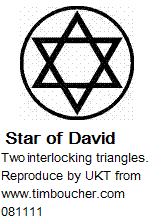
of the arms of Y you get an upside down triangle - the Female or {yau:ni.}-sign.
(See online Wikipedia article: Star of David
http://en.wikipedia.org/wiki/Star_of_David 081111 in connection with
interlocking triangles.) Please remember, I am a material
scientist - a skeptical chemist like Robert Boyle, and I don't pay credence
to any assumption even though it be made by me! What I have suggested here
is simply one of the vague ideas which I will entertain during my study.
Firstly, the square-ness of the shapes is probably due to the ease of chiseling
the stone surface. However, if written on palm leaf, the characters would be more rounded.
Secondly, note the regular shape of the cross depicting the akshara {ka.}.
To show that it can go round right-handed or left-handed (to depict eternal motion),
four lines can be added which would result in the holy-symbol,
the Swastika, of the Ancient Aryans, which the Nazis misused
which has resulted in the Swastika being associated with Evil.
Now, compare Myanmar {ka.} to Asoka {ka.}, by taking out the curvatures of the Myanmar
{ka.}. You get a "capital Y", not a cross! When you join the tips
of the arms of Y you get an upside down triangle - the Female or {yau:ni.}-sign.
(See online Wikipedia article: Star of David
http://en.wikipedia.org/wiki/Star_of_David 081111 in connection with
interlocking triangles.) Please remember, I am a material
scientist - a skeptical chemist like Robert Boyle, and I don't pay credence
to any assumption even though it be made by me! What I have suggested here
is simply one of the vague ideas which I will entertain during my study.
UKT notes
• dark L
• pitch-register language
• Pinya-Era (13th Century) inscription in Buddh Gya
• suprasegmental
Contents of this page
p015
 The hyphenated term 'Burmese-Myanmar' is not a mistake: Burmese is the
spoken language or simply the 'language', and Myanmar is the written 'script'
used by Burmese, Karen, Mon, Pali, Sanskrit, Shan, etc. in the country of Myanmar.
The hyphenated term 'Burmese-Myanmar' is not a mistake: Burmese is the
spoken language or simply the 'language', and Myanmar is the written 'script'
used by Burmese, Karen, Mon, Pali, Sanskrit, Shan, etc. in the country of Myanmar.
My wife and I, while writing this Burmese for Foreign Friends
had realized that, to be effective, we had to learn Phonetics and
Linguistics. Accordingly, we started to learn these disciplines which were
very foreign to us. We were both chemists, but now in Canada we had to learn
new skills even though we were approaching 60. I was the leader but she
supported me all the way. In the meantime, I had to learn the mechanics of
stock trading to earn an income: we were "too old" to be employed.
Eventually, I learned the technical method or what the fundamentalists
called the "chartist". I devised a method of my own based on my knowledge of
"cycles" in Astrology - the Thirty-year Cycle. (You don't have to
believe in Astrology, but as long as others do in such pseudo-sciences,
these methods are useful.) The method was a success and
we eventually founded the Tun Investments Limited incorporated in Ontario, Canada.
In these lessons, which I am rewriting alone now that my dear wife
is no more, I find it necessary to introduce terms from Phonetics and
Linguistics such as "allophone", "phoneme", "grapheme", and "
pitch-register", which I hope
would be of help to you. However, if you are uncomfortable with them, just
ignore them. But, just be aware of the bracket convention I am using: {...}
Burmese-Myanmar in Romabama, <...> regular English words, /.../ and [...]
the International Phonetics Association (IPA) transcriptions, broad and narrow, respectively.
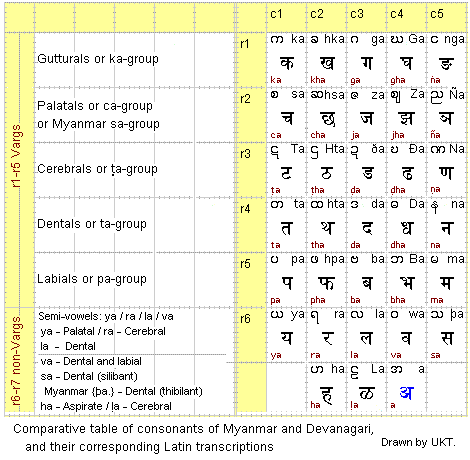
 The first characters of the Myanmar akshara-matrix are
 {ka.} and
 {hka.}.
Very few in Myanmar, including myself at one time, do not realized that
the English <k> sounds like
{hka.}.
This sound is the most common and is found in words like
<kin> [kʰɪŋ] and sounds like
{hka.}.
Very few in Myanmar, including myself at one time, do not realized that
the English <k> sounds like
{hka.}.
This sound is the most common and is found in words like
<kin> [kʰɪŋ] and sounds like
 {hking}. The
{ka.}
sound is found only after <s> in words like <skin> or [skɪŋ].
{hking}. The
{ka.}
sound is found only after <s> in words like <skin> or [skɪŋ].
English speakers do not hear the difference in sounds of [k] and [kʰ].
However, to us and to the people of South Asia (i.e. the Indian subcontinent),
they are very distinct and are assigned different graphemes, e.g. Devanagari क
U0195 [k] and ख U0916 [kʰ].
The third letter is
 {ga.} which is like <g> in the English 'get' and is entirely different
from the <g> in the French 'gens'. The second letter
{hka.} is pronounced intermediately between the sounds of the first
and the third letters. If you are to pronounce these three letters one after the other,
you will find that the first is pronounced in the front part of the mouth
and the third way back in the interior, i.e. in the order:
{ka.} ,
{hka.} and
{ga.}. Moreover, when you are articulating
{ka.} and
{hka.} your
vocal cords do not vibrate at all or vibrate very little. However, when
{ga.} is being articulated, the vocal cords are noticeably vibrating.
Thus the phonation of
{ka.} ,
{hka.} and described as voiceless, and
{ga.} as voiced. Thus,
{ka.} ,
{hka.} and
{ga.} forms a very well defined series.
{ga.} which is like <g> in the English 'get' and is entirely different
from the <g> in the French 'gens'. The second letter
{hka.} is pronounced intermediately between the sounds of the first
and the third letters. If you are to pronounce these three letters one after the other,
you will find that the first is pronounced in the front part of the mouth
and the third way back in the interior, i.e. in the order:
{ka.} ,
{hka.} and
{ga.}. Moreover, when you are articulating
{ka.} and
{hka.} your
vocal cords do not vibrate at all or vibrate very little. However, when
{ga.} is being articulated, the vocal cords are noticeably vibrating.
Thus the phonation of
{ka.} ,
{hka.} and described as voiceless, and
{ga.} as voiced. Thus,
{ka.} ,
{hka.} and
{ga.} forms a very well defined series.
I have observed that the English-speaking North Americans can
pronounce the second and the third letters, but never the first. Many could not even
distinguish between the sounds of the first and second letters. They all pointed
out that these are just variation of the same sound, or allophones.
As a Burmese-native speaker, I have always considered these sounds
to be quite distinct from one another, and that
they seem to form a group which I have named a "triad".
If you look at the Myanmar akshara-matrix, you will see that it is divided
into two main groups: the
 {wag}
(classifiable by point of articulation and into voiceless, voiced, and
nasals - [MEDict478]), and the {a.wag} (non-classifiable) groups. The Sanskrit
word corresponding to the first Pali-Myanmar is 'varg'. Of course, {a.wag}
correspondingly means the 'non-varg'. The {wag}-group is further divided into
the voiceless-voiced group and the nasals.
{wag}
(classifiable by point of articulation and into voiceless, voiced, and
nasals - [MEDict478]), and the {a.wag} (non-classifiable) groups. The Sanskrit
word corresponding to the first Pali-Myanmar is 'varg'. Of course, {a.wag}
correspondingly means the 'non-varg'. The {wag}-group is further divided into
the voiceless-voiced group and the nasals.
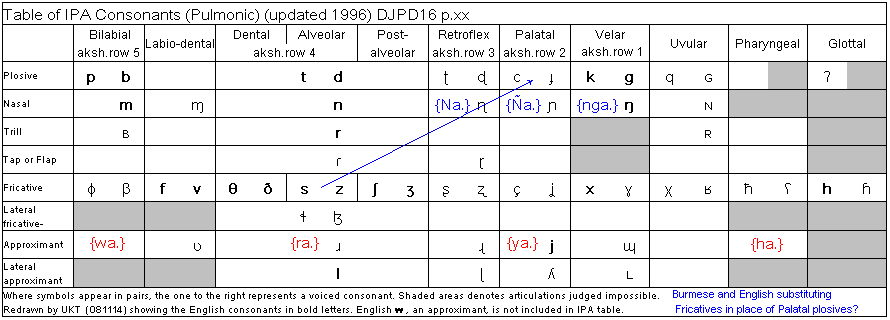
Since Myanmar is based on phonemic principles you should always consult
the IPA (International Phonetic Alphabet) tables. Caveat:
In comparing the Myanmar to IPA, I am relying on my own
(I am a native-Burmese speaker speaking English as my second language since
childhood) pronunciation which may not be exactly the same as that of another
native-Burmese speaker.
Contents of this page
Please repeat after me. For those who are familiar with phonetics, I have given
the IPA narrow transcription according to my own pronunciation.
{ka.} [k] ;
{hka.} [kʰ] ;
{ga.} [g]
 {sa.} [s] ;
 {hsa.} [sʰ] ;
 {za.} [z]
 {ta.} [t] ;
 {hta.} [tʰ] ;
 {da.} [d]
 {pa.} [p] ;
 {hpa.} [pʰ] ;
 {ba.} [b]
If you are a native English speaker, you can hear the difference in pronunciation of :
• [k] and [kʰ] in <skin> and <kin>
• [s] and [sʰ] in <...> and <sin>
• [t] and [tʰ] in <stone> and <tone>
• [p] and [pʰ] in <spin> and <pin>
There is one sound very commonly met, and it is similar to that of
{ba.}. It is that of
 {Ba.}
which is pronounced almost the same in Burmese. However, it is said that it
should be articulated a little further back in the mouth.
{Ba.}
which is pronounced almost the same in Burmese. However, it is said that it
should be articulated a little further back in the mouth.
Remember these are the sounds of the characters when they are found at the
beginning a word. Their sounds at the end of the words are not necessarily
the same as given above.
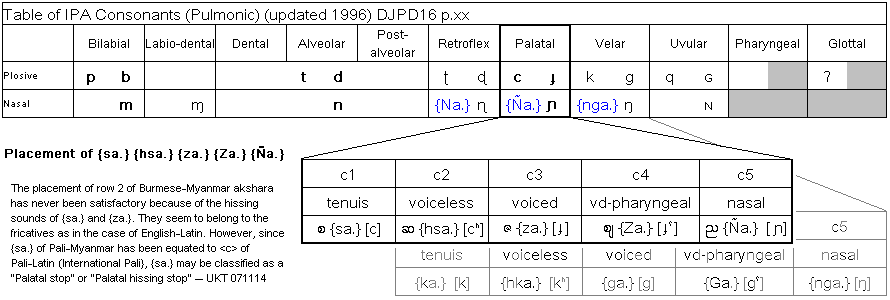
For phonetically inclined: It is said that there is no palatal <c>
in English. However, I must insist that it is only true in the case of onset
consonants in syllables of the type CVÇ, where C is the onset consonant,
V the peak vowel, and Ç the coda consonant. It may not be true in the case of
coda consonants such as <accident> /ˈæk.sɪ.dənt/ (Transcription
of <accident> is from Daniel Jones' English Pronouncing Dictionary,
ed. 16, Cambridge University Press, 2003, p.088.)
In <accident>, the two <c> have different pronunciations,
/k/ and /s/. I have suggested that /k/ could easily be /c/ -- the palatal <c>. If
you can accept this suggestion, then the transliteration and transcription of
{sa.} in syllable
 {thic~sa} is easily, and it makes the Pali <c> easy to understand.
Please remember that since friction at word-endings and syllable codas
is not present in Burmese,
cannot be {this~sa}.
{thic~sa} is easily, and it makes the Pali <c> easy to understand.
Please remember that since friction at word-endings and syllable codas
is not present in Burmese,
cannot be {this~sa}.
The reason why I am so intrigued with the sound of the first letter
{ka.} is because my Burmese name is spelled with it. It was quite unnerving
to hear my beautiful name (at least, I think it is) butchered again and again by
the barbarous tongues of my American friends that finally [{p015end}]
I had to let them call me by the closest name that they could:
Joe. I thank them from calling me 'Joe' because it brought down one of the
highest barriers between us. The next letter that interests my is
{hta.}. It is because my family name is spelled with it.
The English <t> falls between the Burmese
{ta.} and
{hta.}, but more closely to
{hta.}. The Burmese
{ta.} is pronounced with the tip of the tongue touching
the root of the upper teeth. If the tongue does not touch
the teeth but the palate, then you get the sound of
{hta.}. My Burmese name is spelled with
{hta.} in Burmese-Myanmar script, but with
a <t> in the English-Latin script: Tun.
Next, we have six letters forming three "pairs". Lastly,
we will come to the "singles".
Contents of this page
Please repeat after me.
 {nga.} [ ŋ ] ;
 {ña.} [ ɲ ] -- the back nasal pair, pronounced at the back of the mouth.
(If you are a native-English speaker, don't despair:
you will not be able to pronounce them properly!)
 {na.} [n] ;
 {ma.} [m] --
the front nasal pair, pronounced at the front of the mouth
{ma.} [m] --
the front nasal pair, pronounced at the front of the mouth
 {ya.} [ j ] ;
 {ra.}
[ ɹ ] -- the approximant pair which becomes almost silent at the end of the word
{ra.}
[ ɹ ] -- the approximant pair which becomes almost silent at the end of the word
(Burmese
{ra.} is less rhotic than English <r>, and it approaches [ j ] in many cases,
However, Pali-Myanmar
{ra.} is very much like the English <r>.)
The difficulty with the pronunciation of
{nga.} is due to English not having a dedicated grapheme for this sound.
English uses a digraph <ng>, giving the false impression that its sound
is to be articulated starting with the
{na.} (in the front part of the mouth) and moving to
{ga.} (in the interior). In fact,
{nga.} sound has absolutely nothing to do with the
{na.} sound because the area in which
{nga.} produced is "far" from the area where
{na.} is formed. IPA has a dedicated grapheme for this sound: [ŋ].
To native English-speaking North Americans (which includes Canadians):
Pronounce the English <singer> and <finger>. Do you notice that the <ng>
in two words are different? In <singer>, the <ng> is [ ŋ ] and there is no <g>
sound. However, in <finger>, there is <g> at the beginning of the second
syllable. I have asked this to quite a few Canadians who came to visit our
house in Deep River, Ontario, Canada. They were mostly research scientists
with PhDs in Physics and Chemistry, associates of my son Dr. Zin Tun,
who himself is a solid-state physicist working for the National Research Council
of Canada. Quite a few did not even realized that there is a difference,
until I asked them to pronounce the two words. They were really surprised to
find that they had never even noticed it. I myself did not notice it at one
time, until I came across the question while doing research in Linguistics
on the Internet. Since, I am a native-Burmese speaker (actually bilingual in
English and Burmese), I checked the pronunciations in DJPD16.
Similarly, English does not have a symbol to represent the Spanish ñ , and
English has to resort to using a diagraph <ny> for this sound.
Burmese-Myanmar has a symbol for this sound,
{ña.},
which is marked with the Spanish ñ in Romabama.
{ña.} is
called <nya le> or the "small nya". There is a similar symbol
 {Ña.}
called <nya gyi> or the "big nya".
{ña.} is
a true nasal either at the beginning of the word or at the end. However,
{Ña.}
is a nasal only at the beginning of the word. At the end it behaves an an oral.
{Ña.}
called <nya gyi> or the "big nya".
{ña.} is
a true nasal either at the beginning of the word or at the end. However,
{Ña.}
is a nasal only at the beginning of the word. At the end it behaves an an oral.
Contents of this page
Please repeat after me.
 {la.} [ l ] ;
 {wa.} [w] ;
 {tha.} [θ] ;
 {ha.} [h] - the approximants
The pronunciations of the above approximants are quite easy except for
{tha.}. The problem with
{tha.} is
two-fold. Firstly, this sound is present in English as <th> in <thin>.
IPA represents this as [θ]. However, this sound is absent in German and in Sanskrit,
and the Western phoneticians as well as the Sanskrit represent it
as s confusing it with
{sa.}.
Moreover, when Burmese-Myanmar represents it as {tha.}, it became confused
with Sanskrit th which is actually
{hta.}.
The problem we are meeting with
{tha.} is
because modern English has stopped using the Old English "thorn" þ .
In Romabama,
{tha.} is represented with <th> at the beginning of words,
but with <þ> at the end.
For the time being, I have left out the consonants mainly used
for writing Pali. I shall introduce them only in later chapters.
Contents of this page
p017
Vowel letters and Vowel signs.
The Burmese-Myanmar consonants do not need a vowel to produce sound, which is
true of all languages derived from the Asoka script or Brahmi.
However, to produce a sound using the Latin script, we have to use the vowel <a>
which I have represented as {a.}. Thus the English <k> which is mute
is given a sound in {ka.} .
The vowel signs used in Chapter 1 are listed below in section 01.09.
Contents of this page
Please read
pitch-register in my notes and then repeat the examples after me.
(I am not giving IPA representations, because of uncertainties.)
 {a.} {a} {a:} - {ka:} as in 'car' without <r>
 {a.} {a} {a:} - same as above used mainly for one-circle graphemes
or an-printer types of old printing presses
{a.} {a} {a:} - same as above used mainly for one-circle graphemes
or an-printer types of old printing presses
as opposed to graphemes used for two-circle graphemes
or am-printer types.
 {i.} {i} {i:} - {hse:} as in <see>
 {u.} {u} {u:} - {mu:} as in <moo>
 {é.} {é} {é:} - {wé:} as in <way>
 {au.} {au} {aw:} - {hsaw:} as in <saw>
 {au.} {au} {au:}
 {ô.} {ô} {ô:} - {hô:} as in <hoe>
 {oän.} {oän} {oän:} - e.g. {toän:} as in <tone> without <n>
Among the letters of the akshara-matrix are two letters
with what might be called 'legs', viz.
{na.} and
{ra.}.
When these are coupled with certain vowel [{p017end}] signs such as {u} ,
{ô} and {oän}, the 'leg' stands in the way of creating confusion.
To prevent this, the 'legs' are shortened. Thus,
• from
{na.} we get
 {nu.} and
• from
{ra.} we get
 {ru.}.
This transformation of the shapes was drummed into my head and
literally 'rapped' into my knuckles when I first learned my alphabet over fifty
years ago. However, with the introduction of the typewriter and because of the
cost-cutting policies of the printers, many people do not bother to do this
transformation anymore with hilarious results. For example, the {nu.}
in the name of a famous actress, {hkin-than:nu.} is printed as
which is almost identical to {nu.} meaning 'leprous'.
Contents of this page
There are two sets of vowel signs which have two pitch-registers instead of
three: the
 {nauk-pic} and the
 {thé:thé:ting}.
However, in the case of {nauk-pic} the missing modal register is filled with a
sign having the killed {ya.}. Please repeat after me:
{thé:thé:ting}.
However, in the case of {nauk-pic} the missing modal register is filled with a
sign having the killed {ya.}. Please repeat after me:
 {è.} {èý} {è:} -- {tè:} as in <tell> without the double-L.
See dark-L in my note.
{è.} {èý} {è:} -- {tè:} as in <tell> without the double-L.
See dark-L in my note.
 {än.} {än} --- -- {pän.} as in <pump> without <mp>
Contents of this page
Excerpt from:
http://en.wikipedia.org/wiki/Velarization
In some accents of English, such as Received Pronunciation,
the phoneme /l/ has "dark" and "light"
allophones: the "dark" allophone appears in
syllable coda position (e.g. in full), while the "light" allophone
("light" meaning "non-velarized"
rather than "palatalized" here) appears in
syllable onset position (e.g. in lawn).
Other accents of English, such as
Scottish English and
Australian English, have "dark L" in all positions, while
Hiberno-English has "clear L" in all positions.
Go back dark-L-note-b
Contents of this page
From: Wikipedia: Register (phonology)
http://en.wikipedia.org/wiki/Register 081110
In linguistics, a register language, also known as
a pitch-register language, is a language which combines
tone and vowel
phonation into a single
phonological system. Burmese and the Chinese dialect Shanghainese are
examples. Burmese is often considered a tonal language, but differences in
relative pitch are correlated with vowel phonation, so that neither exists
independently.
There are three such registers in Burmese, which have traditionally been
considered three of the four 'tones'. (The fourth is not a tone at all,
but a closed syllable, called "
entering tone" in translations of Chinese phonetics).
Jones (1986) views the differences as
resulting from the intersection of both pitch registers
and voice registers […] Clearly Burmese is not tonal
in the same sense as such other languages and therefore
requires a different concept, namely that of pitch register.
[1] pitch-regis-fn01
Burmese pitch-phonation registers [2]
pitch-regis-fn02
(UKT: I have changed the order of rows to conform to TIL style.
Column "Burmese-Myanmar {Romabama} is my addition)
| Register |
Phonation |
Length |
Pitch |
Example |
Gloss |
Burmese-Myanmar
{Romabama}/ IPA |
| Creaky |
Creaky voice |
medium |
high |
[lá̰ˀ] |
'moon' |
{la.} [lă] |
| Low |
Modal voice |
long |
low |
[làː] |
'come' |
 {la} [la] {la} [la] |
| High |
Breathy voice |
long |
high; falling when final |
[lá̤ː] ~ [lâ̤ː] |
'mule' |
 {la:} [laː] {la:} [laː] |
| Checked |
Final glottal stop |
short |
high |
[lăʔ] |
'fresh' |
 {lût} [lʌt] {lût} [lʌt] |
UKT: the "final glottal stop" given above
is that of Ç of syllables of canonical form CVÇ,
where Ç is the akshara under "virama" or
 {a.thût}.
Here Ç is a consonant of the "plosive" type.
Ç can also be a "nasal" or an "approximant",
and the resulting syllable is like a vowel and has three pitch-registers.
There is one more type of syllable and is the
{thé:thé:ting} type.
It can also have three pitch-registers. {a.thût}.
Here Ç is a consonant of the "plosive" type.
Ç can also be a "nasal" or an "approximant",
and the resulting syllable is like a vowel and has three pitch-registers.
There is one more type of syllable and is the
{thé:thé:ting} type.
It can also have three pitch-registers. |
UKT:
• I do not agree with the phonetic transcriptions given under
"Example" in the above Wikipedia table.
However, I must admit that I do have any formal training in phonetics,
but I stand on my ground as a native Burmese speaker.
I am representing the three pitch-registers in Romabama with
suprasegmentals, e.g.
 {a.} /ă/;
 {a} /a/;
 {a:} /aː/. One of the main reasons I hold against Wikipedia transcription
is, as a material scientist, I find it undesirable to fine-tune the sounds
of a language with many "dialects" which makes it necessary to introduce new
symbols. Moreover, most of the meagre work done on the Burmese language is
by non-Burmese speakers who find it convenient to confine themselves to
large cities like Rangoon (Yangon) and Mandalay which are undoubtedly under
pressure from the foreign languages such as English. Yet, as a scientist,
I am ready to change my views in the light of convincing experimental data.
{a:} /aː/. One of the main reasons I hold against Wikipedia transcription
is, as a material scientist, I find it undesirable to fine-tune the sounds
of a language with many "dialects" which makes it necessary to introduce new
symbols. Moreover, most of the meagre work done on the Burmese language is
by non-Burmese speakers who find it convenient to confine themselves to
large cities like Rangoon (Yangon) and Mandalay which are undoubtedly under
pressure from the foreign languages such as English. Yet, as a scientist,
I am ready to change my views in the light of convincing experimental data.
• With reference to
{lût} [lʌt], since it is part of a word,
 {lût hsût} (See MOrtho243), the example can be confusing. I am saying this from
personal experience when this very example had confused me before. I was
then looking for the differences in "creak", "check", "breathy", etc.,
until I got to study The Phonetic Description of Voice quality, John Laver,
Univ. of Edinburgh. Cambridge Univ. Press, First published 1980. ISBN 0 521 231 760.
This particular book was out of print, but I got it through the interlibrary loan
from a Canadian university, and digitized the whole book in HTML for my own future use.
(For that particular part of my work I had to station myself in my home in Canada:
I work in two places, my first home in Myanmar which is now
my main research station and my present home in Canada.
Now, I am trying to establish a third research base in Singapore - 081114.)
The digitized version, with my additions and analysis,
is in TIL library for use by my fellow researchers.
{lût hsût} (See MOrtho243), the example can be confusing. I am saying this from
personal experience when this very example had confused me before. I was
then looking for the differences in "creak", "check", "breathy", etc.,
until I got to study The Phonetic Description of Voice quality, John Laver,
Univ. of Edinburgh. Cambridge Univ. Press, First published 1980. ISBN 0 521 231 760.
This particular book was out of print, but I got it through the interlibrary loan
from a Canadian university, and digitized the whole book in HTML for my own future use.
(For that particular part of my work I had to station myself in my home in Canada:
I work in two places, my first home in Myanmar which is now
my main research station and my present home in Canada.
Now, I am trying to establish a third research base in Singapore - 081114.)
The digitized version, with my additions and analysis,
is in TIL library for use by my fellow researchers.
Khmer is sometimes considered to be a register language.
It's also been called a "restructured register language"
because both its pitch and phonation can be considered allophonic:
If they are ignored, the phonemic distinctions
they carry remain as a difference in diphthongs and vowel length.
Wikipedia references
pitch-regis-fn01 Robert Jones, 1986.
Pitch register languages, pp 135-136, in John McCoy & Timothy Light eds.,
Contributions to Sino-Tibetan Studies
pitch-regis-fn01b
pitch-regis-fn02 James Matisoff, 2001.
Prosodic Diffusibility in South-East Asia, pp. 309-310. In Aleksandra
Aikhenvald and Robert Dixon, Areal Diffusion and Genetic Inheritance, OUP.
pitch-regis-fn02b
Go back pitch-regis-note-b |
pitch-regis-note-b2
Contents of this page
Excerpt from: Translation of an Inscription in the Pali Character and Burmese Language,
on a stone at Buddh Gya, in Behar (From Journal of the Asiatic Society of Bengal May, 1834),
SOAS Bulletin of Burma Research, Vol. 1, No. 2, Autumn 2003,
ISSN 1479-8484 . Revised: 27 March 2004 --
http://web.soas.ac.uk/burma/1.2%20PDF%20FILES/1.2%2003%20inscription-revised.pdf
(UKT: last online access: 081111)
SOAS Bulletin of Burma Research Editorial note:
After the initial posting of this reprint, Dr. Tilman Frasch
(Manchester Metropolitan University) sent the following useful and cautionary
note on the 19th century translation below: "This is the first of several
attempts to read and translate the text of an inscription Burmese monks left at
Bodhgaya when visiting the site in 1296-98 AD. Burney had reached Bodhgaya in
the company of a Burmese delegation to the Governor-General of India, and
presumably he was helped by the Burmese in his translation. However, neither his
nor any (but one) of the later translations is fully reliable, as usually the
name Putasin is misread as Pyutasin (l. 11 of the Burmese version reprinted
here). Putasin (or Buddhasena) is the name of the local ruler of Bodhgaya; it
was mixed with with the epithet Pyu-ta-sin (or "Lord of 100.000 Pyu" [UKT:
 {pyu tic-thain:}) which the Rakhaing Minthami Egyin attributed to king Alaungsithu.
The only reliable translation comes from G. H. Luce, Sources of Early Burma History,
in Southeast Asian History and Historiography (Festschrift GEH Hall),
eds. C.D. Cowan and O. W. Wolters, Ithaca 1976, p. 41-42."
{pyu tic-thain:}) which the Rakhaing Minthami Egyin attributed to king Alaungsithu.
The only reliable translation comes from G. H. Luce, Sources of Early Burma History,
in Southeast Asian History and Historiography (Festschrift GEH Hall),
eds. C.D. Cowan and O. W. Wolters, Ithaca 1976, p. 41-42."
UKT: Those of you who can read Burmese-Myanmar will be able to read most of the
ancient inscription. I should add that my friend from MLC (Myanmar Language
Commission) U Tun Tint has some doubts on the accuracy of the date "1296-98 AD",
though he does not dispute the authenticity of the inscription itself. My view
on the date (I am not an epigraphist, neither do I claim to be much
knowledgeable in the Burmese language itself), is that the date was probably
true. This inscription was one which has led me to suggest that the Myanmar
script was an ancient script known to the ancient Myanmar Ari monks who were
adapts in pseudo-sciences of Astrology, Alchemy and the Cult of the Magus.
Go back Pinya-inscrip-note-b
Contents of this page
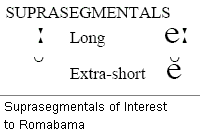 UKT: Wikipedia does not list suprasegmental -- 080315. However, it does say
something about it in Prosody (linguistics)
http://en.wikipedia.org/wiki/Suprasegmental 080318
UKT: Wikipedia does not list suprasegmental -- 080315. However, it does say
something about it in Prosody (linguistics)
http://en.wikipedia.org/wiki/Suprasegmental 080318
Notice that Romabama uses IPA suprasegmentals for IPA transcriptions.
Click to see what IPA has given. Or, to see the complete IPA table go
to:
http://en.wikipedia.org/wiki/International_Phonetic_Alphabet 080317
From Wikipedia
The prosodic domain
Prosodic features are suprasegmental in that they are not confined to any
one segment; rather, they occur in a hierarchy of higher levels of an utterance.
These prosodic units are the actual phonetic spurts or chunks of speech.
They do not in general correspond to grammatical units such as phrases, and
clauses, though they may, and both may reflect how the brain processes speech.
Prosodic units are characterized by several phonetic cues, such as a coherent
pitch contour, and the gradual decline in pitch and lengthening of vowels
over the duration of the unit, until the pitch and speed are reset to begin the
next unit. Breathing, both inhalation and exhalation, only seems to occur at
these boundaries where the prosody resets.
UKT: Only some suprasegmentals are of interest to Romabama, e.g.
 {a.} /ă/;
{a} /a/;
{a:} /aː/.
{a.} /ă/;
{a} /a/;
{a:} /aː/.
Go back supraseg-note-b
Contents of this page
End of TIL file

