Update:
2008-10-31 10:27 AM +0800
TIL
Burmese Grammar 1899
intro.htm
by U Kyaw Tun (UKT), Tun Institute of Learning,
http://www.tuninst.net
From Burmese Grammar and Grammatical Analysis
by A. W. Lonsdale, Education Department, Burma, British Burma Press, Rangoon,
1899. Copied by UKT and staff of TIL . Start: 2008 Aug.
indx-RBM4M |Top
BG1899-indx
Contents of this page
Introduction
Author's footnotes
UKT notes -- note the author's Pali
transcriptions: á is used in place of ā , e.g., Páli for Pāli .
I am showing Lonsdale's transcriptions within Alt0171-Al0187: «...», e.g. «á»
(without slanting the character within)
• Magadha language
• polytonic orthography
Contents of this page
p001
001. The Burmese Language proper is radical or monosyllabic,
but contains many polysyllabic words of foreign origin received
chiefly from Páli. It belongs to the great
Polytonic family of Languages
(fn001-01),
forming one branch of the Tibeto-Burman
subdivision of that family. Its alphabet and the method of writing that
alphabet, however, have been borrowed from the ancient Nagari through the medium
of Magadhi or Pali, the language in which the Buddhist scriptures, introduced
into Burma from Ceylon, were written.
UKT: The reader should note that Magadhi and Pali
may be entirely different as shown by Chi Hisen-lin,
Journal of the Burma Research Society, XLIII, i, June 1960 [see
lang-problem-Buddh.htm
in TIL collection. Available online:
http://www.chibs.edu.tw/publication/LunCong/004/69_90.htm 080822]
in which he states:
" ... there is a comparatively concordant point,
that is, most of the scholars advocated that the Pali language
was a Western dialect, and such was truly the fact.
The declensions of the Pali words are similar to those of
the language used in the Girnar Inscriptions of the Asokan Pillars [see
Asoka-Great.htm from Wikipedia; and Ven. S. Dhammika's
The Edicts of King Asoka
Dhammika-Asoka-edicts.htm in TIL collection], such as
the locative case ending in -amhi and -e,
the accusative case in -ne, etc. But on the other hand, the
Magadha language was an eastern dialect,
in which r had become as l, and s
as ś, while the nominative case of words ending
in -a, ended in -e, etc. There is
a vast difference between the two languages and they should
by no means be confused with each other."
As of today (080823) I am inclined to agree with Chi Hisen-lin.
My conjecture and observation is this: Pali-Myanmar
and Burmese-Myanmar are both Tibeto-Burman languages and
that they are thibilant (referring to r6c5 akshara), where the IPA
[θ] is prominent. On the other hand, Pali that is spoken in
Ceylon from which Pali-Latin was derived is sibilant in which the [θ] is
replaced by [s], and that it is very much tainted by Sanskrit, an Indo-Aryan
language. I can also pinpoint another area where the two languages (or dialects)
are different. It is in the pronunciation of r1c1 akshara. In Pali-Myanmar
 {sa.}
is [s] in the onset of the syllable and [c] in the coda.
However in Pali-Latin it is [ʧ].
{sa.}
is [s] in the onset of the syllable and [c] in the coda.
However in Pali-Latin it is [ʧ].
Chi Hisen-lin's remark "the Magadha language was an eastern dialect,
in which r had become as l, and ..." is intriguing from the
point of view of the Burmese language written in Myanmar script.
Burmese-Myanmar has more than one lateral consonant. The basic consonant
is {la.} which can be represented as IPA /l/. See Tables of IPA and
English consonants in ch02.htm . But
there are more (with reference to MEDict (Myanmar-English Dictionary,
2006) by MLC (Myanmar Language Commission). The numbers given are page
numbers:
• Basic
 {la.} - entered in cell r6c3 cell of the Burmese-Myanmar akshara matrix:
alveolar lateral approximant. MEDict423
{la.} - entered in cell r6c3 cell of the Burmese-Myanmar akshara matrix:
alveolar lateral approximant. MEDict423
• Basic
 {La.} - entered in cell r7c3 cell of the Burmese-Myanmar akshara matrix:
retroflex lateral approximant. MEDict534
{La.} - entered in cell r7c3 cell of the Burmese-Myanmar akshara matrix:
retroflex lateral approximant. MEDict534
• Medial
 {lya.} - formed from {la.} and approximant {ya.}. MEDict460
• Medial
 {lwa.} - formed from {la.} and approximant {wa.}. MEDict461
• Medial
 {lha.} - formed from {la.} and approximant {ha.}. MEDict463
• Medial
 {lhya.} - formed from {la.} and approximants {ya.} and {ha.}
in
{lhya.} - formed from {la.} and approximants {ya.} and {ha.}
in  {lhya}. MEDict468
• Medial
 {lhwa.} - formed from {la.} and approximants {wa.} and {ha.}. MEDict470
In a lighter vein, I should remark (especially to my grandsons, Maung Kan Tun
and Maung Thit Tun, both born outside the country of Myanmar): The favorite
snack of the Burmese-Myanmar is
 {lak-Bak} (the former spelling) -- "fermented tea-leaves"
from the tender leaves of tea plant Camellia sinensis .
{lak-Bak} loosely translated is "something that is a companion of your
hand", and, of course the word for <hand> is
{lak-Bak} (the former spelling) -- "fermented tea-leaves"
from the tender leaves of tea plant Camellia sinensis .
{lak-Bak} loosely translated is "something that is a companion of your
hand", and, of course the word for <hand> is
 {lak}.
So unless you love
{lak-Bak} and can articulate the "laterals", you shouldn't call yourself Burmese!
{lak}.
So unless you love
{lak-Bak} and can articulate the "laterals", you shouldn't call yourself Burmese!
002. The Burmese grammarians, having no suitable grammatical terms
of their own, were obliged to borrow them from the Pali Language.
The term they employ for Grammar is
 {thûd~da-thût~htän} «Sadddá-satthaṁ» (Bur. Thaddá that-htan)
(fn001-02), commonly called
{thûd~da-thût~htän} «Sadddá-satthaṁ» (Bur. Thaddá that-htan)
(fn001-02), commonly called
 {thûd~da kyam:} «Thaddá-kyan», or simply
 {thûd~da} «Thaddá».
This word
{thûd~da} is the Páli
 {thûd~da.} slightly modified in its form, and implies
primarily Sound. Páli Grammarians place all sounds under two heads, viz.
{thûd~da.} slightly modified in its form, and implies
primarily Sound. Páli Grammarians place all sounds under two heads, viz.
 {sait~ta.za. thûd~da.} «Sittaja-sadda» (Bur. «Sciktaza-thadda»)
(fn001-03),
lit. 'mind produced sounds,' and
{sait~ta.za. thûd~da.} «Sittaja-sadda» (Bur. «Sciktaza-thadda»)
(fn001-03),
lit. 'mind produced sounds,' and
 {U.tu.za. thûd~da.} «Utuja-sadda», (Bur. «Uduza-thadda»)
(fn001-04),
lit. season produced sounds.' Under
{sait~ta.za. thûd~da.} are included all sounds uttered by man for the purpose of
communicating thoughts, as well as those made by irrational beings, which,
according to Buddhistic teaching, are [{p001end}] considered to be
endowed with a mental faculty. Under
{U.tu.za. thûd~da.} are included all kinds of sounds produced in nature, such as
those occasioned by thunder, the falling of trees, the rustling of the wind, &c.
Along with these are placed the sounds that are made in the body without any
mental operation, such as those caused by sneezing, snoring, &c.
{U.tu.za. thûd~da.} «Utuja-sadda», (Bur. «Uduza-thadda»)
(fn001-04),
lit. season produced sounds.' Under
{sait~ta.za. thûd~da.} are included all sounds uttered by man for the purpose of
communicating thoughts, as well as those made by irrational beings, which,
according to Buddhistic teaching, are [{p001end}] considered to be
endowed with a mental faculty. Under
{U.tu.za. thûd~da.} are included all kinds of sounds produced in nature, such as
those occasioned by thunder, the falling of trees, the rustling of the wind, &c.
Along with these are placed the sounds that are made in the body without any
mental operation, such as those caused by sneezing, snoring, &c.
{thûd~da.}
(fn002-01) used as a grammatical term,
means only articulate sounds as applied to language whether spoken or written.
003. The written representative of a sound is call
 {ak~hka.ra} «ekkhará», letter,
character. A combination of letters is call
{ak~hka.ra} «ekkhará», letter,
character. A combination of letters is call
 {poad} «pôk» (fn002-02), word. A syllable is called
 {waN~Na.} «wûnna».
004. The Burmese Grammar may be divided into three principal parts, viz.
 {ak~hka.rûp~pa.Bé-da.} «ekkharap-pa-beda», Distinction of Letters;
 {pa.da.wi.wé-sa.na.} «pada-wiwesana», Word Investigation, and
 {ka-ra.ka.kûp~pa.} «karaka-kappa», the Rules concerning the necessary relations
of words in a sentence. Under
{ak~hka.rûp~pa.Bé-da.} are included Orthography and Orthoëpy
(fn002-03) ;
{pa.da.wi.wé-sa.na.}
embraces the classification of words, their accidence and derivation.
{ka-ra.ka.kûp~pa.} is what we understand by Syntax.
{ka-ra.ka.kûp~pa.} «karaka-kappa», the Rules concerning the necessary relations
of words in a sentence. Under
{ak~hka.rûp~pa.Bé-da.} are included Orthography and Orthoëpy
(fn002-03) ;
{pa.da.wi.wé-sa.na.}
embraces the classification of words, their accidence and derivation.
{ka-ra.ka.kûp~pa.} is what we understand by Syntax.
005.  {wa-kya.}
A group of words, containing a noun or a word or words equivalent to a noun, and
a verb, that makes complete sense by itself by expressing a statement,
a command, an entreaty, a wish, or a question is called a sentence;
in Burmese it is termed
{wa-kya.}
(fn002-04); as , [{p002end}]
{wa-kya.}
A group of words, containing a noun or a word or words equivalent to a noun, and
a verb, that makes complete sense by itself by expressing a statement,
a command, an entreaty, a wish, or a question is called a sentence;
in Burmese it is termed
{wa-kya.}
(fn002-04); as , [{p002end}]
 'Moung Ba goes.' -- a statement. [UKT: Notice the spelling "Moung":
rounded vowel. "Maung": unrounded vowel.]
'Moung Ba goes.' -- a statement. [UKT: Notice the spelling "Moung":
rounded vowel. "Maung": unrounded vowel.]
 '(you) go.' -- a command.
 'please let me go.' -- an entreaty.
 'may you be prosperous!' -- a wish.
[UKT: Notice the killed {wa.} the regular form of spelling when we were young]
'may you be prosperous!' -- a wish.
[UKT: Notice the killed {wa.} the regular form of spelling when we were young]
 'Does Moung Ba go?' -- a question.
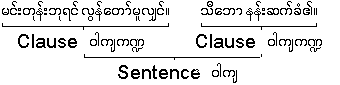
006.  {wa-kya.kaN~ða.} A group of words containing a noun or a word or words equivalent
to a noun, and a verb, that make sense but not complete sense by itself
is called a Clause; in Burmese it is termed
{wa-kya.kaN~ða.}
(fn003-01)
A clause always forms part of a sentence; as,
{wa-kya.kaN~ða.} A group of words containing a noun or a word or words equivalent
to a noun, and a verb, that make sense but not complete sense by itself
is called a Clause; in Burmese it is termed
{wa-kya.kaN~ða.}
(fn003-01)
A clause always forms part of a sentence; as,
007.  {pa.da. sa.ya.} A group of words which does not make an sense by itself
is called a Phrase; in Burmese it is termed
{pa.da. sa.ya.}
(fn003-02) as,
{pa.da. sa.ya.} A group of words which does not make an sense by itself
is called a Phrase; in Burmese it is termed
{pa.da. sa.ya.}
(fn003-02) as,
 'one day';
 'on the road',
 'every day'.
Contents of this page
fn001-01 Poly, 'many'; tonic,
relating to tones or sounds'; polytonic, 'having more than one tone'
fn001-01b
fn001-02 Páli,
 {thût~htän} , 'a treatise'
fn001-02b
{thût~htän} , 'a treatise'
fn001-02b
fn001-03 Páli,
 {sait~tän} , 'mind', and
 {za.} 'born', 'produced' fn001-03b
fn001-04 Páli,
 {U.tu.} , 'season'
fn001-04b
{U.tu.} , 'season'
fn001-04b
fn002-01 From its primary meaning of 'sound',
this word has come to mean 'voice', 'word', -o ; but we shall use it
only in the sense of 'sound'
fn002-01b
fn002-02 This is from Páli
 {pa.da.} which has various meanings, viz.:
step, footprint, matter, -ng, a part, portion, a line of stanza,
a word, a sentence. In this work, it is used only
with the meaning of 'word'. fn002-02b
{pa.da.} which has various meanings, viz.:
step, footprint, matter, -ng, a part, portion, a line of stanza,
a word, a sentence. In this work, it is used only
with the meaning of 'word'. fn002-02b
fn002-03 That part of Grammar
which deals with the correct pronunciation of words.
fn002-03b
fn002-04 This in Páli is
 {wa-kyän} «vákyaṃ» . The Burmese form
{wa-kya.} is pronounced as «wek-kya» .
fn002-04b
{wa-kyän} «vákyaṃ» . The Burmese form
{wa-kya.} is pronounced as «wek-kya» .
fn002-04b
fn003-01 Páli,
 {kaN~ða.} means, 'a part', 'a portion';
{wa-kya.kaN~ða.} = 'a part of a sentence'
fn003-01b
{kaN~ða.} means, 'a part', 'a portion';
{wa-kya.kaN~ða.} = 'a part of a sentence'
fn003-01b
fn003-02 Páli,
{pa.da.} 'word';
 {sa.ya.} "a group", "a cluster"
fn003-02b
{sa.ya.} "a group", "a cluster"
fn003-02b
Contents of this page
UKT:
The statement of Chi Hisen-lin (JBRS, XLIII, i, June 1960): "the Magadha
language was an eastern dialect, in which r had become as l, " is
acceptable, except for the term "dialect". The term "dialect" is incomplete,
because a "dialect" is a subset of a "language" , and the author has not
explicitly stated what language he meant. However, if Magadi had been a distinct
language -- a Tibeto-Burman language, and being in the east, far from the place
in western India through which the Sanskrit speakers had filtered in, we could
expect it to be relatively free from the rhotic nature of Indo-European
languages. And we should expect to see /l/ in the place of /r/. I am basing my
conclusions from my knowledge of Burmese, a typical Tibeto-Burman language.
Go back
Magadha-lang-note-b
Contents of this page
From: The Free Dictionary
http://encyclopedia.thefreedictionary.com/Polytonic+orthography 080821
The polytonic orthography of
Greek uses a variety of
diacritics (πολύ = many + τόνος = accent) to represent aspects of
Ancient Greek pronunciation. It was the standard orthography
for all varieties of Greek from
Hellenistic times until 1982, although the distinctions it represented had
disappeared from the spoken language early in the Christian era.
In 1982, the Greek Parliament adopted the
monotonic orthography. Polytonic is still sometimes used by people
who consider monotonic an unfortunate break with tradition.
Descritption
Polytonic Greek utilizes a set of diacritics on certain letters,
illustrated below using the letter α:
• the accents (tónoi, τόνοι), on the vowel of the accented syllable
of a word and indicating different
tone patterns in Ancient Greek:
¤ ά Oxeía (ὀξεῖα), the
acute accent
¤ ά Tónos (τόνος, used interchangeably in prose
with the oxia, used to strengthen the tone of a vowel in poetry
¤ ὰ
Bareía (βαρεῖα), the
grave accent
¤ ᾶ
Perispōménē (περισπωμένη), the
circumflex, sometimes printed in the form of a
tilde,
macron, or inverted
breve.
• the breathings, written on the first syllable of a word starting with a vowel:
¤ ἁ
Daseía (δασεῖα), or rough breathing
(
spiritus asper), indicating an [h] in Ancient Greek.
Also used on words starting with
rho (ρ) transliterated as rh.
¤ ἀ
Psilé (ψιλή), or smooth breathing
(
spiritus lenis), indicating the absence of an [h].
• ᾳ the ypogegrammeni
(
iota subscript) (ὑπογεγραμμένη),
written under alpha, eta, and omega to
indicate the long diphthongs āi, ēi, and ōi, respectively; sometimes written
adjacent to capitals (in which case it is called an
iota adscript,
prosgegrammeni, προσγεγραμμένη).
The letters
iota and
upsilon can also take a
diaeresis (διαλυτικά)
to show that a pair of vowels is pronounced separately, rather than together:
compare Modern Greek παϊδάκια
[paiðakja]
(lamb chops) and παιδάκια
[peðakja]
(little children). The diaeresis can be combined with acute, grave and
circumflex but never with breathings (since the letter with diaeresis cannot be
the first vowel of the word).
All of these diacritics are important in Classical Greek (and the breathings in
particular are relevant to the
etymology of words in other languages), but except for the diaeresis none
have any significance in the modern language: there is no difference in
pronunciation between words which formerly had smooth and rough breathings,
and the pitch accent has been replaced with a
stress accent. (Note that the transliteration of the names
of the diacritics into the Roman alphabet varies,
chiefly depending on whether they are considered
words from Classical or Modern Greek.)
History
The rough and smooth breathings were introduced in classical times in order to
represent the presence or absence of [h] in Attic Greek, which had adopted a
form of the alphabet in which the H sign was no longer available for this
purpose as it had been used (as
Eta) for the long e.
Aristophanes of Byzantium introduced the various accent markings during the
Hellenistic period for educational purposes. The
majuscule system written entirely in capital letters was used
until the 8th century, when the
minuscule polytonic was widely adopted.
The acute and circumflex accents were invented in
Alexandria; the grave accent then meant an unaccented syllable, when it was
important to mark one. The modern convention, by which an acute accent on the
last syllable of a word becomes a grave accent, was devised in Byzantine times,
after the accent became stress; the convention began with certain
proclitic words, which lose their accent before another word,
and was generalized.
In the later development of the language, the ancient tones were replaced by a
stress accent
making the differences among accents superfluous, and the [h] sound became
silent. Some textbooks of Ancient Greek for foreigners have retained the
breathings, but dropped all the accents, simplifying the task for the learner,
but breaking the link with the modern language.
Following the final adoption of the Demotic
(Dhimotiki)
form of the language, in 1982,
monotonic orthography was imposed by law. The latter uses only the
acute accent
(or sometimes a
vertical bar intentionally distinct from any of the traditional accents) and
diaeresis and omits the breathings. Some individuals, institutions, and
publishers continue to prefer the polytonic system, though an official
reintroduction of the polytonic system does not seem probable.
In an intermediate stage (between the beginning of the 20th century and 1982,
official since the 1960s), the grave was replaced by the acute under certain
circumstances, in particular in handwriting. (Even in Ancient Greek, they almost
always meant the same thing; in modern Greek, there is no difference in the
pronunciation of the three accents.) Greek
typewriters
from that era did not have keys for the grave accent. The grave was also not
taught in primary schools where instruction was in Demotic. This system is still
used in some publications such as the periodical
Estia.
Go back poly-ortho-note-b
Contents of this page
End of TIL file