
The sounds of letters
a. Vowels - ch03-1.htm
b. Consonants - ch03-2 (still to be completed)
ch03-2.htm
by U Kyaw Tun (UKT), Tun Institute of Learning,
http://www.tuninst.net
From Burmese Grammar and Grammatical Analysis
by A. W. Lonsdale, Education Department, Burma, British Burma Press, Rangoon,
1899. Copied by UKT and staff of TIL . Start: 2008 Aug.
Contents of this page
The sounds of letters
a. Vowels - ch03-1.htm
b. Consonants - ch03-2 (still to be completed)
UKT: Young children like to see many different things for themselves. As a child I like to open my mouth wide and see the inside. No matter how I tried I always came to a limit - the limit posed on by my cheeks. If only one were to cut the cheeks a bit -- I hope you hadn't done it on yourself or on your baby sister -- you will see the uvula hanging down from the velum.
UKT notes -- note the author's Pali
transcriptions: á is used in place of ā , e.g., Páli for Pāli .
I am showing Lonsdale's transcriptions within Alt0171-Al0187: «...», e.g. «á»
(without slanting the character within)
• palatopharyngeal arch - mouth cavity
Contents of this page
Contd from p011
20. Every consonant in Burmese has the sound of the vowel
 {a.} inherent in it, so that in its natural state, that is when not blended or
combined with any other letter, it is fully articulated with its sound always
ending in that vowel; thus,
{a.} inherent in it, so that in its natural state, that is when not blended or
combined with any other letter, it is fully articulated with its sound always
ending in that vowel; thus,
 {ka.} «ka»,
 {sa.} «sa»,
etc. When it occurs as the initial or the first letter of a word, it drops this
vowel sound. When it occurs a final, it undergoes a certain modification. These
points will be discussed later on.
{sa.} «sa»,
etc. When it occurs as the initial or the first letter of a word, it drops this
vowel sound. When it occurs a final, it undergoes a certain modification. These
points will be discussed later on.
21. The alphabetical names of the consonants and their powers are given below : -
UKT: by "power", Lonsdale seems to be referring to its "ability" in sound production, i.e. its pronunciation which can be represented by an IPA transcription. I am giving the IPA transcription within [...] for narrow transcription and /.../ for broad transcription.
 {ka.} [k] - This is called
 {ka.kri:}
«ka-gyi:» 'great ka', and has the power of k as in <kaleidoscope>.
[UKT: Phonation is voiceless. The corresponding Devanagari akshara: क ]
{ka.kri:}
«ka-gyi:» 'great ka', and has the power of k as in <kaleidoscope>.
[UKT: Phonation is voiceless. The corresponding Devanagari akshara: क ]
UKT: Lonsdale is using two small circles similar to a 'colon' to represent the emphatic nature of the sound. This is represented in IPA with a "triangular" colon [ː] U02D0. ("U02D0" is the Unicode hexadecimal number corresponding to [ː]). Romabama represents it with a regular colon.
 {hka.} [kʰ] - This is the aspirate of
{ka.}, and is called
{hka.} [kʰ] - This is the aspirate of
{ka.}, and is called
 {hka.hkwé} «hka-gwe» 'curled up hka'. Its power is that of k
aspirated = hk .
{hka.hkwé} «hka-gwe» 'curled up hka'. Its power is that of k
aspirated = hk .
This consonant is usually represented by kh when it occurs
in Páli words written in the Roman character. [UKT: Phonation is voiceless.
Corresponding Devanagari akshara: ख] [{p011end}]
UKT: English speakers recognize [k] and [kʰ] as the allophones of /k/. [kʰ] is realized in most of the English syllables with the sound of /k/. [k] is realized only after <s> as in <skin>. E.g. <kin> [kʰɪŋ] ; <skin> [skɪŋ] (IPA sp check with DJPD16 needed). I maintain that the difference in pronunciation of [k] and [kʰ] is not just 'aspiration' but involves other glottal features as well. I notice that the POA of
{hka.} is further in the interior than
 {ga.} [g] -
(UKT: to be continued)
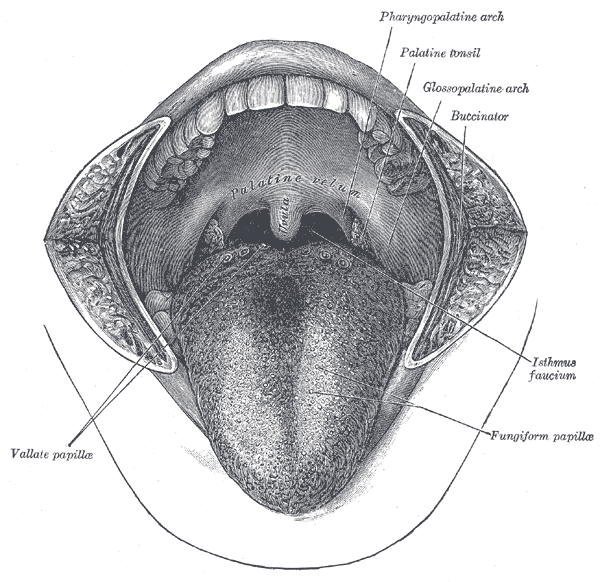
From: http://en.wikipedia.org/wiki/Palatopharyngeal_arch 081021
The palatopharyngeal arch (pharyngopalatine arch, posterior pillar of fauces) is larger and projects farther toward the middle line than the anterior; it runs downward, lateralward, and backward to the side of the pharynx, and is formed by the projection of the Pharyngopalatinus, covered by mucous membrane. (Wikipedia's note: This article was originally based on an entry from a public domain edition of Gray's Anatomy. As such, some of the information contained herein may be outdated. Please edit the article if this is the case, and feel free to remove this notice when it is no longer relevant.)
The inset is the faithful reproduction of a lithograph plate from Gray's Anatomy, a two-dimensional work of art, is not copyrightable in the U.S. as per Bridgeman Art Library v. Corel Corp.; the same is also true in many other countries, including Germany. Unless stated otherwise, it is from the 20th U.S. edition of Gray's Anatomy of the Human Body, originally published in 1918 and therefore lapsed into the public domain. Other copies of Gray's Anatomy can be found on Bartleby and also on Yahoo!.Caption: The mouth cavity. The cheeks have been slit transversely and the tongue pulled forward.
This image is in the public domain because its copyright has expired. This applies worldwide.
Go back mouth-cavity-note-b
End of TIL file