Classification of Consonants according to vocal organs
• Guttural (velar) • Palatal • Lingual • Dental • Labial
• Table of IPA Consonants • Table of English Consonants
Nasals
Vowels
• Vowel diagrams of Daniel Jones, and I. Catford
ch02.htm
by U Kyaw Tun (UKT), Tun Institute of Learning,
http://www.tuninst.net
From Burmese Grammar and Grammatical Analysis
by A. W. Lonsdale, Education Department, Burma, British Burma Press, Rangoon,
1899. Copied by UKT and staff of TIL . Start: 2008 Aug.
Contents of this page
Classification of Consonants according to
vocal organs
• Guttural (velar)
• Palatal
• Lingual
• Dental
• Labial
• Table of IPA Consonants •
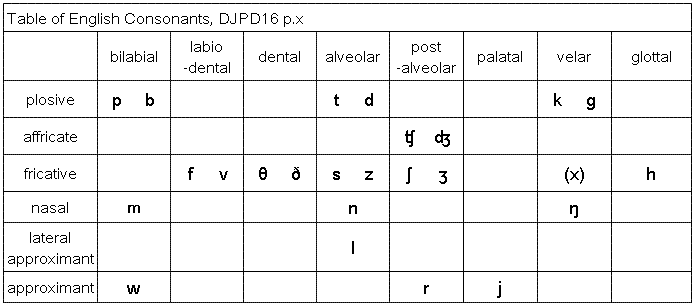
Table of English Consonants
Nasals
Vowels
• Vowel diagrams of Daniel Jones, and I. Catford
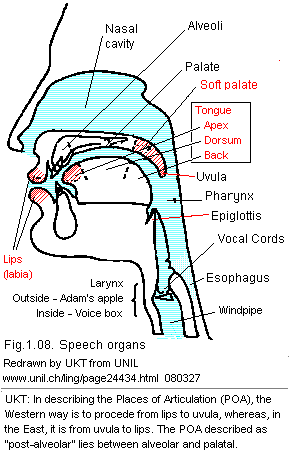
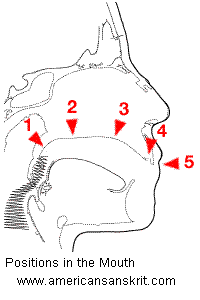
UKT: The Eastern way of describing the Places of Articulation (POA) of the consonants is from the interior to the lips, whereas the Western way is from the lips to the interior.
UKT notes -- note the author's Pali
transcriptions: á is used in place of ā , e.g., Páli for Pāli .
I am showing Lonsdale's transcriptions within Alt0171-Al0187: «...», e.g. «á»
(without slanting the character within)
• suprasegmentals
• Vowels in Practical Phonetics
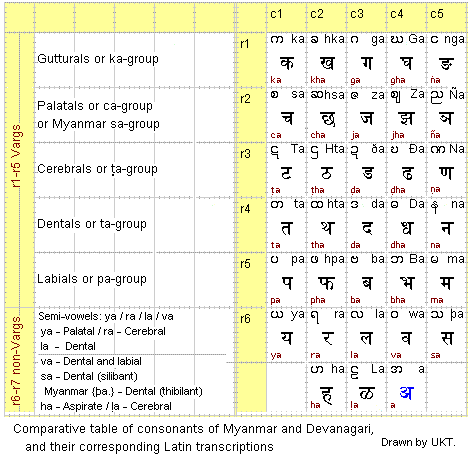
UKT: This caption in modern parlance is: POA (Places of Articulation) of Consonants
013. The Consonants are further classified on quite a different plan from that
explained in par.12 ch01.htm .The classification
is based upon the various parts of the mouth by which the sounds are produced.
The organs brought into play for this purpose are the throat, the roof of the
mouth, the tongue, the teeth, and the lips; thus there are throat-letters,
 {kaN~Hta.za.} Gutturals
(fn007-01);
roof-of-the-mouth-letters ,
{kaN~Hta.za.} Gutturals
(fn007-01);
roof-of-the-mouth-letters ,
 {ta-lu.za.}
Palatals (fn007-02); tongue-letters ,
{ta-lu.za.}
Palatals (fn007-02); tongue-letters ,
 {moad~Da.za.} Linguals or Cerebrals
(fn007-03); teeth-letters ,
{moad~Da.za.} Linguals or Cerebrals
(fn007-03); teeth-letters ,
 {dan~ta.za.}
Dentals (fn007-04); Lip-letters
{dan~ta.za.}
Dentals (fn007-04); Lip-letters
 {AUT~Hta.za.}
Labials (fn007-005). Each of the
classes into which the lettters are divided is called
{AUT~Hta.za.}
Labials (fn007-005). Each of the
classes into which the lettters are divided is called
 {Htaan}.
014. The letters are distributed into different classes mentioned above as follows: --
Gutturals[velar]
 {kaN~Hta. Htaan} -
 and
and
 [UKT: IPA
[ŋ] ] of the
[UKT: IPA
[ŋ] ] of the  -
-
 {ka. wag~ga.} «ka-wegga» or ka group, and
 {ha.} of
the «awegga» series. With these are included the vowels
{ha.} of
the «awegga» series. With these are included the vowels
 {a.} and
 {a}. [{p007end}]
UKT: Note Burmese has three pitch-registers (formerly identified as "tones"): #1
{a:}, which might be described as: "creak", "modal" or medial , and "long-empathic". In terms of IPA, they should be described as " suprasegmentals": #1
See my work on The Human Voice hv4.htm and hv7.htmUKT: It is said and is commonly accepted that Burmese-Myanmar akshara is derived from a south-Indian script through the intermediary Mon script. However, it came as a surprise to me to find that many aksharas of the Burmese-Myanmar bear striking resemblances to the aksharas found on the pillars of King Asoka in India - the oldest aksharas of a complete written language in India. (Please remember that Asoka came about 250 years after the Gautama Buddha.) Thus, my present position (as of today 081010) is that Myanmar akshara is derived directly from that of the King Asoka through the northern route into Myanmar (to Tagaung and other Pyu areas.)
Palatals
 {ta-lu. Htaan} -
 and
and
 [UKT: IPA [ ɲ ] ] of the
 -
{sa. wag~ga.} «sa-wegga» or sa group, and
-
{sa. wag~ga.} «sa-wegga» or sa group, and
 {ya.} of the «awegga» series. The vowels
 {I.} and
 {I} are classed with these.
UKT: Though r2c5 is given as
{ña.}, described as "small nya." which is clearly shown in Pali-Myanmar akshara table. There is no
{piñ~ña}.
Linguals
 {moad~Da. Htaan} -
 and
and
 [UKT: IPA [ ɳ ] ] of the
 -
{Ta. wag~ga.} «ta-wegga» or ta group, and
-
{Ta. wag~ga.} «ta-wegga» or ta group, and
 {ra.} [UKT: IPA [ɹ] ] and
 {La.} of the «awegga» series.
UKT: Lonsdale assertion that
Dentals
 {dan~ta. Htaan} -
 and
and
 of the
 -
{ta. wag~ga.} «ta-wegga» or ta group, and
-
{ta. wag~ga.} «ta-wegga» or ta group, and
 {la.} and
 {tha.} [UKT: IPA [θ] ] of the «awegga» series.
Labials
 {AUT~Hta. Htaan} -
 and
and
 of the
 -
{pa. wag~ga.} «pa-wegga» or pa group, and the vowels
-
{pa. wag~ga.} «pa-wegga» or pa group, and the vowels
 {U.} and
 {U}.
{U}.
UKT: What Lonsdale is describing above should be compared to the consonant tables given below:
UKT note: IPA table does not list c2 consonants: they are considered to be the respective allophones of the c1. We now have:
• Gutturals
• Palatals
• Linguals
• Dentals
• Labials
UKT: Though the section of the head shown on upper right describes the POA, many of us could not place one very prominent organ that we could easily see inside our open mouth. That is the uvula /ˈjuːvjʊlə/ is a small, mucosa-covered set of muscles, musculus uvulae, hanging down from the soft palate, near the back of the throat. The word is derived from the diminutive of uva, the Latin word for "grape", due to the uvula's grape-like shape. Because, the uvula is quite prominent when a person opens his mouth, cartoons often feature the uvula when characters are shown with gaping mouths. In Burmese-Myanmar, uvula is known as
(MEDict468). {lhya-hking}
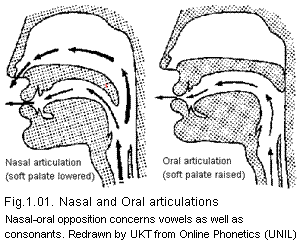
UKT: Though the nasals
15. Nasals -
,
,
,
, and
are Nasals or nose-letters . These are already included in the above classification,
but are also called nasals because, when we pronounce them, we not only commence
their sounds with the organs chiefly employed in forming them, but also allow
our voice to issue through the nose instead of confining it within the mouth.
The Anuthwára
 {a.nu.thwa-ra.} or
 {thé:thé:ting} explained in par. 10 falls under this head.
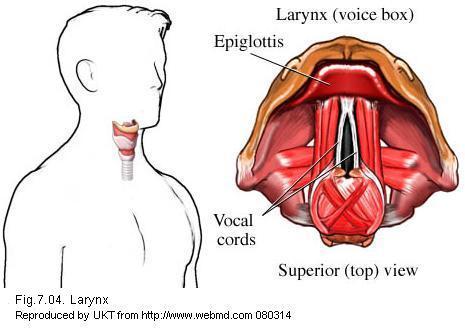
UKT: This section is my presentation.
 The vowels are continuous sounds formed inside the larynx or voice box.
They are modified by the tongue inside the mouth. Until the development
of fiber-optic laryngoscopy, the full involvement of the larynx during
speech production was not observable. However, the role of the tongue has
been studied by phoneticians such as Daniels Jones early in the 20th
century. [Note only after A. W. Lonsdale had written
the Burmese Grammar and Grammatical Analysis
- which we are studying.] In the production of the vowels,
The vowels are continuous sounds formed inside the larynx or voice box.
They are modified by the tongue inside the mouth. Until the development
of fiber-optic laryngoscopy, the full involvement of the larynx during
speech production was not observable. However, the role of the tongue has
been studied by phoneticians such as Daniels Jones early in the 20th
century. [Note only after A. W. Lonsdale had written
the Burmese Grammar and Grammatical Analysis
- which we are studying.] In the production of the vowels,

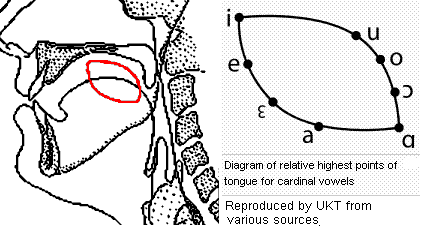
 as you move along from {a} to {au} (note: I am taking the modal pitch-register only),
the tongue body is changing its position according to the red ellipse
shown in the figure on the left.
as you move along from {a} to {au} (note: I am taking the modal pitch-register only),
the tongue body is changing its position according to the red ellipse
shown in the figure on the left.
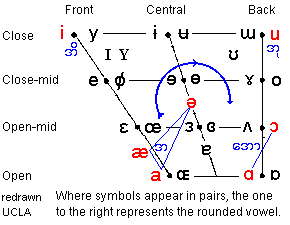
To describe the red ellipse better, it is drawn in the form of a quadrilateral by Daniels Jones. The figure on the right is based on the vowel quadrilateral of Daniel Jones in which I have shown the Burmese-Myanmar vowels. However, there are other vowel diagrams, as the one by Catford (1977) reproduced by J. Laver in the Principle of Phonetics, which is in TIL collection.
See: Teaching Vowels in Practical Phonetics: The Auditory or Articulatory Route? by Martin J. Ball, University of Ulster, http://www.phon.ucl.ac.uk/home/johnm/ball.htm 081028. See the full article in my notes: Vowels in Practical Phonetics.
You will notice that Lonsdale has included
{I.} and
{I} as the vowels articulated in the Palatal position. This is in agreement with
Catford. It should be pointed out that the present practice is to describe the
vowels separately from the POA of consonants
16. The vowel
 {É:} is both guttural and palatal;
 {AU:} is guttural and labial. [UKT: note that the POAs guttural or velar and
labial are so far apart that this "vowel" cannot be articulated. I cannot
understand what Lonsdale had meant. - I am waiting input from my peers.] The
consonant
{AU:} is guttural and labial. [UKT: note that the POAs guttural or velar and
labial are so far apart that this "vowel" cannot be articulated. I cannot
understand what Lonsdale had meant. - I am waiting input from my peers.] The
consonant  {wa.} is dental and labial.
17. The vowels
 {è:} and
 {AU}, not being used in the Páli are not included in the
above arrangement ; Burmese Grammarians, however, consider
{è:} to be both guttural and palatal, and
{AU} guttural and labial.
{AU}, not being used in the Páli are not included in the
above arrangement ; Burmese Grammarians, however, consider
{è:} to be both guttural and palatal, and
{AU} guttural and labial.
18. The Burmese who have followed the Nágari system as introduced by the Páli
grammarians, still keep to the classification exemplified in the foregoing
paragraphs, and have devised no other. [{p008end}]
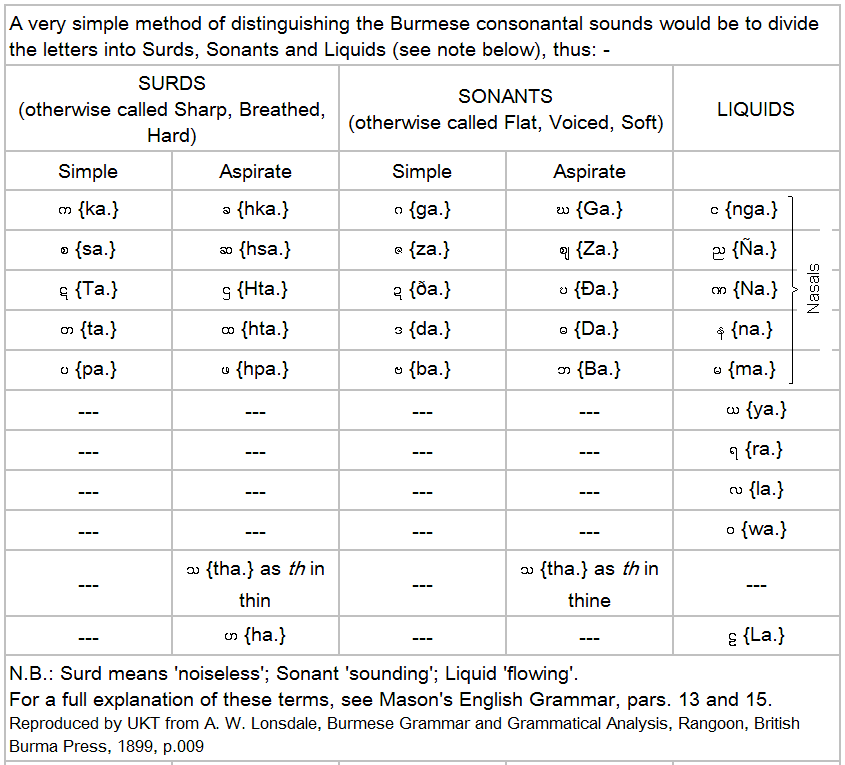 [{p009end}]
fn007-01 Páli,
{kaN~Hta.} 'the throat';
 {za.} 'to produce'. fn007-01b
fn007-02 Páli,
{ta-lu.} 'the palate'.
fn007-02b
fn007-03 Páli,
{moad~Da} 'the head'. 'Cerebral is
the old English designation incorrectly used for
{moad~Da.za}. It is not a suitable term for it means 'brain letter' whereas
{moad~Da.za}, although it signifies 'produced in the head ',
is used to denote a letter pronounced by bringing the tip of tongue
backward and upward nearly to the middle of the palate.
'Cerebral' is now superseded by the more appropriate term 'Lingual'.
fn007-03b
fn007-04 Páli,
{dan~ta.} 'the teeth'
fn007-04b
fn007-05 Páli, {AUT~Hta.} 'the lip'.
[UKT: notice the horizontal conjunct:
 (I am waiting input from my peers.)] fn007-05b
UKT: Wikipedia does not list suprasegmental -- 080315. However, it does say something about it in Prosody (linguistics) http://en.wikipedia.org/wiki/Suprasegmental 080318
Notice that Romabama uses IPA suprasegmentals for IPA transcriptions. Click to see what IPA has given. Or, to see the complete IPA table go to: http://en.wikipedia.org/wiki/International_Phonetic_Alphabet 080317From Wikipedia
The prosodic domain
Prosodic features are suprasegmental in that they are not confined to any
one segment; rather, they occur in a hierarchy of higher levels of an utterance.
These prosodic units are the actual phonetic spurts or chunks of speech.
They do not in general correspond to grammatical units such as phrases, and
clauses, though they may, and both may reflect how the brain processes speech.
Prosodic units are characterized by several phonetic cues, such as a coherent
pitch contour, and the gradual decline in pitch and lengthening of vowels
over the duration of the unit, until the pitch and speed are reset to begin the
next unit. Breathing, both inhalation and exhalation, only seems to occur at
these boundaries where the prosody resets.
UKT: Only some suprasegmentals are of interest to Romabama, e.g.
 {a.} /ă/;
 {a} /a/;
 {a:} /aː/.
Go back supraseg-note-b
by Martin J. Ball, Teaching Vowels in Practical Phonetics: The Auditory or Articulatory Route? . University of Ulster. http://www.phon.ucl.ac.uk/home/johnm/ball.htm 081028
UKT: I haven't taken the figures given by M.J. Ball since they are essentially the same as those already on this file.
Introduction:
Vowel description has traditionally differed from consonant description. This
means that teaching the production of vowels and consonants in practical
phonetics requires different techniques. Unfortunately, this means that students
have to master both approaches to their studies.
Consonants are described and classified according to their production: manner of articulation (e.g. stop, fricative); place of articulation (e.g. alveolar, palatal, velar, uvular); and voicing. Students, therefore, can use these labels to aid in learning the articulation of consonants.
The Vowel Area and Cardinal Vowels :
Vowels, on the other hand, have traditionally been taught via the Cardinal Vowel
System. This system is based on a set of auditory reference points, and vowels
are described in terms of how close they are to these reference points. Cardinal
Vowels, therefore, have to be learnt by students auditorily: through imitating
models, not by learning their articulation.
In
the most recent revision of the International Phonetic Alphabet (1993), the
vowel diagram was re-arranged (see Figure 1)[UKT: essentially the same as the
one I have redrawn by UCLA given on the right.]. All unrounded vowels are
displayed on the left of each point. All rounded vowels are displayed on the
right. A full set of central vowels is provided, and symbols for lax vowels are
added to the diagram.
Vowel Area and Cardinal Vowels:
The vowel quadrilateral is, in fact, quite divergent from the actual shape of
the vowel area (see Figure 2) [UKT: essentially the same as the one on the
left.]. Catford (1977), among others, has suggested a diagram closer to physical
reality could be adopted. This could allow articulatory descriptions of vowels,
similar to those used for consonants. In order to produce a diagram closer to
the vowel area, the angled corners of the Cardinal Vowel diagram need to be
abandoned, and a chart nearer to the ellipse shape in Figure 2 created.
An Articulatory System
Vowels are the next most open articulation type after approximants and
fricatives. This means that close vowels can easily be linked to the palatal,
velar, uvular and pharyngeal places of articulation. Students learn their
production by moving the tongue slightly between consonantal and vocalic
versions at each place.
An articulatory system follows the vowel area more closely, and this means that [i, i, u, o, a, a] are all located on the upper periphery. Other vowels are labelled as being close-mid, open-mid or open in relation to one of the places of articulation. Due to the shape of the diagram, the lower left corner vowel [a] is both an open palatal and an open pharyngeal vowel.
Advantages and Disadvantages to an Articulatory System
Only one set of articulatory labels need to be learnt, and the same method of
learning sound production can be applied to consonants and vowels. Further, the
vowel diagram is closer to the vowel area.
However, only production of the upper periphery vowels is easy to learn, as it is unclear how one learns the values of close-mid, open-mid and open. An articulatory system aids learning vowel production, but not description: description of both consonants and vowels is an auditory task - as is using Cardinal Vowels.
Phonologically, three-vowel systems ([i, a, ul) plot better on the CV system, as they appear clearly as 'extreme' vowels. Languages having high, mid, and low vowel phonologies group their vowels as in the CV system rather Um the polar co-ordinate system. Also it is difficult to arrange central vowels on the polar co-ordinate diagram, and show their relation to peripheral vowels.
Catford (1977) points out reasons why the CV system appears more natural: if we plot vowels acoustically (FI by F2), the resultant diagram closely resembles the CV chart. He also notes that the muscle systems used to move the tongue within the vowel area give us proprioceptive feedback that high versus low, and front versus back are natural classes: as shown in CV diagrams.
Conclusion
An articulatory system certainly could make the learning of vowel production
easier. The system also brings consistency between vowels and consonants.
However, it does not help in vowel description; and has phonological problems.
It is doubtful, therefore, whether a switch in teaching vowels in practical
phonetics is warranted.
References (cited by M.J. Ball)
• Catford, I. (1977) Fundamental Problems in Phonetics. Edinburgh:
Edinburgh University Press.
• IPA (1993) Council actions on the revisions of the IPA. Journal of the
International Phonetic Association, 23, 32-34.
Go back vow-pract-note-b
End of TIL file