
The Alphabet
Representing Burmese-Myanmar aksharas in Romabama (UKT)
The vowels
Mismatch of pitch-registers
or "tones" between Burmese with three and Pali with two
{a.nu.thwa-ra.} or anusvara -
 {thé:thé:ting}
The consonants
ch01.htm
by U Kyaw Tun (UKT), Tun Institute of Learning,
http://www.tuninst.net
From Burmese Grammar and Grammatical Analysis
by A. W. Lonsdale, Education Department, Burma, British Burma Press, Rangoon,
1899. Copied by UKT and staff of TIL . Start: 2008 Aug.
Contents of this page
The Alphabet
Representing Burmese-Myanmar
aksharas in Romabama (UKT)
The vowels
Mismatch of pitch-registers
or "tones" between Burmese with three and Pali with two
{a.nu.thwa-ra.} or anusvara -
{thé:thé:ting}
The consonants
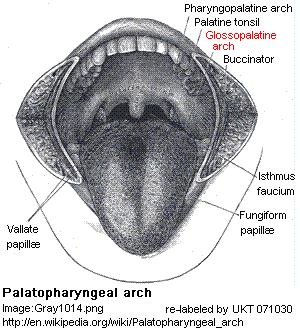
UKT: The most prominent part at the back of the mouth you can readily see is the uvula. The pix further right shows the uvula more prominently by cutting portion of the cheek. In this picture you can see most of the articulators involved in the production of the consonants.
UKT notes -- note the author's Pali
transcriptions: á is used in place of ā , e.g., Páli for Pāli .
I am showing Lonsdale's transcriptions within Alt0171-Al0187: «...», e.g. «á»
(without slanting the character within)
• anusvara - anunaasika
• Laryngeal characteristics of modal voice
008. Strictly speaking, the Burmese alphabet consists of forty-two letters
of which ten are vowels,
 {tha.ra.} «thara», and thirty-two consonants,
 {byæÑ:} «byi»: These represent simple or elementary sounds.
It is well known that English transcription of Burmese is not
satisfactory so far, and thus instead of trying to come up with a transcription
scheme, I am starting with transliteration.
It is accepted that because Myanmar script is a descendant of the
Brahmi script which is based on sound phonemic principles, Myanmar is also a
phonetic script. Therefore there is no reason why it could not be transliterated
into IPA (International Phonetic Alphabet) script.
This simplifies my task into simply arriving at a one-to-one
transliteration of Myanmar into IPA. But, here we are faced with an unfortunate
situation: IPA alphabet is represented in non-ASCII graphemes such as [ ŋ ] (=
 {nga.}),
[ ɲ ] (=
{nga.}),
[ ɲ ] (=  {ña.}) , and [θ] (=
 {tha.}/{þa.})
for which English-Latin has no equivalents. Because, English-Latin has used
digraphs <ng> for [ ŋ ], <ny> for [ ɲ ] , and <th> for [θ], the transcribers has
simply used the English digraphs to represent the Burmese aksharas instead of
using other Latin characters. They could have easily used, <ñ> for
("nya-lé"),
<Ñ> for
{tha.}/{þa.})
for which English-Latin has no equivalents. Because, English-Latin has used
digraphs <ng> for [ ŋ ], <ny> for [ ɲ ] , and <th> for [θ], the transcribers has
simply used the English digraphs to represent the Burmese aksharas instead of
using other Latin characters. They could have easily used, <ñ> for
("nya-lé"),
<Ñ> for  ("nya-gyi"), and Old-English "thorn" <þ> for
("tha").
In Romabama I have not confined myself to pure "modern" letters of the English
alphabet. However, we are still left with no character for
{nga.}. So
far, I haven't been able to come up with a readily recognizable ASCII character.
("nya-gyi"), and Old-English "thorn" <þ> for
("tha").
In Romabama I have not confined myself to pure "modern" letters of the English
alphabet. However, we are still left with no character for
{nga.}. So
far, I haven't been able to come up with a readily recognizable ASCII character.
Then comes the problem of representing Burmese-Myanmar vowels. The
problem is not easy because of the following reasons:
• The akshara has an "inherent vowel" which is not shown, but because of the
inherent vowel, the akshara itself has a sound of its own. It is in fact a
syllable. It is not mute. However, the letter of the alphabet, because it does
not have an inherent vowel, is mute. Thus
 {ka.} is
pronounceable, whereas <k> is mute. To make <k> have a sound, a vowel has to be
supplied. To form syllables of CVC type from the akshara, a device known as 'virama'
or "vowel-killer" is used. Until a few decades ago, the transcribers did not
know that the akshara-character and the letter of the alphabet are different.
Lonsdale was one of those transcribers.
{ka.} is
pronounceable, whereas <k> is mute. To make <k> have a sound, a vowel has to be
supplied. To form syllables of CVC type from the akshara, a device known as 'virama'
or "vowel-killer" is used. Until a few decades ago, the transcribers did not
know that the akshara-character and the letter of the alphabet are different.
Lonsdale was one of those transcribers.
• English vowels are complex with diphthongs and triphthongs. Burmese vowels are
monophthongal. However, most of the transcribers, including Lonsdale, insist
that Burmese has diphthongs and triphthongs. Whereas, I hold that because native
Burmese-speakers, including myself at one time, are unable to pronounce English
words such as <boy>, <oil> and <cow>, there are neither diphthongs nor
triphthongs in Burmese.
• There is no clear distinction in English between the so-called non-aspirated
and aspirated letters such as [k] (=
{ka.}) and
[kʰ] (=  {hka.}).
They are supposed to be the allophones of /k/. This is not the case with
Burmese-Myanmar. They are not allophones, but sounds in their own rights, and
the so-called aspiration is not simple but involves glottal characteristics as
well. Thus English <k> cannot fully represent the sounds involving [k] and [kʰ].
{hka.}).
They are supposed to be the allophones of /k/. This is not the case with
Burmese-Myanmar. They are not allophones, but sounds in their own rights, and
the so-called aspiration is not simple but involves glottal characteristics as
well. Thus English <k> cannot fully represent the sounds involving [k] and [kʰ].
• There are two "tones", short and long in English vowels, whereas there are
three.
To see how I am trying to solve the problem of representing Burmese-Myanmar vowels in Romabama, using syllables with coda consonants, please go to ch04-4.htm .
009. The Vowels are
UKT: compare this table to the one given in par. 23 p.016 in whichis not given.
You will note that in pairs of vowels, such as{a.} «a» and
{a} «á», there is an inconsistency between Burmese-Myanmar and Pali-Myanmar. Burmese-Myanmar has 3 pitch-registers: #1 - creak (very short), #2 - modal (medium), and #3 - emphatic (and long), whereas in Pali-Myanmar there are only two: short (
{rath~tha. tha.ra.}) and long (
{di-Ga. tha.ra.}).
To me at least (as of today: 081015), the only way to integrate the two is to write: creak, short, modal, long, emphatic . If you do not pay attention to this problem, you will end up equating Pali short vowels sometimes to the Burmese creaks and sometimes to the Burmese modals, and Pali long vowels to the Burmese modals in some instances and to the Burmese emphatics in others.
• I presume that Lonsdale is following the IAST (or its equivalent of his day), and has used á for ā , í for ī, and ú for ū for Burmese vowels based on Pali vowels.
• I have observed that the three pitch registers of Burmese can be represented by the IPA suprasegmentals: [ă] , [a] (temporarily represented as am) and [aː].
Integrating these two presumptions together, I got: a. a am á aːNote that Lonsdale represents his transcriptions in "italics" (slanting) in the original book, but since the slant is interfering with the display, I have taken it out and have inserted the Lonsdale's characters within «...». Differentiate them from Romabama which are shown within { }.
Lonsdale has given «or » for two graphemes:
and
: I presume that it is not a mistake because Lonsdale is giving the transcription (depending on sound heard) and not transliteration as given by Romabama.
Romabama recognizes two kinds of "vowels": the "vowel letters" and "vowel signs". For example:
•{I.} and
{I} - cap letters, corresponding with
•{i.} and
{i} - The vowel signs are "signs" used to change the inherent the vowel of consonants. e.g.
-{ki.} and
{ki} - formed from vowel signs and
Pali grammarians reckon only eight vowels, three of which are
short, called
{rath~tha. tha.ra.} «ratha thara», viz.
{a.} ,
{I.} , and
 {U.}; the rest are long, called
{di-Ga. tha.ra.} «diga thara», viz.
{a},
{I},
{U.}; the rest are long, called
{di-Ga. tha.ra.} «diga thara», viz.
{a},
{I},
 {U},
{U},
 {É} and
{AU:}.
The vowels
{É} and
{AU:}.
The vowels
 {è} and
 {AU} are distinctly Burmese and not to be found in Pali,
although there are letters in Sanskrit nearly corresponding to
them in sound. They may be accounted long. ¶UKT
{AU} are distinctly Burmese and not to be found in Pali,
although there are letters in Sanskrit nearly corresponding to
them in sound. They may be accounted long. ¶UKT
UKT: The Mismatch of pitch-registers or "tones". The problem of mismatch between the Pali's vowels, short and long, and the Burmese three, creak (#1), modal (#2) and emphatic (#3), is only found when the two languages are presented together as in Buddhist texts with Burmese commentaries -- an observation I have made after listening to many religious discourses by different Burmese monks and {lu-pran-tau} or ex-monks. Please do not forget that the speaker is constantly switching from one language to another. I have come to this position only after my study of Voice Quality. See my works in Human Voice hv4.htm , and also my notes accompanying this file on - Laryngeal Characteristics of the modal voice. See also Romabama pitch-registers in ch06.htm
The vowels are either similar, called
 {tha.waN},
«thawûn», or dissimilar, called
{tha.waN},
«thawûn», or dissimilar, called
 {a.tha.waN} «athawûn»; thus,
{a.} and
{a} , and
{I.} and
{I},
{U.} and
{U} are similar;
{É:} and
{è:} in Páli, and
{É:} ,
{è:} ,
{AU:} , and
{AU} in Burmese are
dissimilar, not only to one another but to all the others.
{a.tha.waN} «athawûn»; thus,
{a.} and
{a} , and
{I.} and
{I},
{U.} and
{U} are similar;
{É:} and
{è:} in Páli, and
{É:} ,
{è:} ,
{AU:} , and
{AU} in Burmese are
dissimilar, not only to one another but to all the others.
UKT: I would have to disagree with Lonsdale with respect to
#1{au.} , #2
{au}, #3
{au:} , then:
#1 -- , #2
(
(
(
In the Thinbôngyi
 {thing-poan:kri:} or Burmese spelling book two other letters are found added to
the ten vowels shown above. They are
{thing-poan:kri:} or Burmese spelling book two other letters are found added to
the ten vowels shown above. They are
 {än} «an» and
 {a:} «á:» .
{än} is a nasal or nose letter
{a:} «á:» .
{än} is a nasal or nose letter
 {na-thi.ka. ak~hka.ra}
(
fn004-01), and is not strictly a vowel (see infra.) [{p004end}]
{a:} is not a separate letter, but the second vowel
{a} with its natural tone modified by the two circular dots.
(see par.51.).
{na-thi.ka. ak~hka.ra}
(
fn004-01), and is not strictly a vowel (see infra.) [{p004end}]
{a:} is not a separate letter, but the second vowel
{a} with its natural tone modified by the two circular dots.
(see par.51.).
UKT: The nasals are similar to the vowels in having tone registers: e.g.
#1{än.}, #2
These tone registers are found in nasalized consonants, e.g.
#1{kän.}, #2
{kän}. (
010. Anuthwára
 {a.nu.thwa-ra.} -- The nasal letter
{än} is called the Anuthwára. [UKT: See
anusvara in my notes.] In Pali it is classed with the consonants,
and, according to the way it is pronounced in Sanskrit,
it has the power of m in «aham». It is represented by «in» in the
transliteration of Pali words formed with it. In Burmese it is placed amongst
the vowels as already stated, and is pronounced exactly like the English an in
pan pronounced as if written palin. When combined with a consonant it is
indicated by a tiny circle placed above the letter. From being used in this
manner, it is commonly called
{thé:thé:ting} «the:-the:-tin» (from
{a.nu.thwa-ra.} -- The nasal letter
{än} is called the Anuthwára. [UKT: See
anusvara in my notes.] In Pali it is classed with the consonants,
and, according to the way it is pronounced in Sanskrit,
it has the power of m in «aham». It is represented by «in» in the
transliteration of Pali words formed with it. In Burmese it is placed amongst
the vowels as already stated, and is pronounced exactly like the English an in
pan pronounced as if written palin. When combined with a consonant it is
indicated by a tiny circle placed above the letter. From being used in this
manner, it is commonly called
{thé:thé:ting} «the:-the:-tin» (from
 {thé:thé:} 'minute', and
 {ting} 'to place on.') It is also called
 {naig~ga.hi.ta.} «niggahita» or, according to the Burmese,
 {naig~ga.hait} «neiggaheik».
UKT: We find the double-dot used by Lonsdale in «the:-the:-tin».
011. The Consonants:
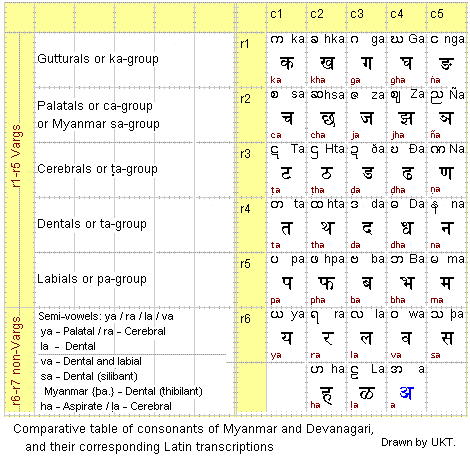
UKT: Note that in all the transcriptions given for the consonantal akshara the <a> is present. This is the so-called 'inherent vowel' present in the akshara of all Brahmi-derived scripts which makes them pronounceable. They are all syllables. The sound of this inherent vowel is usually described as the sound of the English short <a>. This is the fundamental problem of transcription because the English short <a> is pronounced in any convenient way depending on the nearby English consonant. See English short <a> in my notes.
UKT: The transcriptions given on the left-above are Lonsdale's. They are different from Rombama where the characters are given within {...}. Romabama characters show how the word is spelled in Burmese-Myanmar. Since Myanmar is a phonetic alphabet, you can pronounce according to the way in which it is written. Generally, it will give the pronunciation similar to that of the dialects of the Rakhine coast and the Yaw region. The pronunciation would be slightly different from that of the mainland Myanmar. Notice that the consonantal aksharas are shown in a matrix of 7 rows x 5 columns, and are divided into two sections: the
{wag} (Sanskrit: Varg) and the
{a.wag} . They are the basic aksharas. You will come to know later about other consonantal characters, the medials, derived from the basic aksharas.
012. The above arrangement is in accordance with the Nágarí system.
It will be seen that the first twenty-five consonants are divided into five groups or
classes each containing five letters. The groups collectively are called
 {piñ~sa. wag~ga.} (
fn005-01) «pyinsawegga» [{p005end}],
each of which is known by the first letter of the group, thus
{ka.} to
{nga.} is called the
{piñ~sa. wag~ga.} (
fn005-01) «pyinsawegga» [{p005end}],
each of which is known by the first letter of the group, thus
{ka.} to
{nga.} is called the
 {ka. wag~ga.} «ka wegga»;
 {sa.} to
{Ña.}, the
{sa. wag~ga.} «sa wegga»; and so on.
{sa.} to
{Ña.}, the
{sa. wag~ga.} «sa wegga»; and so on.
UKT: Though r2c5 is given as
{piñ~ña}.
UKT: It is interesting to note that Lonsdale does not list {a.} amongst his consonants. To the consonants, he said, "may be added the «anuthwára»
In the modern tables, this position is occupied by
This has led me to compare the following two series. It is necessary to arrive at the letters of alphabet I would have to choose for the respective Romabama spellings.
1• (

-- (#1) #1 #2 #3 -- ({a.}) {au.} {au} {au:} (I have been using these spellings for more than a decade - 081010)
2• (
-MLC /o: za/ - n. sweet sop, Bot.name: Annona squamosa (MEDict615). Pitch-register given is #3
-MLC /an o:/ - v. same as
-MLC /ou' o:/ - n. koel [UKT: nightingale] (MEDict610). Pitch-register given is #3.
However, Lonsdale has given. See par.22, p.016 in ch04.htm (which if I am not mistaken was the way I had spelled it as a child).
-
Burmese-Myanmar characters given in red are those not listed in MEDict and Myan-Ortho, from which I presume that they are non-existent. Taking all these facts into consideration, I have given the Romabama spellings as:
(I am waiting input from my Myanmar peers - 081010) .
Note: Because, MLC has chosen <o> forin Romabama. The problem has become acute in my cross-linguistic study of Burmese-Myanmar and Pali-Myanmar. Accordingly, I have started using <ô> (Latin letter small O with circumflex) for
The first letter of each group is pronounced sharp and strong,
and the third has the flat sound of the first; thus, (1st)
{ka.} «ka», (3rd)
 {ga.} «ga» . The second letter is the aspirate of the first; thus, in
,
{hka.} «kha» * is the aspirate of
{ka.} «ka» ; the fourth is the aspirate of the third; thus in
{ga.} «ga» . The second letter is the aspirate of the first; thus, in
,
{hka.} «kha» * is the aspirate of
{ka.} «ka» ; the fourth is the aspirate of the third; thus in
 ,
{Ga.} «gha» is the aspirate of
{ga.} «ga», but the Burmese do not pronounce it differently from
{ga.} . The fifth letter is a nasal.
,
{Ga.} «gha» is the aspirate of
{ga.} «ga», but the Burmese do not pronounce it differently from
{ga.} . The fifth letter is a nasal.
UKT: * Lonsdale is not consistent in giving the transcription of
Romabama has adopted the {hka.} to be in conformity with the second letters of other rows: {hsa.}, {hta.}, {hpa.}.
The rest of the letters. i.e.
 {ya.} ,
 {ra.} ,
 {la.} ,
 {wa.} ,
{tha.} ,
{wa.} ,
{tha.} ,
 {ha.} , and
 {La.} , are called
 [a.wag~ga.} «awegga», 'no class.' [{p006end}]
fn004-01 Páli,
 {na-thi.ka.} 'the nose',
= 'nose letter', i.e.: a letter sounded through the nose.
fn004-01b
{na-thi.ka.} 'the nose',
= 'nose letter', i.e.: a letter sounded through the nose.
fn004-01b
fn005-01 Páli
 {piñ~sa.}
'five';
{wag~ga.} 'class'. The Burmese form of
{wag~ga.} is
{wag}
fn005-01b
{piñ~sa.}
'five';
{wag~ga.} 'class'. The Burmese form of
{wag~ga.} is
{wag}
fn005-01b
UKT: Simply put, it is the vowel sign
From: http://en.wikipedia.org/wiki/Anusvara#Burmese 081006
Anusvara (Dev: अनुस्वार anusvāra) is the diacritic used to mark a type of nasalization used in a number of Indic languages. Depending on the location of the anusvara in the word, and on the language within which it is used, its exact pronunciation can vary greatly.
In the Devanagari script, anusvara is represented with a dot
above the letter (मं) [UKT: म U092E is equivalent to
 {ma.}. The dot above gives the pronunciation
 {män}]. In IAST, it is written below the character (ṃ).
Some transcriptions render notation of phonetic variants used in some Vedic
shakhas with variant transcription (ṁ).
{män}]. In IAST, it is written below the character (ṃ).
Some transcriptions render notation of phonetic variants used in some Vedic
shakhas with variant transcription (ṁ).
UKT: Sanskrit is language: Devanagari is the script in which Sanskrit is written in India. In Myanmar-country, Sanskrit is written in Myanamr script. It is analogous to Pali.
Pali is the language: Myanmar is the script in which Pali is written in Myanmar-country. It is written in Devanagari in India.
Unless, you differentiate between the "script" and "language" you can get into serious trouble: Remember Burmese is the language and Myanmar is the script. To avoid this confusion I generally use the terms: Burmese-Myanmar, Hindi-Devanagari, Pali-Myanmar, Pali-Devanagari, etc. for the Eastern languages; and English-Latin, French-Latin, Spanish-Latin for European languages. Thus, Romabama is Burmese-Latin, and the International Pali is Pali-Latin.
In Sanskrit, nasalization of a preceding vowel is an allophone
of /m/n/ before a following consonant (either word-internally or across
a word boundary); /m/ is only realized as [m] before vowels or in
pausa.
In the Devanagari script, this nasalization is expressed by the anusvara diacritic dot
above the preceding letter, called bindu ("dot") [UKT:
 {bain~du.}]. The nasalization can be realized either as a
nasal stop
homorganic (i.e. sharing the same place of articulation) to the following
consonant (e.g. [ɳ] before retroflex sounds, [ŋ]
before velar sounds, etc.), or as [m] when word-final.
{bain~du.}]. The nasalization can be realized either as a
nasal stop
homorganic (i.e. sharing the same place of articulation) to the following
consonant (e.g. [ɳ] before retroflex sounds, [ŋ]
before velar sounds, etc.), or as [m] when word-final.
In Hindi, it is pronounced as a nasal stop homorganic to the following consonant, or as nasalization of the preceding vowel when no consonant follows. It has merged in pronunciation with the chandrabindu diacritic in Hindi, the two used in complementary distribution depending on the character over which they are placed.
In other Indic languages. Anusvara is used in other languages using Indic scripts as well, usually to represent suprasegmental phones (such as phonation type or nasalization), or for other nasal sounds.
UKT: In other Indic languages, the distinction between language and script is not clear. Thus:
• Bangla-Bengali ("Bangla" is the termed used in a paper "Acoustic Classification of Bangla Vowels" by Syed Akhter Hossain, M. Lutfar Rahman, and Farruk Ahmed, INTERNATIONAL JOURNAL OF APPLIED MATHEMATICS AND COMPUTER SCIENCES VOLUME 4 NUMBER 2 2007 ISSN 1305-5313. The downloaded PDF file is in the TIL archives.)
• Burmese-Myanmar
It is regrettable that in this very Wikipedia paper the distinction between language and script is not properly made. See below:
In the Bengali script, the anusvara diacritic (অনুস্বার onushshar in Bengali) is written as a circle above a slanted line (ং), and represents the voiced velar nasal /ŋ/. It is used in the name of the Bengali language বাংলা [baŋla]. It has merged in pronunciation with the letter ঙ ungô in Bengali. Although the anusvara is a consonant in Bengali phonology, it is nevertheless treated in the written system as a diacritic, in that it is always directly adjacent to the preceding consonant, even when spacing consonants apart in titles or banners (e.g. বাং-লা-দে-শ bang-la-de-sh, not বা-ং-লা-দে-শ ba-ng-la-de-sh for বাংলাদেশ Bangladesh), it is never pronounced with the inherent vowel "ô", and it cannot take a vowel sign (instead, the consonant ঙ ungô is used pre-vocalically).
In the Burmese script, the anusvara is represented as a dot underneath a nasalised final to indicate a creaky tone (with a shortened vowel).
UKT: Statements like "anusvara is represented as a dot underneath a nasalised final" usually threw me off until I came up with unambiguous statements that "anusvara" is
{auk-mric} [dot below] (MEDDict620).
{ngän} (pitch-register #2) ["dot above"] -->
{ngän.} (pitch-register #1) [dot above + dot below]
{nga} (pitch-register #2) -->
{ngaa.} (pitch-register #1) [dot below]
In the Sinhala script, the anusvara is not a diacritic but an independent grapheme. It has circular shape (ං) and resembles a Latin <o> or a <0>, which is why it is called binduva in Sinhala, which means ´ zero´. The anusvara represents the voiced velar nasal /ŋ/ at the end of a syllable. It is used in the name of the Sinhala language සිංහල. It has merged in pronunciation with the letter ඞ ṅa in Sinhala.
Anunaasika (anunāsika) is a form of vowel nasalization, often represented by an anusvara. It is a form of open mouthed nasalization akin to the nasalization of vowels followed by "n" or "m" in Parisian French. When "n" or "m" follow a vowel, the "n" or "m" becomes silent and causes the preceding vowel to become nasal (i.e. pronounced with the soft palate extended downward so as to allow part or all of the air to leave through the nostrils). Anunaasika is sometimes called a subdot because of its IAST representation.
In Sanskrit and related orthographies it is represented as an anusvara, a dot on top of the breve above the letter (example: मँ ). When transliterated using IAST, it is represented by a consonant (usually "m") with a dot below (examples: ṃ ṇ even though only the preceding vowel may be voiced.
In Burmese, the anunaasika (ံ) creates a nasalised final, when attached as a dot above a letter. The anunaasika primarily occurs in loan words.
UKT: As of today (081006), I am unable to trace "anunaasika" in my dictionaries. However, from the little Pali that I know "naasika" has something to do with "nasalization". But a "dot above a letter" shows that it is a {thé:thé:ting}.
We have another dot: this time below a letter. A "dot below" is {auk-mring.}, and it produces a sudden stop which is described as a "creak" by the Westerners, e.g.
Go back anusvara-note-b
From: Classical Dictionary of Hindu Mythology and Religion, Geography, History and Literature, by John Dowson, Kessinger Publishing, 2003, p-roman18. - http://books.google.ca/... 081031
The English alphabet has no distinct letter for this sound, but uses every one of its vowels in turn, and some even of its double vowels to represent it; so it is the <a> and <e> in <servant>, the <i> in <bird>, the <o> in <word>, the <u> in <curd>, the <y> in <myrtle>, and the <ca> in <heard>. The Sanskrit short <a> has this sound invariably, and unaffected by any combination of consonants
Go back Engl-short-a-note-b
UKT: This section is based on The Phonetic Description of Voice quality, by John Laver, Cambridge Univ. Press, 1980, p.109-118.
"... The production of modal voice is thus carried out with only moderate adductive tension (AT) and moderate medial compression (MC), with moderate longitudinal tension (LT) when the fundamental frequency is in the lower part of the range used in ordinary conversation. The vibration of the larynx in this condition is regularly periodic, efficient in producing vibrations, and without audible friction brought on by incomplete closure of the glottis. ..."
Many factors are involved in the production of "voice" (such as the modal voice)
and there are bound to differences in production of the "modal voice" when we go
from one group of speakers (say, Myanmar) to the next (say, Indian); or from one
language (Burmese) to another (Pali). These factors are:
01. - the lips are not protruded
02. - the larynx is neither raised nor lowered
03. - the supralaryngeal vocal tract is most nearly in equal cross-section
along its full length
04. - front oral articulations are performed by the blade of the tongue
05. - the root of the tongue is neither advanced nor retracted
06. - the faucal pillars do not constrict the vocal tract
07. - the pharyngeal constrictor muscles do not constrict the vocal tract
08. - the jaw is neither closed nor unduly open
09. - the use the velopharyngeal system causes audible nasality
only where necessary for linguistic purposes
10. - the vibration of the true vocal folds is regularly periodic,
efficient in air use, without audible friction, with the folds
in full glottal vibration under moderate longitudinal tension,
moderate adductive tension and moderate medial compression
(van den Berg 1968)
11. - overall muscular tension throughout the vocal apparatus
is neither high nor low.
Go to Laryngeal-modal-note-b
End of TIL file
