• Aloe vera • {rha:saung:lak-pup}
 / {thhya:saung:lak-pup}

• Aloe spp.
compiled by U Kyaw Tun, U Pe Than, and staff of TIL. Not for sale.
Family: Aloaceae 1
entry
• Aloe vera • {rha:saung:lak-pup}
/ {thhya:saung:lak-pup}
• Aloe spp.
Main Index of DB | Top
Contents of this page
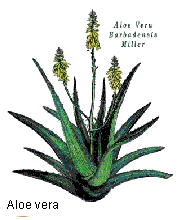
syn. Aloe barbadensus
See: TIL library collection on A. vera
Burmese-Myanmar transcript names:
• Agri.Dept.2000 52-1376:
 {rha:saung:lak-pat}
• Chklist: Shazaung-let-pat
• LSR 379:
{rha:saung:lak-pat}
• FAO : NL
• KS-TMN : NL
• Nagathein 3-131:
 {rha:saung:lak-pat a.kri:}
• UHM 03: Sha-zaung-let-pat
Myanmar-Script Spelling:
•
{rha:saung:lak-pap}
 --
MMDict 279
--
MMDict 279
•
{rha:saung:lak-pap} /|sha: zaun: le' pa'|/- n. aloe, Aloe vera -- MEDict 416
•
 {rha:saung:lak-pap ping} -- MOrtho 231
Data above updated (070309) in Akshara index r6c2raM.htm
Note on the Burmese-Myanmar to Burmese-Latin transliteration: Romabama transliteration follows as closely as possible the spelling in Burmese-Myanmar akshara.
The pronunciation of the last syllable {pup} may sound like "pat" to those who have been exposed to English syllables in which the last consonant (linguistic term: 'coda') is pronounced. However, in all aksharas including Myanmar, the last consonant is a "killed" consonant: it is not pronounced, and it does not matter whether the spelling is {pup} or {pat} as far as the coda is concerned. Unfortunately there is no equivalent in English vowels to represent the inherent vowel of the Myanmar akshara which is commonly described as 'close to the English "short" a'. However, we must note that the pronunciation can also be described as 'æ'. The pronunciation of the English vowels is not unchanging as in the aksharas including Myanmar, which changes the 'peak' (linguistic term describing the vowel in the English syllables) in Romabama syllable from "a" to "u".
Another point of confusion is due to non-standardisation of the Myanmar orthography, and various authors spell the same word differently. However, in MMPDB, I have tried my best to use the official spelling given by the Myanmarsar Commission in "Myan-Ortho", "Myan-Engl-Dict" and "TravPo-M-Dict", and I have to give the name asUKT: Nagathein listed three species of Aloes each with a subscript to differentiate the species:
A. vera - {rha:saung:lak-pat a.kri:} -- literal translation: Aloe major
A. indica - {rha:saung:lak-pat a.ngèý} -- literal translation: Aloe minor
A. rubescens - {rha:saung:lak-pat a.ni} -- literal translation: Aloe red. See photo on right. Click to enlarge.
http://www.illustratedgarden.org/mobot/rarebooks/page.asp?relation=SB438C361799V1&identifier=0095
A. rubescens, according to Nagathein 3-135 to 3-140, is extremely bitter, and is the plant from which{moat-hka:} is produced. Caveat: In his description of how
Chklist data: 070309
• Aloe vera L. Habit: Herb. Distribution: Cultivated. Common Names:
Shazaung-let-pat
Hindi:
Sanskrit:


English common name used in Myanmar :
• Agri.Dept.2000 52-1376: Aloes
• FAO : NL
• Lè-seik-shin 379: Barbados Aloe
• KS-TMN : NL
• Nagathein 3-131: Aloe vera
• UHM 03: Aloes, Curacae Aloe, Barbados Aloe
Picture:
• Leader :
http://www.hejnsvigbynet.dk/index.php?id=221
• Plant and men
http://www.growmorebiotech.com/aloe%20vera%20plant.jpg
• Inflorescence
http://www.swsbm.com/Images/A/Aloe_vera.jpg
Plant identification characters :
• A perennial herb with an extensive fascicled root system and a rosette of 12-20 thick succulent lanceolate leaves and a raceme of flowers. -- UHM
Distribution in Myanmar:
• Prome, Zigon, Mongnai, Taunglelon (Southern Shan State) -- UHM
Part used and uses :
• Dried juice of the leaves. Purgative in colon constipation, contraindicated in hemorrhoids, menstruation and pregnancy, antiseptic (U Nu, U.B.A.R.I.) -- UHM
• Transparent gel from the pulp of the meaty leaves of Aloe vera has
been used topically for thousands of years to treat wounds, skin infections,
burns, and numerous other dermatologic conditions. Dried latex from the inner
lining of the leaf has traditionally been used as an oral laxative.
There is strong scientific evidence in support of the laxative properties of
aloe latex, based on the well-established cathartic properties of anthroquinone
glycosides (found in aloe latex). However, aloe's therapeutic value compared
with other approaches to constipation remains unclear.
There is promising preliminary support from laboratory, animal, and human
studies that topical aloe gel has immunomodulatory properties which may improve
wound healing and skin inflammation. --
www.mayoclinic.com/health/aloe-vera/NS_patient-Aloe 24
Apr 2006. See entire monograph in
TIL library.
• The clear gel at the centre of the A. vera leaf has a reputation for both
anti-inflammatory and healing effects. Scientific studies have confirmed or
refuted these observations and discovered possible mechanisms of action.
Important findings of this review of the research are as follows:
- A. vera has been reported to reduce inflammation and swelling
- A. vera has been shown to increase wound healing rate
- Subcutaneous injection of A. vera is more effective in treating wounds,
when decolourized.
- A. vera administered via oral, subcutaneous or topical routes inhibits
inflammation and stimulates wound healing
-A. vera reduces acute inflammation in adjuvant arthritis
- A.vera is effective in reducing pain, oedema and wound size in diabetic
animals
- Retardation of tumours and stimulation of the immune system to viruses
have been reported therapeutic effects of A. vera
- A. vera has been suggested as a substitute for steroids as it does not
initiate connective tissue breakdown
- A. vera has an inhibitory system that influences both inflammation and
immune response
- A. vera also has a stimulatory system, which enhances wound healing
http://podiatry.curtin.edu.au/encyclopedia/aloe_vera/
Constituents :
• 1. Glucoside Barbaloin, aloe-emedin bitter resin isobarbaloin (7) -- UHM
• "Aloe is derived from the A. vera plant, a green, succulent, cactus-like
plant belonging to the lily family. The substance, A. vera, is derived from
thin-walled mucilaginous cells of the inner central zone of the leaf. It is this
gel that is thought to have emollient and moisturizing effects and therapeutic
properties." (Rund, 1996, p.19). A. vera is a complex plant that contains many
biologically active substances. Davis, Parker, Samson et al (1991b) reported
that one tablespoon of A. vera contains over 75 different chemicals that have
biological activity. Therefore it has proved difficult to isolate a single
active ingredient, and it has been suggested that there is a synergistic
relationship between the constituents (Leung, cited in Bradshaw, 1996, p.25).
Any substance which can be safely used to treat wounds and inflammatory
conditions in the foot would be beneficial to podiatric patient care. A review
of research on A. vera should give a clearer understanding of whether it's
claimed therapeutic effects can be substantiated.
Bradshaw (1996) commented that "there may be no great value in identifying
specific substances in A. vera, as it's influence appears to be exerted via the
synergistic and antagonistic activity of stimulatory and inhibitory systems. An
isolated constituent of A. vera may have little or no effect.". Despite this
concept, the biggest area of research into A. vera is concentrated on identifying
active ingredients. --
http://podiatry.curtin.edu.au/encyclopedia/aloe_vera/
Results of search for 'Aloe' in the Checklist of Plants of
Myanmar, U.S. National Herbarium, 9 Mar 2007.
• Aloe littoralis Koen. Habit: Herb. Distribution: Reported from
Myanmar. Common Names: Shazaung-let-pat-thein
• Aloe vera L. Habit: Herb. Distribution: Cultivated. Common
Names: Shazaung-let-pat
UKT: The below species are listed by Chklist:
1. Cardiocrinum, 2. Fritillaria, 3. Lilium, 4. Lloydia, 5. Nomocharis
UKT:
Aloe is not listed.
USDA-NRCS-data listed Aloe in the family Aloaceae
USDA-NRCS-data
"ALOE","Aloe L.","aloe","Aloaceae"
"ALAR8","Aloe arborescens Miller","candelabra aloe","Aloaceae"
"ALFE2","Aloe ferox Miller","Cape aloe","Aloaceae"
"ALGR8","Aloe graminicola Reynolds","","Aloaceae"
"ALPE9","Aloe perryi Baker","Perry's aloe","Aloaceae"
"ALSC12","Aloe ×schoenlandi Baker [saporaria × striata]","","Aloaceae"
"ALSE10","Aloe secundiflora Engl.","","Aloaceae"
"ALSU8","Aloe succotrina All.","Fynbos aloe","Aloaceae"
"ALVE2","Aloe vera (L.) Burm. f.","Barbados aloe","Aloaceae"
"ALBA","Aloe barbadensis P. Mill.",">>Aloe vera","Aloaceae"
"ALPEV","Aloe perfoliata L. var. vera L.",">>Aloe vera","Aloaceae"
"ALVU3","Aloe vulgaris Lam.",">>Aloe vera","Aloaceae"
Entry format: Botanical name / Family / Ref. Burmese-Myanmar
transcripts • Agri.Dept.2000 :
• Chklist: • LSR : • FAO : • KS-TMN:
• Nagathein :
• UHM :/ Myanmar-Script Spelling (•
Official Myanmar Dictionaries : - TravPo-M-Dict - Myan-Engl-Dict - Myan-Ortho
/ Chklist data / Hindi /
Sanskrit / English common name used in Myanmar / Picture /
Plant identification characters / Distribution in Myanmar / Part
used and uses / Constituents /
End of TIL file

