------------ (iii) Syllables with a medial Consonant as Onset and a Coda: CVÇ with C = 2, 3 and Ç = 1
Of Monosyllables with a final Consonant [ e.g.
 {k}]
{k}] Syllables CVÇ with various Medials as Onsets
CareyGram03.htm
From Grammar of the Burman Language,
by F. Carey, 1814.
-
https://books.google.co.nz/books?id=mmEOAAAAQAAJ&pg=PA1&redir_esc=y#v=onepage&q&f=false
201102
Downloaded copy in TIL HD-PDF and SD-PDF Libraries, and in TIL Bk-Cndl Online
Library
-
FCarey-GrammBurmanLang<Ô> /
Bkp<Ô> /
BkCnd<OL> (link chk 201103)
There are are 351 printed pages in the downloaded copies, but no TOC.
However, in -
https://books.google.fr/books?id=mmEOAAAAQAAJ 210112,
there is a Table des matières, which gives the book divided into 26 sections.
Downloaded and set in html and edited
by U Kyaw Tun (UKT) (M.S., I.P.S.T., USA), and staff of Tun Institute of Learning
(TIL).
Not for sale. No copyright. Free for
everyone. Prepared for students and
staff of TIL Research Station, Yangon, MYANMAR :
http://www.tuninst.net ,
www.romabama.blogspot.com
Section 03 :
contd:
------------ (iii) Syllables with a medial
Consonant as Onset and a Coda: CVÇ with C = 2, 3 and Ç = 1
Of
Monosyllables with a final Consonant [ e.g.
{k}]
Syllables CVÇ with various Medials as Onsets
One medial-former
§090. Table II - Ya'pin sign
 :
:
 {kya.},
 {kyi.},
 {kyu.},
 {kyé},
  {kyau:},
  {kyän}
§091. Table III - Ra'ric sign
 /
/ :
:
 {kra.},
  {kri.},
  {kru.},
  {kré},
  {krau:},
  {krän}
§092. Table IV - Wa'hswè sign

 {kwa.}/{qua.},
 {kwi.}/{qui.},
 {kwu.}/{quu.},
 {kwé}/{qué},
 {kwau:}/{quau:},
 {kwän}/{quän}
[UKT 210208: Carey has given only Ya'pin, Ra'ric, and Wa'hswè only.
He seems to have missed Ha'hto ]
Two medial-formers
§093. Table V - Yapin-Wahswè sign
§090.
The combinations of this table have the symbolic
character [Ya'pin sign]
inserted immediately after ["after" is not a suitable word] the initial consonant.
UKT 210120: Application of Ya'pin sign
{k·ya.} - with the central dot in Romabama representing schwa. Without the schwa, the conjunct is mute.
The medial
{kya} (2 blnk), and
{kya:} (3 blnk). The only difference between a basic consonant and a medial is its stability under a virama
{a·þût}: base consonants such as
{ka.} are stable, but medials like
N.B. Previously to the first line of each table, the compound consonants [Carey does not differentiate medials and conjuncts] combined with the vowels are inserted, each of which may be followed by a final consonant, and forms a new table. (p023end-p024begin)
[Ya'pin medials as Onsets and their vowels.]
-
vowel /a/
-
{kya.} <kya> ,
{kya} <kya>
-
vowel /i /
-
{kyi.} <kyi > ,
 {kyi} <kyee>
[UKT 210208: Don't confuse
{kyi} with
 {kyæÑ}]
- vowel /u/
-
{kyu.} <kroo > ,
 {kyu} <kyoo>
- vowel /é/
-
{kyé} <kye> ,
 {kyè:} <kyi>
[UKT:
 {kyèý} can be confused with
{kyæÑ}]
{kyèý} can be confused with
{kyæÑ}]
- vowel /ɔ/
-
{kyau:} <kyau } ,
 {kyau} <kyau>
- vowel /ʔ/
-
{kyän} <kyan> ,
{kya:} <kyah>
UKT 210208: Carey presents his Table II in two parts: firstly, medials and their vowels.
see CareyGram01.htm > §051 .
The second part is syllables produced with medials as Onsets. Their vowels become the nuclear vowel of the syllable.
[Ya'pin syllables with nuclear vowel
 {a.} /a/ ]
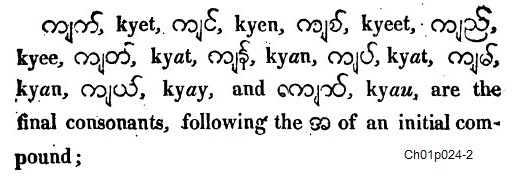
- row#1 -
 {kyak} <kyet>,
  {kyín} <kyen>
- row#2 -
 {kyic} <kyeet>,
 {kyæÑ} <kyee>
- row#4 -
 {kyût} <kyat>,
 {kyûn} <kyan>
- row#5 -
 {kyûp} <kyat>,
 {kyûm} <kyan>
- row#6 -
{kyèý} <kyay>,
 {kyauO} <kyau>,
[Codas ] are the final consonants, following the
[vowel]
{a.} /æ/ of an initial compound ;
[Ya'pin syllables with nuclear vowel
 {i.} /i/ ]

- row#4 -
 {kyaait} <kyit>,
 {kyain} <kying>
- row#5 -
 {kyaip} <kyit>,
 {kyaim} <kying>
are the final consonants [Codas], following the [vowel]
 {I.} of an initial compound .
[Ya'pin syllables with nuclear vowel
 /u/ ]
/u/ ]
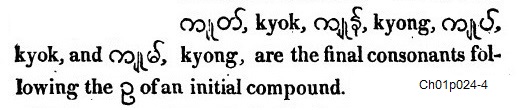
- row#4 -
 {kyoat} <kyok>,
 {kyoan} <kyong>
- row#5 -
 {kyoap} <kyok>,
 {kyoam} <kyong>
are the final consonants [Codas], following the [vowel]
 {U.} of an initial compound .
UKT 210123: I wonder why Carey had not included
{kyoän} which is in our lexicon, whilst
[Ya'pin syllables with nuclear vowel
 {au} /ɔ/ ]
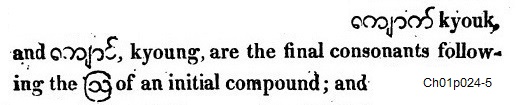
- row#1 -
 {kyauk} <kyouk>, and
 {kyaún} <kyoung>,
are the final consonants [Codas] following the [vowel]
 {AU} of an initial compound , and
[Ya'pin syllables with nuclear vowel
 {o}
/o/ ]
{o}
/o/ ]

- row#1 -
 {kyeik} <kyaik>,
 {kyeín}, and
- row#6 -
 {kyeíO} <kyo>,
are the final consonants
following the digraph diphthong
{o} of an initial compound [Onset],
 {kyoäm} <kyong>, is the same as
above.
{kyoäm} <kyong>, is the same as
above.
UKT 210123: I consider
{þé:þé:tín} and
{ma.þût} never occurs together. Note also that
§091.
The combinations of this table have the
symbolical character [Ra'ric sign]
/
inserted immediately after ["after" is not a suitable word] the initial consonant.
[Ra'ric medials as Onsets and their vowels.]
-
vowel /a/
-
{kra.} <kra> ,
 {kra} <kra>
- vowel /i /
-
{kri.} <kri > ,
 {kri} <kree>
[UKT 210124: Don't confuse this with
 {kræÑ}]
- vowel /u/
-
{kru.} <kroe > ,
 {kru} <kroo>
- vowel /é/
-
{kré} <kre> ,
 {krè:} <kri>
[UKT:
 {krèý} can be confused with
{kræÑ}]
{krèý} can be confused with
{kræÑ}]
- vowel /ɔ/
-
{krau:} <krau } ,
 {krau} <krau>
- vowel /ʔ/
-
{krän} <kran> ,
 {kra:} <krah>
UKT 210124: Above in CareyGram01.htm > §039 , I've already stated that Bur-Myan is non-rhotic, whereas Pali-Myan and the Rakhine dialects are. It is instructive to compare
Table II and Table III . Try to find out which word is in the present day lexicon by looking into Myanmar-English Dictionaries such as MLC MED-2006vow /a/ -
vow /i/ -
vow /u/ -
vow /é/ -
vow /ɔ/-
vowel /ʔ/ -
[Syllables with Nuclear vowel /æ/ ]

- row#1 -
 {krak} <kret>,
  {krín} <kren>
- row#2 -
 {kric} <kreet>,
{kræÑ} <kree>
{kric} <kreet>,
{kræÑ} <kree>
- row#4 -
 {krût} <krat>,
 {krûn} <kran>
- row#5 -
 {krûp} <krat>,
 {krûm} <kran>
- row#6 -
{krèý} <kray>,
 {kyauO} <kyau>,
are syllables in which the Codas final consonants follow the
[vowel]
{a.}, of an [Onset] medial initial consonant compounded with
 {ra.}.
UKT 210124: It is instructive to compare Table II and Table III
- row#1 -
- row#2 -
- row#4 -
- row#5 -
- row#6 -
[Syllables with Nuclear vowel /i/ ]
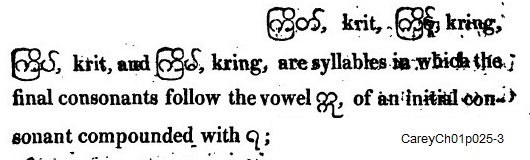
- row#4 -
 {krait} <krit> ,
 krain} <kring>
- row#5 -
 {kraip} <krit> ,
 {kraim} <kring>
are syllables in which the coda final consonants follow the vowel
{I.}, of a
medial consonant compounded with
{ra.}
[Syllables with Nuclear vowel /u/ ] 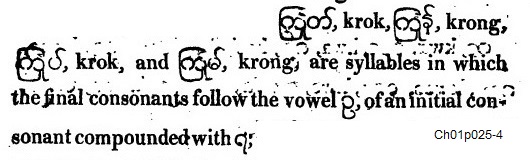
- row#4
-
 {kroat} <krok>
,
{kroat} <krok>
,
 {kroan} <krong>,
- row#5
-
 {kroap} <krok>
,
{kroap} <krok>
,
 {kroam} <krong>
are syllables in which the coda final consonants follow the vowel {U.}, of
a medial consonant compounded with
{ra.}
[Syllables with Nuclear vowel /ɑ/ ] 
- row#1 -
 {krauk} <krouk> ,
 {kraún} <kroung>
are syllables in which the coda final consonants follow the vowel
{AU} /ɔ/, of
a medial consonant compounded with
{ra.}
UKT 210128: Carey has made a mistake here. From the pronunciation of
[Syllables with Nuclear vowel /o/ ]

- row#1 -
 {kreik} <kraik> ,
 {kreín} <kraing>, and
 {kreiO} <kro> are syllables in which final consonants follow the diphthong
{o} /o/, of
an initial consonant compounded with
{ra.};
{kreiO} <kro> are syllables in which final consonants follow the diphthong
{o} /o/, of
an initial consonant compounded with
{ra.};
 {kroäm} is the same as
{kroam}, above.
{kroäm} is the same as
{kroam}, above.
(p025end-p026begin)
 N.B. The symbol [Ra'ric]
/
of the above and following combinations is almost always pronounced as the
symbol [Ya'pin]
. The English r therefore which properly represents the
symbol [Ra'ric]
/
must always be pronounced as the consonant y . Ex.
{krak}
is not pronounced <kret> but <kyet> .
N.B. The symbol [Ra'ric]
/
of the above and following combinations is almost always pronounced as the
symbol [Ya'pin]
. The English r therefore which properly represents the
symbol [Ra'ric]
/
must always be pronounced as the consonant y . Ex.
{krak}
is not pronounced <kret> but <kyet> .
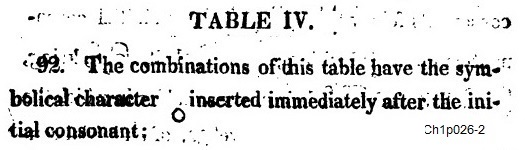 §092.
The combinations of this table have the
symbolical character [Wa'hswè ]
inserted immediately after the initial consonant;
§092.
The combinations of this table have the
symbolical character [Wa'hswè ]
inserted immediately after the initial consonant;
UKT 210129: There are two ways of writing Wa'hswè
{wa.hswè:} "hanging-wa." - with a perfect circle
or with a slightly triangular circle
[Wa'hswè medials as Onsets and their vowels.]
- vowel /a/ -
{kwa.}/{qua.} <kwa >;
 {kwa} <kwa >
- vowel /i / -
{kwi.}/{qui.} <kwi >;
 {kwi} <kwee>
- vowel /u/ -
{kwu.}/{quu.} <kwoo>;
 {kwu} <kwoo>
- vowel /é/ -
{kwé}/{qué} <kwe>;
 {kwè:} <kwi>
- vowel /ɔ/ -
{kwau:}/{quau:} <kwau >;
 {kwau} <kwau>
- vowel /ʔ/ -
{kwän}/{quän} <kwan> ;
 {kwa:} <kwah>
UKT 210131: Now, a word about my intention of trying to include Roman-Latin in BEPS. Roman-Latin is the ancient language influencing English-Latin. To do this, I'll have to look into how Ya'pin and Wa'hswè are different due to the spreading or rounding of lips. This difference can be traced to the difference in pronunciation of medial formers
{ya.} (spread-lips), and
{wa.} (round lips). The < kw > of
See Uvular consonants in my notes.

[Syllables with Nuclear vowel
{a.} /æ/ ]
- row#1 -
 {kwak}/{quak} <kwet>;
 {kwín}/{quín} <kwen>
- row#2 -
 {kwic}/{quic} <kweet>;
 {kwæÑ}/{quæÑ} <kwee>
- row#4 -
 {kwut} <kwat>;
 {kwun} <kwan}
- row#5 -
 {kwup} <kwat>;
 {kwum} <kwan}
- row#6 -
 {kèý} <kway>;
 {kwéO}
[The above ] are syllables in which a final consonant [Coda] follows the
vowel
{a.} /æ/ of an initial compounded with
{wa.} [Onset].
UKT 210208: There are 4 medial formers, because of which there there should be four medials acting as onsets. Cary seems that Carey has missed the Ha'hto . Yet in CareyGram01.htm > §059
§059. The symbol of{ha.}, in words purely Burman, is affixed to all the nasals,
besides which it is affixed to only{þa.}
I'll try to insert what he has missed, using the most :[Ha'hto medials of
{ma.} as Onsets and their vowels] ---- [Ya'pin medials of {ka.} as Onsets and their vowels. See: §090.]
- vowel /a/ -{mha.} ,
{mha} --------------------------------- - vowel /a/ -
- vowel /i / -{mhi.} ,
{mhi} ------------------------------------ - vowel /i / -
[UKT 210208: Don't confuse{mhæÑ}] ----- [UKT 210208: Don't confuse
- vowel /u/ -{mhu.} ,
{myu} --------------------------------- - vowel /u/ -
- vowel /é/ -{mhé:} ,
{mhè.} ------------------------------- - vowel /é/ -
[UKT:{mhæÑ.}] ------- [UKT:
- vowel /ɔ/ -{mhau:} ,
{mhau} ------------------------- - vowel /ɔ/ -
- vowel /ʔ/ -{mhän} ,
{mha:} ----------------------------- - vowel /ʔ/ -
[UKT 210208: I've to use
UKT 210207: See
- CareyGram01.htm > §058
for: Ya'pin{ya.pín.}
{ra.ric.}
------ Wa'swè{ha.hto:}
- CareyGram01.htm > §060
for: Ya'pin-wa'hswè,
------- Ra'ric-wa'hswè
UKT 210107: Romabama names of medial-formers. See also MLC-BO1986, page-
{HTa.}
Ya-wa medial-former, Ya'pin-wa'hswè -
Ra-wa medial-former, Ra'ric-wa'hswè -Ya-ha medial-former, Ya'pin-ha'hto -
Ra-ha medial-former, Ra'ric-ha'hto -
Wa-ha medial-former, Wa'hswè-ha'hto -Ya-wa-ha medial-former, Ya'pin-wa'hswè-ha'hto -

Ra-wa-ha medial-former, Ra'ric-wa'hswè-ha'hto -

§093.
The combinations of the table have the symbolical character
inserted immediately after the initial consonant.
 [Ya'pin-wa'hswè medials as Onsets and their vowels.]
End of TIL file


