
BEPS02.htm
by U Kyaw Tun (UKT) (M.S., I.P.S.T., USA), Tun Institute of Learning
(TIL).
Based on Burmese Grammar and Grammatical Analysis
by A. W. Lonsdale, Education Department, Burma, British Burma Press, Rangoon,
1899. In two parts:
Part 1. Orthoepy (pronunciation) and orthography (spelling) --
BG1899-1-indx.htm -
update 2019Nov
Part 2. Accidence (morphology) and syntax (sentence structure) --
BG1899-2-indx.htm - update
121117
I plan to update Lonsdale's work and name it BEPS (Burmese, English, Pali,
Sanskrit speeches in Myanmar, Latin, and Devanagri scripts) Grammar. But before
I could do it, I must equip myself with Linguistics and Phonetics. This is my
attempt to educate myself in these fields.
Be kind to remember, I am a chemist-cum-chemical engineer, and had no knowledge of Linguistics and Phonetics. Moreover, I was very weak in traditional grammar - both English and Burmese - and had almost no knowledge of Pali, and had absolutely no knowledge Sanskrit speech and Devanagari script. I am just a learner and bound to make fatal mistakes. I am doing this for my own satisfaction at this late age in life: I'm 85. I am sharing my work with own students and staff of TIL . Not for sale. No copyright. Free for everyone. Prepared for students and staff of TIL Research Station, Yangon, MYANMAR : http://www.tuninst.net , www.romabama.blogspot.com
Asokan and Myanmar aksharas with Pyu in between

Asokan related modern scripts
My version of MLC Burmese Grammar is now available as pdf pages on the Internet, uploaded by
https://whiteboylearningburmese.wordpress.com/books/ 160409
See downloaded pdf files in TIL PDF libraries: HD-PDF-B and SD-PDF-B (link chk 191010)
1. bg-mlc-1-1. 2. bg-mlc-1-2. 3. bg-mlc-1-3. 4. bg-mlc-1-4. 5. bg-mlc-2-5. 6. bg-mlc-2-6.
1. bkp1. --- --- 2. bkp2. --- ---- 3. bkp3.--- ---- 4. bkp4. -- - --- 5. bkp5. --- ---- 6. bkp6.
Ink-on-paper book available in TIL Research Library in 3 volumes, 17 sections.
UKT
081010, ..., 160413, 191111:
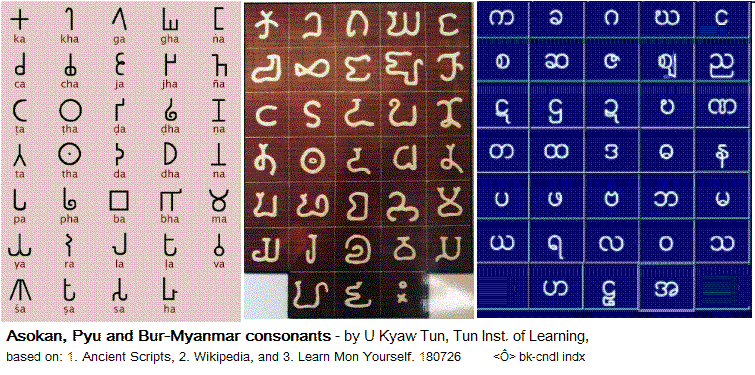
It is said and is commonly accepted that Bur-Myan akshara is derived from a south-Indian script through the intermediary Mon script.
There is no reason why Asokan should go through south India when Magadha
 {ma-ga-Da.} is
directly linked to northern Myanmarpré via land routes across the mountain
passes and river basins. These land routes had been in existence even in Geological ages
before the Himalayas were being formed.
{ma-ga-Da.} is
directly linked to northern Myanmarpré via land routes across the mountain
passes and river basins. These land routes had been in existence even in Geological ages
before the Himalayas were being formed.
UKT 191121: Watch videos from TIL HD-VIDEO and SD-VIDEO libraries in Geology section (link chk 191121)
- EvolutionHimalayas<Ô> / Bkp<Ô>
- HowHimalayaFormed<Ô> / Bkp<Ô>
However, let's accept the notion of an any intermediary south-Indian script, and let's see what that south-Indian script is supposed to be. Is it Kadamba script?
From:
-
https://en.wikipedia.org/wiki/Kadamba_script 191111
"... The Kadamba script is one of the oldest of the southern group of
South Asian scripts that evolved from the Brahmi script. By 5th century CE
it became different from other Brahmi variants and was used in southern
Indian states of Karnataka and Andhra Pradesh. It evolved into the Old
Kannada script by the 10th century CE and was used to write Kannada and
Telugu.
[1]
Many scripts were derived from the Kadamba script, including the Pyu
script.
[citation
needed]"
UKT: Since the Wikipedia article does not include a sample of Kadamba
script, I've to go to Ancient Scripts.
From:
-
http://www.ancientscripts.com/kadamba.html 191111
"The Kadambda script is one of the early Southern group of South Asian
scripts. It evolved from the Brahmi script and became stylistically
different from other Brahmi variants by the 5th century CE. It was used
roughly in what is nowadays the modern states of Karnataka and Andhra
Pradesh in southern India. By the 10th century CE it has involved into the
Old Kannada
script which was used to write the Kannada and Telugu languages."
However, it came as a surprise to me to find that many aksharas of the Bur-Myan bear striking resemblances to the aksharas found on the pillars of King Asoka in Magadha Kingdom of ancient India - the oldest aksharas of a complete written language in India. (Please remember that Asoka came about 250 years after the Gautama Buddha.)
Thus, my present position is that
Myanmar script and Asokan Brahmi script of
Magadha Mahajanapada
 were closely related that we do not know which is
descended from which. The intermediary script is probably Pyu script of
Myanmarpré.
were closely related that we do not know which is
descended from which. The intermediary script is probably Pyu script of
Myanmarpré.
Asokan Brahmi script language should be termed Magadhi-Asokan, and that
it was known in northern present-day Myanmarpré, particularly in the Kingdom
of Tagaung
 {ta.kaún:} and other Pyu
 {pyu} areas since the time of King Abiraza

 {a.Bi.ra-za mín:} (himself from
northern India long before the time of Gautama Buddha.
{a.Bi.ra-za mín:} (himself from
northern India long before the time of Gautama Buddha.

 Further, if that were the
case how would I explain the marked difference in shape between Asokan & Bur-Myan
and Asokan in r1c1
Further, if that were the
case how would I explain the marked difference in shape between Asokan & Bur-Myan
and Asokan in r1c1
 {ka.}
{ka.}  and r4c1
 {ta.}
{ta.}
 ?
?
Would I dare suggest that Asokan was not the parent, but that, there was a much older script from which both Asokan and Myanmar are derived?
In that
older script, the r3, the retroflex is important, and that the full circle
representing perfection is the king. Look at the first three
aksharas. In Asokan, r3c2 is a full circle, and r3c1 & r3c3 are facing it as
if attendance. In Myanmar, they are all on pedestals, e.g.
 {Ta.},
 {HTa.},
and
{HTa.},
and
 {ða.}.
In my hypothetical "magic square", a 3x3 matrix, the Perfection is the Buddha,
whereas the Atman and its exact opposite your personal pride or Ego are looking
away from Perfection.

You will see the same idea on the platform of any Myanmar pagoda, the arrangement of the Planet posts.
I base my conjecture on my explanation of the "magic" rune known as
 {sa.Da.ba.wa.
ïn:}.
{sa.Da.ba.wa.
ïn:}.
See Cult of the Rune in Folk Elements in Buddhism
--
flk-ele-indx.htm , (link chk 191111)
and go to
> Nine Gods -
ch02.htm
> Cult of Magus (Cult of Runes is part of Cult of Magus) -
ch05-magus.htm
It is important for the study of Bur-Myanmar, which
is slightly different from Pali-Myanmar. I have made
appropriate changes in the following table from F. Mason & E. Mazard:
1. Magadhi-Asokan, 2. Pal-Myan, 3. Sinhala-Lanka, and 4. Sanskrit-Devanagari: from
¤ A Pali grammar on the basis of Kaccayano
 {kic~sæÑ:} - by Rev. F. Mason, 1868
Downloaded versions from various source are available in TIL HD-PDF and SD-PDF
libraries : (all links chk 191122)
-
FMason-Kicsi<Ô> /
bkp<Ô>
-
FMason-Kicsi-German<Ô> /
bkp<Ô>
- Francis Mason & Eisel Mazard
(馬大影) version of Shin Kicsi
Pali Grammar, 1st distribution in 2015
- FMasonMazard-PalGramm<Ô> /
Bkp<Ô>


 To study Mag-Asok (Magadhi-Asokan), I have
to write a Lakkwak similar to the one for
Bur-Myan,
To study Mag-Asok (Magadhi-Asokan), I have
to write a Lakkwak similar to the one for
Bur-Myan,
a Lakkwak --
lakkwak.gif
(link chk 191110)
I have several sources for this task:
#1. Francis Mason's A Pali grammar on the basis of
Kaccayano
{kic~sæÑ:} 1868 (Eisel Mazard ed.
(馬大影) 2005, 2015)
- FMasonMazard-PalGramm<Ô> /
Bkp<Ô> (link chk 191110)
UKT191110: To know more about Eisel Mazard, read his work titled
"Problems of
“Canon” and “Reason” in Theravāda Studies", 2014, in TIL HD-PDF and
SD-PDF libraries:
-
EMazard-ProblemsCanonReasonTheravad<Ô> /
Bkp<Ô> (link chk 191110) .
#2. Ancient Scripts
#3. Cunningham's Asoka Inscriptions , 1877
- ACunningham-InscripAsoka<Ô> /
bkp<Ô> (link chk 191110)
You will notice the variations between the sources, and my version is what I
consider to be a "happy medium" (Chemical Engineering Jargon which nobody likes,
but use because of its utility).
There eight (or nine) vowels in Asokan Brahmi with two modes of
writing: vowel-letters, and vowel-signs.
Remember, Asokan was used for writing both Pali (derived from Magadhi & Sinhala)
and Sanskrit speeches. Magadhi belongs to Tib-Bur (Tibeto-Burman) language
group, Sinhala to Aus-Asi (Austro-Asiatic) and Sanskrit to IE (Indo-European
Aryan).
I have struck out the word Brahmi, because the Brahmin-Poannars have
nothing to do with it. They failed to decipher it when called upon by the
Mogul-Emperor of Delhi in the 14th century. Asokan Brahmi was
deciphered by an an Englishman, James Prinsep in the 19th century. Secondly, the
word Aryan has been struck out because of its association with Adolph Hitler and
his racist policies of 20th century.


In my figures below, the guide-lines I use are mine: single circle 5 pix; double circle 7 pix. The height of cell is 22 pix. Keep in mind that a consonant and the vowel-sign modifying it are not separated by a white space.

End of TIL file
