 /
/  {É}
ए - compare: /e/ -
{É}
ए - compare: /e/ -
 {é.}
{é} {é:}
{é.}
{é} {é:}  {É-ka.}
एक
{É-ka.}
एक

 {É-ka}
एक
{É-ka}
एक

 {É-ké}
एके
{É-ké}
एके

 {É-kè:}
एकैकं
{É-kè:}
एकैकं

 {É-kau:} एको

 {É-ta.}
एतत्
{É-ta.}
एतत्

 {É-ta}
एतां
{É-ta}
एतां

 {É-ti.}
एति
{É-ti.}
एति

 {É-té}
एते
{É-té}
एते

 {É-tè:}
एतैः
{É-tè:}
एतैः

e2-042top-2.htm
from: Online Sanskrit Dictionary, February 12, 2003 . http://sanskritdocuments.org/dict/dictall.pdf 090907
Downloaded, set in HTML, and edited by U Kyaw Tun, M.S. (I.P.S.T., U.S.A.), and staff of TIL Computing and Language Centre, Yangon, Myanmar. Not for sale. No copyright. Free for everyone.
index.htm | Top
SED-vow-dissim-indx.htm
/
{É}
ए - compare: /e/ -
{é.}
{é} {é:} {É-ka.}
एक
{É-ka}
एक
{É-ké}
एके
{É-kè:}
एकैकं
{É-kau:} एको
{É-ta.}
एतत्
{É-ta}
एतां
{É-ti.}
एति
{É-té}
एते
{É-tè:}
एतैः
UKT notes
• {é} and {è:} vowels •
Pranava yoga
{É}
UKT: Before you go into this file make sure you realize the pitfalls of Two-three tone problem between English and Burmese. Read about the {é} and {è:} pitch-registers (tones) of English and Burmese .
{É-ka.}
एक
•
एक (eka)
Skt: एक (eka) - one - OnlineSktDict
Pal: eka adj. one, single, alone, a certain, same -
UPMT-PED056
•
एकं (ekaM)
Skt:
एकं (ekaM) - one - OnlineSktDict
•
एक: (ekaH)
Skt:
एक: (ekaH) - one - OnlineSktDict
•
एकत्वं (ekatvaM)
Skt:
एकत्वं (ekatvaM) - in oneness - OnlineSktDict
•
एकत्वेन (ekatvena)
Skt:
एकत्वेन (ekatvena) - in oneness - OnlineSktDict
•
एकदंतं (ekada.ntaM)
Skt:
एकदंतं (ekada.ntaM) - one who has a single
tusk - OnlineSktDict
•
एकदंताय
(ekada.ntaaya)
Skt:
एकदंताय
(ekada.ntaaya) - to the one-tusked - OnlineSktDict
•
एकमक्षरं
(ekamakSharaM)
Skt:
एकमक्षरं
(ekamakSharaM) - pranava - OnlineSktDict
See my note on Pranava yoga aka Om yoga or Om meditation.
•
एकमेवाद्वितीयं(ekamevaadvitiiyaM)
Skt:
एकमेवाद्वितीयं(ekamevaadvitiiyaM)
- one without a second - OnlineSktDict
•
एकया
(ekayaa)
Skt:
एकया
(ekayaa) - by one - OnlineSktDict
•
एकवचनं
(ekavachanaM)
Skt:
एकवचनं
(ekavachanaM) - singular - OnlineSktDict
•
एकस्थं
(ekasthaM)
Skt:
एकस्थं
(ekasthaM) - in one place - OnlineSktDict
•
एकस्मिन्
(ekasmin.h)
Skt:
एकस्मिन्
(ekasmin.h) - in one - OnlineSktDict
{É-ka}
एक
•
एकाः (ekaaH)
Skt:
एकाः (ekaaH) - one - OnlineSktDict
•
एकाकिनि
(ekaakini)
Skt:
एकाकिनि
(ekaakini) - solitary woman - OnlineSktDict
•
एकाकी (ekaakii)
Skt:
एकाकी (ekaakii) - alone - OnlineSktDict
•
एकाग्र (ekaagra)
Skt:
एकाग्र (ekaagra) - one-pointed - OnlineSktDict
•
एकाग्रं
(ekaagraM)
Skt:
एकाग्रं
(ekaagraM) - with one attention - OnlineSktDict
•
एकाग्रेण
(ekaagreNa)
Skt:
एकाग्रेण
(ekaagreNa) - with full attention - OnlineSktDict
•
एकान्तं
(ekaantaM)
Skt:
एकान्तं
(ekaantaM) - overly - OnlineSktDict
•
एकाक्षरं
(ekaakSharaM)
Skt:
एकाक्षरं
(ekaakSharaM) - the one syllable - OnlineSktDict
{É-ké} एके
•
एके (eke)
Skt:
एके (eke) - in one - OnlineSktDict
•
एकेन (ekena)
Skt:
एकेन (ekena) - alone - OnlineSktDict
{É-kè:}
एकैकं
•
एकैकं (ekaikaM)
Skt:
एकैकं (ekaikaM) - one by one - OnlineSktDict
•
एकैकमक्षरं
(ekaikamakSharaM)
Skt:
एकैकमक्षरं
(ekaikamakSharaM) - each and every word - OnlineSktDict
{É-kau:} एको
•
एकोऽहं (eko.ahaM)
Skt:
एकोऽहं (eko.ahaM) - I the one single being - OnlineSktDict
{É-ta.}
एतत्
•
एतत् (etat.h)
Skt:
एतत् (etat.h) - it - OnlineSktDict
•
एतन् (etan.h)
Skt:
एतन् (etan.h) - this - OnlineSktDict
•
एतयोः (etayoH)
Skt:
एतयोः (etayoH) - of these two - OnlineSktDict
•
एतस्य (etasya)
Skt:
एतस्य (etasya) - of this - OnlineSktDict
{É-ta}
एतां
•
एतां (etaaM)
Skt:
एतां (etaaM) - this - OnlineSktDict
•
एतान् (etaan.h)
Skt:
एतान् (etaan.h) - all these - OnlineSktDict
•
एतानि (etaani)
Skt:
एतानि (etaani) - all these - OnlineSktDict
•
एतावत् (etaavat.h)
Skt:
एतावत् (etaavat.h) - this much - OnlineSktDict
{É-ti.}
एति
•
एति (eti)
Skt:
एति (eti) - attains - OnlineSktDict
Pal: eti v. (√i) to come, go, attain - UPMT-PED057
{É-té}
एते
•
एते (ete)
Skt:
एते (ete) - they - OnlineSktDict
•
एतेन (etena)
Skt:
एतेन (etena) - by this - OnlineSktDict
•
एतेषां (eteshhaaM)
Skt:
एतेषां (eteshhaaM) - of the Pandavas - OnlineSktDict
{É-tè:}
एतैः
•
एतैः (etaiH)
Skt:
एतैः (etaiH) - all these - OnlineSktDict
•
एधते (edhate)
Skt:
एधते (edhate) - (1 ap) to grow - OnlineSktDict
•
एधांसि (edhaa.nsi)
Skt:
एधांसि (edhaa.nsi) - firewood - OnlineSktDict
•
एनं (enaM)
Skt:
एनं (enaM) - this - OnlineSktDict
•
एभिः (ebhiH)
Skt:
एभिः (ebhiH) - by them - OnlineSktDict
•
एभ्यः (ebhyaH)
Skt:
एभ्यः (ebhyaH) - to these demigods - OnlineSktDict
•
एव (eva)
Skt:
एव (eva) - ( used to put emphasis) - OnlineSktDict
•
एवं (evaM)
Skt:
एवं (evaM) - thus - OnlineSktDict
•
एवंविधः (eva.nvidhaH)
Skt:
एवंविधः (eva.nvidhaH) - like this - OnlineSktDict
•
एवंविधाः
(eva.nvidhaaH)
Skt:
एवंविधाः
(eva.nvidhaaH) - like this - OnlineSktDict
•
एवापि (evaapi)
Skt:
एवापि (evaapi) - also - OnlineSktDict
•
एषः (eshhaH)
Skt:
एषः (eshhaH) - this - OnlineSktDict
•
एषा (eshhaa)
Skt:
एषा (eshhaa) - this - OnlineSktDict
•
एषां (eshhaaM)
Skt:
एषां (eshhaaM) - of them - OnlineSktDict
•
एष्यति
(eshhyati)
Skt:
एष्यति
(eshhyati) - comes - OnlineSktDict
•
एष्यसि
(eshhyasi)
Skt:
एष्यसि
(eshhyasi) - you will attain - OnlineSktDict
by UKT 100329
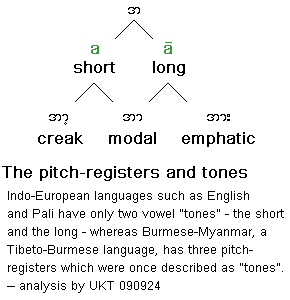
Before we can tackle the problem of pronunciation differences between Pali-Myanmar (probably derived from classical Magadhi of Asoka period) and Pali-Latin (derived from classical Pali of Asoka period), we have to clearly define the problem between the modern Burmese and modern English.
Burmese has three tones or pitch-registers, whereas English has only two: the short and the long. I have been illustrating the problem with the most simple vowel (at least for Myanmar and Devanagari): a and ā , the short-a and the long-a. Now we have come to more complex issues.
First, for the English language and its dialects, I have come to realize that the phoneme /a/ is not as important /æ/ and /ɑ/. And so when I came across statements that the consonant akshara (of the abugida) has an embedded "inherent vowel" similar to English short a, I was lost.
"Each consonant letter represents a single consonantal sound but also has the peculiarity of having an inherent vowel, generally the short vowel /a/ in Devanagari and the other Indic scripts. Thus U0915 क DEVANAGARI LETTER KA represents not just /k/ but also /ka/. In the presence of a dependent vowel, however, the inherent vowel associated with a consonant letter is overridden by the dependent vowel."
-- Unicode Consortium, http://www.unicode.org/versions/Unicode4.0.0/ch09.pdfIn fact, this particular information from Unicode was the eye-opener for me to study the akshara aspect of the Burmese-Myanmar language which has eventually led me to compare the Burmese-English-Pali-Sanskrit (BEPS) languages.
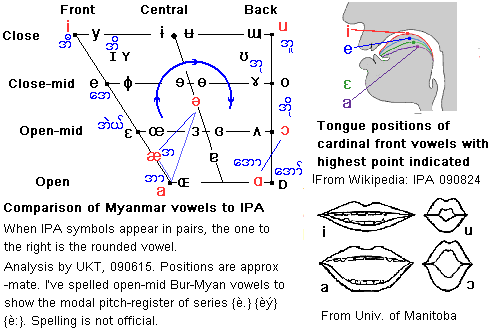
The problem met in the cross-linguistic study is the differences in pronunciation of the vowels, particularly the mid vowels (front and back) and the low back vowels (rounded and unrounded).
The front central vowels showing the three registers:
/e/ -{hkít}.
/ɛ/ -{è.} {èý} {è:}
The back central and low back vowels with three registers:
/ɔ/ -{o.} {o} {o:} - Note that the checkable vowel is {o}
/ɑ/ -{au.} {au} {au:}
UKT: Note that the usual checkable vowel is the short vowel of English and the middle (modal) register of Burmese. However in English and borrowed words in Burmese long vowels have to be checked. In such cases following the lead given in IPA, I use the triangular colon after the peak vowel. This is equivalent to checking the emphatic register of Burmese. See ईक्ष् (iikSh.h). Waiting for comments from my peers. 100417.
Because of possibility of a multitude of phones across languages, we must note that we now have a problem commonly met in physical sciences: the problem of precision and accuracy.
Go back e-and-ei-tones-note-b
From Wikipedia http://en.wikipedia.org/wiki/Pranava_yoga 100408
Pranava yoga is a name given to the classical method of meditation outlined in the Upanishads, the Bhagavad Gita, and the Yoga Sutras of Patanjali. It is also called Om yoga and Om yoga meditation. It is, simply put, fixing the mind on the sound of the mantra “Aum” – the sacred syllable that both symbolizes and embodies Brahman, the Absolute Reality – as the mantra is constantly repeated in unison with the breath. The purpose of pranava yoga is to become free from suffering and limitation.
The purpose is well stated in the Upanishads: “What world does he who meditates on Aum until the end of his life, win by That? If he meditates on the Supreme Being with the syllable Aum, he becomes one with the Light, he is led to the world of Brahman [the Absolute Being] Who is higher than the highest life, That Which is tranquil, unaging, immortal, fearless, and supreme.” – Prashna Upanishad 5:1,5,7
Aum, according to Hindu philosophy, is the primordial sound from which the whole universe was created. Aum, also called the Pranava, is the original Word of Power, and is recited as a mantra. A mantra is a series of verbal sounds having inherent sound-power that can produce a particular physical or psychological effect, not just something that has an assigned intellectual meaning. The word mantra derives from the Sanskrit expression ‘mananaath thraayathe’ which loosely means “a transforming thought”; literally, “that which, when thought, carries one across [the worldly ocean of sorrow]”. The power of a mantra lies in its ability to produce an objective, perceptible change in the yogi who repeats it correctly.
In the yoga tradition, Aum is the most sacred of holy words, the supreme mantra. Aum is also called the Pranava, a Sanskrit word which means both controller of life force (prana) and life-giver (infuser of prana). “That which causes all the pranas to prostrate themselves before and get merged in the Paramatman, so as to attain identity with Him, is for that reason known as the Pranava.” – Atharvashikha Upanishad 1:10a.[1] Aum is called the Shabda Brahman – God as Sound/Vibration. According to yoga theory, the universe has emanated from this primal movement in God. By following the thread of Aum back in meditation to more and more subtle levels of awareness, the yogi regains union with Brahman.[2][3][4][5]
The Upanishads (both the major and minor) are full of references to Aum and meditation on Aum. Below is a small sampling:
• "He who utters Om with the intention ‘I shall attain Brahman’ does verily attain Brahman." - Taittiriya Upanishad 1.8.1
• "The Self is of the nature of the Syllable Om...Meditate on Om as the Self" - Mandukya Upanishad 1.8.12, 2.2.3)
• "The form of meditation that came to manifest as the foremost of all, for the regeneration of all seekers, was the First Word, indicative of Brahman [God]: the Syllable Om. Meditation on Om should be resorted to by seekers after liberation. This Syllable is the Supreme Brahman." – Atharvashikha Upanishad 1:1,2
• "God is the Syllable Om, out of Him proceeds the Supreme Knowledge." – Svetasvatara Upanishad 4:17
• "Om is Brahman, the Primeval Being. This is the Veda which the knowers of Brahman know; through it one knows what is to be known." – Brihadaranyaka Upanishad 5.1.1
• "One should meditate on this Syllable [Om]." – Chandogya Upanishad 1.1.1
• "The Syllable Om is the bow: one's self, indeed, is the arrow. Brahman is spoken of as the target of that. It is to be hit without making a mistake. Thus one becomes united with it [Brahman] as the arrow becomes one with the target." – Mundaka Upanishad 2.2.4
Speaking from the perspective of the Infinite Being, enumerating his major manifestation-embodiments, Krishna says: "I am the syllable Om."(Gita 7:8) He also says the same thing in 9:17 ("I am...the sacred monosyllable") and 10:25 ("Among words I am the monosyllable Om").
What to "do" with aum is then outlined by Krishna: "Engaged in the practice of concentration... uttering the monosyllable Om -- the Brahman -- remembering Me always, he...attains to the supreme goal. I am easily attainable by that ever-steadfast Yogi who constantly and daily remembers Me."– Bhagavad Gita 6:13; 8:12-14[6]
Patanjali’s Yoga Sutras, the most ancient and authoritative text on Yoga, outlines the purpose and process of yoga as follows:
"Ishwara [ईश्वर God] is a particular Purusha [Spirit, Person] Who is untouched by the afflictions of life, actions, and the results and impressions produced by these actions. In Him is the highest limit of omniscience. 36 Being unconditioned by time He is teacher even of the ancients. His designator [vachaka] is the Pranava [Om]. 37 Its japa [constant repetition] and bhavanam is the way [or: should be done]. From it result [come] the disappearance of obstacles and the turning inward of consciousness. Disease, languor, doubt, carelessness, laziness, worldly-mindedness, delusion, non-achievement of a stage, instability, these cause the distraction of the mind and they are the obstacles. [Mental] pain, despair, nervousness, and agitation are the symptoms of a distracted condition of mind. For removing these obstacles [there should be] the constant practice of the one principle [the japa and bhavanam of Om]." – Yoga Sutras of Patanjali 1:24-32[7]
UKT: More in Wikipedia article.
Go back pranava-yoga-note-b
End of TIL file