Update:
2012-01-05 03:47 AM +0630
TIL
Sanskrit English Dictionary
than02ska1-193b1-5.htm
from: Online Sanskrit Dictionary, February 12, 2003 .
http://sanskritdocuments.org/dict/dictall.pdf 090907
Downloaded, set in HTML, and edited by U Kyaw Tun, M.S. (I.P.S.T., U.S.A.), and
staff of TIL Computing and Language Centre, Yangon, Myanmar. Not for sale. No
copyright. Free for everyone.
index.htm | Top
SED-frica-r6-indx.htm
UKT notes
• Sanskrit
Contents of this page
{þän-ska.} संस्क
= स ं स ् क
p193b1-5
• संस्कार
(sa.nskaara)
= स ं स ् क ा र
= स ं स्क ा र
Skt: संस्कार
(sa.nskaara) - impression, conditioning - OnlineSktDict
UKT: The problem with the above spelling is
स्क
= स ् क . It is a
conjunct and not a medial and cannot be
pronounced. Therefore the whole word needs
to be respelled as संस्
का र . I wait for
input from my peers. - UKT110920
• संस्काराः
(sa.nskaaraaH)
Skt:
संस्काराः
(sa.nskaaraaH) - (Masc.Nom.PI.) prescribed ritual duties(16?) - OnlineSktDict
Contents of this page
p193b1-6
• संस्कृत्
(sa.nskRit.h)
= स ं स ् क ृ त ् = संस्
कृ त्
Skt:
संस्कृत्
(sa.nskRit.h) - Sanskrit - OnlineSktDict
See my note on
Sanskrit
Contents of this page
p193b2
• संस्कृत
(sa.nskRita)
Skt: संस्कृत
(sa.nskRita) - refined - OnlineSktDict
•
संस्कृतशिक्षणं
(sa.nskRitashikshaNaM)
Skt:
संस्कृतशिक्षणं
(sa.nskRitashikshaNaM) - learning of Sanskrit - OnlineSktDict
Contents of this page
p193b2-2
• संस्कृति
(sa.nskRiti)
Skt: संस्कृति
(sa.nskRiti) - culture - OnlineSktDict
Contents of this page
p193b2-3
• संस्तभ्य
(sa.nstabhya)
Skt:
संस्तभ्य
(sa.nstabhya) - by steadying - OnlineSktDict
Contents of this page
p193b2-4
• संस्था (sa.nsthaa)
Skt: संस्था
(sa.nsthaa) - (f) institution - OnlineSktDict
• संस्थानं
(sa.nsthaanaM)
Skt: संस्थानं
(sa.nsthaanaM) - (n) institute - OnlineSktDict
Contents of this page
p193b2-5
•
संस्थापनार्थाय
(sa.nsthaapanaarthaaya)
Skt:
संस्थापनार्थाय
(sa.nsthaapanaarthaaya) - to reestablish - OnlineSktDict
Contents of this page
p193b2-6
•
संस्पर्शजाः
(sa.nsparshajaaH)
Skt:
संस्पर्शजाः
(sa.nsparshajaaH) - by contact with the material senses - OnlineSktDict
•
संस्पर्शन
(sa.nsparshana)
Skt:
संस्पर्शन
(sa.nsparshana) - (neut) contact - OnlineSktDict
Contents of this page
p193b2-7
•
संस्मृत्य
(sa.nsmRitya)
Skt:
संस्मृत्य
(sa.nsmRitya) - remembering - OnlineSktDict
Contents of this page
p193b3
• संहरते (sa.nharate)
Skt: संहरते
(sa.nharate) - winds up - OnlineSktDict
Contents of this page
p193b3-2
• संहार (sa.nhaara)
Skt: संहार
(sa.nhaara) - destroy (take away) - OnlineSktDict
• संहारः
(sa.nhaaraH)
Skt: संहारः
(sa.nhaaraH) - (m) slaughter, destruction - OnlineSktDict
Contents of this page
p193b3-3
• संहित (sa.nhita)
Skt:
संहित (sa.nhita) - sandhi :
the phonetic combination of words in Sanskrit - OnlineSktDict
Contents of this page
p193b3-4
• संहिता (sa.nhitaa)
Skt: संहिता
(sa.nhitaa) - (f) code - OnlineSktDict
•
संहितासंधि
(sa.nhitaasa.ndhiH)
Skt:
संहितासंधि
(sa.nhitaasa.ndhiH) - sa.nhitaa + sandhiH joined together?
- OnlineSktDict
Contents of this page
p193b3-5
• संहृ (sa.nhRi)
Skt: संहृ (sa.nhRi)
- to completely destroy - OnlineSktDict
• संहृष्ट
(sa.nhRishhTa)
Skt: संहृष्ट
(sa.nhRishhTa) - (adj) happy - OnlineSktDict
Contents of this page
p193b3-6
• संज्ञके
(sa.nGYake)
= स ं ज ् ञ क े
Skt: संज्ञके
(sa.nGYake) - which is called - OnlineSktDict
•
संज्ञार्थं
(sa.nGYaarthaM)
Skt:
संज्ञार्थं
(sa.nGYaarthaM) - for information - OnlineSktDict
Contents of this page
p193b4
• संज्ञितं
(sa.nGYitaM)
Skt: संज्ञितं
(sa.nGYitaM) - in the matter of - OnlineSktDict
Contents of this page
p193b4-2
• संज्ञितः
(sa.nGYitaH)
Skt: संज्ञितः
(sa.nGYitaH) - is called - OnlineSktDict
• संज्ञैः
(sa.nGYaiH)
Skt: संज्ञैः
(sa.nGYaiH) - named - OnlineSktDict
Contents of this page
From Wikipedia:
http://en.wikipedia.org/wiki/Sanskrit 110427
 Sanskrit
(Skt:
संस्कृतम्
saṃskṛtam /sə̃skɹ̩t̪əm/,
originally संस्कृता वाक्
saṃskṛtā vāk,
"refined speech"), is a historical Indo-Aryan language and the primary
liturgical language of Hinduism, Jainism and Buddhism. (Wiki-note01).[note
1] Today, it is listed as one of the 22 scheduled languages of India[2]
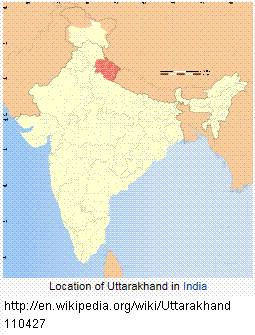
and is an official language of the state of Uttarakhand.[3]
Sanskrit
(Skt:
संस्कृतम्
saṃskṛtam /sə̃skɹ̩t̪əm/,
originally संस्कृता वाक्
saṃskṛtā vāk,
"refined speech"), is a historical Indo-Aryan language and the primary
liturgical language of Hinduism, Jainism and Buddhism. (Wiki-note01).[note
1] Today, it is listed as one of the 22 scheduled languages of India[2]
and is an official language of the state of Uttarakhand.[3]
UKT: The orthography of "Sanskrit" is noteworthy. The onset-consonant
used in this disyllabic word is a thibilant, /θ/, and not a sibilant such as
/s/ nor /ʃ/. Yet the pronunciation is sibilant. I wonder whether this
confusion is yet another confusion since the days of proto-Indo-European
(PIE) languages comparable to centum-satem isogloss. See Wikipedia
http://en.wikipedia.org/wiki/Centum-Satem_isogloss 110428. We must not
forget that the four languages of BEPS are used by peoples with very
distinct facial features which may also reflect very different neurological
features. What is the Pali used in Myanmar? Is it the same as the Pali used
in Sri Lanka? If it were not it, would be better to apply a different name
to it such as Magadhi-Myanmar! After all it was the language used by Tib-Bur
speaker-group to which Gautama Buddha obviously belonged based on the place
in which he was born, and places where he had preached. - UKT110428.
isogloss n. 1. A geographic boundary line delimiting
the area in which a given linguistic feature occurs. -- AHTD
Classical Sanskrit is the standard
register as laid out in the grammar of
Pāṇini, around the 4th
century BCE. Its position in the cultures of Greater India is akin to that of
Latin and Greek in Europe and it has significantly influenced most modern
languages of the Indian subcontinent, particularly in India, Pakistan and Nepal.[4]
The pre-Classical form of Sanskrit is known as
Vedic Sanskrit, with
the language of the Rigveda
being the oldest and most archaic stage preserved, its oldest core dating back
to as early as 1500 BCE.[5]
This qualifies Rigvedic Sanskrit as one of the oldest attestations of any
Indo-Iranian language, and one of the earliest attested members of the
Indo-European language family [IE - different from Tib-Bur (Tibeto-Burman)], the
family which includes English and most European languages.[6]
The corpus of
Sanskrit literature encompasses a rich tradition of poetry and
drama as well as
scientific, technical,
philosophical and
Hindu religious texts. Sanskrit continues to be widely used as a ceremonial
language in Hindu religious rituals in the forms of
hymns and
mantras. Spoken
Sanskrit is still in use in a few traditional institutions in India and there
are many attempts at
revival.
Name
The Sanskrit verbal adjective
sáṃskṛta- may be translated as "put together, constructed, well or
completely formed; refined, adorned, highly elaborated". It is derived from the
root
saṃ-skar- "to put together, compose, arrange, prepare",[7]
where
saṃ- "together" (as English same) and
(s)kar- "do, make".
The term in the generic meaning of "made ready, prepared, completed,
finished" is found in the Rigveda.
Also in Vedic Sanskrit,
as nominalized neuter
saṃskṛtám, it means "preparation, prepared place" and thus "ritual
enclosure, place for a sacrifice".
As a term for "refined or elaborated speech" the adjective appears only in
Epic and Classical Sanskrit, in the
Manusmriti and in the
Mahabharata. The language referred to as
saṃskṛta "the cultured language" has by definition always been a
"sacred" and "sophisticated" language, used for religious and learned discourse
in ancient India, and contrasted with the languages spoken by the people,
prākṛta-
"natural, artless, normal, ordinary".
UKT: More in the Wikipedia article.
Go back Skt-note-b
Contents of this page
End of TIL file