 {þa.sa.} सच : {sa.} here is palatal plosive-stop
 {þa.za.} सज
{þa.ña.} स ञ
tha1sa1-195top-7.htm
from: Online Sanskrit Dictionary, February 12, 2003 . http://sanskritdocuments.org/dict/dictall.pdf 090907
Downloaded, set in HTML, and edited by U Kyaw Tun, M.S. (I.P.S.T., U.S.A.), and staff of TIL Computing and Language Centre, Yangon, Myanmar. Not for sale. No copyright. Free for everyone.
index.htm | Top
SED-frica-r6-indx.htm
{þa.sa.} सच : {sa.} here is palatal plosive-stop
UKT notes
• Sanjaya - the charioteer-narrator •
Selaginella bryopteris - medicinal plant
'sanjeevani' ?
{þa.sa.} सच : {sa.} here is palatal plosive-stop
•
सचन्त
(sachanta)
Skt: सचन्त
(sachanta) - to accompany, procure - OnlineSktDict
•
सचिव
(sachiva)
Skt: सचिव
(sachiva) - (m) minister - OnlineSktDict
•
सचिवः
(sachivaH)
Skt: सचिवः
(sachivaH) - (m) secretary - OnlineSktDict
•
सचेताः
(sachetaaH)
Skt: सचेताः
(sachetaaH) - in my consciousness - OnlineSktDict
•
सच्छब्दः
(sachchhabdaH)
Skt: सच्छब्दः
(sachchhabdaH) - the sound sat - OnlineSktDict
•
सजल
(sajala)
Skt: सजल
(sajala) - With water - OnlineSktDict
•
सज्ज
(sajja)
Skt: सज्ज
(sajja) - adorned, equipped - OnlineSktDict
•
सज्जते
(sajjate)
Skt: सज्जते
(sajjate) - becomes attached - OnlineSktDict
•
सज्जन
(sajjana)
Skt: सज्जन
(sajjana) - good man - OnlineSktDict
•
सज्जन्ते
(sajjante)
Skt: सज्जन्ते
(sajjante) - they become engaged - OnlineSktDict
•
सञ्चय (saJNchaya)•
सञ्चयान् (saJNchayaan.h)•
सञ्चिका (saJNchikaa)•
सञ्छिन्न्न (saJNchhinna)•
सञ्जनयन् (saJNjanayan.h)•
सञ्जय (saJNjaya)See my note on Sanjaya, and also how I came to know about Bhagavad Gita
through U Nyeing Maung. Please note we are both Theravada Buddhists and not Hindus.
•
सञ्जयति
(saJNjayati)
Skt: सज्नजयति
(saJNjayati) - binds - OnlineSktDict
•
सञ्जायते
(saJNjaayate)
Skt: सज्नजायते
(saJNjaayate) - develops - OnlineSktDict
•
सञ्जीवनी
(saJNjiivanii) =
सञ्जीवनी
Skt: सज्नजीवनी
(saJNjiivanii) - a life-restoring elixir or herb - OnlineSktDict
See my note on Selaginella bryopteris purported to be
sanjeevani and sanjivini booti (Skt: संजीवनी),
•
सण्घटन
(saNghaTana)
Skt: सण्घटन
(saNghaTana) - organisation unity - OnlineSktDict
From Wikipedia: http://en.wikipedia.org/wiki/Sanjaya 110429
Sanjaya (Skt: संजय, meaning "victory") is a character from the ancient Indian epic Mahābhārata.[1]
In Mahabharata, a story of war between the Pandavas and the Kauravas, the blind king Dhritarashtra is the father of the principals of the Kaurava side. Sanjaya is Dhritarashtra's advisor and also his charioteer. Sanjaya, who has the gift of seeing events at a distance granted by the sage Vyasa, narrates to Dhritarshtra the action in the climactic battle of Kurukshetra, which includes the Bhagavad Gita.[2]
UKT: Sanjaya the charioteer-narrator was the clairvoyant (who could hear and see by telepathy). He was the narrator of Bhagavad Gita which forms the principal part of Hindu philosophy. I was introduced to Bhagavad Gita (in English) by my family friend U Nyein Maung the husband of Daw Thaung (of Burma Telecommunication Department in the 1950s). She and her husband were like elder sister and brother to me since I was about 12.
"Shoot straight and true Arjuna: that is your duty as a commander. Whether your victim dies or not is not your concern: it is the will of God which is incomprehensible to you. Whether you like the outcome or not does not matter: your duty is just to shoot straight and true!"
At the time A-Ko U Nyein Maung ("A-Ko" in Burmese is "elder brother") told me about Bhagavad Gita, I was the head of the Chemistry Department at the RIT (Rangoon Institute of Technology) and I was upset when I had to discipline a member of my staff who had gone astray. It is now many years later that I am writing this note. A-Ko U Nyeing Maung had passed away - never to be forgotten. Mama Thaung still lives but she has lost her memory and I am too upset to see her as a "vegetable". I want her to remain vibrant and full of energy - in my memory at least - as I used to know her! -- UKT110429
Sanjaya had the unpleasant duty of breaking the news of the death of Dhritarashtra's hundred sons at the hands of Bhima at different points of time in the battle and offers the sorrowing king solace in his darkest hours. He is known to be brutally frank in his recital of the day's battle events and his own opinions, which usually would predict the utter destruction of the Kauravas at the hands of Arjuna and Krishna.
In the Bhagavad Gita, passages often start with the Sanskrit words "Sanjaya uvāca:" ("Sanjaya said:"). The entire Bhagavad Gita is a recital of Sanjay to Dhritarashtra of the conversation between Krishna and Arjuna.
UKT: End of Wikipedia article
Go back Sanjaya-note-b
From Wikipedia: http://en.wikipedia.org/wiki/Selaginella_bryopteris 110429
 Selaginella
bryopteris, known commonly as sanjeevani and
sanjivini booti (Skt: संजीवनी), is a
lithophytic
plant. It is used medicinally in India. Nitin Sabherwal[1]
The popular name sanjeevani which translates as "One that infuses life"
derives from the medicinal properties. Sanjeevani grows on the hills of tropical
areas, particularly the
Arawali Mountain terrains from east to west in India. The dry plants have
traditionally been used as an remedy for several human health complications for
centuries in India, particularly by tribal peoples.[citation
needed] Traditional uses include relief from
heat stroke, dysuria,
irregular menstruation,
and jaundice, but the
effectiveness has not been scientifically validated.[1]
Selaginella
bryopteris, known commonly as sanjeevani and
sanjivini booti (Skt: संजीवनी), is a
lithophytic
plant. It is used medicinally in India. Nitin Sabherwal[1]
The popular name sanjeevani which translates as "One that infuses life"
derives from the medicinal properties. Sanjeevani grows on the hills of tropical
areas, particularly the
Arawali Mountain terrains from east to west in India. The dry plants have
traditionally been used as an remedy for several human health complications for
centuries in India, particularly by tribal peoples.[citation
needed] Traditional uses include relief from
heat stroke, dysuria,
irregular menstruation,
and jaundice, but the
effectiveness has not been scientifically validated.[1]
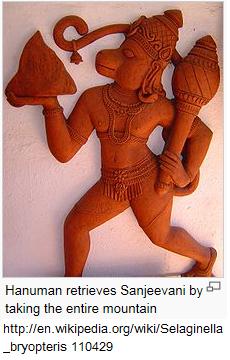
In Hindu mythology, Sanjeevani is a magical herb which has the power to cure any malady. It was believed that medicines prepared from this herb could revive a dead person. This herb is mentioned in the Ramayana when, Ravana's son Indrajit hurls a powerful weapon at Lakshmana. Lakshmana is badly wounded and is nearly killed by Indrajeet. Hanuman was called upon to fetch this herb from the mount Dunagiri (Mahodaya) in the Himalayas or Valley of Flowers.[citation needed] Upon reaching Mount Sumeru, Hanuman was unable to identify the herb and decided to lift the entire mountain and bring it to the battlefield.
While some references in scientific literature list Selaginella bryopteris as the Sanjeevani mentioned in Hindu mythology, a search of ancient texts currently underway in CSIR laboratories has so far not revealed any plant that can be definitively confirmed as Sanjeevani. In certain texts it is written that Sanjeevani glows in the dark.[2][3]
UKT: More in Wikipedia article.
Go back S-bryopteris-note-b
End of TIL file