 {þa.pa.} सप
 tha1pa1-197b1-8.htm
from: Online Sanskrit Dictionary, February 12, 2003 . http://sanskritdocuments.org/dict/dictall.pdf 090907
Downloaded, set in HTML, and edited by U Kyaw Tun, M.S. (I.P.S.T., U.S.A.), and staff of TIL Computing and Language Centre, Yangon, Myanmar. Not for sale. No copyright. Free for everyone.
index.htm | Top
SED-frica-r6-indx.htm
{þa.pa.} सप
•
सपत्नान्
(sapatnaan.h)
Skt: सपत्नान्
(sapatnaan.h) - enemies - OnlineSktDict
•
सप्त
(sapta)
Skt: सप्त
(sapta) - seven - OnlineSktDict
Pal: satta - m. a living entity, person, rational being. num.
seven - UPMT-PED215
¤ सप्तर्षि
saptarṣi
Skt: सप्तर्षि
saptarṣi - Wiki
See my note on Saptarshi - The Seven Rishi
• सप्तवर्ग
(saptavarga)
Skt: सप्तवर्ग
(saptavarga) - Seven Vargas a sequence harmonic charts.
Consists of Rashi,
Hora, Drekkana, navaa.nsha, dvaahasha.nsha,
tri.nshaa.nsha and Saptaa.nsha - OnlineSktDict
• सप्तांश
(saptaa.nsha)
Skt: सप्तांश
(saptaa.nsha) - A varga. The harmonic Seventh Division. Used
for delineations of
children and grandchildren and one's
creative projections - OnlineSktDict
•
सफल
(saphala)
Skt: सफल
(saphala) - fruitful - OnlineSktDict
•
सबान्धवान्
(sabaandhavaan.h)
Skt: सबान्धवान्
(sabaandhavaan.h) - along with friends - OnlineSktDict
• सभा (sabhaa)
Skt: सभा
(sabhaa) - assembly - OnlineSktDict
• सभासद (sabhaasada)
Skt: सभासद (sabhaasada)
- literally one who sits in the assembly - OnlineSktDict
•
सम
(sama)
Skt: सम
(sama) - Equal - OnlineSktDict
Pal: sama - m. tranquility, calmness, toil, fatigue. adj. level,
even - UPMT-PED221
See also • शम (shama)
Skt: शम (shama) - tranquility - OnlineSktDict
•
समं
(samaM)
Skt: समं
(samaM) - in equanimity - OnlineSktDict
•
समंतात्
(sama.ntaat.h)
Skt: समंतात्
(sama.ntaat.h) - from all around - OnlineSktDict
• समः (samaH)
Skt: समः
(samaH) - equipoised - OnlineSktDict
•
समकोनासन
(samakonaasana)
Skt: समकोनासन
(samakonaasana) - the sideways leg-splits posture - OnlineSktDict
• समग्रं
(samagraM)
Skt: समग्रं
(samagraM) - in total - OnlineSktDict
• समग्रान्
(samagraan.h)
Skt: समग्रान्
(samagraan.h) - all - OnlineSktDict
• समघनता
(samaghanataa)
Skt: समघनता
(samaghanataa) - isodensity - OnlineSktDict
•
समचित्तः
(samachittaH)
Skt: समचित्तः
(samachittaH) - equal-minded/ equanimity - OnlineSktDict
•
समचित्तत्वं
(samachitaatvaM)
Skt: समचित्तत्वं
(samachitaatvaM) - equilibrium - OnlineSktDict
•
समचुम्बकशील
(samachumbakashiila)
Skt: समचुम्बकशील
(samachumbakashiila) - isoclinic - OnlineSktDict
•
समतल
(samatala)
Skt: समतल
(samatala) - Level surface - OnlineSktDict
•
समता
(samataa)
Skt: समता
(samataa) - equilibruim - OnlineSktDict
•
समतित्य
(samatitya)
Skt: समतित्य
(samatitya) - transcending - OnlineSktDict
•
समतीतानि
(samatiitaani)
Skt: समतीतानि
(samatiitaani) - completely past - OnlineSktDict
•
समतोल
(samatola)
Skt: समतोल
(samatola) - equillibrium - OnlineSktDict
•
समत्वं
(samatvaM)
Skt: समत्वं
(samatvaM) - equanimity - OnlineSktDict
•
समद
(samada)
Skt: समद
(samada) - furious - OnlineSktDict
•
समदर्शनः
(samadarshanaH)
Skt: समदर्शनः
(samadarshanaH) - seeing equally - OnlineSktDict
•
समदर्शिनः
(samadarshinaH)
Skt: समदर्शिनः
(samadarshinaH) - who see with equal vision - OnlineSktDict
•
समधिगच्छति
(samadhigachchhati)
Skt: समधिगच्छति
(samadhigachchhati) - attains - OnlineSktDict
•
समन्ततः
(samantataH)
Skt: समन्ततः
(samantataH) - from all sides - OnlineSktDict
•
समन्तात्
(samantaat.h)
Skt: समन्तात्
(samantaat.h) - everywhere - OnlineSktDict
•
समन्वयः
(samanvayaH)
Skt: समन्वयः
(samanvayaH) - (m) co-ordination - OnlineSktDict
•
समन्वितः
(samanvitaH)
Skt: समन्वितः
(samanvitaH) - qualified - OnlineSktDict
•
समप्रतिद्रव्य
(samapratidravya)
Skt: समप्रतिद्रव्य
(samapratidravya) - isoantibody - OnlineSktDict
•
समबह्याङ्ग
(samabaahyaa.nga)
Skt: समबह्याङ्ग
(samabaahyaa.nga) - isocortex - OnlineSktDict
•
समबुद्धयः
(samabuddhayaH)
Skt: समबुद्धयः
(samabuddhayaH) - equally disposed - OnlineSktDict
•
समबुद्धिः
(samabuddhiH)
Skt: समबुद्धिः
(samabuddhiH) - having equal intelligence - OnlineSktDict
•
समभार
(samabhaara)
Skt: समभार
(samabhaara) - isobaric - OnlineSktDict
•
समभारत्त्व
(samabhaarattva)
Skt: समभारत्त्व
(samabhaarattva) - isobarism - OnlineSktDict
•
समभारिक
(samabhaarika)
Skt: समभारिक
(samabhaarika) - isobar - OnlineSktDict
•
समभुजीय
(samabhujiiya)
Skt: समभुजीय
(samabhujiiya) - (adj) equilateral - OnlineSktDict
•
समभूल्यता
(samamuulyataa)
Skt: समभूल्यता
(samamuulyataa) - equivalence - OnlineSktDict
•
समय
(samaya)
Skt: समय
(samaya) - time - OnlineSktDict
•
समर्चा
(samarchaa)
Skt: समर्चा
(samarchaa) - well worshipped - OnlineSktDict
•
समवर्णिक
(samavarNika)
Skt: समवर्णिक
(samavarNika) - isochromatic - OnlineSktDict
•
समवर्तताग्रे
(samavartataagre)
Skt: समवर्तताग्रे
(samavartataagre) - was there before - OnlineSktDict
•
समवस्थितं
(samavasthitaM)
Skt: समवस्थितं
(samavasthitaM) - equally situated - OnlineSktDict
•
समवायः
(samavaayaH)
Skt: समवायः
(samavaayaH) - (m) company - OnlineSktDict
•
समविलोपी
(samavilopii)
Skt: समविलोपी
(samavilopii) - isobestic - OnlineSktDict
•
समवृत्ती
(samavRittii)
Skt: समवृत्ती
(samavRittii) - prANayAma with equally long inhalation, exhalation, suspension - OnlineSktDict
•
समवेताः
(samavetaaH)
Skt: समवेताः
(samavetaaH) - assembled - OnlineSktDict
•
समवेतान्
(samavetaan.h)
Skt: समवेतान्
(samavetaan.h) - assembled - OnlineSktDict
•
समव्यासिक
(samavyaasika)
Skt: समव्यासिक
(samavyaasika) - isodiametric - OnlineSktDict
•
समसंलग्नक
(samasa.nlagnaka)
Skt: समसंलग्नक
(samasa.nlagnaka) - isoagglutinative - OnlineSktDict
•
समसंलग्नता
(samasa.nlagnataa)
Skt: समसंलग्नता
(samasa.nlagnataa) - isoagglutination - OnlineSktDict
•
समसंलग्नत्त्व
(samasa.nlagnattva)
Skt: समसंलग्नत्त्व
(samasa.nlagnattva) - isoagglutinin - OnlineSktDict
•
समस्त
(samasta)
Skt: समस्त
(samasta) - all - OnlineSktDict
•
समस्तं
(samastaM)
Skt: समस्तं
(samastaM) - entire - OnlineSktDict
•
समस्ताः
(samastaaH)
Skt: समस्ताः
(samastaaH) - all; the entire - OnlineSktDict
•
समस्थिती
(samasthitii)
Skt: समस्थिती
(samasthitii) - standing still - OnlineSktDict
From Wikipedia: http://en.wikipedia.org/wiki/Saptarshi 100519
 The
Saptarshi (सप्तर्षि
saptarṣi a Sanskrit
dvigu meaning "seven sages"; Bengali: সপ্তর্ষি shoptorshi) are the
seven rishis who
are extolled at many places in the
Vedas and Hindu
literature. The Vedic Samhitas never actually enumerate these rishis by name,
though later Vedic texts such as the Brahmanas and Upanisads do so. They are
regarded in the Vedas as the
patriarchs
of the
Vedic religion. The
Big Dipper
asterism is also called Saptarshi.
The
Saptarshi (सप्तर्षि
saptarṣi a Sanskrit
dvigu meaning "seven sages"; Bengali: সপ্তর্ষি shoptorshi) are the
seven rishis who
are extolled at many places in the
Vedas and Hindu
literature. The Vedic Samhitas never actually enumerate these rishis by name,
though later Vedic texts such as the Brahmanas and Upanisads do so. They are
regarded in the Vedas as the
patriarchs
of the
Vedic religion. The
Big Dipper
asterism is also called Saptarshi.
The earliest list of the Seven Rishis is given by Jaiminiya Brahmana 2.218-221: Vasiṣṭha, Bharadvāja, Jamadagni, Gautama, Atri, Viśvāmitra, and Agastya, followed by Brihadaranyaka Upanisad 2.2.6 with a slightly different list: Gautama and Bharadvāja, Viśvāmitra and Jamadagni, Vasiṣṭha and Kaśyapa, and Atri. The late Gopatha Brāhmana 1.2.8 has Vasiṣṭha, Viśvāmitra, Jamadagni, Gautama, Bharadvāja, Guṅgu, Agastya, and Kaśyapa.
In post-Vedic texts, different lists appear; some of these rishis were recognized as the 'mind born sons' (Skt: manasa putra) of Brahma, the representation of the Supreme Being as Creator. Other representations are Mahesha or Shiva as the Destroyer and Vishnu as the Preserver. Since these seven rishis were also among the primary eight rishis, who were considered to be the ancestors of the Gotras of Brahmins, the birth of these rishis was mythicized.
Sapta Rishis are the Hierarchy working under the guidance of the Highest Creative Intelligence, God. The present batch of the Sapta Rishis: Bhrigu, Atri, Angirasa, Vasishta, Pulastya, Pulalaha and Kratu. Their work is to help every soul to go back to its Source, God. They live in the highest plane, Satya Loka. They have their representative Rishi in the Himalayas who is assisted by 1,440,000 Rishis (Light Workers) living in different parts of the earth. They monitor and guide the processes that help people to transit to the Light Age (Satya Yuga). They bring down to the earth the required Knowledge and Energies to strengthen the processes of Transition (Pralaya). They are naturally the most evolved Light Beings in the Creation and the guardians of the Divine Laws[1].
In post-Vedic religion, Manvantara is the period of astronomical time within an aeon or Kalpa, a "day (day only) of Brahma"; like the present Śveta Vārāha Kalpa, where again 14 Manvantaras add up to create one Kalpa.
Each Manvantara is ruled by a specific Manu, apart from that all the deities, including Vishnu and Indra; Rishis and their sons are born anew in each new Manvantara, the Vishnu Purana mentions up to seventh Manvantara [2].
Urja, Stambha, Prańa, Dattoli, Rishabha, Nischara, and Arvarívat.
Sons of Vashishtha:
Kaukundihi, Kurundi, Dalaya, Śankha, Praváhita, Mita, and Sammita.
Jyotirdhama, Kavya, Chaitra, Agni, Vanaka, and Pivara.
Hirannyaroma, Vedasrí, Urddhabahu, Vedabahu, Sudhaman, Parjanya, and Mahámuni.
Sumedhas, Virajas, Havishmat, Uttama, Madhu, Abhináman, and Sahishnnu.
Kashyapa, Atri, Vashishtha, Vishvamitra, Gautama, Jamadagni, Bharadwaja [3].
There are many contradictory lists of the names of the Saptarshis. These usually include Atri, Kashyapa and Vasishta, but the other four are varying. One such list is used in the Sandhyavandanam: Atri, Bhrigu, Kautsa, Vasishtha, Gautama, Kashyapa and Angirasa. Other lists include Vishwamitra and Jamadagni. The exact list of saptarshis are not perfectly known as it is supposed that the astral links to the hierarchy were lost in medieval India due to the effects of Kaliyuga.
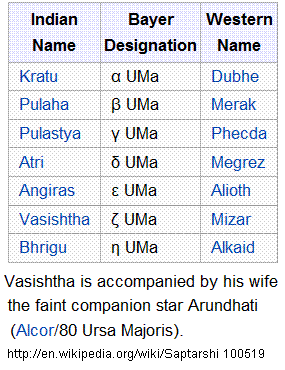
In Hindu astronomy the seven stars of the Saptarshi Mandal or Big Dipper or Ursa Major are named as :
Kratu, Pulaha, Pulastya, Atri, Angiras, Vasishtha, Bhrigu
1. The Satapata Brahmana and Brihadaranyaka Upanishad (2.2.4) acknowledge the names of seven rishis (or Saptarshis) as:
• Atri
• Bharadvaja
• Gautama
• Jamadagni
• Kashyapa
• Vasishta
• Vishvamitra
2. Krishna Yajurveda in the Sandhya-Vandana Mantras has it as:
• Angiras
• Atri
• Bhrigu
• Gautama
• Kashyapa
• Kutsa
• Vasishtha
3. Mahabharata gives the Seven Rishis’ names:
4. Brihat Samhita gives the Seven Rishis’ names as:
• Marichi
• Vasishtha
• Angiras
• Atri
• Pulastya
• Pulaha
• Kratu
The reason for the differences in the mentioned list is that there are seven Rishis who govern the functioning of the Cosmos in Batches and all the above mentioned Rishis have had the post of a 'Saptarishi' at some point in time.
The Kumarasambhava is one among the five Mahakavyas written by the famous poet Kalidasa. The kavya is about the birth of the War-God Subramanya(Muruga). The saptarshi play a very important role in the sixth canto of Kumarasambhava.Their greatness is explained well in the Paramesvaraprabhava.
1. ^ Sapta Rishis Path, the information to be found under menu selection RISHIS>Sapta Rishis
2. ^ Account of the several Manus and Manwantaras Vishnu Purana, translated by Horace Hayman Wilson, 1840, Book III: Chapter I. p. 259, The first Manu was Swáyambhuva, then came Swárochisha, then Auttami, then Támasa, then Raivata, then Chákshusha: these six Manus have passed away. The Manu who presides over the seventh Manwantara, which is the present period, is Vaivaswata, the son of the sun...
3. ^ Inhabitants of the Worlds Mahanirvana Tantra, translated by Arthur Avalon, (Sir John Woodroffe), 1913, Introduction and Preface. The Rishi are seers who know, and by their knowledge are the makers of shastra and "see" all mantras. The word comes from the root rish Rishati-prapnoti sarvvang mantrang jnanena pashyati sangsaraparangva, etc. The seven great Rishi or saptarshi of the first manvantara are Marichi, Atri, Angiras, Pulaha, Kratu, Pulastya, and Vashishtha. In other manvantara there are other sapta-rshi. In the present manvantara the seven are Kashyapa, Atri, Vashishtha, Vishvamitra, Gautama, Jamadagni, Bharadvaja. To the Rishi the Vedas were revealed. Vyasa taught the Rigveda so revealed to Paila, the Yajurveda to Vaishampayana, the Samaveda to Jaimini, Atharvaveda to Sumantu, and Itihasa and Purana to Suta. The three chief classes of Rishi are the Brahmarshi, born of the mind of Brahma, the Devarshi of lower rank, and Rajarshi or Kings who became Rishis through their knowledge and austerities, such as Janaka, Ritaparna, etc. The Shrutarshi are makers of Shastras, as Sushruta. The Kandarshi are of the Karmakanda, such as Jaimini.
Go back Saptarshi-note-b
End of TIL file