 {sa.}
- palatal plosive-stop
{sa.}
- palatal plosive-stop  {sa} : the
 {weik-hkya.}-form,
 ,
though commonly used is not TIL preferred
,
though commonly used is not TIL preferred  {su.}
{su.}  {su}
{su} {sé}
{sé}  {sau:}
  {sak~}
  {sak~ka.}
 {sak~hka.}
 {sût~ta.}
 sa1.htm
by U Myat Kyaw & U San Lwin, MLC (Myanmar Language Commission), 2002
Set in HTML, and edited, with additions from other sources, by U Kyaw Tun (UKT) (M.S., I.P.S.T., USA), Daw Thuzar Myint, and staff of Tun Institute of Learning (TIL) . Not for sale. No copyright. Free for everyone. Prepared for students and staff of TIL Computing and Language Center, Yangon, MYANMAR : http://www.tuninst.net , http://www.softguide.net.mm , www.romabama.blogspot.com
index.htm |
Top
PED-MK-indx.htm
{sa.}
- palatal plosive-stop
{sa} : the
{weik-hkya.}-form,
,
though commonly used is not TIL preferred
{su.}
{su}
{sé}
{sau:}
{sak~}
{sak~ka.}
{sak~hka.}
{sût~ta.}
UKT notes :
• Arising of Material Form
{sa.} In Skt-Dev it is written as equivalent to tenuis
{kya.} or voiceless
{hkya.}. These two are taken as allophones in Eng-Lat and commonly written as <ch> /ʧ/.
Note: Both IPA and IAST gives wrong representations for this row of consonants. The inconsistencies between Tib-Bur speakers and those of IE is due to the difference in mode of articulation of consonants. Tib-Bur speakers always begin deep in the interior of the mouth, but IE speakers begin from the front.
UKT 140516: This section deals with the Mind and draws freely from Abhidhamma. To get what other authors had said of the various entries, see:
¤ The Abhidhamma in Practice by N.K.G. Mendis , 2006
- http://www.accesstoinsight.org/lib/authors/mendis/wheel322.html 140516
¤ Dhammasaṅgaṇi by Edward Muella, 1885
- downloaded Dhammasangani-pdf (312 pdf pages)
UKT 140522: the pdf is a photocopy from an old book whose pages have turned yellow and is not easy for my eyes. In the Introduction, the author stated that he had used a Burmese mss and a Lanka mss. I wonder what the Burmese mss was. Our country has lost quite a few when the British-colonialists had had a free hand.

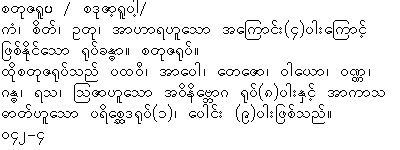
«catucakkasampatti»
- n. four conditions for success -
1. being able to live in an environment conducive to prosperity and wholesome
living
2. having accumulated meritorious deeds in the past;
3. living an honest life and striving for self betterment;
4. association with wise and noble persons. 042-3
«catujarūpa»
- n. material phenomena arising out of
four factors, namely - the resultant of
moral and immoral actions committed, mind
and mental concomitants in the present life,
heat or temperature and nutritive essence.
042-4
UKT 140516: The four causes of a material form aka body: kamma {kän}, consciousness {sait}, heat {U.tu.}, and nutriment
{a-ha-ra.} . This material form is based on 9 "elements": 1. Earth, 2. Water, 3. Air, 4. Heat, etc. See my note on Material Form
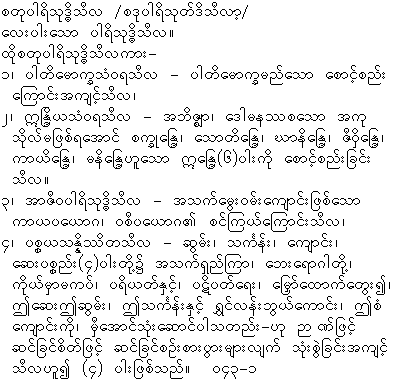
«catupārisuddhisīla»
- n. moral purity of monks founded on
four aspects of :-
1. pātimokkhasaṁvara
sīla
- hewing to the body of monastic
disciplinary rules known as pātimokkha;
2, indriyasaṁvarasïla
- control of the five senses and
mind to maintain moral rectitude;
3.ājīvapārisuddhisīla
- sanctity of word and deed in the
manner of livelihood.
4. pacayasannissitasīla
- correctness of attitude in the
use of the four material requisites of a
monk, ie food offertory, robes, monastery
and medicines are to be considered as just
support for the body and mind to enable
the learning and practice of the
doctrines. 043-1

«catumadhu»
- n. electuary made of butter, honey,
molasses and sesame oil. 043-2

«Catumahārājika»
- n. the fifth plane on Mount Meru and
celestial abode of the four guardian
deities of the world, Dhataraṭṭha,
Virūpakkha, Virūḷhaka
and Kuvera. 043-3

«catulokapāla»
- n. the four guardian deities [UKT 140516:
they are not déva] of the world residing in
the realm of Catumahārājika. 044-1

«catuvagga»
- n. the four entities of:
#1. dhamma - practice
according to the Doctrine;
#2. attha - benefit;
#3. kāma - sensulity;
#4. magga, phala, nibbāna -
(the right) path, fruition and nirvana. 044-2

«catuddasīuposatha»
- n. observation of eight precepts
on the new moon day (ie. the 14th
waning day of the moon). 044-3
UKT 140520: The term "new moon day" means that the Moon is not visible. It is the last day of the Lunar month:
{la.kwèý né.}. A better term might be "no moon day". The day after is the beginning of the new Lunar month.

«caraṇa»
- n. conduct (it consists of 15 aspects;
- morality; keeping the sense under control;
moderation in eating; wakefulness during
the day and sleeping only during one of
the three watches at night; being replete
with the 7 attributes of virtuous men;
attainment of four stages of mental
absorption or jhāna) 044-4
UKT 140517: The following is how I have itemized the 15 aspects of {sa.ra.Na.}
- n. conduct (it consists of 15 aspects;
¤ morality;
¤ keeping the senses (of sight, hearing, etc.) under control;
¤ moderation in eating;
¤ wakefulness during the day and sleeping only during one of the three watches at night;
¤ the 7 attributes of virtuous men;
¤ attainment of four stages of mental absorption or jhāna
I still need to check.

«carimabhava»
- n. final rebirth of a Buddha or
saint (arahantā).
Also antimabhava; pacchimabhava. 044-5
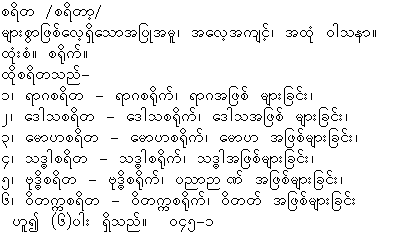
«carita»
- n. intrinsic nature or temperament of
a person. (6 classes are differentiated:-
1. preponderance of lust;
2. preponderance of anger or hatred;
3. preponderance of ignorance;
4. predominance of devoutedness;
5. predominance of intelligence;
6. predominance of a contemplative and questing trait)
- 045-1

«cariya»
- n. practice; endeavour; striving
(consisting of three kinds:
1. lokatthacariya
- striving for worldly benefits;
2. ñātatthacariya
- striving for the good of one's
family, relatives, nation etc;
3. buddhatthacariya
- striving towards attainment of
Buddhahood). 045-2
UKT 140520: Attainment of Boddhi-wisdom which gives rise to Nibbana is the final goal of many. They have no intention of teaching others what they know. A Buddha, on the other hand sets out to teach how to attain the wisdom leading to Nibbana. As a Buddhist my final goal is the wisdom: the complete control over Greed, Anger, Sex and Pride (in common English language usage). It is the message I pass on to my Western friends.
{sa}

«cāga»
- n. charity; philanthropy; sacrifice. 045-3

«cāgānussati»
- n. reflecting repeatedly and exulting
in one's charitable deed. See also
anussati. 045-4

«cārita»
- n. personal behaviour; conduct. 045-5

«cāritasīla»
- n. conduct in keeping with the tenets
of Buddha's injunctions. 045-6
{su.}

«cuti»
- n. death. 045-7
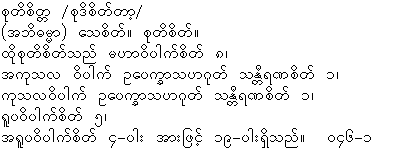
«cuticitta»
- n. [A] death consciousness. (19 kinds of death consciousness are enumerated:-
¤ 8 kinds of mahävipäka citta;
¤ 1 of kusalavipāka upekkhosaha-guta santīranaṇa citta;
¤ 1 of kusalavipāka upekkhoshaguta santīraṇa citta;
¤ 5 of rūpavipāka citta; and
¤ 4 of arūpavipāka citta). 046-1

«cuditaka»
- n. person who is the object of an inquest. 046-2
{su}

«cūḷasotapanna»
- n. person approaching a streamwinner
(sotapanna) in the respect of having
attained the fourth level of purity
(kiṅkhāvitaraṇa visuddhi),
being rid of doubts about the past,
present and future etc. 046-3
{sé}

«cetana»
- n.
1.volition;
2. volitive mental concomitant, being
one of the seven mental
concomitants or properties
(sabba citta sādharaṇa) constituting
consciousness. 046-4
«cetasika»
- n. mental concomitant; any of the 52 mental factors which arise with
consciousness, brings it under its influence and in the end perished with the
latter. (Enumerated as 13 aññasamana cetasika, 14 akusala cetasika and 25
sobhaṇa cetasika) 046-5

«cetasikadukkha»
- n. mental distress. 047-1

«cetiya»
- n. a thing which is worshipped in the
Buddha's stead; shrine; tumulus; stupa
etc. 047-2

«cetiyaṅgaṇa»
- n. platform surrounding a stupa. 047-3

«cetopariyañāṇa»
- n. power to discern the thoughts of others.
Also paricittavijānanañāṇa.
047-4
{sau:}

«codanä»
- n. inquest; accusation; reproof. 047-5
UKT: We should find out whether entries 047-5 & 047-6 are out of serial order,
or, 047-5 should have a change of spelling to {saw:da.na} related to back-vowel /ɔ/ where as {sau:da.ka.} to /ɑ/ .

«codaka»
- n. inquisitor. 047-6
{sak~} {sak~ka.}

«cakkabyūha»
- n. tactical deployment of troops on an
encircling movement; envelopment
tactics. 047-7

«cakkavāḷa»
- n. great circular plane or sphere
forming the world. 047-8

«cakkavattī»
- n. (universal) monarch, possessor of
the wondrous chariot. 047-9
UKT 140520: The word «cakkavattī» means a king who has command of a flying machine. The first mention of humans (King Rama of the northern India, and KIng Rāvana of Lanka) using such a machine is described in Ramayana. To the Theravada Buddhists of Myanmarpré Rama was a human king waging war against the king of Lanka. However, the latter is believed to be a
{Bi-lu:} - a term applied to "half-humans" who live among us but are very inhumane in conduct. They Buddhist-Myanmar love Rama for being a just king whereas they hate the Lankan king for stealing another man's wife. The deitification of human beings of note by religionists is the root cause of confusion in inter-religion study. For an account of Ancient Indian Flying Machines, see: Wikipedia: http://en.wikipedia.org/wiki/Vimana#Vedas 140520
{sak~hka.}

«cakkhāyatana»
- n. [A] faculty of sight; fundament of
visual perception; "eye base",
See also āyāyātana.
047-10
«cakkhu»
- n. eye; organ of sight; faculty of sight
(the term covers
1. maṁsa cakkhu
- the physical organ of sight;
2. ñāṇa cakkhu/paññācakkhu
- ability of the mind to visualize;
3. dibbacakkhu supernormal
- vision of celestial gods beings;
4. samanta cakkhu
- omniscience.
Alternately -
1 Buddha cakkhu
- visionary powers of the Buddha;
2 samanta cakkhu
- omniscience;
3 paññā cakkhu
- intellectual vision;
4 dibba cakkhu
- divine eye, supernormal vision of
celestial gods beings;
5 dhamma cakkhu
- knowledge related to three lower
supramundane paths.
-- 048-1

«cakkhudasaka»
- n. [A] decad of physical qualities of
sight consisting of cakkhupasada or
sensory surface of the eye, eight
inseparable material qualities
(avinibhogarūpa) and vitality
(jivitarūpa); "eye decad".
048-2

«cakkhudvāra»
- n. [A] sensory "door" or
receptor through which awareness of
visual stimuli is admitted to the
consciousness. See also dvāra.
048-3
«cakkhudvāravīthi»
- n. consciousness process arising
out of visual object impinging upon ocular
sensory receptor. Also cakkhuviññānavīthi. 049-1

«cakkhudvārikacitta»
- n. [A] 46 kinds of consciousness
related to
visionary experience occurring through
the sensory receptors of sight, viz.:
¤ pancadvāravijjana - 1 form
the five-door adverting
consciousness in which
the ocular sensory receptor turn
toward the object;
¤ kāyaviññāṇacitta
- 2 forms
phase of mind in which cognizance
of the presence of the object
by the consciousness results
from contact with the sensory surface;
¤ sampaṭicchana - 2 forms
- phase of mind in which the
sensory receptors
admit the external stimulus;
¤ santīraṇa or investigating
consciousness - 3 forms
- phase of mind
in which the nature of stimulus so
received is explored;
¤ kāmajavana or apperceptive
consciousness -- 29 kinds
- phase of mind in which the
object comes under introspection and
¤ tadāramana, or retentive
consciousness - 8 kinds
- phase of mind in which the
visionary experience is ingested in
the consciousness.
- 049-2

«cakkhudhātu»
- n. [A] nature of the sensory surface
of the eye to give rise to the sense
of sight. 049-3

«cakkhupasāda»
- n. ocular sensory matter located in
the seven membranous layers at the centre
of the iris. 049-4

«cakkhuviṅṅānacitta»
- n. consciousness of visual stimuli
based on the sensory surface of sight
combined with light and attention given
to the object; sense of sight. 050-1

«cakkhuviññānadhātu»
- n. cognitive nature of the sense
of sight towards visual stimuli. 050-2
«cakkhuviṅṅānavīthi»
- n. Same as cakkhudvāravīthi. 050-3

«cakkhuvatthu»
- n. [A] visual sensory surface on
which the sense of sight and its mental
concomitants arise. See also vatthu. 050-4

«cakkhundriya»
- n. control of the faculty of sight. 050-5
{sût~ta.}
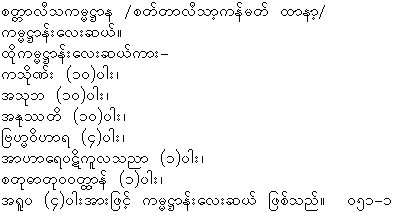
«cattālīsakammathāna»
- n. the 40 subjects for meditation consisting of :-
1. the 10 kasiṇa,
meditation devices such as earth, water, fire etc.
2. the 10 asubha,
or repulsiveness depicted by various kinds of corpses;
3. the 10 anussati,
or practice of constant mindfulness;
4. the 4 Brahmavihāra
- sublime states of compassion, loving kindness etc;
5. the one of āhārepaṭikūlasaññā
- or perception of repulsiveness in food;
6. the one of catudhātuvavattān
- capability to analyse and differentiate the four great essentials;
7. 4 stages of arūpa jhūna
- gained by concentration on the infinity of space to gain the first stage which then becomes the object of concentration to gain the second and then proceeding in this manner to the third and fourth stages.
-- 051-1
by N.K.G. Mendis (Dr.} in The Abhidhamma
in Practice, 2006
-
http://www.accesstoinsight.org/lib/authors/mendis/wheel322.html 140516
UKT 140516: Dr. Mendis is a medical doctor
from Sri Lanka, with address in Canada.
I have edited the layout for easy reading.
The material elements never occur in isolation but in groups or clusters called kalaapas. [UkT ¶]
A kalaapa can contain from eight to thirteen material elements. There is no cluster of matter without at least eight elements, the four primary elements and four secondary elements — namely color, taste, smell, and nutriment. A unit containing only these is called a Pure Octad.
Material phenomena arise through four causes: kamma, consciousness, heat, and nutriment :
Kamma conditions the physical organism at conception. At the moment of conception three kalaapas are generated through kamma — the decads of sex, body, and the mind-base. [UKT ¶]
The sex decad (bhaava dasaka) has the essential octad plus the sex element, either male or female, and the life element. [UKT ¶]
The body decad (kaaya dasaka) is made up of the essential octad plus the element of bodily sensitivity and the life element. [UKT ¶]
The mind-base decad (vatthu dasaka) is made up of the essential octad plus the mind-base element and the life element. [UKT ¶]
After the embryo has been formed through these three decads, from about the eleventh week of gestation onwards, the decads of the other four sense organs begin to form. Kamma causes and sustains these material phenomena through the whole course of life.
The mind can not only influence matter but also produce material phenomena. Psychosomatic illnesses like duodenal ulcers, high blood pressure, and asthma indicate such operations. Other examples are levitation, telekinesis, and fire-walking. [UKT ¶]
UKT 140520: "Fire-walking" is not a gimmick or a cheap magician trick. I happened to take part in one of the Shi'a ceremonies in Mandalay in the 1960's witnessed by my son, my wife, my brother-in-law and other friends. A Shi'a Muslim friend of mine, one Mr. Khorosani, in a challenging way stated that anybody with a pure heart including Buddhists could do it. I passed on the remark to a friend of mine, U Tun Yi, then Electrical Engineer with the Public Works Dept. with head office in Mandalay General Hospital. He simply agreed to the proposal, and three of us, myself in the lead, followed by U Tun Yi, and Mr. Khorosani himself stood in line in front of the fire-pit. There were many Shi'as lining up behind us. As soon as the fire-master gave the signal that the fire was hot enough, we started our walk. It was like stepping across the softest of carpet I had ever done, except it was hot. We all came out unscathed.
There is a scientific explanation: the fire was so hot that water evaporating from the sole of feet became a thin layer of moisture between the embers [there must be no ash particles on the embers] and the flesh. I had known the theory for a long time reading about the "boiling lead experiment" performed at one of Chemistry Public lectures at the Royal Society in London. It was Prince Edward himself (before he became king) who took part, and his mother the Queen was "we were not pleased"!. Though not the experiment I had read about, here are others:
http://www.oxforddnb.com/templates/article.jsp?articleid=22368&back= 140520
http://www.gutenberg.org/files/25112/25112-h/25112-h.htm 140520
In the normal course of events consciousness is responsible for volitional bodily action and speech, the postures, respiration, production of sweat and tears, and the three alterable elements — buoyancy, pliancy, and efficiency.
The heat element (tejo), one of the four primaries present in all clusters of matter, can itself cause different kinds of matter to arise, both simple octads and more complex formations.
4. Nutriment (aahaara).
The nutriment element (ojaa), present in all clusters, when supported by external nutriment, has the capacity to produce different kinds of material phenomena which in turn have reproductive power. These begin to arise from the time the mother's nutriment circulates in the fetus. This nutritive element is one of the causes of long life.
UKT 140516: This excerpt is from a well written booklet by a medical doctor.
Go back Material-form-note-b
End of TIL file.
