Remember
 {a.þût} is not allowed in Pal-Myan.
We find only conjuncts in which the
upper member is equivalent to the
vowel in association
with
 {ka.} being checked by the IPA
plosive-stops /k/ /t/ /p/ &
nasals /n/ /m/
{ka.} being checked by the IPA
plosive-stops /k/ /t/ /p/ &
nasals /n/ /m/
kup.htm
by U Myat Kyaw & U San Lwin, MLC (Myanmar Language Commission), 2002
Set in HTML, and edited, with additions from other sources, by U Kyaw Tun (UKT) (M.S., I.P.S.T., USA), Daw Thuzar Myint, and staff of Tun Institute of Learning (TIL) . Not for sale. No copyright. Free for everyone. Prepared for students and staff of TIL Computing and Language Center, Yangon, MYANMAR : http://www.tuninst.net , http://www.softguide.net.mm , www.romabama.blogspot.com
index.htm |
Top
PED-MK-indx.htm
Remember
We find only conjuncts in which the upper member is equivalent to the vowel in association
with
 {kûp}
: vowel checked by {p} or IPA /p/
{kûp}
: vowel checked by {p} or IPA /p/
UKT notes :
• Kalpa :
 {kûp~pa.}
{kûp}
{kûp~pa.} Skt-Dev: काल्प «kālpa», adj. relating to a period called kalpa - SpkSkt
कल्प «kalpa», m. period - SpkSkt
See my note on kalpa
«kappa»
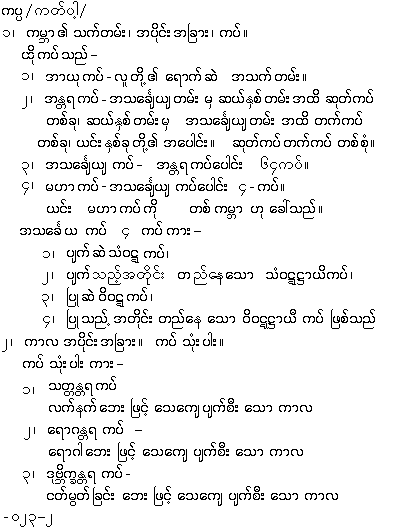
- ¹. world cycle, term or span of time from the time of coming into existence to
its
dissolution; aeon.
¤ āyukappa - present life span of human beings;
¤ antarakappa - a complete cycle consisting of a period of regression in which
the life span of human beings decreases from an infinite number of years
to 10
years and a period of progression in which it increases from 10 to
an infinite
number of years;
¤ asiṅkhyeyyakappa - period of time equivalent to 64 antarakappa;
¤ mahākappa - a complete world cycle consisting of 4 asiṅkheyyakappa phases i.e.
(i) saṁaṭṭakappa - dissolution phase
(ii) saṁvaṭṭaṭṭhāyīkappa - void phase following destruction
(iii) vivaṭṭakappa - formation phase
(iv) vivsaṭṭatthāyīkappa - phase while existing as formed
². the three pestilences consisting of:-
- 1. satthantarakappa - period of destruction due to the pestilence of war
- 2. rogantarakappa - period of destruction due to disease
- 3. dubbhikkhantarakappa - period of destruction due to the pestilence of
famine
- MK-PED023-2
 {kûp~pa. bain~du.}

«kappabindhu»
- n [V] pattern of dots made in one corner of a new robe after
receiving it so as to destroy its newness and make it [useless, and not] fit
[for other use other than] to be used [by the monks] .
- MK-PED024-1
 {kûp~pi.}
«kappi»
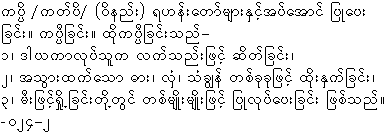
- n. [V] act of rendering something ritually fitting for a monk. (Such as a lay
person might make fruits or vegetables fit for consumption either by pinching
off some part, perforating with a sharp awl or knife or exposure to flames thus
removing or destroying its genitive process)
- MK-PED024-2
UKT 140503: The Viniya rules stipulate that a monk must not destroy life, or the embryo which would give rise to a life-form. Thus, it is up to the layman to "destroy" the vital force present in an embryo (as in the seed of a plant) before offering it to the monk. Thus, a monk must not eat the flesh of an animal that was purposely killed for him to eat. However, he may eat what we would call a "road-kill" - an animal killed by traffic. Buddhism does not promote "vegetarianism".
 {kûp~pi.ya. ka-ra.ka.}

«kappiyakāraka»
- n. [V] one who makes an offertory acceptable of a monk.
MK-PED025-1
 {kûp~pi.ya. ku.Ti.}

«kappiyakuṭi»
- n. [V] four kinds of monastic dwellings
which are permitted by ecclesiastic rules-
1. gahapatikuṭi-
dwelling formerly owned by human beings who have donated it for monastic use by
intoning the appropriate words;
2. sammutikuṭi
- dwelling which has been made fit for monastic use by ritualistic incantation
of sacred texts;
3. gonisādikākuṭi
- monastery without fencing;
4. ussāvanantikākuṭi
- dwelling simultaneously erected and proclaimed by monks to be within the
bounds " kappiyakuṭimkaroma"
- MK-PED025-2
 {kûp~pi.ya. wut~htu.}

«kappiyavatthu»
- n. sth suitable for monks
- MK-PED025-3
 {kûp~pi.yé a.kûp~pi.ya. þiñ~ñi.ta}

«kappiye - akappiya saññitā»
- [V] eccelesiastical offence of using
sth thought to be forbidden although
it is in reality, allowed. See also
kukkuccapakatatā
- MK-PED 025-4

«kappaṭṭhiti»
- n. the four eternal phenomena in this world-cycle:-
1. the sign of a rabbit on the moon
2. the dwelling of the Buddha-to-be during his existence as a quail which was
unharmed by wildfire recounted in the Vaṭṭaka
Jātaka
3. the house belonging to Ghaṭikāra
which no rain could wet
4. 4. reeds which have remained without nodes from the time the Buddha-to-be in
his existences as a monkey had made a vow that they be so 026-1
- UKT 140503: Pal-Myan
{kûp~pa.} is
«kappa» .
UPMT-PED067 gives:

Set pdf page at 125%. Pr-Sc and paste on Paint in .gif
format.
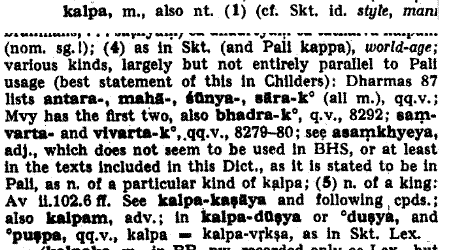
Franklin Edgerton, 1885–1963, gives in Buddhist Hybrid Sanskrit:
 FE-BHS172
 UKT 140503: I am getting the idea that this description of world cycles was of
Buddhist origin brought out by
Buddhaghosa in Visuddhimagga written in SriLanka many centuries
-- 430 CE -- after the death of the Buddha. I am led to speculate that the
eminent Buddhist commentator
Buddhaghosa had based his source on the pre-Buddhistic ideas of Tib-Burman
speakers of the Himalayan regions extending into the present-day Myanmarpé.
There are claims that
Buddhaghosa himself was a native of Thaton in southern Myanmarpé and was a
Mon-Myan speaker. For similar ideas, we should look into Tibet Buddhism, and its
predecessor the Bön religion which probably is related to the Bodaw
UKT 140503: I am getting the idea that this description of world cycles was of
Buddhist origin brought out by
Buddhaghosa in Visuddhimagga written in SriLanka many centuries
-- 430 CE -- after the death of the Buddha. I am led to speculate that the
eminent Buddhist commentator
Buddhaghosa had based his source on the pre-Buddhistic ideas of Tib-Burman
speakers of the Himalayan regions extending into the present-day Myanmarpé.
There are claims that
Buddhaghosa himself was a native of Thaton in southern Myanmarpé and was a
Mon-Myan speaker. For similar ideas, we should look into Tibet Buddhism, and its
predecessor the Bön religion which probably is related to the Bodaw
 {Bo:tau:}-subset
of Bur-Myan Theravada religion. See also Folk Elements in Buddhism by
Maung (Dr.} Htin Aung --
flk-ele-indx.htm (link chk 140503)
{Bo:tau:}-subset
of Bur-Myan Theravada religion. See also Folk Elements in Buddhism by
Maung (Dr.} Htin Aung --
flk-ele-indx.htm (link chk 140503)
05.
Cult of Magus -
ch05-magus.htm (link chk 140503)
See also the video Tibetan Book of the Dead
--
https://www.youtube.com/watch?v=Ermcc6iDqQA 140503
From Wikipedia: http://en.wikipedia.org/wiki/Kalpa_aeon 140503
Kalpa is a Sanskrit word (Hindi: कल्प kalpa) meaning an aeon, or a relatively long period of time (by human calculation) in Hindu and Buddhist cosmology. The concept is first mentioned in the Mahabharata. The definition of a kalpa equalling 4.32 billion years is found in the Puranas (specifically Vishnu Purana and Bhagavata Purana).
UKT 140503: The following account is in Visuddhimagga by Buddhaghosa written ca. 430 CE in Sri Lanka. It is probably influenced by Hindu views.
According to Visuddhimagga, there are several explanations for types of kalpas and their duration. In the first explanation, there are four types:
In another simple explanation, there are four different lengths of kalpas. A regular kalpa is approximately 16 million years long (16,798,000 years[1]), and a small kalpa is 1000 regular kalpas, or about 16 billion years. Further, a medium kalpa is roughly 320 billion years, the equivalent of 20 small kalpas. A great kalpa is 4 medium kalpas, or around 1.28 trillion years.
Buddha had not spoken about the exact length of the Maha-kalpa in number of years. However, he had given several astounding analogies to understand it.
1. Imagine a huge empty cube at the beginning of a kalpa, approximately 16 miles in each side. Once every 100 years, you insert a tiny mustard seed into the cube. According to the Buddha, the huge cube will be filled even before the kalpa ends.
2. Imagine a gigantic rocky mountain at the beginning of kalpa, approximately 16 x 16 x 16 miles (dwarfing Mt. Everest). You take a small piece of silk and wipe the mountain once every 100 years. According to the Buddha, the mountain will be completely depleted even before the kalpa ends.
In one situation, some monks wanted to know how many kalpas had died so far. The Buddha gave the analogy:
1. If you count the total number of sand particles at the depths of the Ganges river, from where it begins to where it ends at the sea, even that number will be less than the number of passed kalpas.[2]
In Hinduism (cf. Hindu Time Cycles), it is equal to 4.32 billion years, a "day of Brahma" or one thousand mahayugas,[3] measuring the duration of the world (scientists estimate the age of the Earth at 4.54 billion years).[4] Each kalpa is divided into 14 manvantara periods, each lasting 71 yuga cycles (306,720,000 years). Preceding the first and following each manvatara period is a juncture (sandhya) the length of a Satya-yuga (1,728,000) years.[5] Two kalpas constitute a day and night of Brahma. A "month of Brahma" is supposed to contain thirty such days (including nights), or 259.2 billion years. According to the Mahabharata, 12 months of Brahma (=360 days) constitute his year, and 100 such years the life cycle of the universe. Fifty years of Brahma are supposed to have elapsed, and we are now in the shvetavaraha-kalpa of the fifty-first; at the end of a Kalpa the world is annihilated.
UKT - More in Wiki article
Go back Kalpa-note-b
End of TIL file