 {ka}
{ka}  {ka-ya}
  {ka-yi}
  {ka-yu.}
 ka2ya2.htm
by U Myat Kyaw & U San Lwin, MLC (Myanmar Language Commission), 2002
Set in HTML, and edited, with additions from other sources, by U Kyaw Tun (UKT) (M.S., I.P.S.T., USA), Daw Thuzar Myint, and staff of Tun Institute of Learning (TIL) . Not for sale. No copyright. Free for everyone. Prepared for students and staff of TIL Computing and Language Center, Yangon, MYANMAR : http://www.tuninst.net , http://www.softguide.net.mm , www.romabama.blogspot.com
index.htm |
Top
PED-MK-indx.htm
UKT 140427: There are Bur-Myan words derived from Pal-Myan in def. given by UMK-USL. You can spot them by their viram aka
{a.þût}-sign which was not present in Pal-Myan. Bur-Myan & Pal-Myan are highly integrated, which I take to be because both are Tib-Bur languages. I dispute that Pali spoken in Myanmarpré (which is now mixed up with Lankan-Pali) was Indo-European. The mother tongue (L1) of Gautama Buddha was the Pali spoken in Myanmarpré.
{ka}
{ka-ya}  {ka-ya-nu.ga.ta.}
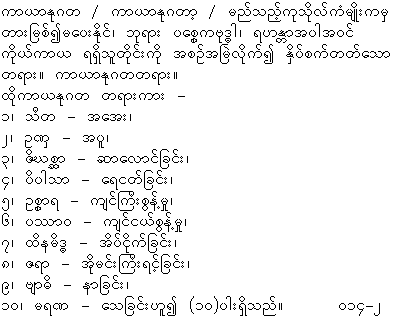
«kāyānugata»
- n. physical distress and
inconveniences such as [UKT additions
within sq. brackets]
01. thīta - cold [low ambient
temperature due to weather],
02. uṇha - heat [high ambient
temperature due to weather] ,
03. jighacchā - hunger [requirement
of the physical body],
04. pipāsā - thirst [requirement
of the physical body],
05. uccāra - having to defecate
[requirement of the physical body to
eliminate solid waste],
06. passāva - having to urinate
[requirement of the physical body to
eliminate liquid waste],
07. thina - middha-lethargy [requirement
of the physical body to rest],
08. jarā - ageing [ageing of the
physical body],
09. vyādhi - illness [normal process
due to ageing and attack of outside
organisms, etc.], and
10. maraṇa - death [normal physical
process, or due to outside acts]
which no amount of past meritorious deeds
can prevent from their occurrence and which
even Buddhas, Silent Buddhas and saintly
persons are not immune to.
- MK-PED014-2
UKT 140426: You will note that the above 10 inconveniences are simply natural processes that happens to any living organisms recognized by modern science. Immortality, and other unnatural processes are just fiction. It shows that Gautama Buddha was a normal human being who came to possess a very high intellect or wisdom. He lived a normal life-span of 80 years, and when he died he was cremated just like everyone else leaving nothing but bits of un-burnt bones.
 {ka-ya-nu.paþ~þa.na þa.ti.pûT~HTa-na.}
UKT 140427: This word is a compound of 2 large words which are themselves compounds. In the def. by UMK-USL, there are Bur-Myan words derived from Pal-Myan. You can spot them by their viram aka

«kāyānupassanāsatipathāna»
- n. repeated contemplation of the body
with intense application of mindfulness.
See also satipathāna.
- MK-PED014-3
 {ka-ya-ya.ta.na.}

«kāyāyatana»
- n. fundament of sensory perception
and mental concomitants; "body base"
- MK-PED015-1
{ka-yi.}  {ka-yi.ka.doak~hka.}

«kāyikadukkha»
- n. physical suffering; privation.
- MK-PED015-2
 {ka-yi.ka.þu.hka.}

«kāyikasukha»
- n. physical well-being.
- MK-PED015-3
 {ka-yain~dri.ya.}

«kāyindriya»
- n. sentient surface of the body
controlling physical contact and
resultant sensations; the faculty of
physical sensations.
- MK-PED015-4
{ka-yu.} {ka-yu.zu.ka.ta}
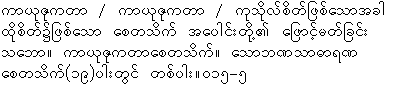
«kāyujukatā»
- n. rectitude of mental concomitants;
- MK-PED015-5
 {ka-la.}
  {ka-la.da-na.}

«kāladāna»
- n. timely charity expressed through
five modes: -
1. āgantuka-dāna - charitable
acts toward guests;
2. gamikadāna - acts of charity
toward itinerants;
3. gilānadāna - charity for
the ill or injured;
4. dubbhikhadāna - charity for
the famine stricken;
5. sīlavantana-vaphaladāna
- partaking of the first crops from ones'
fields or orchards only after offering
the first crops to virtuous persons.
- MK-PED015-6
 {ka-la.wi.pût~ti.}

«kālavipatti»
- n. age of decadence; period when human
life span regresses.
- MK-PED016-1
UKT 140427: UMK-USL definition of
• Ecology - http://en.wikipedia.org/wiki/Ecology 140427
• Maximum Life Span - http://en.wikipedia.org/wiki/Maximum_life_span 140427
• Life Expectancy - http://en.wikipedia.org/wiki/Life_expectancy 140427
See my note on Yuga{yu.ga.} aka
{yoag}
 {ka-la.þoat~ta.}

«kālasutta»
- n. second major level of purgatory
where inmates are marked with the ruling
line to be cleaved with hatchets and adzes.
- MK-PED016-2
 {ka-la.þûm~pût~ti.}

«kālasampatti»
- n. golden age: good times.
- MK-PED016-3
 {ka-li.}
  {ka-li.ka}

«kālika»
- n. [V] sustenance allowed monks and
novices at times stipulated as follows: -
1. yāvakālika - cereals such
as rice which must be taken before noon
on the day it is offered;
2. yāmakālika - fruit juice
and cordials which can be taken at any
time from the time of offering up to dawn
of the next day;
3. sattāha-kālik - sugar,
palmyra candy and the like which can be
consumed within seven days from the time
of offering;
4. yāvajīvakakālika -
herbal nostrums and medicine which can be
taken anytime within one's lifetime after
being offered.
- MK-PED016-4
 {ka-lé}
  {ka-le-na.Dûm~ma.þa-kic~hsa}

«kālenadhammasākicchā»
- n. auspiciousness of engaging in
philosophical discussions at suitable
times.
- MK-PED017-1
 {ka-le-na.Dûm~maþ~þa.wa.na.}

«kālenadhammassavana»
- n. auspiciousness of listening to
sermons on the doctrine.
- MK-PED017-2
- UKT 140427
From Wikipedia: http://en.wikipedia.org/wiki/Yuga 140427
Yuga युग
{yu.ga.} aka
{yoag} in Hindu philosophy is the
name of an epoch or era within a four age
cycle. According to Hindu cosmology,
life in the universe is created and
destroyed once every 4.1 to 8.2 billion years,
[1]
[2]
which is one full day (day and night) for
Brahma. The lifetime of a Brahma
himself may be between 40 billion and 311
trillion years.
[1]
[UKT ¶]
The cycles are said to repeat like the seasons, waxing and waning within a greater time-cycle of the creation and destruction of the universe. Like Summer, Spring, Winter and Autumn, each yuga involves stages or gradual changes which the earth and the consciousness of mankind goes through as a whole. A complete yuga cycle from a high Golden Age, called the Satya Yuga to a Dark Age, Kali Yuga and back again is said to be caused by the solar system's motion around another star. [3]
Go back yuga-note-b
End of TIL file