ka1.htm
by U Myat Kyaw & U San Lwin, MLC (Myanmar Language Commission), 2002
Set in HTML, and edited, with additions from other sources, by U Kyaw Tun (UKT) (M.S., I.P.S.T., USA), Daw Thuzar Myint, and staff of Tun Institute of Learning (TIL) . Not for sale. No copyright. Free for everyone. Prepared for students and staff of TIL Computing and Language Center, Yangon, MYANMAR : http://www.tuninst.net , http://www.softguide.net.mm , www.romabama.blogspot.com
index.htm |
Top
PED-MK-indx.htm
UKT 140422: TOC is in 2 groups: {wag}- & {a.wag}-consonants.
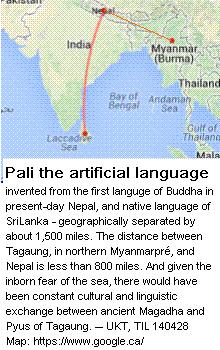
UMK-USL gives every entry firstly in Pal-Myan, secondly in Bur-Myan pronunciation, and thirdly as explanation in Bur-Myan. Notice the vowel changes when going from Pal-Myan to Bur-Myan. Pali language was invented in SriLanka from the first language of Gautama Buddha of Magadha kingdom in the far north of the Indian subcontinent, and the native language of Lanka which is Austro-Asiatic. As an artificial language, you need to pronounce Pali precisely without any sing-song pronunciations as in Sanskrit.
The vowel sounds of Magadhi and Bur-Myan, belonging to the same linguistic group, the Tibeto-Burman, are similar. Please note I am not saying that Magadhi and Burmese are the same. I am saying that because they belong to the same linguistic group, the vowel sounds would be the same. What I am saying is that "Pali" spoken in Myanmarpré is the same as Magadhi the first language of Gautama Buddha with slight changes because of the Lankan speech.
 {ka.}
{ka.}
 {ka.ka.}
 {ka.Ta.}
 {ka.Na.}

 {ka.ta.}
 {ka.ba.}
 {ka.ma.}
 {ka.ra.}
 {ka.la.}
 {ka.wa.}
 {ka.þa.}
See my note on the Sun-gazers of Myanmarpré
UKT 140421: Capitalizing proper names and the beginning of sentences in International Pali is derived from English. There is no capital letters in Pal-Myan and Skt-Dev. Romabama follows the usage of Pal-Myan and Skt-Dev. Use of capital letters in Romabama is to expand the English-Latin alphabet from 26 letters to 52 letters. Yet because of the need of more ASCII letters, I have to use letters from French and Spanish.
UKT notes :
•
Bur-Myan Palatal Approximant
 {Ña.}
{Ña.}
•
Kakusandha Buddha :
 {ka.ku.þûn} Buddha
•
Krishna :
कृष्ण
«kṛṣṇa»
• Milarepa : ability to fly through air
•
Sun-gazing or «āloka kasiṇa»
• Yuga :
 {yu.ga.} युग
{ka.}
{ka.ka.} {ka.ku.þûn~Da.}

«Kakusandha»
- n. name of the first of the
five Buddhas of which four have attained
enlightenment in this present world
(Kakusandha Buddha attained enlightenment
while seated under the Albizzia lebbek
tree)
- MK-PED001-1
{ka.ku.þûn~Da.}
 --
UHS-PMD0275
--
UHS-PMD0275
UKT from UHS: m.
See my note on Kakusandha-Buddha
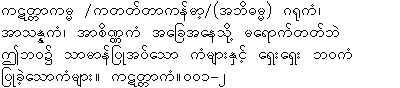
{ka.Ta.}
 {ka.Tût~ta kûm~ma.}
«kaṭattā-kamma»
- n. karma accumulated from
previous existences and consequences
of non-volitional activities in the
present one; accumulated karma.
- MK-PED001-2
 {ka.Tût~ta.}
-  -
UHS-PMD0278
-
UHS-PMD0278
UKT from UHS: n. the action that is fit to be undertaken
{ka.Na.} {ka.Nha.gau-ta.ma.ka.}

«kaṇhagotamaka»
- n. one of the four genera of
serpents from which all species of
serpents are said to originate. See
also virüpakha; chavyāputta;
erāpatha.
- MK-PED001-3
 {ka.Nha.}
-  -
UHS-PMD0283
-
UHS-PMD0283
UKT from UHS: mfn. blackness, black colour, Vishnu deva. n. black pepper
UKT note: Skt-Dev equivalent is Krishna कृष्ण «kṛṣṇa» 'black, dark blue' -- the Eighth Incarnation of Vishnu and as such we can understand the meaning given by UHS. He was the author of Bhagava Gita - the most famous Hindu philosophy. See my note on Krishna
{ka.Nha-gau:ta.ma.}
-  - UHS-PMD0283
UKT from UHS: m. the Naga king by the name of Kanhagautama
{ka.ta.} {ka.ta.yu.ga.}
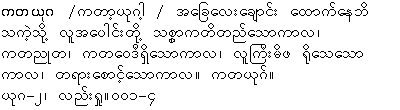
«katayuga»
- n. first of the four ages into which
a world era is divided; age of filial
piety and justice. See also yuga.
- MKPED001-4
 {ka.ta.}
-  -- UHS-PMD0283
UKT from UHS: mfn. accomplished. n. what is proper has been accomplished.
{yu.ga.} युग -- UHS-PMD0799
UKT: See my note on Yuga the four epochs of Hindu cosmic time. I opine that this idea is not central to Buddhist philosophy which does not pay attention to the creation of the universe.
 {ka.tiñ~ñu.ta}
 See my note on Bur-Myan Palatal Approximant

«kataññyutā»
- n. being heedful of another's
goodwill; gratitude.
- MK-PED001-5
{ka.tiñ~ñu.ta} -- UHS-PMD0284
{ka.ba.}  {ka.ba.Li-ka-ra.a-ha-ra.}

«kabaḷīkārāhāra»
- n. solid nutriment; food.
- MK-PED001-6
 {ka.ba.la.} -- UHS-PMD0293
 {a-ha-ra.} -- UHS-PMD0188
{ka.ma.} {ka.ma.}

«kama» : there are five process as follows:
n. order -
process -
course
1. up pattikkama - development process
2. pahānakkama - discarding order
3. paṭipattikkama - practice procedure
4. bhũmikkama - order of planes of existence
5. desanakkama - course of a lecture
- MK-PED002-1
{ka.ma.} -- UHS-PMD0293
{ka.ra.} {ka.ra.za. ka-ya.}

«karazakāya»
- n. incipient organism
formed by insemination; embryo.
- MK-PED002-2
 {ka.ra.} -- UHS-PMD0297
 {ka.ra.za.} -- UHS-PMD0298
{ka.ra.za. ka-ya.} -- UHS-PMD0298
 {ka.ru.Na}

«karuṇā»
- n. [A] 1. compassion.
2. contemplation to develop compassion;
karuṇābhāvanā.
- MK-PED002-3
{ka.la.} {ka.la.la.}

«kalala»
- n. embryo
- MK-PED002-4
UKT 140428: I remember, as a teenager studying for the Rangoon University Exam. I happened to ask my instructor in the classroom to explain what
{ka.la.la. ræÑ-kræÑ} meant. He just smiled. He was too embarrassed to say the word "semen". My problem was two-fold: lack of sex-education, and the misspelled word. It was and still is misspelled as
{ka.la.la. ré-kræÑ} - with the word for "water" instead of "liquid". The word for "liquid" is
{a.ræÑ}, and the word for "water" is
{ré}. We have to make an effort to explain in chemistry classes the difference between the two.
 {ka.la-pa.}
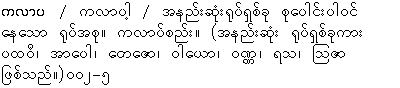
«kalāpa»
- n. cell formed of a minimum
of eight constituents i.e. the four essential
principles of matter (extension, cohesion
or fluidity, heat and motion), appearance,
odour, taste and nutriment.
- MK-PED002-5
 {ka.li.yu.ga.}
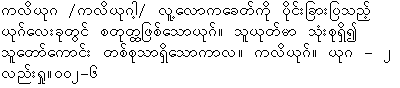
«kaliyuga»
- n. last of the four ages into
which a world era is divided; age of
decadence in which the bad outnumber the
good by three to one. See also yuga.
- MK-PED002-6
 {ka.lya-Na.}

«kalyāṇa»
- n.
¹. excellence in the entire
corpus [the beginning, the middle, &
the final part] of Buddha's teachings:
1. [the beginning] -
ādikalyāṇa - excellence
of moralistic precepts forming the
initial part;
2. [the middle] -
mijjhekalyāṇa - excellence
of equanimity forming the middle part;
3. [the final] -
pariyosāṇa kalyāna -
excellence of the path and fruition
leading to nirvana
forming the final part.
². virtuosity in the
physique of a person esp a woman
1. kesā-dark flowing tresses;
2. vaya-youthfulness;
3. maṁsa-firm fleshed;
4. aṭṭhi-pearly white teeth
and fingernails glowing with a rosy hue
5. chavi-golden complexion
- MK-PED003-1
 {ka.lya-Na. pu.htu.za.na.}

«kalyāṇa puthujana»
- n. worldling who comprehends the sublime
concepts of the aggregates of corporeality,
sense bases, the elements or principles of
matter, and truth. See also andhaputhujana.
- MK-PED003-2
 {ka.lya-Na. mait~ta.}

«kalyāṇamitta»
- n. noble friend
( a friend who possesses the noble
qualities of
1. sīla - observance of moral precepts;
2. samādhi - equanimity;
3. paññā - knowledge of the law of
dependent of origination and the nature
of mind and matter;
4. dhammadāna - ability to expound
on the doctrinal concepts;
5. peyyavācā - ability to
give good counsel;
6. atthacariyā - altrusistic propensity;
7. samānatthatā - treating
someone as oneself)
- MK-PED004-1
{ka.wa.} {ka.wi.} «kavi»

«kavi»
- n. learned person; sage (There are
four categories of sages;
- 1 cintākavi - one able to reason
out things;
- 2 sutakavi - one able to build up on
knowledge acquired;
- 3 atthakavi - one able to analyse and
elaborate on or condense concepts;
- 4 paṭibhānakavi - one who
has an incisive and ready wit)
- MK-PED004-2
{ka.þa.} {ka.þi.Na.}

«kasiṇa»
- n. object one concentrates
on while meditating; meditation device
(There are ten such devices; -
01. pathavī kasiṇa - disc of clay or earth; -
02. āpo kasiṇa - a stretch of water; -
03. tejo kasiṇa - fire; -
04. vāyo kasiṇa - wind; -
05. nila kasiṇa - blue coloured object; -
06. pīta kasiṇa - yellow coloured object; -
07. lohita kasiṇa - red object; -
08. odāta kasiṇa - white object; -
09. okāsa kasiṇa - space;
10. āloka kasiṇa - light
- MK-PED005-1
UKT 140429: An important phrase in Bur-Myan left unexplained:
{Zaan ra. rûn} 'to acquire {Zaan}'. See my note on Milarepa (a historical person)
 {ka.þi.Na pa.ri.kûm~ma.}

«kasiṇaparikamma»
- n. preliminary
stage to concentration.
- MK-PED005-2
 {ka.þi.Na mûN~ða.la.}
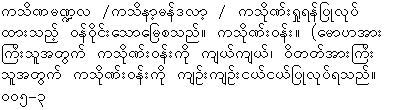
«kasiṇamandala»
- n. circular object
for concentration (It should be wide for
an undiscerning person and circumscribed
for the discursive)
- MK-PED005-3
{Ña.}
UKT 140421: Pal-Myan does not have
the Bur-Myan phoneme
{Ña.} which is similar to velar approximant
 {ya.}. Bur-Myan
{Ña.} is a palatal approximant. Because
Bur-Myan
{Ña.} and
{ya.} can be "killed" to give
{ya.}. Bur-Myan
{Ña.} is a palatal approximant. Because
Bur-Myan
{Ña.} and
{ya.} can be "killed" to give
 {Ñ} &
{Ñ} &
 {y}, Bur-Myan {Ña.} is not a nasal.
It is an approximant with some nasal qualities.
{y}, Bur-Myan {Ña.} is not a nasal.
It is an approximant with some nasal qualities.
In Pal-Myan there is no basic phoneme similar to
{Ña.}. What it has is the horizontal
conjunct of two
 {ña.}
{ña.}
Pal-Myan
{ñ~ña.}
When applied with a viram{a.þût}, the conjunct is destroyed, and it the first
{piñ~ña} 'education'.
Go back palatal-approx-note-b
- UKT 140424
As a skeptical chemist, and engineer, I am not interested in mythical personages. The word "Buddha" simply means a human being who came to be endowed with the highest form of knowledge (without any religious connotation). As such I am interested in Gautama Buddha only. The top person of the Tibet-Buddhist religion, the Dalai Lama is supposed to be a "Living Buddha". Whether he is endowed with the highest form of knowledge or not is simply beyond me. He is a simply a very respectable human being to me.
From Wikipedia: http://en.wikipedia.org/wiki/Kakusandha_Buddha 130308
In Buddhist tradition, Kakusandha (Pāli) is the name of the twenty-fifth Buddha, the first of the five Buddhas of the present kalpa, and the fourth of the seven ancient Buddhas, known in Sanskrit as Krakucchanda, and in Tibetan as Khorvadjig. His biography is recorded in the Buddhavamsa, one of the books of the Pāli Canon.
Kakusandha Buddha was born in Khemavati (now Gotihawa), in Kapilavastu District, in the Lumbini Zone of southern Nepal. [1] His father was Aggidatta, a Brahmin of the king Khemankara of Khemavati. His mother was Visakha. His wife was Virochamana (also known as Rocani); he had a son, Uttara (son of Kakusandha). [UKT ¶]
Asoka visited Gotihawa, Nepal when he visited Lumbini, Nepal and installed a stone pillar and inscribed his visit in the pillar. There is also a stupa in Gothihawa. Therefore, it is generally accepted due to the pillar that the birthplace of Kakusandha is in Gothihawa, Nepal near Kapilvastu, Lumbini, Devadaha and Ramagrama of Nepal.
Kakusandha lived for four thousand years in the household in three palaces: Ruci, Suruci and Vaddhana (or Rativaddhana). At the age of four thousand, he renounced the worldly life while riding on a chariot. He practised austerities for eight months. [2] Before attaining enlightenment, he had accepted some milk-rice from the daughter of the Brahmin Vajirindha of the village Suchirindha, as well as grass for his seat from the yavapalaka Subhadda. He attained enlightenment under a sirisa tree, then delivered his first sermon to the assembly of eighty-four thousand monks in a park near Makila.
Kakusandha performed the twin miracle under a sala tree, at the gates of Kannakujja. Among his converts was a fierce yaksha named Naradeva. Kakusandha kept the fast-day ( uposatha) every year.
His chief disciples were Vidhura and Sanjiva among the monks, and Sama and Champa among the nuns. His personal attendant was Buddhija. Acchuta and Samana among the men, and Nanda and Sunanda among the women were his chief lay-supporters. Acchuta built a monastery for Kakusandha Buddha on the same site, which was later chosen by Anathapindika for Jetavana Arama for Gautama Buddha.
According to the Samyutta Nikaya (ii.194), the Vepulla peak of Rajgir was then called Pachinvamsa; and the people of the region Tivara.
Kakusandha's body was forty cubits in height, and he died at the age of forty thousand years in Khemavati. The thūpa erected over his relics was one league high. [2]
The bodhisattva who was to become Siddhartha Gautama was born as King Khema during the time of Kakusandha. Kakusandha was the Buddha who foretold that King Khema, who offered him alms with robes and medicines, would become the Gautama Buddha in the future. [3]
UKT: End of Wikipedia article.
Go back Kakusandha-note-b
- UKT 140423
The word Skt-Dev word कृष्ण
«kṛṣṇa» simply means
'black, dark blue'. The corresponding word
in Pal-Myan is
{ka.Nha.} . A person with a dark skin
with a blue hue would be referred to as
कृष्ण
«kṛṣṇa».
From Wikipedia: http://en.wikipedia.org/wiki/Krishna 130308
Krishna ( कृष्ण «kṛṣṇa», 'black, dark blue') [6] is a Hindu deity, one of the "avatars" (or "incarnation") of Vedic Supreme Deva-God Vishnu or Narayana. [UKT ¶]
According to Bhagavata Purana, which is a sattva purana [7] and is considered as purest and greatest of all puranas, Lord Krishna is termed as Svayam Bhagavan since he was the purna-avatara or full incarnation of Supreme Lord Vishnu or Narayana. [8] [9] As stated in Bhagavata Purana, Lord Vishnu or Narayana appeared before Vasudeva and Devaki in his divine real form before taking birth. [UKT ¶]
Both Vasudev and Devaki after praising Lord Vishnu requested him to hide his divine form agreeing to which Lord Vishnu transformed himself into a small human baby. According to this account, Lord Krishna never took birth from the womb of his mother like a common human baby and was himself Lord Narayana or Vishnu who came down to planet Earth from his Supreme Abode Vaikuntha to eradicate the evil forces, to restore the Dharma and to liberate the worthy ones or devotees and appeared like a normal human being outwardly. [4] [10]
UKT: More in Wikipedia article
Go back Krishna-note-b
UKT 140429:
A controversial word left unexplained in
English interpretation of
{ka.þi.Na.} «kasiṇa», is the Bur-Myan word
 {Zaan} (MED2006-155) or Pal-Myan
 {Za-na} (UHS-PMD0420). Though the common
wisdom is that
{Zaan} is derived from
{Za-na}, it may be other way around,
because the underlying idea is the
"ability to fly through the air"
-- not "knowledge". The phrase
with this word is
{Zaan ra. rûn} 'to acquire {Zaan}'. The
word in colloquial Bur-Myan language is
the 'ability to fly in the air'.
{Za-na} (UHS-PMD0420). Though the common
wisdom is that
{Zaan} is derived from
{Za-na}, it may be other way around,
because the underlying idea is the
"ability to fly through the air"
-- not "knowledge". The phrase
with this word is
{Zaan ra. rûn} 'to acquire {Zaan}'. The
word in colloquial Bur-Myan language is
the 'ability to fly in the air'.
 I opine that the idea was from the
original idea of the Tib-Bur language
group. I became acquainted with the
biography of Milarepa (c. 1052 –
c. 1135 CE) in a book lent by retd.
Professor of Chemistry, Dr. U Nyunt Win
of Yangon University, who is my childhood
(pre-teen) friend. Flying through the air
by magic was in the biography of Milarepa,
who was a sorcerer (he had killed many by
his black magic) who repented to become
a Buddha of the Black Hat Lamas of Bhutan.
I wonder whether the local beliefs in
Bodaws & Zawgyis, and
Nagas now represented by wild
pythons coexisting with the local
population at various Myanmar pagodas are
what is left after the religious reforms
of King Anawrahta in the 11th century.
I am writing this from memory, and I am
unable to give the precise reference on
the Black Hats. However see
I opine that the idea was from the
original idea of the Tib-Bur language
group. I became acquainted with the
biography of Milarepa (c. 1052 –
c. 1135 CE) in a book lent by retd.
Professor of Chemistry, Dr. U Nyunt Win
of Yangon University, who is my childhood
(pre-teen) friend. Flying through the air
by magic was in the biography of Milarepa,
who was a sorcerer (he had killed many by
his black magic) who repented to become
a Buddha of the Black Hat Lamas of Bhutan.
I wonder whether the local beliefs in
Bodaws & Zawgyis, and
Nagas now represented by wild
pythons coexisting with the local
population at various Myanmar pagodas are
what is left after the religious reforms
of King Anawrahta in the 11th century.
I am writing this from memory, and I am
unable to give the precise reference on
the Black Hats. However see
¤
http://en.wikipedia.org/wiki/Milarepa 140429 ,
¤
http://en.wikipedia.org/wiki/Karma_Kagyu 140429
¤
http://en.wikipedia.org/wiki/Bon 140429
Note: Bön and
 {paung:} are probably the same.
Go back Milarepa-note-b
UKT 140420:
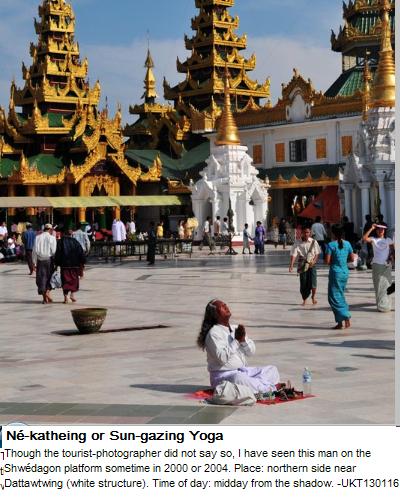
Sun-gazing or āloka kasiṇa is an extreme form of self-torture not recommended by Gautama Buddha (Theravada Buddhism). It is one of the methods of pre-Buddhistic Vedic practices of Tibeto-Burman speakers of the foot-hills of Himalayas extending from Afghanistan into northern Myanmarpré.
It is not Hinduism which is nowadays
made up of three main subsets:
Shaivism (worshippers of Siva-Déva),
Vaishnavism (worshippers of
Vishnu-Déva), and Shaktism
(worshippers of Shakti-Dévi or Mother
Goddess). Note: Dévas and Dévis, like
Allah, God, & YHWH, are axioms not
accepted by Science. Buddhism (Theravada)
on the other hand is based on Four
Principles or natural laws which were
discovered by a human being. It is thus
a science and philosophy.
See Wikipedia articles:
-
http://en.wikipedia.org/wiki/Hindu 140421
-
http://en.wikipedia.org/wiki/Shaktism 140421
-
http://en.wikipedia.org/wiki/Buddhism_and_science 140421
Though not recommended by Gautama Buddha, yet, there are those who to gain mystical power engage in pre-Buddhistic Vedic practices. Since Buddha has a high respect for the ancient Vedic Rishis such activities are condoned by Theravada Buddhists of Myanamarpré. It seems that the intense UV-light of the sun does not effect the eye sight because these practitioners do not go blind. However, to be to be able to gaze at the midday sun, one has to practice slowly under proper guidance of a master. If anything goes amiss, the result is madness, and in this case blindness.
My father U Tun Pe in his youth had some experience under the guidance of his mentor Arakanese U Kyaw Dun, an instructor at Insein GTI (Govt. Technical Institute) in 1920's. (I was named after him. The Arakanese version Kyaw Dun has been Burmanized to Kyaw Tun.) The mentor and student practiced these kasiṇa . One day, the mentor declared to his student that he was ready to step into pathavī kasiṇa which can cause insanity for any slight error. True to his word U Kyaw Dun became insane, and had to leave his teaching job. U Kyaw Dun went back to Arakan (now officially Rakhine state) and my father discontinued his studies at GTI and the yogic practice. And he warned me to be wary of such practices. His recommendation was only the practice of mindfulness . See kasiṇa MK-PED005-1
Go back sun-gazing-note-b
-- UKT 130322
From Wikipedia: http://en.wikipedia.org/wiki/Yuga 130322
Yuga युग
{yu.ga.}, in Hindu philosophy is the
name of an 'epoch' or 'era' within
a cycle of four ages. These are:
Satya Yuga,
Treta Yuga,
Dvapara Yuga, and finally
Kali Yuga.
[UKT ¶ ]
According to Hindu cosmology, life in the
universe is created, destroyed once
every 4.1 to 8.2 billion years,
[1]
[2]
which is one full day (day and night) for Brahma
 {brah~ma}. The lifetime of a Brahma himself
may be 311 trillion and 40 billion years.
[1]
[UKT ¶ ]
{brah~ma}. The lifetime of a Brahma himself
may be 311 trillion and 40 billion years.
[1]
[UKT ¶ ]
The cycles are said to repeat like the seasons, waxing and waning within a greater time-cycle of the creation and destruction of the universe. Like Summer, Spring, Winter and Autumn, each yuga involves stages or gradual changes which the earth and the consciousness of mankind goes through as a whole. A complete yuga cycle from a high Golden Age of enlightenment to a Dark Age and back again is said to be caused by the solar system's motion around another star. [3]
... ... ...
It should be obvious that the life style in the four Yugas is the same as life style of people of the four Hindu Varnas.
• Krita/Satya Yuga – Brahmana Varna
• Treta Yuga – Kshatriya Varna
• D(v/w)apara Yuga – Vaishya Varna
• Kali Yuga – Shudra Varna
The Varna of a person is determined by the two attitudes, Positive and Negative,
• Brahmana Varna – Positive and Negative attitudes merge to become one and the same
• Kshatriya Varna – Positive and Negative attitudes are separate
• Vaishya Varna – There is just Positive attitude and no negative attitude
• Shudra Varna – The two attitudes are absent
Brahmana Varna gives best quality of life and authority but can be used under ideal conditions only. All activities of life are interlinked and eternal. This forces Brahmana to be honest. Shudra Varna gives maximum freedom but least quality of life. In this Varna all activities are independent of each other and transient. The enormous flexibility makes it the ideal Varna for chaotic conditions. The Varnas were banned because Hindus tried to have both the authority of Brahmana Varna and the freedom of Shudra Varna. The Varnas were therefore, replaced with the Virtual Yugas.
UKT: More in the Wikipedia article.
Go back yuga-note-b
End of TIL file