 {ga.}
{ga.}  {ga}
{ga} {gi.}
{gi.} {gi}
{gi} {gau:}
  {gïn~}
: in the place of
{gïn~}
: in the place of
 {a.þût},
you will see only conjuncts in Pal-Myan
{a.þût},
you will see only conjuncts in Pal-Myan {gaiz~}
 {gaut~}
{gûn~}
ga1.htm
by U Myat Kyaw & U San Lwin, MLC (Myanmar Language Commission), 2002
Set in HTML, and edited, with additions from other sources, by U Kyaw Tun (UKT) (M.S., I.P.S.T., USA), Daw Thuzar Myint, and staff of Tun Institute of Learning (TIL) . Not for sale. No copyright. Free for everyone. Prepared for students and staff of TIL Computing and Language Center, Yangon, MYANMAR : http://www.tuninst.net , http://www.softguide.net.mm , www.romabama.blogspot.com
index.htm |
Top
PED-MK-indx.htm
{ga.}
{ga}
{gi.}
{gi}
{gau:}
{gïn~}
: in the place of
{a.þût},
you will see only conjuncts in Pal-Myan
{gaiz~}
{gaut~}
{gûn~}
UKT notes :
• {ga.ru.kûm~ma.}
«
garukamma»
• Gandharva - the celestial musicians and dancers
• Weather forecasting -
{gaw:pa-la.ka. ni.mait~ta.}
{ga.}

«gati»
- n. destination after death of a being;
next existence in afterlife which may
either be-
1. devagati - realm of the celestial gods
and supreme beings,
2. manussagati - realm of humanity,
3. nirayagati - purgatory,
4. petagati - realm of the unhappy and
hungry dispossessed beings
5. tiricchānagati
- the animal world. 032-2

«gatinimitta»
- n. premonition of destined afterlife;
rebirth omen; sign of destiny which may be
in the form of -
1. upalabhitabba gatinimitta
- direct
indication of predestined afterlife; or
2. upabhoga gatinimitta
- indication by alluding to he
amenities (or horrors) associated with
the predestined afterlife. 033-1

«gamikavatta»
- n. duties required of a monk before
embarking on a journey. 033-2

«garukamma»
- n. very grave karma that cannot be
obviated by any other karma;
(ānantariya kamma, the commission
of any of the five heinous deeds which
will destine one to hell and
niyatamicchādiṭṭhi, the
ingrained entertaining of wrong concepts
constitute immoral garukamma,
while mahaggata kamma or supremely
developed karma leading one to the fine
material and the formless spheres of
existences make up moral garukamma) 033-3
UKT 140507: To get more on this entry see my note on garukamma
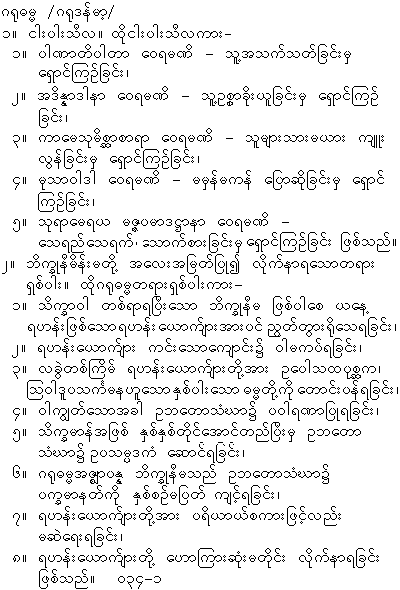
«garudhmma»
- n.
1. the five precepts consisting of:-
1. pānātipātāvirāmani
- abstaining from killing;
2. adinnadānāvirāmaṇi
- abstaining from taking that which has not been given;
3. kāmesumicchācārvirāmaṇi
- abstaining from sexual misconduct;
4. musāvādāvirāmaṇi
- abstaining from falsehood;
5. surāmeraya majjapamā daṭṭhānāvirmaṇi
- abstaining from imbibing alcoholic drinks
2. the eight precepts prescribed for ordained
nuns bhikkhuni are :-
1. even a nun bhikkhuni who had
spent a hundred years in the Order must give respect
to a freshly ordained monk;
2. a nun bhikkhuni
must observe the rains retreat only in a
monastery complex which has
its own complement of monks;
3. a nun bhikkhuni
has to request admonition from monks on the
full moon day and
the new moon day of each month;
4. perform the end of rains
retreat ceremony before an audience of
monks and nuns bhikkhuni
5. be ordained by a complement
of monks and nuns bhikkhuni
only after observing
required precepts for a
probationary period of two years;
6. a nun bhikkhuni
who has committed an infraction of these
solemn precepts must strive
towards regaining acceptance
and confidence of both orders;
7. a nun bhikkhuni
refrains from making insinuating remarks
aimed at monks;
8. a nun bhikkhuni
obeys every admonition made by monks. 034-1
UKT 140509: There is a world of unconcileable difference between the two words "nun" and "bhikkuni". First and foremost is the word "nun" is pure English with Christian connotation with its root in the Atta doctrine. The word "bhikkuni" is Pali with Theravada Buddhist connotation with its root in the Anatta doctrine. Secondly, the word "bhikkuni" means a "female monk", whereas the "nun" is the "bride of Christ".
What we have in present-day Myanmarpré are not bhikkunis. Neither are they "brides" of anybody. They are lay-women who have taken upon themselves of their own free will to keep the Nine precepts or even Ten precepts and are not bounded the the rules of the Bhikku & Bhikkuni. They are termed "Sila-keepers" or "Silashin". What some of the women, particularly those from the West are striving is to equate our Silashin with Bhikkuni. See: http://www.enabling.org/ia/vipassana/Archive/L/Lottermoser/burmeseNunsLottermoser.html 140509

«garubhaṇṭa»
- n. [V] things which belong to the monastic order as a whole and cannot be
apportioned to individual monks for personal use. 035-1

«garurūpa»
- n. heaviness of material qualities;
the elements of extension and cohesion.
035-2
«gahapatikuṭi»
- n. [V] former lay dwelling donated to monks and converted to monastic use by
the former owner's intonation of appropriate words. 035-3

«gahapatimahāsla»
- n. one designated as a man of wealth; plutocrat with the qualification of
having liquid assets of 400 million and being able to spend 5 amnaṇa (30
bushels) of silver while earning a kumbha (60 bushels) of silver daily. 035-4
{ga}

«gāmakhitta»
- n. area falling within a village headman's jurisdiction. 035-5

«gāmasīma»
- n. boundary demarcating the extent of
a village headman's jurisdiction. 036-1

«gārava»
- n. respect; veneration. 036-2

«gāvuta»
- n. unit of measure of distance equal to one-fourth of a yojanā. 036-3

«gāha»
- n. wrong concept. "Book learning without brains results in being bitten by
wrong concepts" 036-4
{gi.}

«gimhāna utu»
- n. summer. See also hemanta utu, vassāna utu. 036-5

«gilāna»
- n. the ill; the sick; the infirm. 036-6
{gi}

«gīta»
- n. 1.singing. 2. song. 036-7

«gocara»
- n. circuit; circuit made by monks on their rounds of accepting food
offertories. 036-8

«gocaragāma»
- n. village where monks make their circuit for accepting food offertories.
036-9
{gau:}

«Gotama»
- n.
¹. the historical Buddha revered by Buddhists.
². a descendant of the clan of Gotama. 036-10
UKT 14051: The present Eng-Lat spelling is "Gautama". The change in spelling meant that the vowel is the most open represented by /ɑ/ and not /ɔ/ 'Open O' as was formerly thought.
«Gotama Buddha»
- n. the historical Buddha who attained enlightenment while seated under the Bo
(pipal) tree after practising austerities for six years and lived up to the age
of eighty. 036-11

«gonisādikākuṭi»
- n. [V] monastery without enclosure, See also kappiya kuṭi.
037-1

«gopaka»
- n. one who looks after; one who cares for. 037-2
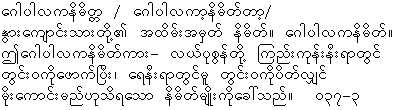
«gopālakanimitta»
- n. tell-tale signs observed by a cowherd (For example a cowherd might see land
crabs closing their burrow openings near the waterline and making new burrow
openings high and dry which he will read as a sign of plentiful rains in the
future) 037-3
UKT: See my note on weather forecasting

«gopālakauposatha»
- n. observing the eight precepts in the manner of a cowherd. 037-4
{gïn~}

«gaṅgeyya»
- n. name of a class of leaf-coloured elephants that had inhabited the Gangetic
region. 037-5
{gaiz~}
«gijjhakūṭa»
- n. mountain with a peak shaped like a vulture; name of one of the five
mountain peaks ringing Rājagaha
city. 037-6
{gaut~}

«gotrabhūcitta»
- n. last thought-moment as a worldling on severing the lineage of the sensual
world and entering the communion of saints (ariyāpuggala);
'' maturity-moment" 037-7

«gotrabhupuggala»
- n. person who has gained the knowledge of severing worldly ties; "matured
one". 038-1

«gantha»
- n. ties which bind one to relentless rounds of rebirth and suffering; these
consist of the following four attitudes:-
1. abhijjhākāyagantha
- the fetter of covetuousness;
2. byāpādakāyagantha
- the fetter of malfeasance;
3. sīlabbataparāmāsakāyagantha
-
4. idaṁsaccābhinivesakāyagantha
-
«ganthadhura»
- n. duty of a monk to learn the Tipitaka scriptures (It constitutes one of his
two main duties.) See also vipassanādhura.
038-3
«gandhadhātu»
- n. [A] particles which give off aroma and reveal their presence. See also dhātu.
038-4
«gandhāyatana»
- n. [A] basis for olfactory sensation; that is to say aromatic particles which
stimulate the olfactory organ, the medium of air through which these are
transmitted and mental concomitants in the cognitive process which render this
sensation to be consciousness. 038-5

«gandhāramana»
- n. aroma; sensation of smell. 038-6

«gandhabbha»
- n. class of minstrel gods [celestials - not Déva or Dévi]
inhabiting the topmost reaches of the mountain Meru, at the centre of the
Buddhist cosmos. 038-7
UKT 140513: See my note on Gandharva
-- UKT 140507 The idea of Action (kamma) in this life-time acting in future lives, is intricately related to life-after-death idea which is not scientifically verifiable at the present. As such I cannot place this idea on an equal footing with the Four Principles (beginning with Dukkha-principle), Anatta-principle, and the Twenty-four foundations of human thoughts and actions.
From Kamma in Theravada Buddhism, by Dr. Phramaha Thotsaporn Iddhivaro, Visiting Lecturer, Faculty of Buddhism University, MCU, Thailand.
-- http://www.undv.org/vesak2012/research/004_thotsaporn.pdf
Downloaded pdf is in TIL library.
The third four kamma is Garu-Kamma: weighty kamma. Bahula-kamma or
Acinna-kamma: habitual kamma. Asanna-kamma: death threshold kamma; proximate
kamma. Katatta-kamma or Katattavapana-kamma: reverse kamma; casual act (fn. 3).
1. Garu-kamma: weighty kamma.
This kamma is Niyatamicchadhitthi: permanent wrong view, Anantariya-kamma:
weighty kamma, and Mahaggata-kusalakamma: great gone to. Niyatamicchadhitti
originates in Lobhamula-citta. Anantariya-Kamma originates in Dosamula-citta.
Mahaggata-kamma originates in Rupavacarakusalacitta: form-sphere moral
consciousness and Arupavacara-kusalacittacitta: formless-sphere moral
consciousness.
2. Bahula-kamma or acinna-kamma: habitual kamma.
This kamma means something which doing repeatedly. This kamma makes human
to recall again. For human who do good thing they are happy. For human who do
bad thing they are unhappy.
This kamma originates in Akusala-citta, and Mahakusala-citta.
3. Asanna-kamma: death-threshold-kamma.
This kamma means something which human think or do when they are going to
die. If they are thinking good thing, they are going to Sugati: happy state. If
they are thinking bad thing, they are going to Dugati: state of unhappiness.
This kamma originates in Akusala-citta, and Mahakusala-citta.
4. Katatta-kamma or katattavapana-kamma: reverse kamma; casual act.
This kamma means something which human act with no proper volition. No
need to mention about that.
All twelve kamma I mentioned above is conventional explanation. Most of them appear in Suttantapitaka. They are called kamma in Suttantanaya or conventional truth.
UKT: The author gives his sources as:
Primary source:
1. Anguttara -Nikaya Tika-Nipata. 20/445/131,551/338.
2. Khuddhaka-Nikaya Iti-Vuttaka. 25/208,248,242/272.
3. Digha-nikaya-Patika-Vagga. 11/379/290.
4. Anguttara-Nikaya-Duka-Nipata. 20/275/77.
Secondary source:
Phrasaddhammajotika Dhammacariy. Paramatthajotika, Volumes 5, 9. Bangkok.
Saddhammajotika Foundation, 2550/2007.
Phra Brahmagunabhorn (P.A. Payutto). Dictionary of Buddhism, Bangkok.
Dictionary of Buddhism Foundation, 2551/2008.
Go back garukamma-note-b
-- UKT 140513
Male Gandhabba are employed by Indra - the king of the Déva - as musicians,
and the females as celestial dancers known in Skt-Dev as Apsara. Gandhabba are
supposed to be of lower rank than the Déva.
--
http://en.wikipedia.org/wiki/Apsara 140513
A notable feature of the Gandhabba is free sex.
"Gandharva
marriage The voluntary union of a maiden and her lover which springs from
sexual desire is called Gandharva marriage."
--
http://en.wikipedia.org/wiki/Marriage_in_Hinduism 140513
"... based on mutual attraction between a man and a woman, with no rituals,
witnesses or family participation"
--
http://en.wikipedia.org/wiki/Gandharva_marriage 140513
In a way the customary Bur-Myan marriage known as {pu.hso: tûn:ting ling-ma.ya:} "male dress on a clothe line in a female residence" is Gandhava marriage. However, once united the couple stays faithful - no more free sex - for the rest of their lives unless annulled by public notice the minimum of which is "the knowledge of the seven households of the front neighbours and seven of the back.
This customary marriage is now done in front of a judicial and two witnesses. It may be followed by a public reception. What is noteworthy is the absence of any Buddhistic rituals in the whole process. However, as entering a new house, five Buddhist monks would be "fed" the following day.
At the present, those who consider themselves to be high society would employ a Brahmin or a highly literate Burmese as a master of ceremony at the public reception. This is just to imitate the royals of Mandalay of bygone days who would like to give the marriage a Hindu flavour and get blessings from Hindu gods and goddesses.
Go back Gandharva-note-b
-- UKT 140512
 • Weather forecasting
A cowherd is not necessarily an peasant, e.g. a rice-growing farmer. In Hanthawaddy district in the Irrawaddy River Delta of Myanmarpré, where I was born, it is the rice-growing farmer who is more interested in forecasting the seasonal weather. Wet-rice cultivation needs monsoon rains, but too much rain would drown his crops, and too little would sun-burn them.
There are several signs dependent on birds and animals that tells him about the
weather for the upcoming rice-growing season. One was by looking at
tree-sparrows
 {sa-bu:taung:} and crows building their nests. When they build their nests high
in the trees it shows fair weather. When they build their nests on lower
branches, it means heavy rains and strong winds.
{sa-bu:taung:} and crows building their nests. When they build their nests high
in the trees it shows fair weather. When they build their nests on lower
branches, it means heavy rains and strong winds.
In the pix you can see a male
 Another
is by looking at land-crabs. When they burrow near to the water-edge of the
delta-creeks which are tidal, it shows fair weather. When they burrow farther
inland or higher up, it means heavy rains and floods.
Another
is by looking at land-crabs. When they burrow near to the water-edge of the
delta-creeks which are tidal, it shows fair weather. When they burrow farther
inland or higher up, it means heavy rains and floods.
I had read somewhere, that it was the Chinese leader,
Mao Zedong, who
told his Western-oriented intellectuals that the farmers know about the coming
of storms by looking at aquatic worms. If they stay near the surface of the
pond, it means fair weather, but once they stay at the bottom it means a storm
is imminent. See
Weather - Nature's Forecasters - Animals and Birds ,
http://treechange.hubpages.com/hub/WEATHER-Natures-Forecasters-Animals-and-Birds
140512
Go back weather-note-b
End of TIL file.