 {Ga.}
{Ga.}GGa1.htm
by U Myat Kyaw & U San Lwin, MLC (Myanmar Language Commission), 2002
Set in HTML, and edited, with additions from other sources, by U Kyaw Tun (UKT) (M.S., I.P.S.T., USA), Daw Thuzar Myint, and staff of Tun Institute of Learning (TIL) . Not for sale. No copyright. Free for everyone. Prepared for students and staff of TIL Computing and Language Center, Yangon, MYANMAR : http://www.tuninst.net , http://www.softguide.net.mm , www.romabama.blogspot.com
index.htm |
Top
PED-MK-indx.htm
{Ga.}
UKT notes :
• Olfaction aka olfactics - the smell
process
{Ga.} UKT 140515: The Pal-Myan word {Ga.na.} deals with the smelling process. See my note on Olfaction aka olfactics .

«ghana»
- n. solid
1.
āramaṇaghana
- conceiving the conglomeration of sensations as a palpable entity
2. santatighana
- consciousness of a series of sensations which seemingly merge into a
continuum
3. kiccaghana
- concept of a soul, entity or being engendered by taking the total
physical and mental experiences as a unified whole.
4. sam
ũhaghana
- conceiving the bodily organs and the body as an solid entity when the
body octad including the four great essentials, the elements of extension,
cohesion etc are always in a flux of generation, stasis and dissolution. 039-1

«ghāna»
- n. sensory receptor of smell; olfactory organ; the nose. 040-1

«ghānadasaka»
- n. decad of material qualities related to olfactory sensation; the olfactory
organ, the eight inseparable material qualities including the Four Great
essentials, and vitality; "nose decad". 040-2

«ghānadvāra»
- n. [A] the olfactory sense organ resembling a door through which various
smells are perceived. 040-3

«ghānadvāravīthi»
- n. [A] process of consciousness arising from contact between the olfactory
sense organ and odours; the process begins from pañācadvāravajjana, the
five-door adverting consciousness phase.
In this phase, the five sensory receptors turn
toward the object.
It is followed by ghānaviññāna-citta phase in which recognition of
the object's presence results from contact with the olfactory sense receptor,
¤ sampaṭicchana
- phase in which the external stimulus is admitted,
¤ santiraṇa
- phase
in which the nature of the admitted object is examined,
¤ votthapana
- phase in
which its nature is decided upon,
¤ kāmajavana
- phase in which the object comes
under introspection, and
¤ tadāramana
- phase in which the perceived sense of smell
is ingested in the consciousness. 040-4
UKT 140515: I have edited and formatted USL's translation.

«ghānadvārikacitta»
- n. [A] 46 kinds of consciousness occurring through the sensory receptor of
smell;
¤ paṅcadvāravajjana
-- 1 kind
- consciousness in the phase in which the five sensory receptors turn
toward the object,
¤ ghānaviṅṅāna-citta
-- 2 kinds
- 2 kinds of consciousness resulting from the olfactory sensory
experience,
¤ sampaṭicchana
---- -- 2 kinds
- 2 kinds of consciousness in the receiving phase,
¤ santiraṇa
------------ -- 3 kinds
- 3 kinds of consciousness in the investigating phase,
¤ votthapana --------- -- 1 kind
- consciousness related to the determining phase,
¤ kāmajavana
------- -- 29 kinds
- consciousness in the apperception phase and
¤ tadāramana
------- -- 8 kinds
- consciousness in the retentive phase.
- 041-1
ap·per·cep·tion
- n. Psychology ¹. Conscious perception with full awareness. ². The process of understanding by which newly observed qualities of an object are related to past experience. [New Latin apperceptiō apperceptiōn - Latin ad- ad-Latin perceptiō perception ; -- AHTDUKT 140515: I have formatted USL's translation

«ghānadhātu»
- n. [A] responsive nature of the olfactory sense receptor to odours. 041-2

«ghānapassāda»
- n. [A] sensory surface of the sense organ of smell; (covering an area shaped
like a goat's hoof inside the nasal canal) 041-3

«ghānaviññāṇa-citta»
- n. consciousness of the nose to various odours. 041-4

«ghānaviññāṇadhātu»
- n. the nature of the nose to receive olfactory sensations. 041-5

«ghānaviññāṇavīthi»
- n. the process of consciousness arising from being conscious of olfactory
stimulus coming into contact with the sensory receptor of smell. See also ghānadvāravīthi.
042-1
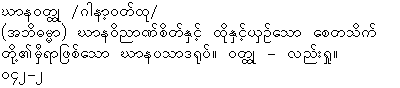
«ghānavatthu»
- n. [A] sensory surface of smell (olfactory sense receptor) on which olfactory
sensations and their mental concomitants arise. 042-2
-- UKT 140515
How do we see and how do we hear have been well understood.
I have dealt with the hearing process, and have come to conclude that the hearing process depends on a large extent of psychology and culture. Gautama Buddha was a native of the Magadha Kingdom, and his L1 (mother tongue) would have been the speech of Magadha or Magadhi - a Tibeto-Burman language. Since, Bur-Myan is also of the same linguistic group, the vowel sounds of the Buddha would be the same as those of the Pali speakers (monks, nuns and elders of Myanmarpré). His speech would be quite different from that of the International Pali which was derived from Magadhi and the Lankan speech -- the latter belonging to Austro-Asiatic linguistic group.

HUMAN VOICE - indx-HV.htm (link chk 140415)
How sound is produced and heard [former hv6.htm] - snd-hear.htm (link chk 140515)
In this note you will see something of the smelling process or Olfaction, aka olfactics. It also depends to a large extent on our culture and genetics, and is partly psychological in nature.
From Wikipedia: http://en.wikipedia.org/wiki/Olfaction 140515
 Olfaction, also known as olfactics,
[1] is the
sense of smell. This sense is mediated
by specialized sensory cells of the nasal
cavity of vertebrates, which can be
considered analogous to sensory cells of
the antennae of invertebrates. In humans,
olfaction occurs when odorant molecules
bind to specific sites on the
olfactory receptors. These receptors
are used to detect the presence of smell.
They come together at the glomerulus,
a structure which transmits signals to
the olfactory bulb (a brain structure
directly above the nasal cavity and
below the frontal lobe).
[2]
Many vertebrates, including most mammals
and reptiles, have two distinct olfactory
systems — the main olfactory system,
and the accessory olfactory system (used
mainly to detect pheromones). For
air-breathing animals, the main olfactory
system detects volatile chemicals, and
the accessory olfactory system detects
fluid-phase chemicals.
[3]
Olfaction, along with taste, is a form
of chemoreception. The chemicals
themselves that activate the olfactory
system, in general at very low
concentrations, are called odorants.
Although taste and smell are separate
sensory systems in land animals,
water-dwelling organisms often have
one chemical sense.
[4]
Olfaction, also known as olfactics,
[1] is the
sense of smell. This sense is mediated
by specialized sensory cells of the nasal
cavity of vertebrates, which can be
considered analogous to sensory cells of
the antennae of invertebrates. In humans,
olfaction occurs when odorant molecules
bind to specific sites on the
olfactory receptors. These receptors
are used to detect the presence of smell.
They come together at the glomerulus,
a structure which transmits signals to
the olfactory bulb (a brain structure
directly above the nasal cavity and
below the frontal lobe).
[2]
Many vertebrates, including most mammals
and reptiles, have two distinct olfactory
systems — the main olfactory system,
and the accessory olfactory system (used
mainly to detect pheromones). For
air-breathing animals, the main olfactory
system detects volatile chemicals, and
the accessory olfactory system detects
fluid-phase chemicals.
[3]
Olfaction, along with taste, is a form
of chemoreception. The chemicals
themselves that activate the olfactory
system, in general at very low
concentrations, are called odorants.
Although taste and smell are separate
sensory systems in land animals,
water-dwelling organisms often have
one chemical sense.
[4]
Volatile small molecule odorants, non-volatile proteins, and non-volatile hydrocarbons may all produce olfactory sensations. Some animal species are able to smell carbon dioxide in minute concentrations. [5]
UKT: More in the Wikipedia article.
Go back Olfaction-note-b
End of TIL file.