Update:
2013-02-16 06:15 AM +0630
TIL
Nat in My Classroom!
Using Spirit Worship to Infuse Southeast
Asia into the K-16 Classroom
Marc Jason Gilbert, Department of
History and Sociology, North Georgia
College and State University, Dahlonega,
Georgia, 30597,
http://home.alltel.net/rshayd2785/
mgilbert@ngcsu.edu
 Downloaded and edited by U Kyaw Tun
(UKT) (M.S., I.P.S.T., USA), and
staff of Tun Institute of Learning
(TIL) . Not for sale. No copyright.
Free for everyone. Prepared for
students and staff of TIL
Computing and Language Center, Yangon,
MYANMAR :
http://www.tuninst.net ,
http://www.softguide.net.mm ,
www.romabama.blogspot.com
Downloaded and edited by U Kyaw Tun
(UKT) (M.S., I.P.S.T., USA), and
staff of Tun Institute of Learning
(TIL) . Not for sale. No copyright.
Free for everyone. Prepared for
students and staff of TIL
Computing and Language Center, Yangon,
MYANMAR :
http://www.tuninst.net ,
http://www.softguide.net.mm ,
www.romabama.blogspot.com
UKT 050115, 130211:
Burmese spellings in both Myanmar
script and in Romabama and are
included. Romabama spellings are
within { }, and words within
< > are regular English words.
This is the second
time I am going through this paper.
I thank the author for not objecting
to uploading his paper to TIL
website. I have added new materials
to his original paper.
I was turning Romabama
from a transliteration into a
transcription when I first uploaded
this paper. Many years have passed,
and I have learned a bit of Sanskrit
written in Devanagari script (Skt-Dev)
and have learned quite a lot on the
various Indian cultures, and I am
incorporating the ideas on Devas,
Asuras, Rakshas, etc. which go under
the rubric Nat in Bur-Myan.
index.htm | |Top
myn-indx.htm
Spirit Worship: the Basics
Coming of the Great Traditions
Buddhism : UKT caption for easy reading
Hinduism : UKT caption
Confucianism and Taoism : UKT caption
Taoism : UKT caption
Islam : UKT caption
Christianity : UKT caption
Case studies:
Burma: Nats and the State
Thailand
Bali
Java
MJG footnotes
UKT references
UKT notes
• All-Spirits •
Buddhism
• Buddhist doctrine of no soul
• Coming of Buddhism into N. Burma
• Cult of Bodhisattva •
Green death
• Guan-Yin aka Kuan Yin •
Nat-tiger, Were-tiger, Were-crocodile, and Undead
• Nirvana or Nibbana •
Prayers of the living
• Shiva's Linga • Sufism
• A world of Spirits • Soul
• Unseen Entities in our homes •
Wizard or Alchemist
Contents of this page
UKT:

The word "Nat" used by
M. J. Gilbert is a Bur-Myan word
which is quite confusing to a Bur-Myan
Buddhist let alone a Westerner. There
are two kinds of Nats: the Higher
Nats (Devas) and the Lower Nats
(Spirits).
What many, especially those in the
West, do not realized is that
Burmese-Buddhists do not actually
"worship" the Nats as
they would the Buddha. They have a
set of different terminology:
feasts for the Nats -
 {nût-ka.na:}, place of residence -
 {nût-kwun:}. We do the signs of
obeisance - kow-tow - which is what
we do to an elder. In times of need
we expect help from them as we would
from a friend. And so it is always
a good policy to have Nats as friends.
Of course, there are exceptions among
us who do actually worship the nats.
{nût-kwun:}. We do the signs of
obeisance - kow-tow - which is what
we do to an elder. In times of need
we expect help from them as we would
from a friend. And so it is always
a good policy to have Nats as friends.
Of course, there are exceptions among
us who do actually worship the nats.
The Higher Nats, according to Buddhism,
are those who inhabit the six celestial
worlds all above the human world. The
status of a Higher Nat is a very
desirable thing to most of the Burmese
except for a few. The exceptions are:
those aspiring to for complete
cessation of the cycle of birth-rebirth
and those aspiring for Bodaw or Mahatma
stage.
One entity among the Higher Nats, the
 {maar nût}, the arch-opponent of the
Buddha, is also very confusing even to
a Bur-Myan Theravada-Buddhist. We cannot
say that he is the arch-enemy because
the Buddha did not hold anybody to be
his enemy.
{maar nût}, the arch-opponent of the
Buddha, is also very confusing even to
a Bur-Myan Theravada-Buddhist. We cannot
say that he is the arch-enemy because
the Buddha did not hold anybody to be
his enemy.
The king of the highest Nat-heaven, the
{maar nût}, considers every entity
belonging to the Cycle of Birth and Rebirth
 (þän-þa.ra} to be his subjects, and does
not want anyone to leave the cycle,
whereas the Buddha is for leaving this
cycle. Though he is commonly described
as the <devil>,
{maar nût} is very much unlike the
Christian Devil who inhabits the
nether worlds.
(þän-þa.ra} to be his subjects, and does
not want anyone to leave the cycle,
whereas the Buddha is for leaving this
cycle. Though he is commonly described
as the <devil>,
{maar nût} is very much unlike the
Christian Devil who inhabits the
nether worlds.
The Lower Nats, on the other hand,
are inhabitants of the world ruled
by one of the Four Guardian Gods
of the World known as

 {sa.tu.ma.ha-raiz nût-ming:}. The
status of a Lower Nat is not to be
desired. In many ways they are held
to be much lower than humans in the
potential to be liberated from the
Cycle. In this paper, the Nats
(at least, the Bur-Myan Nats)
referred to by M. J. Gilbert are
the Lower Nats.
{sa.tu.ma.ha-raiz nût-ming:}. The
status of a Lower Nat is not to be
desired. In many ways they are held
to be much lower than humans in the
potential to be liberated from the
Cycle. In this paper, the Nats
(at least, the Bur-Myan Nats)
referred to by M. J. Gilbert are
the Lower Nats.
Myanmar-Buddhists are taught by the
Bur-Myan Theravada-Buddhist Sangha
not to be afraid of such pitiable
entities, and if a Myanmar-Buddhist
is dedicated to the Buddha, the
Teachings, and the Sangha, he
is beyond the pale of such Nats.
Before the establishment of what today
are the religions of Southeast Asia
(Hinduism,
Buddhism, Taoism, Islam and
Christianity), the peoples of the
region had well-established religious
belief systems. These belief systems
focused, to a greater or lesser extent
within each human community, on spirit
worship. In the past, such spirit
worship was the object of scorn
among European colonialists and
missionaries seeking to “civilize”
these “animist” peoples and,
conversely, it became the most
favored object of Western anthropological
researchers who sought in it primordial
religious impulses no longer easily
visible in the modernized world. [UKT ¶]
Today, the efforts by outsiders to
interpret or “represent” the “folk”
religions of Southeast Asia has itself
become a leading cottage industry among
analysts of post-modern culture. While
Western scholars today debate the
meaning of indigenous Southeast Asian
beliefs systems, or, increasingly, the
debate over their debate over the
meaning of Southeast Asian indigenous
beliefs systems, these systems
themselves offer invaluable and
accessible insights not only into
the unique elements of Southeast Asian
civilization, but into the universal
elements of religious practice, including
the evolution of belief systems via
absorption of and adaptation to, new
religious ideologies. [UKT ¶]
They also illuminate the relationship
between church and state and the
divine grace that attends the
performance of moral and spiritual
behavior. As spirit worship remains
an active force in the daily lives
of the people, continually shaping
the relations between the living and
the dead, the sacred and the profane,
they offer a window into daily life
in Southeast Asia.
Contents of this page

 Southeast Asian peoples have long
believed that human beings lived in
a world of spirits, which human
beings joined upon death. Many of
these spirits inhabit worlds unseen
to the living, such as in cities at
the bottom of rivers or in heavenly
kingdoms. [UKT ¶]
Southeast Asian peoples have long
believed that human beings lived in
a world of spirits, which human
beings joined upon death. Many of
these spirits inhabit worlds unseen
to the living, such as in cities at
the bottom of rivers or in heavenly
kingdoms. [UKT ¶]
UKT: It is not only the Southeast
Asian peoples, but Europeans such as
Ancient Romans believed in spirits
before the Christians persecuted them
to extinction. The ancient Romans
believed in good spirits, Ma'nes,
and the bad ones, Lemures. See
Wikipedia:
http://en.wikipedia.org/wiki/Manes 130211
The spirits of men and women who lived
lives of great good or great evil can
influence the lives of the living.
They thus become the object of prayers
designed to protect people from the bad
spirits and draw support from the good
ones. [UKT ¶]

For example, in Viet Nam, where warfare
was often the norm, it became common
practice for villages to venerate the
memory of a military hero who had
rescued the village from harm. Few
people attained such status, but it
is believed that all those who had
joined the ranks of the dead,
especially one's own ancestors,
remained concerned with the affairs
of those in the material world. Some
need the
prayers of the living to help them
settle safely into their new spirit
lives; others might act as guardians
of a family's moral order. As
historian Michael Aung-Thwin has noted,
“belief in the presence of
ancestors in the supernatural world
is essentially a belief in the
continuity of an individual soul
after death.”
fn01
UKT, 130212: The common English
word "soul" should be used
with care. The Buddhists do not
believe in a permanent,
indestructible Soul -- in the
sense used by Christians and Hindus.
Yet they do believe in an
"aggregate" that is
forever changing. This
"aggregate" is known as
 {wi.Ñaiñ}. It is this aggregate
that passes from a dying entity
to a new entity at the moment
of death. It continues to change
in the new entity. There is no part
in the aggregate that could be
called permanent. What the Buddhists
believe is not a "soul".
{wi.Ñaiñ}. It is this aggregate
that passes from a dying entity
to a new entity at the moment
of death. It continues to change
in the new entity. There is no part
in the aggregate that could be
called permanent. What the Buddhists
believe is not a "soul".
Note to Language students:
The aggregate,
{wi.Ñaiñ}, written in this way is
Bur-Myan. For definition, see
MED2006-475. The akshara
 {Ña.} is Bur-Myan and is not
co-joined to
{Ña.} is Bur-Myan and is not
co-joined to
 {wi.}. The Pal-Myan equivalent is
a conjunct in which the first part
of the syllable is pronounced as
{waiñ~}.
{wi.}. The Pal-Myan equivalent is
a conjunct in which the first part
of the syllable is pronounced as
{waiñ~}.
 Thus, all ancestors, not merely heroes,
were honored by prayers and rituals
performed by the living. These rituals
were particularly important because a
villager's ancestors were thought to
linger in nearby waters, wells,
farmlands and trees and their good
will was considered necessary for
prosperity. Many took the form of
spirit guardians of the household,
village gate, field or forest. [UKT ¶ ]
Thus, all ancestors, not merely heroes,
were honored by prayers and rituals
performed by the living. These rituals
were particularly important because a
villager's ancestors were thought to
linger in nearby waters, wells,
farmlands and trees and their good
will was considered necessary for
prosperity. Many took the form of
spirit guardians of the household,
village gate, field or forest. [UKT ¶ ]
Most feared were
the spirits of those who died
before their proper time or without
a proper ritual burial. These could
become wandering souls with great
power to strike fear and do harm;
though some ghosts could serve as
moral teachers to help the living
on their way to better fates. [UKT ¶]
 Over time, a shrine might be erected
in honor of a powerful spirit and
festivals were held during which
spirits of the dead would walk among
and be honored by the living, an event
somewhat like that which takes place
on All Hallows Eve in Europe,
Halloween in the United States and
The Day of the Dead in Latin America.
http://daphne.palomar.edu/library/displays/October99/default.htm
[UKT ¶]
Over time, a shrine might be erected
in honor of a powerful spirit and
festivals were held during which
spirits of the dead would walk among
and be honored by the living, an event
somewhat like that which takes place
on All Hallows Eve in Europe,
Halloween in the United States and
The Day of the Dead in Latin America.
http://daphne.palomar.edu/library/displays/October99/default.htm
[UKT ¶]
So firmly entrenched were these beliefs
that they have survived the waves of
world religions that have swept across
Southeast Asia over a period of more
than two thousand years.
Contents of this page
 The arrival of Buddhism from India
and China posed little threat to
the Southeast Asian world of spirits.
[UKT ¶]
The arrival of Buddhism from India
and China posed little threat to
the Southeast Asian world of spirits.
[UKT ¶]
UKT 130212: Although I can accept
the idea of Buddhism arriving in
SE Asia via sea-routes, I cannot
accept it for northern Myanmarpré.
See my note on
Buddhism in Northern-Burma .
Buddhists identify man's attachment to
or desire for, the fruits of a constantly
frustrating material world as the source
of all unhappiness, pain, selfish acts
and what Westerners call sin. This
attachment ensures that, at a person's
death, release from the material world
(salvation) is impossible; thus the
soul remains on earth and is thought
to be reincarnated in an earthly host,
such as the body of a new born child
[or, even a new born animal]. Only by
renouncing the world can salvation or
nirvana be attained. Buddhists view
nirvana not as a place, but as a
state of grace, where attachment,
frustration and sin are no more.
UKT 130212: There is a great difference
in interpreting the idea of Nibbana
or Nirvana by the Theravada Buddhists
and Mahayana Buddhists. Based on this
interpretation, we can even say that
the two branches of Buddhism are
separate religions: "Theravadism"
and "Mahayanism". Because
of this the Bur-Myan Buddhists, the
"Theravadists" cannot
tolerate the "Mahayanists".
I suggest that even the idea of
Nibbana-Nirvana be separately defined
and shown with different orthographies.
 Theravada Buddhists stress that
[Nibbana]
Theravada Buddhists stress that
[Nibbana] nirvana
can be best achieved by following the
path pursued by the historical Buddha,
Siddhartha Gautama on his own journey
towards enlightenment. His life is seen
as a model of human achievement, not
as the acts of a divine being.
[UKT ¶]
Mahayana Buddhists stress that the
life of the Buddha was not a quest
for personal salvation, but an
example of how to attain the salvation
of all. All believers are capable of
achieving to their own salvation,
but they are also capable of using
the divine state [not fully acceptable
to Theravadists] such enlightenment
yields to liberate those still enslaved
by attachment and selfish desire.
Mahayana Buddhists believe that, over
time, many such teachers or their
eternally compassionate spirits have
touched the peoples of the world. These
bodhisattvas (possessors of wisdom)
 {bau.Di.þût} are known even by those yet
to know of Buddhist tradition. They are
the local or indigenous spirits
venerated as noble ancestors, heroic
leaders, and good spirits dwelling in
sacred spots or in much loved natural
phenomena, such as rain clouds.
{bau.Di.þût} are known even by those yet
to know of Buddhist tradition. They are
the local or indigenous spirits
venerated as noble ancestors, heroic
leaders, and good spirits dwelling in
sacred spots or in much loved natural
phenomena, such as rain clouds.
 It should come as no surprise that
many Southeast Asian peoples quickly
embraced the Mahayana variant of
Buddhism. Mahayana teachings respected
indigenous rituals and objects of
worship and expressed values and ideas
they already possessed. It also offered
attractive new forms of rituals and
community service through its open and
popular version of temple activities
and monastery life: Mahayana monks
aided in public prayers, maintained
temples, and performed private services
for the people, such as comforting the
sick and dying. Many Southeast Asians
prayed for the help of bodhisattvas,
who came to be seen as having a certain
amount of power over much feared local
spirits. [UKT ¶ ]
It should come as no surprise that
many Southeast Asian peoples quickly
embraced the Mahayana variant of
Buddhism. Mahayana teachings respected
indigenous rituals and objects of
worship and expressed values and ideas
they already possessed. It also offered
attractive new forms of rituals and
community service through its open and
popular version of temple activities
and monastery life: Mahayana monks
aided in public prayers, maintained
temples, and performed private services
for the people, such as comforting the
sick and dying. Many Southeast Asians
prayed for the help of bodhisattvas,
who came to be seen as having a certain
amount of power over much feared local
spirits. [UKT ¶ ]

Theravada Buddhism was, however, no less
successful. Even in its purest form, it
had reached out to popular local deities
and afforded a role for lay practice,
particularly those rituals governing
life passages (birth, coming of age, and
marriage) and long identified with local
fertility and family spirits even in its
land of origin, India. [UKT ¶ ]
A Chinese variation
on this theme, Kuan Yin [Guan-Yin}, the
Goddess of Mercy, is worshipped
throughout much of mainland Southeast
Asia as a symbol of wealth and
prosperity. Find more on Kuan Yin at
http://www.csupomona.edu/~plin/ews430/buddhism2.html. [link not active --
UKT 130214]
Buddhism generally may have also been welcomed as it embraced the traditionally
active role played by women in much of Southeast Asian religion. Women, who had frequently
held high office in spirit cults and serve as spirit mediums to this day, played an important
role in maintaining Buddhist institutions and were honored by the sons they contributed to
the order of monks. The “otherworldliness” that Buddhism fostered also built
bridges between local landlords and peasants. The rich were encouraged to identify with
the sufferings of the poor as an act of spiritual merit. In short, Buddhist prayer and
other practices furthered developed the people's sense community and offered immediate
access to a source of strength that could support them in time of need in this life and
salvation in the next.
The connection between Buddhism in
India and China also meant that local
people could, by merely merging Mahayana
belief with their own, obtain access
to the rich knowledge base of, and
commercial opportunities provided by,
these great civilizations. Classical
Southeast Asia was largely ruled by
royal patrons of Buddhism, who wisely
acted to synthesize Buddhist philosophy
with the indigenous spirit world. This
synthesis, which reached a very high
order in Burma, acted to strengthen the
hold of the rulers on the ruled. In
Southeast Asia, land was plentiful,
but people were not. A king's dominion
over the spirit world, or his association
with it, was a powerful means to secure
the loyalty of the people and their labor.
Contents of this page
 Hinduism, which probably came to
Southeast Asia via sea born trade, shared
the religio-political stage with Buddhism
during the region's classical period. As
its capacity for synthesis of exotic
religious traditions is unmatched in
history, it is not surprising that, while
its impact is most visible today in Bali,
there are few corners of Southeast Asia
where the language, arts, literature and
liturgy of Hinduism has not left a mark
on indigenous spiritual practice as well
as on local variants of both Buddhism and
Islam. For example, the sources of the
best-known performance pieces of Southeast
Asia are classical Hindu epics, even in
Muslim Indonesia where the heroes are
portrayed as “princes” rather
than pillars of Hindu mythology and
theology. [UKT ¶]
Hinduism, which probably came to
Southeast Asia via sea born trade, shared
the religio-political stage with Buddhism
during the region's classical period. As
its capacity for synthesis of exotic
religious traditions is unmatched in
history, it is not surprising that, while
its impact is most visible today in Bali,
there are few corners of Southeast Asia
where the language, arts, literature and
liturgy of Hinduism has not left a mark
on indigenous spiritual practice as well
as on local variants of both Buddhism and
Islam. For example, the sources of the
best-known performance pieces of Southeast
Asia are classical Hindu epics, even in
Muslim Indonesia where the heroes are
portrayed as “princes” rather
than pillars of Hindu mythology and
theology. [UKT ¶]
In Burma and Thailand, the nominally
Buddhist cities of Mandalay and Bangkok
have
linga ['penis'] dedicated to the
Lord Shiva. [UKT ¶]
UKT 130214
Theravada Myanmar Buddhist would be
much ashamed if they were considered
to be phallic worshippers. If only
they were to know that the actual
representation of the Shiva's linga
they would be more ashamed. The
Shiva's linga is shown as being stuck
in the virginal of the Goddess Parvati
-- a sexual act being performed in
public!
The concept of sakti or divine
energy embodied in such shrines affords
an opportunity for Hinduism to embrace
the simplest forms of animism. While
sakti emanates from a Divine
Consciousness, it can also be found in
sacred trees and even in stones, as
moviegoers may have seen in the
George Lucas film, Indiana Jones and
the Temple of Doom. Thus, the
foundations of the cultural walls that
exist between indigenous Southeast Asian
spirit worship and classical Hindu
practice is often difficult to discern.
This may not be because of any act of
unilateral or multilateral adaptation.
[UKT ¶]
It can be argued that the Southeast Asian
spirit world has roots in an early
Austronesian or Maylay-Polynesian culture
whose migrants traveled across Southeast
Asia to the eastern fringes of India.
Certainly, at the level of folk belief,
some aspects of Indian and Southeast
Asian spirit worship have much in common,
if not common roots.
For a time, Hinduism, like Buddhism,
lent political cachet to indigenous
rulers. It is clear that in ancient
Champa, among the Khmer and Thai peoples
or across the Indonesian archipelago
from Western Java to Bali, royal
involvement in the rituals of Hinduism
sustained Southeast Asian social and
political orders until the 14th century.
Contents of this page

 Two other religious traditions
filtered into Southeast Asia via China:
Confucianism and Taoism. The teachings
of the philosopher Confucius emphasized
the virtues of loyalty, courage, mutual
respect and filial piety (devotion of
the type expected of the son to the
father). They stressed above all the
promotion of public harmony, as harmony
in the world of men (The Middle Kingdom)
was related to the greater harmony of
Heaven above and Earth below. All were
part of a greater spiritual harmony,
the Tao, in which all elements achieved
perfect balance. [UKT ¶]
Two other religious traditions
filtered into Southeast Asia via China:
Confucianism and Taoism. The teachings
of the philosopher Confucius emphasized
the virtues of loyalty, courage, mutual
respect and filial piety (devotion of
the type expected of the son to the
father). They stressed above all the
promotion of public harmony, as harmony
in the world of men (The Middle Kingdom)
was related to the greater harmony of
Heaven above and Earth below. All were
part of a greater spiritual harmony,
the Tao, in which all elements achieved
perfect balance. [UKT ¶]
UKT 130215: How to pronounce the
Chinese word Tao or Dao is a
problem to a Bur-Myan. The word
is now represented as
 {tauk}. The representation in Romabama
seems to be easy: {tao}, but since
it cannot be transcribed into Bur-Myan,
this Romabama spelling is wrong. The
solution I think of is to represent
is with a killed-{wa.} as:
{tauk}. The representation in Romabama
seems to be easy: {tao}, but since
it cannot be transcribed into Bur-Myan,
this Romabama spelling is wrong. The
solution I think of is to represent
is with a killed-{wa.} as:
 {tauw}.
 Confucius believed that this spiritual
balance could be achieved by men not
through “otherworldliness”
but through the proper performance of
ritual behavior or righteous conduct
in all human relationships. The
correctness of these teachings seemed
to be reflected in the success enjoyed
by China's then legendary first
dynasties. Confucius hoped that new
model emperors would arise whose
behavior could again serve as mankind's
example of harmonious conduct for
his officials. [UKT ¶]
Confucius believed that this spiritual
balance could be achieved by men not
through “otherworldliness”
but through the proper performance of
ritual behavior or righteous conduct
in all human relationships. The
correctness of these teachings seemed
to be reflected in the success enjoyed
by China's then legendary first
dynasties. Confucius hoped that new
model emperors would arise whose
behavior could again serve as mankind's
example of harmonious conduct for
his officials. [UKT ¶]
Examples of proper ritual conduct by
all educated people would not merely
inspire public servants, but also the
heads of households and senior children
who would themselves become models
for family life as, it was believed,
they had done in better times past.
As Confucian philosophy was based on
a political and moral order directly
derived from ancient Chinese custom
and practice, it made little headway
in Southeast Asia beyond its immediate
neighbor Viet Nam, which endured almost
a thousand years of Chinese political
domination. [UKT ¶]

 However, since Confucius allowed that
ancestor worship was itself a sign of
proper filial piety, and Confucianism
developed forms of worship that included
household altars, joss sticks and fruit
offerings, there was a more than adequate
bridge between Confucian ideals and
practice and the Southeast Asian spirit
world. Further, wherever in the Southeast
Asian world the Chinese went, they carried
their own amalgam of folk beliefs and
legends that were quickly woven into
local tradition. These include the
Chinese Earth, Sky and Kitchen Gods
in Vietnam and the
were-tiger [Nat-tiger, were-tiger,
were-crocodile, un-dead in Myanmarpré]
throughout mainland and island
Southeast Asia. Much of this process
was aided by the spread of Taoism to
these regions.
However, since Confucius allowed that
ancestor worship was itself a sign of
proper filial piety, and Confucianism
developed forms of worship that included
household altars, joss sticks and fruit
offerings, there was a more than adequate
bridge between Confucian ideals and
practice and the Southeast Asian spirit
world. Further, wherever in the Southeast
Asian world the Chinese went, they carried
their own amalgam of folk beliefs and
legends that were quickly woven into
local tradition. These include the
Chinese Earth, Sky and Kitchen Gods
in Vietnam and the
were-tiger [Nat-tiger, were-tiger,
were-crocodile, un-dead in Myanmarpré]
throughout mainland and island
Southeast Asia. Much of this process
was aided by the spread of Taoism to
these regions.
UKT 130214: Perhaps similar to the
Chinese Earth, Sky and Kitchen Gods,
the Bur-Myan Buddhists believe that
there might be Unseen Entities in our
homes. Taking pity on them, we give
them lighted candles which they might
offer to the Buddha for advancement
of their lot. See my note on
Unseen Entities in our homes .
Contents of this page
UKT 130214: The founder of Taoism
was Laozi, (fl. 600 BC)
http://en.wikipedia.org/wiki/Laozi
130214
Unlike Confucianism, which promoted
the harmony of the Tao through political
and social behavior, Taoists sought
to achieve this goal by personal
meditation. Taoists came to believe
that the study of the Tao could be
aided by the study of nature, which,
like human beings, was also part of
the Tao. This focus led to a preoccupation
with how the study of the spirit or
life force (chi) within all
things and its manipulation could lead
to perfection in life (immortality) or
in death (salvation by absorption into
the Great Chi or Tao). [UKT ¶]
In time, Taoism became associated with
popular forms of spirit worship in
China and developed complex forms of
medicinal practice, astrology and
geomancy that were designed to
increase the flow of chi in
positive ways that would lead to peace,
prosperity and even immortality.
When introduced by the Chinese, many
Southeast Asian peoples, particularly
the Vietnamese, welcomed and adopted
Taoist belief and practice much as they
did Buddhism -- as a variation of their
own folk traditions. And perhaps they
were in a larger sense. Again,
Austronesian culture may have spread
through Viet Nam and China long before
the birth of the Great Masters.
Contents of this page
UKT: What I know of Islam is just
"hearsay", and I have no
comments to make. -- 130214
 Islam represented a clearly exogenous
religious impulse whose monotheism would
at first seem to be anathema to the
indigenous spirit world, despite its
acknowledgement of jinn. Much
of Islam, however, came to Southeast
Asia via Sufi mystics and pragmatic
traders from India where Islamic values
had made crucial adaptations to
Asian religious practice, particularly
the worship of Sufi saints. [UKT ¶]
Islam represented a clearly exogenous
religious impulse whose monotheism would
at first seem to be anathema to the
indigenous spirit world, despite its
acknowledgement of jinn. Much
of Islam, however, came to Southeast
Asia via Sufi mystics and pragmatic
traders from India where Islamic values
had made crucial adaptations to
Asian religious practice, particularly
the worship of Sufi saints. [UKT ¶]
UKT: See my note on
Sufism .
Indeed, according to Indonesian legend,
the first teachers of Islam in Java
were endowed with supernatural powers.
The Indonesian government has taken
action against some shamanistic
practices, but usually in areas where
there is political tension that the
government officially ascribes to
such “backward” practices.
Javanese enjoy worshipping at the
shrines of Saints and do not hesitate
to employ the services of a spirit
practitioner (or dukun) when
Western medicine fails them.
Contents of this page
UKT 130214: What are angels? Aren't
they 'Spirits'?
Like Islam, Christianity might shun
the belief in spirits, but in
Southeast Asia, as in Mexico,
indigenous interpretations of the
veneration of saints and passion
plays dominate. In the nominally
Christian northern Philippines,
respect is accorded the veneration
of traditional anito (spirits),
shamans number in the thousands
and Catholic priests are powerless
to stop cockfighting, a popular form
of fertility worship among almost
all Southeast Asians. In the
Philippines, some Western authors
speak of a “Folk Christianity”
and a “ Folk Protestantism”
with the exogenous religions focusing
on “ultimate concerns” and
the “traditional ceremonies are
used to wrestle with everyday concerns'.
fn02
On the other hand, at least one
Indonesian Christian scholar has found
in Ratu Adil, the Javanese
messianic Just King figure, “a
Javanese face of Jesus".
fn03
Anthropologists have, in any event,
found that in Java, at least in some
theological respects, Adam and Eve
and Vishnu are one.
fn-04
Contents of this page
Case Studies and Classroom Exercises

 Thanks to the pioneering work of
Michael Aung-Thwin, we are able to
penetrate the multiple levels of
spirit worship within the Buddhist
context that has become closely
associated with the Burmese State.
In Burma, nats, as spirits are
called, come in many forms. [UKT ¶]
Thanks to the pioneering work of
Michael Aung-Thwin, we are able to
penetrate the multiple levels of
spirit worship within the Buddhist
context that has become closely
associated with the Burmese State.
In Burma, nats, as spirits are
called, come in many forms. [UKT ¶]
UKT 130214: The Bur-Myan word
 {nût} means "someone who should
be worshipped" whether out of
respect, fear, belief, etc. Thus the
Buddha may be described as a
{nût}. The living king is a
{nût}. Even the head of the household
-- the father, the bread-earner of
the family -- is a a
{nût}. Of course, unseen ones, such
as the Deva
{nût} means "someone who should
be worshipped" whether out of
respect, fear, belief, etc. Thus the
Buddha may be described as a
{nût}. The living king is a
{nût}. Even the head of the household
-- the father, the bread-earner of
the family -- is a a
{nût}. Of course, unseen ones, such
as the Deva
 {dé-wa.} (female: Devi), Asura,
and Spirit are
{nût}. Caution: don't call
a live woman a
{dé-wa.} (female: Devi), Asura,
and Spirit are
{nût}. Caution: don't call
a live woman a
 {nût þa.mi:}. This term is applied
to a prostitute!
{nût þa.mi:}. This term is applied
to a prostitute!
If a female, such as
the mother, the aunt, or the eldest
sister is the provider, the term
applicable to her is Devi
 {dé-wi} or better
 {mèý-tau}.
There are localized ghosts, spirits that
represent cultural icons, and
ideological nats, which represent
broader religious impulses. Thus,
a good woman betrayed falsely can
become enshrined as heroine nat.
The spirit representing man's
relationship with nature is enshrined
as The
Wizard or Alchemist. The Bodhisattva
Aveloketshvara may appear as Lokhi Nat,
a spirit of joy and prosperity, while
Siddhartha Gautama Buddha is himself
a nat.
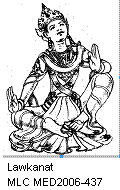 UKT 050115, 130215
--
Buddha and Nat --
"Siddhartha Gautama Buddha is
himself a nat." is one of the
most misleading statements I have come
across in this article. A nat is still
in the Cycle of Births-Rebirths, while
Gautama Buddha after {pari-nib~baan}
is no longer in the Cycle.
UKT 130207:
-- The word "Lokhi Nat"
used by MJG is probably
 {lau:ka.nat}. It is used as a simile for a peace-loving king.
{lau:ka.nat} - n. 1. a
deity revered by the world. 2.
celestial being noted for peacemaking,
usually depicted in dancing posture
with the feet holding timing cymbals.
-- MLC MED2006-437

 The rulers of Pagan, the capital of
classical Burma (Myanmar) were careful
to link the religions of Burma to
traditional Burmese spirit world as
they worked to consolidate the Burmese
state. As Aung-Thwin writes, with
the “process of political and
religious integration, where Buddhism
emerged as the dominant belief system
in a centralized state, the need to
unify the rest of society's numerous
and scattered ancestral spirits and
their cults . . . became compelling.
fn-05
[UKT ¶]
The rulers of Pagan, the capital of
classical Burma (Myanmar) were careful
to link the religions of Burma to
traditional Burmese spirit world as
they worked to consolidate the Burmese
state. As Aung-Thwin writes, with
the “process of political and
religious integration, where Buddhism
emerged as the dominant belief system
in a centralized state, the need to
unify the rest of society's numerous
and scattered ancestral spirits and
their cults . . . became compelling.
fn-05
[UKT ¶]
Burmese rulers placed the Vedic deity
Indra [UKT: refuted. See below] -- who
was closely associated with Buddhism
and a symbol of royalty in both the
Hindu and Buddhist faiths -- at the
head of a national pantheon of spirits
composed of Thirty-Seven Nats. These
became the “guardians of the state
and royal family and guarantors of
dynastic continuity." The pantheon
was divided up to “represent one
of the local ancestors and/or guardian
spirits” each of who was given
an actual fiefdom from the reigning
king. Those of the King's subjects
living in this fiefdom worshipped that
nat throughout their lives, even if
they moved elsewhere.
fn-06
UKT 130215: Vedic deity Indra, or more
properly the Hindu deity Indra, and
the Buddhist Sakka
 {þi.kra:ming:} are two very different
characters. A close reading the
literature shows the former to be a
war-lord, a drunkard and a womanizer
(an adulterer who goes after other
people's wives), whereas the latter
is a "saint".
{þi.kra:ming:} are two very different
characters. A close reading the
literature shows the former to be a
war-lord, a drunkard and a womanizer
(an adulterer who goes after other
people's wives), whereas the latter
is a "saint".
It should also be noted that the word
Indra stands for the "office of
the king" of the lowest Deva
world
 {dé-wa. lau:ka.}. According to
Buddhism there are other Deva worlds
above the "Indra-dom"
(glorified "kingdom"),
and that of the
{maar nût} to be the highest.
{dé-wa. lau:ka.}. According to
Buddhism there are other Deva worlds
above the "Indra-dom"
(glorified "kingdom"),
and that of the
{maar nût} to be the highest.
The thoroughness with which the Kings
of Burma pursued the formalization
of nat worship can be seen in the
fact that by the 11th century Burmese
Kings incorporated recognition of nats
into Buddhist rites, over-ridding the
Buddhist doctrine of no soul .
[UKT ¶]
The seriousness in which they pursued
this process is revealed in the fact
that when a King or Queen died on the
throne, golden images of the deceased
royalty were made and displayed in
the Hall of Ancestors three times a
year. In effect, through veneration,
they sought the status of nats themselves,
and with good reason. The Burmese
worshipped nats in an effort to get
them to intervene in their favor. This
was particularly true if the nat was
the spirit form of a person who had
died before their time, a condition
known as a "
green death"
 {a.saim:þé}, for these spirits
were considered capable of great evil
if not propitiated. Such spirits were,
accordingly, greatly feared by the
populace, all the more so if they were
royal! As Aung-Thwin observed, if a king
or popular hero died a green death his
“malevolent spirit could affect
the entire culture. ”
fn-07
{a.saim:þé}, for these spirits
were considered capable of great evil
if not propitiated. Such spirits were,
accordingly, greatly feared by the
populace, all the more so if they were
royal! As Aung-Thwin observed, if a king
or popular hero died a green death his
“malevolent spirit could affect
the entire culture. ”
fn-07
Of course, Burmese royalty recognized
that it was through propitiation and
veneration that nats were created:
the longer the power of an individual
spirit was respected, the greater its
power and prestige. In what must rank
among one of the more interesting
chapters of religious history, Burma's
kings, through
the creation of the pantheon of the
Thirty Seven nats, employed this
process to their political advantage
by using it to help co-opt political
opposition. [UKT ¶]
UKT 130216: Using religion to
political advantage is not only
confined to Burma. We should look
into how Emperor Constantine
consolidated and expanded his power
using Christianity as a means. No
doubt Constantine was a devout
Christian as Anawratha was Theravada,
but there are strong parallels
between the two in using religion. See:
http://www.pbs.org/wgbh/pages/frontline/shows/religion/why/legitimization.html
130216
It appears that all [UKT: there are
exceptions] the nats in the pantheon
had died a green death and most of
them had done so at the
“wrongful” command of the
King! [UKT: ¶]
UKT: An exception would be Htihpru Hsaung Nat.
He did not have to die a violent death:
he was old, and enjoying all comforts
of a king thanks to his son King Anawrahta.
So we should interpret "green death"
as due to great attachment to something,
someone, or some cause.
By elevating these to the level
of national recognition, the Burmese
Kings demonstrated their sensitivity
to injustice and their righteousness
in offering redress of grievances.
Notably, the names of the nats in
the pantheon could change over time
to suit contemporary political needs,
deeds and misdeeds, but the number
was kept at thirty seven to reflect
the stability of a spirit world in
which each Burmese dynasty was
represented. [UKT ¶]
UKT 130215: What is the significance
of the numeral 37? It can be understood
readily if we are to note that the
number is 36+1. The numeral #1, is
the increase due to Anawrahta's
"appointment" of Sakka
{þi.kra:ming} to rule over the 36.
So we must look for the significance of
#36, or its factor #3.
¤ 12 Zodiacal constellations
¤ 12 months in a year
¤ 12 gates in a city
¤ 12 years for the planet-Jupiter to make one round of the
celestial sphere, etc.
The pantheon of the Thirty Seven Nats
thus offered the ultimate in continuity
and organization, while providing
“for the assimilation of disparate
groups and individuals would might
otherwise have been disconnected by
time, place and social structure from
one another, thereby bonding the
society's past leadership with
the present.”
fn-08
Thus it was that in Burma, nats
protect not only the bonds between
the people and their rulers, but
also the bonds between the
generations of the living with
their ancestors.
UKT:
The creation of the pantheon of the Thirty
Seven natsin Folk-elements in
Burmese Buddhism by Dr. Htin Aung: --
flk-ele-indx.htm (link chk 130215).
See in particular "
Anawrahta tries to suppress Nat-worship"
(link chk 130215) and the subsequent "
He finally allows it to survive with
modifications" (link chk 130215)

 Students can approach the royal aspects
of nat worship in various ways. Younger
students can examine the stories of how
people came to be nats. Two of the most
famous stories well illustrate the
forces at work in nat formation.
Shrines on either side of the gates
of the royal city of Pagan are devoted
to Maung Din De
Students can approach the royal aspects
of nat worship in various ways. Younger
students can examine the stories of how
people came to be nats. Two of the most
famous stories well illustrate the
forces at work in nat formation.
Shrines on either side of the gates
of the royal city of Pagan are devoted
to Maung Din De
 {maung-ting.tèý} and his sister Shwe Myak Hna
 {rhwé-myak-nha}

 (known as Golden Face) who were put to
death unjustly by a king. [UKT ¶]
(known as Golden Face) who were put to
death unjustly by a king. [UKT ¶]
Alternatively, students can explore
the story of Popa Medaw
 {poap-pa: mèý-tau} (literally, mother
at
{poap-pa: mèý-tau} (literally, mother
at of Mount Popa).
She was the mother of two men who were
given the fiefdom of the region around
Mount Popa, and later wrongly suspected
of betraying the king and executed by
him. [UKT ¶]
UKT 130215: The two men mentioned
above were military heroes
 {rhwé-hpyiñ:lé:} and his elder brother
who after a campaign had been lapsing
in their assigned duties. They were
executed by their commander Kyansittha
on disciplinary grounds. Much, much
later, Kyansittha became one of
greatest kings in Pagan history.
{rhwé-hpyiñ:lé:} and his elder brother
who after a campaign had been lapsing
in their assigned duties. They were
executed by their commander Kyansittha
on disciplinary grounds. Much, much
later, Kyansittha became one of
greatest kings in Pagan history.

They can also explore the role of
important nats in Burmese mythology:
such as the Wizard or Alchemist (Zawgyi).
[UKT: factual error] The Alchemist is
a figure of great joy as he represents
the relationship between man and nature,
whose curative powers he employs as
a salve to illness and a balm to human
strife. [UKT ¶]
As he is also a stock figure in the
rich and colorful tradition of Burmese
puppetry, he can act as a door to a
world of the imagination younger
students will find beautiful as well
as fascinating. Older students may
wish to make a virtual visit the
Alchemist's shrine on Mount Popa,
on whose summit shrines to Burma's
principle nats can be found.
 [UKT ¶]
A performance of Burmese puppetry is
not beyond the capabilities of any
class. Atlanta's renowned Center for
the Puppetry Arts has the world's
largest collection of materials on
puppetry arts and information on
Burmese puppetry (www.puppetry.org).
On-line resources include a photographic
file offering photographs of a set of
the Burmese puppetry pantheon at
http://www.myanmar.com/gov/puppet.html.
The richness of Burmese Buddhism is
discussed at a related site:
http://www.myanmar.com/gov/tourist/rel.html.
Students can also compare it with, or
use as an alternate focus, the Indonesian
puppet tradition (wyang kulit).
UKT: The Alchemist,
 {zau-gyi} should not be classified
with Nats. He is never revered because
of his sexual exploits. Those who
are revered are the
{zau-gyi} should not be classified
with Nats. He is never revered because
of his sexual exploits. Those who
are revered are the

 {waiz~za Bo:tau:} who are on a par
with the Indian Mahatmas.
{waiz~za Bo:tau:} who are on a par
with the Indian Mahatmas.
More senior students of wider Asian
civilization will find a remarkable
modern parallel in the evolution of
Shinto in Japan from the diverse
veneration of thousands of divine
spirits called kami into a national
cult called State Shinto from 1868
to 1945.fn-09
9
Contents of this page
 The people of Thailand, like their
Burmese counterparts, seamlessly combine
Buddhism and spirit worship. This is
most visible in popularity of the
“tree-saving monks” of
northern Thailand, which has recently
attracted international attention. [UKT ¶]
The people of Thailand, like their
Burmese counterparts, seamlessly combine
Buddhism and spirit worship. This is
most visible in popularity of the
“tree-saving monks” of
northern Thailand, which has recently
attracted international attention. [UKT ¶]
The most visible evidence of spirit
worship in that country is the
ubiquitous Thai "spirit house".
Spirits may act as guardians of a gate
or a house, but they also dwell in
nature and wise men and women offer
their respect to them by creating homes
for them, particularly where the natural
environment has been harmed or
obliterated by human beings. No visitor
to Bangkok, or even to a traditional
Thai restaurant in the United States,
will have any difficulty in seeing
these structures, festooned with
offerings of flowers and votive figures.
Fortunately, a rather wide door to has
been opened onto the subject at
http://infothai.com/wtcmcr/sprthous.htm.
Students can easily produce a replica
of a spirit house out of paper or of
any kind of wood; popular in Bangkok
today are stucco and concrete spirit
houses. A model for a paper-cut spirit
house can be obtained by writing to
the author at
mgilbert@ngcsu.peachnet.edu.
The world of spirits is omnipresent
in the city of Bangkok. Migrants from
the north bring their graceful teak
spirit houses onto their apartment
balconies while the city itself has
a richly adorned linga, that
potent Hindu symbol of fecundity and
creative power, which in Bangkok serves
(as does a similar image in Mandalay
[UKT refutes]) to act as the city's
guardian. Bangkok's Chinese community
has its own guardian, Sam Po Shan
(Sam Po Tai Shen in Chinese). This is
the spirit-form of Admiral Cheng Ho,
leader of the Ming naval expeditions
to southern Asia. Appropriately enough,
he also serves as the guardian spirit
of travelers in Thailand and in Malaya,
where he made earthly visitations in
the 1400s.
Thailand does not have a spirit pantheon
similar to the Burmese thirty-seven Nats.
Instead, Thai kings represented
themselves as rulers and patrons of all
religions. This posture was well suited
to the diverse peoples whose loyalty
they sought to command. An element of
Burmese spirit worship has recently
made itself known in Thailand. [UKT ¶]
The Thai monarchy has recently been
threatened by the political and economic
turbulence that has wracked the Thailand.
To their rescue, and to the rescue of
the nation, has come an effort to deify,
or raise to the status of a national
spirit, Chulalongkorn, or Rama V, son
of King Mongkut. Mongkut has been
immortalized in the West in theater
and film productions of the "King and I."
His son, however, has always held
an even greater place of respect among
the Thai people for presiding with
considerable wisdom and political
aplomb over the modernization of the
Thai nation.
http://aseanfocus.com.au/gateway/thailand/1990sP6.asp.
At its most recent hour of need, a
popular movement has grown that is
attempting to secure a higher spiritual
status for Chulalongkorn.www.pscw.uva.nl/lets7/religion.html-scroll down
to "A cult between Patronage and Civic Society."
Though Thailand has no official pantheon
of Nats after the Burmese example,
it may soon have a supernatural dynastic
figure that may also act as a guardian
of national order and prosperity.
www.chaipat.orgth/journal/dec98/eng/activity.html .
Students can be asked to follow
the Thai example by recommending
"national spirits" for their own
home nation.
Contents of this page
 The "spirit worship" elements of
Balinese Hinduism have received
sufficient attention as to warrant
little explication here. It may
suffice to say that while the
semblance of classical Hindu theology
and ritualized forms of worship
are apparent in Bali, among common
Balinese it is the Hindu symbol and
ritual that most often serves
indigenous ends, or is superceded
by indigenous concerns. [UKT ¶]
The "spirit worship" elements of
Balinese Hinduism have received
sufficient attention as to warrant
little explication here. It may
suffice to say that while the
semblance of classical Hindu theology
and ritualized forms of worship
are apparent in Bali, among common
Balinese it is the Hindu symbol and
ritual that most often serves
indigenous ends, or is superceded
by indigenous concerns. [UKT ¶]
The most extreme departures include
temples open to the sky, altars devoid
of images, the emphasis placed the
battle between good and the Rangda/Barong
dance: the witch-widow Rangda bears
a resemblance to the powerful Hindu
deity Durga, but the Barong and her
dance with him have little connection
to Indian lore. These departures, as
well as the more obvious links
between Bali and India, offer the
richest foci for course related activities.

 These include classroom assemblages
of a Balinese temple and family
compound or reproductions of Balinese
spirit figures. Perhaps the most
fruitful K-12 exercise would be
reproductions of a room altar or
the ngedjot, the daily offering.
More advanced students might write
essays comparing Balinese funerals
with their Indian and Western
counterparts, the role of women in
folk religion, or comparing Indian
and Balinese modalities
These include classroom assemblages
of a Balinese temple and family
compound or reproductions of Balinese
spirit figures. Perhaps the most
fruitful K-12 exercise would be
reproductions of a room altar or
the ngedjot, the daily offering.
More advanced students might write
essays comparing Balinese funerals
with their Indian and Western
counterparts, the role of women in
folk religion, or comparing Indian
and Balinese modalities

 of worship of the chief manifestations
classical Hindu spiritual reality,
Brahma, Shiva and Vishnu (to which
the Balinese add Sanghyang Widi,
supreme god). Gateways to Balinese
animism and material of great use
in shaping classroom exercises can
be found at
http://bali-paradise.com/bali/culturecustoms.html.
of worship of the chief manifestations
classical Hindu spiritual reality,
Brahma, Shiva and Vishnu (to which
the Balinese add Sanghyang Widi,
supreme god). Gateways to Balinese
animism and material of great use
in shaping classroom exercises can
be found at
http://bali-paradise.com/bali/culturecustoms.html.
Contents of this page
Javanese syncretism is the subject
of many studies useful for student
projects. Jean Johnson has prepared
an excellent guide on this subject
for both teachers and students entitled
"Decoding Borobubur", available
directly on the web at
http://www.askasia.org/frclasrm/lessplan/100070.htm.
Other sources, which address the
Javanese synthesis of Islam,
Hinduism, and Buddhism in dance,
music, and medicine (as well as
the mariginalization of Christianity)
can be found at the following websites:
Of particular value is an old site
which provides ditailed answers to
two significant questions:
1) How have the people of Java
integrated their indigenous religions
with that of Hinduism and Islam?
2) What are some important symbols
of this Javanese cultural synthesis?
Other forms of Javanese symbolism may
be found at the following website:
http://www.medieval.org/music/world/java.html
http://www.joglosemar.co.id/mataramking.html
http://home.wxs.nl/~bvg-s/JavArtCD.html
http://www.mallard.org/more/javapup.htm
Contents of this page
Study Questions
The above discussion, the resources
that follow and web-based scavenger
hunts should enable students to
address the following question.
Define the terms animism, ancestor
worship, shaman, guardian spirit,
anito, faith healer, Bodhisattva,
Rangda, Barong, and spirit possession.
How are the indigenous religious
beliefs of Southeast Asia expressed
in ritual, music, holidays dance,
puppetry or architecture? Can you
identify an aspect of
Muslim/Hindu/Buddhist/Christian belief
or practice that suggests the presence
of indigenous religious practice?
What are some examples or the persistence
of indigenous spirit traditions in the
modern Southeast Asian religious
practice? What role does spirit
worship play in the daily lives of
Southeast Asians? Discuss the role
of women indigenous/exogenous
religion in Southeast Asia. Discuss
the process by which religion and
politics became intertwined in
Southeast Asia. Why would a people
seek to venerate their ancestors?
What aspects of Buddhism, Christianity,
Hinduism, Islam or Taoism open a
door to the inclusion of spirit
worship? What forces act to exclude
it? What are some forms of spirit
worship in Southeast Asia that bear
comparison to those in Africa, Europe,
the Americas or your own neighborhood?
Contents of this page
Resources
Infusing the spirit world of Southeast Asia
into any curricula may depend upon the
availability of several components:
Teacher-training materials, visual aids,
test banks, exercises and in-classroom
activities. It is intended that, in time,
all the materials mentioned above,
a bibliography, a filmography,
original videotaped programming and
a Web resource directory will soon
be housed at the Teaching World History
in Georgia Web Site. This Web Site
resides on the NGCSU Department of
History and Sociology Homepage at
www.ngc.peachnet.edu/Academic/Arts_Let/History/deptweb/index.htm.
The slides employed in this presentation
will also be available on the
Teaching World History in Georgia Web Site.
Contents of this page
Teacher Aids
There are some useful teacher oriented
materials in print. The Southeast Asia
Outreach Program of the University of
Hawaii has series of workbooks for
each nation in Southeast Asia geared
at the secondary and post-secondary
level that features excellent
background material on the Southeast
Asian Spirit World for students and
teachers. These workbooks also feature
tests, maps, bibliographies and
exercises. They are available
through e-mail via
cseas@hawaii.edu. They can
also be obtained by calling
(808) 956-2688 or by Fax (808) 956-2682.
Contents of this page
Bibliography of books, films, and web resources
• Beatty, Andrew.
Varieties of Javanese Religion: An Anthropological Account. Cambridge, U.K.: Cambridge
University Press, 1999. Most recent work on Javanese religion.
• Dang Nhat Minh, dir.
When the Tenth Month Comes (90 minutes) is a striking 1984 35mm black and white
Vietnamese film about a woman struggling to raise a child with a husband who is missing in action. A little
light comes into her life when a local schoolteacher, who is helping her to keep her husband's likely death
from her son and aged father-in-law, falls in love with her. At a key moment, the village god aids her by
providing a kite for the child (or was it the schoolteacher?). The final resolution of the story comes only
when the child, who runs away, finds a passing group of soldiers who bring a moving climax to the film. The
centerpiece of the story, however, is its exploration of the Vietnamese day of the dead (held during the
Tenth Lunar Month) when the departed visit the living. During the festival, the wife finds the spirit of her
husband and he tries to bring some peace into her world.
• Dundes, Alan, ed.
The Cockfight: A Casebook. Madison, Wis.: University of Wisconsin Press, 1994.
This edited volume includes the “first person account” of an illegal Balinese cockfight by
anthropologist Clifford Geertz that is very accessible to students (see below for another source for this
essay). Geertz's work can be employed along side a companion essay in this work by Scott Guggenhiem on
cockfighting in the Philippines.
• Fadiman, Anne.
The Spirit Catches You and You Fall Down: a Hmong Child, Her American Doctors, and the
Collision of Two Cultures. New York: Noonday Press, 1998. Also on video. Excellent introduction to Hmong
culture and spirit worship. Focus is the study of a Hmong family's response to the tragic illness of a
daughter.
• Geertz, Clifford.
Deep Play: Notes on the Balinese Cockfight. Indianapolis: Bobbs-Merrill, 1972.
Reprinted from Daedalus, vol. 101, Winter, 1972. Delightful story of an illegal cockfight that may be better
at narrative than scholarly analysis, but useful all the same.
• Geertz, Clifford.
The Religion of Java. Chicago: University of Chicago Press, 1974. Most recent
edition of classic source which, while scholars find it dated and methodologically flawed, is still a useful
introduction to the subject.
• Henry, Rodney L.
Filipino Spirit World. Manila: OMF Publishers, 1986. A good introduction to
the “folk” basis and continuing practices of Filipino Christians as seen from a Christian
perspective.
• Krantz, Claire Wolf.
“On Their Own Terms,” in Art in America 84, no. 7 (1996): 35-.
Surveys the impact of animism and western painting on Indonesian art.
Rodrigue, Yves. Nat-Pwe: Burma's Supernatural Sub-Culture. Translated by Roser Flotats. Paintings
of the “Thirty-Seven Nats” by Noel F. Singer. Gartmore: Kiscadale, 1992. Good illustrations; short
on analysis. Now available in paperback via Amazon.com.
• Spiro, Melfor E.
Burmese Supernaturalism. New Brunswick, NJ: Transaction Publishers, 1996. Latest
and revised edition of classic 1978 standard anthropological study of Burmese spirit worship. This and the
work of Sir Richard Temple (see below) are the most useful resources on nat worship.
• Sastroamidjojo, M. S. A.
“A Physicist Looks at the Javanese Shadow-Puppet Performance” at
http://www.mallard.org/more/javapup.htm.
While the title conveys some of this article's interdisciplinary content, it conceals its loving and deeply
spiritual look at the inner workings of a wayang kulit performance that students will find interesting
and informative.
• Temple, Sir Richard Carnac.
The Thirty-Seven Nats: A Phase of Spirit-Worship prevailing in Burma.
London: Kiscadale, 1991. Reprint of classic study by a famous colonial official who respected indigenous
cultures enough to collect their testimony on indigenous religious practice, but not enough to support their
efforts to achieve full self-government!
• Terrada, Alice M.
Under the Starfruit Tree: Folktales form Vietnam. Honolulu: University of Hawaii
Press, 1989. Contains folktales that often touch upon the role of spirit worship.
• Thanegi, Ma.
The Illusion of Life: Burmese Marionettes. Bangkok: White Orchid Press, 1994. An
excellent introduction to the topic with illustrations. Available through the Asia Society in New York.
Contents of this page
Web Resources
Asean Focus Group: http://aseanfocus.com.au/gateway/thailand/1990sP6.asp
Bali Culture and Customs Life-Cycle: http://www.bali-paradise.com/bali/culturecustoms.html
Buddhism 2: http://www.csupomona.edu/~plin/ews430/buddhism2.html
Central Javanese Gamelan:
http://www.medieval.org/music/world/java.html
Day of the Dead:
http://daphne.palomar.edu/library/displays/October99/default.htm
Decoding Borobudur:
http://www.askasia.org/frclasrm/lessplan/l000070.htm
History and Sociology at NGCSU: http://www.ngc.peachnet.edu/Academic/Arts_Let/History/deptweb/index.htm
Javanese Puppets: http://www.mallard.org/more/javapup.htm
Java's Art of Classical Dancing: http://home.wxs.nl/~bvg-s/JavArtCD.html
Materam Kingdom: http://www.joglosemar.co.id/mataramking.html
Religion and Culture: http://www.myanmar.com/gov/tourist/rel.html
The Puppet Theatre in Myanmar: http://www.myanmar.com/gov/puppet.html
WTCMCR-The Thai Spirit House: http://infothai.com/wtcmcr/sprthous.htm
http://aseanfocus.com.au/gateway/thailand/1990sP6.asp
Contents of this page
fn01. Michael Aung-Thwin, Pagan: The Origins of Modern Burma (Honolulu: University of Hawaii Press, 1985):
53. fn01b
fn02. See Rodney L. Henry, Filipino Spirit World (Manila: OMF Publishers, 1986).
-
fn02b
fn03. Gani Wiyono, “Ratu Adil: A Javanese Face of Jesus,”
at
http://www.apts.edu/jam/99-1/99-1-gwiyono.htm
-
fn03b
fno4. Andrew Beatty, “Adam and Eve and Vishnu: syncretism in the Javanese slametan,” in the Journal
of the Royal Anthropological Institute 2, no.2 (1996): 271-
fn04b
fn05. Aung-Thwin, Pagan: 55 fn05b
fn06. Aung-Thwin, Pagan:55 fn06b
fn07. Aung-Thwin, Pagan:53 fn07b
fn08. Aung-Thwin, Pagan:56 fn08b
fn09. Carmen Becker, “Shinto and the Sacred Dimension of Nature”
at
http://www.shinto.org/2-2-e.html
fn09b
Contents of this page
• American Heritage Talking Dictionary (AHTD)
• Childers, R.C.,
A Dictionary of Pali Language,
Kegan, Paul, Trench, Trubner & Co, London, 1909, 5th impr: 1974
•
U Hoke Sein,
The Universal Burmese-Englsh-Pali
Dictionary, 1st ed., {meiz~zu-tha.ka. sa-pé}, Yangon, 1981
• U Khin Maung Than,
Traditional Nat Cult
(in Burmese), 2nd ed, {pin-wa:roan° sa-pé}, Yangon, 2001
• Klein, W,
Burma, Apa Productions (HK) Ltd, 1981
• Min Rama (U Ohn Maung),
Thirty-seven Nat Puja (in
Burmese) {a.theing:a.wun: sa-pé}, Yangon, 1992
• Min Si Thu,
Early History of Nat-worship in Myanmar
(in Burmese), {shwé-daung:taung sa-pé},
2nd printing, Yangon, 2004.
• U Myat Kyaw and U San Lwin,
A Pali Myanmar-English Dictionary (UMK-USL) of the Noble Words of the Lord Buddha,
Myanmar Language Commission, 2001
• Pali Text Society (PTS), Pali-English Dictionary, Oxford,
1999 reprint
• U Ba Than Myanmar Razawin (approved school text},
1st printing 1929, 8th printing
by {eis~hsa-tha.ya.} press, 1964
• U Kalar Maha Razawin Gyi (in Burmese) Hanthawaddy
Press 4th printing 1962
• U Po Kya Thirty-seven Kings (in Burmese), 1st
printing 1937, 2nd printing
by {pa-ra.mi sa-pé}
1999, pp.146
• U Sein Pe, Method of Nine-god Puja (in Burmese),
{shwé-ti~-sa-pé-teik},
Yangon, 1982
• U Than Hswé, Historical Pagan Pagodas (in
Burmese),
{sa-pé-bi-maan} Press, Yangon, 1975
• Dr. Than Tun, Ancient Myanmar History (in Burmese),
{ma.ha-da.gaon sa-pé
htoat-wé-ré:}, Yangon, 1969
• The Glass Palace Chronicle (in Burmese), (GPC-Bur)
Mandalay Royal Printing Press, 1829. 4th printing in 1993 by Information
Ministry, Myanmar.
Contents of this page
UKT, 050115, 130212:
UKT: Because I need a collective term, I will use "All-Spirits" similar
to "All-Hallows".
See Wikipedia:
http://en.wikipedia.org/wiki/Halloween 130212
These are all spirits to the Western mind. Yet to a Bur-Myan,
they are quite different. One thing that is common to all is that they had died
greatly attached to "see-able" world. If they had died with a grudge
against a person, mostly their enemy, they would become Nats; if attached to
property had buried they would become Treasure-guardians; and some unspecified
thing such as an idea, a person, an animal, and even a tree they would become
ghosts.
Now that they are spirits, they would be under the
rule of one of the Four Guardian Gods of the World. Of the three, Ghosts
 {þa.rè:-tis~hsé} are
those who suffered most -- they are still suffering the pains of being killed or
dying under duress. They have hideous appearances (if only you could see them)
and are always "starving" unless somebody "feeds" them: they always suffer from
the pains of hunger.
{þa.rè:-tis~hsé} are
those who suffered most -- they are still suffering the pains of being killed or
dying under duress. They have hideous appearances (if only you could see them)
and are always "starving" unless somebody "feeds" them: they always suffer from
the pains of hunger.
The most favorable are the Nats (properly the Lower Nats
belonging to the group of 37 nats.).
The next are the Treasure-guardians
 {OAc~sa-saung.}. are beautiful beings (if only you could see them) and live quite
pleasurable lives. They are mostly females. Most of them had not died violent
deaths and are guarding the treasures they had owned and which they had hoped to
use some time in the future. Or they had hidden the treasure to be used when the next Buddha
appeared.
{OAc~sa-saung.}. are beautiful beings (if only you could see them) and live quite
pleasurable lives. They are mostly females. Most of them had not died violent
deaths and are guarding the treasures they had owned and which they had hoped to
use some time in the future. Or they had hidden the treasure to be used when the next Buddha
appeared.
All these Spirits are still attached to sensual pleasure, and from time to
time look forward to having sex, and would go after a living person of the
opposite sex and finally lured the living to death, so that they could be
together.
Go back all-spirits-note-b
Contents of this page
-- UKT, 050115, 130211
There are two great schools of Buddhism
which at the present time are quite
different from each other though they
both stem from the teachings of the
historical Gautama Buddha. The Buddhism
that is practiced in Myanmar or Burma
is the Theravada school of Buddhism which
is quite different from the Mahayana
school that is practiced in China and in
Tibet. When I read this paper, I am reading
from the point of view of a Theravada
Buddhist.
However, since I am a material
scientist and a skeptical chemist, and I
have been critically analysing my
traditional beliefs so much so, that, I
believe in only the first, the second and
arguably the third sermons. The rest,
I hold them with an open mind -- not to
believe without evidence is just as bad
as to believe.
The first sermon, gives me a picture of
Siddhartha (a former prince, but now a
hermit) rejecting all "authorities"
and "beliefs", and starting from
a clean slate of mind to discover a
universal truth. He came up with an altruism:
"all sentient entities (human, animals,
or whatever) is not free from mental
suffering".
This Law is the Principal of Suffering.
With law, he had rejected the idea of an
Allah, a God, and a Creator as nothing
but axioms which cannot be verified.
After coming up with this law and the
next -- on the question of "a
permanent principle" that is not
changeable and non-destructible which
is commonly known as Atta, and coming
up with some corollaries, he realized
that he had gained insight into the
nature of things, and that he had become
a Buddha, the enlightened one. Because
his clan name was Gautama, he became
known as the Gautama Buddha. He was
born of human parents, he went through
a life of physical suffering -- suffering
from diseases and physical injuries,
and he died a natural death. He was
cremated and only bits of bones remain.
To me he was one of the scientists who
I could admire, and his teachings are
just pure science.
Go back
Buddhism-note-b
Contents of this page
UKT 130215:
Buddhism recognizes that there is
{wi.Ñaiñ} which is "an ever-changing
aggregate" (not permanent) something
akin to "soul" which passes
from a dying person to the new-born. The
{wi.Ñaiñ} is very different from the
Christian or Hindu idea of a permanent
"soul".
An interesting question has arisen
at one time whether a
{wi.Ñaiñ} can split up into two or more,
thus giving rise to more than one
new-borns. The actual case was related
by my mother of a monk who underwent
a NDE (near-death-experience).
See Wikipedia:
http://en.wikipedia.org/wiki/Near-death_experience
130215
The monk came back, but at the same
time a male child was born. This male
child claimed himself to be the monk,
and could recognized the monk's personal
belongings to be his -- a sign taken
by the locals to be that the child
was the reincarnate monk. But the
monk had recovered and was living.
So the local wisdom was that the
{wi.Ñaiñ} had split into two.
Go back
no-soul-note-b
Contents of this page
-- UKT 050115, 130211
The question of introduction of Buddhism
into Myanmarpré was never an issue in
my mind until I stumble along into the
Akshara form of writing -- technically
Abugida.
Linguistically Burma (English spelling
using Latin Alphabet: Eng-Lat) was and
still is populated by Tib-Bur
(Tibeto-Burman) speakers. This area
stretching form Afghanistan in the west,
through Nepal in the middle, into northern
Myanmarpré, enjoys a unique weather system
due to the Himalayan range cutting
off the cold northern polar winds.
Then sometime in ancient times IE
(Indo-European) speakers crossed over
to northern-western India, and the
Dravidian speakers came in from the
south of India in hordes to subjugate
the Tib-Bur speakers. Burma was
protected by high north-to-south
mountains in the east, and some what
less-high north-to-south mountains
in the west. Large armies, especially
with the war-chariots, could not come
in. Humans, in small companies of even
one or two have been travelling on
foot in this area since the evolution
of pre-humans and possibly
Homo erectus (my presumption
in the Pondaung-Ponnya area).
Gautama Buddha was born in the Tib-Bur
speaking area in Nepal and died just
across the border in India. So I can
very well say that Buddhism was never
introduced into northern Burma -- it
developed in our general area. It is
quite probably that the Buddha himself
had looked east into northern Myanmarpré
from the mountains in Manipur. All
through out human history, humans have
been tracking on foot along this area.
It is recorded in Bur-Myan (Burmese
speech written in Myanmar script)
chronicles that a king, King Abiraza,
from northern India had come into
northern Myanmarpré to found the Pyu
Kingdom of Tagaung long before the
Burmese Kingdom of Pagan came into
being. Since it is definitely easier
to come on foot from northern India
to northern Myanmarpré there is no
reason why Buddhism should have to
come via ship.
It is probable the King Abiraza had
participated in the Battle of Ten Kings
in Ancient India long before the birth
of Gautama Buddha and was fleeing from
the new comers. See Wikipedia:
http://en.wikipedia.org/wiki/Battle_of_the_Ten_Kings
130212
Go back
Buddhism-N-Burma-note-b
Contents of this page
-- UKT 050115, 130211
 The idea of a female Bodhisattva as used
by Mahayanits, such as KuanYin and
Tara, especially the Tara of the Tantra
Buddhists is not acceptable to Theravada
Buddhists of Myanmarpré. The religious
reform brought about by King Anawrahta in
the 11th century and his persecution of
the Ari-monks to extinction was due (my
presumption) to the introduction of Tara
by the Tantric Buddhists into the
Buddhist kingdom of Pagan. A female, as
scantily dressed as Tara of Sri Lanka
was nothing but an erotic sex-object for
the males to enjoy sexually.
The idea of a female Bodhisattva as used
by Mahayanits, such as KuanYin and
Tara, especially the Tara of the Tantra
Buddhists is not acceptable to Theravada
Buddhists of Myanmarpré. The religious
reform brought about by King Anawrahta in
the 11th century and his persecution of
the Ari-monks to extinction was due (my
presumption) to the introduction of Tara
by the Tantric Buddhists into the
Buddhist kingdom of Pagan. A female, as
scantily dressed as Tara of Sri Lanka
was nothing but an erotic sex-object for
the males to enjoy sexually.
Yet many Myanmar-Buddhists, especially
the males, aspire to be bodhisattvas
before the attainment of Nibbana. It
is not the principal aim of a
Theravada-Buddhist. For the females,
who aspire to become a bodhisattva, is
to become a male first. The females can
attain Nibbana straightaway and the idea of
becoming a bodhisattva is nothing but
Self-aggrandizement -- just a form of
conceit.
Because of this attitude, the Mahayana
School "looks down" upon the
Theravada School calling it the Hinayana
or the Lesser Vehicle much to the
chagrin of the Theravada-Buddhists.
In fact, Hinayana is considered to be
a derogatory term. To the Theravadims,
the Mahayanists are just Self-promoters.
Go back
cult-bodhisattiva-note-b
Contents of this page
-- UKT: 050115, 130216
This translation of the Burmese word
{a.saim:} to "green" is a
typical error done by non-Burmese and by
those Burmese who try to play with words.
The Bur-Myan word {a.saim:} when used
together with {þé} or "death"
is not to be translated as the color
green but as <untimely>. Thus,
{a.saim:þé} is not "green death"
but "untimely death". When
a person dies of an
{a.saim:þé} or "untimely death",
he or she dies with a great attachment
to life or with an intense hatred
towards the person responsible for his
or her death. Such a strong
"feeling" usually results
in the person becoming a ghost or a
nat of
 {sa.tu.ma.ha-raiz boän}. Such a nat
is also called a
{sa.tu.ma.ha-raiz boän}. Such a nat
is also called a
 {nût-saim:} which could literally
and erroneously be translated as a
"green nat".
{nût-saim:} which could literally
and erroneously be translated as a
"green nat".
I have been asked how I would
interpret Jesus dying on the Cross
and his subsequent appearances. It
was meant to put me in a bind, for
the questioner already knew my
answer, which I would have to give
in spite of my love and admiration
for the young man who died with
the last words: and
Matthew 27:46 (King James
Version). And about the ninth hour
Jesus cried with a loud voice,
saying,
Eli, Eli, lama sabachthani?
that is to say, My God, my God,
why hast thou forsaken me?
Mark 15:34 (King James
Version). And at the ninth hour
Jesus cried with a loud voice,
saying,
Eloi, Eloi, lama sabachthani?
which is, being interpreted,
My God, my God, why hast thou forsaken me?

with a loud cry giving up his Spirit.
See Wikipedia:
http://en.wikipedia.org/wiki/Sayings_of_Jesus_on_the_cross
130215
What about describing Virgin Mary's
Grotto as a
{mèý-tau nût kwun:}?
http://www.all-about-the-virgin-mary.com/betania-apparitions.html 130215
With apparitions being described, I
have no choice but to vocalize things
that I do not want.
Go back
Green-death-note-b
Contents of this page
UKT 050115, 130214:
Guan-Yin aka Kuan Yin is not
revered in Myanmarpré. Those Bur-Myan
who have heard about this entity are
mainly of Chinese descent. She (or
formerly a "he") is just
another goddess (or god) of the
Mahayana Chinese.
At the end of the above para, MJG has
given a link on Kuan Yin:
http://www.csupomona.edu/~plin/ews430/buddhism2.html.
The link is not active due to a change
in spelling of "Kuan Yin" to
"Guan-Yin" "who switched
from a male in India to a female figure
in China and Japan, becoming the Goddess
of Mercy with the Chinese name Guan-Yin
and the ..." under the title
"Love" and the Eastern spirit:
a philosophic ..."
http://www.csupomona.edu/~jis/1995/ding.pdf 130213
Instead of Guan-Yin, an entity revered
by Theravada Bur-Myan is the Vedic
Mother-goddess (I emphasize Vedic --
not Hindu -- in spite of whatever
"grab-god" Hindu religionists
would say), is
 {mèý-tau þu-raþ~þa.ti.}. She is not
considered to be a
{bau.Di.þût}.
{mèý-tau þu-raþ~þa.ti.}. She is not
considered to be a
{bau.Di.þût}.
Mother-goddess
{mèý-tau þu-raþ~þa.ti.} never was a male.
She is the personification of the Vedic
river Saraswati of the Rig Veda which
was made into a Hindu text by the
Grab-god Hindu religionists. Here we
should note that the Vedic words were
so unpronounceable by the Skt-Dev speakers
of the IE linguistic group, that Panini
had to codified Vedic into Classical
Sanskrit. I hold that Vedic was the
religion of the original inhabitants
of India -- the Tib-Bur speakers --
and it preceded Buddhism (and Hinduism).
Go back
Kuan-yin-note-b
Contents of this page
-- UKT 050115, 130214
Nat-tiger or the tiger-vehicle of the Nat
 {si:tau-kya:}, particularly that of
{rhwé-hpyiñ:lé:} is a very much feared
animal. It is supposed to be a real
animal in the service of the Nat, who
is a womanizer. If he wants a woman,
even when she is already married, he
must have her. Anybody who offended
the Nat
{rhwé-hpyiñ:lé:} can be "carried"
off, either physically or in an
"unseen way" by the Nat-tiger
-- in other words, the offending person
die. As story of this nature is told
about one of 37 female-Nats,
{si:tau-kya:}, particularly that of
{rhwé-hpyiñ:lé:} is a very much feared
animal. It is supposed to be a real
animal in the service of the Nat, who
is a womanizer. If he wants a woman,
even when she is already married, he
must have her. Anybody who offended
the Nat
{rhwé-hpyiñ:lé:} can be "carried"
off, either physically or in an
"unseen way" by the Nat-tiger
-- in other words, the offending person
die. As story of this nature is told
about one of 37 female-Nats,
 {mèý-U.}. The following is what I know
of the story: I still have to check
further.
{mèý-U.}. The following is what I know
of the story: I still have to check
further.
Mè U
{mèý-U.} was a beautiful village woman
in one of the northern Myanmar villages
during the Pagan period. She was already
married to a forester. The Nat, assuming
a human body came in the guise of a
young man, came to her loom. She true
to her husband, spurned off the
advances of the Nat
{rhwé-hpyiñ:lé:}. The would-be adulterator
sent his tiger who promptly carried
her off. She died - obviously eaten by the
animal, with the result that she herself
became a Nat. She, as a Nat became the
mortal enemy of Nat
{rhwé-hpyiñ:lé:}. She, now a Nat, went
to her husband and took his
 {laip-pra} or "soul". He died
and now they are happily united as
husband and wife in the Nat-world.
{laip-pra} or "soul". He died
and now they are happily united as
husband and wife in the Nat-world.
For definition of
{laip-pra}, see:
- n. 2. incorporael part
of a human being, spirit -- MED2006-455
The idea of
{laip-pra} should be compared to that
of the Tibetan Bardo
http://en.wikipedia.org/wiki/Bardo 130214
Were-tiger,
 {þa.mûn:kya:} is a human being who
because of his Left-handed knowledge
or 'black magic' can turn himself
into a tiger and attack a villager
(in the hills of northern Myanmar.}.
{þa.mûn:kya:} is a human being who
because of his Left-handed knowledge
or 'black magic' can turn himself
into a tiger and attack a villager
(in the hills of northern Myanmar.}.
Were-crocodiles are real crocodiles
which have grown so large, over 9
cubits, large that they came to have
the magical power to assume a human
form, marry a human-woman and have
human-children. There is a local
story told in the environs of Rangoon
of the crocodile
 {nga.mo:raip}, who had children by
a human woman and who had live in
the area of the
{nga.mo:raip}, who had children by
a human woman and who had live in
the area of the
 {kyeik-weing:} pagoda. A very large creek
east of Rangoon still bears the name of
{nga.mo:raip}. This is a Mon-Myan story
which has been Burmanized so much that
I still need to go after more details.
It appears that
{nga.mo:raip} and his kind were not to
be feared. He was in the service of
King Okkalapa -- the legendary ruler
of Rangoon or Dagon as it was called.
He used to carry the son of the King
on his back across the Rangoon river
to the Syriam-side to see his lover
princess who was born as her dead
mother was about to be cremated.
Even though she was a princess, because
she was born in a cemetery, she had her
palace in the cemetery.
{kyeik-weing:} pagoda. A very large creek
east of Rangoon still bears the name of
{nga.mo:raip}. This is a Mon-Myan story
which has been Burmanized so much that
I still need to go after more details.
It appears that
{nga.mo:raip} and his kind were not to
be feared. He was in the service of
King Okkalapa -- the legendary ruler
of Rangoon or Dagon as it was called.
He used to carry the son of the King
on his back across the Rangoon river
to the Syriam-side to see his lover
princess who was born as her dead
mother was about to be cremated.
Even though she was a princess, because
she was born in a cemetery, she had her
palace in the cemetery.
The crocodile,
{nga.mo:raip}, had crocodile enemies. A
vicious enemy of his was a female-crocodile
who had lost one of her fore-fingers in
a previous fight with
{nga.mo:raip}. Seeing
{nga.mo:raip} with the prince on his back
in which condition,
{nga.mo:raip} was vulnerable she
approached.
{nga.mo:raip} asked his royal passenger
to get into his mouth, so that he could
swim faster. With the prince safe in
his mouth, and with his mouth shut, he
swam fast to escape. He did, but being
very tired, he forget about the prince.
The king not seeing his son, called up
{nga.mo:raip}, who remembered to open
his mouth. The prince, without much air
in the crocodile's mouth was drawing
his last breath. He died. At the news
the Syriam princess also died of broken
heart. There were two funeral pyres,
one on the Rangoon side for the prince,
and another on the Syriam side for the
princess. The smoke from the pyres rose
into the air and got mingled and then
disappeared. It was a lovely tragic
story which I have heard many times as
a child.
The Kyut or "Un-dead"
 {kyût} (the term "Un-dead"
is my own coined word) are those who
died as a community -- a whole village
-- in the matter of one or two days
due to an epidemic like pneumonic plague.
Since, no one got a burial, none even
noticed that they had died. They came
back to "to life" and came
to possess material bodies after
sun-down and went on carrying their
daily lives until dawn. Some of them,
might got out of their village, visit
the real living and some even got married
to the living and have children -- their
kind. They live a normal "life"
in their material bodies, until a
Right-hand magician comes along, and
tells them that they are dead. Then
they "died" suddenly and
the bodies which they just had
turned into bones.
{kyût} (the term "Un-dead"
is my own coined word) are those who
died as a community -- a whole village
-- in the matter of one or two days
due to an epidemic like pneumonic plague.
Since, no one got a burial, none even
noticed that they had died. They came
back to "to life" and came
to possess material bodies after
sun-down and went on carrying their
daily lives until dawn. Some of them,
might got out of their village, visit
the real living and some even got married
to the living and have children -- their
kind. They live a normal "life"
in their material bodies, until a
Right-hand magician comes along, and
tells them that they are dead. Then
they "died" suddenly and
the bodies which they just had
turned into bones.
An unknowing traveller, just after
sundown might come to a such a village,
and enjoyed the villagers' hospitality
and might sleep there. In the morning
he would find himself among the ruins,
and only then he would realized that
he had been in a
{kyût}-village. It seems that these
{kyût} are harmless and we should
pity them.
It is said that the area of present
Nay-pri-daw is the area of
{kyût}-villages.
Go back
Nat-tiger-note-b
Contents of this page
-- UKT 050115, 130212
The statement "Buddhists view
nirvana not as a place" needs
to be commented on. At least in Myanmarpré,
many usually get confused over the
definition of Nirvana (Sanskrit)
or Nibban
 {nib~baan} (Pali-Myan) because of
popular statements like
{nib~baan} (Pali-Myan) because of
popular statements like
 {nib~baan rhwé præÑ} "the Golden
Country of Nibban". Practically,
a person attains nirvana when he or
she is really free from Greed, Anger,
and Ignorance (which I have narrowed
down to Sex & Pride for ease of
understanding by the Westerners). He
or she is totally then
"detached" from everything
including the very idea of a permanent
Soul.
{nib~baan rhwé præÑ} "the Golden
Country of Nibban". Practically,
a person attains nirvana when he or
she is really free from Greed, Anger,
and Ignorance (which I have narrowed
down to Sex & Pride for ease of
understanding by the Westerners). He
or she is totally then
"detached" from everything
including the very idea of a permanent
Soul.
Nirvana or Nibban is defined by the
Third Principle of Buddhism:
"the state of Cessation of
Attachment".
The following is how I understand
the Four Noble Truths
or (in my parlance) the
Four Principles of Buddhism:
1. Principle of Suffering:
Every sentient being is not free from mental
suffering.
2. Principle of Cause:
Suffering is brought about by Attachment.
3. Principle of Cessation:
Freedom from Attachment is
freedom from Suffering.
4. Mode of Cessation:
Eight aspects are: proper livelihood,
proper endeavor, proper attitude, etc.
Go back
nirvana-note-b
Contents of this page
--
UKT, 050115, 130211
The phrase "the prayers of the
living" needs a bit of clarification.
Some Burmese-Buddhist prayed to
the Spirits to help them in certain
ways to help them in their daily
lives. A common prayer would be to
bring in customers to their business,
to their shops, to punish their enemies,
etc. This is what I understand by
"prayers to". This attitude
is frowned on by the Theravada Buddhist
clergy saying that these Spirits are
powerless: it is only the teachings of
the Buddha that could improve our lives.
Then there is another kind of
"prayer", and that is to be
directed to some higher entity or Law
to help a particular spirit such as
the one who had recently died. This
type of prayer, the "prayer
for" the dead, or prayer for the
spirit is sanctioned by the clergy.
It is believed by the devote Myanmar
Buddhists, that whenever the living
(not necessarily the close relatives)
do a religious act and call on those
in the spirit world to rejoice in the
act, and if an inhabitant of the
{sa.tu.ma.ha-raiz Boän} could
"rejoice" and say
"well-done" or
 {þha-Du.} three times, his status would
improve eventually promoting him to a
Higher Nat world.
{þha-Du.} three times, his status would
improve eventually promoting him to a
Higher Nat world.
Go back to
prayers-of-note-b
Contents of this page
-- UKT 050115, 130211
What is Linga or Lingam? Not wishing
to upset my Hindu friends, let's see
the dictionary meaning:
लिङ्ग «liṅga»
-- n. penis
-- Online Skt Dictionary:
http://spokensanskrit.de/index.php? 130213
= ल ि ङ ् ग -->
 {laing~ga.}
So that leads us to translate Shiva's
Linga as "Shiva's penis".
Now let's see who this Shiva, a divinity,
really was. He is supposedly a Vedic
Deva, but in the oldest Rig Veda hymn,
Gayatri Mantra, he was not mentioned.
There was one entity Sva: , who have
been "interpreted by Hindu
religionists as Shiva. It is to be noted
that these religionists have included
Gautama Buddha, an atheist holding the
Anatta view, as one of the reincarnations
of Vishnu-deva, and so we need not bother
about these "grab-god religionists"
who would readily say "the god you
are worshipping is just one of our minor
gods." Whoever Shiva was, it is
preposterous to imagine that you would
find an "erect penis" in public
in Mandalay, a devout Buddhist city.
I cannot imagine what had led M. J. Gilbert
to state that "the nominally Buddhist
cities of Mandalay and Bangkok have linga
dedicated to the Lord Shiva". What
he had mistakenly maintained as a linga
is nothing but a sign post with a crown
to shed off the rain-water. To the
Myanmar-Buddhists, the Hindu deity Siva
is just one of inhabitants of the Deva
Loka, who is still very much an inhabitant
of the Cycle of Births-Rebirths, and who
has to escape the Cycle. Siva to the
Myanmar-Buddhist is
 {þi-wa. nût} who is under the rule of
{þi.kra:ming:}.
{þi-wa. nût} who is under the rule of
{þi.kra:ming:}.
Go back
Shiva-linga-note-b
Contents of this page
-- UKT: 130214
Those who are interested in this sect
of Islam should read about the Sufi
dargahs in Myanmarpré, and about the
last Mughal Emperor of India who died
in 1862 in exile (by the colonial
British Raj) in Rangoon. He is regarded
as a Sufi saint. See Wikipedia:
http://en.wikipedia.org/wiki/Bahadur_Shah_II
130214
A general account on Sufism:
From Wikipedia:
http://en.wikipedia.org/wiki/Sufism 130214
Sufism or taṣawwuf
(Arabic:
تصوّف )
is defined by its adherents as the inner,
mystical dimension of
Islam.
[1]
[2]
[3]
A practitioner of this tradition is
generally known as a
ṣūfī
(صُوفِيّ). [UKT ¶]
Sufis believe they are
practicing
ihsan (perfection of worship) as
revealed by Gabriel to Muhammad,
"Worship and serve Allah as you
are seeing Him and while you see Him
not yet truly He sees you."
Sufis consider themselves as the
original true proponents of this pure
original form of Islam. [UKT ¶]
They are strong adherents to the principal
of tolerance, peace and against any form
of violence. The Sufi have suffered
severe persecution by their coreligionist
brothers the
Wahhabi and the
Salafist. In 1843 the
Senussi Sufi were forced to flee
Mecca and Medina and head to the
Sudan and Libya.
[4]
Classical Sufi scholars have defined
Sufism as "a science whose
objective is the reparation of the
heart and turning it away from all
else but God".
[5]
Alternatively, in the words of the
Darqawi Sufi teacher
Ahmad ibn Ajiba, "a science
through which one can know how to
travel into the presence of the Divine,
purify one's inner self from filth,
and beautify it with a variety of
praiseworthy traits".
[6]
Classical Sufis were characterised by
their attachment to
dhikr (a practice of repeating the
names of God) and asceticism. Sufism
gained adherents among a number of
Muslims as a reaction against the
worldliness of the early
Umayyad Caliphate (661-750 CE
[4]).
[UKT ¶]
Sufis have spanned several continents
and cultures over a millennium, at first
expressed through Arabic, then through
Persian, Turkish and a dozen other languages.
[7]
[UKT ¶]
"Orders"
(
ṭuruq), which are either
Sunnī or
Shī'ī or mixed
[8]
in doctrine, trace many of their
original precepts from the Islamic Prophet
Muhammad through his cousin
and son-in-law
'Alī, with the notable
exception of the
Naqshbandi who trace their origins
through the first Caliph,
Abu Bakr.
[9]
Other exclusive
schools of Sufism describe themselves
as distinctly Sufi.
[10]
Modern Sufis often perform dhikr after
the conclusion of prayers.
[11]
Some mainstream scholars of Islam
define sufism as simply the name
for the inner or esoteric dimension
of Islam.
[1]
René Guénon in Insights into
Islamic Esoterism and Taoism
(Sophia Perennis 2003) contended
that Sufism was the esoteric aspect
of Islam supported and complemented
by exoteric practices and Islamic
law. [UKT ¶]
However, according to
Idries Shah, the Sufi philosophy
is universal in nature, its roots
predating the rise of Islam and the
other modern-day religions, save for
perhaps Buddhism and Jainism; likewise,
some Muslims consider Sufism outside
the sphere of Islam.
[1]
[12]
UKT: More in the Wikipedia article.
Go back
Sufism-note-b
Contents of this page
-- UKT , 050115, 130211
At least to me, a Theravada Myanmar-Buddhist,
this statement by M. J. Gilbert needs to
be explained. The Cycle of Birth-Rebirth
is made up of 31
 {Boän} or worlds, which are believed to be
stacked one above the other in the Cosmos.
All the inhabitants of the 31
{Boän} are subject to "Suffering"
{Boän} or worlds, which are believed to be
stacked one above the other in the Cosmos.
All the inhabitants of the 31
{Boän} are subject to "Suffering"
 {doak~hka.} and "Pleasure" or
"Enjoyment"
{doak~hka.} and "Pleasure" or
"Enjoyment"
 {þhu.hka.}. Even the inhabitants of
the highest
{Boän} still undergoes "Suffering"
albeit to a minimal extent, whereas even
the inhabitants of the lowest
{Boän} or hell can still enjoy
"Pleasure" to a miniscule
extent.
{þhu.hka.}. Even the inhabitants of
the highest
{Boän} still undergoes "Suffering"
albeit to a minimal extent, whereas even
the inhabitants of the lowest
{Boän} or hell can still enjoy
"Pleasure" to a miniscule
extent.
The human world is a balanced world with
equal amounts of "Suffering"
and "Enjoyment". Above the
human world are the so-called
"Pleasure" worlds because
there is more pleasure than suffering,
and below the human world are the
"Suffering" worlds because
there is more suffering than pleasure.
To a skeptical scientist like me,
many of the 31
{Boän} are beyond our senses and can
be ignored. We live in a world of human
beings and animals. The humans belong
to the human
{Boän} and animals to the animal
{Boän}. The human
{Boän} is more desirable than the animal
{Boän}.
The word "animal" needs to
be explained. An animal is defined as
one who knows only three things:
to eat, to sleep (or rest), and to mate
(or have sex)". The "human"
is a bit more -- he knows all the three
things the animal knows, plus, how to
discern what is "good and proper"
from what is "bad and improper".
Doing "good and proper" leads
to more "good and proper" --
an advancement, and doing "bad and
improper" leads to more
"bad and improper" -- a descent.
The only thing which we should bother
is a human can be reborn into an animal
world and vice versa. Or, a human can be
"reborn" into one of the 29
unseen worlds (the existence of which
is scientifically unproven). Nats
belong to the "unseen world".
The Higher Nats belong to the Nat-worlds
proper or Deva Loka
{dé-wa. lau:ka.} -- i.e. the Pleasure
world, whereas the Lower Nats belong
to to a much lower world or worlds
ruled by a
{sa.tu.ma.ha-raiz nût-ming:} where
there is slightly more "Suffering"
than "Pleasure", and hence
is not to be desired.
Go back
spirit-note-b
Contents of this page
-- UKT 050115,
One of the mysteries of Buddhism,
particularly the Theravada Buddhism,
is Atta
 {ût~ta.} which is loosely translated
by the non-Buddhists as the Soul.
Buddhism rejects the theory of Soul
as irrelevant and maintains that
since no permanent Soul can be
"found", the existence of
a Soul is nothing but a figment
imagination. This is the Theory of Anatta
{ût~ta.} which is loosely translated
by the non-Buddhists as the Soul.
Buddhism rejects the theory of Soul
as irrelevant and maintains that
since no permanent Soul can be
"found", the existence of
a Soul is nothing but a figment
imagination. This is the Theory of Anatta
 {a.nût~ta.}. I have been asked many
times if there is no such thing as
a Soul, that is reborn into the next
existence. The simplest and, therefore,
which is controversial, is that the
Soul is not permanent, and what had
transmigrated is just a very temporary
(not permanent) non-Soul.
{a.nût~ta.}. I have been asked many
times if there is no such thing as
a Soul, that is reborn into the next
existence. The simplest and, therefore,
which is controversial, is that the
Soul is not permanent, and what had
transmigrated is just a very temporary
(not permanent) non-Soul.
Go back
soul-note-b
Contents of this page
-- UKT 050115, 130215
Though many in Myanmar believe that there are bound to nats everywhere, they
do not venerate them, but care for them. And to show our care, on the third
night during the Lighting Festival of Thitingyut, lighted candles are given to
them -- those who live in or around the house: the kitchen, the pot in which
uncooked rice is stored, the drinking water pot, the stairs, large trees nearby,
water-well, and even the latrine (out-house). The candles are given to the nats so that they
can make an offering of light to the Buddha and thereby gain merit. This essence
of this custom is make the humans feel that they are far superior than the lowly
nats.
Go back Unseen-entities-note-b
Contents of this page
-- UKT 050115, 130215
The
alchemist who has obtained supernatural powers is a Zawgyi
{zau-gyi},
He is still a man: a superman.
He must have sex occasionally. However, since he can no longer stand the smell
of a human female, he must resort to "robots". There are trees in the forest
that bears fruits with strange shapes and sometimes these fruits resemble a
human female of perfect form. He plucks this fruit, and with his magical power
make it become alive. He can then have sex with her, until she, the fruit, rots.
However, such trees are scares and not all fruits of perfect shape, and there
are always one than one
{zau-gyi}
ready pluck it. There were "fruit-fights" among
{zau-gyi}.
The
{weiz~za} or Wizard
is more advanced than the sex-starved
{zau-gyi}.
He doesn't need sex anymore. Such
{weiz~za}
have control over lowly
{nûts},
ghosts, and living witches and warlocks. The emblem of
{weiz~za}
is the Swastika. There are two kinds of
{weiz~za}:
those of the Left-hand path with the Left-handed Swastika (the forerunner of the
Nazi Swastika), and those of the Right-hand path with the Right-handed Swastika
-- the Swastika of the Jains.
The Swastika was the emblem of the ancient Harappans of the Indus-Saraswati
civilization of India. See:
http://en.wikipedia.org/wiki/Indus_Valley_Civilization 130214
See Folk Elements in Burmese Buddhism by Dr. Htin Aung, on
Cult of
Alchemy (link chk: 130214)
Go back Waizza-note-b
Contents of this page
End of TIL file
