Update:
2019-05-02 04:27 AM -0400
TIL
Primate Fossils found in Myanmarpré
fossil.htm
A collection by U Kyaw Tun (UKT) (M.S., I.P.S.T.,
USA), Daw Khin Wutyi, Daw Thuzar Myint
and staff of Tun Institute of
Learning (TIL) . Not for sale.
No copyright. Free for everyone.
Prepared for students and
staff of TIL Research Station,
Yangon, MYANMAR
-
http://www.tuninst.net ,
www.romabama.blogspot.com
index.htm | |Top
paleoant-indx.htm
Note: Only some portions of the mentioned references,
extensively edited, are given.
You'll need a geologic timeline to keep you in
perspective. A question to be asked: did geomagnetic reversals effect how the
ancient adventurers fared in their distant travels?

The origin of Man
Multiregional evolution (MRE)
Out of Asia theory
Out of Africa theory - and recent revisions
Out of Europe - and a Greek of course!
Indo-Aryan migration - out of India?
The adventurous primate - now from Myanmarpré
Pondaung formation of Myanmarpré
Afrasia djijidae -
Amphipithecus mogaungensis -
Evolutionary history
Range and ecology
Homo erectus
and H. sapians : the Humans
Denisovan : a subspecies of H. sapian
UKT notes
Contents of this page
 UKT
180228: Where did the modern humans originate?
In which continent, Africa, Asia, or Europe did
they evolved? First and foremost, ignore all religions.
UKT
180228: Where did the modern humans originate?
In which continent, Africa, Asia, or Europe did
they evolved? First and foremost, ignore all religions.
Or, did the modern humans originate only in a single region
and spread out to other regions, or in many regions?
Moreover, how did they communicate with each
other - animal-calls or languages-with-syntax.
Remember that just as there are many variations
in anatomical features, there are many languages
and dialects all because of the use of different
sets of muscles in the throat.
First, let's look into Multiregional evolution
(MRE) model.
Contents of this page
From Wikipedia:
https://en.wikipedia.org/wiki/Multiregional_origin_of_modern_humans
180228
The multiregional hypothesis, multiregional evolution (MRE), or polycentric
hypothesis is a scientific model that provides an alternative explanation to the
more widely accepted "Out of Africa" model of monogenesis for the pattern of
human evolution.
Multiregional evolution holds that the human [Homo ] species first arose
around 2 Ma. (two million years ago) and subsequent human evolution has been
within a single, continuous human species. This species encompasses all archaic
human forms such as H. erectus and Neanderthals as well as modern
forms, and evolved worldwide to the diverse populations of anatomically modern
humans (Homo
sapiens).
The hypothesis contends that the mechanism of
clinal variation through a model of
"Centre and Edge" allowed for the
necessary balance between
genetic drift,
gene flow and
selection throughout the Pleistocene, as well as overall evolution as a
global species, but while retaining regional differences in certain
morphological features.
[1]
Proponents of multiregionalism point to fossil and
genomic data and continuity of archaeological cultures as support for their
hypothesis.
The multiregional hypothesis was first proposed in 1984, and then revised in
2003.
Contents of this page
From Wikipedia:
https://en.wikipedia.org/wiki/Out_of_Asia_theory
180227
"The Out of Asia theory is a
scientific theory which contended that modern
humans first arose in Asia. Most anthropologists
until the mid 20th century preferred Asia, over
Africa, as the continent where the first
hominids evolved.
[1] The
recent African origin of modern humans
("Out of Africa") is the currently
preferred theory."
The out of Asia theory later fell into decline, one of the reasons was
because
Franz Weidenreich merged the Asia hypothesis into the
multiregional origin
(MRE) of modern humans, extending many other regions into his
theory from the Old World with
gene flow
between various populations which influenced many anthropologists of the time.
[17]
[18]
The last support for the out of Asia theory was
due to the finds of fossils such as the
Dryopithecus and Ramapithecus
in Eurasia up until the early 1980s. See Wikipedia:
-
https://en.wikipedia.org/wiki/Dryopithecus
180228
¤ Dryopithecus is a genus of
extinct apes that is known from Eurasia during the
late Miocene period."
- Google definition
¤ Ramapithecus - noun:
a fossil anthropoid ape of the Miocene epoch, known
from remains found in SW Asia and East Africa, and
probably ancestral to the orangutan."
-
https://en.wikipedia.org/wiki/Sivapithecus
180828
¤ Sivapithecus (Shiva's Ape)
(syn: Ramapithecus): is a
genus of
extinct
apes. Fossil remains of animals now assigned to
this genus, dated from 12.2 million years old
[1] in the Miocene Epoch, have been found since
the 19th century in the
Siwalik Hills in the Indian Subcontinent. Any
one of the species in this genus may have been the
ancestor to the modern
orangutans.
UKT 180228: Rama the hero of Ramayana (probably
myth based on history) was the human-king who had
the support of apes and monkeys - as the story goes
- in his battle against the king of Lanka.
Shiva-déva, on the other hand, is nothing but an
axiomatic entity based on human imagination.
Contents of this page
From Wikipedia:
https://en.wikipedia.org/wiki/Recent_African_origin_of_modern_humans
180228
The recent African origin of modern humans,
also called the "Out of Africa"
theory (OOA), recent single-origin
hypothesis (RSOH), replacement
hypothesis, or recent African origin model
(RAO), is, in paleoanthropology, the dominant
[1]
[2] model of the geographic origin and early
migration of anatomically modern humans
(Homo sapiens).
The model proposes a "single origin" of
Homo sapiens in the taxonomic sense,
precluding parallel evolution of traits
considered anatomically modern,
[3]
[4] but not precluding limited
admixture between H. sapiens and archaic
humans. H. sapiens most likely developed in
East Africa between 300,000 and 200,000 years ago.
The "recent African origin" model proposes
that all modern non-African populations are
substantially descended from populations of
H. sapiens that left Africa after that time.
In the 2010s, studies in population genetics have
uncovered evidence of interbreeding of H. sapiens
with archaic humans both in Africa and in Eurasia,
[17] which means that all modern population
groups, both African and non-African (Western
Eurasian, East Asian and Australoid) while mostly
derived from early H. sapiens to a lesser
extent are also descended from regional variants
of archaic humans.
Contents of this page
News story "First human ancestor came
from Europe - not Africa, 7.2 million-yr-old
fossils indicate" ,
by Hannah Osborne, reporter, 5/22/17 at 2:00 PM,
Newsweek Magazine:
http://www.newsweek.com/first-hominin-europe-east-africa-human-evolution-613494
180301
The first hominin species, a line that
eventually leads to humans, may have emerged in
Europe 7.2 Ma. (million years ago) and not Africa
-- the most widely accepted starting point for
our ancestors.
An international team of scientists has presented
two studies that suggest the divergence point between
chimpanzees and humans took place in the Eastern
Mediterranean rather than East Africa. Their findings,
published in PLOS ONE, are based on two fossils
of the species Graecopithecus freybergi,
which were discovered in Greece and Bulgaria
and have now been dated to between 7.2 and 7.1 Ma.
(million years ago).
Previously, scientists had thought hominins
and chimps split between seven and five
million years ago, with the first in the hominin line
emerging in Africa. But these fossils, scientists say,
tell a different story about the onset of human
evolution
Both fossils -- a lower jaw and an upper
premolar -- were examined using state-of-the-art
computer tomography, allowing the scientists to look
at their internal structures.
Their findings showed the teeth are fused in a way
that is characteristic of early humans, including
Ardipithecus and Australopithecus,
the latter of which the famous Lucy fossil
belongs to. The jawbone also had dental root
features that appear to belong to a pre-human rather
than to an ancient chimp.
This raises the possibility that the fossils represent
the oldest hominin ever discovered and that the “major
splits in the hominid family occurred outside Africa,”
they wrote.
Researchers say environmental changes caused the
divergence and used geological analysis to reconstruct
the conditions from the Sahara to the Mediterranean
during this time. They showed that the desert would
have spread far into Southern Europe, creating a
barrier between Africa and the locations where
Graecopithecus was found.
The study has been met with skepticism because the
vast majority of fossil evidence appears to suggest
our ancestors emerged in Africa and migrated outwards.
UKT 180228: As a corollary to early-humans or
pre-humans spreading out from Europe, we will have
to ask how these early-humans communicate with each
other. Did they just use animal-calls or a language
with syntax?
Since the modern great apes can use language to communicate with
each other and amongst themselves, we have to conclude that early-humans and
pre-humans would have language skills:
-
https://en.wikipedia.org/wiki/Great_ape_language 180301
If - and a big if at that - these
early-humans had
used a language, would you call whatever they had used an Indo-Aryan language? I
must now speculate that speech and script develop side-by-side in a
proto-language developing into a full language. This will be our next topic.
Contents of this page
UKT: 130107, 180226

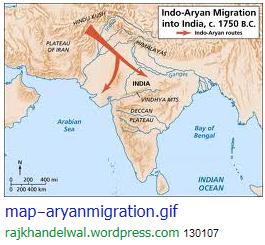
UKT 180227: Don't get confused with the Indo-Aryan Migration, which concerns
the origin of IE (Indo-European linguistic group) speakers. Here we are
speaking about the origin of human species.
UKT 130107, 180227:
There are two theories as to the origin of the
Aryans, self-supposedly the Perfect Race,
coming from the East to West, which opposes
the West to East views held by Euro-centric
scholars who held that everything that is
superior and good has to come from Europe, particularly from Greece.
There is a theory known as Out of India
theory aka Indigenous Aryans theory, is a
linguistic theory of the origin of the
Sanskrit speech. See Wikipedia:
-
https://en.wikipedia.org/wiki/Indigenous_Aryans
180226
The theory does not take into account the equally
important part of language - the script.
Sanskrit-speech is now written in Devanagari-script.
Instead of speculating the origin of the
Devanagari-script, or its forerunner the
Nagari-script, I must point out the oldest stone
inscriptions found in the Indian subcontinent are
those of Emperor Asoka who ruled almost all
of the Indian subcontinent from c. 268 to 232 BCE.
See Wikipedia:
-
https://en.wikipedia.org/wiki/Ashoka
180226.
The Asokan-script (erroneously dubbed the
Brahmi-script) is a phonetic script different from
the Latin-script which is non-phonetic. The
r4c1 consonant-akshara (pronounceable) of
Asokan-script is
 ,
but what we are finding as its equivalent on the
border of Asia and Europe, in the country of
Georgia is
,
but what we are finding as its equivalent on the
border of Asia and Europe, in the country of
Georgia is
თ (U10D7: consonant "Tan"),
ი (U10D8: vowel "In"), and ა (U10D0: vowel "An" - the
Life-giver).
The name of the capital of Georgia - the
country - is spelt the Bur-Myan თ {ta.}.
Then the bombshell: why hadn't the Asokan
Brahmi consonant, which has
the shape of a bola 'the triangular cross'
went along?
It suggests that
Bur-Myan script is
older than the Asokan Brahmi
!

It is Out of Myanmarpré , at least for
the script - a part of language.
The British colonizers specifically, and
the Europeans in general always thought
that every thing has to come from the West, and
they invented now controversial
Aryan Invasion Theory.
The Westerners postulated that from northern India,
culture, particularly the script for writing the
spoken Burmese language spread to southern India,
and then into southern Myanmarpré, and finally made
its way into the heartland of the Bur-Myan people.
I vehemently oppose that colonialist-view.
It is Out of Myanmarpré , at least for
the script - a part of language, an important
aspect of culture that has gone to the West and to
Britain itself - to the land of Saint George!
Now there is a finding and a theory that
at least a primate that had lived in Myanmarpré
37 million years ago, had taken the journey
out of the East and had travelled to the West.
Contents of this page
- UKT 170516, 180226:
UKT 180226: After reading a news article by
Rob Waugh, reporter,
http://www.dailymail.co.uk/sciencetech/index.html
120605 , [article no longer available], it dawned on me to write about the
Adventurous Primate from the north-western area of Myanmarpré, a part of
mainland Asia soon after the continental drifts. India was a part of Africa
which broke apart and drifted towards the mainland of Asia forming the
Himalayas ranges . extending into Myanmarpré forming the Pondaung-formation.
What I've written as an
introduction below is just my opinion with no
intention of insulting anyone living
and axiomatic.
Reading through the world's literature, I was
under the impression that my native Myanmarpré,
the land of my forefathers, was so backward and
undeveloped, that everything had to be imported
from abroad. I accuse the British colonialists
who had promoted such an idea to justify their
robbery and finally their annexation of the
Kingdom of Burma in the 19th century.
 The modern colonialists had made us believe that
it was only because of them - the invaders
- that we have became civilized. I am now finding
out that long time ago, other groups of IE
(Indo-European) speakers had infiltrated the area
of the subcontinent of India. At that time the
culprits were ancient ones headed by Ponnars
The modern colonialists had made us believe that
it was only because of them - the invaders
- that we have became civilized. I am now finding
out that long time ago, other groups of IE
(Indo-European) speakers had infiltrated the area
of the subcontinent of India. At that time the
culprits were ancient ones headed by Ponnars
 {poaN~Na:} worshipping the male axiomatic gods,
Vishnu-déva
{poaN~Na:} worshipping the male axiomatic gods,
Vishnu-déva
 {baiþ~þa.no: nût} and Siva-déva
 {þi-wa. nût}. These invaders did not marched in
or sailed in en masse , but in small groups
or individual boats. They were used to crossing
deserts and oceans using celestial navigation, and
they all wielded superior arms made of iron.
{þi-wa. nût}. These invaders did not marched in
or sailed in en masse , but in small groups
or individual boats. They were used to crossing
deserts and oceans using celestial navigation, and
they all wielded superior arms made of iron.
The area of the Indian subcontinent extending into
South-East Asia, were mostly inhabited by Tib-Bur
(Tibeto-Burman) speakers. They had worshipped female
goddesses or Mothers or Mèdaws, such as
Mèdaw Thurathati
 {þu-raþ~þa.ti mèý-tau}, the anthropomorphised
human-knowledge, known and yet to be known. She is
not a Dévi: not a female déva. She is just a Mother
{þu-raþ~þa.ti mèý-tau}, the anthropomorphised
human-knowledge, known and yet to be known. She is
not a Dévi: not a female déva. She is just a Mother
 {mèý-tau}, an anthropomorphic form of something
such as a country, or even the terrestrial Earth
on which the humans and animals live. They were
mostly agriculturalists, not used to star-gazing
for celestial navigation. They need to know only
about weather and seasons when to start growing
and begin harvesting their crops. They had no time
for military exploits, and when the invaders came,
the natives had only bronze-age weapons to fend off
the ancient colonialists. And of course they lost
and were made into slaves.
{mèý-tau}, an anthropomorphic form of something
such as a country, or even the terrestrial Earth
on which the humans and animals live. They were
mostly agriculturalists, not used to star-gazing
for celestial navigation. They need to know only
about weather and seasons when to start growing
and begin harvesting their crops. They had no time
for military exploits, and when the invaders came,
the natives had only bronze-age weapons to fend off
the ancient colonialists. And of course they lost
and were made into slaves.
 The conquerors, because of their military conquests
thought highly of themselves, and considered the
conquered peoples to be inferior. The intellectuals
amongst the conquistadors - the Poannars
{poaN~Na:} started out writing "stories"
which they claimed to have been heard
directly from their gods, [I wonder what kind of
sound waves were involved: it could be just their
imaginations!].
The conquerors, because of their military conquests
thought highly of themselves, and considered the
conquered peoples to be inferior. The intellectuals
amongst the conquistadors - the Poannars
{poaN~Na:} started out writing "stories"
which they claimed to have been heard
directly from their gods, [I wonder what kind of
sound waves were involved: it could be just their
imaginations!].
The interlopers then claimed that it was only
because of them that the natives had improved,
and had been salvaged from wrong religions!
Theirs is the Right-Hand Path, but those
which had been practiced by the natives is the
Left-Hand Path - just Black Magic.
They changed the Védas of the natives, branding
the useful branches of useful knowledge - such as
those of astronomy, linguistics, mathematics, and
medicine, into supporting "limbs" Vedanga: and
promoted the "worship of their gods"
into the main "body". They appointed
themselves as "specialists" and various
kinds of "specialists of sacrificial
worship".
They demoted the king of heaven Indra [likened to
the father], his consort Soma [likened to be the
Mother to bring comfort to the children], and his
messenger Agni. They further turned Soma into an
intoxicant - a psychedelic drug to delude their
followers and awed the conquered peoples
They promoted Vishnu-déva and "humanized"
Siva-déva from a fierce storm god bent on destruction
and death to be the protector of themselves and their
slaves, and assigned everyone to his god-assigned duties thereby
created "castes". They married off the
{mèý-tau} of the natives as wives of their male gods
unwitting making Siva into the most promiscuous male
who uses his wives as "sex-slaves". They
portrayed Siva as one enjoying perpetually sex with Parvati (a mother-goddess of the natives) in full
public view!
Contents of this page
UKT 180227: The fossil primate mentioned by
Rob Waugh, in his news-report,
http://www.dailymail.co.uk/sciencetech/index.html
120605 , is A. djijidae .
From Wikipedia:
https://en.wikipedia.org/wiki/Afrasia_djijidae
130106,
161006, 170516, 180227
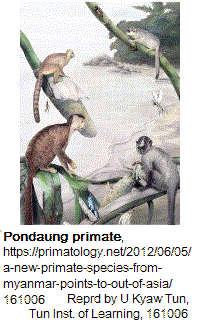 Afrasia djijidae is a fossil
primate that lived in Myanmarpré approximately
37 Ma. (Million years ago), during the late middle
Eocene-epoch in the Paleogenic-period.
Afrasia djijidae is a fossil
primate that lived in Myanmarpré approximately
37 Ma. (Million years ago), during the late middle
Eocene-epoch in the Paleogenic-period.

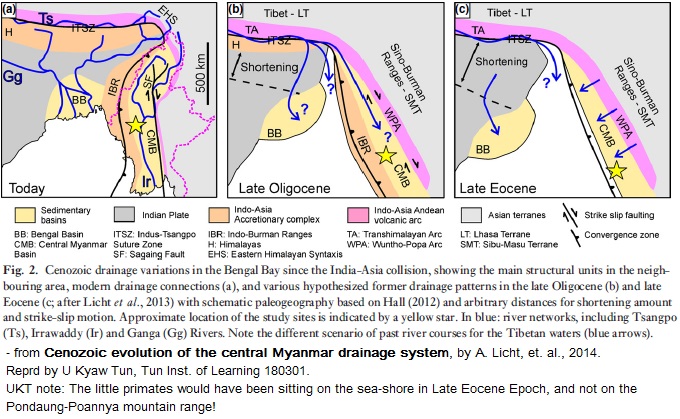
Maps: Cenozoic evolution of the central Myanmar drainage system:
insights from sediment provenance in the Minbu Sub-Basin by A. Licht, L.
Reisberg, C. France-Lanord, Aung'naing Soe, and J-J. Jaege, 2014
-
ALichtEtAl-CenozoicMyanDrainage<Ô> /
Bkp<Ô> (link chk 180301)
 The only species in the genus
Afrasia, it was a small primate,
estimated to weigh around 100 grams (3.5 oz).
Despite the significant geographic distance
between them, Afrasia is thought
to be closely related to
Afrotarsius, an enigmatic fossil
found in Libya and Egypt that dates to 38–39
Ma. [UKT ¶ ]
The only species in the genus
Afrasia, it was a small primate,
estimated to weigh around 100 grams (3.5 oz).
Despite the significant geographic distance
between them, Afrasia is thought
to be closely related to
Afrotarsius, an enigmatic fossil
found in Libya and Egypt that dates to 38–39
Ma. [UKT ¶ ]
If this relationship is correct, it
suggests that early
simians (a related group or
clade consisting of monkeys, apes,
and humans) dispersed from Asia to Africa
during the middle Eocene Epoch and would add
further support to the hypothesis that
the first simians evolved in Asia,
not Africa. [UKT ¶ ]
Clade
https://en.wikipedia.org/wiki/Clade 180302
"A clade (from Ancient Greek:
κλάδος,
klados, "branch") is a group
of organisms that consists of a common ancestor
and all its lineal descendants, and
represents a single "branch" on the
"
tree of life".
[1]"
Neither Afrasia nor Afrotarsius,
which together form the family
Afrotarsiidae, is considered
ancestral to living simians, but they are part
of a side branch or stem group known as
eosimiiforms. Because they did not
give rise to the stem simians that are
known from the same deposits in Africa,
early Asian simians are thought to have
dispersed from Asia to Africa more than
once prior to the late middle Eocene.
Such dispersals from Asia to Africa also
were seen around the same time in other
mammalian groups, including
hystricognathous
rodents and
anthracotheres.
Afrasia is known from four isolated
molar teeth found in the Pondaung Formation
of Myanmarpré. [UKT ¶]
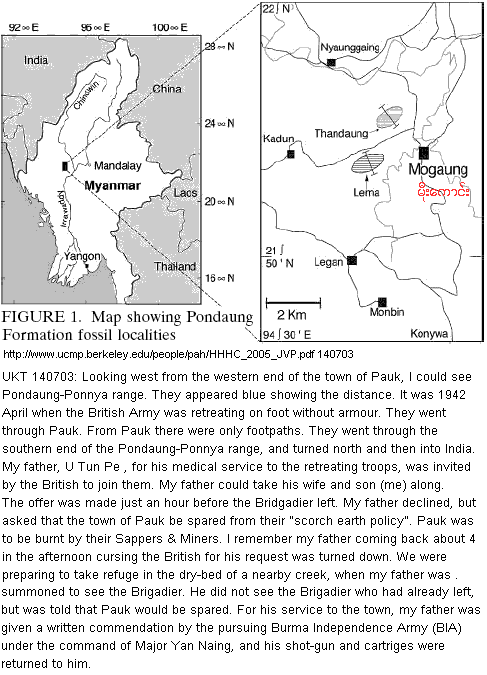 These teeth are similar to
those of Afrotarsius and
Eosimiidae, and differ only in details
of the chewing surface. For example, the
back part of the third lower molar is
relatively well-developed. In the
Pondaung Formation, Afrasia
was part of a diverse primate community
that also includes the eosimiid
Bahinia and members of the families
Amphipithecidae and Sivaladapidae.
These teeth are similar to
those of Afrotarsius and
Eosimiidae, and differ only in details
of the chewing surface. For example, the
back part of the third lower molar is
relatively well-developed. In the
Pondaung Formation, Afrasia
was part of a diverse primate community
that also includes the eosimiid
Bahinia and members of the families
Amphipithecidae and Sivaladapidae.
The name Afrasia derives from the
continental names "Africa" and
"Asia", and refers to the
occurrence of eosimiiform primates on both
continents. The species, A. djijidae,
was named in memory of a young girl from
Mogaung
 {mo:kaún:} village in central Myanmarpré.
[1]
{mo:kaún:} village in central Myanmarpré.
[1]
Contents of this page
UKT 180227:
From Wikipedia:
https://en.wikipedia.org/wiki/Amphipithecus 180226
Amphipithecus mogaungensis ("ape-like creature of Mogaung",
derived from the
Ancient Greek , was a primate that
lived in Late
Eocene
Myanmar. Along with another primate
Pondaungia cotteri, both are difficult to categorise within the order
Primates.
What little is known suggests that they are neither
adapiform or
omomyid
primates, two of the earliest primate groups to appear in the fossil record.
Deep mandibles and mandibular molars with low, broad crowns suggest they are
both simians,
a group that includes monkeys, apes, and humans, though more material is needed
for further comparison. The teeth also suggest that these were
frugivore
primates, with a body mass of 6–10 kilograms (13–22 lb).
[1]
In early 1923, notable fossil prospector,
Barnum
Brown (famed for discovering the first
Tyrannosaurus rex skeleton) traveled with his wife Lilian Brown to
Yangon, the
capital of
Myanmar. Brown focused his fossil prospecting along areas of Pondaung
Sandstone.
It was in the outskirts of
Mogaung town
that he identified a mandible with three teeth (Right). He did not recognise the
significance of his find until 14 years later, when
Edwin H. Colbert identified the fossil as a new species of primate and the
earliest known anthropoid in the world.
[2]
Contents of this page
UKT 180301: Don't run away with the idea that Afrasia djijidae and
Amphipithecus mogaungensis were pre-humans. They were at their best
ape-like creatures, and they lived in the late Eocene Epoch more than 30 million
years ago when the Himalayas and its extensions into Myanmarpré, such as the
Pondaung-Poannya range were being formed. See maps given above: Cenozoic evolution of the central Myanmar drainage system:
insights from sediment provenance in the Minbu Sub-Basin by A. Licht, L.
Reisberg, C. France-Lanord, Aung'naing Soe, and J-J. Jaege, 2014. The little
primates would have lived along the sea-shore.
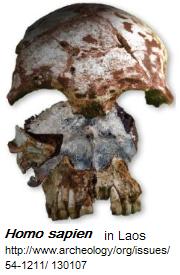
What can be called humans, from the fragments of a human skull found Tam Pa Ling
Cave in Laos, dated between 46,000 and 63,000 years old (not even 1 Ma.) came
into existence after many million years. after the little adventurous primates.
See Wikipedia:
-
https://en.wikipedia.org/wiki/Tam_Pa_Ling_Cave 180301
"Tam Pa Ling (Cave of the Monkeys) is a cave in the
Annamite Mountains in north-eastern Laos. It is situated at the top of Pa
Hang Mountain, 1,170 m (3,840 ft) above sea level.
Three
hominin
fossils have been discovered in the cave: TPL1, a skull belonging to
an
anatomically modern human; TPL2, a
mandible
with both modern and
archaic traits; and TPL3, a partial mandible with both modern and
archaic traits. The three fossils represent three separate individuals and date
from around 70,000 to 46,000 years old.[1]
The discoveries definitively established that modern humans had migrated to
Southeast Asia by at least 60,000
BP.[2][3]
So it would not be entirely correct to say that Myanmarpré was the place of
origin of the humans - that
 {lu-þa: a.sa. ba.ma-præÑ ka.} is not wholly tenable. Instead of which we should
say that
Afrasia djijidae , is a missing link in human evolution.
{lu-þa: a.sa. ba.ma-præÑ ka.} is not wholly tenable. Instead of which we should
say that
Afrasia djijidae , is a missing link in human evolution.
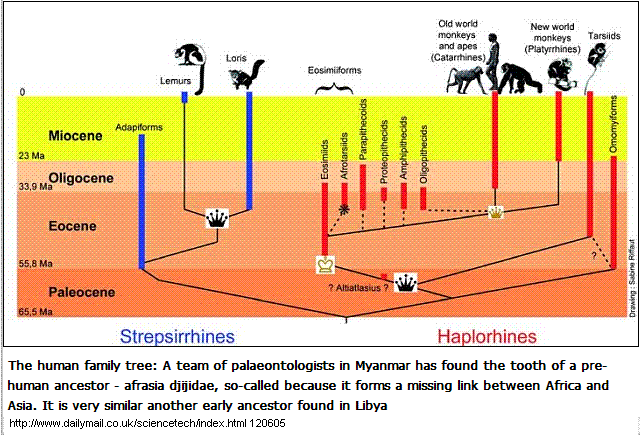
Afrasia djijidae , so-called
because it forms a missing link.
Afrasia djijidae was first described
in 2012 on the basis of isolated teeth from
the 37 million year old
Pondaung Formation, which is close to
the village of Nyaungpinle in Myanmar.
[1]
[3] [UKT ¶ ]
Pondaung Formation of Myanmarpré
UKT 170304:
#1. The age of Pondaung formation has been estimated to be middle
to be late Eocene based on stratigraphic evidence or late middle
Eocene based on comparison with mammals from North America and Europe. In
the research reported below, fission-track age on zircon grains from
a tuff bed in the Pondaung formation has helped to clarify the precise age
of the fauna: 37.2 ± 1σ Ma. corresponding closely with Eocene boundary. See
the downloaded research paper in TIL HD-PDF and SD-PDF
libraries
- MTakai-PondaungFormation<Ô>
/
Bkp<Ô> (link chk 180302)
Note: Myanmar researchers who participated in the project:
• Soe Thura Tun, Dept. of Geology, Univ. of Pathein, Pathein
• Aye Ko Aung, Dept. of Geology, Dagon Univ., East Dagon Myothit, Yangon
11422
• Maung Maung, Dept. of Geology, Mandalay Univ., Mandalay
#2.
from:
http://linkinghub.elsevier.com/retrieve/pii/S1631068302000209?via=sd
140703
"Abstr: The primate-bearing
Pondaung
 {poän-taún poän-Ña} Formation (northwestern
part of central Myanmarpré) is mainly
composed of cyclic sequences of
sandstones and variegated clays
that are divisible into 12 lithofacies
and are grouped under seven facies
associations. These established
facies associations represent the
deposition in a fluvio-deltaic
environment. The anthropoid primate
remains occur in swale-fill sediments,
sometimes in carbonate nodules of
pedogenetic origin and also, in small
crevasse channel deposits of the
upper part of the Pondaung Formation.
The sedimentary facies associated to
these anthropoid primates contribute
to the understanding of their
morpho-anatomic features. To cite
this article: A.N. Soe et al.,
C. R. Palevol 1 (2002) 153–160."
{poän-taún poän-Ña} Formation (northwestern
part of central Myanmarpré) is mainly
composed of cyclic sequences of
sandstones and variegated clays
that are divisible into 12 lithofacies
and are grouped under seven facies
associations. These established
facies associations represent the
deposition in a fluvio-deltaic
environment. The anthropoid primate
remains occur in swale-fill sediments,
sometimes in carbonate nodules of
pedogenetic origin and also, in small
crevasse channel deposits of the
upper part of the Pondaung Formation.
The sedimentary facies associated to
these anthropoid primates contribute
to the understanding of their
morpho-anatomic features. To cite
this article: A.N. Soe et al.,
C. R. Palevol 1 (2002) 153–160."
#3. See A new genus and species of Hyænodontid Creodont from the Pondaung
Formaion (Eocene-epoch, Myanmarpré), by N. Egi, P. A. Holroyd, T.
Tsubamoto, N. Shigehara, M. Takai, Soethura Tun, Aye'ko Aung, and Aung'naing
Soe, in the J. of Vertebrate Paleontology 24(2):502–506, June 2004.
See downloaded paper of 2004 in TIL HD-PDF and SD-PDF libraries:
-
NEgiEtAl-PondaungForm<Ô> /
Bkp<Ô>
(link chk 180227)
Prior to the discovery of
A. djijidae, early Asian
simians were typically classified in
two families,
Eosimiidae and
Amphipithecidae. While eosimiids are
generally considered the most
basal simian
clade
(a
stem group of simians), the
phylogenetic placement of amphipithecids
is more disputed. Amphipithecids are usually
considered to share affinities with either
eosimiids or
crown simians (those simians that are
part of the smallest clade that contains
the living simians); the latter view is
favored.
Eosimiids were first described from findings
in China in 1994 [5] and are still best known
there (two genera are now known,
Eosimias and Phenacopithecus),
but have also been recorded in Pakistan
(Phileosimias ) and Myanmar
(Bahinia ).[6][7] All species had a
small body size and a mix of primitive
(ancestral) and
derived traits (. The largest eosimiid,
Bahinia, is from the Pondaung
Formation, the same
stratum as
Afrasia, and the morphology of its
molars bridges the gap between the more
primitive molars of Eosimias and
the more derived molars of the later
Eocene African simians. Afrasia,
on the other hand, is more comparable in
size to the eosimiids from China.
[4]
The upper molars of Afrasia are
nearly identical in morphology and size
to those of
Afrotarsius,
[4] an animal known from 38–39
million year old deposits in Libya
(species Afrotarsius libycus)
[8] and about 30 million year old
deposits in Egypt (A. chatrathi).
[9][10] [UKT ¶]
Afrotarsius was originally
described as a tarsier, but later suggested
to be related to primitive simians.
[11] Because of their close
similarities, Afrasia and
Afrotarsius are together placed in
the family
Afrotarsiidae.
[2]
A phylogenetic analysis placed Afrasia
as a
sister
group to Afrotarsius, forming the family Afrotarsiidae. Afrotarsiidae
was found to be most closely related to Eosimiidae, and unrelated to tarsiers.
The clade formed
by Afrotarsiidae and Eosimiidae was designated as the infraorder
Eosimiiformes by Chaimanee et al. in 2012. Eosimiiformes are the
sister group of crown simians.
[2]
However, the classification of Afrotarsius as a stem simian is not
accepted by all researchers, and the phylogenetic claims and their implications
rest on only the four molars of Afrasia initially discovered.
[3]
Contents of this page
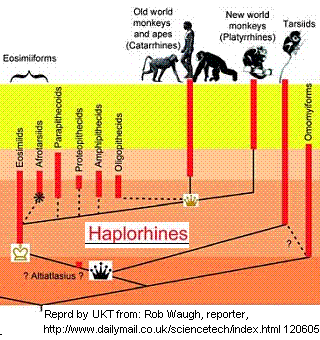
UKT 180301: See downloaded notes and pix on Strepsirrhies and Haplorhines,
by S. Moore, from
https://learning.hccs.edu/faculty/scotty.../anth2301/anth-2301.../anth-2301-week-9-ste...
180301
in TIL HD-PDF and SD-PDF libraries
-
SMoore-AnthroStrepsiHaplo<Ô> /
Bkp<Ô>
(link chk 180301)
 Afrasia has only
been found in the Eocene
Pondaung Formation of central Myanmar,
a rock unit which has been dated to about 37 million years ago using
magnetostratigraphy and
fission track dating.
This places it at the end of the
Bartonian
stage, near the
Middle–Late
Eocene boundary.
Although many tons of sediments in the area have been screened for fossils,
Afrasia is still known only from four teeth, suggesting that it was a rare
species.
Afrasia has only
been found in the Eocene
Pondaung Formation of central Myanmar,
a rock unit which has been dated to about 37 million years ago using
magnetostratigraphy and
fission track dating.
This places it at the end of the
Bartonian
stage, near the
Middle–Late
Eocene boundary.
Although many tons of sediments in the area have been screened for fossils,
Afrasia is still known only from four teeth, suggesting that it was a rare
species.
Since fossils were
first discovered there in 1916, a rich fossil fauna has been recovered in the
Pondaung Formation.
In addition to Afrasia, primates found there include
-- the eosimiid
Bahinia;
--
the amphipithecids
Pondaungia,
--
Ganlea, and
--
Myanmarpithecus;
and
-- the
sivaladapids
Paukkaungia and
Kyitchaungia.
[32]
UKT: More in the Wikipedia article.
Contents of this page
From: Z. Zorich
http://www.archeology/org/issues/54-1211/ 130107
Fragments of a human skull at Tam Pa Ling Cave in Laos, dated between 46,000 and
63,000 years old, are providing insights into how the first Homo sapiens settled
Southeast Asia and later Australia.
UKT: 46,000 - 63,000 years ago would be about 40-60 BBE. (check my
calculation). If so, who were the humans in the age of Mahabharatta? Shall
we say that they were Homo erectus? -- UKT130108
Archaelogists Fabrice Demeter of the National Museium of Natural History in
Paris and Laura Shakelford of the Illinois State Geological Survey analyzed the
skull. According to Shakelford, it does not show any evidence that the
individual's ancestors interbred with Homo erectus, a hominin species that lived
in the are for more than one million years.
The skull itself is small and belonged to a young adult at least 18 years old.
No artifacts were found with the bones, but the cave's location, far from the
coast, shows that modern humans migrated through the river valleys and into the
mountains of Laos as they continued their trek.
UKT: I haven't found much on H. erectus in Myanmar. -- 130107
Contents of this page
From Wikipedia:
http://en.wikipedia.org/wiki/Denisovan 140702
Denisovans or Denisova hominins
are
a Paleolithic-era species of the genus Homo or subspecies of Homo
sapiens. In March 2010, scientists announced the
discovery of a finger bone fragment of a juvenile female who lived about 41,000
years ago, found in the remote
Denisova Cave in the Altai Mountains in Siberia, a cave which has also been
inhabited by Neanderthals and modern humans.[1][2][3]
Two teeth and a toe bone belonging to different members of the same population
have since been reported.
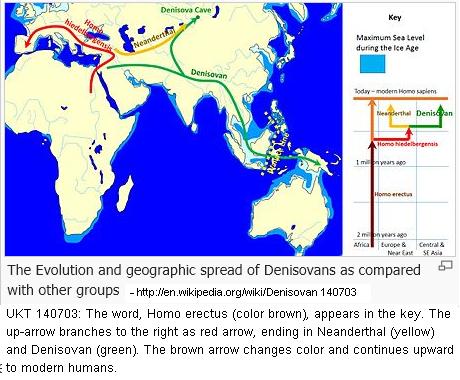
Analysis of the
mitochondrial DNA (mtDNA) of the finger bone showed it to be genetically
distinct from the mtDNAs of Neanderthals and modern humans.[4]
Subsequent study of the
nuclear
genome from this specimen suggests that this group shares a common origin
with Neanderthals, that they ranged from Siberia to Southeast Asia, and that
they lived among and interbred with the ancestors of some present-day modern
humans, with about 3% to 5% of the DNA of
Melanesians and
Aboriginal Australians deriving from Denisovans.[5][6][7]
[UKT ¶]
Other ethnicities, such as the
Malays,
Polynesians, the
Dravidians of
India,
Burmans, and
Mon-Khmer-speaking peoples may be included in this category as well. [UKT ¶]
UKT 140703: It is unfortunate that the writer of the above para has
ignored that the "Other ethnicities" are speakers of highly different
linguistic groups: Austro-Asiatics and Tibeto-Burmans who uses different
sets of vocal muscles to articulate the hyoid bone. Their phonologies are
different.
A comparison with the genome of a Neanderthal from
the same cave revealed significant local interbreeding, with local Neanderthal
DNA representing 17% of the Denisovan genome, while evidence was also detected
of interbreeding with an as yet unidentified ancient human lineage.[8]
Similar analysis of a toe bone discovered in 2011 is underway,[9]
while analysis of DNA from two teeth found in different layers than the finger
bone revealed an unexpected degree of mtDNA divergence among Denisovans.[8]
In 2013, mitochondrial DNA from a 400,000-year-old hominin femur bone from
Spain, which had been seen as either Neanderthal or
Homo heidelbergensis, was found to be closer to Denisovan mtDNA than to
Neanderthal mtDNA.[10]
Anatomy
Little is known of the precise anatomical features of the Denisovans since
the only physical remains discovered thus far are the finger bone, two
teeth from which genetic material has been gathered and a toe bone. The
single finger bone is unusually broad and robust, well outside the variation
seen in modern people. Surprisingly, it belonged to a female, indicating the
Denisovans were extremely robust, perhaps similar in build to the Neanderthals.
The tooth that has been characterized shares no derived morphological features
with Neanderthal or modern humans.[16]
An initial morphological characterization of the toe bone led to the suggestion
that it may have belonged to a Neanderthal-Denisovan hybrid individual, although
a critic suggested the morphology was inconclusive. This toe bone is currently
undergoing DNA analysis by Pääbo.[9]
Some older finds may or may not belong to the Denisovan line. These includes
the skulls from
Dali
and Maba,
and a number of more fragmentary remains from Asia. Asia is not well mapped with
regard to human evolution, and the above finds may represent a group of "Asian
Neanderthals".
UKT: more in Wikipedida article.
Contents of this page
Contents of this page
End of TIL file