Update:
2010-12-15 07:52 AM +0800
TIL
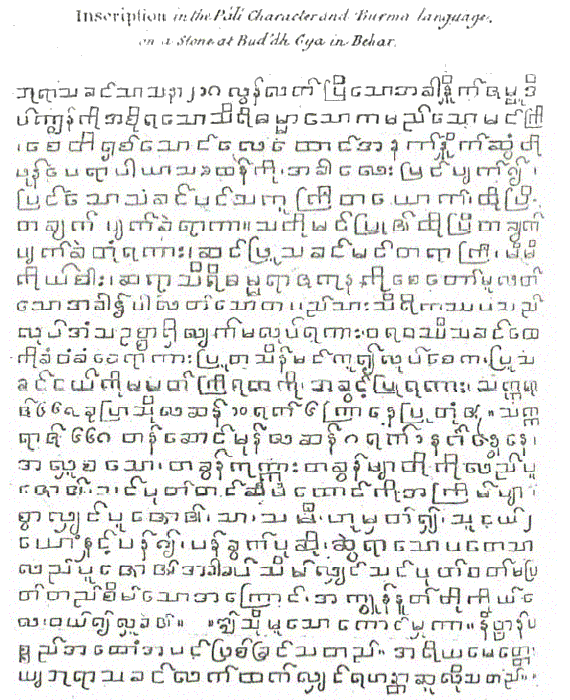
Translation of an Inscription in the Pali Character and Burmese
Language, on a stone at Buddh Gya, in Behar
Bur-inscrip-india.htm
From Journal of the Asiatic Society of Bengal May, 1834
SOAS Bulletin of Burma Research, Vol. 1, No. 2, Autumn 2003,
ISSN 1479-8484 . Revised: 27 March 2004
http://web.soas.ac.uk/burma/1.2%20PDF%20FILES/1.2%2003%20inscription-revised.pdf
080118
Downloaded and set in HTML by U
Kyaw Tun, et. al. Not for sale. Prepared for students of TIL
Computing and Language Center, Yangon, MYANMAR.
You'll need only Arial Unicode
MS font to read these files. Any other Unicode font may not display the
characters correctly. Myanmar akhkara are in gif-glyphs.
TIL website main index
index.htm | |Top
Bur-inscrip-india
Contents of this page
UKT notes
Contents of this page
SOAS Bulletin of Burma Research
Editorial note:
After the initial posting of this reprint, Dr. Tilman Frasch
(Manchester Metropolitan University) sent the following useful and cautionary
note on the 19th century translation below: "This is the first of several
attempts to read and translate the text of an inscription Burmese monks left at
Bodhgaya when visiting the site in 1296-98 AD. Burney had reached Bodhgaya in
the company of a Burmese delegation to the Governor-General of India, and
presumably he was helped by the Burmese in his translation. However, neither his
nor any (but one) of the later translations is fully reliable, as usually the
name Putasin is misread as Pyutasin (l. 11 of the Burmese version reprinted
here). Putasin (or Buddhasena) is the name of the local ruler of Bodhgaya; it
was mixed with with the epithet Pyu-ta-sin (or "Lord of 100.000 Pyu") which the
Rakhaing Minthami Egyin attributed to king Alaungsithu. The only reliable
translation comes from G. H.Luce, Sources of Early Burma History, in Southeast
Asian History and Historiography (Festschrift GEH Hall), eds. C.D. Cowan and O.
W. Wolters, Ithaca 1976, p. 41-42."
Translation of an Inscription in the Pali Character and Burmese
Language, on a stone at Buddh Gya, in Behar
From Journal of the Asiatic Society of Bengal May, 1834
When the Burmese ambassador MENGY MAHA CHESU and his suite were
on their way to the Upper Provinces, to visit the Governor General; they took
the opportunity of paying their devotions at the celebrated Buddhist temple near
Gya. There, as usual making notes of every occurrence, they took copies of an
ancient inscription in the Pali character, discovered by them, in a half-buried
situation near the Maha Bodhi gach or sacred papal tree, on the terrace
of the temple. A copy of their manuscript having come into RATNA PAULA’s hands,
he had obliged me by lithographing the text; as a sequel to the more lengthy
inscription from Ramree in the present number.
It will be remembered that there is a near coincidence in the
names of the kings of Ava, alluded to in the two inscriptions; although an
interval of more than 500 years separates the two in date; this can only be
cleared up by a better knowledge of the history of the country, than we now
possess. In the Burmese chronological table, published in Crawfurd’s Embassy,
SATO-MANG-BYA (probably the same as Sado-meng) only founded Angwa or Ava
in the Sakkaraj year 726. In 667-8, TA-CHI-SHANG-SI-HASU reigned in Panya;
his grand-son founded and reigned in Chit-gaing.
UKT: Some Myanmar words from the above paragraph:
•
SATO-MANG-BYA --
 {þa.to: ming:
hpya:} /
{þa.to: ming:
hpya:} /
 {þa.to: ming:
Bu.ra:}
{þa.to: ming:
Bu.ra:}
•
Sakkaraj year 726 -- {thak~ka.riz 726}
Burmese era 726. Myanmars are very well-versed in
astronomy-cum-astrology, and the king on
the advise of his council would start a new era. BE 726 belongs to
the present era, which was started
by a king during the pre-Pagan period. It is to be noted that
though every-day life is counted by
the lunar calendar, the years are counted by the solar calendar,
and it is the duty of the royal
council, to calculate the exact number of days, hours and minutes
to be added to every year
at the time of the transit of the Sun from Constellation Pisces to
Constellation Aries.
•
TA-CHI-SHANG-SI-HASU --
 {tic.si:þhying
þi-ha-þu}
{tic.si:þhying
þi-ha-þu}
(probably the king who on finding a dead white elephant floating
down the Irrawaddy river,
had it propped up and mounted it. He then claimed himself as the
"Lord of One" which in
Burmese-Myanmar is
 {tic-si:þhyin}
(MLC inscription:
{tic-si:þhyin}
(MLC inscription:
 [{ti'si:shin}] ?)
•
Panya --
 {ping: ya.}
•
Chit-gaing --
 {sic kaing:}
The fall of Pagan to the Mongols (Chinese) is cited to be 1287, and 1296-98 AD
corresponds to the end of Pagan period and the beginning of the Pinya period.
A remark about Myanmar official names: it is the usual practice to
refer to the kings and people in high places by their titles and so the Burmese
ambassador, and MENGY MAHA CHESU
 {ming:kri: ma.ha sæÑ-thu} is the title conferred
on the person by royal decree. MENGY or
{ming:kri: ma.ha sæÑ-thu} is the title conferred
on the person by royal decree. MENGY or
 {ming:kri:} means "High Official"
referring to the power bestowed on him; MAHA
{ming:kri:} means "High Official"
referring to the power bestowed on him; MAHA
 {ma.ha} means "Great"; and SITHU is
the title bestowed on him by royal decree.
{ma.ha} means "Great"; and SITHU is
the title bestowed on him by royal decree.
At page 111, Lieut. BURT refers to an unintelligible inscription
at Gya, mentioned by Mr. Harington; but that contained only one line, and was in
a different locality. The present inscription seems therefore to have escaped
attention up to the present moment; it is now recorded as furnishing an
authentic note on the construction of the Buddha Gya monument in the year
1305 A.D.; for it may be presumed that the previous Chaityas and Buddhist
structures had been long before levelled with the ground, and the inscription
states, that previous missions to reconstruct the edifice had been unsuccessful.
As proving that this spot is held in peculiar veneration by the Burmese, it may
be remembered that in 1823, a deputation of Buddha priests was sent from
Amarapura, by the Burman emperor, to perform the obsequities of his predecessor,
recently deceased, at the shrine of Buddha Gya.
“This is one of the 84,000 shrines erected by SRI DHARM ASOKA,
ruler of the world (Jambodwip), at the end of the 218th year of Buddha
annihilation, (B.C. 326) upon the holy spot in which BHAGAVÁN (Buddha) tasted
milk and honey (madhupayasa). In lapse of time, having fallen into
disrepair, it was rebuilt by a priest named NAIKMAHANTA. Again, being ruined, it
was restored by Raja SADO-MANO. After a long interval it was once more [{p009end}] demolished, when Raja SEMPYU-SAKHEN-TARA-MENGI appointed his
gúrú SRI-DHAMMARAJA-GUNA to superintend the building. He proceeded to the spot
with his disciple, SRI KÁSYAPA, but they were unable to complete it, although aided in
every way by the Raja. Afterwards VARADASI-NAIK-THERA petitioned the Raja to undertake
it, to which he readily assented, commissioning prince PYUTASING to the work, who again
deputed the younger PYUSAKHENG and his minister RATHA, to cross over and repair the
sacred building. It was thus constructed a fourth time, and finished on Friday the 10th
day of Pyadola, in the Sakkaraj year 667 (A.D. 1305). On Sunday, the 8th of Tachaon-mungla,
668 (A.D. 1306), it was consecrated with splendid ceremonies and offerings of food,
perfumes, banners, and lamps, and púja of the famous ornamented tree called calpa-vriksha;
and the poor (two?) were treated with charity, as the Raja’s own children? Thus was
completed this meritorious act, which will produce eternal reward and virtuous fruits. May the
founders endure in fame, enjoy the tranquillity of Nirbhan, and become Arahanta
on the advent of Arya Maitri (the future Buddha).”
[{p010end}]
Contents of this page
Contents of this page
End of TIL file