Update:
2012-11-06 09:42 PM +0630
TIL
Burmese for Foreign Friends
intro.htm
by U Kyaw Tun (UKT) and Daw Than Than, Jan 1991
Edited by UKT, and digitization by UKT and the staff of TIL.
http://www.tuninst.net ,
http://www.softguide.net.mm , www.romabama.blogspot.com
Start: 2008 Nov. Update: 110911, 120821, 121105
indx-E4MS.htm |
Top
B4FF-indx.htm
Contents of this page
Introduction
Speech and Script
Speech (spoken language) of Gautama Buddha
Akshara - the axiomatic agreement
between speech and script
Pali: Indo-European or Tibeto-Burman
The Runes or Magico-religious instruments
The classifiables and the
difficultly classified :
 {wag} &
 {a.wag}
Transliteration : now transcription (120821)
UKT notes
• abugida
Contents of this page
p001
-- by UKT
Welcome to BURMESE FOR FOREIGN FRIENDS.
Contents of this page
Before we set out on our journey into the Burmese language,
and the country of Myanmar, let us settle on the term
"language". The word "language" means a
spoken language - a system of sounds -- used by humans to communicate
with each other. When these sounds are recorded on paper,
papyrus, clay tablets, stones, metal sheets, etc.,
we get the written language or simply 'script'.
We have to be clear about using our terms
even though they are in use daily in a community,
because once we get into a different community,
a different time-frame or period in history - even into
a different social setting, these common terms can come
to have different meanings. Therefore, let's be clear:
language means the spoken part of communication and script
means the written part.
I will be using terms like:
Bur-Myan (spoken Burmese in Myanmar script),
Eng-Lat (English-Latin), and
Hin-Dev (Hindi-Devanagari)
where there are different names for the spoken
and the written parts.
However, we may come
across terms such as:
Bangala-Bengali and
Tamil-Tamil
where there are no well
defined names (at least that I know) for the spoken and the written parts, and
the cross-overs such as:
Bur-Lat (Burmese-Latin) aka Romabama
Pal-Myan (Pali-Myanmar) ,
Pal-Dev (Pali-Devanagari), and
Skt-Dev (Sanskrit-Devanagari).
We must not forget that in the country of Myanmar (which I am hesitating
calling: Myanmarland or Myanland) -- which in full is
 {mrûn-ma-præÑ}, or in the Irrawaddy dialect 'Myanmarpre', there are other spoken languages
which are written in the Myanmar script: Karen-Myanmar, Mon-Myanmar,
Shan-Myanmar, etc.
{mrûn-ma-præÑ}, or in the Irrawaddy dialect 'Myanmarpre', there are other spoken languages
which are written in the Myanmar script: Karen-Myanmar, Mon-Myanmar,
Shan-Myanmar, etc.
Karen
 {ka.ring} /kə. ɹ ɪŋ/, Mon
 {mwun} /mʷ ʊn/, and Shan
 {þhyum:} /ʃʌm/ are all Myanmar languages.
They are different from Burmese
{ba.ma}, and speakers do not understand each other.
Yet they are all Myanmar languages because they are
spoken by the indigenous peoples of the Myanmarland.
They are all Tibeto-Burman languages, and as a group
are different from Austro-Asiatic (Southern Asiatic) or Dravidian,
and also different from Indo-European or Indo-Iranian.
{þhyum:} /ʃʌm/ are all Myanmar languages.
They are different from Burmese
{ba.ma}, and speakers do not understand each other.
Yet they are all Myanmar languages because they are
spoken by the indigenous peoples of the Myanmarland.
They are all Tibeto-Burman languages, and as a group
are different from Austro-Asiatic (Southern Asiatic) or Dravidian,
and also different from Indo-European or Indo-Iranian.
MLC rendition Shan
 {rhum:} is phonetically untenable, because the word has no rhotic sound in it.
To introduce Sanskrit, Romabama has to invent a new grapheme
for the phoneme /ʃ/ . The grapheme is derived from
{rhum:} is phonetically untenable, because the word has no rhotic sound in it.
To introduce Sanskrit, Romabama has to invent a new grapheme
for the phoneme /ʃ/ . The grapheme is derived from
 {Sa.} /s/ with a {ha.hto:}-sound: {sha.}.
It is a lucky break, because of its usefulness in inter-transcription
of Burmese to English and back. Now I can spell Shan
{Sa.} /s/ with a {ha.hto:}-sound: {sha.}.
It is a lucky break, because of its usefulness in inter-transcription
of Burmese to English and back. Now I can spell Shan
 {shum:}.
Note: Unfortunately, Romabama has to use the same glyph
for both the dental fricative-sibilant
{Sa.} ष /s/ and palatal plosive-stop
 {sa.} च /c/. Bur-Myan, unlike Skt-Dev, does not
have the dental fricative-sibilant. Romabama needs to
differentiate them in the coda-position as
{sa.} च /c/. Bur-Myan, unlike Skt-Dev, does not
have the dental fricative-sibilant. Romabama needs to
differentiate them in the coda-position as
 {S} and
 {c}.
{c}.
Note: As a linguist, I have no preference for one
language over another, and when I list them together, I arrange them
in alphabetical order to be un-biased and politically correct.
On the other hand Arakanese, Burmese, Danu, Tavoyan, Yaw, etc., are dialects of
Bur-Myan because in careful speech the speakers can understand each other except
for different usages and terms.
Therefore, the term "Myanmar language" is a misnomer
unless you mean that it is a spoken language used in Myanmarpre
{mrûn-ma-præÑ} -- the country of Myanmar. The term Myanmar language
is not only confined to Burmese even though it is spoken
by the majority in the Irrawaddy valley.
Myanmar is the script used by many spoken indigenous languages.
When my wife (Daw Thanthan Tun) and I (U Kyaw Tun) started out
to write BURMESE FOR FOREIGN FRIENDS, we did not know
the difference between the English words 'language' and 'script',
and in the original version, the terms we have used may be confusing.
We should have started out from our Bur-Myan usage of
 {sa.ka:} 'spoken language', and
 {sa} 'written script'. Myanmar Language Commission (MLC)
must therefore concern itself with Karen-Myanmar,
Mon-Myanmar, and Shan-Myanmar. As for Chin
{sa} 'written script'. Myanmar Language Commission (MLC)
must therefore concern itself with Karen-Myanmar,
Mon-Myanmar, and Shan-Myanmar. As for Chin
 {hkying:} and Kachin
 {ka.hkying}, because they are using a different script,
they may or may not be included. It is for
the Myanmarpre Government to decide.
{ka.hkying}, because they are using a different script,
they may or may not be included. It is for
the Myanmarpre Government to decide.
Contents of this page
Unlike the electronic recording, the sound of a language
which you can hear cannot be regenerated from the script
with a touch of the button. And so we have to have a set of symbols
aka glyphs agreed upon by the users to mean
the system of sounds. When you see a written symbol,
and read (or sing) it aloud, and the sound you hear is
the sound generated by the reader and not the original sound.
Therefore, to claim that "such and such is the correct
Pali-sound (to take an example)" purported to mean
that it was used by a historical person such as the Gautama Buddha
is a just a tall claim and nothing else.
According to language experts the Burmese language,
the language of some thirty millions of natives of Burma
(the name given by the British Raj to the country),
belongs to the group of Tibeto-Burman (Tib-Bur) languages.
It is entirely different from the Indo-European (IE)
(formerly known as the Indo-Aryan) languages such as Latin & Greek,
French & English and German & Russian. However, since Myanmarpre
-- the country of Myanmar -- has always been under the sway of India
where IE languages such as Hindi (modern), and Sanskrit (ancient language)
are spoken, we can find elements of IE languages particularly that of Sanskrit,
in the modern Burmese language. What about Pali? Was it ever spoken in India
as is now spoken by our Myanmar monks and nuns?
Did Gautama Buddha speak Pali or the more common Magadhi?
I refer to what the noted Pali scholar T. W. Rhys Davids,
has written in the Introduction to Pali-English Dictionary
published in 1921 by the Pali-Text Society :
California Digital Library, 1952 :
http://archive.org/details/palitextsocietys00pali 121015
"He [the Buddha] was born in what is now Nepal,
but was then a district under the suzerainty of Kosala
and in one of the earliest Pali documents he is
represented as calling himself a Kosalan.
"When, about a thousand years afterwards,
some pandits in Ceylon began to write in Pali,
they wrote in a style strikingly different from
that of the old texts. Part of that difference
is no doubt due simply to a greater power of
fluent expression unhampered by the necessity
of constantly considering that the words composed
had to be learnt by heart. When the Sinhalese used
Pali, they were so familiar with the method of writing
on palmleaves that the question of memorizing
simply did not arise. It came up again later. But
none of the works belonging to this period were
intended to be learnt. They were intended to be read."
But, I argue, with land routes between northern India and
northern Myanmar being constantly in use since the days
before the Buddha, (refer to the story of King Abiraza
coming from northern India to northern Myanmar, mentioned
in the Glass Palace Chronicles -- before the Buddha came on scene),
there must have been constant interchange of languages.
What languages? I dare say they were Tibeto-Burman languages
in which the vowels would sound strikingly similar and
in which rhoticity, fricatives, and hissing sibilants
would be minimal. The so-called Pali spoken in Myanmarland
is more likely to be similar to what our Lord Buddha
had spoken and quite dissimilar to what the pundits in
Ceylon must have devised. Since International Pali
is mainly derived from Ceylonese "Pali", its
accents would be totally unlike that of the Buddha.
More than ninety per cent of the Burmese speakers are Buddhists,
and since Pali is the holy language of Theravada Buddhism,
the religion of the majority, we can find a very large number
of Pali or Pali-derived words in the Burmese language. Moreover,
since most of the people believe in astrology, we find
derivatives of Sanskrit. This is why I am engaged in a review
of A. A. Macdonell's A Practical Sanskrit Dictionary.
http://www.tuninst.net/SED-MC/MC-indx.htm 120822, and
Pali words in PTS and U Pe Maung Tin's dictionaries.
Contents of this page
Now, let's come to the written part of the human communication
- the script. There are two systems in use that is of interest
to us. The alphabetic system and the
abugida
aka the alpha-syllabary.
Or, if you are uncomfortable with the tern abugida
just call it the akshara
 {ak~hka.ra} system.
There are 33 consonantal glyphs in the Burmese-Myanmar
akshara-matrix of 7 rows X 5 columns. The Burmese people
are extremely fond of matrices probably because
they are used to writing
 {ing}. We will tell you what these
{ing} are later in this programme. At this time,
just make a note that Bur-Myan has no 'singulars'
and 'plurals', no past and present tenses, no inflexions
-- the grammar is very simple..
{ing}. We will tell you what these
{ing} are later in this programme. At this time,
just make a note that Bur-Myan has no 'singulars'
and 'plurals', no past and present tenses, no inflexions
-- the grammar is very simple..
Among the 33 consonantal glyphs there are some ten
used mainly to write Pali and Sanskrit and their derivatives.
They are found in row #3 whose POA (Place of Articulation)
is retroflex, and under column #4 whose phonation is voiced
and which comes straight from the voice box (behind Adam's Apple).
Though dubbed "aspiration" and marked with <h>,
they have nothing to do with the aspiration
found in Cockney (remember "Pygmalion" and
its adaptation "My Fair Lady" where Henry Higgins
is 'enry 'iggins'?). As a substitute term I have dubbed them
"deep-h".
Contents of this page
Though I am not exactly sure of classification of Pali as a language,
there is no doubt that Sanskrit is an IE language.
Moreover from the time of Abiraza (preceding Gautama Buddha)
who presumably was accompanied by Poanna-Brahmins as
family priests speaking Sanskrit, and commoners
(womenfolk, soldiers and servants) speaking Magadhi
(from which Pali was derived), Burmese spoken at Taguang
would have surely come under the influence
of both Sanskrit and Pali.
Speakers of English will find many words related
to Latin & Greek, and thence to English & French
in Bur-Myan words. Therefore, I must say, that though
Bur-Myan is Tib-Bur, it has many commonalities with IE.
You will find rhotic accents from Sanskrit and Pali
mostly in dialects spoken on the Western coast --
the Rakhine State and in many indigenous groups.
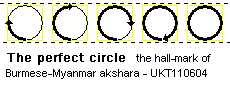
 The Bur-Myan script is very simple to write.
It is based on rounded circles. And, if you know
how to draw a perfectly rounded circle, starting
from the bottom and going clockwise, you can write
the Bur-Myan script. It is entirely different
from the Chinese. It is more simple to write than Eng-Lat.
The Bur-Myan script is very simple to write.
It is based on rounded circles. And, if you know
how to draw a perfectly rounded circle, starting
from the bottom and going clockwise, you can write
the Bur-Myan script. It is entirely different
from the Chinese. It is more simple to write than Eng-Lat.
To some writers, such as V.C. Scott O'Connor
(in 'Mandalay and Other Cities of the Past in Burma',
Hutchinson & Co., London, 1907. Reprint by White Lotus Co. Ltd.,
Bangkok, 1987. ISBN 974-8495-17-5. p423), the Bur-Myan akshara
was formerly thought to be based on the Gupta script
of northern India. However, later epigraphists traced
it the Pallavas of the South. But, I hold a different view.
The Pallava script,
 from:
http://skyknowledge.com/pallava.htm 120821
from:
http://skyknowledge.com/pallava.htm 120821
The reader is asked to compare the shapes of the glyphs
in the two scripts, Pallava and Myanmar. Which is simpler?
Which is more natural: a change from simple to complex
or the other way around?

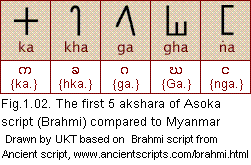
I contend that the Myanmar script is directly descended
from the Asoka script (now dubbed Brahmi - the language
of Poanna-Brahmins), or even to a more ancient script
which may be Vedic (if there was one), because there are many
similarities between Asoka and Myanmar in script.
The influence of Asokan script would be enhanced during
the lifetime of the Buddha, when another group of
Thakka-thakis kings and princes (relatives of the Buddha)
had to sought refuge in Tagaung founding the second city.
Contents of this page

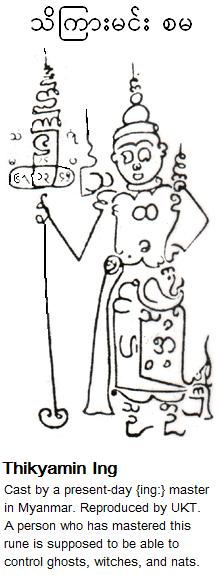 The Bur-Myan script based on perfectly rounded circles
had been, and is still used to cast runes or
{ing:}, a pre-Buddhistic instrument of a magico-religion
which the Theravada Buddhist-clergy is trying
to suppress. Try as they might they would not succeed,
because some of them are deeply involved in such
practices. I am referring to the case of the notorious
U LarBa - a Buddhist monk who after indulging in
{Bau:Di.þa-ra. ing:} became a ritualistic cannibal.
He was caught just as he was going after his last victim.
He was sentenced to death, but died before his execution
-- probably because no one dared to put a noose around his neck.
The Bur-Myan script based on perfectly rounded circles
had been, and is still used to cast runes or
{ing:}, a pre-Buddhistic instrument of a magico-religion
which the Theravada Buddhist-clergy is trying
to suppress. Try as they might they would not succeed,
because some of them are deeply involved in such
practices. I am referring to the case of the notorious
U LarBa - a Buddhist monk who after indulging in
{Bau:Di.þa-ra. ing:} became a ritualistic cannibal.
He was caught just as he was going after his last victim.
He was sentenced to death, but died before his execution
-- probably because no one dared to put a noose around his neck.
I personally talked to one of his monastery-boys,
David by name. David was a laboratory attendant in
the Chemistry Department in the early 1970's.
David did not know what his sayadaw U LarBa was doing.
David was questioned by the police. It was Professor U Aung Khin,
Professor of Chemistry, Arts&Science University, Rangoon,
who told me about David's connection to U LarBa.
I wasn't in the know because, when the case came to
light I was still in Mandalay. I questioned David
about the case, and what he told me was simply bone-chilling.
A curious parallel is found in the West -
the Wicca religion 'the religion of Earth Mother'.
Go online and see :
http://en.wikipedia.org/wiki/Wicca 120822
Please note: The above is pure supposition arrived at
from my foray into the folk elements of Buddhism in Myanmarland.
It is almost impossible to penetrate the magico-religious circles,
unless I personally joined up. And as I have seen cases of
people trying to connect to those circles undergoing
a profound mental change sometime resulting in insanity,
I think it is not advisable to go much deeper.)
[{p001end}]
Contents of this page
The 33 consonants of Bur-Myan akshara matrix is
made up of two parts: the
{wag} aka 'classifiables' and the
{a.wag} 'difficult-to-classify'. The
{wag} is a matrix of 5X5 and is the proper matrix showing where
(the Place of Articulation - POA) is, and, how (the manner) the
individual sounds are produced.
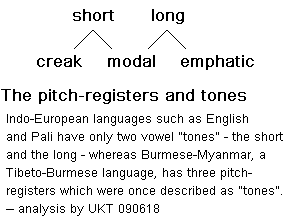
It is stated that there are some 12 simple vowels.
However since the Bur-Myanmar language, a pitch-register language,
has what the Westerners thought to be allophones,
I am inclined to increase it to beyond 30.
I might as well introduce at this point to the reader
the Two-three tone problem that exists between
Burmese and English which was a major hurdle in my
transcription work.
The Bur-Myan script is written in three levels;
a main level, and a level above the main level and a level below.
Most of the consonants are written on the main level,
while the vowel signs are written on all three levels.
Some letters are written on the bottom-most level in conjuncts
(or conjoined aksharas).
The Bur-Myan script is always written from left to right:
it is impossible to write from right to left.
The punctuation marks are also quite different from
that of English and French. The diacritics
might be confusing at first, but if we recall that
the French write their e's in three different ways:
è, e and é , and the Spanish have two marks of interrogation:
¿(Alt0191) and ?, Burmese cannot be particularly
more difficult than languages that use the Latin script.
However, it is always comforting to remember that
what we are attempting is, to introduce the Burmese language
to a speaker of English.
This is not a scholarly work; at best, it is the work
of an amateur who is a native son of Burma, and who thinks
he knows English, some French, just a wee bit of technical German,
some words of Swedish, and who aspires to learn Spanish.
Since, he has lived for some time in Australia, where he
used to wash his face in the 'bison' - not basin - and
where all his friends were 'mites' - not mates, and in
the United States and Canada where no one was supposed to
speak the King's English, it is hoped that
BURMESE FOR FOREIGN FRIENDS should be interesting
if not entertaining. [{p002end}]
Contents of this page
p003
And now (120821) Transcription
Before I was comfortable with the vowels of Burmese
and IPA-English, I had left Romabama in the transliteration
stage. To come to a transcription stage I have to study
Sanskrit in Devanagari. And now I realize that
the Romabama vowels in the syllable must be changed
to reflect the pronunciation. In the transliteration stage,
the vowels had remained as they were in the free
akshara stage. To be specific, lets say, I want
to transcribe an ordinary English word like C-A-T.
Letter-to-Akshara transliteration gives {kat}
-- a wrong pronunciation:
 {ka,} +
 {ta.} + {a.þût} or virama -->
 {kût}
{kût}
The pronunciation of
is {kût} and not {kat}. This means
I have to change the vowel from /a/ to /ʌ/.
It took me many years to come to this realization: only after
I have studied phonetics and phonology. See my work on the Human Voice
http://www.tuninst.net/HumanVoice/HV-indx.htm#Cont-this-pg 121105
And still many more to confirm that I have to change the vowel:
for which I have delved into Skt-Dev and Pal-Myan. Now that
I have become comfortable with the vowel change, Romabama has
become a transcription and is no longer a transliteration.
-- UKT120821
To the best of my knowledge, there had been no attempt
to write the Bur-Myan language in the Latin script
of the Roman alphabet. And, as late as 1984,
Caroline Courtard wrote in the "In Search of Burma"
(Frederick Muller Limited, London SW19 7JZ):
"Transliteration from the Burmese does not conform
to a single system; one comes across the same word spelt
a multitude of different ways."
Thus, the first hurdle I had to overcome in presenting
Burmese for Foreign Friends is to devise
a consistent system of writing the language with Latin script
of Roman alphabet which would be readily understood
by a speaker of English or French from North America.
Please note that I am not confining myself to using
the letters used for writing the English language,
but would be using the extended Latin alphabet.
I wish I could use the IPA alphabet. However, IPA
uses non-ASCII characters which are not suitable
for writing email. Romabama is meant for email
and the Internet, and I have to confine myself
to using the ASCII characters only. See Romabama rules,
in particular the rule for vowels:
http://romabama.blogspot.ca/2012/08/romabama-rule-03v.html 120821
Or, Introduction to Romabama,
http://www.tuninst.net/SED-TIL/intro-rbm/intro-RBM.htm 120821
Being a native-born speaker of Burmese who had traveled
extensively in Myanmarpre and who had worked as
a university teacher, in various places in Myanmarpre
for over thirty years, I have come across many dialects
spoken by my friends and students. At one time, I had to
teach my students in English, and I know how difficult
it is for an adult to learn a second language or even
a different dialect.
See my work on Language Acquisition and Learning
http://www.tuninst.net/LAT/LAT4M.htm#Cont-this-pg 121105
My study was based on:
¤ Principles of Language Learning and Teaching,
4th. ed. (& 3rd ed.), by H. Douglas Brown
Addison Wesley Longman, Inc. Copyright 2000. ISBN 0-13-017816-0
http://www.tuninst.net/LAT/n-Brown3/n-Brown3-indx.htm#Cont-this-pg 121105
¤ A History of English Language Teaching, by A. P. R. Howatt
Oxford Univ. Press, 1984, 2001.
http://www.tuninst.net/LAT/n-Howatt/n-Howatt-indx.htm#Cont-this-pg 121105
¤ Didactics, by Timothy Mason (stopped in preparation stage)
Moreover, since I have lived and studied in
the U.S., Australia and Canada, I have come
to appreciate the difficulty facing a foreigner
in trying to pronounce even my own Burmese name.
Eventually, this led me to change my name
to the nearest to it in pronunciation. When children
were born to me, I have to name them not only in
conformity with the Burmese-Buddhist custom,
but also with a mind to making the names pronounceable
by non-Burmese speakers. On top of it all, I had
to adopt a family name. Since my father's name
was U Tun Pe, which literally means 'Father Tun',
Tun has become our family name.
I had attempted to devise a system of transliteration-transcription
many times previously based on the English system of writing.
In fact, it all started when as a pre-teen (I'm now 79)
I tried to type out the Burmese language on my father's
English typewriter after noticing that the English <c>
and <o> are of the same shapes as
Bur-Myan {nga.} /ŋ/ and {wa.} /w/.
Now after nearly two decades of studying linguistics
and phonetics, and at present (year 2012) studying
four languages in three scripts, BEPS
(Burmese-English-Pali-Sanskrit in Myanmar-IPA-Devanagari),
I am able to give the IPA transcriptions. I am following
a bracket convention which I urge the reader to remember:
¤ {...} - Romabama - Burmese-Latin
¤ /.../ - IPA phonemic transcription
[please note that I am giving my own 'pronunciation'
and NOT the usual phonetic transcription given by
foreign phoneticians and their students in Myanmarland.]
¤ <...> - regular English words
¤ «...», IAST (International Alphabet for
Sanskrit Transliteration). -
http://en.wikipedia.org/wiki/International_Alphabet_of_Sanskrit_Transliteration
110911
¤ Other brackets such as (...) and [...]
with usual conventional meanings are also used.
Unfortunately, there is no natural or logical correspondence
in English between a letter and a sound it represents.
This has led George Bernard Shaw to propose [{p003end}]
that the word 'fish' should be spelled 'ghoti':
<gh> to represent the sound /f/ as in enough, <o>
to represent the sound /i/ as in women, and <ti>
to represent the sound /ʃ/ as in <nation>. And, therefore,
my previous attempts were never successful.
Then, when I came to learn French, it dawned on me that
a word such as <comment> is pronounced differently in French.
In European languages, speech and script are different:
English-Latin, French-Latin, Spanish-Latin )
the same word is pronounced differently.
I had to forget the English system completely
to read French. This idea is the basis on which
I have devised my system of writing the Burmese language
with the Latin script. I have named my system 'Romabama' or
 {rau:ma.ba.ma} 'Burmese sounds in Roman alphabet'. Romabama could very well be
 {ro:ma.ba.ma} the 'backbone of Burmese sounds'.
Since, Bur-Myan is a scientific language [See A. W. Lonsdale,
BG1899-indx.htm] based on phonemic principles, you can
pronounce Burmese according to Romabama script. Of course,
you will not sound like a native of the Irrawaddy valley
(that of Yangon and Mandalay), but you will be understood.
You will be told that you sounded like a Rakhine aka
Arakanese of the western coast of Myanmar.
Just as in French, do not pronounce the end consonant (or coda).
This is the most important rule in my system. Remember that in
Bur-Myan as in the Indic languages, the syllable is supreme --
not the invidual letters of the Alphabet. The syllable structure
is the same: Consonant-Vowel-Consonant. In our languages the coda
consonant is always under virama which kills the inherent vowel.
Never forget that Burmese-Myanmar is based on syllables
of the canonical form CVÇ, where the coda-akshara is
a "killed" akshara.
The vowel is monophthongal in pronunciation in spite
what the Western phoneticians say -- Burmese-speakers,
including myself at one time, are unable to pronounce
English words like <oil>, <boy> and <cow>.
The vowel sound of a digraph must be pronounced as
a monophthong in Burmese. In English the diagraph is
pronounced as a diphthong. This is the reason why
native-born Burmese speakers have difficulty
in pronouncing the English diphthongs.
Thus, the word
 {peing} which is very close in pronunciation to English <pine>
is spelled {peing}. Do not pronounce the ng ,
and never spell Romabama words with the so-called
"magic e".
{peing} which is very close in pronunciation to English <pine>
is spelled {peing}. Do not pronounce the ng ,
and never spell Romabama words with the so-called
"magic e".
Remember, Myanmar is a phonetic script similar to IPA:
preceding it by hundreds of years, if not by thousands.
Romabama spelling can be easily arrived at by:
1. choose the onset,
2. choose the coda, and then,
3. choose (or guess) the peak vowel.
Since, I have introduced my system gradually, I hope
that there would be no difficulty for you
in studying the Burmese language by yourself. [{p004end}].
In the mean time, my son U (Dr.) ZinTun (Ph.D. in Physics)
has recovered his mother's and my voices from
the original C60 tapes. The sound files are mostly
in mp3 format and I hope you will be able to play them
by clicking on <)) signs.
In my presentation, I have given the dialogs mostly
between a male actor (myself in the original tapes),
and a female actor (my wife before she passed away).
Of course there are other voices -- mostly those of
my research staff in Yangon. The story is fictitious
even though I have used the names of my family members.
I had hopes of continuing the story to the
eventual marriage and raising a family. But my wife
and I were already old even at the time of the first
recordings and age was showing in the voices. I hope
to get new actors eventually (if I am able to pay them),
and then I will be able to continue my stories.
In these lessons, I will introduce aspects of
the Burmese culture, and aspects of Theravada Buddhism
as practiced by ordinary people of the Irrawaddy basin
-- the majority of the population. Remember it is
not exactly what the Buddhist clergy have in mind.
The ordinary folks do believe in
 {nût}
and worship them much to the annoyance of the clergy.
{nût}
and worship them much to the annoyance of the clergy.
Contents of this page
-- UKT: The following is taken from Wikipedia. If only I had written it,
it would be slightly different. Eventually, I will muster enough courage
to write a note on Abugida.
From:
http://en.wikipedia.org/wiki/Abugida 081104
An abugida (pronounced
/ˌɑːbuːˈɡiːdə/,
from Ge‘ez አቡጊዳ ’äbugida
or Amharic አቡጊዳ ’abugida)
is a segmental writing system which is based on consonants but
in which vowel notation is obligatory. About half the writing systems
in the world are abugidas, including the extensive Brahmic family
of scripts used in South and Southeast Asia.
[UKT: Myanmar belongs to the Brahmic family of scripts -
found on the pillars erected by the Buddhist emperor.
The script on the pillars were written a few centuries
after the death of Gautama Buddha.]
In general, a full letter of an abugida transcribes a consonant.
Full letters are written in a linear sequence in
a consistent direction. Vowels are dependent on the consonant.
They are written through modification of the consonant letter,
either by means of diacritics which are placed in a vowel-dependent position
relative to the consonant (rather than always progressing in the same direction
as the sequence of full letters) or through changes in the form of
the consonant itself.
Vowels not preceded by a consonant may be represented with:
• a zero consonant letter with dependent vowel signs attached
[UKT: In Bur-Myan, it is
 {a.} from which we get
 {i.},
{i.},
 {u.},
{u.},
 {é}, etc.]
• separate full letters for each initial vowel, that are
distinct from the dependent vowel signs
Consonants not followed by a vowel may be represented with:
• a dependent vowel sign which explicitly indicates
lack of a vowel (virama)
UKT: virama (Sanskrit) means the vowel killer or
 {a.þût}. I have shortened <virama> to 'viram' .
• lack of a dependent vowel sign (often with ambiguity
between no vowel and a default inherent vowel)
UKT: the "inherent vowel" is represented
in Romabama with
{a.}, but not shown in Myanmar.
• a dependent vowel sign for a short or neutral vowel such as schwa (with
ambiguity between no vowel and that short or neutral vowel)
UKT: Schwa is IPA [ə] with the shape of Myanmar
 {hka.}. This sound is present in disyllabic words like
 {a.ni} where the stress is not on
{a.} and is pronounced very lightly. Since,
there is no dedicated grapheme to represent
Schwa in Bur-Myan, it has not been represented i
n Romabama. However, it has been pointed out that
it would help foreigners learning Burmese
if there was representation of Schwa in Romabama.
For doing so, the best
candidate that has been suggested is {å} (Alt0229). Thus,
{å-ni}.
{a.ni} where the stress is not on
{a.} and is pronounced very lightly. Since,
there is no dedicated grapheme to represent
Schwa in Bur-Myan, it has not been represented i
n Romabama. However, it has been pointed out that
it would help foreigners learning Burmese
if there was representation of Schwa in Romabama.
For doing so, the best
candidate that has been suggested is {å} (Alt0229). Thus,
{å-ni}.
• conjunct consonant letters where two or more
consonant letters are graphically joined in a ligature
UKT: there are three types of conjuncts in Myanmar:
the pronounceable medials (e.g.
 {kya.}), mute vertical conjuncts (e.g.
 {k~ka.}), and mute horizontal conjuncts (e.g.
 {th~tha.}/{þ~tha.}.
• dependent consonant signs, which may be smaller and/or differently placed
versions of the full consonant letters, or distinct signs
UKT:
 {king-si:} -- representing
 {nga.}-killed -- is found as
 in disyllabic words. It is not shown in Pali-Text Soc. dictionary. It is the coda of
the first syllable, and the consonant below it,
is the onset of the second syllable. The signs
in disyllabic words. It is not shown in Pali-Text Soc. dictionary. It is the coda of
the first syllable, and the consonant below it,
is the onset of the second syllable. The signs
 {thé:thé:ting},
 {auk-mric} (MEDict620) and
 {wic~sa.} (MEDict480} would fit into this category.
The term abugida was adopted into English [UKT: in 1996] as a
linguistic term by Peter T. Daniels. It is the Ethiopian name of the Ge‘ez
script, derived from the first four letters aləf, bet, gäməl, dənt (in
the traditional A B G D order of Hebrew and Greek), graded by the first four
vowel forms, much as the term abecedary is derived from the Latin a be
ce de. As Daniels used the word, an abugida contrasts with a syllabary,
where letters with shared consonants or vowels show no particular resemblance to
each another, and with an alphabet proper, where independent letters are used to
denote both consonants and vowels. Sometimes, abugidas have been considered to
be syllabaries or intermediate between syllabaries and alphabets ("semi-syllabaries",
"alpha-syllabaries", etc.). Less formally, however, abugidas are simply
called "alphabets".
UKT: calling an abugida an alphabet is the source of
many problems in the study or BEPS. The basic units
of the abugida are syllables and they are pronounceable,
whereas the basic unit of the alphabet are letters without
sounds.
Go back abu-note-b
Contents of this page
End of TIL file