NOUNS

ch202.htm
by U Kyaw Tun (UKT), Tun Institute of Learning,
http://www.tuninst.net
From Burmese Grammar and Grammatical Analysis
by A. W. Lonsdale, Education Department, Burma, British Burma Press, Rangoon,
1899. Copied by UKT and staff of TIL . Start: 2008 Aug.
Contents of this page
Definition
Classes of nouns
Proper nouns
Common nouns
UKT:
UKT notes -- note the author's Pali
transcriptions: á is used in place of ā , e.g., Páli for Pāli .
I am showing Lonsdale's transcriptions within Alt0171-Al0187: «...», e.g. «á»
(without slanting the character within)
•
063. A Noun is a word used for the purpose of naming anything. The Burmese term
for Noun is
 {naam} from the
Páli
{naam} from the
Páli  {na-ma.},
meaning 'name'.
{na-ma.},
meaning 'name'.
064. Burmese Nouns may be divided into five classes [UKT: two major classes or
five smaller classes. The two major classes are: concrete nouns
 {tha.wût~htu.ka. naam}, and abstract nouns
 {sait-ta.za. naam}]: -
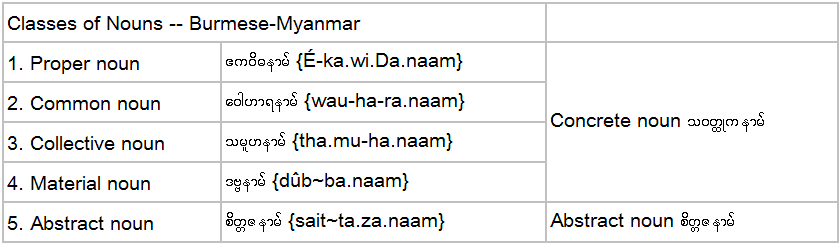

065. The term
 {É-ka.wi.Da.} signifies 'one sort or kind,' that is, 'singular' or 'noting that
of which there is but one.' Hence
{É-ka.wi.Da. naam} denotes the name given to one particular
person, place or thing, as distinguished from every other; as,
{É-ka.wi.Da.} signifies 'one sort or kind,' that is, 'singular' or 'noting that
of which there is but one.' Hence
{É-ka.wi.Da. naam} denotes the name given to one particular
person, place or thing, as distinguished from every other; as,
• Persons --
 {maung-Ba.}
'Moung Ba';
{maung-Ba.}
'Moung Ba';
 {ma.lha.} 'Ma Hla';
  {mi.hpru} 'Mi Hpyú';
  {tau-o}
'Dau Ô';
{tau-o}
'Dau Ô';
 {U:mrût-tha} 'U Myat Thá'
[{p039end}];
{U:mrût-tha} 'U Myat Thá'
[{p039end}];
 {ko-hkeing} 'Kô
Hkaing'. [{p039end}]
{ko-hkeing} 'Kô
Hkaing'. [{p039end}]
• Places and things --
 {ta.roap præÑ}
' China';
{ta.roap præÑ}
' China';
 {man~ta.lé:}
'Mandalay';
{man~ta.lé:}
'Mandalay';
 {gïn~ga}
'Ganges';
{gïn~ga}
'Ganges';
 {pè:hku:} 'Pegu';
 {hi.ma.wan~ta}
'Himalaya';
{hi.ma.wan~ta}
'Himalaya';
 {ya.meik} 'Yamaik'.

066. The term
 {wau:ha-ra.} means
'that which is current or in common use'; hence
{wau:ha-ra. naam}
denotes the name given in common to every person, place or thing of the same
kind; as,
{wau:ha-ra.} means
'that which is current or in common use'; hence
{wau:ha-ra. naam}
denotes the name given in common to every person, place or thing of the same
kind; as,  {sa-oap}
'book';
{sa-oap}
'book';  {kyaung:}
'school';
{kyaung:}
'school';  {mric}
'river';
{mric}
'river';
 {koan-thæÑ} 'trader';
 {lu} 'man';
 , {mring:} 'horse';
 {hsait} 'goat';
 {ping-lèý} 'sea'.

067.
The word
 which signifies 'aggregation,' or 'mass,' is applied to nouns to denote
a number of individuals taken together and considered as one whole; as,
which signifies 'aggregation,' or 'mass,' is applied to nouns to denote
a number of individuals taken together and considered as one whole; as,
 , 'flock
of sheep;'
, 'flock
of sheep;'
 , 'audience;'
 , 'army;'
 , 'a society.'

068. The term
 signifies 'material,' 'substance,' and is therefore applied to
nouns denoting materials, such as
signifies 'material,' 'substance,' and is therefore applied to
nouns denoting materials, such as
 , 'gold;'
 , 'rice;'
 , 'paper;'
 , 'salt;'
 ,
'cotton.'
,
'cotton.'
069. The word,
 as already explained (par. i), means ' produced by the mind.' It
is here applied to that class of nouns which imply some quality, property, state
or action apart form any person or thing possessing t hat quality, property,
&c., as,
as already explained (par. i), means ' produced by the mind.' It
is here applied to that class of nouns which imply some quality, property, state
or action apart form any person or thing possessing t hat quality, property,
&c., as,
 , 'wisdom;'
 , 'intellect;'
 , 'power;'
 , 'whiteness;'
 , 'a going;'
 ,
'health.'
,
'health.'
(i) Nouns of Quality,
 signifies 'quality,' 'property,' 'characteristic;' hence
 denotes the name given to some quality or property; as,
 , 'beauty;'
 ,
'hardness;'
,
'hardness;'
 , 'strength;'
 , 'power;'
 , 'ability;'
 , 'art,' 'science.'
Most of these nouns are derived from adjectives which show quality or property. (see infra.)
(ii) Adjectival and Verbal Nouns (Gerunds),


 These are formed from adjectival and
verbal roots by prefixing
These are formed from adjectival and
verbal roots by prefixing
 or affixing
 ; as,
; as,
From the adjective
, 'high;'
'height,' 'highness.'
, 'the condition of being high.'
From the adjective
, 'fragrant;'
'fragrance,' 'that which is fragrant.'
'the property of being fragrant.'
From the adjective
, 'pretty;'
'prettiness,' 'beauty;' 'that which is pretty.'
From the verb
, 'to sleep:'
'sleep.'
, 'the state of sleeping.'
From the verb
, 'to help,' 'aid,' 'assist:',
'aid,' 'help.'
, 'the act of aiding, helping.'
From the verb
, 'to speak,' 'say,' 'utter;'
'speech, utterance.'
, 'the act of speaking, saying, uttering.'
071. Such abstract nouns denote quality, action or state. The nouns formed with are not always abstract : they are often employed as concrete nouns. The two different uses may be understood from the following:
When the nouns is used merely as the abstract designation of an attribute ,
properly, action or state without reference to any concrete thing whatever,
it is an abstract noun ; when used with special reference to some
concrete things whose attribute , property , action or state it
expresses, and for which it stands, then it is a concrete noun. For
instance, in the statement
 'the redness of (the) paper is not pretty,'
 is used
purely in the abstract sense, the word being simply an abstract name of
one of the attributes of the paper, which here is 'red .'
is used
purely in the abstract sense, the word being simply an abstract name of
one of the attributes of the paper, which here is 'red .'


 But in 'bring
the book ; which book? the red, bring that which is red,'
is used
with special reference to the book which is distinguished from the rest by its
attributes 'red.' By the use of the name of this attribute in the
place of the concrete noun 'book,' the abstract idea assumes a
concrete form
as used here, is therefore a concrete noun. The nouns
formed with from adjectives are very commonly used in this way. The uses of
those formed from verbs are explained in pars. 306-307.
But in 'bring
the book ; which book? the red, bring that which is red,'
is used
with special reference to the book which is distinguished from the rest by its
attributes 'red.' By the use of the name of this attribute in the
place of the concrete noun 'book,' the abstract idea assumes a
concrete form
as used here, is therefore a concrete noun. The nouns
formed with from adjectives are very commonly used in this way. The uses of
those formed from verbs are explained in pars. 306-307.
From the use of adjectival nouns in the concrete sense exemplified above, the
formation of compound nouns such as
 ,
,
 ,
,
 may be easily accounted for. It will be
noticed that the adjectives and
may be easily accounted for. It will be
noticed that the adjectives and
 are really abstract nouns formed with
, and used
in the concrete sense precisely in the same way as
But when they are joined to
are really abstract nouns formed with
, and used
in the concrete sense precisely in the same way as
But when they are joined to
 ,
,
 ,
and respectively, the formative
naturally drops out in the combination.
,
and respectively, the formative
naturally drops out in the combination.
072. Nouns undergo a change of form to indicate Number, Gender, and Case. In Burmese, however, these distinctions are made without any inflexion.

073. Burmese nouns have two numbers, the Singular
 ,
and the Plural
,
and the Plural
 .
The Singular number denotes one; the Plural number denotes more
than one.
.
The Singular number denotes one; the Plural number denotes more
than one.
074. A noun in its simple form is in the Singular number; as
 . The
Plural is marked by affixing
. The
Plural is marked by affixing
 ,
,
 or
or
 ,to the
Singular; as,
,to the
Singular; as,
| Singular | Plural | ||
| {aim} | house | {aim-mya:} | houses |
| {lu} | man | {lu-mya:, lu-to.} | men |
| {thu-ngèý} | child | {thu-ngèý-mya:, thu-ngèý-to.} | children |
| {moan.thæÑ} | baker | {moan.thæÑ-mya:, moan.thæÑ-to.} | bakers |
| {ra.han:} | yahan | {ra.han:mya:, ra.han:to.} | yahans |
| {a.mhu.} | business | {a.mhu.mya:} | businesses |
| {tha.rak-thi:} | mango | mangoes |
End of TIL file